The working of the interbank money market (the call money market)
and the conduct of monetary policy are inextricably linked in economies that
depend predominantly on indirect instruments of monetary policy. The stability
of the call money rate, namely, the rate at which short term funds are lent
and borrowed is, therefore, of critical importance to central banks which view
it as an operational target to signal the stance of monetary policy. Experience
shows that regulatory initiatives taken to improve the efficiency of market
functioning also help in fostering market stability. In the Indian case, for
example, it may not be inappropriate to postulate that permitting a wider section
of market constituents to operate in the repos market (viz., outside
the central bank) since March 2003 led to a reduction in the volatility of the
call money rate caused by improved matching of demand/supply between deficit/surplus
segments. By the same token, therefore, there is a case for encouraging increased
participation and, more importantly, expanding the range of eligible collateral
for market repos to enhance the efficacy of short term interest rate targeting.
The measures announced in the Annual Policy statement for 2005-06 and the suggestions
made by the Technical Advisory Committee on Money Market to further expand the
scope of activity in market repos are, therefore, highly significant in the
present context.
JEL Classification : E52
Keywords : Call money market rate, Liquidity Adjustment Facility
(LAF), Autoregressive Conditional Heteroscedasticity, Conditional Variance.
Introduction
The overnight call money or the inter-bank money market rate
is presumably the most closely watched variable in day-to-day conduct of monetary
operations and often serves as an operating target for policy purposes. The
choice of operating tactics from
* The views expressed in the paper are solely those of the author and must
not be ascribed to the institution to which he belongs.
quantity to rate based targeting, following the IS/LM based
analysis of Poole (1970), has been largely accepted in favour of interest rate
targeting, because of the diminished link between monetary aggregates and economic
objectives of monetary policy as a result of the fast pace of financial innovations.
Most central banks, therefore, presently use indirect instruments in an attempt
to maintain the short term interest rate at a desirable level with the use of
appropriate liquidity management practices. The most common of these instruments
of liquidity management is the central banks’ repo facility which enables modulation
of the marginal liquidity on a day to day basis so as to ensure stable conditions
in the money market and, particularly, to maintain the short term money market
rate as close as possible to the official/policy rate. Changes in the short-term
policy rate made by central banks provide signals to markets, and various segments
of the financial system, therefore, respond by adjusting interest rates/returns
depending on their sensitivity and the efficacy of the transmission mechanism.
Economic implications for investment and spending decisions of producers and
households follow as usual, thereby affecting the working of the real sector
viz., changing aggregate demand and supply, and eventually inflation
and growth in the economy. It is, therefore, clear that the interest rate stance
of a central bank and its implications for economic activity and inflation play
an important role in the conduct of monetary policy.
The objective of the paper is, therefore, to assess the volatility
pattern of the call money rate in India during the last three years and to estimate
its sensitivity vis-à-vis the Reserve Bank of India’s liquidity
adjustment facility (LAF) auction decisions for the purpose of eliciting underlying
market characteristics. Attempt is made to provide evidence, albeit
indirectly, on how regulatory changes related to other instruments in the money
market may have affected the functioning of the interbank call money market.
Finally, some evidence is also offered on the link between money market volatility
and interest sensitive financial markets, particularly the government securities
market.
The remainder of the paper is structured as follows. Section
I provides an overview of liquidity management in India while cross-country
experience is set out in Section II. Data used in the analysis are explained
in Section III. Methodology used and the empirical analysis are presented in
Section IV and concluding observations are given in Section V.
Section I
Liquidity Management in India
The liquidity management practice in India has undergone significant
changes in the 1990s, from greater reliance on direct instruments to almost
full dependence on indirect instruments over these years. The transition to
this framework has been enabled because of far reaching changes in the framework
of monetary policy enabled especially by the introduction of market based price
discovery mechanism and reduction in the financing of government deficits by
the Reserve Bank. As a consequence, it was possible to achieve a successful
transition, since June 2000, to a full fledged liquidity adjustment facility
(LAF) permitting eligible participants such as banks and primary dealers (PDs)
to manage their day to day liquidity needs through recourse to the facility.
The evolution in liquidity management practices over these years is a logical
outcome of the economic reforms which led to the phasing out most of the standing
facilities and reduced the emphasis on direct monetary policy instruments. The
LAF allows the Reserve Bank to have a strong grip on system’s liquidity, on
a day to day basis, and consequently helps in achieving its goals of policy
more successfully than was the case hitherto. In the recent times, as liquidity
conditions have turned surplus because of capital flows, reverse repo auctions
have been operated to sterilise excess liquidity to maintain stability in the
money market rate around a desired level. Reverse repo operations are conducted
on a daily overnight basis and, also for relatively longer period to enable
absorption of excess liquidity depending on evolving conditions. Although the
presence of excess liquidity naturally ordains that bids are fully accepted
to gain the comfort of maintaining the market rate around the official rate,
the decision on the acceptance of a given proportion of bids out of the total
submitted is taken in keeping, inter alia, the daily
primary liquidity flow projections arising from various transactions
of the Reserve Bank with the rest of the economic system. While a number of
transactions capturing liquidity flows are pre-known to the Reserve Bank, quite
a few like ways and means advances, changes in currency demand and cash balances
of the government are not known a priori with certainty.
The inevitability of large open market operations under conditions
of unabated capital flows is virtually preordained given the sensitivity of
the inter-bank market to sudden changes in liquidity flows. However, the declining
stock of Central Government securities with the Reserve Bank made it necessary
to evolve alternative mechanisms to augment the inventory of repoable securities
to ensure stability of the money market. Towards this end, the Reserve Bank
in consultation with Government introduced the Market Stabilisation Scheme (MSS)
in 2004 to absorb excessive/ enduring liquidity in the system. Yet given the
unrelenting surge in foreign exchange inflows, the task of maintaining stability
in the money market continues to remain a difficult task. In the current milieu,
when the auction rate for LAF is generally kept fixed, the quantity is automatically
determined, as all reverse repo bids are fully accepted. In this case, the market
rate also quickly stabilizes around the reverse repo rate as the system’s surplus
liquidity is taken away at a given price. The comfort level achieved through
daily liquidity management based on LAF however is occasionally disturbed when
sudden liquidity shortages cause sharp fluctuations in the money market rate.
Although, such spikes have often been short lived given the timely liquidity
support offered by the Reserve Bank, yet there is a need to moderate these fluctuations
in the larger interest of overall liquidity management.
On the other hand, for prudential reasons and as recommended
by the Narsimham Committee in 1998, the Reserve Bank has transited to a system
of pure interbank call/notice money market. Accordingly, the average lending
by non banks in a reporting fortnight, based on their average daily lending
in call /notice market during 2000-01, was progressively reduced from 85 percent
(May 2001) to 75 percent (June 2003) to 60 percent (December 2003) to 45 percent
(June 2004)
to 30 percent (January 08, 2005) to 10 percent (June 11, 2005)
and completely phased out from the fortnight beginning August 06, 2005. Non
bank participants except PDs are also not permitted to borrow from the call/notice
market. As these limits on lending have been imposed, the parallel development
of the repos market outside of the RBI managed by the Clearing Corporation of
India Limited (CCIL) as a central counterparty has taken shape. Non banks are
expected to take recourse to the collateralised repos outside the RBI for purposes
of borrowing and lending of funds.
The CCIL meanwhile also introduced an innovative money market
product called the Collateralised Borrowing and Lending Obligation (CBLO) in
January 2003 which provided investors the benefit of guaranteed settlement and
an exit option before maturity. As a result of the introduction of market repos
and the CBLO and phased removal of non bank participation in the call money
market, the trading volumes in these markets have increased substantially. Between
2003-04 and 2004-05, for example, the CBLO market grew by a phenomenal 1180
percent. The CBLO segment can be further encouraged by making it more attractive
especially for urban cooperative banks to participate in the market by expanding
the range of eligible repoable assets by making assets such as state development
loans more acceptable through consolidation. Technical initiatives such as enabling
repo transactions through secured and cost effective communications links could
also be introduced to improve the reach amongst a multiplicity of small participants,
thereby integrating dispersed pools of idle liquidity with the needs of solvent
borrowers. In the past, significant regulatory reliefs such as that in March
2003 were offered when constituent subsidiary general ledger (CSGL) account
holders were permitted to participate in the interbank repo market. More measures
in this direction especially, permitting wider sections of the constituents
of PDs to participate in the CBLO segment would in all likelihood help in further
deepening of the money market. In regard to the range of eligible collateral
assets, depending on the comfort level of the central counterparty, there is
a need also to permit interbank repos in PSU bonds and private and corporate
debt securities for market repos provided they are held in dematerialised form
and transactions are done through recognised stock exchanges. This position
has been indicated by the Reserve Bank earlier. The same could, hence, also
be considered in the case of CBLO market. The range of participants in the market
has also been widened over time. In case of CBLO, for example, while banks,
PDs and cooperative banks who are members of the Negotiated Dealing System (NDS)
are permitted, non-NDS members like corporates, co-operative banks, NBFCs, Pension
Funds and Trusts also became eligible as associate members of the CCIL’s CBLO
segment to borrow and lend in the CBLO market from January 2004. With the phasing
out of the non-bank participation in the interbank call money market, once a
greater range of market participants, especially deficit/surplus segments, is
encouraged to participate together in a common but secured market for repos/CBLO
and a wider array of repoable collateral is available, the efficiency of targeting
of the inter-bank call money market would improve on account of better liquidity
smoothing across market participants, especially during phases when liquidity
shocks result in overshooting of the short term interest rate.
International evidence also underlines the fact that contrary
to unsecured markets (especially, call money market), a collateralised repo
market is able to achieve much better liquidity smoothing across solvent market
participants despite the difficulties in the management of collateral risk (Freixas
and Holthausen, 2001). In actual practice, the growth in the global market for
repos with a widening pool of collateral has been driven by the improved confidence
in the management/mitigation of risk and increased outsourcing of collateral
risk management to central counterparties.
Section II
Some International Liquidity Management Practices
Different market based intervention techniques are employed by central banks
to manage liquidity on a day-to-day basis. Central banks have been increasingly
favouring market operations, especially buying and selling securities than standing
facilities in conducting their monetary policies. While different practices
and operational frameworks exist, the objective continues to be the same, namely,
fostering stability of short-term interest rates around the operating target
announced by central banks. The review of the liquidity management practices
presented here is based on several published sources or material otherwise available
in the public domain.
The European Central Bank (ECB) intervenes in the money market through its
most important policy instrument namely the Main Refinancing Operations (MRO)
conducted through repos. The MROs provide the bulk of liquidity support and
are implemented through weekly tenders for a maturity period of two weeks. The
remaining liquidity needs are met by Long Term Refinancing Operations (LTRO)
which are operated once a month and have a maturity of three months. Since June
2000, the MROs are conducted at variable rates. However, the ECB announces a
minimum bid rate at which no bids are acceptable. Bids at the highest rate are
accepted first and bids with successively lower rates are accepted in turn until
the total liquidity to be injected is exhausted. The minimum bid rate indicates
the stance of monetary policy. Besides the MRO the ECB also offers a marginal
lending and standing deposit facility to counterparties. Since June 2000 the
ECB has set its lending rate one percentage point above and its deposit rate
one percentage point below the minimum bid rate announced for its MRO. The deposit
facility is operated by the ECB in order to facilitate overnight deposits with
the ECB. In principle, the deposit facility allows banks to reduce reserves
when they have surplus reserves. The lending and deposit facilities of the ECB
are made available half an hour after the closure of TARGET (Trans-European
Automated Real-time Gross settlement Express Transfer
system) – a RTGS system used for settlement of central bank operations, large-value
euro interbank transfers as well as other euro payments providing real-time
processing and settlement in central bank money with immediate finality. The
Eurosystem accepts a wide range of collateral assets from non financial institutions
for its refinacing operations. Eligible collateral includes, apart from marketable
debt instruments, non marketable debt instruments and even some equities. No
difference is made between these assets in terms of quality as they fulfil minimum
eligibility criteria specified by the Eurosystem. In retrospect, given this
framework for liquidity management, it has been found that the overnight inter-bank
rate EONIA (Euro Overnight Index Average) has generally remained within the
corridor defined by lending and deposit rates, usually within one-half of a
percentage point of the minimum bid rate. As a result, the marginal standing
facilities that define the corridor for policy rates have seldom been used by
market participants in the Eurosystem.
The Bank of England (BoE) introduced fundamental changes in
the operating procedures following the grant of operational independence in
1997 and the separation of Debt Management Office (DMO) in 2000. Accordingly,
the BoE presently sets its own official rate of interest so as to meet the target
rate of inflation set by the government. The daily operations of the BoE include
an initial forecast of the liquidity need which is amended throughout the day.
Market interventions are made at two regular times during the morning and noon.
Additional facilities are offered late in the day above the official repo rate,
which sets the ceiling for the overnight interest rate. Besides, the BoE also
offers a standing deposit facility remunerated at rate lower than the official
repo rate by one percentage point which, in effect, sets a floor to the overnight
interest rate. In an assessment of the open market operations of the BoE, especially,
in regard to the introduction of the special deposit facility, Allen (2002)
suggests that its introduction since June 27, 2001 somewhat narrowed down the
range of fluctuation of short rates around the official repo rate. The deposit
facility, in fact, introduced as a ';mopping'; facility for surplus
liquidity successfully limited the extent to which short dated rates could fall
below the official rate, resulting in a proper control over the volatility of
short rates.
The US Federal Reserve (USFR) intervenes through outright and
temporary operations. Outright operations are conducted to offset long term
imbalances in liquidity mismatches and conducted by way of treasury bill and
coupons. Temporary operations are conducted through repos in treasury securities
and are used to offset daily imbalances. The liquidity operations of the USFR
are supported by discount window borrowings which serve as a marginal lending
facility. The Federal Reserve System accepts a wide range of collateral such
as mortgage based securities issued by federal agencies and government sponsored
enterprises, apart from securities that are direct obligation of the US treasury
or other securities that are fully guaranteed as to principal and interest by
government agencies or government sponsored enterprises (Edwards, 1997).
Besides the central banks’ own initiatives aimed at liquidity
management, the repurchase transactions among domestic counterparties have increased
phenomenally. The collateral acceptable for these transactions in the US includes,
apart from treasuries, securities issued by Agencies (Fannie Mae, Ginnie Mae,
etc.) and mortgage based securities guaranteed by Agencies. The Federal
Reserve Banks also provide daylight overdraft facilities at a charge of 36 basis
points to allow dealers to finance positions. Obviously, this is done to ensure
that all genuine liquidity needs of the wider market are met and the settlement
is completed without any problems. As at end December 2004 the outstanding volume
of domestic market repos in the US was $ 5 trillion. In the case of Eurosystem
also the growth in repo market has been encouraging although this segment is
less integrated than the swap and unsecured segments, due to existing differences
in practices, laws, regulations and fragmentation of market infrastructure.
The ECB has been keenly interested in the activity in the repo market segment
and has supported the integration of the euro market for short term securities.
As at end December 2004, the Euromarket had about EURO 5 trillion outstanding
as market repos. The enormous growth in the repos transactions has resulted
from the perceived benefits of such transactions. Repo markets compete with
banking system by providing a method of granting and receiving loans and generally
tend to reduce interest rates for borrowers while increasing it for depositors.
In addition, the market for repos based on bonds helps in improving the efficiency
and liquidity of bond markets and minimise the probability of undue price fluctuations.
Besides the rapid growth of domestic repos markets, the international
financial system has experienced increasing global integration and depth of
the money markets in the recent years, helping to cover short term liquidity
mismatches experienced by large banks/other financial institutions by means
of repurchase transactions facilitated by the International Securities Market
Association (ISMA). At present repurchase transactions are easily carried out
across national borders besides those among domestic counterparties. According
to the survey carried out by the ISMA in December 2003,
the total size of repo outstanding was estimated at EUR 3.77
billion. Survey results also suggested that whereas 39.3 per cent of reported
outstanding repo contracts were with domestic counterparties, 52.1 per cent
were cross-border including both euro and non-euro zone counterparties. The
share of electronic trading of these transactions was also on the rise. The
collateral analysis suggested that while fixed income securities issued by the
sovereign governments in the EU were predominantly used as collaterals in repo
transactions, the pool of collateral was widening with the increasing acceptance
of non-government bonds (Pfandbrief and mortgage backed securities) and equity.
It is widely believed that the growth of the collateralised repo market has
served an important role, viz., enhancing the overall stability of the
financial system by removing counterparty risks by means of funded credit protection
against risky transactions in unsecured wholesale financial markets.
An empirical analysis of the behaviour of volatility of short
term money market rate conducted by Thompson (2003) for major developed countries
shows that while volatilities have generally been reduced over time in the recent
years, higher volatilities in countries such as the UK are ascribable to low
reserve requirements. According to Thomson (also Kasman, 1992) low reserve requirements
have tended to impede the flexibility of banks in managing their reserve positions
leading to higher fluctuations in the overnight rate. However, most central
banks in the developed world have taken initiatives to expand the scope of the
market by enhancing the range of collateral acceptable for monetary operations
and in some cases improving the participation rate itself.
Section III
Data : Sample and Definitions
As mentioned before, the empirical exercise is devoted to eliciting
the volatility of the call money rate in the recent past including possible
relationship with certain important regulatory initiatives taken by the Reserve
Bank. The analysis is also devoted to assessing the sensitivity of interest
rate targeting especially in relation to the LAF auction decisions of the Reserve
Bank on a day to day basis. Daily data on reverse repo auctions (submitted and
accepted), weighted call money rate and the official repo rate are taken for
the period from April 2002 to March 2005 which, by and large, has been a period
characterised by surplus liquidity except for some sporadic periods of liquidity
stress. The data employed is available in the public domain and is regularly
disseminated through the official website of the Reserve Bank (www.rbi.org.in).
Wherever required, data have been appropriately transformed for testing the
hypothesis put forward in the paper.
Section IV
Methodology and Empirical Evidence
The econometric methods used in estimation are the Nelson Beveridge
(NB) time series decomposition and an ARCH-M[1,1] (Autoregressive Conditional
Heteroscedasticity in Mean) model estimation which is widely used for modelling
volatility in financial markets. While the NB decomposition serves to differentiate
between permanent and cyclical components in a time series, the ARCH model introduced
by Engle (1982) imposes a systematic structure to the variance process making
it amenable to interpretation and use in forecasting. These methods are briefly
explained below in an understandable language, without using mathematical notations.
References pertaining to the statistical methods are given at the end.
(i) Nelson Beveridge Decomposition
This decomposition method was proposed by Beveridge and Nelson (1981).The NB
method is based on the presumption that stationary short term fluctuations tend
to shift the long run path or the trend of the series in question. In the NB
method, the contemporaneous innovation to the trend is perfectly negatively
correlated with itself. For example, a positive shock to the call money rate
because of consistent tightening of liquidity will be contemporaneously negatively
correlated with the trend until shocks force the trend to adjust upwards over
time. The NB method was applied to the weighted call money rate with ARIMA(1,0,1)
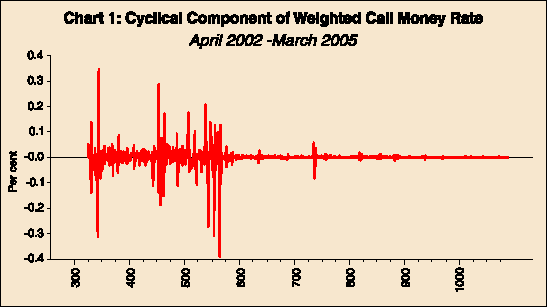
structure to obtain estimates of the cyclical (or temporary) component which
are plotted in Chart 1 below.
Chart 1 clearly reveals a substantial containment of market
volatility beginning March 2003 (observation number 600 onwards on the X-axis
when the transient component looks considerably subdued) coinciding with the
Reserve Bank’s decision to permit CSGL account holders to participate in the
market for interbank repos.
(ii) The ARCH-M Model
The standard ARCH effect in data implies ‘volatility clusters’
which can be captured to place appropriate structures to the volatility of the
series, which may be otherwise highly unpredictable and difficult to interpret.
The coefficients derived from estimated ARCH models are more efficient than
those obtained from simple OLS method and offer a special ground for inference
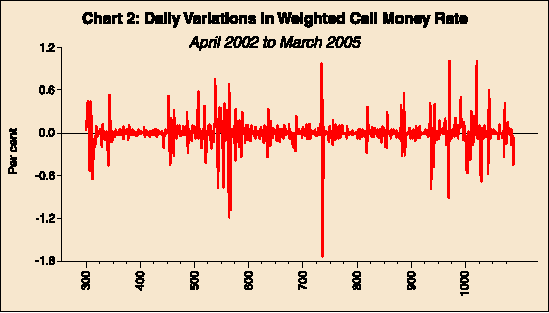
making. Chart 2 provides evidence on ARCH effects in call money rate suggesting
episodic volatility including clusters of low amplitude variations followed
by lower values and vice versa. It is, therefore, reasonable to specify the
model for call money rate in terms of the mean and conditional variance equations
in ARCH models.
As a variant to the general ARCH model described above, we employ here the
ARCH-M model introduced by Engel et.al (1987)
wherein each time the mean of the process is determined by
additional information contained in standard deviation seen at the same time.
The ARCH-M modelling is of special interest in studying financial time series
as the conditional variance plays an important role in determining an explicit
trade-off between expected returns and the variance or the covariance among
returns. In the traditional capital asset pricing model (CAPM), for example,
the expected excess return on the market portfolio is linear in its conditional
variance, suggesting the usefulness of ARCH-M type models.
The algebraic structure of the ARCH-M model is presented below.
The Mean Equation

DIFRATE =the difference between weighted call money rate and the reverse
repo rate (%).
TOTACCP =total amount of reverse repo bids accepted daily (Rs crore) h = model
based conditional variance ERROR = error term
The mean equation explains the variations in the gap between
call money rate and the policy rate (viz., repo rate) by decision taken
by the Reserve Bank in respect of the daily amounts of bids accepted from counterparties
in reverse repo auctions and the recursive conditional variance itself. The
model posited above does not use any lag(s) of the dependent variable in the
equation. Taking lags of the dependent variable in the equation is often subject
to criticism from practitioners, especially, the rationale of taking past information
on the dependent variable into account. Critics often also question the validity
of such empirical models arguing that since much of the explanation in the estimated
equation is attributed to lagged dependent variables, they do not have much
practical use. By dropping lagged endogenous variables therefore, we avoid this
criticism, and the only term that is left unexplained is the error term, which
may arise from factors such as less accurate projections of cash flows in the
banking system arising from exogenous factors such as changing demand for currency
by the public, government cash flows and flows on account of external capital/private
remittances and even news and expectations etc. These mismatches in supply
and demand of funds can be addressed by expanding the scope of the repo market
especially when regulatory concerns require that the participation in the interbank
call market should be limited to banks only. The error term is expected to be
highly variable but can be suitably modelled by imposing systematic structure
as proposed in the econometric literature so as to be useful in decision-making.
Conditional Variance
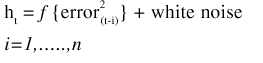
As the system is highly volatile and shows volatility clusters,
the conditional variance of the process can be systematically captured using
the square of previous error terms obtained from the mean equation. The estimation
of conditional variance based on ARCH models has been customarily found quite
successful in modelling financial markets with high frequency market operations
and
volatility. They have also been used to forecast volatilities to address the
needs of trading desks to help in evolving operating strategies.
As is evident from the recursive nature of the estimation,
coefficients of the ARCH-M models are obtained from non linear numerical optimisation
techniques applied to the joint estimation of the mean and variance equations.
In this paper we employ the Berndt, Hall, Hall and Hausman (BHHH) procedure
for maximising the log-likelihood function.
The estimated model specifies the daily difference between
the weighted call rate and the official reverse repo rate as a function of the
amount of the reverse repo bids accepted by the Reserve Bank daily and the conditional
variance - assuming that conditional volatility itself plays an important role
in explaining the gap between the two rates.
The coefficient estimates of the model suggest that variations
in amounts accepted in reverse repo auctions have a statistically significant,
though small, impact on the gap between the weighted call money rate and the
reverse repo rate (aggregate coefficient estimate is invariant if even the first
lag of the accepted amount is included in the estimation). For example, for
the time sample under consideration, accepting additional Rs 10,000 crore on
a current day would have reduced the said gap between the call money rate and
the reverse repo rate, on an average, by barely two basis points. The
Empirical Estimate of the daily ARCH-M model [April, 2002 to mid November,
2004]
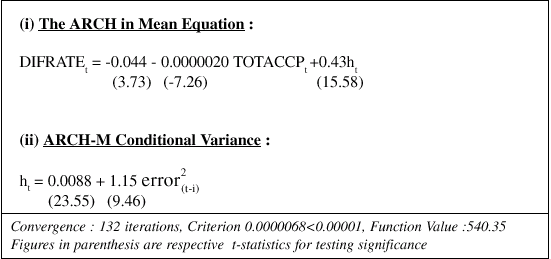
implication of this finding is that even as the entire bid
amount at reverse repo auction is accepted, and if the amounts accepted were
to actually signify the total excess liquidity in the system, the model should
be in a position to explain the gap almost fully. However, since the model,
on an average, explains only 24 percent of the actual average gap of 25 basis
points over the sample period, the usual law of equilibrium wherein if a rate
is fixed, the amount is automatically determined and vice versa appears
to be perceptibly violated. As it will be shown later, the average margin of
error between the estimated gap and the actual gap reported above is attributable
mainly to the phases when the money market suddenly became tight and the Reserve
Bank had to offer accommodation through its repo window. On the other hand,
the actual gap between the call rate and reverse repo rate during times of surplus
liquidity especially, when the reverse repo window was open, is fairly well
explained by the model with a minimal margin of error. It therefore, follows
that any unexplained gap between the two rates could be ascribed to market segmentation
(especially, the inability of the cash surplus and deficit segments to meet
fully to clear the market) instead of auction decisions alone. It appears that
the impedance in reaching an overall market wide equilibrium is because of frictions
in the functioning of the money market which may need to be resolved to allow
the market operate near its potential strength. This conclusion is corroborated
by the fact that the coefficient of the ARCH-M effect in the mean equation is
significantly much higher at 0.43 and hence, explains a large proportion of
the average gap between the call and the reverse repo rate as compared to the
reverse repo accepted variable. It is obvious that reduction of the gaps between
the market rate and the policy rate could be achieved satisfactorily by containing
the volatility of the money market, especially that occurring during instances
of sudden liquidity stress, by widening the participation rate of economy wide
deficit (demand)/surplus (supply) segments and expanding the range of repoable
collateral in the repos market. It is noteworthy that recognising this aspect,
the Reserve Bank in March 2003 permitted Constituent Subsidiary General Ledger
(CGSL) account holders to participate in the repo market, thereby increasing
the participation rate of constituents and substantially reducing the volatility
in the market - a fact substantiated by empirical NB decomposition. Given the
integral link between the money and government securities market, increasing
the range of repoable securities may also help in insulating the government
securities market from exposures to market risks caused by random liquidity
shocks.
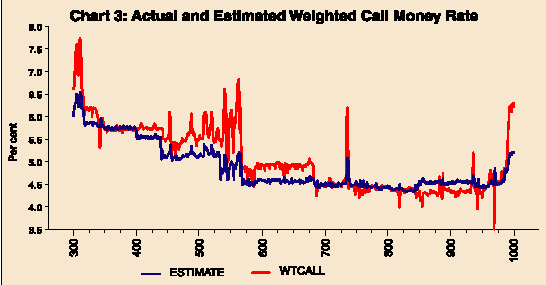
Chart 3 compares the actual call money rate with the estimated
rate derived from the mean equation of the ARCH-M model estimated above. It
is observed that though the estimated trajectory tracks the actual path of call
money rate closely throughout the sample period, there are certain occasions
when large spikes are observed which are not explained fully by the empirical
model. These spikes caused by sudden mismatches in liquidity of the otherwise
stable equilibrium require appropriate balancing through timely liquidity injection
measures.
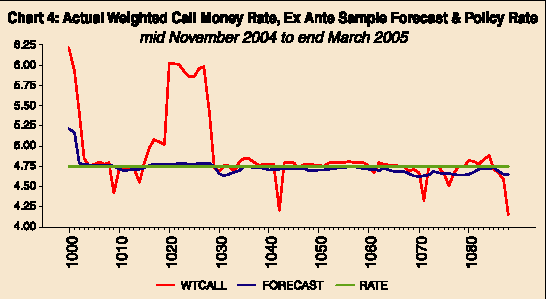
The daily ex-ante (out of sample) forecasts of call
money rate for the period from mid November 2004 up to end March 2005 are plotted
against the actual out turns in Chart 4.
Model estimates suggest that while the out of sample forecasts
closely track the policy rate following the law of equilibrium mostly during
periods of surplus liquidity with an average error of just three basis points,
the call money rate shows the tendency to overshoot (average ex-ante
tracking error of 17 basis points) during times of liquidity shortages which
are seen as large spikes in the Chart 4, necessitating RBI to open its repo
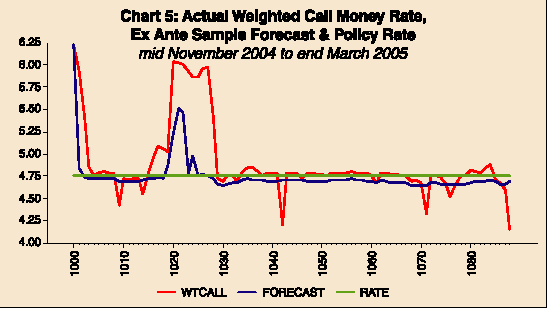
window. As depicted in Chart 5 the forecast performance is not significantly
improved
even if the model is augmented with the information on repo
interventions (viz., repo amounts accommodated by RBI during periods
of liquidity shortages). Therefore, since the accommodation provided during
shortages does not explain the variation in gaps substantially, it appears that
much more explanation should be owed by other factors, namely the operational
aspects in the market itself.
The inter-bank money market volatility may be transmitted to
other financial markets causing financial entities to bear the costs of portfolio
adjustments. One of these financial markets is the
government securities market which has a significant bearing
on the balance sheets of banks and other financial institutions (especially,
insurance companies and pension funds) given the large holdings of such securities
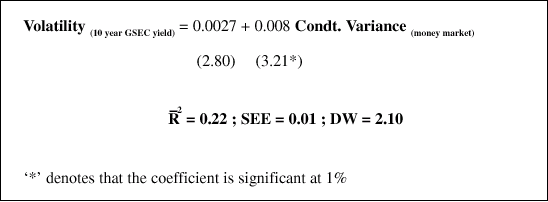
in their portfolios. In order to test the impact of money market volatility
on the volatility in the yields of government securities, a simple AR1 regression
for the full sample is performed to compute the volatility in the yield of government
securities (based on secondary market yield of the representative central government
security with 10-year residual maturity). A regression is then performed with
volatility of government securities as independent variable and the conditional
volatility derived from the ARCH-M model as explanatory variable.
The empirical evidence suggests that the volatility in the
government securities market is significantly influenced by the volatility (or
liquidity shocks) in the money market, explaining about 22 per cent of the fluctuation
in yield. It is therefore necessary that the volatility in the money market
caused by liquidity shocks is moderated to the maximum extent possible so that
securities yields are determined on the basis of fundamental economic factors
such as inflationary expectations rather than day to day liquidity conditions.
Section V
Concluding Observations
The deviations of the call money rate from the policy rate
particularly aggravated during periods of liquidity stress, notwithstanding
complete accommodation offered to eligible counterparties by the RBI suggests
that encouraging greater participation and permitting a wider range of collateral
in the repos market would help in improving the efficiency of interest rate
targeting. The task of doing so though is admittedly difficult under the present
circumstances given the perceived difficulties in collateral management such
as pricing and risk mitigation for classes of collaterals other than sovereign
securities.
It may, however, be mentioned that the willingness of central
banks particularly those in developed economies to accept a wider array of commercial
collaterals even for direct monetary operations is predicated upon the need
to uphold the integrity of the policy rate and to minimise the cost of volatility
in interest sensitive financial markets. It is in this context that the present
structure of the money market needs to be viewed, given the implications for
related financial markets. The evidence provided by the empirical model brings
out that while the call money rate is tracked reasonably accurately during surplus
liquidity conditions, the predictive power suffers a loss when liquidity shortages
suddenly emerge. The fluctuations in the call money rate during these periods
of shortage are observed to continue for a couple of days notwithstanding the
fact that most often full accommodation is provided by the Reserve Bank. The
average daily in-sample bias of 25 basis points in forecast seen during the
sample period is attributable mainly to random liquidity shocks experienced
by the market. This bias could be expected to increase whenever the market begins
to return to the deficit mode. It, therefore, stands to reason that further
integration of the money market by expanding participation in market repos and,
perhaps more importantly, finding ways to introduce other classes of eligible
collateral could help in the timely matching of the needs of the surplus and
deficit sectors. Meanwhile, the feasibility of increasing the number of LAF
operations alongside options to separate the timing of repo and reverse repo
operations for market stabilisation could also be considered.
Given the increasing market orientation of the financial system
and the significant interest sensitivity in the recent years, ensuring long
term consistency between the policy rate and the targeted rate would serve to
limit the volatility in different segments of interest sensitive financial activities.
The experience regarding the improvement in the stability of
the money market rate since the expansion, in March 2003, of inter-bank repos
market due to the participation of CSGL account holders, lends support to the
idea that enhanced participation rate in the repos market would promote stability.
The Annual Policy Statement of the Reserve Bank for the year 2005-06 has taken
important initiatives to increase participation by permitting non-scheduled
urban co-operative banks and listed companies having gilt accounts with scheduled
commercial banks subject to eligibility criteria. The development of the market
repos would also be benefited by the draft guidelines in respect of securitisation
of standard assets leading to orderly growth of the market for asset backed
papers, which may then have the likelihood of being accepted as eligible repoable
collateral. The proposal for an electronic trading platform for market repos
would also improve the price discovery process.
The introduction of other eligible collateral for repos/CBLO
would reduce risk of unsecured lending in the call money market, and in others
such as in the inter-corporate deposit market and hence serve to foster greater
stability of the financial system. It is notable that the report of the Technical
Advisory Committee on money market has also favoured the introduction of asset
backed commercial papers. An expected externality from the expansion of eligible
securities for market repos is the stimulus that would be imparted to the hitherto
dormant markets for these financial products.
Finally, as a technical point of interest, since systematic
or conditional element in volatility is a dominating feature of the market process,
it is desirable that conditional volatility is estimated on an ongoing basis
for forecasting the volatility of inter-bank money market rate for policy support.
References
Allen, W.A. (2002) : ';Bank of England open market operations: the introduction
of a deposit facility for counter parties';, BIS paper No. 12, BIS.
Berndt, E.K., B.H. Hall, R.E. Hall., and J.A. Hausman (1974): ';Estimation
and Inference in Non-Linear Structural Models.'; Annals of Economic
and Social Measurement,Vol. 3/ 4 , 653-665.
Beveridge, S., and C.R.Nelson (1981) : ';A New Approach
to Decomposition of Economic Time Series into Permanent and Transitory Components
with Particular Attention to Measurement of Business Cycles';, Journal
of Monetary Economics, 7.
Edwards, C.L. (1997) : ';Open Market Operations in the 1990s';, Federal
Reserve Bulletin, November, 859-874.
Engle, R.F., Lilien, D.M., and Robins, R.P. (1987) : ';Estimating
Time Varying Risk Premia in the Term Structure : The ARCH-M Model';, Econometrica,
Vol 55, No. 2.
Freixas, X., and Cornelia Holthausen.(2001) : ';Interbank Market Integration
and Asymmetric Information';, Review of Financial Studies, WP No.
74.
Kasman, B. (1992) : ';A Comparison of Monetary Policy Operating
Procedures in Six Industrial Countries';, Federal Reserve Bank of New
York, 17, No. 3,5-24.
Poole, W. (1970) : ';Optimal Choice of Monetary Policy in a Simple Stochastic
Macro Model';, Quarterly Journal of Economics, 84.
Reserve Bank of India (2004) : ';Report of the Internal Group on Liquidity
Adjustment Facility';, Reserve Bank of India Bulletin, January, 2004.
Reserve Bank of India (2005) : ';Report of the Technical Group on Money
Market';. www.rbi.org.in.
Thompson, J. (2003) : ';Intervention by Central Banks in the Money Market';,
CIBEF, Liverpool Business School, Liverpool.