Foreword It is a great pleasure to introduce this booklet on “Functions and Working of RBI”-2024 edition, four years after release of the last edition in the year 2020. The first edition was brought out in 2010 to create and spread awareness among general members of public on Reserve Bank’s multifaceted roles ranging from management of currency, financial markets and payment systems to maintaining financial stability, regulating and supervising the financial sector and conduct of monetary policy, etc. The subsequent editions have enriched and updated the contents based on the developments in the financial sector-both domestic and international and the Bank’s response to such developments. The COVID pandemic had a huge disruptive impact on the country’s financial sector and the economy. The measures taken to support economic recovery included pro-active monetary policy measures including unconventional ones like long term repo operations (LTRO), targeted LTRO, Government Securities Acquisition Programme (GSAP) and special Open Market Operations (OMO), opening of special refinance facilities / lines of credit and so on. The last four years witnessed a digital transformation of the financial landscape. Digital payment systems expanded, and use of United Payments Interface (UPI) grew exponentially. Reserve Bank innovation Hub (RBIH) was set up as a subsidiary to promote and facilitate innovation in the financial sector. Unified Lending Interface (ULI), a key project undertaken by RBIH, is expected to facilitate frictionless credit to individuals and businesses. In this period, the regulatory and supervisory norms were also strengthened, and stricter cybersecurity and risk management guidelines were put in place. The recent past saw initiatives like introduction of Central Banking Digital Currency (CBDC) and focus on internationalisation of Rupee. Sustainable finance and climate initiatives have also gained traction. It was, therefore, felt necessary to bring in a new edition capturing these and other such major developments that have marked the Bank’s journey post bringing out of the last edition. The current edition is special as it is being brought out as we are celebrating the 90th year of existence of Reserve Bank. We hope that this updated version will demystify RBI and bring clarity on the Bank’s critical and ever-evolving role in the economic development of the country while maintaining financial stability. We are confident that the publication’s use and relevance will not only be limited to students of finance and economics but would enrich the knowledge of a much wider diaspora of readers. We would like to acknowledge the contribution of the team at RBSC, specially that of the members of faculty and various Central Office Departments for their painstaking efforts in shaping and upgrading the contents. We also express our deep gratitude to Deputy Governor, RBI, Shri Swaminathan J, for unveiling the latest edition on November 4, 2024. Further, we would like to express our gratitude to Rajbhasha Department, Central Office and Chennai Regional Office for their support in carrying out translation of the content in Hindi to enable us to bring out the publication in both Hindi and English language. We welcome suggestions and feedbacks at principalrbsc@rbi.org.in, which will help us in enhancing the future editions and keeping the content relevant and useful. Mala Sinha
Principal, RBSC
| List of Abbreviations | | AA | Account Aggregator | | ABPS | Aadhaar Bridge Payment System | | ACB | Audit Committee of the Board | | ACD | Agricultural Credit Department | | AD | Additional Director | | AD / AP | Authorised Dealer / Authorised Person | | AD Cat | Authorised Dealer - Category (I/II/III) | | ADF | Asset Development Fund | | AePS | Aadhar enabled Payment System | | AFA | Additional Factor Authentication | | AFS | Available for Sale | | AGL | Aggregate Gap Limit | | AGR | Alternate Grievance Redress | | AI | Artificial Intelligence | | AIF | Alternative Investment Fund | | AIFI | All India Financial Institution | | AI-ML | Artificial Intelligence and Machine Learning | | AML | Anti-Money Laundering | | APB | Aadhar Payment Bridge | | ARCH | Auto Regressive Conditional Heteroskedasticity | | ARCs | Asset Reconstruction Companies | | ASISO | Automated Sweep-in and Sweep-out | | ATB | Auction Treasury Bill | | B2B/ B2C | Business to Business / Business to Customer | | BBPCU | Bharat Bill Payment Central Unit | | BBPOU | Bharat Bill Payment Operating Unit | | BBPS | Bharat Bill Payment System | | BC | Business Correspondent | | BCBS | Basel Committee for Banking Supervision | | BCSBI | Banking Codes and Standards Board of India | | BFS | Board for Financial Supervision | | BFs | Business Facilitators | | BHIM | Bharat Interface for Money | | BIS | Bank for International Settlements | | BkSPI | Banking Services Price Index | | BLBC | Block Level Bankers’ Committee | | BLS | Bank Lending Survey | | BoP | Balance of Payments | | BPSS | Board for Regulation and Supervision of Payment and Settlement Systems | | BR Act | Banking Regulation Act, 1949 | | BSPI | Business Service Price Index | | BSR | Basic Statistical Return | | CALCS | Capital Adequacy, Asset Quality, Liquidity, Compliance, Systems and Control | | CAMELS | Capital Adequacy, Asset Quality, Management, Earnings, Liquidity and Systems and Control | | CBDC / R / W | Central Bank Digital Currency CBDC - Retail / Wholesale | | CBS | Core Banking System | | CCIR | Comprehensive Credit Information Repository | | CCP | Central Counter Party | | CCs | Currency Chests | | CCS | Consumer Confidence Survey | | CD | Certificate of Deposit / Credit to Deposit | | CDES | Currency Distribution and Exchange Scheme | | CDIS | Co-ordinated Direct Investment Survey | | CDS | Credit Default Swaps | | CEPC/ CEPD | Consumer Education and Protection Cell /Consumer Education and Protection Department | | CET 1 | Common Equity Tier 1 Capital | | CF | Contingency Fund | | CFL | Centres for Financial Literacy | | CFPB | Consumer Financial Protection Bureau | | CFR | Central Fraud Registry | | CFT | Combating Financing of Terrorism | | CGD | Comprehensive Guidelines on Derivatives | | CGRA | Currency and Gold Revaluation Account | | CIC | Currency In Circulation / Core Investment Company / Credit Information Companies | | CIC (R) Act | Credit Information Companies (Regulation) Act, 2005 | | CIMS | Centralised Information Management System | | CIN | Challan Identification Number | | CIR | Credit Information Report | | CIs | Credit Institutions | | CISBI | Central Information System for Banking Infrastructure | | CIT | Cash In Transit | | CLS | Continuous Linked Settlement | | CMB | Cash Management Bill | | CMS | Complaint Management System | | CNP | Card Not Present | | CoA / CoR | Certificate of Authorisation/ Certificate of Registration | | CP | Card Present / Commercial Paper | | CPI | Consumer Price Index | | CPIN | Common Portal Identification Number | | CPIS | Co-ordinated Portfolio Investment Survey | | CPSS | Committee on Payment and Settlement Systems | | CRA | Credit Rating Agency | | CRAR | Capital to Risk weighted Asset Ratio | | CrCS | Credit Conditions Survey | | CRCS | Central Registrar of Co-operative Societies | | CRDC | Currency Research and Development Centre | | CRILC | Central Repository of Information on Large Credits | | CROMS | Clearcorp Repo Order Matching System | | CRPC | Centralised Receipt and Processing Centre | | CRR | Cash Reserve Ratio | | CSD | Customer Service Department/ Central Securities Depositories | | CSF | Consolidated Sinking Fund | | CSITE | Cyber Security and Information Technology Examination | | CTS | Cheque Truncation System | | CVPS | Currency Verification and Processing System | | CWBN | Cylinder Watermarked Bank Note | | DBIE | Database on Indian Economy | | DCC | District Consultative Committees | | DCCB | District Central Cooperative Bank | | DCCs | District Consultative Committees | | DEA | Depositor’s Education and Awareness | | DFHI | Discount and Finance House of India Ltd | | DGI | Data Gaps Initiatives | | DLA | Digital Lending App | | DLRC | District Level Review Committee | | DPI | Digital Payment Index/ Digital Public Infrastructure | | DRG | Development Research Group | | DSL | Data Science Lab | | DSR | Debt Service Ratio | | DvP | Delivery-versus- Payment | | ECB | European Central Bank | | ECB | External Commercial Borrowing | | ECL | Expected Credit Loss | | ECS | Electronic Clearing Service | | EDPMS | Export Data Processing and Monitoring System | | EEFC | Exchange Earners Foreign Currency Account | | EMIs | Equated Monthly Instalments | | ETCD | Exchange Traded Currency Derivative | | ETF | Exchange Traded Fund | | ETP | Electronic Trading Platform | | EU | European Union | | EV | Economic Value | | EWG/ EWI/ EWS | Early Warning Group / Early Warning Indicator/ Early Warning Signals | | EXIM | Export-Import Bank of India | | FAME | Financial Awareness Messages | | FAR | Fully Accessible Route | | FATF | Financial Action Task Force | | FATS | Foreign Affiliate Trade Statistics | | FBA | Financial Benchmark Administrator | | FBIL | Financial Benchmarks India Private Ltd | | FC | Financial Commitment | | FCA | Foreign Currency Assets | | FCCB/ FCEB | Foreign Currency Convertible Bonds/ Foreign Currency Exchangeable Bonds | | FCNR/ FCNR (B) Account | Foreign Currency Non-Resident/ Foreign Currency (Non-Resident) Account (Banks) | | FCRA | Foreign Contribution (Regulation) Act | | FCS | Foreign Collaboration in Indian Industry Survey | | FCS-OIS | Foreign Currency Settled Overnight Indexed Swap | | FCVA | Foreign Contracts Valuation Accounts | | FDI | Foreign Direct Investment / Federal Deposit Insurance | | FERA/ FEMA | Foreign Exchange Regulation Act / Foreign Exchange Management Act, 1999 | | FETERS | Foreign Exchange Transactions Electronic Reporting System | | FFCR | Free Full Credit Report | | FFMC | Full-Fledged Money Changers | | FG | Forward Guidance | | FI | Financial Inclusion/ Financial Institution | | FI | Foreign Investment | | FICNs | Fake Indian Currency Notes | | FIF/ FI-Index /FIP | Financial Inclusion Fund Financial Inclusion Index/ Financial Inclusion Plan | | FIMMDA | Fixed Income, Money Market and Derivatives Association of India | | FIRREA | Financial Institutions Reform, Recovery, and Enforcement Act | | FISIM | Financial Intermediation Services Indirectly Measured | | FIT | Flexible Inflation Targeting | | FLA/ FLAIR | Foreign Liabilities and Assets/ Foreign Liabilities and Assets Information Reporting | | FLCs/ FLW | Financial Literacy Centres/ Financial Literacy Week | | FLDG | First Loss Default Guarantee | | FMC/ FMI | Financial Markets Committee / Financial Market Infrastructure | | FPC | Fair Practices Code | | FPI | Foreign Portfolio Investor/ Foreign Portfolio Investment | | FPSs | Fast Payment Systems | | FR Act | Factoring Regulation Act, 2011 | | FRA | Forward Rate Agreement | | FRBM | Fiscal Responsibility and Budget Management | | FRBs/ FRSB | Floating Rate Bonds/ Floating Rate Savings Bond | | FRRR | Fixed Rate Reverse Repo | | FSB | Financial Stability Board | | FSDC/ FSDC-SC | Financial Stability and Development Council / Sub-Committee of the Financial Stability and Development Council | | FSI/ FSU | Financial Stability Institute / Financial Stability Unit | | F-TRAC | Financial Market Trade Reporting and Confirmation Platform | | FVTPL | Fair Value through Profit and Loss | | GAH | Gilt Account Holder | | GARCH | Generalized Auto Regressive Conditional Heteroskedasticity | | GCC | General Credit Card | | GDAL | Granular Data Access Lab | | GDDS | General Data Dissemination System | | GDP | Gross Domestic Product | | GFC/ GFSR | Global Financial Crisis/ Global Financial Stability Report | | GRF | Guarantee Redemption Fund | | GS Act | Government Securities Act, 2006 | | G-SAP | G-sec acquisition programme | | G-Sec | Government Security | | GST/ GSTIN | Goods and Services Tax/ Goods and Services Tax Identification Number | | HFC | Housing Finance Company | | HFT | Held for Trading | | HKMA | Hong Kong Monetary Authority | | HLC | High Level Committee | | HPI | House Price Index | | HTM | Held to Maturity | | IBBI | Insolvency and Bankruptcy Board of India | | IBC | Insolvency and Bankruptcy Code | | IBS | International Banking Statistics | | IBU | IFSC Banking Unit | | ICAAP | Internal Capital Adequacy Assessment Process | | ICC | Investment and Credit Companies | | ICCW | Interoperable Card-less Cash Withdrawal | | ICEGATE | Indian Customs Electronic Data Interchange Gateway | | ICMTS | Integrated Compliance Management and Tracking System | | IDBI | Industrial Development Bank of India | | IDF | Infrastructure Debt Fund | | IDG | Inter-Departmental Group | | IDPMS | Import Data Processing and Monitoring System | | IE | Indian Entity | | IESH | Inflation Expectations Survey of Households | | IFC | International Finance Centre | | IFMIS | Integrated Financial Management and Information System | | IFR | Investment Fluctuation Reserve | | IFSC/ IFSCA | International Financial Services Centre / International Financial Services Centres Authority | | IFSC | Indian Financial System Code | | IGB | Indian Government Bond | | IIP | International Investments Position | | ILO | International Labour Organisation | | IME | Informal Micro Enterprises | | IMF | International Monetary Fund | | IMPS | Immediate Payment System | | InvITs | Infrastructure Investment Trust | | IO | Internal Ombudsman | | IoRS | Interoperable Regulatory Sandbox | | IOS | Industrial Outlook Survey | | IOSCO | International Organization of Securities Commissions | | IPA | Issuing and Paying Agent | | IRA | Investment Revaluation Account | | IRACP | Income Recognition and Asset Classification and Provisioning | | IRD | Interest rate derivatives | | IRF | Inter-Regulatory Forum for monitoring Financial Conglomerates | | IRO / IRRBB / IRS | Interest Rate Option/ Interest Rate Risk in Banking Book/ Interest Rate Swaps | | IRTG | Inter-Regulatory Technical Group | | IS | Interest Subvention | | ITRS | International Transactions Reporting System | | JAM | Jan Dhan Yojana, Aadhar and Mobile | | JLGs | Joint Liability Groups | | KCC | Kisan Credit Card | | KFS | Key Facts Statement | | KVIC | Khadi and Village Industries Commission | | KYC | Know Your Customer | | LABs | Local Area Banks | | LAF | Liquidity Adjustment Facility | | LCR | Liquidity Coverage Ratio | | LEI | Legal Entity Identifier | | LERMS | Liberalised Exchange Rate Management System | | LLP | Limited Liability Partnership | | LRS | Liberalised Remittance Scheme | | LSP | Lending Service Provider | | LTRO/LTRRO | Long Term Repo Operations / Long Term Reverse Repo Operation | | LTV | Loan to Value | | LVPS | Large Value Payment System | | MANI | Mobile Aided Note Identifier | | MBP | Market Borrowing Programme | | MCC | Merchant Category Code | | MCGDM | Monitoring Group on Cash and Debt Management | | MCVs | Mobile Coin Vans | | MDA | Micro Data Analysis | | MFI | Micro Finance Institutions | | MGC | Mortgage Guarantee Companies | | MIBOR | Mumbai Inter-bank Outright Rate | | MICR | Magnetic Ink Character Recognition | | MISS | Modified Interest Subvention Scheme | | MMID | Mobile Money Identifier | | MMIFOR | Modified Mumbai Interbank Forward Outright Rate | | MMO | Money Market operations | | MNBCs | Miscellaneous Non-Banking Companies | | MNSB | Multilateral Net Settlement Batch | | MPC/ MPR | Monetary Policy Committee/ Monetary Policy Report | | MSCS | Multi State Co-operative Society | | MSD&E | Ministry of Skill Development and Entrepreneurship | | MSE/ MSME | Micro and Small Enterprise/ Micro Small and Medium Enterprises | | MSF | Marginal Standing Facility | | MSS | Market Stabilisation Scheme | | MTDS/ MTF | Medium Term Debt Management Strategy / Medium-Term Framework | | MTM | Mark to Market | | NACH | National Automated Clearing House | | NAIOs | Non- Administratively Independent Offices | | NAMCABS | National Mission for Capacity Building of Bankers for financing MSME Sector | | NBBL | NPCI Bharat BillPay Ltd. | | NBFC | Non-Banking Financial Company | | NBFC-ICC | NBFC-Investment and Credit Company | | NBFC-IFC | NBFC-Infrastructure Finance Company | | NBFC-P2P | Peer-to-Peer Lending | | NBFI | Non-Bank Financial Intermediation / Non- Bank Financial Intermediary | | NCAs | National Competent Authorities | | NCD | Non-Convertible Debenture | | NCFE | National Centre for Financial Education | | NCMC | National Common Mobility Card | | ND | Nominee Director | | NDDC/ NDF | Non-Deliverable Derivative Contract / Non-Deliverable Forward | | NDS | Negotiated Dealing System | | NDS-OM | Negotiated Dealing System – Order Matching | | NDS-Call | Negotiated Dealing System-Call | | NDSI-NBFC | Systemically Important Non-Deposit taking Non- Banking Financial Companies | | NDTL | Net Demand and Time Liabilities | | NEFT/ NETC | National Electronic Funds Transfer/ National Electronic Toll Collection | | NFS | National Financial Switch | | NGNF | Non-Government Non-Financial | | NHB Act | National Housing Bank Act, 1987 | | NI Act | Negotiable Instruments Act | | NIC | Notes in Circulation | | NII | Net Interest Income | | NOFHC | Non-Operative Financial Holding Company | | NOOPL | Net Overnight Open exchange Position Limit | | NPAs | Non-Performing Assets | | NPCI | National Payments Corporation of India | | NRD-CSR | Non-Resident Deposits - Consolidated Single Return | | NRE/ NRI / NRO | Non-Resident External/ Non- Resident Indian/ Non-Resident Ordinary | | NSDL | National Securities Depository Limited | | NSFE/ NSFI | National Strategy for Financial Education/ National Strategy for Financial Inclusion | | NSFR | Net Stable Funding Ratio | | NSO | National Statistical Office | | NTRP | Non-tax Receipt Portal collections | | NUCFDC | National Urban Cooperative Finance and Development Corporation Limited | | OCI | Overseas Citizens of India | | ODI | Overseas Direct Investment | | ODR | Online Dispute Resolution | | OECD | Organization for Economic Cooperation and Development | | OI | Overseas Investment | | OLTAS | Online Tax Accounting System | | OMFPI | Organized Market Food Price Index | | OMO | Open Market Operation | | OPI | Overseas Portfolio Investment | | OSMOS | Off-site Monitoring and Surveillance System | | OT | Operation Twist | | OTC | Over the Counter | | OTP | One-Time Password | | P2M/ P2P | Peer-To-Merchant / Peer-to-Peer | | PA | Payment Aggregator | | PACS | Primary Agriculture Credit Societies | | PAN | Permanent Account Number | | PB | Payment Bank | | PBC | Principal Business Criteria | | PCA | Prompt Corrective Action | | PCARDB | Primary Co-operative Agriculture and Rural Development Bank | | PCAF | Prompt Corrective Action Framework | | PCE | Partial Credit Enhancement | | PD | Primary Dealer | | PDO | Public Debt Office | | PFMI | Principles for Financial Market Infrastructure | | PFMS | Public Funds Management System | | PG | Payment Gateway | | PIDF | Payment Infrastructure Development Fund | | PMJDY | Prime Minister Jan Dhan Yojana | | PML | Prevention of Money Laundering | | PoS | Points of Sale/ Point of Service | | PPIs | Pre-paid Instruments | | PPP | Public Private Partnerships | | PRI | Prompt Repayment Incentive | | PSL/ PSLCs | Priority Sector Lending/ Priority Sector Lending Certificates | | PSPs | Payment System Participants | | PSS Act | Payment and Settlement Systems Act, 2007 | | PTPFC | Public Tech Platform for Frictionless Credit | | QCVM | Quick Response (QR) code-based coin vending machine | | QR Code | Quick Response Code | | RBA | Risk-based approach | | RB-IOS | Reserve Bank-Integrated Ombudsman Scheme, 2021 | | RBI-RD | Reserve Bank of India - Retail Direct | | RBS | Risk Based Supervision | | RCA | Root Cause Analysis | | RCBs | Rural Cooperative Banks | | RCS | Registrar of Co-operative Societies | | RDG Account | Retail Direct Gilt Account | | REITs | Real Estate Investment Trusts | | Repo | Repurchase Agreement | | REs | Regulated Entities | | RFC/ RFC(D) | Resident Foreign Currency Account / Resident Foreign Currency (Domestic) Account | | RFID | Radio Frequency Identification | | RIDF | Rural Infrastructure Development Fund | | RMCB | Risk Management Committee of the Board (RMCB) | | RNBCs | Residuary Non- Banking Companies | | RoCs | Registrar of Companies | | RRB | Regional Rural Bank | | RS | Regulatory Sandbox | | RTGS | Real Time Gross Settlement | | RTI Act | Right to Information Act | | RTP | Reserve Tranche Position | | SAARC | South Asian Association for Regional Cooperation | | SAC | Standing Advisory Committee | | SAF | Supervisory Action Framework | | SAKAR | Supervisory Assessment of KYC/AML Risks | | SARFAESI Act | Securitisation and Reconstruction of Financial Assets and Enforcement of Security Interest Act, 2002 | | SBNs | Specified Bank Notes | | SBR | Scale-Based Regulation | | SBS | Shredding and Briquetting System | | SCARDB | State Co-operative Agriculture and Rural Development Bank | | SCB | Scheduled Commercial Bank | | SCDs | Small Coin Depots | | SC-NEC | Sub Committee of National Executive Committee | | SDDS | Special Data Dissemination Standards | | SDF/ SDR | Special Drawing Facility/ Special Drawing Rights | | SDF | Standing Deposit Facility | | SDMX | Statistical Data and Metadata eXchange | | SEACEN | South East Asian Central Banks | | SEs | Supervised Entities | | SFB | Small Finance Bank | | SFDB | SAARCFINANCE Database | | SFG | Sustainable Finance Group | | SGB | Sovereign Gold Bond | | SGrB | Sovereign Green Bond | | SGS | State Government Security | | SHG | Self Help Group | | SIPS | Systemically Important Payment System | | SISS | Survey on the Indian Start-up Sector | | SLBC/ SLCC | State Level Bankers’ Committees/ State Level Coordination Committees | | SLF-MF | Special Liquidity Facility for Mutual Funds | | SLR | Statutory Liquidity Ratio | | SLTRO | Special Long-Term Repo Operation | | SMS | Short Messaging Service | | SNA-SPARSH | Single Nodal Agency - Samayochit Pranali Akikrut Sheeghra Hastantaran | | SNRR Account | Special Non-Resident Rupee Account | | SoC | Statement of Cooperation | | SPARC | Supervisory Program for Assessment of Risk and Capital | | SPARSH | System for Pension Administration (Raksha) | | SPD | Standalone Primary Dealer | | SPF | Survey of Professional Forecasters | | SPMCIL | Security Printing & Minting Corporation of India Limited | | SRO | Self-Regulatory Organization | | SRPHi | Survey on Retail Payment Habits of Individuals | | SRVA | Special Rupee Vostro Account | | SSS | Securities Settlement System | | StCB | State Co-operative Bank | | STCI | Securities Trading Corporation of India | | STP | Straight Through Processing | | STRIPS | Separate Trading of Registered Interest and Principal of Securities | | TAFCUB | Task Force for Co-operative Urban Banks | | T-Bills | Treasury Bills | | TGFIFL | Technical Group on Financial Inclusion and Financial Literacy | | TLTRO | Targeted long-term repo operations | | TR | Trade Repositories | | TReDS | Trade Receivables Discounting System | | TREPS | Triparty Repo Dealing System | | TSP | Telecom Service Providers | | UAP | Udyam Assist Platform | | UAPA | Unlawful Activities (Prevention) Act | | UBB | Uniform Balance Book | | UCB | Urban Co-operative Bank | | UDAY | Ujjwal DISCOM Assurance Yojana | | ULI | Unified Lending Interface | | UMPT | Unconventional Monetary Policy Tool | | UPI | Unified Payments Interface | | USSD | Unstructured Supplementary Service Data | | UTLBCs | Union Territory Level Bankers’ Committees | | VRR | Variable Reverse Repo | | VRR | Voluntary Retention Route | | WACR | Weighted Average Call Rate | | WGMS | Working Group on Money Supply | | WLA/ WLAOs | White Label ATMs/ White Label ATM Operators | | WMA | Ways and Means Advances | | WPI | Wholesale Price Index | | WSA | Weekly Statement of Affairs | | WSS | Weekly Statistical Supplement | | WTDs | Whole-Time Directors | | XBRL | Extensible Business Reporting language | | ZLB | Zero-Lower Bound |
Chapter 1: Evolution of Central Banking Globally and in India “There have been three great inventions since the beginning of time: fire, the wheel and central banking” – Will Rogers The evolution of central banks can be traced back to the seventeenth century when Riksbank, the Swedish Central Bank was set up in 1668. The Bank of England was founded in 1694. The Central Bank of the United States, the Federal Reserve established in 1914, was relatively a late entrant to the Central Banking arena. The Reserve Bank of India, India’s central bank, started operations in 1935. At the turn of the twentieth century there were only eighteen central banks. Today, most of the countries have a central bank. Central banks are not regular banks. They are unique both in their functions and their objectives. In the beginning, central banks were established with the primary purpose of providing finance to the government to meet their war expenses and to manage their debt. They were initially known as banks of issue with the term central banking coming into existence only in the nineteenth century. They were founded as “special” commercial banks and would evolve into public-sector institutions much later. The “special” nature of these banks was based on government charters, which made them not only the main bankers to the government but also provided them monopoly privileges to issue notes or currency. Central banks also held accounts of other banks even as they engaged in normal commercial banking activities. Given their “special” status and their size, they soon came to serve as banker to banks facilitating transactions between banks as well as providing them banking services. The eighteenth and nineteenth century witnessed several financial panics. Panics are a serious problem as failure of one bank may lead to failure of others. Banks are susceptible to panics or “runs” as more popularly known, due to the nature of their balance sheets. Their liabilities are short-term and liquid (banks’ major liabilities are demand deposits, which means depositors can ask their money back anytime they want and therefore immediately payable) and the assets are long-term and illiquid (in the sense that it is not easy to sell them and convert into cash quickly). Banks engage in this so-called maturity or liquidity transformation to allocate society’s available pool of resources effectively between savers and borrowers. The failure of banks and its potential adverse impact on the real economy was and is a serious concern for all policymakers. In 1873, Walter Bagehot, an editor of the Economist magazine, published a book titled “Lombard Street”, where he clearly articulated that to avoid panics, central banks should assume the role of “lender of last resort”. The doctrine, which came to be known as Bagehot’s dictum states that a central bank, in periods of panics or crisis, should lend freely, against quality collateral and at a penal rate of interest. The idea being, a bank that is facing a “run” by its depositors or other lenders can tide over temporary liquidity problem in the stress period, by borrowing from the central bank against collateral. It can pay off the depositors and buy some time before things calm down. Given bank runs are self- fulfilling prophecies, if the banks can navigate this period without becoming insolvent, a crisis could be averted. The very fact that the bank was able to meet the withdrawal demands would comfort the other depositors waiting to withdraw and wean them away. Without the ‘lender of last resort’ facility, banks must resort to fire-sale of their assets and that too at a deep discount. Thus, in addition to be a banker to the government and banks, central banks also became lenders of last resort. The main mission of a central bank is to maintain macroeconomic stability and financial stability. Macroeconomic stability refers to achieving stable and sustainable growth and keeping prices stable, i.e., low and stable inflation. Financial stability on the other hand refers to keeping the financial system resilient and avoiding financial crisis. The relative importance of these objectives has varied over time. While the pursuit of sustainable economic growth and low and stable inflation have been fundamental to central banking activities since the early nineteenth century with the advent of the gold standard, the importance of financial stability became more prominent since the Great Depression of the 1930s when the world economy faced large bank failures and deep recession. To achieve the objectives of macroeconomic stability and financial stability, central banks have certain tools at their disposal. To achieve economic stability, central banks use monetary policy. By varying short-term interest rates, i.e., either raising or lowering the interest rates, they control the supply of and demand for money in the economy and thereby economic activity and inflation. For example, if the economy is growing fast and inflation is high, central bank may raise the interest rates it charges the banks to lend money. Higher interest rates will permeate into other rates, such as housing loan, consumer loan, etc. As the cost of borrowing increases, it discourages consumption and investment and thus reduces growth and inflation. On the other hand, if the economy is growing too slow or if the inflation is too low, the central bank will lower the interest rate. This will feed into other rates and encourage spending and investment thereby pushing economic growth and inflation. The trick of the trade is to achieve sustainable growth and low and stable inflation. Thus, sometimes, central banking is said to be “neither a science nor an art, but a craft”. To deal with financial stability, central banks main tool is provision of liquidity. This tool, as explained earlier, is referred to as “lender of last resort”. Some central banks, which are also the banking regulators in their economies employ another tool, viz., regulation and supervision, also to foster financial stability. By setting prudent rules and principles and examining and monitoring banks adherence to these rules and principles, the central banks aim to create a healthy and robust banking and financial system. A resilient and safer banking system will reduce the chances of financial crisis in the first place. In many countries the regulatory and supervisory roles are performed by multiple agencies and therefore may not be a main function of the central bank. The internationalization of commercial banking activity brought several risks to the fore. The failure of two banks in 1974, the Franklin National Bank in the United States and Bank Herstatt in Germany, which had international implications necessitated international cooperation and coordination among central banks. The Basel Committee for Banking Supervision (BCBS) was thus established. The committee sets international regulatory standards, known as Basel Standards, that forms the bedrock for all national and international banking regulations. Since the outbreak of the financial crisis in 2007-08, the toolbox of central banks has been strengthened. These tools or measures are popularly known as “unconventional policies”, reflecting their use in extraordinary circumstances. Quantitative or credit easing, negative [3] interest rates, forward guidance, etc., are some of the tools employed by central banks to deal with the crisis and its aftermath. The central banks also became “market makers of last resort” during the crisis as the markets became dysfunctional. These concepts will be explained in subsequent chapters. Another incident that further shaped evolution of Central Banks is the once-in-a-millennium outbreak of CoVID-19 pandemic. Unlike many other crises that tested or rather shaped the functioning of Central Banks globally, this one emanated from outside the financial sector but nevertheless pushed the Central Banks to put their best foot forward to work together with respective sovereigns to try and minimize the impact of the pandemic on the real economies. Many Central Banks responded invariably but the approach remained quite varied. Expectedly, the central banks deployed their full arsenal of tools, but the responses were tailored to the nature of stress experienced in each country and the evolutionary stage or structure of their financial systems. Central Banks have promptly eased their policy stance, acting decisively to prevent market dysfunction and complemented the same with regulatory forbearance, supervisory flexibility, to support banks' ability and intent to lend. The fiscal policy response from the sovereigns too was swift and forceful. However, the faster recovery has come with some surprises in the form of unleashed inflation. Post pandemic, many central banks have also trained their sights on digital payments including a digital currency. Similarly, as fintech is transforming the financial landscape, the nature of regulation has to adjust. The sheer diversity in the functions performed by fintech firms, necessitates a widening of the regulatory perimeter. The approach to regulation also needs to adapt to the type of entity being regulated. While similar activities should attract uniform regulation in most cases, such activity-based regulation might be less effective than entity-based regulation when one is dealing with financial activities by bigtech firms. Cybersecurity risks are likely to overshadow financial risks for all. Systemic risks, operational risks and risks affecting competition are of prime importance when dealing with large financial market infrastructure entities or bigtech. Countries need to overcome the legislative and regulatory deficits in dealing with concerns surrounding privacy, safety and monetisation of data. Regulations pertaining to data issues needs to adapt to a world where boundaries between financial and non-financial firms is getting increasingly blurred or geographical boundaries are no longer a constraint. (BIS Papers No 11733). Another area where central banks are increasingly becoming involved is managing the risks emanating from climate change. Climate change poses a threat to our long-term growth and prosperity. It has potential to create shocks to monetary stability, growth, financial stability, the safety and soundness of regulated entities. In many countries, including India, the Central Banks are statutorily mandated to pursue a given set of objectives. This means that they should address risks and threats that impact their core mission. Climate change does pose such a risk. They must, therefore, manage outcomes which could affect the stability of the financial system and safety and soundness of the financial entities. More Importantly, the risks arising from climate change transverse geographical boundaries and sectoral segmentations. Therefore, tackling climate change requires global co-ordination and co-operation. Being mindful of these challenges, international organisations such as the IMF and standard-setting bodies such as the BCBS and FSB are stepping up their work on issues relating to climate change. At the global level, several initiatives are already underway under the aegis of the G-20. Different standard setting bodies are undertaking focused work to address the vulnerabilities arising from climate change. The Financial Stability Board (FSB) had published a ';Roadmap for Addressing Financial Risks from Climate Change';, which was endorsed by the G20 in July 2021 and has since been updated. The Roadmap sets out a comprehensive and coordinated plan for addressing climate-related financial risks and covers four areas, i.e., firm-level disclosures, data, vulnerabilities, and regulatory and supervisory practices & tools. Evolution of the Reserve Bank of India The origins of the Reserve Bank of India (RBI) can be traced to 1926, when the Royal Commission on Indian Currency and Finance – also known as the Hilton-Young Commission – recommended the creation of a central bank for India to separate the control of currency and credit from the Government and to augment banking facilities throughout the country. The Reserve Bank of India Act of 1934 established the Reserve Bank and set in motion a series of actions culminating in the start of operations in 1935. Since then, the Reserve Bank’s role and functions have evolved, as the nature of the Indian economy and financial sector changed. Though started as a private shareholders’ bank, the Reserve Bank was nationalised in 1949. The Preamble to the Reserve Bank of India Act, 1934, under which it was constituted, specifies its objective as “to regulate the issue of Bank notes and the keeping of reserves with a view to securing monetary stability in India and generally to operate the currency and credit system of the country to its advantage”. The primary role of the RBI, as the Act suggests, is monetary stability, that is, to sustain confidence in the value of the country’s money or preserve the purchasing power of the currency. Ultimately, this means low and stable expectations of inflation, whether that inflation stems from domestic sources or from changes in the value of the currency, from supply constraints or demand pressures. In addition, the RBI has two other important mandates, inclusive growth and development, as well as financial stability. In a country where a large section of the society is still poor, inclusive growth assumes great significance. Access to finance is essential for poverty alleviation and reducing income inequality. One of the core functions of the RBI, therefore, is to promote financial inclusion that leads to inclusive growth. As the central bank of a developing country, the responsibilities of the RBI also include the development of financial markets and institutions. Broadening and deepening financial markets and increasing their liquidity and resilience so that they can help allocate and absorb the risks entailed in financing India’s growth is a key objective of the RBI. India’s financial system is dominated by banks. Their regulation and supervision are therefore important both from the viewpoint of protecting the depositors’ interest and preserving financial stability. The RBI, deriving powers from the Banking Regulation Act, 1949, designs and implements the regulatory policy framework for banks operating in India. Over the years, the purview of regulation and supervision has been expanded to include non- banking entities also. The global economic uncertainties during and after the Second World War warranted conservation of scarce foreign exchange by sovereign intervention and allocation. Initially, the RBI carried out the regulation of foreign exchange transactions under the Defence of India Rules, 1939 and later, under the Foreign Exchange Regulation Act of 1947. Over the years, as the economy matured, the role shifted from foreign exchange regulation to foreign exchange management. The 1991 balance of payment and foreign exchange crisis was a watershed event in India’s economic history. Being at the centre of country’s monetary and financial system, the RBI played a key supporting role in helping the Government manage the crisis and undertake necessary market and regulatory reforms. The approach under the reform era included a thrust towards liberalisation, privatisation, globalisation and concerted efforts at strengthening the existing and emerging institutions and market participants. The Reserve Bank adopted international best practices in areas, such as, prudential regulation, banking technology, variety of monetary policy instruments, external sector management and currency management to make the new policy framework effective. Central banks are at the heart of a country’s payment and settlement system. “One of the principal functions of central banks is to be the guardian of public confidence in money, and this confidence depends crucially on the ability of economic agents to transmit money and financial instruments smoothly and securely through payment and settlement systems”1. The RBI has, over the years, taken several initiatives in building a robust and state-of-the-art payment and settlement system that not only improves the “plumbing” of the financial system but also its stability. The last two and a half decades have also seen growing integration of the national economy and financial system with the world. While rising global integration has its advantages in terms of expanding the scope and scale of growth of the Indian economy, it also exposes India to global shocks. The crisis of 2007-08 gave a glimpse of financial instability in other economies posing threat to our financial stability. Hence, preserving financial stability has become an even more important mandate for the RBI. In order to alleviate COVID-19 related stress in the financial markets and specific segments of the economy, the Reserve Bank had used a number of targeted and system-level liquidity measures as part of unconventional monetary policies, which led to stable expansion in its balance sheet size. As a per cent of GDP, the Reserve Bank’s balance sheet size expanded to 28.6 per cent in 2020-21 from 24.6 per cent in 2019-20, before moderating to 26.7 per cent in 2021-22 and further to 22.5 per cent in 2022-23 (Chart II.4.2 a & b). The expansion in the Reserve Bank’s balance sheet was, however, relatively subdued as compared with that in the US, the UK and the Euro Area. During the same period, the reserve money (the stock of monetary liabilities in the central bank’s balance sheet/base money) as per cent of GDP in India also remained stable vis-à-vis other major economies as the liquidity measures were carefully designed and targeted with in-built terminal dates, reducing the challenge of exiting from post-COVID unconventional policies1. 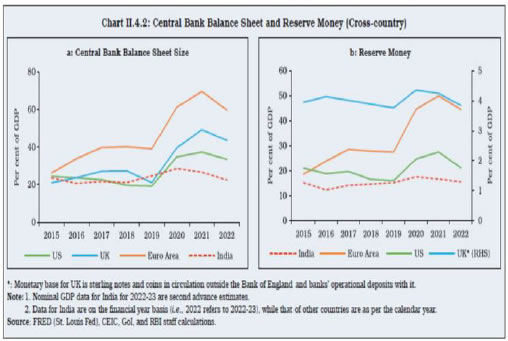 Further, Money supply, commonly proxied by broad money (M3 – Sum of currency with public, demand and time deposits with banks and other deposits with Reserve Bank), viewed in the context of economic activity - M3 to nominal GDP ratio - indicates that India witnessed a faster normalisation of COVID-19 induced stimulus, with the ratio reverting to the pre-pandemic steady levels unlike other major economies (Chart II.4.8). Chapter 2: Legal Framework for Reserve Bank Functions The structure, roles and responsibilities of central banks vary between countries, which is very much evident from their origins and the variety of functions they perform. The statutes governing the establishment and mandate of central banks are also not uniform even as they play a crucial role in determining the functions of central banks across the world. In India, the RBI is the central banking authority constituted by the Reserve Bank of India Act, 1934 (‘RBI Act’), and its duties and responsibilities flow from that statute. However, the range of functions, which the RBI is undertaking is not only covered under the RBI Act2 but is also covered under various other statutes. Thus, the legal backing for the functions of RBI is spread over a number of statutes. In this chapter, we examine in detail the legal provisions vis-à-vis the multifarious functions that are conferred on the RBI. Reserve Bank of India – Legal Background Pursuant to the recommendation of the Royal Commission on Indian Currency and Finance, a Bill was introduced in the Legislative Assembly in 1927 to create a central bank for India, which was later withdrawn due to lack of agreement among various sections of people. Subsequently, the White Paper on Indian Constitutional Reforms (1933) recommended for the establishment of a Reserve Bank in India. Accordingly, a fresh Bill was introduced in the Legislative Assembly, which got passed and received the Governor General’s assent on March 6, 19343. Consequently, the RBI Act came into force and the RBI commenced its operations as the central bank of the country on 1st April 1935 as a private shareholders’ bank, with a paid-up capital of Rupees five crore. Aims and Objectives – The Preamble The purposes for which the RBI has been established as India’s central bank are outlined in the preamble to the RBI Act (amended), as follows: i) to regulate the issue of banknotes and the keeping of reserves with a view to securing monetary stability in India and generally to operate the currency and credit system of the country to its advantage; and ii) that it is essential to have a modern monetary policy framework to meet the challenge of an increasingly complex economy and the primary objective of the monetary policy is to maintain price stability while keeping in mind the objective of growth. Thus, the Preamble in the RBI Act, as amended by the Finance Act, 2016, provides that the primary objective of the monetary policy is to maintain price stability, while keeping in mind the objective of growth, and to meet the challenge of an increasingly complex economy. The RBI Act envisages as an authorized business of RBI the exercise powers and functions and the performance of duties not only under that Act but also under any other law for the time being force4. Accordingly, the functions which the RBI is undertaking are not restricted only within the provisions of the RBI Act, but also extends to various areas, such as, regulation and supervision of banks, consumer protection, management of foreign exchange, management of government securities, regulation and supervision of payment systems, etc., for which powers are drawn from various laws, namely, the Banking Regulation Act, 1949, Foreign Exchange Management Act, 1999, Government Securities Act, 2006, Payment and Settlement Systems Act, 2007, etc. General Administration – Legal Background The general superintendence and direction of the affairs and business of the RBI is entrusted to the Central Board (Section 7 of RBI Act) consisting of Directors appointed under Section 8 of the RBI Act including Directors nominated by the Central Government. The Board of the RBI is headed by the Governor and assisted by not more than four Deputy Governors. The Board exercises all powers and do all acts and things which may be exercised by the RBI. Banking and Other Functions – Legal Background Section 17 of the RBI Act enables RBI to do banking business, such as accepting deposits, without interest, from Central Government, State Governments, local authorities, banks and any other persons. The other business, which the RBI may transact are also mentioned in the said provision. It states that the RBI may accept money as deposits, repayable with interest, from banks or any other person under Standing Deposit Facility Scheme, purchase, sale and rediscount of Bills of Exchange, make short term loans and advances to banks and other institutions, provide annual Contributions to National Rural Credit Funds, deal in Derivatives, purchase and sale of Government Securities, deal in repo or reverse repo, lend or borrow securities including foreign securities, purchase and sale of shares of State Bank of India, National Housing Bank, Deposit Insurance and Credit Guarantee Corporation, etc., keeping of Deposits with SBI for specific purposes, making and issue of Banknotes, etc. Section 18 facilitates the RBI to act as a ‘Lender of Last Resort’. Section 19 lists out the kinds of businesses which RBI may not transact. The provisions of the RBI Act enable the RBI to act as banker to Central Government and State Governments. Under Sections 20 and 21 of the RBI Act, RBI has an obligation and right respectively to accept monies for account of the Central Government and to make payments up to the amount standing to the credit of its account, and to carry out its exchange, remittance and other banking operations, including the management of the public debt of the Union. In the case of State Governments, the said banking functions may be undertaken by way of an agreement between the RBI and the State Government concerned, as provided in Section 21-A of the RBI Act. These agreements made between the RBI and the State Governments are statutory as they are required to be laid before the Parliament as soon as they are made. Issue Functions - Legal Background Issuance of bank notes is one of the key central banking functions the RBI is authorised and mandated to do. Section 22 of the RBI Act confers on RBI the sole right to issue bank notes in India. The issue of bank notes shall be conducted by a department called the Issue Department, which shall be separated and kept wholly distinct from the Banking Department (Section 23). The RBI Act enables RBI to recommend to Central Government the denomination of bank notes, which can be of two rupees, five rupees, ten rupees, twenty rupees, fifty rupees, one hundred rupees, five hundred rupees, one thousand rupees, five thousand rupees and ten thousand rupees or other denominations not exceeding ten thousand rupees (Section 24). The design, form and material of bank notes shall be approved by the Central Government on the recommendations of Central Board of the Reserve Bank of India (Section 25). Every bank note shall be a legal tender at any place in India, however, on recommendation of the Central Board, the Central Government may declare any series of bank notes of any denomination to be not a legal tender (Section 26). Reserve Bank of India is committed to put only clean notes into circulation (Section 27). Another important function is exchange of mutilated or torn notes, which under the RBI Act is not a matter of right, but of grace (Section 28). The bank notes that are being issued by the RBI are exempt from payment of stamp duty (Section 29). The Act describes assets and liabilities of Issue Department (Section 33 & 34). The obligations in respect of supply of coins and different forms of currency are given in Sections 38 & 39 respectively. To facilitate introduction of digital currency, the Act was amended in the year 2022 to (i) explicitly define a “bank note” to mean a note issued by the Bank, whether in physical or digital form, under section 22; and (ii) make certain provisions not applicable to digital form of bank notes (section 22A). Monetary Policy Functions - Legal Background Chapter III-F of the RBI Act provides for a statutory basis for the Monetary Policy Framework and the functioning of Monetary Policy Committee. The Central Government, in consultation with the RBI shall determine the inflation target in terms of the Consumer Price Index, once in every five years, which needs to be notified in the Official Gazette (Section 45ZA). Similarly, it is the Central Government that should constitute a Monetary Policy Committee by notification in the Official Gazette (Section 45ZB). The Monetary Policy Committee shall consist of (a) the Governor of the RBI; (b) Deputy Governor of the RBI in charge of Monetary Policy; (c) one officer of the RBI to be nominated by the Central Board; and (d) three persons to be appointed by the Central Government. The Monetary Policy Committee has been entrusted with the statutory duty to determine the Policy Rate required to achieve the inflation target. The decision of the Monetary Policy Committee is binding on the RBI and the RBI shall publish a document explaining the steps to be taken by it to implement the decisions of the Monetary Policy Committee (Section 45ZJ). It has been the objective of the statute that a committee-based approach will add lot of value and transparency to monetary policy decisions. The meetings of the MPC shall be held at least four times a year and it shall publicize its decisions after each such meeting (Section 45ZK). Public Debt Functions – Legal Background The Parliament of India enacted the Government Securities Act, 2006 (‘GS Act’) with an objective “to consolidate and amend the law relating to Government securities and its management by the Reserve Bank of India” (preamble of the Act). The GS Act applies to Government securities created and issued by the Central Government or a State Government (Section 1 of GS Act). The GS Act prescribes the procedure and modalities to be followed by the RBI in the management of the public debt and also confers various powers on the RBI, including the power to determine the title to a government security, if there exists any doubt in the opinion of the Reserve Bank of India (Section 12 of GS Act). Further, Section 18 of the GS Act provides that no order made by the RBI under that Act shall be called in question by any Court for the reasons stated therein. Prior to the enactment of the GS Act, the said public debt functions of the RBI have been governed by the provisions of the Public Debt Act, 1944. The enactment of the GS Act has not fully repealed the Public Debt Act, 1944. This is evident from Section 31 of the GS Act which states that the Public Debt Act, 1944, shall cease to apply to the Government securities to which that Act applies and to all matters for which provisions have been made under the GS Act. Foreign Exchange Management – Legal Background The powers and responsibilities with respect to external trades and payments, development and maintenance of foreign exchange market in India are conferred on the RBI under the provisions of the Foreign Exchange Management Act, 1999 (“FEMA”). Section 10 of the FEMA empowers the RBI to authorize any person to be known as authorized person to deal in foreign exchange or in foreign securities, as an authorized dealer, money changer or offshore banking unit or in any other manner as it deems fit. Similarly, it empowers the RBI to revoke an authorization issued to an authorized person in public interest, or if the authorized person has failed to comply with the conditions subject to which the authorization was granted or has contravened any of the provisions of the FEMA or any rule, regulation, notification, direction or order made thereunder. However, the revocation of an authorization may be done by the RBI after following the prescribed procedure in the FEMA. Section 13 of the FEMA details out the contraventions which may be adjudicated and penalized by the Adjudicating Authority (Directorate of Enforcement). RBI has been empowered to compound certain contraventions under Section 15 of the FEMA in accordance with the Rules framed in that regard. Banking Regulation & Supervision – Legal Background India has a variety of banks viz., banking companies (banks which are companies and regulated by the Banking Regulation Act, 1949), State Bank of India (constituted by the State Bank of India Act, 1955), Nationalised Banks (constituted by the Banking Companies (Acquisition and Transfer of Undertakings) Act, 1970/ 1980), Regional Rural Banks (constituted under the Regional Rural Banks Act, 1976), and Co-operative banks (constituted either under the Multi-State Co-operative Societies Act, 2002 or State Co-operative Societies Acts). Although RBI is entrusted with the task of regulating and supervising all types of banks in the country, the powers exercisable by it towards different banks are not uniform. The power to regulate and supervise banking companies has been provided by the provisions of the Banking Regulation Act, 1949 (BR Act, 1949) to the RBI. The preamble to the BR Act, 1949, states that it is an Act to consolidate and amend the law relating to banking and the powers of RBI to formulate banking policy (Section 5(ca) of BR Act), to regulate and supervise banking business etc., are scattered across the BR Act, 1949. Section 5(ca) of the BR Act, 1949, states that banking policy means any policy, which is specified from time to time by the RBI, in the interest of the banking system or in the interest of monetary stability or sound economic growth, having due regard to the interests of the depositors, the volume of deposits and other resources of the bank and the need for equitable allocation and the efficient use of these deposits and resources. The appointment, re-appointment or termination of chairman and whole-time directors of a banking company shall not have effect, unless done with the previous approval of the Reserve Bank (Section 35 B of BR Act). Similarly, as a part of control over management, Section 36-AB of BR Act, 1949, empowers RBI to appoint additional directors on the boards of banking companies. Section 36-AA of the BR Act, 1949 enables RBI to remove executives, officers and employees of a banking company under certain conditions. Moreover, the RBI has been empowered under BR Act, 1949, to supersede the boards of banking companies (Section 36ACA of BR Act). Though it is not the role of the Reserve Bank to micro-manage the affairs of banks, it has powers to control advances by banking companies (Section 21 of BR Act). Section 22 of the BR Act, 1949 confers on RBI the power to issue licenses and also to cancel licenses of banking companies. Another important regulatory power that has been vested in the RBI is the power to issue directions to banking companies. Under Section 35A of the BR Act, 1949, RBI has the power to issue directions to banking companies in public interest or in the interest of banking policy or to prevent the affairs of any banking company being conducted in a manner detrimental to the interests of the depositors or in a manner prejudicial to the interests of the banking company or to secure the proper management of any banking company. The Banking Regulation (Amendment) Act, 2017 has provided powers to RBI to issue directions to any banking company to initiate insolvency resolution process in respect of a default, if authorized by the Central Government (Section 35AA of BR Act), and to issue directions to banking companies in relation to resolution of stressed assets (Section 35 AB of BR Act). As part of the supervisory powers, RBI has been empowered to inspect banking companies on its own or at the instance of Central Government under the provisions of the BR Act, 1949 (Section 35). “Thus, an overall responsibility to find out the well-being of a banking company, in improving monetary stability and economic growth as well as keeping in view the interests of depositors”, has been left with the Reserve Bank of India (Janata Sahakari Bank Ltd. V/s. State of Maharashtra (AIR 1993 Bombay 252)). Only those provisions of the BR Act which are mentioned in section 51 of the BR Act will apply to State Bank of India, Nationalised Banks and Regional Rural Banks. In the case of co-operative banks, the application of the provisions of the BR Act will be subject to the modifications mentioned in section 56 of the very same Act. Regulation and Supervision of NBFCs – Legal Background The regulation and supervision of non-banks is one of the critical functions that the RBI has been entrusted with. Section 45-IA of the RBI Act mandates every non-banking financial company to obtain a Certificate of Registration from the RBI and to have a net owned fund as may be specified by the RBI in the Official Gazette, before commencing such non-banking financial business. Further, as a part of regulation and supervision of non-banks, the RBI has been conferred with the statutory powers to regulate or prohibit issue of prospectus or advertisements soliciting deposits of money by non-banking institutions (Section 45J of RBI Act), power to determine policy and issue directions to non-banking financial companies, etc. (Section 45JA of RBI Act). Further, the RBI has been empowered under Section 45-L of the RBI Act to call for information and issue directions to financial institutions for the reasons stated therein. As a part of the supervisory control over the non-banks, the RBI has the power to inspect non- banking institutions under Section 45-N of the RBI Act, 1934. Pursuant to the amendment by Finance Act in 2019, RBI has been empowered to remove a director from Board of an NBFC (Section 45 ID) and/or supersede the Board of an NBFC if the Bank is satisfied that in the public interest or to prevent the affairs of an NBFC being conducted in a manner detrimental to the interest of the depositors or creditors (Section 45 IE). The Bank may, in addition to the above, in the interest of financial stability, amalgamate or reconstruct or split an NBFC into different units (Section 45 MBA). In such a scenario, the Bank may also establish a Bridge Institution, temporary institutional arrangement made under the scheme, to preserve the continuity of the activities of the NBFCs that are critical to the functioning of the financial system. Regulation & Supervision of Co-operative banks – Legal Background In terms of Article 246 of the Constitution of India, the legislative powers of the Union and the State are given in three Lists, viz., the Union List, the State List and the Concurrent List respectively of Schedule VII to the Constitution. The entry relating to incorporation, regulation and winding-up of Cooperative Societies fall in State List whereas the entry relating to banking fall in the Union List. This results in the duality of jurisdiction over cooperative banks by the Reserve Bank of India and the Registrar of Cooperative Societies. In Janata Sahakari Bank Ltd. v. State of Maharashtra, the Bombay High Court has held that “though the control over management of Co-operative Society where it is Co-operative Banking Society or otherwise is vested in the Registrar of Co-operative Societies, but insofar as banking is concerned, by virtue of Section 56 of the Banking Regulation Act, 1949, read with Section 35A of the Act ibid, it will be a subject with which the Reserve Bank of India has full power”. The Banking Regulation (Amendment) Act, 2020 (which replaced Banking Regulation (Amendment) Ordinance 2020 promulgated on June 27, 2020) amended the Banking Regulation Act, 1949 with respect to its applicability to co-operative banks. By virtue of this amendment, certain provisions of the BR Act including those relating to the control over the management and functioning of banks i.e., sections 10, 10A, 10B, 10BB, 10C, 10D, 35B etc. were extended to co-operative banks, which were not applicable earlier. Section 56 has also been modified to give primacy to the provisions thereunder in case of any conflict with any other laws. The Amendment Act states that the BR Act will not apply to primary agricultural credit societies and cooperative societies whose principal business is long term financing for agricultural development, if these societies do not use the words ‘bank’, ‘banker’ or ‘banking’ in their name or in connection with their business and does not act as drawee of cheques. The Amendment Act provides that a cooperative bank may issue equity shares, preference shares, or special shares on face value or at a premium to its members or to any other person residing within its area of operation. Further, it may issue unsecured debentures or bonds or similar securities with maturity of ten or more years to such persons subject to the prior approval of the Reserve Bank of India (RBI), and any other conditions as may be specified by RBI. The Amendment Act adds that in case of a co-operative bank registered with the Registrar of Co- operative Societies of a state, the RBI is empowered to supersede the Board of Directors after consultation with the concerned state government, and within such period as specified by it. Further, section 53A has been newly inserted and made applicable to co-operative banks, whereby RBI may exempt a cooperative bank or a class of cooperative banks from certain provisions of the Act through notification for such time period and under such conditions as may be specified by the RBI. As Sections 49B and 49C of the Banking Regulation Act, 1949 have been made applicable to Co-operative Banks following the Banking Regulation (Amendment) Act, 2020, any changes to a cooperative bank's name or byelaws require written certification from the Reserve Bank confirming no objection before approval by the Central/State Registrar of Cooperative Societies. Regulation of Transactions in Derivatives, Money Market Instruments – Legal Background Chapter III-D was inserted in the RBI Act with effect from January 09, 2007 by way of an amendment to the RBI Act, 1934. In the said chapter, the Parliament of India thought it as appropriate to introduce provisions relating to regulation of transactions relating to derivatives, money market instruments, securities, etc. by the RBI. Sub-section (a) of Section 45U of the RBI Act defines derivative as an instrument to be settled at a future date, whose value is derived from change in interest rate, foreign exchange rate, credit rating or credit index, price of securities (also called ‘underlying’), or a combination of more than one of them and includes interest rate swaps, forward rate agreements, foreign currency swaps, foreign currency-rupee swaps, foreign currency options, foreign currency rupee options or such other instruments as may be specified by the RBI from time to time. Similarly, money market instruments have been defined to include call or notice money, term money, repo, reverse repo, certificate of deposit, commercial usance bill, commercial paper and such other debt instrument of original or initial maturity up to one year as the RBI may specify from time to time. The expression “securities” have been defined to mean securities of Central Government or a State Government or securities of local authority specified by the Central Government and for the purpose of ‘repo’ and ‘reverse repo’ to include corporate bonds and debentures. The power of RBI to regulate transactions in derivatives, money market instruments etc. have been provided under Section 45W of the RBI Act, which states that the RBI may, in public interest or to regulate the financial system of the country to its advantage, determine the policy relating to interest rates or interest rate products and give directions in that behalf to all agencies or any of them, dealing in securities, money market instruments, foreign exchange, derivatives, or other instruments of like nature as the RBI may specify from time to time. Section 45V also provides that transactions in derivatives specified by RBI shall be valid, if at least one of the parties to the transaction is an entity falling within the regulatory purview of RBI, thus conferring certainty to the legal validity of such contracts. Payment and Settlement Functions – Legal Background The Parliament of India enacted the Payment and Settlement Systems Act, 2007 (‘PSS Act, 2007’) with an objective to provide for the regulation and supervision of payment systems in India and to designate the Reserve Bank of India as the authority for that purpose and for matters connected therewith or incidental thereto. Under Section 4 of the PSS Act, 2007, no person shall commence or operate a payment system except with an authorization issued by the RBI. Similarly, under Section 8 of the PSS Act, 2007, RBI has the power to revoke the authorization granted to any person if it contravenes any of the provisions of the PSS Act or does not comply with regulations or fails to comply with the orders or directions issued by the RBI or operates the payment system contrary to the conditions subject to which the authorization was issued. The regulation and supervision of payment systems has been conferred on the RBI by virtue of provisions of Chapter IV of the PSS Act, 2007. The regulatory and supervisory controls include power to determine standards for the functioning of payment systems, power to call for returns, documents or other information, power to enter and inspect payment systems, power to carry out audit and inspections, power to issue directions, etc. Credit Information Companies Regulation Functions Reserve Bank has been entrusted with the task of regulation and supervision of Credit Information Companies under the Credit Information Companies (Regulation) Act, 2005. Three institutions form the essential pillars of the Act, viz. the Credit Information Companies, the Credit Institutions and Specified Users. The Act empowers the Reserve Bank to issue directions to Credit Information Companies and to inspect them. The Reserve Bank is also authorised by the statute to determine policy in relation to functioning of credit information companies. Consumer Protection and promotion Functions – Legal Background Protection of the interests of the depositors is one of the vital mandates of the RBI. The various provisions in the RBI Act, 1934, BR Act, 1949, etc., are replete with the phrases like “in the interests of depositors” wherever it entrusts powers to the RBI. Apart from depositors, the resolution of grievances of customers who deal with its regulated entities is also important for the Reserve Bank of India. Reserve Bank of India has formulated three Ombudsman Schemes for covering operations of banks, NBFCs and payment systems. Reserve Bank of India (RBI) integrated its three erstwhile Ombudsman Schemes viz. (i) the Banking Ombudsman Scheme, 2006, (ii) the Ombudsman Scheme for Non-Banking Financial Companies, 2018, and (iii) the Ombudsman Scheme for Digital Transactions, 2019, into one Scheme - ‘The Reserve Bank - Integrated Ombudsman Scheme, 2021 (the Scheme / RB-IOS, 2021)’ with effect from November 12, 2021. The Scheme simplifies the grievance redress process at RBI by enabling the customers of Regulated Entities (REs) like banks, Non-Banking Financial Companies (NBFCs), Payment System Participants (PSPs) and Credit Information Companies to register their complaints at one centralised reference point. The objective of the Scheme is to resolve the customer grievances involving ‘deficiency in service’ on part of REs in a speedy, cost-effective and satisfactory manner. Reserve Bank of India attaches high importance to its promotional and developmental roles. Clause (8AA) of section 17 of the RBI Act states that the promoting, establishing, supporting or aiding in the promotion, establishment and support of any financial institution - whether as its subsidiary or otherwise, is a business which can be transacted by the Reserve Bank. Section 54 of that Act points to the developmental role of RBI in matters of rural development. It provides that the Reserve Bank may maintain expert staff to study various aspects of rural credit and development and in particular it may (i) tender expert guidance and assistance to the National Bank; and (ii) conduct special studies in such areas as it may consider necessary to do so for promoting integrated rural development. Factoring Regulation Act 2011 - The Act provides a legal framework for the assignment of receivables, outlining the rights and obligations of all parties involved. The RBI's role includes regulating and supervising factors, issuing directions to factors and collecting information from them. MSME Act 2006 – The Act provides for facilitating the promotion and development and enhancing the competitiveness of micro, small and medium enterprises and for matters connected therewith or incidental thereto. The provisions of the Act mandate that a senior official from the RBI, not below the rank of an Executive Director, is included in the National Board for MSMEs, ensuring that the RBI has a significant role in the policy-making process for the MSME sector. RBI is responsible for the smooth flow of credit to MSMEs, so as to minimize the incidence of sickness among and enhance the competitiveness of such enterprises. Conclusion The powers and functions of the RBI have further widened consequent upon the amendments to the Securitisation and Reconstruction of Financial Assets and Enforcement of Security Interests Act, 2002 and the National Housing Bank Act, 1987. The provisions of SARFAESI Act empowers RBI with regard to regulation and supervision of Asset Reconstruction Companies. The amendments made in the year 2019 to the provisions of National Housing Bank Act, 1987 transferred certain regulatory powers over housing finance companies from the National Housing Bank (NHB) to the Reserve Bank of India (RBI). Accordingly, HFCs are being treated as one of the categories of NBFCs for regulatory purposes. Consequent upon the amendment, RBI has, in exercise of its powers under the RBI Act and NHB Act, issued directions to NBFC-HFCs. The change aims to enhance the stability and efficiency of the housing finance sector. Although, the object and purpose of establishment of the RBI, as could be observed from the preamble to the RBI Act, 1934, is to regulate the issue of Bank notes and the keeping of reserves with a view to securing monetary stability and also to formulate monetary policy with an objective to maintain price stability while keeping in mind the objective of growth, the multifarious functions which the RBI has been entrusted with through various legislations shows that the central bank of the country has much wider mandates than what have been summarized in the preamble to the RBI Act, 1934. The regulation and supervision of banks, non-banks, co-operative banks, management of currency, management of public debt of the Union and the State, management of foreign exchange, acting as banker to banks, banker to governments, protection of interests of depositors, spreading of financial literacy, etc., are all part of achieving the common goal as enshrined in the preamble to the RBI Act, 1934. Chapter 3: Monetary Policy Framework Monetary Policy Making in India Definition, objectives and tools Central banks around the world were established to preserve monetary and financial stability. They also had several other functions such as issuance of currency and management of public debt, etc., but monetary and financial stability have over time remained the core objective of central banks. The functions of central banks were written into law to empower them to deliver on their mandate effectively. The Reserve Bank was set up under the Reserve Bank of India Act 1934 with the original Preamble that describes the broad mandate of the Reserve Bank as follows “it is expedient to constitute a Reserve Bank for India to regulate the issue of Bank notes and keeping of reserves with a view to securing monetary stability in India and generally, to operate the currency and credit system of the country to its advantage”. Monetary policy refers to the use of monetary instruments under the control of the central bank to influence variables, such as interest rates, money supply and availability of credit, with a view to achieving the objectives of policy. Accordingly, the objectives of monetary policy evolved as maintaining price stability and ensuring adequate flow of credit to the productive sectors of the economy. With progressive liberalization and increasing globalization of the economy, maintaining orderly conditions in financial markets emerged as an additional policy objective. Thus, over time, the role of monetary policy in India has evolved to maintain a judicious balance between price stability, economic growth and financial stability. However, pursuant to the amendment to the RBI Act, 1934 in May 2016, the primary objective of monetary policy is to maintain price stability while keeping in mind the objective of growth. The amended Preamble to RBI Act reads as follows: “to regulate the issue of Bank notes and keeping of reserves with a view to securing monetary stability in India and generally to operate the currency and credit system of the country to its advantage” “AND WHEREAS it is essential to have a modern monetary policy framework to meet the challenges of an increasingly complex economy; AND WHEREAS the primary objective of the monetary policy is to maintain price stability while keeping in mind the objective of growth”. Evolution of Monetary Policy Framework in India In order to attain the objectives of monetary policy, it is necessary to have a consistent policy framework. Broadly, monetary policy framework consists of objectives, operating procedure and governance arrangements. • Objectives are the aims of monetary policy, which are nominal anchors and long-term in scope but are not directly under the control of the central bank. As a result, central banks strive to achieve these objectives through use of instruments which are under their direct control or indirectly target intermediate and operating targets, which bear a stable relationship with the ultimate objectives. The choice of the operating target is crucial as this variable is at the beginning of the monetary transmission mechanism. Similarly, the selection of intermediate targets is conditional upon the channels of transmission – the process through which monetary policy actions impact the ultimate objectives. • Operating procedure essentially deals with how the central bank intends to influence the operating target and thereby the intermediate target through its liquidity management operations. Therefore, the operating procedure is essentially the day-to-day management of liquidity conditions consistent with the overall stance of the monetary policy. In other words, operating procedure is also called the nuts and bolts of monetary policy, the “plumbing in the architecture” (Patra et al., 2016). • Governance arrangements primarily deal with the process of decision making and focus on responsibilities, powers and accountability of the monetary authority. From the perspective of global best practices, historically, bank reserves and short- term interest rates have evolved as the two dominant operating targets. However, the focus shifted to short-term interest rates in early 1990s with the adoption of market-based monetary policy frameworks, reflecting greater significance of interest rates in monetary transmission mechanism as markets developed in a deregulated environment. Consequently, the overnight rate emerged as the most commonly pursued operating target in the conduct of monetary policy. India's monetary policy framework has undergone several transformations over the years reflecting underlying macroeconomic and financial conditions. During 1971-1985, the monetisation of the fiscal deficit exerted a dominant influence on the conduct of monetary policy. The pre- emption of resources by the public sector and the resultant inflationary consequences of high public expenditure necessitated frequent recourse to the cash reserve ratio (CRR) to neutralize the secondary effects of monetary expansion. Financial repression in the form of interest rate prescriptions, statutory pre-emptions and directed credit partly crowded out the private sector from the credit market. Against this backdrop, the Committee to Review the Working of the Monetary System (Chairman: Dr. Sukhamoy Chakravarty, 1985) recommended a new monetary policy framework based on monetary targeting with feedback, drawing on empirical evidence of a stable demand function for money. Monetary Targeting Framework Under this framework, broad money became the intermediate target while reserve money was one of the main operating instruments for achieving control on broad money growth. Accordingly, monetary (M3) projection was made consistent with the expected real GDP growth and a tolerable level of inflation. Technically, in a simple form, if expected real GDP growth was 6 per cent, the income elasticity of demand for money was 1.5 and a tolerable inflation was 5 per cent, the M3 expansion target was set at 14 per cent [M3 growth = 1.5(6) +5 =14 percent] (Mohanty, 2010). This framework was in operation during mid-1980s to 1997-98. Analysis of the money growth outcomes during the monetary targeting regime indicates that targets were rarely met. The biggest impediment to monetary targeting was lack of control over RBI's credit to the central government, which accounted for the bulk of reserve money creation. With economic and financial sector reforms in the 1990s, there was shift in financing government and the commercial sector with increasing reliance on market-determined interest rates and exchange rate. RBI was able to move away from direct instruments to indirect market-based instruments. The statutory liquidity ratio (SLR) and CRR were gradually reduced to 25 per cent and 9.5 per cent, respectively, of net demand and time liabilities (NDTL) by 1997. Furthermore, as the pace of trade and financial liberalization gained momentum in the 1990s, the efficacy of broad money as an intermediate target was re-assessed. Financial innovations and external shocks emanating from swings in capital flows, volatility in the exchange rate and global business cycles imparted instability to the demand for money. There was also increasing evidence of changes in the underlying transmission mechanism of monetary policy with interest rate and the exchange rate gaining importance vis-à-vis quantity variables. Against this backdrop, the search for an alternative monetary framework in India ended after switching over to a Multiple Indicator Approach in 1998-99. Multiple Indicator Approach The RBI adopted a 'multiple indicator approach' in April 1998 with a greater emphasis on rate channels for monetary policy formulation relative to quantity instruments. Under this approach, a number of quantity variables such as money, credit, output, trade, capital flows and fiscal position as well as rate variables such as rates of return in different markets, inflation rate and exchange rate were analyzed for drawing monetary policy perspectives. The multiple indicator approach was augmented and guided by forward looking indicators since the early 2000s drawn from the RBI’s surveys of industrial outlook, credit conditions, capacity utilization, professional forecasters, inflation expectations and consumer confidence. The RBI, however, continued to give indicative projections of key monetary aggregates as money was deemed to be a crucial information variable. The multiple indicator approach seemed to work fairly well from 1998-99 to 2008-09, as reflected in the average real gross domestic product (GDP) growth rate of 7.1 per cent associated with an average inflation of about 5.5 per cent in terms of both the wholesale price index (WPI) and the Consumer Price Index (CPI). Subsequently, however, there was a growing public debate on the efficacy and even the credibility of this framework as persistently high inflation and weakening growth co-existed as visible signs of stagflation. Use of a large panel of indicators was also not providing a clearly defined nominal anchor for monetary policy. It also left policy analysts unclear about what the RBI looks at while taking policy decisions. In fact, several high-level Committees in India have been highlighting since 2007 that the RBI must consider switching over to inflation targeting. Flexible Inflation Targeting Against this backdrop, the RBI constituted an Expert Committee to Revise and Strengthen the Monetary Policy Framework (Chairman: Dr. Urjit R. Patel) on September 12, 2013 to recommend what was needed to be done to revise and strengthen the current monetary policy framework with a view to, inter alia, making it transparent and predictable. The Expert Committee submitted its report in January 2014 and set the stage for a move towards the adoption of a flexible inflation targeting (FIT) framework as monetary policy in India. In the FIT framework, the policy (repo) rate is set, based on an assessment of the current and evolving macroeconomic situation, with the aim of achieving the inflation target on an average over the business cycle, while accommodating growth concerns in the short run (RBI, 2014). Once the repo rate is announced, the operating framework designed by the RBI envisages liquidity management on a day-to-day basis through appropriate actions, which aim at anchoring the operating target – the weighted average call money rate (WACR) – around the repo rate. The details of the operational framework of monetary policy is elaborated in the next chapter “Market Operations”. These changes in money market rates then get transmitted to the entire financial system, which, in turn, influences aggregate demand – a key determinant of inflation and growth. Prior to the amendment to the RBI Act in May 2016, the flexible inflation targeting framework, as recommended by the above-mentioned Committee, was governed by an Agreement between the Government of India and the Reserve Bank of India in February 2015. The amendment of the RBI Act in May 2016 provided the statutory basis for the implementation of the flexible inflation targeting framework. As per the amended Act, the inflation target would be defined in terms of all India Consumer Price Index (CPI) and the inflation target would be set by the Government of India, in consultation with the Reserve Bank, once in every five years. The failure to achieve the inflation target was defined as when: (a) the average inflation is more than the upper tolerance level of the inflation target for any three consecutive quarters; or (b) the average inflation is less than the lower tolerance level for any three consecutive quarters. In the event of a failure to meet the inflation target, the Reserve Bank has to set out in a report to the Central Government: (a) the reasons for failure to achieve the inflation target; (b) remedial actions proposed to be taken by the Bank; and (c) an estimate of the time-period within which the inflation target shall be achieved pursuant to timely implementation of proposed remedial actions. The only instance of the Monetary Policy Committee (MPC) sending a report to the Government consequent upon inflation exceeding 6 per cent, the upper tolerance threshold around the target, for three successive quarters in 2022 was in November 2022. The amended Act requires the Reserve Bank to publish, once in every six months, a document called the Monetary Policy Report that explains (a) the sources of inflation; and (b) the forecast of inflation for 6 to18 months ahead. The amended RBI Act came into effect in June 2016. In pursuance of the amended Act, the Central Government notified in August 2016 in the Official Gazette an inflation target of 4 per cent Consumer Price Index (CPI) inflation for the period August 5, 2016, to March 31, 2021, with the upper tolerance limit of 6 per cent and the lower tolerance limit of 2 per cent. Section 45ZB of the amended RBI Act, 1934 also provides for a six-member Monetary Policy Committee (MPC) to be constituted by the Central Government by notification in the Official Gazette. Accordingly, a six-member Monetary Policy Committee (MPC) was constituted on September 29, 2016, with three internal and three external members, to determine the policy rate to achieve the inflation target. Under the amended RBI Act, the six- member committee is required to meet at least four times in a year. Three external MPC members are appointed for a period of 4 years. Each member of the MPC has one vote, and in the event of an equality of votes (tie), the Governor of the RBI has a second or casting vote. The resolution adopted by the MPC is published after conclusion of every meeting of the MPC in accordance with the provisions of Chapter III F of the amended Reserve Bank of India Act, 1934. On the 14th day after the policy announcement, the minutes of the proceedings of the MPC meeting are published which include (a) the resolution adopted by the MPC; (b) the vote of each member on the resolution and their underlying rationale; and (c) the statement of each member on the resolution adopted. The Reserve Bank's Monetary Policy Department (MPD) assists the MPC in formulating monetary policy. Views of key stakeholders in the economy, and analytical work of the Reserve Bank contribute to the process for arriving at the decision on the policy repo rate. The Financial Markets Committee (FMC) meets daily to review the liquidity and financial market conditions. The Financial Markets Operations Department (FMOD) operationalises the monetary policy decision of the MPC, mainly through day-to-day liquidity management operations so as to ensure close alignment of the operating target –the WACR– with the policy repo rate. As explained above, monetary policy making in India has evolved over the years. The increasing size of the Indian economy along with the growing sophistication of financial markets over the last three decades has enabled the gradual transition from a monetary targeting framework to a multiple indicator approach and finally to the adoption of FIT. Monetary Policy Tools/Instruments There are various direct and indirect instruments used for implementing monetary policy including Repo Rate, Standing Deposit Facility (SDF), Reverse Repo Rate, Marginal Standing Facility (MSF) under the Liquidity Adjustment Facility (LAF), Bank Rate, Cash Reserve Ratio (CRR), Open Market Operations (OMOs) and Forex Swaps. They are briefly explained below: Repo Rate: The interest rate at which the Reserve Bank provides liquidity under the liquidity adjustment facility (LAF) to all LAF participants against the collateral of government and other approved securities. Standing Deposit Facility (SDF): The rate at which the Reserve Bank accepts uncollateralised deposits, on an overnight basis, from all LAF participants. The SDF rate is placed below the policy repo rate (25 basis points below, as of August 2024). With the introduction of SDF in April 2022, the SDF rate replaced the fixed reverse repo rate as the floor of the LAF corridor. Marginal Standing Facility (MSF): The penal rate at which banks can borrow, on an overnight basis, from the Reserve Bank by dipping into their Statutory Liquidity Ratio (SLR) portfolio up to a predefined limit (2 per cent as of August 2024). This provides a safety valve against unanticipated liquidity shocks to the banking system. The MSF rate is placed above the policy repo rate (currently 25 basis points above, as of August 2024). Reverse Repo Rate: The interest rate at which the Reserve Bank absorbs liquidity from banks against the collateral of eligible government securities. Liquidity Adjustment Facility (LAF): The LAF refers to the Reserve Bank's operations through which it injects/absorbs liquidity into/from the banking system. It consists of overnight as well as term repo/reverse repos (fixed as well as variable rates), SDF and MSF. LAF Corridor: The LAF corridor has the marginal standing facility (MSF) rate as its upper bound (ceiling) and the standing deposit facility (SDF) rate as the lower bound (floor), with the policy repo rate in the middle of the corridor. Bank Rate: The rate at which the Reserve Bank is ready to buy or rediscount bills of exchange or other commercial papers. The Bank Rate acts as the penal rate charged on banks for shortfalls in meeting their reserve requirements (cash reserve ratio and statutory liquidity ratio). The Bank Rate is published under Section 49 of the RBI Act, 1934. This rate has been aligned with the MSF rate and, changes automatically as and when the MSF rate changes alongside changes in the policy repo rate. Cash Reserve Ratio (CRR): The amount that a bank is required to maintain with the Reserve Bank as a specified proportion (per cent) of its Net Demand and Time Liabilities (NDTL) for a fortnight starting from a Saturday till the next reporting Friday. The proportion required to be maintained is notified by the Reserve Bank from time to time. The maintenance of CRR balances over a fortnight is on an average daily basis with a stipulated minimum daily maintenance notified by the Reserve Bank. Statutory Liquidity Ratio (SLR): Every bank in India maintains assets, the value of which shall not be less than such percentage of the total of its demand and time liabilities in India as on the last Friday of the second preceding fortnight, as the Reserve Bank may, by notification in the Official Gazette, specify from time to time (18 per cent as of August 2024), and such assets shall be maintained as may be specified in such notification (typically in unencumbered government securities, cash and gold). Open Market Operations (OMOs): These include both repurchase (repo or reverse repo) operations and outright purchase and sale of government securities, for injection and absorption of liquidity, respectively. Market Stabilisation Scheme (MSS): This instrument for monetary management was introduced in 2004. Surplus liquidity of a more enduring nature arising from large capital inflows is absorbed through sale of short-dated government securities and treasury bills. Depending upon the nature of the surplus liquidity (long term/ short term) the securities under MSS (long term dated securities/ short term CMBs) are issued. The cash so mobilised was held in a separate government account with the Reserve Bank5. Forex Swaps: This is an instrument used for managing system liquidity on durable basis. The swaps are in the nature of a simple sell/buy foreign exchange swap from the Reserve Bank side. A bank sells/buys US Dollars from the Reserve Bank and simultaneously agrees to buy/sell the same amount of US Dollars at the end of the swap period. The Reserve Bank can control the amount of systemic liquidity by conducting appropriate buy/sell swaps. Unconventional Monetary Policy Tools (UMPT) During the global financial crisis, advanced economies suffered steep and persistent fall in the real GDP. Advanced economies’ central banks couldn’t rely solely on conventional monetary policy, i.e., reduction in policy rate due the zero-lower bound (ZLB) constraint of the policy rate leading them to introduce unconventional monetary policies to revive the economy. Unconventional monetary policy broadly consists of quantitative easing (QE) and forward guidance (FG) measures. Quantitative easing measures refer to the asset purchase programs of the advanced central banks, which drastically increased the total assets as well as altered the composition of assets in the central banks’ balance sheet unlike the conventional monetary policies, which had negligible impact on the central banks’ balance sheet. Forward guidance refers to the use of central bank communication to manage expectations about the future course of policy, thereby attempting to influence the financial decisions of the household and firms. UMPT used in India - The Reserve Bank undertook several conventional and unconventional measures in the wake of COVID-19. These measures included (i) extended lending or term-funding operations including liquidity support through refinance; (ii) asset purchase programmes including operation twists (OTs); and (iii) forward guidance, the broad contours of which are discussed below. (i) Liquidity Support Operations (a) Extended lending/term-funding: The Reserve Bank introduced long term repo operations (LTROs) in February 2020 to facilitate monetary policy transmission and support credit offtake. Under the scheme, the Reserve Bank provided long-term liquidity to banks at the erstwhile policy repo rate (5.15 per cent) – a rate lower than the prevailing market rates as well as banks’ own deposit cost – to lower their cost of funds. During February-March 2020, five LTRO auctions (each amounting to ₹25,000 crore with one of 1-year and four of 3-years tenor) were conducted, which augmented system liquidity by ₹1,25,117 crore. In September 2020, however, banks repaid ₹1,23,572 crore (about 98.8 per cent of the funds availed) to reduce their cost of funds by exercising an option of prepayment before maturity. An event study (ES) analysis around announcement days indicated that LTROs had a significant impact on G-sec yields of some maturities (Das et al., 2020; RBI, 2020a). The outbreak of COVID-19 ignited sell-off pressures in financial markets as large global spillovers triggered flight to safety. Consequently, financial conditions tightened as sharp spikes in risk premium on corporate bonds, CPs and debentures dried up trading activity resulting in market illiquidity. Accordingly, targeted long-term repo operations (TLTROs) were introduced to provide liquidity to specific sectors and entities experiencing liquidity stress. TLTRO auctions were conducted during March-April 2020 providing money to banks for deployment in investment grade corporate bonds, CPs, and non-convertible debentures. Banks were required to acquire up to fifty per cent of their incremental holdings of eligible instruments from the primary market and the remaining from the secondary market, including from mutual funds (MFs) and non-banking finance companies (NBFCs). Since the deployment of TLTRO funds was largely confined to primary issuances of public sector entities and large corporates, TLTRO 2.0 was introduced to provide relief to the small and mid-sized corporates, including NBFCs and micro finance institutions (MFIs). Banks were required to invest in investment grade bonds, CPs, and non-convertible debentures of NBFCs, with at least 50 per cent of the total amount availed going to small and mid-sized NBFCs and MFIs. As liquidity measures concentrated on reviving specific sectors that have multiplier effects on growth, ‘On Tap TLTRO’ was introduced in October 2020 with tenors of up to three years at a floating rate linked to the policy repo rate. Funds availed are to be deployed in corporate bonds, CPs, and non-convertible debentures issued by the entities in five specific sectors; additionally, it can also be used to extend bank loans and advances to these sectors. Subsequently, 26 stressed sectors identified by the Kamath Committee (2020) were brought within the ambit of this scheme in December which was further expanded to include bank lending to NBFCs in February 2021. (b) Sector-specific Refinance: In view of tightening financial conditions, all India financial institutions (AIFIs) were facing difficulties in raising resources. To alleviate their liquidity stress and meet sectoral credit needs, special refinance facilities were provided at the policy repo rate to National Bank for Agriculture and Rural Development (NABARD), Small Industries Development Bank of India (SIDBI) and National Housing Bank (NHB) in 2020. A line of credit was extended to the EXIM Bank for a period of 90 days (with maximum rollover up to one year) to avail a US dollar swap facility to meet its foreign exchange requirements. A separate liquidity window of ₹15,000 crore with tenors of up to three years at the repo rate was opened till March 31, 2022 for certain contact intensive sectors, i.e., hotels and restaurants; tourism - travel agents, tour operators and adventure/heritage facilities; aviation ancillary services - ground handling and supply chain; and other services that include private bus operators, car repair services, rent-a-car service providers, event/conference organisers, spa clinics and beauty parlours/saloons. By way of an incentive, banks were permitted to park their surplus liquidity up to the size of the loan book created under this scheme with the Reserve Bank under the reverse repo window at a rate which is 25 bps lower than the repo rate or, termed in a different way, 40 bps higher than the reverse repo rate. The scheme was later extended till June 30, 2022. (c) Liquidity Facility for Mutual Funds: In order to ease redemption pressures on Mutual Funds (MFs) emanating from closure of some debt MFs and minimise their potential contagion effects, a special liquidity facility for mutual funds (SLF-MF) was introduced in April. The Reserve Bank had earlier extended a similar facility to MFs in 2008 during the GFC and later in 2013 following the taper tantrum. 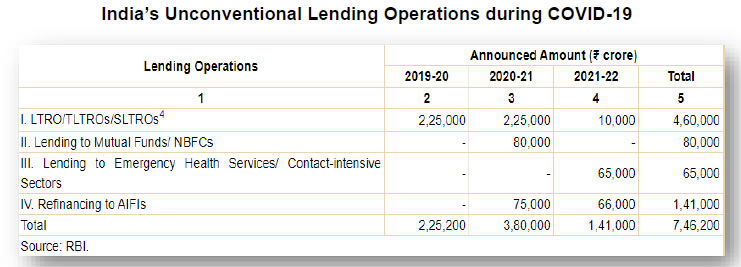 (ii) Asset Purchase Programme (APP): Unlike many central banks, the Reserve Bank’s purchases have been confined to the secondary market and solely in government securities. An innovation was the inclusion of state government securities in October 2020 as a special case for 2020-21. In the backdrop of the Federal Reserve’s experience on Operation Twists (OTs), the Reserve Bank announced special OMOs (OTs) involving the simultaneous purchase of long-term and sale of short-term securities in December 2019, predating the COVID-19 outbreak in India. These operations were aimed at compressing the term premium and reducing the steepness of the yield curve. Moderation in long term risk-free (g-sec) rates, in turn, gets reflected in other financial market instruments that are priced off the g-sec rate, thereby improving monetary transmission. The success of OTs combined with liquidity injection through outright OMOs moderated yields and reduced the cost of borrowing for the Government. With a view to improving monetary policy transmission and enabling a stable and orderly evolution of the yield curve, the Reserve Bank implemented a secondary market G-sec acquisition programme (G-SAP) in April-September 2021. Under the G-SAP, the Reserve Bank provided an upfront commitment on the size of G-sec purchases. The G-SAP allayed market fears and indicated Reserve Bank’s continued support to the market in the face of an enlarged market borrowing programme. Like the regular OMOs, G-SAP was confined to the purchase of government papers from the secondary market. (iii) Forward Guidance (FG): In the aftermath of the pandemic, FG gained prominence in the Reserve Bank’s communication strategy to support the accommodative stance of the monetary policy committee (MPC). The MPC’s reiteration that the policy stance would remain accommodative till the revival of growth epitomizes explicit time-contingent and state-contingent FG. For instance, the MPC noted in October 2020 “…. decided to continue with the accommodative stance as long as necessary – at least during the current financial year and into the next financial year – to revive growth on a durable basis and mitigate the impact of COVID-19 on the economy, while ensuring that inflation remains within the target going forward” (RBI, 2020b). Moreover, the Governor assured financial markets that the Reserve Bank will maintain comfortable liquidity conditions in sync with the monetary policy stance and highlighted the need for cooperative solutions by emphasising that financial market stability and the orderly evolution of the yield curve are public goods (RBI, 2020c). The commitment to ensure congenial financial conditions for sustaining the recovery dispelled illiquidity fears and bolstered market sentiment. The Reserve Bank’s liquidity management operations in support of the stance convinced market participants to respond synchronously and cooperatively, which bears testimony to the effectiveness of FG in monetary policy communication. Thus, FG complemented other UMPT measures in the post-COVID environment. Monetary Policy Transmission Monetary transmission is the process through which monetary policy impulses in the form of policy rate changes by a central bank are transmitted to the entire spectrum of interest rates such as money market rates, bond yields, bank deposit and lending rates and asset prices such as stock prices and house prices. Various economic agents such as households, firms and the government respond to these interest rate changes by adjusting their spending behaviour. This alters aggregate demand of households and firms and by aligning it with aggregate supply conditions, the broader macroeconomic policy objectives such as price stability and sustainable growth of the economy are achieved. The whole process takes months, sometimes, more than a year. The empirical evidence for India suggests that monetary policy actions are felt with a lag of 2-3 quarters on output and with a lag of 3-4 quarters on inflation, and the impact persists for 8-12 quarters. Transmission takes place through various ‘channels’, namely (i) interest rate channel, (ii) credit channel, (iii) exchange rate channel, (iv) asset price channel, and (v) expectations channel, which plays an important role in a market-based monetary policy framework such as FIT. According to many studies, the interest rate channel has been found to be the strongest in India. The efficacy of monetary policy depends on the magnitude and the speed with which policy rate changes are transmitted to the ultimate objectives of monetary policy, viz., growth and inflation. In a bank dominated system like India, the transmission to banks’ lending rates is the key to the successful implementation of monetary policy. Hence, it has been the endeavor of the Reserve Bank to strengthen the monetary transmission by focusing on the design of the lending interest rates of the banking system. However, the issue of transmission from the policy rate to banks’ lending rates has all along been a matter of concern. The transmission to banks’ lending rates has been impeded by a variety of factors and thus the impact of policy change on economic activity and inflation remained muted (Mitra and Chattopadhyay, 2020). To address this concern, the Reserve Bank has refined the interest rate setting methodology of banks from time to time. Effective October 1, 2019, in pursuance of the recommendations of the Internal Study Group (RBI, 2017), the Reserve Bank, mandated that all scheduled commercial banks (excluding regional rural banks) should link all new floating rate personal or retail loans and floating rate loans to Micro and Small Enterprises (MSEs) to the policy repo rate or 3-month T-bill rate or 6-month T-bill rate or any other benchmark market interest rate published by Financial Benchmarks India Private Ltd. (FBIL). With a view to further strengthening monetary transmission, the Reserve Bank directed banks to link their pricing of loans for the medium enterprises also to an external benchmark effective April 1, 2020. Under this benchmarking system, banks are free to choose the spread over the benchmark rate, subject to the condition that the credit risk premium may undergo change only when the borrower’s credit assessment undergoes a substantial change, as agreed upon in the loan contract. External benchmarks are transparent as they are available in the public domain and hence easily accessible to the borrowers. Subsequent to the introduction of an external benchmark system, monetary transmission has improved in the sectors where new floating rate loans have been linked to the external benchmark. Chapter 4: Market Operations The objective, framework and implementation of the market operations of the RBI are discussed in this Chapter, which is divided into two sections. The first section deals with Monetary Policy Operations and the second section deals with the Foreign Exchange Operations of RBI. I. Monetary Policy Operations The objective of monetary policy operations is to enable the transmission of monetary policy to the financial system. The MPC determines the policy interest rate, and the policy stance to achieve the inflation target. The operating target of monetary policy is the weighted average call rate (WACR), which is a volume weighted rate of overnight transactions undertaken in Call money market (uncollateralized segment of the money market with banks and primary dealers as participants). By conducting market operations as per the liquidity management framework designed by it, the RBI endeavors to ensure that the operating target, i.e., the WACR is aligned to policy rate on a daily basis. Liquidity is of paramount importance for a well-functioning and sound financial system. Central bank liquidity refers to reserves provided by a central bank to the banking system. It is the key instrument for monetary policy implementation process and the focal point for liquidity management operations is the banking system liquidity or system liquidity. Banks are required to maintain a mandated level of balances in their accounts with the central bank. These balances are referred to as required reserves. Generally, banks would borrow funds from the central bank to meet their reserve requirement if it cannot be met from the inter-bank market and vice-versa, i.e., deposit the excess over the reserve requirement with the central bank. The liquidity management framework of RBI comprises of Liquidity Adjustment Facility (LAF) for management of transient liquidity, i.e., liquidity surplus or deficit of temporary nature. System Liquidity The focal point for liquidity management operations is the liquidity in banking system known as system liquidity. On a given day, if the banking system is a net borrower from the Reserve Bank, the system liquidity is said to be in deficit (i.e., system demand for borrowed reserves is positive) and if the banking system is a net lender to the Reserve Bank, the system liquidity is said to be in surplus (i.e., system demand for borrowed reserves is negative). In practice, banks maintain a slightly positive margin (excess reserve) over required reserves on a daily basis to meet unanticipated settlement obligations (or precautionary demand for reserves), that needs to be reckoned to arrive at the quantum of liquidity available to the banking system on a given day. Thus, banking system liquidity can be summarised as under: System liquidity = Net borrowing from RBI - Excess reserves maintained by banks…...(1) Net borrowing from RBI = Total of all Repo/MSF/SLF borrowings – Total of all Reverse-repo deposits Excess reserves maintained by banks = Actual reserves maintained by banks – Required reserve Note: A positive figure for equation (1) would indicate that system liquidity is in deficit whereas a negative figure would indicate surplus liquidity. Transient and Durable liquidity System liquidity or demand for reserves can be differentiated depending upon whether the source of demand is transient/frictional or durable. Transient/frictional liquidity refers to the liquidity condition which could reverse course overnight, or over a short period of time. Government cash balances, which are held with the Reserve Bank, are a major source of transient/frictional demand for reserves. Durable liquidity or permanent demand for reserves arises from permanent or long-term changes in the liabilities of the Reserve Bank viz., expansion/contraction in currency in circulation (CiC) and decrease/increase of banking system reserves due to unsterilised Fx intervention operations. An easier derivation of durable liquidity is by adjusting the Government of India (GOI) balance from system liquidity. Thus, if the net borrowing by the banking system from the Reserve Bank is higher than the GOI balance, it indicates that durable liquidity is in deficit and vice-versa. Liquidity Management Framework of RBI Liquidity Adjustment Facility (LAF) is one of the instruments for liquidity management used by RBI to injects/absorb transient liquidity (liquidity surplus or deficit of temporary nature which is short term) into/from the banking system. It consists of overnight as well as term repo/reverse repos (fixed as well as variable rates), Standing Deposit Facility (SDF) and Marginal Standing Facility (MSF). For managing liquidity of enduring/durable nature, instruments like Long Term Repo/Reverse Repo Operations (LTROs/LTRROs), Open Market Operations (OMOs) by outright purchase and sale of government securities, changes in required Cash Reserve Ratio (CRR), Market Stabilisation Scheme (MSS), USD/INR swaps auctions (Forex Swap Auctions) are used. The CRR is a direct instrument which immediately impacts the system liquidity. If CRR is increased, banks must maintain higher balances in their current account with RBI, thereby reducing liquidity in the banking system. Similarly decrease in CRR has the immediate impact of injecting liquidity in the banking system. Other instruments of liquidity management are detailed in the ensuing paragraphs. An Internal Working Group of RBI reviewed the liquidity management framework and published its report in September 2019. The Group continued with the existing objectives of maintaining the call money rate close and consistent to the policy rate and not undermining the price discovery in the inter-bank money market and recommended continuance of a corridor system with the call money rate as the target rate but with greater flexibility in deciding about the appropriate level of liquidity deficit or surplus in the banking system based on financial conditions. Other recommendations included minimizing the number of operations for greater efficiency, discontinuance of assured liquidity of up to 1% of NDTL, inclusion of longer-term repo operations in addition to existing tools for durable liquidity management and dissemination of more information on liquidity management. Based on the recommendations made by the Group, RBI updated its Liquidity Management Framework as tabulated below. | Sl. No. | Instrument | Quantum | Periodicity / Timing | | A. Instruments under LAF framework to manage short-term/transient liquidity | | 1. | 14-day variable-rate repo/ reverse repo auction
(Main operation) | Auction amount is decided by RBI and a single auction (either repo or reverse repo) is conducted based on the assessment of liquidity conditions by RBI. | On reporting Friday (If reporting Friday is a holiday, the auction is conducted on the preceding working day in Mumbai) | | 2. | Variable Rate Term Repo/ Reverse Repo auction (Tenor: overnight and up to 13 days)
(Fine-tuning operations) | The auction amount is decided by RBI based on an assessment of the liquidity conditions. | Discretionary | | 3. | Standing Deposit Facility (SDF) (Tenor: Overnight. However, the RBI retains the flexibility to absorb liquidity for longer tenors under the SDF with appropriate pricing, as and when the need arises.) | No restriction on amount. | Daily between 05:30 p.m. and 11:59 p.m. | | 4. | Marginal Standing Facility (MSF) | Individual banks can draw funds up to Excess SLR + 2 per cent below SLR. | | 5. | FX Swaps | The amount is decided by RBI, based on the assessment of the liquidity conditions. | Discretionary | | 6. | Fixed Rate Reverse Repo | At the discretion of the RBI for purposes specified from time to time. | | B. Instruments to manage durable liquidity | | 7. | Long Term Variable Rate Repo Operation (LTRO)
Tenor: beyond 14 days | The auction amount is decided by RBI, based on an assessment of the liquidity conditions. | Discretionary | | 8. | Long Term Variable Rate Reverse Repo Operation (LTRRO)
Tenor: beyond 14 days | | 9. | FX Swap Auctions | The auction amount is decided by RBI, based on an assessment of the liquidity conditions. | Discretionary | | 10. | Open Market Operations (OMOs) | The amount will be decided by the RBI, based on assessment of the liquidity conditions. | Discretionary | SDF was operationalized in April 2022. With effect from December 30, 2023, RBI has allowed the reversal of liquidity facilities under both SDF and MSF even during weekends and holidays to facilitate better fund management by the banks. Key features of repo/reverse repo/MSF conducted under LAF are summarised below: Discretion with RBI While the main operation is a 14-day variable rate repo or reverse repo (depending upon the prevailing liquidity conditions) at the start of the reporting fortnight under the revised liquidity framework, RBI has the discretion to conduct overnight/ longer term, repo/ reverse repo auctions at variable rates depending on market conditions and other relevant factors. For using this discretion, RBI considers its assessment of the prevailing liquidity conditions based on available data and forecast of liquidity. The details of this mechanism are elaborated later in this chapter. Rate of interest The rate of interest applicable for repo is the policy rate decided by the MPC from time to time. The reverse repo rates and the MSF rates are linked to the policy rate and are decided by RBI from time to time. For variable-rate repo and reverse repo auctions, the applicable rate of interest will be the cut-off as decided by RBI, based on the bids/offers received. Securities eligible as collateral SLR-eligible and unencumbered Government of India dated securities (including oil bonds)/Treasury Bills and State Government Securities (rated and unrated) are considered as eligible securities for repo/ MSF and reverse repo operations. The market value of securities on the day of operation (based on the previous day’s market valuations published by Financial Benchmark India Ltd. (FBIL)) is reckoned to calculate collateral requirement for repo/MSF operations/Reverse repo operations. The RBI also has the option to revalue securities held as collateral at pre- determined intervals as is currently done for LTROs & TLTROs to ensure that lending remains adequately collateralised. Margin Requirement A margin is applied in respect of the eligible securities, which effectively ensures that the borrower using the repo or MSF window to borrow Rupee funds provides extra collateral. For example, if the margin is 5 percent and the market participant is borrowing ₹100 crore from repo window, he would have to provide ₹105 crore worth of eligible securities There is no margin requirement for collateral provided by the RBI under reverse repo operations. Mechanics of operations • The bid/offer is submitted electronically in the Core Banking System (e- Kuber) of RBI by the members within the stipulated time. Settlement of MSF/SDF transactions is automatic and immediate after the placement of the bid/offer in the CBS. • In order to provide eligible LAF participants greater flexibility in managing their end of the day CRR balances, the Reserve Bank provides an optional automated sweep-in and sweep-out (ASISO) facility in its e-Kuber system. Accordingly, banks are able to set the amount (specific or range) that they wish to keep as balances in their current accounts with the Reserve Bank at the end of the day. Depending upon this pre-set amount, MSF and SDF bids, as the case may be, are generated automatically without any manual intervention at the end of the day. This facility is optional and is in addition to the existing mechanism of placing manual bids in the SDF and MSF windows through the e-Kuber portal. • For variable rate operations, settlement is done after announcement of results of the auction. Results of the operations are announced through Press Release on RBI website. Decision regarding cut-off for Variable-Rate auctions • Variable-rate repo: There is no restriction on the number of bids by banks. Banks can bid up to the notified amount. Once the bidding time is over, all the bids are arranged in descending order of the quoted rates and the cut-off rate is arrived corresponding to the notified amount of the auction. Successful bidders are those who have placed their bids at or above the cut-off rate. If there is more than one successful bid at the cut-off rate, then pro-rata allotment is done. No bids are accepted at or below the prevailing repo rate. • Variable-rate reverse repo: The mechanics of a variable-rate reverse-repo auction is opposite of the mechanics for repo auctions. In this case, no offers at or above the prevailing repo rate are accepted. How does the LAF corridor work? To ensure that the WACR does not deviate too much from the policy repo rate, a corridor system with the SDF rate as floor and MSF rate as ceiling is maintained. By accessing the MSF window, banks can borrow Rupee funds from RBI by providing acceptable securities as collateral. By accessing the SDF window banks can place Rupee funds with RBI without any need for RBI to place any collateral. The important point to note here is that both MSF and SDF rates are linked to the policy repo rate set by the MPC with MSF rate being upper bound of the corridor and SDF rate being the lower bound of the corridor. The RBI has the discretion to decide the width of the corridor. For the current policy rates please refer to the RBI website. Banks can also borrow and lend Rupee funds from other market participants in the money market. Therefore, before availing the RBI facility, banks would consider the available options for borrowing and lending in other segments of the money market such as call money, tri-party repo6, market repo, etc. An important factor, which influences the decision of the individual banks to borrow or lend short term funds from/to RBI or other segments of the money market would be the interest rate. While banks also consider various aspects such as the requirement of collateral securities, ease of operations, availability, tenor, etc., interest rate level is the most important factor which enables alignment of WACR with the policy repo rate. Let us understand this with an example. XYZ bank needs to lend its surplus funds. The bank would try to lend to other participants in money market. In a situation of system level liquidity surplus (more lenders than borrowers), the rate in the money market will fall. However, given that banks have the option of deploying their excess funds in the RBI’s Standing Deposit Facility without any limit, the SDF rate sets a floor to the interbank rates as a bank will not lend it to another market participant at a rate below the SDF rate. Similarly, let us suppose XYZ bank needs to borrow overnight Rupee funds. The bank would try to borrow from other participants in money market. In a situation of system level liquidity deficit (more borrowers than lenders), the rates could increase in the market. However, given that banks have the option of borrowing funds under MSF window of RBI, the MSF rate sets the ceiling as banks typically would not borrow from other market participants at a rate higher than the MSF rate. However, the amount of borrowing from MSF window is restricted by the availability of free collateral securities with the bank i.e., eligible securities held in excess of SLR requirements plus allowance given to banks to let their SLR holdings fall below the statutory requirement to the extent permitted by RBI. Therefore, in a scenario of huge system level liquidity deficit, it is possible that the money market rates can breach the ceiling and go beyond the MSF rate. However, such a scenario is only expected in extraordinary circumstances. A narrow corridor limits the possibility of huge deviations of the money market rates from the policy Repo rate and helps in anchoring the WACR to the policy repo rate, while a wider corridor allows greater room for rates to fluctuate and incentivises market development. How is the WACR aligned to the policy repo rate? In periods of huge surplus liquidity, the call rates will trend towards lower bound of the LAF corridor, the SDF rate. Similarly, in periods of huge liquidity deficit, the call rates will be biased towards the upper bound, i.e., MSF rate. To ensure that the WACR is anchored to the repo rate, besides the 14-day main operation RBI uses fine tuning operations, i.e., the discretionary variable-rate repo and reverse repo auctions. The amount and timing is decided by RBI depending upon its assessment of the liquidity conditions. RBI also continuously monitors the money market rates during the market hours and conducts fine-tuning operations, as and when needed, to achieve the objective of keeping the WACR close to the policy rate. For example, if the WACR is close to the SDF rate, it means that there is surplus in the system liquidity. Let us assume that liquidity estimation including feedback from the market participants suggests that about ₹50,000 crore has come into the system due to unanticipated government spending. In such a scenario, the announcement of an additional variable rate reverse repo auction for sufficient amount, will help in supporting the market rates and pushing them higher, bringing it closer to the policy repo rate. Similarly, in a situation of a large deficit in the system, when the WACR is trending towards the MSF Rate, an announcement of an additional variable-rate- repo auction for sufficient amount will pull the WACR lower and align it with the repo rate. To ascertain the amount, tenor and timing of operations, the assessment of the system-level liquidity on an ongoing basis is very important. How is the System level liquidity assessed by RBI? The important factors considered for assessment of the system level liquidity can be classified into known factors and unknown factors. On a day-to-day basis, information about the amount and impact of known factors is readily available with certainty. Some examples of known factors are reversal of outstanding RBI operations under LAF, settlement of OMOs, settlement of forex operations of RBI, government bond redemptions, coupon payments, primary auctions, etc. Information about the amount and impact of unknown factors is not readily available and it needs to be assessed or forecasted. Some examples of unknown factors are the extent of banks maintenance of reserves on any given day, changes in currency in circulation and exact amount of inflows / outflows from the Central Government accounts etc. Forecasting, therefore, relies on past data as well as information gathered from informal communications with government/banks. For arriving at the net impact on system liquidity, both known and unknown factors must be considered. The liquidity management framework in India stands on two broad mutually reinforcing pillars of forward-looking assessment7. • Pillar-I is an assessment of the likely evolution of system-level liquidity demand based on near-term (four to six weeks) projections of autonomous drivers of liquidity. The core of Pillar I is near-term forecasts of autonomous drivers of liquidity, particularly demand for currency (which reflects behaviour of households), demand for excess reserves (which reflects behaviour of the banking system), and the central government's balances with the RBI (which depends on cash flows of the Government). For liquidity management, forex market intervention is also an autonomous driver of liquidity, but since there cannot be any near- term forecasts for these interventions, they are considered as and when the information is available. Using a combination of forward-looking information and a backward-looking assessment of the time series evolution of the determinants of liquidity, projections are generated on a regular basis to inform the RBI's decisions on discretionary liquidity management. • Pillar-II is an assessment of system-level liquidity over a relatively longer time horizon, focusing on the likely growth in broad money, bank credit and deposits, the corresponding order of base money expansion and this assessment is then juxtaposed with a breakdown into autonomous and discretionary drivers of liquidity derived under Pillar I. Thus, Pillar II becomes the broader information set within which decisions relating to discretionary liquidity management measures are taken based on Pillar I assessment. How is the decision regarding discretionary liquidity management operations made by RBI? The RBI's discretionary liquidity management operations (primarily in the form of variable- rate repos/reverse repos and OMOs) are guided by the prevailing stance of the monetary policy committee and the extent of system liquidity surplus / deficit that is ‘reasonable’ at any point of time.), and the assessment of the nature of deficit/surplus, i.e., whether it is transient or durable. For managing liquidity of transient nature, LAF operations are used. However, for managing the liquidity condition of enduring or persistent nature, instruments like LTROs, OMOs, MSS & CRR are used. MSS is used in situations when use of OMOs may not be desirable and/or RBI's own portfolio of securities is not adequate to absorb the surplus system liquidity. The mechanics is explained in the MSS subsection in later paragraph. How to determine whether the liquidity condition is enduring or not? Persistent high levels of outstanding RBI Repos or Reverse Repos indicate that the deficit/surplus is of an enduring nature. As mentioned earlier, Durable liquidity or permanent demand for reserves arises from permanent or long-term changes in the liabilities of the Reserve Bank viz., expansion/contraction in currency in circulation, unsterilised Fx intervention operations and decrease/increase of banking system reserves due to changes in net demand and time liabilities of the banking system (NDTL). However, reversible changes in demand/supply of reserves arising from frictional factors such as tax outflows or government expenditure generate temporary mismatches in the banking system liquidity. For example, if the government balances have come down from positive balance of ₹10,000 crore to around Nil, then this would increase the banking system surplus by that amount till such amount flows back to government account in the form of tax collections and other revenues. Similar kind of impact can be observed for the deficit also. Considering all the factors, RBI decides on the nature of the liquidity surplus or deficit and, accordingly, the appropriate instruments are used. How to manage durable liquidity? Traditionally, OMO and MSS operations are used to deal with durable liquidity. The mechanics of these operations are given in following paragraphs. However, recently, the RBI has augmented its liquidity management toolkit to meet the durable liquidity needs of the system through inclusion of long-term foreign exchange Buy/Sell USDINR swap auctions and introduction of Long-Term Repo Operations (LTROs)/Targeted Long Term Repo Operations (TLTROs). The first such Buy/Sell swap auction was conducted for USD 5 billion for a tenor of 3 years on March 26, 2019. LTROs were introduced in February 2020 to augment the liquidity management toolkit. The mechanism of LTROs is similar to repos but they are of longer duration from one to three years. Mechanics of OMO operations An OMO sale of government securities by the Reserve Bank has the impact of reducing the system liquidity. An OMO purchase of government securities, on the other hand, has the impact of increasing the system liquidity. OMOs are conducted by RBI through auction mechanism or by directly undertaking transactions in the secondary market. Such direct secondary market transactions are undertaken on NDS-OM (Negotiated Dealing System – Order Matching) platform which is an anonymous order matching platform for Government securities. The data on total amount of OMO purchase or sale transactions by the RBI in the secondary market is published weekly, though, with a lag of one week. For conducting OMO through auction mechanism, announcement is made by RBI through press releases giving details of the amount, date and time of auction and the choice of securities. On the day of auction, after the cut-off time for bidding, the bids are processed and the OMO auction committee in RBI decides on the cut-off yield. The decision is announced by way of press release. The frequency of auctions is generally not pre-determined or pre-announced, unlike the primary auctions conducted as part of Government's market borrowing programme. It depends on the evolving liquidity conditions. One important issue regarding OMOs is the impact on G-Sec yields. Announcement regarding OMO sales may have a hardening impact on yield due to higher supply of securities in the system. The selection of securities for OMO auction is an important factor in the success of the auction. The cut-off yield of the OMO auctions are keenly watched by the markets as it may indicate RBI's comfort levels for the yields. Recently, the RBI has conducted special OMOs involving simultaneous sale and purchase of Government securities, also known as ‘Operation Twist’. These operations are liquidity neutral at the inception and can be used to have a desired impact on the long-term and short-term interest rates without altering the liquidity conditions. Mechanics of MSS operations Market Stabilisation Scheme (MSS) is another tool used by the RBI to manage the surplus liquidity in the system. MSS was used in periods when large capital inflows had necessitated RBI intervention in the forex market to contain volatility. The purchase of significant amount of dollars and consequent increase in liquidity required sterilisation operations to prevent inflationary effects of the excessive capital flows. Also, post demonetization, MSS had been used to deal with huge surplus liquidity condition resulting from increase in deposits by public with the banks. To conduct OMO sales and reverse repos, the RBI needs sufficient government securities. As OMO sales and Reverse Repos can only be conducted to the extent of such securities being available with RBI8, the MSS comes handy in a situation where OMO sales are not desirable or the available quantum of government securities with RBI is inadequate to handle the liquidity surplus in the system. Under MSS, Government securities (including Cash Management Bills (CMB), T- Bills and Dated Securities) are auctioned. Unlike normal market borrowing by the government, the amount raised under MSS is kept in a sequestered account and not available for spending by the Government. This is essential as government spending would have resulted in rupee liquidity again getting transferred back to the banking system, thereby defeating the purpose for which the instrument was used. In consultation with RBI, the government decides the ceiling and the threshold limit of MSS for each financial year. After receiving confirmation from the government, the RBI issues a press release with information regarding the ceiling for gross issuances and the threshold amount. Once the gross issuances under MSS reach the threshold limit, or there is an additional requirement, the RBI informs the government of the same, which reviews and advises the revised ceiling and threshold limit. The choice of securities under MSS depends, inter alia, on the estimate regarding the nature of the surplus liquidity conditions. If the surplus is forecasted to linger for a much longer duration, then government securities of longer tenor would be issued, while if the surplus is forecasted to be for a shorter tenor, T-Bills or CMBs would be issued. Press release for conducting the auction is issued by the RBI. During the auction window, the market participants can place their bids electronically in the core banking system of RBI. Like auction of other government securities, an internal auction committee decides the cut-off and the same is communicated by way of press release. The effectiveness of the RBI's operations in the money markets is regularly analysed and published in the bi-annual Monetary Policy Report (MPR), MPC statements and the annual report. The operating framework and its components have also been fine-tuned and revised to support the financial markets, monetary conditions and to fulfil the needs of a modern economy while ensuring consistency with the monetary policy stance. Regular efforts have also been taken to improve the accuracy of forecasting through improved market intelligence for effective liquidity management. Special operations Conducting special operations in money markets is necessitated for financial stability considerations and in view of RBI’s role as lender of last resort. Select special operations are mentioned below: • From October 2008 to October 2009, RBI had conducted special repo auctions with a view to enabling banks to meet the liquidity requirements of Mutual Funds (MFs), Non-Banking Financial Companies (NBFCs) and Housing Finance Companies (HFCs). • In April 2020, to deal with liquidity strains on mutual funds (MFs) in the wake of redemption pressures related to closure of some debt MFs and potential contagious effects because of COVID-19 related disruptions, RBI announced a ₹50,000 crore Special Liquidity Facility for Mutual Funds (SLF-MF). Under this scheme, RBI conducted repo operations of 90 days tenor at the fixed repo rate. The SLF-MF was on-tap and open-ended. Funds availed under the SLF-MF had to be used by banks exclusively for meeting the liquidity requirements of MFs by (1) extending loans, and (2) undertaking outright purchase of and/or repos against the collateral of investment grade corporate bonds, commercial papers (CPs), debentures and certificates of Deposit (CDs) held by MFs. • TLTROs (Targeted LTROs), a variant of the LTROs, were introduced in March 2020 to provide longer duration money to specific sectors/instruments. Liquidity availed by banks under TLTROs had to be deployed in investment grade corporate bonds, commercial paper, and non-convertible debentures in both primary and secondary markets. In April 2020, RBI announced a Targeted Long-Term Repo Operations 2.0 (TLTRO 2.0) to channel liquidity to small and mid-sized corporates, including non-banking financial companies (NBFCs) and micro finance institutions (MFIs) that had been impacted by COVID-19 disruptions. The funds availed under TLTRO 2.0 had to be deployed in investment grade bonds, commercial paper (CPs) and non-convertible debentures (NCDs) of Non-Banking Financial Companies (NBFCs). At least 50 percent of the total funds availed had to be apportioned as given below: -
10 per cent in securities/instruments issued by Micro Finance Institutions (MFIs); -
15 per cent in securities/instruments issued by NBFCs with asset size of ₹500 crore and below; and -
25 per cent in securities/instruments issued by NBFCs with assets size between ₹500 crore and ₹5,000 crore. • In 2021, to provide further liquidity support to the pandemic-impacted sectors, first, an on-tap liquidity window of ₹50,000 crore was opened in May 2021 – initially available till end-March 2022 but later extended up to end-June 2022 – with tenors of up to three years at the repo rate to boost provision of immediate liquidity for ramping up COVID-19 related healthcare infrastructure and services in the country. Second, the Reserve Bank announced a special three-year long-term repo operation (SLTRO) of ₹10,000 crore at the repo rate for the small finance banks (SFBs) in May 2021 to provide further support to small business units, micro and small industries, and other unorganised sector entities. Third, a liquidity window of ₹15,000 crore was opened in June 2021 (initially available till end-March 2022 but later extended up to end-June 2022), with tenors of up to three years at the repo rate to alleviate stress in contact-intensive sectors. Finally, to ensure continued flow of credit to the real economy, the Reserve Bank announced additional liquidity support of ₹66,000 crore for fresh lending during April and June 2021 to select AIFIs. Communication and disclosures For better dissemination of information on liquidity management operations, the Reserve Bank published a daily Press Release detailing the Money Market operations (MMO) to show both the daily flow impact as well as the stock impact of the Reserve Bank’s liquidity operations. Further, a quantitative assessment of durable liquidity conditions of the banking system is published on a fortnightly basis with a fortnightly lag. II. Foreign Exchange Operations of India Objective9 The Rupee exchange rate is determined by the forces of market demand and supply. The objective and purpose of exchange rate management is to ensure that economic fundamentals are reflected in the external value of the rupee. Subject to this general objective, the conduct of exchange rate policy is guided by three major objectives: first, to reduce excess volatility in exchange rates, while ensuring that the market functions in an orderly fashion, and second, to help maintain an adequate level of foreign exchange reserves. To ensure orderly conditions, RBI closely monitors the developments in the financial markets at home and abroad. Due to India's significant reliance on capital flows, which can be often large and lumpy and are subject to sudden stops and reversals, bulk demand for oil imports and bunching up of government payments, the forex market becomes susceptible to bouts of volatility. Of- late, geopolitical events of significant nature such as trade war fears, tensions in the middle- east and severe exogenous shocks (e.g., volatility in markets caused by Covid-19 in the year 2020) have caused disruptions in the global and domestic forex markets. The sharp growth in the offshore trading volumes in the Rupee NDF market in recent years, likely even exceeding the volumes in the onshore markets, is increasingly contributing to the price discovery in onshore market. An important aspect of the policy response in India to the various episodes of volatility has been market intervention combined with monetary and administrative measures to address concerns around excessive volatility, while complementary or parallel recourse has been taken by way of communications through speeches and press releases. Based on the preparedness and maturity of the foreign exchange market and India's position on the external front (in terms of reserves, debt, current account deficit, etc.), reform measures have been progressively undertaken to put in place a liberalized exchange system for current and capital account transactions with a view to further develop the foreign exchange market. While regulatory measures may produce the desired outcomes with a lag, RBI’s forex intervention has the immediate impact on the prevailing demand and supply of foreign currency in the market. With the objective of curbing volatility in exchange rate, RBI conducts sales or purchases of foreign currency in the forex market, to contain the excessive volatility and/or to smoothen out lumpy outflows/inflows. Such sales and purchases are not governed by a predetermined target or band around the exchange rate. Impact of RBI's intervention RBI's intervention helps in curbing excessive volatility of the USDINR currency pair. For example, consider a scenario of huge capital inflows causing spurt in volatility in dollar-rupee movement with sharp appreciating pressure on Rupee vis-à-vis dollar. Such flows lead to appreciation of Rupee because of increase in supply of dollars in the forex market as foreign investors sell dollars to invest in Rupee bonds and equity shares. However, most times, the price adjustment is not smooth. It rather gyrates up and down. In such a scenario, RBI intervention through buying dollars neutralises the impact of temporary oversupply of dollars. But the amount of dollars purchased by RBI intervention does not have a one-to-one relationship with the dollar oversupply. The very hint of RBI intervention impacts the market sentiments, altering the market dynamics and aids smoothening of price action. For example, if Rupee is appreciating sharply against the dollar, the participants (e.g., importers) who are looking for opportunity to buy dollars at the best possible price would like to wait to benefit by buying dollars at lower price. If such an importer anticipates reversal in Rupee appreciation, then he would immediately like to buy the dollars in the market at current price. Similarly, the Authorised Dealers10 (ADs) can undertake proprietary positions within approved limits. The AD banks also take position by buying and selling dollars to benefit from the price movement. Because the AD banks have superior information about supply and demand of foreign currency in the market, they swiftly change their position from dollar overbought to oversold position in foreign currency and vice-versa. Thus, RBI's intervention influences the market participants' behaviour, thereby impacting the short- term supply and demand of dollars in the domestic forex market and bringing stability in the market. Similarly, to deal with increased volatility during episodes of huge capital outflows with depreciating pressure on Rupee, RBI sells dollars in the market. This causes the supply of dollars to go up, thereby stemming the depreciation of Rupee against the dollar. The market sentiments and behaviour of the market participants are impacted, which ultimately lead to stability in the market. One important aspect of RBI intervention in FX market is that it has a concurrent and commensurate impact on rupee liquidity conditions. If RBI sells foreign currency, it receives INR from the market participants and thus the banking system liquidity reduces to that extent. Similarly, when RBI purchases foreign currency in the forex market, the INR liquidity goes up in the banking system. To mitigate this impact of forex intervention on the INR liquidity, the RBI undertakes offsetting transaction via its liquidity management tools. This process is known as ‘sterlisation’ and such forex intervention sometimes is referred as ‘sterlised intervention.’ However, there need not be one to one relationship between both. Instruments used by RBI for forex intervention RBI intervenes in the spot, forwards, swaps and futures market. Rupee exchange rate is determined from transactions in the spot market (T+2 settlement). Rates for forex forwards (other than spot) are derived from a combination of spot and swap transactions. The forward transactions impact both spot rate and forward premiums, whereas swaps only impact the forward premiums. The spot, forwards and swaps are traded in the over the counter (OTC) market. One important factor for operating in the forward market is that it provides maneuverability to RBI to modulate the domestic rupee liquidity conditions in consonance with the prevailing monetary policy stance. For example, when RBI purchases foreign currency from the forex market and wants to postpone the injection of INR liquidity due to its forex operation, it can undertake a sell/buy swap to postpone the delivery of foreign currency to a future date thereby shifting the impact on INR liquidity to a future date. Currency futures are traded on authorised exchanges such as NSE, BSE, etc., and are a part of the exchange traded segment of the forex market. In India, An important difference between the OTC and exchange traded segment is that, while the transactions in the OTC segment are delivery based (both rupee and dollar legs are settled on due dates), transactions on the ETCD (Exchange Traded Currency Derivative) segment are cash settled in Rupee terms with only the profit or loss converted into Rupee terms being settled on due date. Another important advantage of using the ETCD market is that it does not alter the level of forex reserves, as only net amount in Rupee terms is settled and there is no requirement of delivering or taking delivery of dollars. The market operations can be undertaken either directly or through select agency banks, though the general preference is for indirect intervention through selected banks. Both approaches have merits and drawbacks. But the indirect approach has the advantage of maintaining confidentiality of the intervention operations, thereby enhancing their effectiveness11. The data regarding RBI's forex intervention operations is published with some lag in the RBI Monthly Bulletin and the Special Data Dissemination Standards of the International Monetary Fund (both are available on RBI website). Why excessive volatility is bad in forex market? Exchange rate volatility represents the movement in exchange rate over time. The larger the magnitude of its change, or the more quickly it changes over time, the more volatile it is. Standard deviation is a popular measure to determine volatility. Historical standard deviation is a backward-looking measure of volatility, while implied volatility can be derived from options traded in the derivative market. Market players use several other models for forecasting volatility such as ARCH (Auto Regressive Conditional Heteroskedasticity), Generalized Auto Regressive Conditional Heteroskedasticity (GARCH), etc. Volatile exchange rates make international trade and investment decisions more difficult as it increases risks. Exchange rate risk refers to the potential to lose money because of a change in the exchange rate. Some illustrations of how traders and investors may lose money when the exchange rate changes sharply are as follows. Illustration 1: Let us consider that an Indian garment manufacturer had received an order to export 1000 pieces of a particular type of garment to a retailer in USA at 10 dollar per item. The cost of the garment was ₹800 per item for the exporter, and the dollar-rupee was trading at ₹85 per dollar. Accordingly, the exporter was expecting to make a profit of ₹50 per item. Suppose the shipment is expected to occur in 3 months' time and that the payment for the shipment need not be made until that time. Three months have elapsed and 10,000 dollars are received in lieu of shipment of the garments. Now, at the end of this three-month period, suppose Rupee rate has fallen to ₹80 per dollar. On conversion at this rate, Rupee amount comes to only ₹800 per item. This amount is less than the originally expected amount of ₹850 per item. Therefore, the movement in exchange rate has led to a loss of ₹50 per item worth of expected profit. This is an example of the risk an exporter faces due to change in the currency value. Illustration 2: Let us consider another example in which an Indian corporate had borrowed one- million-dollar last year from an overseas bank in USA for a one-year period to take advantage of the lower interest rate prevailing abroad at the dollar-rupee exchange rate of ₹85 per dollar. Consider that the one-year cost of borrowing in USA was 3% for that borrower, while the borrowing rate in India was 10%. The Indian corporate had converted the dollar proceeds to ₹85,000,000 and used the same in his business. The investor did not hedge the currency risk. The dollar unexpectedly appreciated against the Rupee and at the time of repayment it was trading at ₹90 per dollar. So, to refund the borrowed amount with interest, the Indian corporate needs to buy 1.03 million dollars by spending ₹92,700,000 which translates into borrowing costs higher than the rate if he had borrowed in India. On the flip side, favourable currency movements in both the examples cited, would have led to gains. In the first example, had the rupee value changed to ₹90, the shipment value would have increased in Rupee terms, generating a profit of ₹100 per item. Similarly, in the second example, had the exchange rate moved to ₹80, it would have further reduced the cost of his borrowing. Thus, a volatile exchange rate will either lead to unexpected losses or gains. There are several methods to hedge and protect oneself from this type of exchange rate movement (also called currency risk). Some important derivative instruments are forwards, futures and options, etc. In any case, exchange rate fluctuations lead to either increase in risk of losses or additional cost to protect against those risks. Adequacy of foreign exchange reserves Purchase of dollars by RBI through forex market intervention operation has the impact of increase in forex reserves whereas sale of dollars decreases the forex reserves. The adequacy of forex reserves is assessed based on several parameters, which take into account the import cover; quantum, composition and risk profile of various types of capital inflows; as well as the external shocks to which the economy is vulnerable. Unlike many other countries, India has not accumulated its reserves by having a surplus current account, but through large capital inflows. Therefore, one can argue that reserves held by India are not truly “earned”, but are rather “borrowed” in nature, and that they may be required to be “returned” should the capital flows reverse, as it did during 2008–09. Forex reserves entail a cost because of low returns on investments as compared to returns on Rupee investments. RBI intervention data The data related to RBI intervention data is published in the RBI monthly bulletin on trade settlement basis with a lag of one month. The data on purchase, sale and forward outstanding is given for intervention in OTC markets. A separate table on intervention in ETCD Market is also provided. In addition, net drains on foreign currency assets related data with a lag is published in the IMF Special Data Dissemination Standards Template on International Reserves/Foreign Currency Liquidity. Special operations in the forex market With a view to maintaining stable conditions and to restore confidence during periods of liquidity stress, RBI has undertaken special measures in the past to augment both rupee and foreign exchange liquidity. Some important special operations taken in the past are mentioned below. • Post Lehman collapse in 2008, there was global crisis resulting in dollar liquidity shortage in the international market. In order to give comfort to the Indian banks having overseas branches or subsidiaries in managing their short-term foreign funding requirements, a rupee- dollar temporary swap facility was introduced in November 2008. Under this facility, banks were allowed to swap their rupee funds for dollar funds for a maximum period of three months. Further, for funding the swaps, banks were also allowed to borrow under the Liquidity Adjustment Facility (LAF) for the corresponding tenor at the prevailing repo rate. This facility was subsequently extended to EXIM Bank, for meeting their disbursals under lines of credit already committed by them. This facility had the net impact of lending dollars for temporary periods to the eligible entities against the collateral of LAF eligible securities. • A swap window for attracting FCNR (B) dollar funds was announced on September 6, 2013 for scheduled commercial banks (excluding RRBs). The facility remained open till November 30, 2013. Under the facility, a US Dollar- Rupee swap window for fresh FCNR (B) deposits in permitted currencies was allowed for a tenor of 3 to 5 years, in line with the tenor of the underlying FCNR deposits. The swap facility with RBI was available in US Dollars only and was undertaken at a fixed rate of 3.5 per cent per annum. In the first leg of the transaction, the bank sold US Dollars to RBI at RBI Reference Rate. In the reverse leg of the swap transaction, Rupee funds would have to be returned to RBI along with the swap premium to get the US Dollars back. The facility had the impact of increasing the dollar availability with RBI for the swap period. Bulk of the swaps was for the 3-year period, which was extinguished in 2016. • In March 2019, the RBI inducted forex swap auctions (buy-sell or sell-buy Rupee- Dollar swaps) in its liquidity management toolkit. The first such buy/sell auction (thus injecting INR liquidity) was conducted for USD 5 billion for tenor of 3 years on March 26, 2019. The US Dollar amount mobilized through this auction was reflected in RBI’s foreign exchange reserves for the tenor of the swap while also reflecting in RBI’s forward liabilities. In 2020, the RBI used forex swap auctions to provide USD liquidity (via a sell/buy swap) to the market. This is a very versatile tool and can be used to inject/absorb both USD and INR liquidity for a desired long or short-term period. Chapter 5: Financial Stability A well-functioning financial system – comprising financial markets, financial intermediaries (such as, banks, insurance companies, non-banking finance companies, etc.) and financial infrastructure (responsible for payment, clearing and settlement) – is critical for economic growth, as it ensures the efficient transfer of resources from lenders to borrowers. Many bright ideas would go unrealized if one had to start a business only with their hard-earned savings or with the help of their parents, relatives, or friends. At the same time, in the absence of avenues for investment, savings will remain idle or be wasted. Similarly, if you invest in a company and you are not able to sell your shares or bonds or invest somewhere else, you remain invested forever in the same company and it would be very hard for promising enterprises to raise capital and grow. Thus, a stable financial system, by allocating society’s accumulated savings to the most productive available uses, not only provides access to finance, which is essential for economic development, but also plays a key role in managing risk and promoting entrepreneurship. Finance can be obtained through two channels: directly by issuing securities (shares or bonds) or indirectly through financial intermediaries such as banks and non-bank finance companies. This is depicted in Chart -1 below: The two channels are mostly complementary. However, depending upon the nature of development of financial systems in a country, one channel may play a greater role than the other. For example, in countries such as the United States or the United Kingdom where financial markets are more developed, direct or market-based finance is more popular. On the other hand, in countries like France and Germany, banks play a dominant role in the financing of the economy. In India, banks not only are the main source of financing for households and corporates, but also are the main saving vehicle. In the absence of a healthy financial system, the intermediation process will not happen, and economic development will stutter. Financial systems, most of the time, perform their role efficiently. However, when they do not, it leads to financial instability and episodes of financial crisis. Even though a financial crisis is a cause for concern, it becomes catastrophic only if transmitted to the real economy. If the financial system can absorb the shocks and thereby keep the real economy immune from the distortions, it is said to be resilient and is well-functioning. However, there have been many episodes of financial crisis in the modern economy, when the shocks in the financial system spilled over to the real economy resulting in massive unemployment and recession, and sometimes, a crisis initiated from real economy spills into the financial system as in Covid crisis (2020). In particular, banks may stop lending or stop rolling over maturing loans either due to losses in their balance sheets or due to low levels of capital. It could also be due to a sudden liquidity crunch as assets in a bank’s balance sheet are generally long-term and illiquid. In a market-based economy, the lenders may lose trust in the borrower’s ability to repay and would not be willing to invest in their securities or provide any short-term finance. Consequently, financing declines with attendant adverse implications for consumption and investment and ultimately economic growth. The financial literature categorises such an event as Systemic risk – the risk wherein “the provision of necessary financial products and services by the financial system will be impaired to a point where economic growth and welfare may be materially affected”12. A build-up of systemic risk leads to financial instability. Therefore, financial stability is a state whereby the build-up of systemic risk is prevented. The financial crisis of 2007-09 is a manifestation of systemic risk as many economies fell into recession following the bursting of the housing bubble and failure of large financial institutions. The crisis brought to light several new risks that needed to be addressed to prevent systemic risk. These include, but not limited to, the build-up of leverage, the complexity of new financial instruments, the opacity of markets and interconnectedness among institutions. Financial intermediation outside the regulatory perimeter, the so-called Shadow Banking, and its linkages with the regulated banking system, was also a major catalyst for the financial crisis. The build-up of systemic risk has been identified with two dimensions, viz., Time and Cross-sectional dimensions. Therefore, the objective of financial stability should be to address the build-up of systemic risk as also to limit the spill over of the consequences of materialisation of such systemic risk. Spill over of risks arises from interconnectedness of various segments of the financial sectors. One way of limiting the spill over could be to restrict the interconnectedness among the various sectors. However, this will come at a cost of reduced efficiency of the market and substantially enhanced cost of intermediation as well as a high level of inconvenience to the market entities and ultimate consumers of financial services. Therefore, the objective of financial stability should be to identify, monitor and minimise the build-up of systemic risks in financial system and reduce the spill over effects in the most efficient and effective way. This involves a fine dovetailing between the objectives of maximum market efficiency, highest consumer protection and minimum systemic risks. Objectives of financial stability can be achieved by establishing a framework broadly divided under three categories, viz., (1) establishing an institutional and governance structure for financial stability (2) measuring and monitoring systemic risk; and (3) implementing macroprudential policies to mitigate identified systemic risks. Institutional and governance structure for financial stability Post financial crisis of 2007-09, there is recognition of the need to pursue financial stability as an explicit policy objective by many central banks. However, given that the financial system comprises of several financial intermediaries and market segments, increasingly the responsibility for financial stability is vested with the Government in most of the countries with the central banks playing a pivotal supporting role. Measuring and Monitoring Systemic Risk Monitoring of systemic risks on an ongoing basis has become a mandate for most of the Central Banks and Financial Sector regulators. This monitoring is done with the help of various tools, such as stress tests at micro and macro level, analysis of interconnectedness among various financial market entities and sectors, use of various indicators such as banking stability indicator, systemic liquidity indicator, credit-GDP growth trends for the whole economy as well as for different economic sectors. In most of the jurisdictions, these indicators and instruments are published in periodic reports called Financial Stability Reports or Financial Stability Reviews. Implementing policies to mitigate identified systemic risks Once the systemic risks have been identified, the next task is to implement the policies to mitigate such risks. In many modern economies, the functions of regulation and supervision of financial institutions are distributed among a host of agencies. This makes it difficult to coordinate the supervision of the activities of these institutions and share information that could pose risk to the system. Therefore, even though financial stability has been one of the key objectives of central banking, the role of Central Bank was limited to provision of liquidity, i.e., lender of last resort. The financial crisis brought to recognition that the policies and tools to deal with financial stability. Management of financial stability in India before the Global Financial Crisis Maintaining financial stability has been one of the main objectives of the RBI even prior to the crisis. The RBI over the years has been pursuing macroprudential policies, without explicitly labelling them as such, to address systemic risk. The Board for Financial Supervision and the Board for Payment and Settlement Systems, both committees of the Central Board of Directors, were constituted to aggregate information pertaining to the financial system as a whole and take informed decisions to deal with any signs of instability, both at the individual institution level and at the system level. RBI had a record of using time varying LTV ratios to dampen credit growth in commercial and residential real estate segment. In addition, the cross-sectional spill overs of financial markets have beencontained by imposing a strict exposure limit on equity market participation, tracking of unhedged foreign currency exposures of counterparties as well as directing banks to have an aggregate exposure limit on real estate. Similarly, during times of foreign exchange pressure, RBI has imposed strict open position limits of banks and has also in co-ordination with capital markets regulator imposed higher margining norms as well as position limits on exchange traded currency derivatives. The lender of last resort facility as well as Central Bank experience in ensuring price and exchange rate stability makes the central bank’s role in maintaining financial stability even more significant. Management of financial stability in India post the Global Financial Crisis: The Government set up Financial Stability Development Council (FSDC) in December 2010 as the apex level forum for strengthening and institutionalizing the mechanism for maintaining financial stability, enhancing inter-regulatory coordination and promoting financial sector development. The Chairman of the council is the Finance Minister, and its members included the heads of financial sector regulators, viz., Reserve Bank of India (RBI), Securities and Exchange Board of India (SEBI), Insurance Regulatory and Development Authority of India (IRDAI), Pension Fund Regulatory and Development Authority (PFRDA), Finance Secretary and/or Secretary, Department of Economic Affairs (DEA), Secretary, Department of Financial Services, and Chief Economic Adviser. Later, FSDC was reconstituted in May 2018 to include additional members such as Minister of State responsible for DEA, Secretary of Department of Electronics and Information Technology given the importance of digital transactions and data privacy, Revenue Secretary subsequent to rollout of Goods and Services Tax (GST) and the Chairperson of the Insolvency and Bankruptcy Board of India (IBBI). Further, in August 2020 Chairperson of International Financial Services Centres Authority (IFSCA) was included as a member of FSDC. The Council can invite experts to its meeting if required. Without prejudice to the autonomy of regulators, the Council monitors macro prudential supervision of the economy, including functioning of large financial conglomerates and addresses inter-regulatory coordination and financial sector development issues. It also focuses on financial literacy and financial inclusion. A sub-committee of the FSDC was formed to assist the FSDC, which replaced the previous High-Level Coordination Committee on Financial Markets. The sub-committee is headed by the Governor, RBI and has representation from all the members of FSDC {excluding the Finance Minister and Minister of State (Finance)}. In addition, the four Deputy Governors are also members, and an Executive Director from RBI (in charge of financial stability) is the member secretary of the sub-committee. The sub-committee meets regularly to review the developments in the macro economy and financial markets to maintain financial stability and monitor macro-prudential regulation in the country. Further, five Technical Groups have been constituted by the Sub Committee to provide focused attention to specific areas. These are: i) Inter-Regulatory Technical Group (IRTG) - Formed to enhance cooperation and information sharing among the country's financial sector regulators. It comprises representatives from key financial regulatory bodies, including RBI, the Securities and Exchange Board of India (SEBI), the Insurance Regulatory and Development Authority of India (IRDAI), and the Pension Fund Regulatory and Development Authority (PFRDA) ii) Technical Group on Financial Inclusion and Financial Literacy (TGFIFL) – Formed as an initiative to promote financial literacy and inclusion across the country to address the gaps in financial knowledge and access among various segments of the population, particularly marginalized and underserved communities. iii) Inter-Regulatory Forum (IRF) - A collaborative platform established to facilitate better coordination and communication among various financial regulators. This forum aims to enhance the regulatory framework governing the financial sector by promoting dialogue on shared challenges and emerging issues that affect multiple segments of the financial system. iv) Early Warning Group (EWG) – A special committee established to monitor and assess potential risks to financial stability at an early stage. v) Inter-Regulatory Technical Group-FinTech (IRTG-FinTech) - A collaborative initiative in India aimed at fostering dialogue and coordination among various financial regulators regarding the development and regulation of financial technology (FinTech) innovations. The financial crisis of 2007-09 reinforced the importance of financial stability for macroeconomic stability and to strengthen the existing architecture, the RBI set up an operationally independent Financial Stability Unit (FSU) in August 2009 which became Financial Stability Department (FSD) in 2023. The FSD prepares half-yearly financial stability reports, which reflect the collective assessment of the sub-committee of the FSDC on risks to India’s financial stability. The other major functions of the FSD include, but not limited to, conduct of macro-prudential surveillance of the financial system on an ongoing basis, carry out periodic systemic stress tests to assess resilience of the banking system and development of models for assessing financial stability issues were inadequate. Focus on micro prudential policies, which are aimed at safety of individual institutions, was found to be insufficient and macroprudential policies aimed at safeguarding the stability of the financial system and preventing the build-up of systemic risk gained prominence. The objectives of macroprudential policies are twofold: • To mitigate procyclicality, i.e., prevent the excessive build-up of risk through debt and leverage, which amplifies boom and bust cycles (time dimension) • To improve the resilience of the financial system, i.e., its ability to absorb shocks without major disruptions to the real economy, by limiting contagion (cross-sectional dimension) and targeting systemically important financial institutions (higher capital levels for example) To achieve the above objectives, many instruments are identified. These instruments sometimes are standalone macroprudential tools or they can be an overlay on the existing micro prudential instrument. To achieve the first objective, i.e., to mitigate procyclicality, leverage ratio (to reduce leverage and thereby curb lending of banks), limiting loan-to-value ratios (home buyers for example must bring in more of their money), dynamic provisioning, higher risk-weights on bank loans, etc., are employed. Similarly, long term institutional investors can be precluded from investing in certain sectors or prescribed not to invest in instruments below a certain credit rating. At the system level, regulators can prescribe some across the sector measures such as countercyclical capital buffer when a pre-decided threshold, say credit to GDP gap, is breached. To enhance the resilience of the financial system, capital buffers (accumulation of capital as precautionary reserves during economic upturns to use them in economic downturns), liquidity buffers (presence of significant high-quality liquid assets in the balance sheet), higher capital requirements for systemically important institutions, stress tests to assess the strength of the balance sheet, etc., are used. Management of financial crisis by RBI during and post Covid-19 pandemic When the COVID-19 pandemic struck, RBI reduced the policy rate sizeably by 115 bps in a span of two months (March-May 2020); however, RBI refrained from being ultra-accommodative by not reducing the policy repo rate below the inflation target of 4 per cent. In tandem, financial conditions were eased substantially through liquidity augmenting measures amounting to ₹17.2 lakh crore (equivalent to 8.7 per cent of GDP of 2021-22). All these measures were nuanced, against good collaterals, with banks as counterparties and preferably with sunset clauses, keeping in mind the price and financial stability challenges that may arise in future. During 2021, surplus liquidity was gradually migrated from the short end to the longer horizon, which lifted short-term rates from ultra-low levels, thereby obviating financial stability challenges. The pandemic measures exemplified how RBI could effectively balance different objectives – maintaining price stability within the flexibility provided by the FIT framework, while also addressing financial stability considerations simultaneously. Even during the COVID-19 pandemic when RBI eased policy rates significantly and in the subsequent inflation upsurge when policy was tightened sharply, banks were given greater flexibility by adjusting the proportion of securities they could hold under the held to maturity (HTM) category to avoid marked to market (MTM) losses that triggered the banking crisis of March 2023. Besides, RBI adopted a prudent approach and have taken several initiatives to revamp regulation and supervision of banks, NBFCs and other financial entities by developing an integrated and harmonized architecture. As a result, India’s banking system remains resilient and healthy, as reflected in sustained growth in bank credit backed by improved asset quality, adequate capital and liquidity buffers and robust earnings growth. RBI, through financial stability measures that strengthened market functioning, facilitated price stability by ensuring smoother policy transmission. Recent developments concerning financial stability reveal several key trends and challenges globally, driven by economic shifts, regulatory changes, and technological advancements. 1. Macroeconomic Conditions • Rising Interest Rates and Banking Sector Strains: Central banks have been navigating high inflation and adjusting monetary policies accordingly. Given the lags in monetary policy transmission, interest rate risks from higher policy rates tend to materialise over several quarters in financing costs. A prolonged period of high interest rates is also expected to test the resilience of the banking sector. For example, the European Central Bank's Financial Stability Review published in November 2023 highlights that rising interest rates have led to higher loan-loss provisions and a decline in bank profitability. Loan demand has weakened, and credit standards have tightened, contributing to subdued loan growth. • Global Disinflation and Vulnerabilities: The International Monetary Fund's Global Financial Stability Report published in April 2024 indicates that while near-term global financial stability risks have decreased, medium-term vulnerabilities remain. The report emphasizes that a longer disinflation journey could surprise investors, leading to a repricing of assets and a resurgence of financial market volatility. Further, the accumulation of debt in both public and private sectors can create debt vulnerabilities. 2. Technological Advancements and Risks • Artificial Intelligence in Finance: The Financial Stability Board has been examining the integration of AI in financial services. AI is being used to automate functions, aid compliance, and develop new financial products. However, the implementation of AI introduces model risks, data quality issues, and governance challenges. The potential for overreliance on AI models, like dependencies on credit rating agencies in the past, poses significant risks if not properly managed. • Cyber risks- The number of cyberattacks has increased substantially in the last 5 year and the financial sector remains highly exposed to cyber risks. The IMF warns that “severe incidents at major financial institutions could pose an acute threat to macrofinancial stability through a loss of confidence, the disruption of critical services, and because of technological and financial interconnectedness”. 3. Regulatory and Supervisory Responses: • Enhanced Stress Testing and Regulatory Standards: To address vulnerabilities, particularly in a high-interest-rate environment, authorities are enhancing stress testing and tightening regulatory standards. This includes improving oversight of nonbank financial intermediaries (NBFIs) and ensuring adequate liquidity provisions during periods of stress. The latest developments concerning financial stability in India, as outlined in RBI’s recent reports and updates, focus on several key areas: • Sound macroeconomic fundamentals: Indian economy is poised to sustain resilient growth owing to its strong macroeconomic fundamentals as reflected in moderating inflation, a strong external position and ongoing fiscal consolidation. • Resilience of the Financial Sector: The RBI's Financial Stability Report highlights the robustness of the Indian banking sector amidst global uncertainties. It emphasizes that Indian banks have maintained strong capital positions and healthy asset quality, which are critical for financial stability. • Non-Performing Assets (NPAs): There has been a significant improvement in the management of NPAs. The gross NPA ratio for banks has declined, reflecting better asset quality and effective resolution mechanisms for stressed assets. • Global Risks: The RBI is closely monitoring global financial conditions, especially in light of geopolitical tensions and policy tightening by major central banks. These global factors could have spillover effects on the Indian economy and financial markets. • Cybersecurity: With the increasing digitalization of financial services, the RBI has underscored the importance of strengthening cybersecurity measures. This includes enhancing the resilience of financial institutions against cyber threats and ensuring robust IT governance frameworks. • Climate Risk: The RBI is also focusing on integrating climate-related financial risks into its regulatory and supervisory frameworks. This involves assessing the impact of climate change on financial stability and encouraging sustainable finance practices. These developments underscore the RBI's commitment to ensuring a stable and resilient financial system in India amidst evolving global and domestic challenges. Overall, while the global financial system is currently stable, ongoing vigilance is required to manage emerging risks from technological integration and evolving economic conditions. Policymakers and financial institutions must collaborate to ensure robust governance frameworks and maintain resilience against potential systemic shocks. Chapter 6: Overview of the Indian Financial System The Indian Financial System broadly consists of Money (physical and digital money), Financial Institutions (banks, non-banking financial companies, insurance companies, mutual funds, etc.,) Financial Markets (money market, Government Securities market, foreign exchange market, capital markets, etc.), Financial Instruments, Financial Market Infrastructure and Financial Services (refer fig.1). Reserve Bank of India derives its extensive powers under RBI Act and the Banking Regulation Act, to regulate and supervise various banks in India. Apart from the above, RBI also derives powers to regulate and supervise various components of the financial system under different Acts. To name of few, some of the Acts that are most pertinent are Foreign Exchange Management Act, 1999, Insolvency and Bankruptcy Code, 2016, Payment and Settlement System Act, 2007, etc. Rationale for Financial Regulation The financial system performs several vital functions: intermediating between savers and investors, facilitating payments, risk-sharing, providing liquidity, alleviating information asymmetry between borrowers and lenders, etc. A well-functioning financial system contributes to economic welfare, whereas a dysfunctional or unstable financial system leads to economic hardship. The objective of regulation is to ensure that the financial system performs these vital functions without any adverse impact on the real economy. The traditional approach of prudential regulation has been to safeguard the stability of individual institutions. In addition to prudential regulation, regulations aimed at consumer protection are also in place. Regulations, which examine how individual institutions respond to exogenous shocks and ensure their soundness are called micro prudential regulations. The focus of regulation has taken a macroprudential character in the aftermath of the global financial crisis, as it showed that the existing regulatory architecture was inadequate to deal with the build-up of systemic risk where the financial system as a whole was impaired and was not in a position to perform intermediation. Therefore, the approach was to use a combination of both micro prudential and macroprudential regulations to make the financial system resilient and maintain financial stability. In the recent times, the Reserve Bank has been endeavouring to adopt principle-based regulations which means regulator would focus on setting broad principles, thereby allowing for a nuanced approach to risk management by the regulated entities. It helps in balancing flexibility with achieving regulatory objectives. Regulatory and Supervisory structure in India The regulation and supervision of the financial system in India is carried out by different regulatory and supervisory authorities. The regulatory role of Reserve Bank covers commercial banks, co-operative banks and certain categories of Non-Banking Financial Companies (NBFCs) registered with it. The Ministry of Corporate Affairs (MCA) regulates other financial companies registered with it. Further, the Finance (No.2) Act, 2019 (23 of 2019) has amended the National Housing Bank Act, 1987 that conferred certain powers for regulation of Housing Finance Companies (HFCs) with Reserve Bank. In respect of co-operative sector, there exists a system of dual regulation, wherein the Registrar of Co-operative Societies (RCS) of the respective States in respect of Single State Co-operative Banks and the Central Registrar of Co-operative Societies (CRCS) in respect of Multi-State Co-operative Banks jointly regulates these entities with Reserve Bank. While Reserve Bank is concerned with the banking function of the co-operative banks, the management control rests with the RCS/CRCS. This dual control impacts both the regulation and supervision of the co-operative banks. The Insurance Regulatory and Development Authority of India (IRDAI) regulates the insurance sector and the capital market, credit rating agencies, etc., are regulated by Securities and Exchange Board of India (SEBI). The concept of Differentiated Banks was introduced in the country based on the recommendations of a committee under the chairmanship of Dr Nachiket Mor in the year 2013, to offer comprehensive financial services to small businesses and low-income households. The concept of ‘payment bank’ was first discussed in the report submitted by the committee which started the formal discourse on differentiated banking in India. Subsequently, Reserve Bank issued guidelines for setting up Small Finance Banks (SFBs) and Payments Banks (PBs) in November 2014. The supervisory role of the Reserve Bank covers commercial banks (including SFBs and PBs), urban co-operative banks (UCBs), some Financial Institutions (FIs) and Non-Banking Financial Companies (NBFCs) registered with it. The Regional Rural Banks (RRBs), State Co-operative Banks (StCBs) and District Central Co-operative Banks (DCCBs) are supervised by National Bank for Agriculture and Rural Development (NABARD), while the Housing Finance Companies (HFCs) are supervised by National Housing Bank (NHB). In addition to regulating and supervising financial institutions, RBI also regulates and supervises certain segments of the financial markets and the financial market infrastructure which would be discussed in the subsequent chapters. The Indian financial system is a dynamic and evolving network that plays a crucial role in supporting the country's economic growth and development. With its diverse set of institutions, markets, and regulatory bodies, the system is well-positioned to navigate the challenges and seize the opportunities of a rapidly changing economic landscape. Continued reforms, technological advancements, and a focus on financial inclusion will be key to ensuring the long-term stability and resilience of the Indian financial system. Chapter 7: Regulation of Commercial Banks The prime rationale for bank regulation can be traced to the special role that banks play in an economy. The core act of banking – acceptance of deposits which are withdrawable on demand and using such funds for lending and investing – helps the economic growth by mobilising savings and encouraging investment and consumption. In the discharge of their role of financial intermediaries, banks perform transformation functions – of size, risk, liquidity and maturity, which expose them to significant risks. As liquidity and maturity transformers, banks fund long term illiquid assets (mortgages, for example) using short term and liquid instruments such as demand deposits. The resultant asset-liability mismatch, while being central to banking business, makes banks fragile by design. Inability, or even the perceived inability, to refund the deposits on demand could lead to erosion of public confidence resulting in a ‘run’, which can bring down any bank. The mechanisms put in place to repose public confidence in the banking system - depositor insurance and provision of liquidity support by the Central Bank - could themselves lead to other regulatory concerns such as moral hazard. Considering these risks faced by banks, a well-designed regulatory framework is a sine qua non for ensuring the safety and well-functioning of the banking system. Banks are highly leveraged institutions as they mobilise huge quantum of deposits and borrowings against a relatively very low quantum of their own equity capital. Since banks build-up huge leverage using depositors’ funds, protection of depositors’ interests becomes one of the central reasons for bank regulation. Unsophisticated depositors of banks may not be able to monitor banks effectively due to asymmetric information availability. Such scenario of availability of asymmetric information arises when one party to the economic transaction has greater material information than the other party. Even if a depositor could assess the current value of a bank’s assets vis-à-vis its liabilities, the condition could change as the banking business is dynamic with banks continuously altering their asset holdings and taking on new depositors and creditors. For a developing economy like India, there is also much less tolerance for downside risk among depositors many of whom place their life savings with the banks. Hence, from a moral, social, political and humane perspective, it is imperative that the banking system is well regulated. The central role banks occupy in the financial system in facilitation of payment and settlement services and in the transmission of monetary policy also make the stability of banking system an uncompromising objective of regulators. Banking crises can adversely impact the economy by disrupting the payment and settlement systems and making monetary policy transmission less effective, thus resulting in huge social costs in terms of output losses and unemployment. All the above reasons call for a well-designed banking regulation. What Regulation does not intend to accomplish? While the depositor protection, systemic stability and fostering of competition, etc., are goals of regulation, there are several aspects that banking regulation is not intended to accomplish13. Firstly, preventing the failure of individual banks is not the primary focus of banking regulation, subject to the condition that depositors are protected, financial stability is not affected, and adequate banking services are maintained. Secondly, banking regulation should not substitute banker’s commercial decisions about its operations. Finally, banking regulation should not favour certain groups over others. Banks also should not be protected from competition from other institutions. Legal framework for banking regulation Prior to the enactment of the Banking Regulation Act, 1949, the provisions of law relating to banking companies were contained in the Indian Companies Act. Company law was introduced in India with the Companies Act 43 of 1850, which was based on the English Companies Act, 1844. When the Reserve Bank of India Act, 1934 came into effect, an important function of the Reserve Bank was to hold the custody of the cash reserves of banks, granting them accommodation in a discretionary way and regulating their operations in accordance with the needs of the economy through instruments of credit control. With regard to the banking system of the country, the primary role of the Reserve Bank was conceived as that of the lender-of-last-resort for the purpose of ensuring the liquidity of the short-term assets of banks. The Banking Regulation (BR) Act was passed on February 17, 1949, which comprehensively deals with several aspects of the banks ranging from setting up of a bank to amalgamation besides several operational issues. In addition, the functioning of banks is also covered under various statutes, depending on their category, e.g., SBI Act 1955, Banking Companies (ATU) Act 1970 and 1980, RRB Act 1976. Further in 1965, Section 56 was inserted in Banking Regulation Act to regulate functioning of Co-operative banks. Evolution of Banking Regulation in India As functions of the Reserve Bank evolved over the years, the regulatory and supervisory approaches were modified as and when deemed necessary. In tune with the developments that have taken place from time to time in the Indian economy in general and the banking system in particular, the objectives and approaches of regulation and supervision have also changed, while retaining the basic purpose of maintaining the soundness and stability of the banking system. The focus of the Reserve Bank’s role as a regulator and supervisor has shifted gradually from rule based and entity-based regulation to activity based and scale-based regulation. As the Indian banking system gradually started acquiring global character in recent years, the regulation and supervision have focused on preventing systemic instability, fostering competition and improving market practices. While the fundamental objective of regulation and supervision continued to be “maintaining the soundness and stability of the financial system” all along, regulation and supervision has simultaneously focused on other objectives such as transparency of balance sheet, protection of depositor interest, meeting social needs and improving the efficiency, reducing information asymmetries and preventing money-laundering activities. In sum, with constant changes in the domestic and external financial environment, the Reserve Bank responded appropriately from time to time, and in a proactive manner, by fine tuning the focus of its regulatory and supervisory function as the situation evolved. Indian Banking System Commercial Banks The commercial banking sector in India is quite diverse. Based on the ownership pattern, banks can be broadly categorised into public sector banks, private sector banks and foreign banks. While the State Bank of India, nationalised banks and Regional Rural Banks (RRBs) are constituted under respective enactments of the Parliament, the private sector banks and foreign banks are considered as banking companies as defined in the Banking Regulation Act, 1949. Till 2015, only universal banking licenses were being issued. However, since 2015, licenses for differentiated banks (niche banks – Payment banks & Small Finance Banks) are also being issued alongside licenses for universal banks. Regional Rural Banks Regional Rural Banks (RRBs) were setup with a view to developing the rural economy by providing credit and other facilities, particularly to the small and marginal farmers, agricultural labourers, artisans and small entrepreneurs. Being local level institutions, RRBs together with commercial and co-operative banks, were assigned a critical role to play in the delivery of agriculture and rural credit. The equity of the RRBs was contributed by the Central Government, State Government concerned and the sponsor bank in the proportion of 50:15:35. The function of financial regulation over RRBs is exercised by Reserve Bank and the supervisory powers have been vested with NABARD. Local Area Banks Local Area Banks (LABs) were conceived as low-cost structures and for providing efficient and competitive financial intermediation services in their areas of operation in the rural and semi-urban areas. The Scheme envisaged a Local Area Bank with a minimum capital of INR 5 Crore and an area of operation comprising three contiguous districts. Further, to provide LABs an opportunity to grow, in December 2012, they were permitted to expand their area of operation to two more districts. Foreign Banks Foreign banks are permitted to operate in India either as branches or Wholly Owned Subsidiaries (WOS). Permission for opening of branches by foreign banks in India is guided by India’s commitment to WTO. Salient banking regulations Given the special risks faced by banks and, at the same time, the deleterious impact their failure has on the economy, it is imperative that the banking regulation is comprehensive and robust. The banking regulation seeks to regulate the entire gamut of bank's functions starting from their inception to winding up. Broadly the banking regulation strategies relate to ex-ante strategies such as entry regulations, activity regulations, prudential regulations, governance regulations, conduct regulations and information regulations and ex-post regulations such as resolution policies. Bank licensing For commencing banking operations in India, whether by an Indian or a foreign bank, a license from the Reserve Bank is required. The Banking Regulation Act, 1949 provides that a company intending to carry on banking business must obtain a license from RBI except such of the banks (public sector banks and RRBs), which are established under specific enactments. The RBI issues license only after ‘tests of entry’ are fulfilled. The minimum statutory requirements for setting up new banks in India are stipulated in the Banking Regulation Act, 1949. Ownership in private sector banks is regulated with the intent of ensuring that the ultimate ownership and control of banks are well diversified and the major shareholders of banks are ‘fit and proper’ on a continuing basis. The shareholding limits and dilution schedule to comply with the limits have been prescribed to achieve diversified ownership in banks. In the past, bank licenses for setting up Universal Banks (UBs) were given on a ‘Stop and Go’ basis. Accordingly, ten licenses were issued based on Guidelines on Entry of New Private Sector banks issued in 1993 and two licenses were issued each based on licensing guidelines issued in 2001 and 2013. The licensing policy was reviewed and has been replaced with a ‘continuous authorisation’/ On tap licensing policy in 2016, with a view to increasing the level of competition and bringing new ideas into the system. Accordingly, a framework for ‘on tap’ licensing was established. With a view to furthering the cause of financial inclusion using the functional building blocks of payments, deposits and credits, guidelines for licensing of Small Finance Banks (SFBs) and Payments Banks (PBs) were issued in 2014. The objectives of setting up of payments banks are to further financial inclusion by providing (i) small savings accounts and (ii) payments/remittance services to migrant labour workforce, low-income households, small businesses, unorganised sector entities and other users. The objectives of setting up of SFBs are to further financial inclusion by (i) provision of savings vehicles, and (ii) supply of credit to small business units; small and marginal farmers; micro and small industries; and other unorganised sector entities, through high technology-low-cost operations. Accordingly, ten licenses were issued to SFBs of which one SFB was amalgamated with another SFB. Seven licenses were issued to PBs of which one bank has voluntarily wound down its business. After a review of the performance of the existing SFBs and to encourage competition, licensing of these banks was made ‘on-tap’ in 2019 and presently two (2) SFBs are licensed under these guidelines. Further, with the objective of bringing better clarity, the eligibility criteria for an SFB to transition into a Universal bank were issued in April 2024. Branch Expansion - Opening of new place of business (banking outlets) The opening of new place of business and shifting of existing places of business of banks is governed by the provisions of the Banking Regulation Act, 1949. In terms of these provisions, banks cannot, without the prior approval of the Reserve Bank of India (RBI), open a new place of business in India or abroad or change, otherwise than within the same city, town or village, the location of the existing place of business. However, to cater to the financial needs of a larger number of underprivileged and unbanked population, RBI liberalised the branch licensing norms wherein all domestic commercial banks (other than RRBs, Local Area Banks and Payments Banks) are permitted to open, unless otherwise specifically restricted, Banking Outlets14 in Tier 1 to Tier 6 centres without having the need to take permission from RBI in each case. Domestic commercial banks have been advised to open at least 25% of such ‘banking outlets’ in unbanked rural centres. Further, Reserve Bank introduced the concept of Digital Banking Units (DBU) in April 2022, as a digitally pivoted differentiated business model/ strategy for banks with dual objectives of accelerated ‘digital financial inclusion’ and ‘availability of digital banking infrastructure’. DBUs are envisaged to accelerate the reach and awareness of digital banking products and services and lessen the hesitation among customers for availing financial services digitally. Maintenance of Statutory Reserves Commercial banks are required to maintain a certain portion of their Net Demand and Time Liabilities (NDTL) in the form of cash with the Reserve Bank, called Cash Reserve Ratio (CRR). In addition to the cash reserves, every bank shall also maintain assets in India, the value of which shall not be less than the prescribed percentage of its NDTL in the form of investment in unencumbered approved securities, Cash, Gold and any other instrument notified by RBI. This is called Statutory Liquidity Ratio (SLR). Prudential Norms Prudential norms are the guidelines issued by the banking regulator to ensure safety and soundness of banks. Prominent prudential norms relate to Income Recognition and Asset Classification, Capital Adequacy, Exposures, etc. • Income Recognition and Asset Classification and Provisioning (IRACP) Norms- Asset Quality: In the course of their business, banks lend and invest in various classes of assets, some of which may turn non-performing either due to the systemic factors such as economic downturn or idiosyncratic factors specific to the borrower. Banks are required to objectively identify such stressed assets and take corrective action. In line with the international norms in this regard, Reserve Bank issued prudential guidelines on Income Recognition, Asset Classification and Provisioning to ensure greater consistency and transparency in the financial statements of banks. In line with the international guidelines in this regard, Indian banks are required to classify assets as non-performing once they cease to generate income for the bank. Illustratively, if the interest and/or instalment of principal of a term loan remains overdue for a period of 90 days, the banks are required to classify them as non-performing loans. Banks are required not to recognise income on such assets on accrual basis and are also required to make provisions on the non-performing assets. The classification of non-performing assets is graded based on the age of the non-performing assets and provisions are prescribed depending upon the ageing of the asset, availability of security, with higher provisioning requirements for higher grades of NPAs. • Basel guidelines on Capital and Liquidity: Bank’s capital (common equity and other permitted classes of capital) acts as loss absorbing buffer protecting depositors in the event of unexpected losses faced by the bank. Further, the level of capital also determines leverage of the bank, ensuring its safety. Under the Basel Capital Adequacy framework, banks’ capital requirements have been linked to the risk profile of their asset classes. Further, banks which are classified as Domestic Systemically Important Banks are required to keep additional capital buffers. The Basel framework evolved over a period since the introduction of Basel I framework in 1988, which required the banks to hold capital as a percentage of their credit risk exposures. Gradually, the framework was expanded to include other risks on the banks’ balance sheet such as market risk and operational risk. The comprehensive Basel II guidelines issued in 2006 provided banks with a flexibility to assess risks using their internal models in addition to the standardised models. The global financial crisis which witnessed the failure of well-capitalised banks, triggered an overhaul of the capital framework and led to the introduction of Basel III. It addresses shortcomings of the pre-crisis regulatory framework and provides a regulatory foundation for a resilient banking system that supports the real economy. It seeks to increase the quantity and quality of capital, enhance the risk coverage, and introduce macro-prudential elements such as leverage ratio, capital conservation buffer, countercyclical capital buffer and liquidity ratios (Liquidity Coverage Ratio and Net Stable Funding Ratio). The liquidity ratios specifically seek to address deficiencies which were witnessed in liquidity risk management during the crisis such as inadequate liquidity risk management governance, failure to address funding concentrations, lack of meaningful cash flow projections to assess the liquidity position, insufficient holdings of high-quality liquid assets, gaps in stress testing and inappropriate linkage of the contingency plans with stress tests, etc. Guidelines on both LCR and NSFR have come into effect from June 9, 2014, and October 01, 2021, respectively. The Reserve Bank prescribed the new standardised approach, replacing all earlier approaches, for determining the minimum capital requirements for operational risk in order to secure greater convergence with the revised Basel standards. Under the new standardised approach, banks are required to consider a financial statement-based business indicator component (BIC), along with loss data-based internal loss multiplier (ILM) [for larger banks] in their operational risk regulatory capital calculation. • Exposure Norms: A bank’s exposures to its counterparties may result in concentration of its assets to a single counterparty or a group of connected counterparties. As a prudential measure aimed at better risk management and avoidance of concentration of credit risks, the Reserve Bank of India has put in place Large Exposure Norms Framework containing therein fixed limits on bank’s exposures to a single counterparty and Group of connected counterparties. Apart from limiting the exposures to a single or a Group of counterparties, banks have also been advised to consider fixing internal limits for aggregate commitments to specific industry or sectors, so that the exposures are evenly spread over various sectors. In addition, banks are also required to observe certain statutory limits on shareholdings in companies and other regulatory exposure limits in respect of capital market exposures and intra-group exposures. The guidelines also provide for exemptions towards certain exposures to Government of India, State Governments and regulatory bodies like RBI/ NABARD. Investment Guidelines: Banks can invest in a variety of instruments such as government securities, other approved securities, shares, debentures and bonds, subsidiaries/joint ventures and other instruments like commercial paper and mutual fund units, among others. The Reserve Bank of India issues guidelines for the investment portfolio of the banks, keeping in view the developments in the financial markets and taking into consideration the evolving international practices. In view of the significant developments over time in the global standards on classification, measurement and valuation of investments, the linkages with the capital adequacy framework as well as progress in the domestic financial markets, a need was felt to review and update the prudential norms for the investment portfolio of banks, which has remained largely unchanged for over two decades. Under the revised guidelines, the entire investment portfolio of the banks should be classified under three categories, viz, Held to Maturity (HTM), Available for Sale (AFS) and Fair Value through Profit and Loss (FVTPL). Held for Trading (HFT) shall be a separate investment sub-category within FVTPL. The main features include principle-based classification of investment portfolio, tightening of regulations around transfers to/from held to maturity (HTM) category and sales out of HTM, inclusion of non-SLR securities in HTM subject to fulfilment of certain conditions, removal of ceilings on HTM, symmetric treatment of fair value gains and losses, a clearly identifiable trading book under Held for Trading (HFT), removing the 90-day ceiling on holding period under HFT, and more detailed disclosures on the investment portfolio. While the revised guidelines align the accounting norms for banks' investment portfolios with global financial reporting standards, important prudential safeguards such as investment fluctuation reserve (IFR), due diligence/limits with respect to non-SLR investments, internal control systems, reviews and reporting etc. have been retained and prudential concerns on the reliability of valuation have been addressed. • Resolution of Stressed Assets: Swift, time-bound resolution of stressed assets is critical for de-clogging bank balance sheets and for efficient reallocation of capital. The Banking Regulation (Amendment) Act, 2017, and the subsequent authorisation given by the Government of India therein, empowered the Reserve Bank to issue directions to the banks for resolution of stressed assets, including referring assets to the Insolvency and Bankruptcy Code 2016 (IBC). The action taken by the Reserve Bank under the said provisions and issuance of the Prudential Framework for Resolution of Stressed Assets on June 7, 2019 reflect a paradigm shift in the regulatory approach towards resolution of stressed assets in India. The Framework is aimed at ensuring early resolution of stressed assets in a transparent and time- bound manner, with collective action clauses, so that maximum value could be realised by the lenders while also recognising the potential going concern value of stressed assets. Unlike previous schemes for restructuring, complete discretion and flexibility has been given to banks to formulate their own ground rules in dealing with borrowers who have exposures with multiple banks. The lenders can implement resolution plans that are tailored to their internal policies and risk appetites. • Credit Risk market: Deepening of the credit risk market in India is a necessary condition to take the financial system to the next level of sophistication. RBI has been taking many steps towards this in the recent years. RBI facilitated establishment of Secondary Loan Market Association as a self-regulatory organisation for development of secondary market for corporate loans. Directions issued for development of credit risk market are discussed below in brief: o Transfer of Loan Exposures: A robust secondary market in loans can be an important mechanism for management of credit exposures by lending institutions. It also creates additional avenues for raising liquidity. The Master Directions on Transfer of Loan Exposures issued on September 24, 2021, lay down the comprehensive regulatory framework for transfer of loan exposures by banks, NBFCs and AIFIs. In particular, an enabling framework has been put in place for transfer of stressed loan exposures to a wider set of market participants, subject to specified conditions. o Securitisation: The directions on ‘Securitisation of Standard Assets’ issued on September 24, 2021, focusing on traditional securitisation structures, have rationalized the regulatory framework. The requirements on minimum holding period and minimum retention requirement have been considerably simplified, while the capital requirements for securitisation exposures have been converged with the Basel III requirements, including the concessional capital regime in case of simple, transparent, and comparable (STC) securitizations. The guidelines also stipulate requirements for various facility providers to provide a robust support ecosystem for securitisation. Further, a discussion paper on securitisation of stressed assets framework was issued on January 25, 2023, for public comments. Based on public comments and internal deliberations, final guidelines will be issued shortly. Risk Management Banks in the process of financial intermediation are confronted with various kinds of financial and non-financial risks, viz., credit, interest rate, foreign exchange rate, liquidity, equity price, commodity price, legal, regulatory, reputational, operational, etc. These risks are highly interdependent and events that affect one area of risk can have ramifications for a range of other risk categories. Reserve Bank issues guidelines from time to time to banks to ensure that the banks’ management gives considerable importance to improve the ability to identify, measure, monitor and control the overall level of risks undertaken. The guidelines relate to aspects such as banks’ risk management structure, mechanism to assess and manage various risks, risk aggregation and capital allocation. Further, banks are also required to operationalise formal stress testing framework to help them in building a sound and forward-looking risk management framework. Banks are required to assess their resilience to withstand shocks of all levels of severity indicated by the regulator, and should be able to survive, at least the baseline shocks. Climate related Risks With the effects of climate change becoming more pronounced, it has become imperative for assessment of climate related risks for and by the Regulated Entities as well as for the financial system as a whole. In this regard, the RBI has started regulatory and risk assessment of climate related risks for the Regulated Entities through forming a new division known as the Sustainable Finance Group (SFG). Being a full-service central bank with financial stability as part of its mandate, the Reserve Bank recognises that climate change can translate into climate-related financial risks for Regulated Entities (REs) which can have broader financial stability implications. Therefore, to prepare a strategy based on global best practices on mitigating the adverse impacts of climate change, a Discussion Paper (DP) on Climate Risk and Sustainable Finance was placed on RBI website on July 27, 2022, for public comments and feedback. Based on analysis of the feedback received in this regard, it was decided to issue climate risk related guidelines for REs: a) Broad framework for acceptance of Green Deposits; b) Disclosure framework on Climate-related Financial Risks, and; c) Guidance on Climate Scenario Analysis and Stress Testing. The guidelines on acceptance of green deposits have been issued on April 11, 2023 while the other two guidelines are slated to be issued shortly. Regulation of Interest Rates a) The interest rates on deposits have been progressively deregulated providing banks greater flexibility in resource mobilisation. However, keeping the customer service under consideration, the deposit rates are required to be uniform across all branches and for all customers and no discrimination is permitted in the matter of interest paid on the deposits, between one deposit and another of similar amount and tenor, accepted on the same date, at any of its offices by the banks. Banks can allow higher interest in respect of deposits of senior citizens, and additional interest in respect of deposits of bank’s own staff and executives, including retired staff (subject to conditions) and associations of staff (except associations of retired staff). Further, the interest rates offered are required to be reasonable, consistent, transparent and available for supervisory review/scrutiny as and when required. b) In respect of interest rates on advances, while banks have been provided flexibility to offer all categories of advances on fixed or floating interest rates, the regulations require that such rates are fair and transparent and are determined on the basis of an internal or external benchmark rate. The banks have been mandated to link all new floating rate personal or retail loans and floating rate loans extended to MSMEs to external benchmarks such as Repo Rate, Government of India 3-Months and 6-Months Treasury Bill yields published by Financial Benchmarks India Private Ltd (FBIL), or any other benchmark market interest rate published by FBIL. Banks can offer such external benchmark linked loans to other types of borrowers as well. External benchmarks, being publicly known, ensure greater transparency in determination of interest rates. To avert the delays in transmission of monetary policy, banks have been advised to reset the interest rates under external benchmark system at least once in three months. In order to ensure transparency, standardisation, and ease of understanding of loan products by borrowers, banks have been advised to adopt a uniform external benchmark within a loan category; in other words, adoption of multiple benchmarks by the same bank is not allowed within a loan category. Know Your Customer Norms Sound 'Know Your Customer' (KYC) policies and procedures are critical for protecting the safety and soundness of banks and the integrity of banking system in the country. To prevent money laundering through the banking system, the Reserve Bank has issued 'Know Your Customer' (KYC), Anti-Money Laundering (AML) and Combating Financing of Terrorism (CFT) guidelines. These instructions are based on the provisions of Prevention of Money Laundering (PML) Act, 2002 and Prevention of Money Laundering (Maintenance of Records) Rules, 2005 and are in alignment with recommendations of Financial Action Task Force (FATF). The Reserve Bank's regulatory stance on KYC is with the aim to safeguard banks from being used by criminal elements for money laundering activities and to enable banks to understand the risk posed by customers, products and services, delivery channels and helping them assess and manage their risks prudently. Banks are required to carry out KYC exercise for all their customers to establish their identity and report suspicious transactions to the Financial Intelligence Unit. Corporate Governance Corporate Governance is the key to protecting the interests of all the stakeholders and the need for good corporate governance has been gaining increased emphasis over against the years. Banking regulation in India shifted from prescriptive mode to prudential mode in 1990s, which implied a shift in balance away from regulation and towards corporate governance. Banks are accorded greater freedom and flexibility to draw up their own business plans and implementation strategies consistent with their comparative advantage. This freedom necessitated tighter governance standards requiring bank Boards to assume the primary responsibility and the directors to be more knowledgeable and exercise informed judgement on various strategies and policy choices. With a view to strengthening corporate governance, over a period of time, various guidelines have been issued in matters relating to the role to be played by the Board, fit and proper criteria for the directors of banks in general and for elected directors of Public Sector Banks in particular, calendar of reviews to be undertaken by the Board, broadening the fields of specialisation for directors against the backdrop of innovations in banking and technology, bifurcation of the post of Chairman and Managing Director (CMD), etc. Further, with an objective to better align the compensation policy with evolving international best practices over the past few years, and for an objective assessment of remuneration sought by the banks for their whole-time directors, the guidelines related to compensation have been revised. A Discussion Paper on ‘Governance in Commercial Banks in India’ was issued in June 2020 to review the framework for governance in the commercial banks. To address few operative aspects based on the feedback received, instructions were issued in April 2021 regarding the Chair and meetings of the board, composition of certain committees of the board, age, tenure and remuneration of directors, and appointment of the whole-time directors (WTDs). The instructions mandated an independent Part-time Chairman, specified the composition of significant Board Committees viz. Audit Committee of the Board (ACB), Risk Management Committee of the Board (RMCB) and Nomination and Remuneration Committee (NRC), as also specified the tenure, age limit and remuneration of non-executive directors (NEDs) and tenure of MD&CEO. Further, considering the crucial role of NEDs in the efficient functioning of bank Boards and its various Committees and in order to further enable the banks to sufficiently attract qualified competent individuals on their Boards, the ceiling in respect of the fixed remuneration of NEDs was increased to ₹30 lakh per annum in February 2024. Banks have also been advised to ensure presence of at least two WTDs on the Board, including the MD&CEO in view of growing complexity of the banking sector as also the need for effective succession planning, especially in view of regulatory stipulation of tenure and upper age limit for MD&CEO positions. Disclosure Norms Public disclosure of relevant information is an important tool for enforcing market discipline. Hence, over the years, the Reserve Bank has strengthened the disclosure norms for banks. Banks are now required to make disclosures in their annual report, among others, about capital adequacy, asset quality, liquidity, earnings and penalties, if any, imposed on them by the regulator, etc. Deposit Insurance Deposit Insurance protects depositors against the loss of their deposits in case a deposit institution is not able to meet its obligation to the insured depositors. All commercial banks, including the branches of foreign banks functioning in India, local area banks and regional rural banks are covered under the Deposit Insurance Scheme. Under the Scheme the insurance cover is limited to ₹5,00,000/- per depositor for deposits held in ‘the same capacity and in the same right’ at all the branches of the bank taken together. The premium paid by the insured banks to the DICGC is required to be borne by the banks themselves and not passed on to the depositors. Resolution of banks The banking companies whose financial parameters are precarious are closely monitored by RBI. The aim of RBI’s actions is to quickly nurse back weak banks to health, and if such efforts do not yield the desired outcomes, then resolve them in a manner as non-disruptive as possible. The stressed banks are provided sufficient time and latitude to draw up a credible capital and revival plan. However, if there are no credible plans for capital infusion or any merger proposal for revival for the banking company, in order to safeguard the interest of the depositors and ensure stability of financial system, RBI may initiate the process of compulsory amalgamation or reconstruction of a banking company. Accordingly, RBI applies to the Central Government for compulsory amalgamation/ reconstruction under Section 45 of the Banking Regulation Act, 1949. After the amendment to Section 45(4) of the B.R.Act, 1949, in the year 2020, the decision for amalgamation can be made during the period of moratorium or at any other time. Draft Scheme on reconstruction/ compulsory amalgamation, as per Section 45(6) of the BR Act is placed on RBI website for comments/ objections from the stakeholders. These comments/suggestions are incorporated in the draft scheme, wherever found appropriate. The draft scheme is then sent to Government of India for approval and is notified by Government of India. However, there may be cases wherein, the RBI, being satisfied, in the public interest or if the banking company ceases to carry on banking business in India or if the banking company fails to comply with any of the conditions imposed upon it for granting licence under Sub-sections (1) or (3) or (3A) of Section 22 of the BR Act, may cancel the licence of a banking company under the provisions of Section 22(4) of the BR Act. The banking company aggrieved by the decision of the RBI cancelling the banking licence under Section 22(4) of the BR Act, may, within thirty days from the date on which such decision is communicated to it, appeal to the Central Government. Para banking Activities Deregulation of the banking sector and the development of the financial sector encouraged many banks to undertake non-traditional banking activities, also known as para- banking. Section 6(1) of the Banking Regulation Act lists down the businesses which a banking company can undertake in addition to the business of banking defined under Section 5 (b) of the Act. Further, the detailed prudential norms for para-banking activities are consolidated in the Master Direction on Financial Services provided by Banks dated May 26, 2016. The Reserve Bank has permitted banks to undertake diversified activities, such as, mutual funds business, insurance business, merchant banking activities, factoring services, card business, pension fund management, investment advisory services, agency business, membership of SEBI approved stock exchanges, etc. While some of the activities are permitted to be undertaken departmentally, certain activities are to be undertaken only through subsidiary/Joint Venture route by way of equity participation in line with the stipulated prudential norms. Banks are also permitted to invest in equity/unit capital of financial/non-financial companies, Alternative Investment Funds and Real Estate Investment Trust/Infrastructure Investment Trust in line with the Prudential Regulation for Banks’ Investments as stipulated in the Master Direction ibid. Regulation of All India Financial Institutions All India Financial institutions (AIFIs) are an important part of the Indian financial system as they provide medium to long term finance to different sectors of the economy, through refinance and direct lending. These institutions have been set up to meet the growing demands of particular segments, such as, export, rural and agricultural sector, housing and small-scale industries, infrastructure, and have been playing a crucial role in channelizing credit to these sectors and addressing the challenges / issues faced by them. The five AIFIs, viz. Export-Import (EXIM) Bank of India, National Bank for Agriculture and Rural Development (NABARD), the National Bank for Financing Infrastructure and Development (NaBFID), National Housing Bank (NHB) and Small Industries Development Bank of India (SIDBI) are under regulation and supervision of the Reserve Bank. These AIFIs have been constituted under their own statutes which, along with the provisions of the Reserve Bank of India Act, 1934, provide the legal framework for their regulation. As in the case of commercial banks, prudential norms relating to income recognition, asset classification and provisioning, exposures, investments, capital adequacy and disclosures are applicable to the AIFIs as well. AIFIs are also subject to on-site inspection and off-site surveillance. Credit Information Companies Credit reporting addresses a fundamental problem of credit markets: asymmetric information between borrowers and lenders, which may lead to adverse selection, credit rationing and moral hazard problems. Credit reporting system consists of the institutions, individuals, statutes, procedures, standards and technology that enable information flows relevant to making decision relating to credit and loan agreements. Credit Reporting System in India currently consists of four credit Information companies (CICs) viz., TransUnion CIBIL limited, Experian Credit Information Company of India Private Ltd, Equifax Credit Information Services Private Limited and CRIF High Mark Credit Information Services Pvt. Ltd. and credit institutions – Banks, All India Financial Institutions, NBFCs, Housing Finance companies, State Financial Corporations, Credit Card Companies etc., are governed by the provisions of Credit Information Companies (Regulation) Act, 2005, Credit Information Companies Rules 2006 and Credit Information Companies Regulation, 2006. The credit information reports (CIR) of borrowers can be obtained from the CICs by specified users listed under CIC regulations which include credit institutions, telecom companies, other regulators, insurance companies, stockbrokers, credit rating agencies, resolution professionals, etc. Credit Institutions have been advised to include CIR from at least one CIC as one of the inputs for credit appraisal. However, first time borrowers’ loan applications should not be rejected just because they have no credit history. CICs also offer value added products like credit scores. Individual borrowers can also obtain credit report from CICs. RBI has directed CICs to furnish Free Full Credit Report (FFCR) which includes credit score to individual borrowers once in a calendar year. Participative and consultative approach for Regulatory Measures The Reserve Bank generally seeks comments/ feedback from the stakeholders/public on new/major regulatory measures, incremental regulatory changes in the extant guidelines and comprehensive review of the existing guidelines/regulations. In the case of new/major regulatory measures, public consultations are invariably undertaken by the Reserve Bank by placing the relevant working group reports, discussion papers, and draft circulars/guidelines on its website before issuing the final regulatory guidelines. In-house consultations with stakeholders are also undertaken to gauge their readiness and acceptability to ensure policy effectiveness. Wider consultations with all the stakeholders usually take place while comprehensively reviewing the extant regulation. In certain cases, advisory committees are set up for discussions and consultations on various aspects of proposed measures/regulations. In response to various queries and ongoing engagement with stakeholders on the regulatory measures, a mechanism of issuing frequently asked questions (FAQs) is also in place for providing clarifications, besides ensuring continuous feedback from the public/stakeholders on the extant regulatory guidelines. Recent Guidelines Investments in Alternative Investment Funds (AIFs) A few instances of alleged evergreening were flagged whereby investments by REs in the AIF schemes were appropriated by the stressed borrowers of the concerned REs for repayment of their loans. To prohibit any such prudential violation including evergreening, following measures were initiated : (a) REs were prohibited from investing in any of the AIF schemes, which has downstream investment in any of the debtor companies of the concerned RE; (b) REs were mandated to liquidate their existing investments in AIFs within a stipulated period of 30 days, if AIF scheme had invested or subsequently invests in RE's debtor company, failing which REs shall make full provision for their investments in that particular scheme; and (c) REs were mandated that any investment in junior tranche will be deducted in full from their regulatory capital fund. To ensure consistency in implementation and to provide further regulatory guidance on some of the key issues, further clarifications were issued advising that: (i) downstream investments exclude equity shares but include other instruments; (ii) provisioning applies only to extent of RE's investment in the AIF scheme (proportionate basis), and not on the entire investment; (iii) proposed deductions from capital affect both Tier-1 and Tier-2 capital, encompassing all forms of subordinated exposures including sponsor units and (v) investments in AIFs through intermediaries such as fund of funds or mutual funds are beyond the scope of these guidelines. Fair Lending Practice - Penal Charges in Loan Accounts In the wake of divergent practices amongst the REs with regard to levy of penal interest/ charges, revised guidelines were issued which mandate REs to formulate a Board approved policy on penal charges and transparently disclose the quantum and reason for levying of penal charges to the borrowers. Further, penalty, if charged by RE for non-compliance of material terms and conditions of loan contract by the borrower, shall be in the form of 'penal charges' and shall not be levied in the form of 'penal interest'. REs have also been prohibited from capitalising the penal charges, i.e., no further interest shall be computed on such charges. Reset of Floating Interest Rate on Equated Monthly Instalments (EMI) based Personal Loans In respect of EMI based floating rate personal loans, in the wake of rising interest rates, several consumer grievances related to elongation of loan tenor and/or increase in EMI amount, without proper communication with and/or consent of the borrowers were received. To address the issue, regulations have been issued to REs, wherein REs are required to assess, at the time of sanction itself, whether there is adequate headroom for absorbing the impact of rising interest rates. Further, whenever there is reset of floating interest rate in any product category, REs have been advised to provide the option to the borrowers to switch over to a fixed rate as per their Board approved policy. The borrowers shall also be given the choice to opt for (i) enhancement in EMI or elongation of tenor or for a combination of both options; and, (ii) to prepay, either in part or in full, at any point during the tenor of the loan. REs shall ensure that the elongation of tenor in case of floating rate loan does not result in negative amortization. The regulations also stipulate transparent disclosure of various charges incidental to the exercise of these options and proper communication of key information to the borrowers. Responsible Lending Conduct - Release of Movable/Immovable Property Documents on Repayment/Settlement of Personal Loans To address the divergent practices followed by REs in release of movable/immovable property documents after closure of loan account, leading to customer grievances and disputes, regulations were issued mandating REs to release all the original movable/ immovable property documents, including removal of charges registered with any registry, within 30 days after full repayment/ settlement of the loan account. The regulations, inter alia, prescribe compensation for delay in return of documents by REs and place the responsibility on REs for obtaining duplicate/ certified copies of the documents in case of loss/damage. Strengthening of Customer Service Rendered by CICs (Credit Information Companies) and Credit Institutions (CIs) To strengthen customer service rendered by CICs and CIs, a compensation framework has been prescribed for non-adherence to the timelines (30 days) for updation/rectification of credit information by them. Further, CICs have been advised to notify customers via short messaging service (SMS) or e-mail regarding access to their credit information report. To bring more transparency in the credit information reporting process, CIs have been advised to notify their borrowers via SMS or e-mail while submitting information to CICs regarding default or days past due in the existing credit facilities. In addition, CIs shall have a dedicated nodal point for addressing customer grievances raised by CICs, conduct root cause analysis (RCA) of customer grievances on a half-yearly basis and inform the customers the reasons for the rejection of their data correction request. CICs have been advised to ingest the credit information data into their database within seven days of receipt from CIs (revised to five days effective from January 1, 2025), disclose the data of the complaints received on their website, conduct periodic review of their 'search and match' logic algorithm and prominently display the link for accessing the free full credit reports on their website. Guidelines on Digital Lending Based on the recommendations made by the Working Group on Digital Lending, the Reserve Bank issued guidelines on digital lending applicable to all commercial banks, primary (urban) co-operative banks, state co-operative banks, district central co-operative banks and non-banking financial companies, including housing finance companies (collectively referred to as REs). The guidelines seek to achieve transparency and fairness inter alia, by (a) mandating flow of funds between lenders and borrowers only through their bank accounts without any pass-through account/ pool account of any third party; (b) ensuring loan service providers do not collect any fee/charges directly from the customer; (c) transparent disclosure of the key facts of the borrowing arrangement including the all-inclusive cost to a borrower; (d) ensuring need based collection of data with audit trails backed by explicit customer consent; and, (e) putting in place an appropriate privacy policy with regard to customer data. Further, it has been reiterated that the outsourcing arrangements entered by REs with a lending service provider (LSP) / digital lending app (DLA) do not diminish the REs’ obligations and they shall continue to conform to the extant guidelines on outsourcing. The REs shall ensure that the LSPs engaged by them and the DLAs (either of the RE or of the LSP engaged by them) comply with the guidelines. Guidelines on Default Loss Guarantee (DLG) in Digital Lending Certain business practices of REs could create new risks as, under DLG agreements entered into by some REs with Digital Lending Apps (DLAs)/ Fintech companies, up to 100 per cent of the credit risk was borne by the latter due to the First Loss Default Guarantee (FLDG) provided to the former. Under such arrangements, the DLAs effectively lent their own funds to borrowers using the license of an REs who did not share any risk but were getting a guaranteed yield in return. Proliferation of such instances could inflate the risks associated with unregulated lending as well as delay the process of identification of stress in specific sectors/ portfolios. Considering the need to strike a balance between prudence and innovation, the Reserve Bank issued instructions permitting DLG arrangements with suitable regulatory guardrails. DLG arrangements involve LSPs offering to bear default losses on a loan portfolio up to a pre-determined percentage of the portfolio where the RE has an outsourcing agreement with such LSPs. REs shall ensure that total amount of DLG cover on any such portfolio shall not exceed five per cent of the amount of that loan portfolio and the same can be offered only in the form of cash, fixed deposit or bank guarantee. Further, REs shall put in place a Board approved policy before entering into any DLG arrangement. Any DLG arrangement shall not act as a substitute for credit appraisal requirements. Also, in order to promote transparency, REs are required to ensure disclosure of DLG on the website of LSPs. Framework for Compromise Settlements and Technical Write-offs In terms of the extant regulations, credit related recovery matters of lending institutions are largely deregulated. Such recovery measures could be either through resolution of the stress in the borrowers’ accounts through various statutory or out of the Court mechanisms or it may be through compromise settlements. While certain regulations were issued to commercial banks and NBFCs with regard to undertaking compromising settlements/write offs, there was no self-contained regulatory framework on the matter. In the case of cooperative banks, there were no enabling regulatory framework on compromise settlements, while permission of the Registrar of Co-operative Societies (RCS) is required for waiver of any loan/ dues owed to co-operative banks, as per the respective State statutes. Hence, a comprehensive regulatory framework governing compromise settlements and technical Write-Off of loans covering all regulated entities was issued on June 08, 2023. The Framework will inter alia cover the factors to be taken into account before considering sacrifice/waiver, Norms for permitted sacrifice/waiver, Delegation of Power, Prudential treatment, Reporting Mechanism, Oversight by the Board, Cooling Period, Treatment of accounts categorized as fraud and wilful defaulter. Regulatory measures towards consumer credit and bank credit to NBFCs Post-Covid, credit-offtake towards the consumer credit segment, especially the unsecured portfolio has been quite substantial. Also, increasing dependency of NBFCs on bank borrowings was leading to regulatory concerns. Although asset quality at broader portfolio level was not exhibiting any major signs of stress, the consistent high credit growth reported in the above segments warranted a prudential intervention. Accordingly, a circular was issued on November 16, 2023, effecting various quantitative and qualitative measures. Framework for acceptance Green Deposits Green deposits are interest-bearing deposits, received by the regulated entity (RE) for a fixed period the proceeds of which are earmarked for being allocated towards green finance. To encourage REs to offer green deposits to customers, protect depositors’ interest, address greenwashing risks and help augment the flow of credit to green activities/projects, the framework for acceptance of green deposits was issued in April 2023. The framework mandates REs to put in place a Board-approved Financing Framework for effective allocation of green deposits covering, inter-alia, the eligible green activities/projects that could be financed out of proceeds raised through the green deposits, the process for project evaluation and selection by the RE, the allocation of proceeds of green deposits and its reporting, third-party verification/assurance of the allocation of proceeds and the impact assessment, and the particulars of the temporary allocation. REs shall be allocating the funds raised from green deposits in the sectors like renewable energy, energy efficiency, clean transportation, sustainable water and waste management, green buildings, etc., adopted from the Govt. of India’s ‘Framework for Sovereign Green Bonds’. Further, REs shall place a review report before its Board of Directors within three months of the end of the financial year, inter-alia, covering, amount raised under green deposits during the previous financial year, list of green activities/projects to which proceeds have been allocated, the amount allocated to the eligible green activities/projects, and a copy of the Third-Party Verification/Assurance Report and the Impact Assessment Report. Treatment of Large Wilful Defaulters and Defaulters The Reserve Bank had introduced a scheme for handling wilful defaulters, effective from April 1, 1999. The instructions on wilful defaulters have been revised after a review of the extant instructions and consideration of various judgments/ orders from the Hon’ble Supreme Court and Hon’ble High Courts, as well as suggestions received from banks and other stakeholders. As per the latest guidelines, in addition to Scheduled Commercial Banks, Scheduled Primary (Urban) Cooperative Banks, and All India Financial Institutions, the applicability of the wilful defaulters’ framework has been extended to tier 3 and 4 Non - Scheduled Primary (Urban) Co-operative Banks, NBFCs in Middle and above layers, Regional Rural Banks and Local Area Banks. Definition of wilful default has been broadened to include borrowers who had committed to infuse capital but failed to do so. For early detection of wilful default, review of all NPA accounts for identification of wilful default within six (6) months of their classification as NPA has been prescribed. Penal measures applicable to wilful defaulters and their associated entities include bar on institutional finance, cooling-off period of one year after being removed from the list of wilful defaulters for additional credit facilities, a five-year (after removal of name from the wilful defaulter list) restriction on credit facilities for starting new ventures, and ineligible for restructuring of credit facility. To ensure a fair and transparent process, a two-level structure involving an identification committee and a review committee has been prescribed. The composition of the identification and review committee has been elaborated for different type of lenders, taking into consideration their unique organisational structures. The process of classification of wilful defaulters has been refined, introducing disclosure of all materials and information on which show cause notice is based, provision for written representation against the order of identification committee to the review committee and a provision for personal hearing for the borrower by the review committee. Further, the updated directions provide clarity on the treatment of wilful default accounts subsequent to resolution under the Insolvency and Bankruptcy Code (IBC) process or on loan assignment. Specific measures against the wilful defaulters, inter- alia, including initiation of criminal proceedings, publishing of photographs and penal measures have been provided. Additionally, lenders have been directed to submit details of wilful defaulters and large defaulters (defaulters with outstanding amount of ₹1 crore and above and classified as doubtful or loss or suit has been filed) to Credit Information Companies on a monthly basis. Frequency of reporting of credit information by Credit Institutions to CICs Credit Institutions (CIs) were required to report the credit information of its borrowers to Credit Information Companies (CICs) on a monthly basis or at such shorter intervals as may be mutually agreed upon between the CI and the CIC. In order to ensure that credit information reports provided by CICs reflect a more recent information, the frequency of reporting of credit information by CIs to CICs has been increased from monthly to fortnightly intervals or at such shorter intervals as mutually agreed upon between the CI and the CIC, with effect from January 1, 2025. CIs were also advised to ensure fortnightly submission of credit information to CICs within seven calendar days of the relevant reporting fortnight. Bolstering conduct aspects of card operations – Master Direction on Credit Card and Debit Card – Issuance and Conduct Directions, 2022 The Master Direction was issued on April 21, 2022 and was subsequently updated on March 07, 2024. These directions are aligned to the latest developments in the card market and have introduced safeguards in the interest of the cardholders. Customer-consent has been taken as the focal point of the Master Direction. The following are the important changes that have been made to the extant instructions: (a) Customer Acquisition – Providing Key Fact Sheet during application, Time window (10:00 hrs to 19:00 hrs) to call customers for telemarketing, providing copy of signed agreement, enabling digital consent for credit card application. (b) Underwriting standards – Transparency in EMI conversion, no usage beyond the sanctioned credit limit to mitigate fraud risks. (c) Interest rates - Interest charged on credit cards shall be justifiable having regard to the cost incurred and the extent of return that could be reasonably expected by the card-issuer. The interest rates as prescribed in the board approved policy and the rationale for the same shall be auditable. (d) Closure of credit card – Timeline of seven working days and ₹500 per calendar day penalty for any delay, initiation of closure of unused credit card account (more than a year) with intimation. (e) Billing – Option to change billing cycle by cardholder, explicit consent to adjust a credit transaction (1% of credit limit or ₹5000, whichever is lower) to the credit limit, automatic adjustment of credit transactions towards the payment due, displaying the modes authorised by card-issuers for accepting payments towards credit card dues. (f) Customer Conduct – details of recovery agents to be provided to cardholder, activation of credit card through OTP based consent in case a card remains inactive for more than 30 days from the date of issuance, action against employee or sales agent based on complaints, reporting of credit information to CICs only when a credit card is activated, etc. Key Facts Statement on Loans and Advances With a view to addressing concerns relating to non-transparency of the interest or charges/ fees levied by the Regulated Entities (REs), the Reserve Bank of India has issued a circular on Key Facts Statement (KFS) which is applicable to retail and MSME term loan products sanctioned by all REs. The borrowers are required to be provided with a statement containing the key information regarding a loan agreement, including all-in-cost of the loan, in simple and easy to understand format. KFS shall also include a computation sheet of annual percentage rate (APR), and the amortisation schedule of the loan over the loan tenor. APR shall include all charges which would be levied by the RE and charges to be recovered from the borrowers by the RE on behalf of third-party service providers on actual basis. REs have time till September 30, 2024 to put in place adequate systems and processes to ensure all new Retail and MSME term loans sanctioned on or after October 1, 2024, including fresh loans to existing customers, are in compliance with the guidelines. Amendments to certain Statutes A brief on the amendments made in BR Act, 1949 and MSCS Act, 2002 vide Banking Regulation (Amendment) Act, 2020 and The Multi-State Co-operative Societies (Amendment) Act, 2023 respectively. The objective of the amendment to BR Act was to enhance RBI's regulatory oversight over co-operative banks in terms of management, capital, audit and liquidation in order to strengthen co-operative banks. The 2023 amendment to MSCS Act, 2022 seeks to amend the Act in order to align its provisions with those provided under Part IXB of the Constitution and address certain concerns with the functioning and governance of co-operative societies. Interest Rate Risk in Banking Book Interest Rate Risk in Banking Book (IRRBB) refers to the current or prospective risk to banks’ capital and earnings arising from adverse movements in interest rates that affect their banking book positions. When interest rates change, the present value and timing of future cash flows change. These changes in turn affect the underlying value of banks’ rate-sensitive assets, liabilities, and off-balance sheet items and, hence, their economic value (EV). Changes in interest rates also affect banks’ earnings by altering interest rate-sensitive income and expenses, affecting their net interest income (NII). Excessive IRRBB can pose a significant risk to banks’ current capital base and/or future earnings if not managed appropriately. Accordingly, in alignment with the revised framework issued by the Basel Committee on Banking Supervision (BCBS), final guidelines on governance, measurement and management of Interest Rate Risk in Banking Book were issued on February 17, 2023. While the final date of implementation is yet to be communicated, the banks have been advised to be in preparedness for managing the interest rate risk under the new framework. Chapter 8: Supervision of Commercial Banks Commercial Banking Supervision – Concepts and Evolution Supervision, in simple terms, is the enforcement of rules and regulations that are formulated by the regulator to govern the behaviour of regulated entities and at the same time spot loopholes or grey areas where regulatory reinforcement may be due. RBI undertakes supervision of the commercial banks located in India as well as branches of Indian banks located outside India under various provisions of the Banking Regulation Act, 1949. The Department of Supervision (DoS) is responsible for supervision of all RBI regulated entities, viz., commercial banks, non-banking finance companies, urban co-operative banks, small- finance banks and payments banks, All India Financial Institutions (AIFIs)and Credit Information Companies (CICs). One of the fundamental questions that arise is how supervision is different from regulation. In common parlance they are often used interchangeably as they serve the same objective – protecting the interest of the depositors and preserving financial stability. However, there is a difference between the two functions. ‘Regulation’ is synonymous with laying down the rules and norms for doing business by all the market players and, therefore, is uniformly applicable to all market participants. ‘Supervision’, on the other hand, is the process through which the rules and norms are enforced at individual entity level. Thus, while regulation is applicable to the system as a whole, supervision is entity-specific, with the intensity of supervision being proportional to the perceived risk levels”15. The rationale for supervision of banks is identical to that of regulation of these entities. The overarching objective of preserving financial stability by promoting a resilient banking system is the foundation for effective supervision. Notably, banks occupy a pre-eminent place in the financial system and spur economic activity by undertaking maturity and liquidity transformation and supporting the critical payment systems. However, the business of banking has several attributes (leverage, asset-liability mismatch, etc.), which have the potential to generate instability. Moreover, banks also enjoy backing from Government/Regulator in terms of liquidity support and depositor guarantee. This in turn can potentially lead to moral hazard issues, such as excessive risk taking and consequent impairment of balance sheet. From a systemic perspective, failure of banks can cause immense damage to the real economy as an impaired banking system cannot perform the essential function of financial intermediation between savers and borrowers. Therefore, effective supervision of banks is essential to ensure that banks adhere to the rules and regulations in letter and in spirit as well as their risk culture and risk governance does not pose threat to its solvency. Until the early 1990s, supervision function was serving as an adjunct to the existing regulatory framework that primarily focused on licensing, pricing of services including administration of interest rates on deposits as well as credit, reserves and liquid asset requirements. The evolution of Basel accord in 1988 and the economic liberalization post the 1991 balance of payment crisis, which resulted in banking sector reforms, lead to a shift in supervisory approach. Supervision shifted from intrusive micro-level intervention to a more broad-based approach that reflected the prudential nature of regulation, deregulation of interest rates, and private ownership of banks. The adoption of Basel standards realigned the supervisory and regulatory practices to international best practices. However, this was and is done in a phased manner taking into consideration the stage of development of Indian financial system and overall economic condition. Over the years, many expert groups were formed to review the processes and practices to improve the supervisory approach. The important ones include, but not limited to, Working Group to Review the System of On-site Supervision of Banks (Chairman: S. Padmanabhan, 1995), Working Group on Consolidated Accounting and Other Quantitative Methods to Facilitate Consolidated Supervision (Chairman: Vipin Malik, 2001), Working Group on Monitoring of Systemically Important Financial Intermediaries (Financial Conglomerates) (Convener: Smt. Shyamala Gopinath, 2004), the High Level Steering Committee for Review of Supervisory Processes for Commercial Banks (Chairman: K C Chakrabarty, 2012), Inter-Regulatory Working Group on FinTech and Digital Banking (Chairman: Shri Sudarshan Sen, 2018) and Working Group on digital lending including lending through online platforms and mobile apps (Chairman: Shri Jayant Kumar Dash, Executive Director, 2021). The Basel Committee on Banking Supervision (BCBS) has identified Core Principles for Effective Banking Supervision originally published in September 1997. This has been used as a benchmark by many countries, including India, for assessing the quality of their supervisory systems and for identifying future work to be done. Since 1997, however, significant changes have taken place in banking regulation and supervision, necessitating a review of these principles. The latest such revision was carried out in September 2012 and there are currently 29 core principles covering supervisory powers and responsibilities, supervisory expectations of banks, emphasising the importance of good corporate governance and risk management, as well as compliance with supervisory standards. What are the attributes of good supervision? An IMF Staff Position note titled “The Making of Good Supervision: Learning to Say ‘No’”, provides some insight. It identifies five key attributes that are essential for a good supervisory framework. First, Good supervision is intrusive, i.e., the supervisor should have a thorough understanding of the supervised entity’s business model, its risk culture and governance structure. A hands-off approach is not advisable when it comes to bank supervision. Second, Good supervision is sceptical but proactive. Supervisors should not take things for granted and question bank’s actions even in good times. Third, Good supervision is comprehensive. Supervision should not be restricted to only the bank and its core activities. It should encompass subsidiaries, off-balance sheet vehicles or structures, etc. Often the risk may emanate from the periphery rather than from the core and the supervisor must be vigilant. Fourth, Good supervision is adaptive. Given the high level of innovation in financial industry, the supervisors should continuously upgrade their skills to stay in touch to identify emerging risks. Finally, Good supervision is conclusive. Supervisors must follow-through and ensure that supervisory findings are taken to a logical conclusion. In order to bring about good supervision, according to the IMF note, two supporting pillars are necessary: the ability to act and the will to act. The ability to act is dependent on the legal authority, the necessary resources, clear strategy, a robust internal setup and effective working relationship with other regulators and supervisors. The will to act is judged in terms of having a clear and unambiguous mandate, operational independence, accountability, skilled staff, healthy relationship with the industry, and an effective partnership with boards of directors. Legal and Institutional Structure in RBI RBI has been entrusted with the responsibility of supervising the Indian banking system under various provisions of the Banking Regulation Act (BR Act), 1949 and RBI Act, 1934. In particular, the inspection of banks under section 35 of B.R. Act is undertaken as a follow up of the bank licensing regulation and objectives as laid down in Section 22 of the Act. The substantive objective of the statutory inspections is to verify whether the conditions subject to which the bank has been issued license to undertake banking business [vide sub- section 3, and for foreign banks also 3A of Sec.22] continue to be fulfilled by them. RBI set up the Board for Financial Supervision (BFS), a sub-committee of the Central Board of RBI, in November 1994, with the objective of dedicated and integrated supervision of all credit institutions, i.e., banks, development financial institutions and non-banking financial companies. The BFS is the responsible for Consolidated Supervision of the financial sector under the jurisdiction of RBI (scheduled commercial banks and urban co-operative banks, financial institutions and non-banking finance companies). The Governor, RBI is the Chairman of the BFS, and the Deputy Governor in charge of banking supervision, is nominated as the Vice Chairman. The other deputy governors of the Reserve Bank are ex-officio members and four non-official directors from the Central Board of the RBI are co-opted as members for a term of two years. DoS acts as the Secretariat of the BFS, which normally meets once every month to deliberate various supervisory issues and approve the rating of banks. Prior to 1993, the Department of Banking Operations & Development (DBOD) was responsible for the supervision and regulation of commercial banks. In December 1993, the Department of Supervision (DoS) was carved out of the DBOD, with the objective of segregating the supervisory role from the regulatory functions of RBI. As the financial system developed and complexity grew, it was felt that dedicated and focused supervision of different financial entities was the need of the hour. Accordingly, DoS was split into Department of Banking Supervision (DBS), Department of Non-Banking Supervision (DNBS) and Department of Co-operative Bank Supervision (DCBS). The latter two were created for supervision of non-banking finance companies and urban co-operative banks. In November 2019, with a view to having a holistic approach to supervision and regulation of the regulated entities so as to address growing complexities, size and inter- connectedness as also to deal more effectively with potential systemic risk that could arise due to possible supervisory arbitrage and information asymmetry, it was decided to integrate the supervision function into a unified Department of Supervision (DoS). This restructuring is aimed at adopting a graded supervisory approach to all the RBI supervised entities linked to their size and complexity; to facilitate more effective consolidated supervision of financial conglomerates among the RBI supervised entities; and to help build experienced and skilled human resources that also results in its efficient allocation. Furthermore, to train, develop, and improve the skills of personnel in the supervisory departments, a ‘College of Supervisors’ was set up. The ‘College of Supervisors’ will provide extensive training to the officers on a wide array of subjects and functions related to supervision of all regulated entities. Approach / Models used for Supervision It is well acknowledged that there is no single optimal structure or process for supervising banks. Accordingly, supervisory approach adopted by a country is a function of stage of development of its financial system and size and complexity of the banking system. Some of the other factors, which influence the supervisory approach include, but not limited to, the business models of banks and the availability of technological and human resources for conducting supervision. The Core Principles for Effective Banking Supervision issued by the Basel Committee on Banking Supervision (BCBS) provides the broad framework for supervision. Principle 8 states that “ An effective system of banking supervision requires the supervisor to develop and maintain a forward-looking assessment of the risk profile of individual banks and banking groups, proportionate to their systemic importance; identify, assess and address risks emanating from banks and the banking system as a whole; have a framework in place for early intervention; and have plans in place, in partnership with other relevant authorities, to take action to resolve banks in an orderly manner if they become non- viable.” Prior to the global financial crisis, in most jurisdictions, a rule-based or compliance- based supervisory approach was in place. The banks were supervised under what is known as the CAMELS (Capital Adequacy, Asset Quality, Management, Earnings, Liquidity and Sensitivity to Market Risk) Model. In the Indian context, S in the CAMELS acronym stood for Systems and Control. This approach focused on the monitoring and examination of financial condition of banks and their compliance with the rules and regulations. Under this model, onsite examination is carried out on an annual basis supported by offsite surveillance. The CAMELS approach was focused on solvency and liquidity of the banks and primarily aimed at limiting the risk of loss to depositors. This approach had the drawback of being a ‘Single- Size Fit’ approach and is found to be behind the curve when it comes to keeping pace with innovation in the financial sector. The global financial crisis revealed that though many countries had similar financial systems and operated under similar set of rules (Basel Standards), some of them were less affected. One of the reasons attributed to this upshot is “better supervision”. Given the inherent weaknesses in the CAMELS model, which may have contributed to the lax supervision in existence before the crisis, a move towards a risk-based or risk-focused approach to supervision gained momentum in many countries. There were primarily two reasons for this shift towards risk-based supervision. First, there is a growing recognition that banking in the traditional sense of accepting deposits for the purpose of lending is no longer in vogue and banks and banking are becoming complex. Second and equally important is the realisation that supervisory resources are scarce and need to be optimally deployed to meet supervisory goals. Thus, there was a need for a robust supervisory framework, which proactively identifies incipient risks and takes measures to address them. Recognizing this, the Reserve Bank of India constituted a High-Level Steering Committee under the Chairmanship of former Deputy Governor, Shri K C Chakrabarty, in August 2011, to review the supervisory processes for commercial banks. The regulator, industry and academics had representation in the Committee. The Committee, inter alia, recommended a shift to a risk-based approach to supervision from the existing compliance-based approach. Based on the recommendations of the committee, a risk-based approach to supervision was implemented from 2013 onwards in a phased manner. All the scheduled commercial banks in India are now under the Risk Based Supervisory (RBS) framework and the erstwhile CAMELS framework is no longer in vogue. Risk-based Supervision (RBS) RBS may be defined as “an ongoing process wherein risks of a bank are assessed and appropriate supervisory plans designed and implemented by the supervisor”. RBS can thus be seen as a structured process, which identifies material and critical risks that a bank may potentially face, and through a focused supervisory review process, assesses the bank’s ability to manage the potential risks along with its financial vulnerability to adverse outcomes. The substantive objectives of supervision, risk-based or otherwise, are two-fold: • Ensuring safety and soundness of the individual banks and thereby protecting the interest of depositors; and • Safeguarding the stability of the financial system The risk-based approach to supervision aims to achieve the above overarching objectives through a supervisory process of comprehensive and structured assessment of the major risks faced by banks. The risk-based approach marks a considerable shift from the earlier predominantly compliance-based CAMELS/ CALCS16 methodology, but it continues to involve assessing the level of compliance in banks with an objective of assessing the compliance culture and attendant risks. At a broad level, the risk-based and compliance-based approaches have much in common. They both involve a combination of on-site examination and off-site data analysis. The critical difference is that under risk-based approach a more organised structure is in place to identify and quantify those activities of a bank that carry greater risk and also assess the risk management practices and controls in place to mitigate the risk. Risk-based supervisory approach is intended to result in a supervisory system assesses the safety and soundness of banks. It seeks to achieve an accurate assessment of a bank’s risks in order to ascertain the extent of capital commensurate to the level of risks a bank is exposed to. In doing so, the risk-based supervision targets early identification and timely response to emerging risks. This would enable the supervisor to optimally use the scarce supervisory resources to deal with the identified risks. Moreover, unlike in a compliance-based CAMELS model where individual risks are examined in isolation, in a risk- based framework, interaction between risks is examined. Thus, improving proportionality and economic efficiency of supervision through the optimal use of supervisory resources and developing specialised expertise is the cornerstone of RBS. The RBS framework as adopted by RBI is called SPARC (Supervisory Program for Assessment of Risk and Capital). While the supervisory approach under CAMELS is performance based, reactive and is a point-in-time assessment, SPARC is risk-based, forward- looking, proactive and dynamic in identifying incipient risks and prompting early response. The three key objectives of SPARC are: (1) to apply differentiated supervision based on risk profile of the bank. i.e., different banks will be subjected to varying degrees of supervision; (ii) focus on areas deemed as higher risk for the bank. i.e., within a bank the focus will be given to areas that are identified to have significant material risks; and (iii) to help banks in improving their risk management systems, oversight and controls. The focus of SPARC is on the unexpected losses (say, exposure as opposed to outstanding) for which more capital may be required. A risk-based supervisory framework has two dimensions: First, the risk of failure, which is based on the assessment of the inherent risks, the controls in place at the entity level, the governance & oversight at the bank and available capital; second, the impact of failure, which takes into account the relative significance of the entity or the group in the overall financial system. The risk of failure determines the overall supervisory rating. To assess the risk of failure, both onsite and offsite risk discovery is carried out. The offsite risk discovery process involves collection of data, documents, etc., as well as discussions with the management personnel of the banks. The offsite risk discovery process provides information about the key risk areas (the universe of risk measures includes, credit risk, market risk, operational risk, liquidity risk, etc.) pertaining to a bank. The offsite risk discovery process will determine the areas, which need further clarity and necessitate an onsite visit, the length of on-site visit and the supervisory resources required to conduct such visit. The offsite surveillance is a key component of the supervisory framework, even more so in RBS. The offsite surveillance enables the RBI to monitor continuously the health of the banks, which act as input for remedial actions, if any. Since optimal utilisation of scarce supervisory resources is one of the key objectives of the RBS, offsite monitoring assumes greater importance as onsite examination is carried out in a targeted fashion with the most critical areas receiving supervisory attention. The onsite risk discovery process involves further investigation into identified risk areas including obtaining additional information. In this step, a dedicated team of supervisors conduct onsite inspection of the identified areas/ aspects at the premises of the banking entity. The severity of risk and the volume of business determines periodicity, length and intrusiveness of on-site examination. A major part of the on-site examination involves:(i) discussion with the key functionaries of the bank regarding processes, products, policies, procedures, etc., (ii) verification of the accuracy of information submitted by the bank as part of regulatory reporting, including any additional data/ information received, (iii) review of the effectiveness of the controls in place to deal with the material risks the bank is exposed to, (iv) review of overall board and management oversight and the role played by risk management and internal audit function in the bank, and (v) review of compliance with regulatory guidelines and accounting standards including testing of transactions based on a pre-determined sample size to ascertain if they are in compliance with the guidelines. Thus, the RBS framework incorporates both elements of leading indicators that is aimed at risk discovery and lagging indicators such as capital and compliance review. Even though the risk-based approaches applied by different supervisors are broadly similar, they vary depending on several factors, including the mandates of the supervisory agencies. An important dimension that many supervisory agencies have incorporated into their risk-based system is determining the systemic importance of each firm. Systemically important firms, all other things being equal, attract greater supervisory attention (and resources) than non-systemically important firms. The creation of a Senior Supervisory Manager (SSM) is one of the key features of SPARC. The creation of SSM is primarily aimed at having a single point of supervisory contact for banks within RBI. This is expected to improve the efficiency and effectiveness of the supervisory processes by removing multiple points of contact for the banks within the Department of Supervision and more broadly within RBI, which at times could undermine an effective and continuous supervision. The SSM for a bank is supported by a dedicated team of officers. The SSM is expected to develop a strong understanding of the bank and its operations through off-site and on-site examination and continuous monitoring. To summarise, the key benefits of a risk-based framework for supervision are: (i) optimal use of scarce supervisory resources, which in turn results in better use of organisation’s resources (ii) a dynamic and ongoing assessment of risks faced by regulated entities; (iii) early identification and recognition of emerging risks; (iv) a structured and consistent framework for evaluating risks based on separate assessment of both inherent risks and risk management controls. This also enables in a system-wide assessment of banking sector risks as all the entities are evaluated under the same model with less subjectivity; and (v) a better understanding of a bank’s business, systems, processes, human resource, etc. Typology of Supervisory Approaches Considering the differentiated approach to supervision and the proportionality paradigm, variant RBS models are developed in addition to the main model for regular banks and the others for small or niche banks, based on certain benchmarks. To achieve the right balance between onsite and off-site supervisory processes, the following classification is adopted in the supervision of different categories of banks. (a) Full Scope Supervision (FS): Involves the most detailed and intrusive supervisory approach, both on-site and off-site, covering all the material risks of a bank (b) Select Scope Supervision (SS): Off-site supervision plays the major role in this approach with on-site examination a function of concerns emerging from off-site analysis. Moreover, on-site examination shall be centred around operations that are critical to the functioning of the bank, such as IT/Cyber risks in respect of private banks, compliance in the case of small finance banks, etc. (c) Thematic Assessment (TA): This approach is aimed at assessing topical themes, such as asset quality, cyber risk, etc., with the assessment covering a group of banks or all banks. (d) Targeted Scrutiny (TS): Under this approach, scrutiny is undertaken to examine specific aspects of a bank based on supervisory or market intelligence inputs. (e) Supervisory Assessment of KYC/AML Risks (SAKAR) Framework - Focused Supervision of KYC/AML Risks in Supervised Entities - In order to give a specialised supervisory focus to KYC/ AML risks in the SEs and to assess the varying degrees of KYC/AML risks, a risk-based approach (RBA) to KYC/AML supervision of SCBs was designed and implemented in the supervisory cycle 2020-21. The RBA, inter alia, involved designing KYC/AML specific supervisory data templates, an analytical model consisting of various risk indicators/drivers which would aid in appropriate risk profiling of the banks and provide useful insights about the emerging KYC/AML risks. With a view to enhance the scope of RBA for KYC/AML supervision, the same has also been extended to select UCBs and select NBFCs which, going forward, is expected to provide specialised inputs in their supervisory assessment. The RBA has helped to identify the banks which are exposed to higher KYC/AML risks on account of their business models, customer base, volume and value of transactions and such banks have been subjected to focused on-site assessments for identification of the gaps in the controls and processes in KYC/AML area. The RBA for KYC/AML supervision has aided in sensitising the SEs on their KYC/AML risks in a more focused manner and to put in place appropriate mitigation / control measures in addressing such risks. The risk assessment has been further strengthened with the introduction of Control Gap Assessment for KYC/AML Risks in banks. With this, a holistic view of the KYC/ AML risks at the SEs will be facilitated, as the inherent risk assessment through the data-driven analytical model will be supplemented by a focused supervisory assessment of the control/ risk mitigating framework at the entity level. (f) Micro Data Analysis (MDA): Core Banking and Other Core Systems’ data dumps, which includes customer level, account level and transaction level data, are received from banks in respect of their various domains of functioning. These data are analysed for supervisory concerns including those relating to compliances to the RBI guidelines, maintaining banking ethics, and implementation of recommended best practices, etc. The results of these analyses are shared with on-site SSM teams for further examination and inclusion in Risk Assessment Reports (RAR), if considered fit. (g) Advanced Supervisory Analytics Group (ASAG): Advanced SupTech tools and techniques including artificial intelligence (AI) and machine learning (ML) are used for analyzing concerns across supervisory functions such as risk assessment and process improvements. The focus of the analysis remains on generating forward looking assessments/ inputs (as against diagnostic/ descriptive assessment), standardizing risk assessment processes for all kind of risks and transitions from being human centric/dependent to machine centric with an overlay of human judgement, and effectively scaling/ integrating the data collection and analytical functions. Some examples of advanced analytics deployment are validating supervisory data framework, getting social media insights around exceptional price movement of banking and finance stocks to assess conduct risk, study of agendas/notes/minutes relating to board/ sub-committees of supervised entities to assess effectiveness of board’s oversight, understand balances and trends in meeting’s deliberations/ activities and thereby understanding management objectives, validation of deliberations on RMP, fraud vulnerability assessments by constructing a Fraud Vulnerability Index. Other focus areas encompass risk themes covering market risk, market surveillance, conduct risk through misconduct analysis, micro and macro prudential risks, concentration risk, Operational risk including outsourcing risk, etc. Grouping of banks for differentiated supervisory approach The proportionality paradigm demands differentiated approach to supervision. Accordingly, banks are classified into groups/subgroups for deciding the appropriate supervisory approach. The principle criteria used to categorize banks is market share of their reported assets. The supervisory intrusion is linked to the category of the bank under normal circumstances though the same can be reviewed based on risks emanating in case of any entity. Various Tools of Supervision To conduct meaningful supervision of regulated entities, both off-site surveillance and onsite examination are equally important. RBI uses a judicious mix of off-site and on-site tools to conduct a ‘close and continuous’ supervision of banks. Off-site Supervision Off-site supervision is a key supervisory tool used by authorities to analyse a bank’s profile, culture, risk tolerance, operations and environment on a dynamic basis. It provides the specific inputs that shape on-site examination. The objective of off-site supervision is to make a preliminary risk assessment of the bank and discover key risk areas. This involves assessment of their business plan/ strategies, group structure, financial statements, compliance and internal audit/plans and reports, observations of external auditors, etc. This along with assessment of macroeconomic factors and market intelligence inputs aid in deciding the scope, focus, resources and time required for onsite examination. In this context, an Off-site Monitoring and Surveillance (OSMOS) system was set up as a complementary tool to on-site inspection, which has been replaced with Centralised Information Management System (CIMS) in June 2023. CIMS is largely the centralized portal for collection of various returns that are collected at different periodicities, viz., weekly, fortnightly, monthly, quarterly, half yearly and annual. Central Repository of Information on Large Credits (CRILC) has been introduced in 2014 as part of Framework for Revitalising Distressed Assets in the economy. Credit information on large borrowers17 are collected from the banks under this system with effect from quarter ended June 2014. Information collected through the offsite supervisory returns (along with CRILC) cover balance sheet, income, expenditure and profitability, capital, assets quality, ownership, off-balance sheet exposures, liquidity and several other areas with significant details. All users concerned access off-site data through the CIMS- Database on Indian Economy (DBIE) site18. Borrower level credit information reported in the CRILC system and sharing relevant information among the banks has eliminated information asymmetry and brought in much needed transparency. It is expected to enhance the credit appraisal mechanism in banks providing hitherto missing requisite information about the borrower. Thus, CRILC has been found very useful for the banks, SSMs as well as for policy making. Data and Statistics Group primarily strives for (i) timely collection of data from the banks, (ii) to maintain reasonable degree of data quality and (iii) to facilitate making sense of the data by providing useful and meaningful readily available standard reports in CIMS-DBIE apart from need-based analysis and supply of voluminous data. Onsite Examination Onsite examination complements off-site surveillance by focusing on conducting validation checks of data gathered under off-site surveillance, assessing the risk areas identified, including capital assessment, and following-up on issues identified from previous assessments. Onsite examination demands not just high levels of technical skills but also interpersonal skills to both understand and assess the risk as well as draw information that may be material to a bank’s ability to continue as a going concern. Para-supervisory Activities Central Fraud Registry As Frederick William Robertson eloquently said, “There are three things in the world that deserve no mercy - hypocrisy, fraud, and tyranny”. Fraud - there is no universal definition of what it means - is a generic term used to describe human ingenuity that engage in unscrupulous activities with the aim to gain an unfair advantage either through suppression of truth or promoting falsehood. Frauds in banking are a serious matter as banks deal with large amounts of public money in their role as financial intermediaries. While there can be many causes for fraud, it is important to detect them at an early stage to contain the losses and prevent their recurrence. Keeping this objective in mind, a Central Fraud Registry (CFR) has been operationalised with effect from January 20, 2016. The CFR provides “a searchable centralised database for use by banks”, which can alert them in timely identification of fraud risk. Banks are required to put in place systems and procedures to ensure that the information available in CFR is used for credit risk and fraud risk management effectively. Recently, RBI has revised the guidelines on Fraud Risk Management in Regulated Entities, bringing in the aspect of observance of principles of natural justice during the process of fraud identification. The guidelines pertaining to EWS and red flagging of accounts (RFA) have also been strengthened further to make these robust, effective and technology driven. Cyber Security Framework Information technology has become an integral part of the operational aspects of a bank and the use of technology has grown exponentially in the recent past. While the use of technology has many advantages, it also exposes banks to cyber and IT risks. In the wake of rising concerns on cyber security incidents in banks, the BFS directed that the RBI should have a thorough supervisory insight into the IT systems of the banks. Accordingly, an Expert Panel on Cyber Security and IT Examination was constituted with Executive Director In-Charge of Department of Banking Supervision as the Chairperson. A dedicated Cyber Security & IT Examination Cell (CSITE Cell) was also established in June 2015 within the RBI. Under the aegis of the Expert Panel, a comprehensive circular, “Cyber Security Framework in Banks”, covering the best practices pertaining to various aspects of cyber security was issued. Further circulars on various domains of IT and cybersecurity including Digital Payment Security Controls, Outsourcing of IT Services and IT Governance have been issued to ensure adequate guidance to the Regulated Entities for effectively managing the IT and cybersecurity risks. Also, based on threat intel inputs and incidents reported by the Regulated Entities, advisories, alerts are issued for sensitising them about the threat & to enable them to take prompt preventive/corrective action. Onsite supervisory mechanism: The compliance with extant instructions on IT/ cyber risks are assessed through IT Examination of banks periodically based on the nature and riskiness of the RE. Some of the aspects in focus during IT examination include: • Improving IT Governance • Oversight of third-party service providers • Robust IT Assurance mechanism • IT investment impetus • Maintaining technological agility with fintech partners • Use of latest technologies and automated tools to identify any emerging issues • Ensuring basic cyber hygiene for smaller entities Offsite supervisory mechanism The cyber security posture of supervised entities is monitored through collection and analysis of varied data/ information on a periodic and adhoc basis. The cyber security posture is captured through a set of quantifiable indicators which is collected on a quarterly basis. Other periodic data which are collected include data on public facing applications and their databases, data on downtime of digital banking channels, cyber incident summary, DR testing etc. The compliance with extant advisories, circulars/ Master Directions are also assessed through offsite monitoring which are further validated in the onsite IT examination. The offsite supervisory inputs complement and supports onsite supervision in cybersecurity and IT risk monitoring by identifying potential threats and vulnerabilities and enabling onsite inspections to be more targeted and effective in addressing specific cyber risks. DAKSH Reserve Bank's Advanced Supervisory Monitoring System (DAKSH) was launched by the Governor, RBI on October 6, 2022. It is a web-based end-to-end workflow application through which RBI monitors supervisory compliance in a more focused manner with the objective of further improving the compliance culture in REs like Banks, NBFCs, etc. The application will also enable seamless communication, inspection planning and execution, cyber incident reporting and analysis, provision of various MIS reports etc., through a web platform which enables anytime-anywhere secure access. Early Warning System and Action Early warning indicators are critical to detect the build-up of vulnerabilities in the banking system. At a macro level, this involves looking at aggregate indicators such as credit- to-GDP ratio, economy-wide debt service ratios (DSRs), etc., to identify systemic risk. At a micro level, banks are subject to stress testing, capital planning, asset quality review, liquidity monitoring, etc. These are aimed at alerting the bank management and supervisory authorities about the potential adverse shocks that could arise from a wide range of risks as well as provide an estimate to banks and supervisory authorities of the financial resources that might be needed to absorb losses should risks materialise. In 2022-23, a new EWI framework has been developed and back-tested which provides a comprehensive view of SCBs’ financial performance. This EWI framework provides an early warning in terms of breaches of critical thresholds across a set of 18 significant ratios. MAG is in the process of revamping the EWI framework basis the Global Financial Stability Report (GFSR) for October 2023, published by the IMF. To bring uniformity in approach besides aligning the expectations on chief compliance officer (CCO) with best practices, the guidelines on compliance function in banks were amended. The circular is expected to enhance the independence, authority, transparency and responsibility in the workings of CCOs with special focus on requirement of board approved compliance policy, ensuring independence of CCO by prescribing minimum tenure, guidelines for transfer, removal, eligibility criteria, along with selection process, among others. Prompt Corrective Action (PCA) The ';Core Principles for Effective Banking Supervision'; drawn up by the Basel Committee in 1997, which were in the nature of minimum requirements intended to guide supervisory authorities in strengthening their current supervisory regime, stressed upon the necessity of supervisors having at their disposal adequate supervisory measures, backed by legal sanctions, to bring about timely corrective action when banks fail to meet prudential requirements (such as minimum capital adequacy ratios), when there are regulatory violations or the depositors’ interest is threatened in any other way. Accordingly, a system of Prompt Corrective Action (PCA), based on pre-determined rule-based structured early intervention, was put in place in December 2002 to strengthen the existing supervisory framework. As per the original scheme of PCA the RBI will initiate certain structured actions, such as, restrictions on dividend payments, entry into new lines of business, acceptance of fresh deposits, etc., on those banks that have hit the trigger points in terms of capital adequacy, asset quality and profitability. As per the directions of the Sub-Committee of the Financial Stability and Development Council (FSDC-SC) the RBI decided to review and upgrade the existing PCA framework for banks. The revised PCA framework was notified in April 2017 was again revised in 2021 to be effective from Jan 01, 2022. It applies to all Scheduled Commercial Banks including foreign banks operating through branches or subsidiaries, but excluding Small Finance Banks, Payment Banks and Regional Rural Banks, based on breach of risk thresholds of identified indicators. The key areas for monitoring banks under the revised framework are capital, asset quality and leverage. The indicators tracked for capital, asset quality and leverage are CRAR/Common equity Tier 1 ratio, Net NPA ratio and regulatory min Tier 1 leverage ratio respectively. Three levels of risk thresholds are defined, breach of which result in invocation of PCA and result in certain mandatory and discretionary actions. Mandatory actions include restriction on dividend distribution, branch expansion, higher provisions, etc. There is a common menu for selection of discretionary actions such as Special Supervisory Interactions (for example, special audit of the bank), Strategy related actions (instruct bank to undertake business process reengineering), Governance related actions (actively engage with the bank’s Board on various aspects as considered appropriate), Capital related (reduction in exposure to high risk sectors to conserve capital), Credit risk related (strengthening of loan review mechanism), Market risk related (restrictions on derivative activities), HR related (review of specialized training needs of existing staff), Profitability related (restrictions on certain forms of capital expenditure) and Operations related (restrictions on branch expansion plans). In addition, the PCA framework does not preclude the RBI from taking any other action as it deems fit in addition to the corrective actions prescribed in the framework. A bank is placed under PCA framework based on the audited financial results and the ongoing supervisory assessment made by RBI. However, RBI may impose PCA on any bank during the year (including migration from one threshold to another), in case the circumstances so warrant. Stress Testing The role of stress testing has rapidly evolved and grown in importance since the Global Financial Crisis of 2007-09. Many jurisdictions are using stress testing to decide the appropriate level of ‘supervisory capital’. In December 2013, RBI issued guidelines on stress testing and made it mandatory for all banks to carry out tress tests involving shocks prescribed in the guidelines at a minimum. The guidelines stated that banks should be able to survive at least the base line shocks and adopt stress testing programmes that is commensurate with the degree of sophistication. MAG performs supervisory stress testing of SCBs, and the results are shared with the SSMs of SCBs as well as the Top Management of the Bank. Recently, the single-factor stress testing model being used by MAG for SCBs has been substituted by a multi-factor model of stress testing, which includes macroeconomic factors like inflation, GDP growth, exchange rate and unemployment rate, supplemented by SCB specific idiosyncrasies to ensure that asset quality and capital to risk-weighted assets ratio (CRAR) positions are in sync with macroeconomic factors as well as institution specific features. Presenting Supervisory Outcomes With experience gained and in order to have a modular approach to the components of comprehensive supervisory processes, the supervisory outcomes are broken down to (i) Risk Assessment Reports (RAR) taking care of unexpected losses of the banks; (ii) Inspection Report (IR) covering the expected losses of the banks through (a) Assessment of Regulatory Operations i.e compliance review and (b) Capital Review involving assessment of available capital; and (iii) Assessment of Conduct of Business covering issues relating to bank’s customer and market conduct. Supervision in cross-national context Internationally active banks can be a source of risk both for the jurisdiction in which it operates as well as for the home country where its major operations are carried out. Therefore, it is important for countries to cooperate in supervising these entities. Since regulation and supervision of banks is mostly at national level rather than supranational level, such cooperation among the authorities is vital in preserving financial stability across borders. RBI periodically conducts onsite examination of Indian bank branches located abroad to ensure that they adhere to both home and host country regulations as well as to understand the risks posed by branch balance sheets to the bank balance sheet. In line with the BCBS principles on cross-border supervisory cooperation, the Reserve Bank continued to have engagements with overseas counterpart supervisors. The Reserve Bank hosted the 25th Southeast Asian Central Banks-Financial Stability Institute (SEACEN-FSI) Conference of the Directors of Supervision of Asia-Pacific Economies and 36th Meeting of the Directors of Supervision of SEACEN members at Mumbai. The Reserve Bank also hosted a delegation of Bangladesh Bank for a study visit cum workshop on risk-based supervision at Mumbai. Supervisory Colleges The Reserve Bank of India has set up, as part of supervision of cross border operations of Indian banks abroad, Supervisory Colleges for six major banks (State Bank of India, Bank of Baroda, Bank of India, ICICI Bank Ltd., Axis Bank Ltd. and Punjab National Bank) which have significant international presence. The main objectives of Supervisory College are to enhance information exchange and cooperation among supervisors to improve understanding of the risk profile of the banking group. This, in turn would facilitate more effective supervision of internationally active banks. Further, DoS has entered into MoU with a large number of global institutions (44 MOUs two Exchange of Letter – EoL and One Statement of Cooperation (SOC) in the matter of supervisory cooperation and exchanges. During the year 2023-24, the Reserve Bank conducted supervisory college meetings of select banks and held seven meetings with overseas supervisors for exchange of information on supervisory concerns, methodologies and best practices. The Reserve Bank, in turn, participated in seven supervisory colleges meetings for select banks held by overseas supervisors as the host authority. Representatives from the Reserve Bank attended respective workshops by the European Central Bank (ECB) and the Hong Kong Monetary Authority (HKMA) on 'Supervisory Approach, Methodology and Practices'. Governance Practices in PSBs and PVBs A robust governance structure is the first and the most important requirement for ensuring stability of a bank as well as sustainable financial performance. Accordingly, one of the focus areas in recent years has been to strengthen governance practices within the SEs. This aspect is not only examined during the onsite supervisory process but is also emphasised through continuous engagements with the SEs in the form of conferences and meetings with the Board/Senior Management, and through offsite system level assessments. Banks, as the most significant providers of credit, differ from other entities as their collapse has wider ramifications for depositors, institutions, and the financial system itself. This makes it imperative to subject banks to specific regulations and close monitoring. Banks are expected to have proper policies in place and suitable internal controls so that the governance structure is well implemented as banks act as fulcrum to the financial structure and the economy. It is imperative that banks have robust governance policies and processes encompassing strategic direction, group and organisational structure, control environment, responsibilities of the Boards and Senior Management, commensurate with the risk profile and systemic importance of the bank. The Boards have the responsibility of approving and overseeing implementation of the bank's strategic plan; risk appetite and related policies; establishing and communicating corporate culture and values; and laying down policy related to conflict of interest and a strong control environment. During the supervisory assessment, the above aspects and implementation of policies are examined. These cover availability of adequate number of Board members with appropriate skills and expertise and effective conduct of Board meetings in accordance with laid down policies, among other aspects. Sound governance practices in PSBs and PVBs help in providing confidence to various stakeholders, particularly the depositors who do not have a say in the banks' business decisions. This requires deeper involvement of the Boards of banks in strategic issues and risk oversight. Constant Evaluation of the Governance Framework in SEs As governance is of paramount importance and invariably at the root cause of supervisory concerns, the Reserve Bank has reoriented its engagement with the Management and Directors of the SEs. During the year, conferences were held for the Directors on the Boards of PSBs and PVBs with the theme of 'Governance in Banks - Driving Sustainable Growth and Stability', which were attended by the Governor and top management of the Reserve Bank. The Governor, RBI, also held meetings with Managing Directors (MDs) and Chief Executive Officers (CEOs) of PSBs and PVBs. In these meetings, SEs were encouraged to further strengthen the governance structure to enable early identification and mitigation of risks. Periodic conferences are also organised for the Reserve Bank Nominee Directors (ND) and Additional Directors (AD). Inter-Regulatory Cooperation with Domestic Financial Regulators Modelled around the ‘lead regulator’ principle, the Inter-Regulatory Forum for monitoring Financial Conglomerates (IRF) was set up in August 2012 under the aegis of Sub-Committee of Financial Stability and Development Council. IRF, chaired by the Deputy Governor-in-Charge of Department of Supervision, Reserve Bank of India (RBI) comprises representatives from other regulators/supervisors at the Whole Time Member level. With the addition of National Housing Bank (NHB) as a permanent invitee since 2019, the Forum now consists of RBI, Securities and Exchange Board of India, Insurance Regulatory & Development Authority of India, Pension Fund Regulatory and Development Authority and NHB. The IRF serves as a college of domestic financial sector regulators/supervisors for strengthening the supervision of Financial Conglomerates (FCs) and assessing risks to systemic stability arising from the activities of the FCs. It is expected to provide a platform to share concerns/information on any issue having systemic spillovers and inter-regulatory dimensions. Its coordinated oversight includes conducting periodic meetings with FCs, collating quantitative and qualitative information to identify emerging risks, reviewing major supervisory concerns emerging from off-site analysis and facilitating structured exchange of information amongst domestic regulators/supervisors. The scope of the IRF also encapsulates framing policies on various matters relating to FCs, such as defining the criteria for identification of FCs and material group entities. Changing Contours of Supervisory Engagements with SEs Supervisory engagement with SEs follows the broad principles of relevance, transparency, clarity, comprehensiveness and timeliness. Over the years, the domain of engagement with SEs has enhanced significantly both in terms of interaction level and frequency. The supervisory approach of the Reserve Bank has been constantly evolving to embrace the changing realities in the banking and financial sector. Resultantly, the contours of the supervisory engagements with the SEs have been evolving constantly, moving beyond the traditional approaches as detailed below: Meetings with Outlier SEs The realm of analysis in offsite assessment was enhanced to identify the incipient and emerging vulnerabilities amongst banks and non-banks, and sectoral stress events. For the purpose, advanced technology and data analytics are being leveraged to facilitate data-driven decisions, identify risks, and take timely actions to safeguard financial stability. Further, close examination of the business models of SEs and meticulous assessment regarding its alignment with the stated risk appetite is also being undertaken. The Reserve Bank's top management holds meetings with SEs identified as outliers in the above-mentioned assessments. Further, as required, conferences have been conducted for the Boards of Directors and Heads of Assurance Functions of the banks. Assurance Functionaries As assurance functions of the SEs act as extended supervisory arms of the Reserve Bank, strengthening of the internal assurance functions has been a supervisory priority in the recent years. During the year, a conference was organised for the assurance functionaries of banks to convey the supervisory expectations. Training establishments of the Reserve Bank also regularly hold programmes for assurance functionaries of the SEs. Calibrated Continuous Supervision In addition, supervisory teams constantly engage with SEs at multiple levels during the onsite inspection. Under the risk-based supervision framework, apart from structured annual supervisory cycle, the supervisors also proactively engage with the SEs based on the evolving situations. In a nutshell, engagement with the SEs at various levels forms a critical part of early and effective intervention. The insights gained from these engagements help in alleviating potential supervisory concerns and/or accentuate the more escalated supervisory interventions to nudge the SEs towards desirable supervisory objectives. At the same time, gaining support from important stakeholders also enhances the acceptance, reduces the cost and, hence, makes the supervisory intervention more effective. FATF Mutual Evaluation of India India was subjected to 'Mutual Evaluation' (ME) process by the FATF. The ME process, inter alia, involves the assessment on the compliance to the FATF recommendations (technical compliance) as well as on the effectiveness of the AML/CFT/CPF framework put in place by the jurisdiction in preventing the abuse of the financial sector for money laundering/terrorist financing/ proliferation financing purposes [effectiveness assessment (EA)]. The Reserve bank as the Sectoral Regulator actively contributed along with the other stakeholders during the assessment, in demonstrating compliance to the standards and effectiveness of the systems put in place to address ML / TF risks. Chapter 9: Regulation and Supervision of Co-operative Banks “Cooperatives are a reminder to the international community that it is possible to pursue both economic viability and social responsibility” – Former UN Secretary General - Ban Ki- moon Introduction Mahatma Gandhi once said: “Suppose I have come by a fair amount of wealth - either by way of legacy, or by means of trade and industry - I must know that all that wealth does not belong to me; what belongs to me is the right to an honorable livelihood, no better than that enjoyed by millions of others. The rest of my wealth belongs to the community and must be used for the welfare of the community”. This forms the essence of the co-operative movement, which is based on the principles of community camaraderie, mutual help, democratic decision making and open membership, etc. commonly known as “Co-operative Principles”. History of co-operative movement The co-operative movement in India is more than one century old. The organisation of co-operative institutions in India dates to 19th century, when the first mutual aid society ‘Anyonya Sahakari Mandali’ was formed in Gujarat at Baroda on February 05, 1889. The first major impetus was provided to these institutions by the passage of the Co-operative Society Act in 1904 and the Kancheepuram Co-operative Credit Society in Tamil Nadu became the first credit society to get registered under this Act. Later in 1919, the subject of co-operation was transferred from Central Government to Provincial States. Co-operative credit institutions are an important segment of the banking/financial system, as they play a vital role in mobilizing deposits and purveying credit to people of small means. They form an important vehicle for financial inclusion and facilitate transactions. Traditionally, the co-operative institutional structure in India is divided into two categories viz. ‘Rural’ and ‘Urban’ with the rural cooperatives having a federal structure. The present structure is graphically represented below. Characteristics of Co-operative Institutions -
They have focused area of operation. -
The Board of Directors is elected by shareholders in a democratic manner. -
The borrowing from these institutions is restricted only to its members, with some exceptions i.e., consumer durables loan to nominal members, loan against term deposits of non-members (Salary Earner’s Urban Co-operative Banks), housing loan to co-operative housing societies. -
There is share linking to borrowing, viz., the borrowing member is required to hold share capital in the co-operative bank, the amount of which should not be less than a certain specified percentage of the amount borrowed from the bank. -
Members can cast only one vote irrespective of the number of shares held. -
The shares of these institutions cannot be listed and traded. Difference between Co-operative Credit Societies and Co-operative Banks ‘Co-operative societies’ appear at entry 32 in the State List, whereas ‘Banking’ appears at entry 45 in the Union List under the Seventh Schedule to the Constitution of India. Hence, Co-operative Societies in India are a state subject, and they do not fall under the regulatory purview of RBI. Co-operative Credit Societies primarily cater to the credit needs of its members by mobilizing deposits from their own members. Co-operative Credit Societies, which are licensed to carry out banking activities function as a co-operative bank and are eligible to accept deposits from the public. Urban Co- operative Banks (UCBs) are primarily registered as Co-operative Societies under the provisions of either the State Co-operative Societies Act of the respective State or the Multi-State Co- Operative Societies Act, 2002, if the area of operation of the bank extends beyond the boundaries of one State. Legal framework for regulating Co-operative Banks Banking Regulation Act (then called the as Banking Companies Act) came into force in 1949, however, the banking laws were made applicable to co-operative societies only in March 1966 through an amendment to the Act (and renamed as Banking Regulation Act) by insertion of section 56 (Part V) of the Act, which is commonly known as Banking Regulation Act, 1949 (AACS)- (As Applicable to Co-operative Societies). With this, co-operative banks came under the dual control of respective State Governments / Central Government and the Reserve Bank, which make these institutions distinctly different from commercial banks. While administrative aspects like registration, recruitment, and liquidation are regulated by the State/Central Governments, matters related to banking are regulated by the Reserve Bank under the Banking Regulation Act, 1949 (AACS). There are also certain aspects where the Governments and RBI have concurrent powers. Recently, amendments have been made in Banking Regulation Act (BR), 1949 and Maharashtra State Co-operative Societies (MSCS) Act, 2002 vide Banking Regulation (Amendment) Act, 2020 and The Multi-State Co-operative Societies (Amendment) Act, 2023 respectively. The 2023 amendment to MSCS Act, 2002 seeks to amend the Act in order to align its provisions with those provided under Part IXB of the Constitution and address certain concerns with the functioning and governance of co-operative societies. The objective of the amendment to BR Act was to enhance RBI's regulatory oversight over co-operative banks in terms of management, capital, audit and liquidation in order to strengthen co-operative banks. The amended Act inter alia and provided for augmenting capital by Urban Co-operative Banks through issues of shares, debentures and other similar securities, by way of public issue or private placement, with the approval of and subject to conditions that may be stipulated by RBI. The amended Act also has various other provisions of the principal Act, such as those related to management, audit, amalgamation, etc., to co-operative banks. The amended Act empowers RBI to remove a director and appoint additional director on the board of co-operative banks. It further added that in case of a co-operative banks registered with the Registrar of Co- operative Societies of a State, the RBI may supersede the Board of Directors after consultation with the concerned State Government, and within such period as may be specified by it. Moreover, RBI may exempt a cooperative bank or a class of co-operative banks from certain provisions of the Act through notification for such time and under such conditions as may be specified by it. Over the years, the Reserve Bank has been initiating reforms to strengthen the co-operative banking structure. Its two-pronged strategy consists of statutory reforms and regulatory support. The Reserve Bank revised the regulatory framework governing UCBs on July 19, 2022. The vision guiding the framework is to consolidate their position as friendly neighborhood banks by catering to the heterogeneity in the customer base, while offering more operational flexibility to strong UCBs to enhance their contribution to credit intermediation. While UCBs are regulated and supervised by RBI, Rural Co-operative Banks, viz., the State Co-operative Banks (StCBs) and the District Central Co-operative Banks (DCCBs) are regulated by RBI but supervised by National Bank for Agriculture and Rural Development (NABARD). The Long-Term Rural Co-operatives, viz., State Co-operative Agriculture and Rural Development Bank (SCARDB) and Primary Co-operative Agriculture and Rural Development Bank (PCARDB) do not fall under the regulatory or supervisory purview of RBI. Definition of a Co-operative Bank Sec. 5 (ccv) of Banking Regulation Act, 1949 (AACS) defines UCBs as a co-operative society, other than a primary agricultural credit society and satisfying the following conditions: -
The primary object or principal business of which is the transaction of banking business -
The paid-up share capital and reserves of which are not less than one lakh of rupees; and -
The byelaws of which do not permit admission of any other co-operative society as a member. Growth and Consolidation When the provisions of Banking Regulation Act, 1949 were made applicable to these UCBs in 1966, making it mandatory to obtain a license from RBI to do banking business, there were about 1100 UCBs with deposits and advances of ₹167 crore and ₹153 crore respectively. Thereafter, Reserve Bank pursued a liberal licensing policy, especially pursuant to the recommendations of the Marathe Committee. Accordingly, from 1311 UCBs in the year 1993, the number increased to 2104 by 2003. However, nearly one-third of the newly licensed UCBs became financially unsound within a short period. In the light of the experience and the prevailing financial health of the UCB sector, it was decided in 2004-05 that the Reserve Bank would consider issuance of fresh licenses only after a comprehensive policy on UCBs, including an appropriate legal and regulatory framework for the sector, was put in place. No fresh licenses have been issued since then for setting up of new UCBs. Due to mergers/amalgamations, conversion to credit societies and cancellation of licenses of UCBs over the years, the number of UCBs in the country has come down to 1472 as on March 31, 2024. Initiatives taken by RBI to strengthen the sector To improve the financial soundness of the UCB sector, through better coordination between the co-regulators, the Reserve Bank of India entered Memoranda of Understanding (MoU) with all State Governments and the Central Government since 2005. As part of the arrangements under MoU, the Reserve Bank constituted, in each State, a State-level Task Force for Co-operative Urban Banks (TAFCUB) for UCBs. A Central TAFCUB was constituted for the multi-state UCBs. TAFCUBs identify potentially viable and non-viable UCBs having financial weaknesses in the states and suggest revival path for the viable and non-disruptive exit route for the non-viable ones. The exit of non-viable banks could be through merger/ amalgamation with stronger banks, conversion into societies, or liquidation as the last option. To give direction and impetus to the resolution processes for weak banks (banks with precarious financial position), Reserve Bank has issued guidelines for financial restructuring to aid revival of weak banks including various financial instruments that can be used for the purpose and on merger of UCBs with other UCBs including with and without Deposit Insurance and Credit Guarantee Corporation (DICGC) support, acquisition of UCBs with commercial banks, etc. Guidelines for voluntary transition of UCBs into Small Finance Banks (SFBs) was brought out in 2018 subject to certain conditions and, in 2019, for bringing about improvement in the governance and banking functions of UCBs, guidelines were issued for constitution of Board of Management (BOM), in addition to Board of directors (BoD). Apart from this, Reserve Bank increased the Priority Sector Lending (PSL) target for UCBs from 40% to 75% (in a graded approach) in order to strengthen the role of UCBs in financial inclusion. To disincentivize the non-achievers, contribution towards eligible funds with National Bank for Agriculture and Rural Development (NABARD)/ National Housing Bank (NHB)/ Small Industries Development Bank of India (SIDBI) / Micro Units Development and Refinance Agency ltd (MUDRA) and other similar funds has been prescribed. The UCBs achieving the PSL targets are incentivized by way of higher limits on bullet repayment loans. Further, RBI has tightened exposure norms linking the ratio to the robust Tier I capital instead of total capital and mandated UCBs to have at least 50 per cent (to be achieved in phased manner) of their aggregate loans and advances comprising of small value loans. Nonetheless, they continue to remain outside the Lead Bank Scheme of RBI and not represented in various fora of State Level Bankers Committee (SLBC). To bolster cyber security preparedness of UCBs, baseline cyber security controls have been prescribed in a graded manner. The approach for a graded approach was to help the UCBs bolster their cyber security preparedness and to also ensure that the UCBs offering a range of payment services and higher. Information Technology penetration is brought at par with commercial banks in addressing cyber security threats. The approach for a graded approach was to help the UCBs bolster their cyber security preparedness and to also ensure that the UCBs offering a range of payment services and higher Information Technology penetration are brought at par with commercial banks in addressing cyber security threats. With an aim to strengthen the cyber resilience of the UCBs against the evolving IT and cyber threat environment, in September 2020, the Reserve Bank released the ‘Technology Vision for Cyber Security: 2020-2023’ for UCBs, based on inputs from various stakeholders. It envisaged a five-pillared strategic approach covering (i) governance oversight; (ii) utile technology investment; (iii) appropriate regulation and supervision; (iv) robust collaboration; and (v) developing necessary IT and cyber security skills sets. For handholding UCBs in improving their cyber security posture, a comprehensive set of training programmes tailor-made for UCBs were designed by Cyber Security and Information Technology Examination (CSITE) Group in collaboration with College of Agricultural Banking, Pune. This initiative was rolled out in the month of August 2021. Regulation of UCBs The Reserve Bank of India derives its powers to regulate UCBs mainly from the Banking Regulation Act, 1949 (AACS) and Reserve Bank of India Act, 1934. The regulations include issue of branch licenses, authorization for extending their area of operation, prescribing CRR and SLR requirements and prudential norms for capital adequacy, income recognition, asset classification and provisioning norms, exposure norms, targets for priority sector lending, inclusion of UCBs into second Schedule of RBI Act, 1934, governance related guidelines, etc. Approach to Regulation of Co-operative Banks With a view to enabling UCBs to offer banking services on par with commercial banks, RBI has permitted them to open specialized branches, currency chests, on-site/off-site/mobile Any Time Money (ATMs), undertake intra-day short selling in government securities and ready forward contracts in corporate debt securities, access Centralized Payment System/Real Time Gross Settlement (RTGS) /National Electronic Fund Transfer (NEFT) /Negotiated Dealing System – Order Matching (NDS-OM), open Current Account and SGL accounts with RBI, sell insurance products/mutual fund units, act as PAN service agents, undertake Point of Presence services for Pension Fund Regulatory Development Authority (PFRDA), engage Business Correspondents/Business Facilitators, offer mobile banking /internet banking facility and trading facilities to Demat account holders, issue prepaid instruments, etc. Scheduled UCBs have been permitted access to Liquidity Adjustment Facility (LAF) and Marginal Standing Facility (MSF) of RBI. Thus, these co-operatives provide universal banking services in a niche geographical area, whereas commercial banks are mandated to provide niche services throughout India. Revised Regulatory framework for UCBs The UCBs have been categorized into following four tiers for regulatory purposes: -
Tier 1 - All unit UCBs and salary earners’ UCBs (irrespective of deposit size), and all other UCBs having deposits up to ₹100 crore. -
Tier 2 - UCBs with deposits more than ₹100 crore and up to ₹1000 crore. -
Tier 3 - UCBs with deposits more than ₹1000 crore and up to ₹10,000 crore. -
Tier 4 - UCBs with deposits more than ₹10,000 crore. The deposits referred to above shall be reckoned as per audited balance sheet as on 31st March of the immediately preceding financial year. If a UCB transits to a higher Tier on account of increase in deposits in any year, it may be provided a glide path of up to a maximum of three years, to comply with higher regulatory requirements, if any, of the transited higher tier. Revised Regulatory Framework for Urban Co-operative Banks (UCBs) – Net Worth and Capital Adequacy UCBs shall have minimum net worth as under: -
Tier 1 UCBs operating in a single district shall have minimum net worth of ₹2 crore. -
All other UCBs (of all tiers) shall have minimum net worth of ₹5 crore. -
UCBs which currently do not meet the minimum net worth requirement, as above, shall achieve the minimum net worth of ₹2 crore or ₹5 crore (as applicable) in a phased manner. Such UCBs shall achieve at least 50 per cent of the applicable minimum net worth on or before March 31, 2026 and the entire stipulated minimum net worth on or before March 31, 2028. UCBs shall maintain minimum Capital to Risk Awaited Ratio (CRAR) as under: -
Tier 1 UCBs shall maintain, as hitherto, a minimum CRAR of 9 per cent of Risk Weighted Assets (RWAs) on an ongoing basis. -
Tier 2 to 4 UCBs shall maintain a minimum CRAR of 12 per cent of RWAs on an ongoing basis. -
UCBs in Tier 2 to 4, which do not currently meet the revised CRAR of 12 per cent of RWAs, shall achieve the same in a phased manner. Such UCBs shall achieve the CRAR of at least 10 per cent by March 31, 2024, 11 per cent by March 31, 2025, and 12 per cent by March 31, 2026. Share linking to borrowing norms In terms of the extant norms, UCBs which maintain CRAR of 12 per cent on a continuous basis, are exempted from the mandatory share linking norms. On a review, it has been decided that the share-linking to borrowing norms shall be discretionary for UCBs which meet the minimum regulatory CRAR criteria of 9 per cent and a Tier 1 CRAR of 5.5 per cent as per the latest audited financial statements and the last CRAR as assessed by RBI during statutory inspection. National Urban Cooperative Finance and Development Corporation Limited (NUCFDC)- Umbrella Organisation for UCBs The NUCFDC, registered with RBI as type-II NBFC-ND, has been granted Certificate of Registration as a non-deposit accepting Non-Banking Financial Company by the RBI to function as an umbrella organization for UCBs as well as self-regulatory organization (SRO) for the urban cooperative banking sector (going forward). This dual role would empower the NUCFDC to provide financial support and establish certain regulations for the sector, driving positive change. NUCFDC mission is to foster mutual support and protect UCBs in their growth, governance, enhance their IT capabilities and inculcate ability to face the challenges of competition and contribute towards the nation’s economic and social development. Appointment of Chief Risk Officer in Primary (Urban) Cooperative Banks With the growing complexities in the cooperative sector and the increase in their size and scope of business, UCBs face diverse and greater degree of risks in their operations. Accordingly, UCBs having asset size of ₹5,000 crore or above have been advised in June 2021 to appoint a chief risk officer. They have also been advised to set up a risk management committee of the Board in order to provide the required level of attention on various aspects of risk management. Supervision of UCBs To ensure that UCBs function on sound lines and their methods of operation are consistent with statutory provisions and are not detrimental to the interests of depositors, they are subject to both (i) on-site inspection and (ii) off-site surveillance. i) On-site Inspection: The statutory inspections conducted under Section 35 read with Section 56 of the Banking Regulation Act, 1949 follows the CAMELS pattern to assess the Capital Adequacy (C), Asset Quality (A), Management (M), Earnings (E), Liquidity (L) and Systems & Control (S) of the UCBs. These inspections basically make a core assessment and brings out specific review of: -
Financial condition and performance, -
Governance and oversight of Board and Management, systems and controls and Compliance with regulatory and other guidelines. -
Risk assessment that is inherent to the banks business models, management, credit, liquidity, market, operational and systems and controls. ii) Off-site surveillance: In order to have continuous supervision over the UCBs, the Reserve Bank has supplemented the system of periodic on-site inspections with off-site surveillance (OSS) through a set of periodical prudential returns that will be submitted by UCBs to RBI. These returns are analyzed at RBI for identifying incipient indicators that may cause deterioration in the health of the banks. Sometimes, the analysis may also act as a trigger to take up a UCB for inspection before it is scheduled. Prompt Corrective Action (PCA) Framework The existing Supervisory Action Framework (SAF) for Primary Urban Co-operative banks has been reviewed vide DoS, Central Office Circular dated July 26, 2024, on Prompt Corrective Action Framework (PCA) for UCBs. The PCA Framework shall be applicable to all UCBs under Tier 2, Tier 3 and Tier 4 categories except UCBs under All Inclusive Directions. Tier 1 UCBs, though not covered under the PCA Framework as of now, shall be subject to enhanced monitoring under the extant supervisory framework. The exemption of Tier 1 UCBs from the PCA Framework shall be reviewed in due course. The objective of the PCA Framework is to enable supervisory intervention at an appropriate time and require the UCBs to initiate and implement remedial measures in a timely manner, to restore their financial health. The PCA Framework does not preclude RBI from taking any other action as it deems fit at any time, in addition to the corrective actions prescribed in the Framework. The provisions of the PCA Framework will be effective from April 1, 2025. Capital, Asset Quality and Profitability will be the key areas for monitoring in the revised PCA Framework. Indicators to be tracked for Capital, Asset Quality and Profitability would be CRAR, Net NPA Ratio (percentage of net NPA to net advances) and net profit, respectively. Breach of any risk threshold (as detailed under) may result in invocation of PCA. 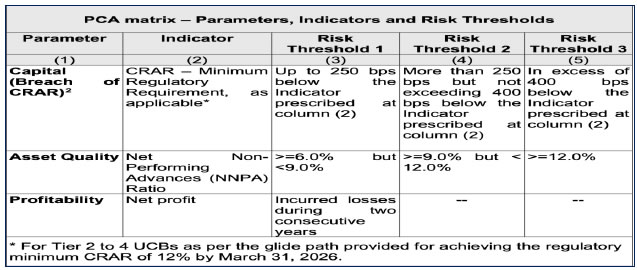 A bank will generally be placed under PCA Framework based on the Reported/Audited Annual Financial Results and/or the ongoing Supervisory Assessment made by RBI. However, RBI may impose PCA on any bank during the course of a year (including migration from one threshold to another) in case the circumstances so warrant. Although supervisory action taken will primarily be based on the criteria specified under the PCA Framework, the Reserve Bank will not be precluded from taking appropriate supervisory action in case stress is noticed in other important indicators/parameters or in case of serious governance issues. Also, the Reserve Bank will not be precluded from taking any supervisory action other than those indicated in this circular, based on the merits of each case. Exit from PCA and Withdrawal of Restrictions under PCA - Once a bank is placed under PCA, taking the bank out of PCA Framework and/or withdrawal of restrictions imposed under the PCA Framework will be considered: a) if no breaches in risk thresholds in any of the parameters are observed as per four continuous quarterly financial statements, one of which should be Audited Annual Financial Statement (subject to assessment by RBI); and b) based on supervisory comfort of the RBI, including an assessment on sustainable improvement in key financials of the bank. Framework for Compromise Settlements and Technical Write-offs In terms of the extant regulations, credit related recovery matters of lending institutions are largely deregulated. Such recovery measures could be either through resolution of the stress in the borrowers’ accounts through various statutory or out of the Court mechanisms or it may be through compromise settlements. While certain regulations were issued to commercial banks and NBFCs with regard to undertaking compromising settlements/write offs, in the case of cooperative banks, RBI had not issued guidelines on compromise settlements, as respective State statutes require permission of the Registrar of Co-operative Societies (RCS) for waiver of any loan/ dues owed to co-operative banks. Hence, a comprehensive regulatory framework governing compromise settlements and technical write-off of loans covering all regulated entities (including UCBs, State Co-operative Banks and Central Cooperative Banks) was issued on June 08, 2023. The Framework covers inter alia the factors to be considered before considering sacrifice/waiver, norms for permitted sacrifice/waiver, delegation of power, prudential treatment, reporting mechanism, oversight by the Board, cooling period, treatment of accounts categorized as fraud and wilful defaulter. Provisioning for Standard Assets On April 24, 2023, the Reserve Bank harmonised the provisioning norms for ‘standard’ assets applicable to all categories of UCBs, irrespective of their tier in the revised framework. The direct advances to agriculture and small and medium enterprise (SME) sectors attract a uniform provisioning requirement of 0.25 per cent, while the provisioning requirement for advances to the commercial real estate (CRE) sector, commercial real estate - residential housing (CRE-RH), and all other standard advances is 1.00 per cent, 0.75 per cent and 0.40 per cent, respectively. Tier 1 UCBs, which were maintaining 0.25 per cent provisions on “all other standard advances” were permitted to achieve the requirement of 0.40 per cent in a staggered manner by March 31, 2025. Regulatory measures to enhance Cyber Security in UCBs A set of baseline cyber security controls was prescribed for UCBs in October 2018. Subsequently, considering the different levels of Information Technology maturity level of the UCBs, a need was felt to prescribe a cyber security framework which will mandate implementation of progressively stronger security and IT/cyber governance measures based on the nature, variety and scale of digital product offerings by the UCBs. The graded approach was sought to be adopted to help the UCBs bolster their cyber security preparedness and to also ensure that the UCBs offering a range of payment services and higher Information Technology penetration are brought at par with commercial banks in addressing cyber security threats. Accordingly, a comprehensive cyber security framework was issued on December 31, 2019. The framework categorized UCBs into four levels based on their digital depth and interconnectedness to the payment systems landscape. Apart from this, a number of controls have been prescribed for UCBs covering payment ecosystem between UCBs and sponsor banks, Board oversight over cyber security, migration to bank specific email domain, mitigation of ransomware threats, etc. RBI’s Supervisory strategy for Cyber Security As part of the offsite review, an incident reporting mechanism has been established, requiring UCBs and other Supervised Entities (SEs) to report unusual cyber incidents to the RBI. If the reported incidents are deemed to have systemic implications, they are analyzed, and the modus operandi is communicated to other SEs through advisories and alerts, enabling them to take timely preventive or corrective measures. As part of onsite examination of UCBs, selected UCBs undergo onsite IT Examination (ITE), which focuses primarily on verifying compliance with the cybersecurity framework established by the RBI for UCBs. Rural Co-operatives Rural credit co-operatives came into existence essentially as an institutional mechanism to provide credit to farmers at affordable cost and address the twin issues of rural indebtedness and poverty. With its phenomenal growth in outreach and volume of business, rural credit co-operatives have a unique position in the rural credit delivery system. Through the short-term and long-term structures, they continue to play a crucial role in dispensation of credit for increasing productivity, providing food security, generating employment opportunities in rural areas and ensuring social and economic justice to the poor and vulnerable. -
The long-term co-operative credit structure has the State Co-operative Agriculture and Rural Development Banks (SCARDBs) at the apex level and the Primary Co- operative Agriculture and Rural Development Banks (PCARDBs) at the district or block level. These institutions were conceived with the objective of meeting long-term credit needs in agriculture, and they are not under the regulatory purview of Reserve Bank of India. -
The short-term co-operative credit structure (STCCS) of the country primarily meets the crop and working capital requirements of farmers and rural artisans. The pyramid of STCCS is primarily 3-tier and is federal in nature within a State. At the apex level is the State Co-operative Bank (StCB) at the state, at the district level there are District Central Co-operative banks (DCCBs) and at the village level, there are Primary Agricultural Credit Societies (PACS). Across India, there are more than 95000 PACS. They are not subject to regulation by the Reserve Bank of India, as they fall outside the scope of the Banking Regulation Act of 1949. They are regulated and monitored by the respective State Governments. While regulation of State Co-operative Banks (StCBs) and District Central Co- operative Banks (DCCBs) vests with Reserve Bank, their supervision is carried out by National Bank for Agriculture and Rural Development (NABARD) under Section 35 (6) read with Section 56 of the Banking Regulation Act, 1949. As part of regulation of StCBs and DCCBs, RBI prescribes CRR and SLR requirement in addition to prescribing prudential norms on capital adequacy, income recognition, asset classification and provisioning norms, exposure norms, etc. 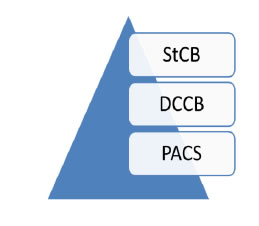 Regulation of Rural Co-operatives The Banking Regulation (Amendment) Act, 2020 (39 of 2020) has been notified for the State Co-operative Banks (StCBs) and District Central Co-operative Banks (DCCBs) with effect from, April 1, 2021, vide Notification dated December 23, 2020, issued by Government of India. With the issue of the notification, the amalgamations of the DCCBs with StCBs have to be sanctioned by Reserve Bank of India in terms of the provisions of the Section 44-A read with Section 56 of the Banking Regulation Act, 1949. Also pursuant to this notification, DCCBs are permitted to open new place of business/install ATMs or shift the location of such offices only after obtaining prior approval of the Reserve Bank of India in terms of Section 23 read with Section 56 of BR Act, 1949. Further, RBI has allowed RCBs to offer various services like mobile banking and internet banking facility, distribute insurance products, undertake Point of Presence services for Pension Fund Regulatory Development Authority (PFRDA), issue prepaid instruments and Point of Service (PoS) terminals (for cards) and they can act as a co-branding partner for credit cards etc. Conclusion Co-operative banks stand out due to their distinct structure, clientele, and approach to credit delivery. They serve as foundational institutions in India’s banking system, offering essential banking services to middle- and lower-income groups in urban and semi-urban areas. Their resilience and stability during the global financial crisis have highlighted their significance within the financial systems of both developed and emerging economies. The Reserve Bank of India (RBI) has implemented various policy initiatives to bolster and unify the co-operative banking sector and will maintain these efforts in the future. Chapter 10 - Regulation and Supervision of NBFCs in India India has financial institutions, which are not banks but perform bank like functions, especially the financial intermediation of mobilisation of funds and extending credit. These are Non-Banking Financial Companies (NBFCs) and they play a critical role in the financial system by providing last mile credit intermediation, while absorbing and diversifying risks by catering to segments not serviced by banks and pioneering innovative financial products. In regulating these entities, the challenge is to maintain a fine balance between maintaining the innovativeness and dynamism of the sector while also promoting its resilience. Their sheer number (over 9,000) and heterogeneity makes supervising them a daunting task with onsite supervision needing to be reinforced by offsite monitoring, market intelligence, statutory auditors reports and stakeholder interaction. This Chapter attempts to give an insight into the NBFC sector by delving into the definition of an NBFC, explicating the heterogeneity of the sector and giving an overview of the regulatory and supervisory framework. Definition of NBFC An NBFC is defined under section 45 I(f) of the Reserve Bank of India Act, 1934 (‘RBI Act') as a: -
a financial institution, which is a company; -
a non-banking institution which is a company, and which has as its principal business the receiving of deposits, under any scheme or arrangement or in any other manner, or lending in any manner; -
such other non-banking institution or class of such institutions, as the Bank may, with the previous approval of the Central Government and by notification in the Official Gazette, specify. Thus, largely a ‘financial institution’ that is a company is an NBFC. The term ‘financial institution’ is defined under Section 45I(c) of the RBI Act. Briefly, a financial institution means any non-banking institution that carries on as its business (or part of its business) any of the following activities (‘financial activities’): but does not include any institution, which carries on its principal business in -
Agriculture operations -
Industrial activity -
Purchase or sale of any goods (other than securities) -
Providing any services and -
Sale/purchase/construction of immovable property Sometimes, non-banking institutions that do not carry out the activities of a financial institution are still categorised as NBFCs. They are designated as NBFCs through a notification in the Gazette, as in the case of NBFC-Account Aggregators and NBFC-Peer-to-Peer Lending Platforms19, explained later. Another aspect is that a company need not be fully engaged in financial activities to be classified as an NBFC, but it needs to meet principal business criteria for the purpose. Further, the non-banking institution which undertakes as its principal business, non-financial activities such as agriculture, industrial activity, trading in goods, etc., is not classified as financial institution. The issue is how does one define principal business. Principal Business Criteria (PBC) As explained above only a company that carries on the business of a financial institution (‘financial activity’) as its principal business can be called an NBFC. On the other hand, if a company undertakes agriculture, manufacturing, trading in goods, etc., as its principal activity, it cannot be called an NBFC, even if carries out some financial activity. The term “principal business” is not defined in the RBI Act. Therefore, to give clarity and consistency to the interpretation of the term ‘principal business’, the Bank explained the term vide its press release dated April 8, 1999. As per this press release, to identify a company as an NBFC, the Bank will consider both, the assets and the income pattern as evidenced from the last audited balance sheet of the company to decide its principal business. A company is treated as an NBFC, if its financial assets are more than 50 per cent (excluding fixed deposits20) of its total assets (netted off by intangible assets) and income from financial assets is more than 50 per cent of the gross income. Both these tests are required to be satisfied as the determinant factor for principal business of a company. If a company meets the PBC, then it is an NBFC and is required to be registered with the RBI unless specifically exempted from doing so. Are NBFCs shadow banks? In response to the request by leaders of the Group of 20 (G20) to strengthen oversight and regulation of shadow banking in November 2010, the Financial Stability Board (FSB)21 defined shadow banking as “credit intermediation involving entities and activities (fully or partly) outside the regular banking system” and adopted a two-pronged strategy to address financial stability risks from shadow banking, including a system-wide oversight framework and the coordination and development of policies to address such risks. However, on October 22, 2018, the FSB announced its decision to replace the term “shadow banking” with the term “non-bank financial intermediation” (NBFI) in future communications. This change in terminology is intended to emphasize the forward-looking aspect of the FSB’s work to enhance the resilience of non-bank financial intermediation and clarify the use of the technical terms. Every year the FSB publishes a Global Monitoring Report on Non-Bank Financial Intermediation. The following monitoring aggregates are used in the report dated December 18, 2023: (i) NBFI (non-bank financial intermediation is a broad measure of all non-bank financial entities, composed of all financial institutions that are not central banks, banks, or public financial institutions. (ii) OFIs (other financial intermediaries) are a subset of the NBFI sector, composed of all financial institutions that are not central banks, banks, public financial institutions, insurance corporations (ICs), pension funds (PFs), or financial auxiliaries. (iii) Narrow measure of non-bank financial intermediation (or “narrow measure”) is composed of NBFI entities that authorities have assessed as being involved in credit intermediation activities that may pose bank-like financial stability risks (i.e., credit intermediation that involves maturity/liquidity transformation, leverage or imperfect credit risk transfer) and/or regulatory arbitrage, according to the methodology and classification guidance used in the FSB’s annual NBFI monitoring exercise. | Exemptions from RBI regulation As may have been observed from the definition of NBFC in the RBI Act, even entities such as insurance companies and stock broking companies are NBFCs. However, these entities are regulated by other regulators as part of their statutory function. Therefore, to avoid dual regulation, the RBI has exempted various categories of NBFCs which are regulated by other regulators/ government from registration and/or other requirements. The table below lists various exempted categories and their regulators. | Types of NBFCs/Activities | Regulated by | | Alternative Investment Fund Companies, Merchant Banking Companies, Stock Broking or sub-broking Companies, Stock Exchanges | Securities and Exchange Board of India (SEBI) | | Insurance Companies | Insurance Regulatory and Development Authority (IRDA) | | Mutual Benefit Companies, Nidhi Companies | Ministry of Corporate Affairs (MCA) | | Chit Companies | State Governments | Types of NBFCs Broadly, NBFCs can be categorised in the following ways: -
Based on acceptance of public funds and customer interface -
Based on deposit acceptance, size and other factors -
Based on activity its regulatory framework Based on acceptance of public funds and customer interface Applications for registration of deposit accepting NBFCs (NBFC- D) are not considered since 1997. Further, in June 2016, the RBI issued a press release simplifying and rationalising the process for registration of new NBFCs. In respect of non- deposit accepting NBFCs (NBFC-NDs), there are two types of applications based on sources of funds and customer interface. -
Type I - NBFC-NDs not accepting public funds / not intending to accept public funds in the future and not having customer interface / not intending to have customer interface in the future. The term “Public funds'; shall include funds raised either directly or indirectly through public deposits, commercial paper, debentures, inter- corporate deposits and bank finance but excludes funds raised by issue of instruments compulsorily convertible into equity shares within a period not exceeding 10 years from the date of issue. The processing of cases for Type I - NBFC-ND applicants are subjected to less intensive scrutiny and due-diligence. However, in case these companies intend to avail public funds or have customer interface in future, they are required to seek approval from the Department of Regulation (DoR). -
Type II - NBFC-ND accepting public funds/intending to accept public funds in the future and/or having customer interface/intending to have customer interface in the future. Even the regulatory framework provides certain relaxations for companies that do not access public funds and/ or have customer interface. Based on deposit acceptance, size and other factors Non-deposit taking NBFCs are categorised as Base Layer NBFC (NBFC-BL), if their asset size is less than ₹1000 crore. Non-Deposit taking NBFCs with asset size of NBFCs with asset size of ₹1000 crore and above are categorised as Middle Layer NBFC(NBFC-ML). Notwithstanding this, depending upon the line of activity, NBFCs can be in Base or Middle Layer irrespective of their asset size. Given the sensitivity towards public deposits, deposit taking NBFCs (i.e., NBFC-Ds) categorised at least in the Middle Layer irrespective of their size. Indeed, some regulations for NBFC-Ds are stringent as compared to non-deposit taking NBFCs. The top ten eligible NBFCs in terms of their asset size shall be categorised as Upper Layer NBFC (NBFC-UL). The Upper Layer shall also comprise of eligible NBFCs specifically identified by the Bank based on a set of parameters and scoring methodology. The next category viz., Top Layer (NBFC-TL) is ideally expected to be empty and may get populated if the Bank is of the opinion that there is a substantial increase in the potential systemic risk from specific NBFCs-UL. Based on activity NBFCs are heterogeneous in their activities. While some engage primarily in micro finance and dealing with the underserved sections of society, others specialise in long term project and infrastructure finance. Consequently, it is difficult to have a ‘one size fits all’ regulatory framework and NBFCs need to be categorised based on their principal activities. This does make the regulatory framework complex and attempts have been made to harmonise regulations and reduce the number of categories. Today more than 96 per cent of NBFCs by number fall under the NBFC-Investment and Credit Category (NBFC-ICC) explained below. | Sl. No. | Type of NBFC | Nature of activity | Key Qualifying Criteria | | 1. | NBFC- Investment and Credit Company (NBFC-ICC) | i) Lending (erstwhile Loan companies)
ii) Financing of physical assets including automobiles, tractors and generators (erstwhile Asset Finance Companies)
iii) Acquisition of securities (erstwhile Investment Companies) Includes Gold Loan companies which are NBFCs primarily engaged (i.e., 50 per cent or more of financial assets) in lending against gold jewellery | Does not qualify (or has not been registered) to be in any other category | | 2. | NBFC- Infrastructure Finance Company (NBFC-IFC) | Providing long term loans for Infrastructure development | Infrastructure loans should be at least 75 per cent of total assets. | | 3. | Core Investment Company (CIC) | Investing in / lending to group companies | (i) Not less than 90 per cent of net assets to be investments and loans to group companies and 60 per cent of net assets to be in equity and similar investments of group companies.
(ii) Does not trade in its investments in shares, bonds, debentures, debt/loans of group companies except through block sale for dilution/disinvestment.
(iii) Does not carry out any financial activity than specified. | | 4. | Infrastructure Debt Fund – NBFC (IDF- NBFC) | Refinancing existing debt of completed infrastructure projects | (i) Refinance post commencement operations date (COD) infrastructure projects which have completed at least one year of satisfactory commercial operation
(ii) Finance toll operate transfer (TOT) projects as the direct lender | | 5. | NBFC-Micro Finance Institutions (NBFC-MFI) | Collateral free loans to small borrowers | Deploys at least 75 per cent of total assets in microfinance loans | | 6. | NBFC – Factors | Factoring business i.e. financing of receivables. Registered under section 3 of the Factoring Act | Financial assets in factoring business at least 50 per cent of total assets and income derived there from not less than 50 per cent of total income. | | 7. | Mortgage Guarantee Companies (MGC) | Providing mortgage guarantees for housing loans | At least 90 per cent of business turnover from mortgage guarantee business or at least 90 per cent of gross income from mortgage guarantee business | | 8. | Non-Operative Financial Holding Company (NOFHC) | For setting up new banks in private sector through its promoter/promoter groups | Should have first received an in- principle approval for setting up a commercial bank from RBI. | | 9. | NBFC-Account Aggregator (NBFC-AA) | Providing under contract the service of retrieving, consolidating, organising and presenting financial information of its customer (with explicit consent). | Can only provide account aggregation s er v i ce s . T he financial assets that are under the regulatory ambit of financial sector regulators can be aggregated. These aggregators cannot support the transactions of customers and cannot take services of third-party service providers for undertaking the business of account aggregation. | | 10 | NBFC-Peer-to- Peer Lending Platforms (NBFC-P2P) [notified under section 45I(f)(iii)] | Carries on the business of a P2P lending platform i.e., providing loan facilitation services to participants on the platform. | Can only provide platform. No lending from its own books. | | 11 | Housing Finance Company (HFC) [notified under section 45I(f)(iii)] | Carry on the business of providing finance for housing and housing projects. | (i) Financial assets, in the business of providing finance for housing shall constitute at least 60% of its total assets (netted off by intangible assets).
(ii) Out of the total assets (netted off by intangible assets), not less than 50% shall be by way of housing finance for individuals. | | 12. | Standalone Primary Dealer (SPD) | Primary Dealers are expected to play an active role in the G- Sec market, both in its primary and secondary market segments through various obligations like participating in Primary auctions, market making in G- Secs, achieving minimum secondary market turnover ratio, etc. | At least 50 per cent of total financial investments (both long term and short term) in G-Secs at any point of time. | In addition to the above categories there is a class of NBFCs called Residuary Non- Banking Companies (RNBCs). The principal business of such companies is receiving deposits under any scheme or arrangement or in any other manner and deploying them in the specified manner. However, no fresh registrations for this category are being issued as also presently there is no RNBC registered with the Bank. Miscellaneous Non-Banking Companies (MNBCs) are NBFCs that manage chit fund business22. Chit funds are primarily regulated by State Governments and NBFCs carrying on chit fund business are exempt from registration requirement. Further, MNBCs have been barred from accepting fresh deposits vide circular dated August 28, 2009, and the extant RBI regulatory framework deals with protecting the interest of depositors of the existing depositors of such companies. Apart from the above, there are also Asset Reconstruction Companies (ARCs) that are registered and regulated under the Securitisation and Reconstruction of Financial Assets and Enforcement of Security Interest (SARFAESI) Act, 2002 for acquiring and dealing in financial assets sold by banks and financial institutions. ARCs play a crucial role in resolution of non- performing assets (NPAs). ARCs have been exempting by the RBI from registration under the RBI Act and are instead registered by RBI under section 3 of the SARFAESI Act. The minimum NOF23 stipulated for these companies was increased from ₹2 crore to ₹100 crore in April 2017, which has further been increased to ₹300 crore in October 2022 to be achieved by March 31, 2026. Prudential guidelines on maintenance of capital adequacy, deployment of funds, asset reconstruction, asset classification norms, disclosure norms, etc., have been stipulated for these companies also by RBI. Another way to distinguish NBFCs is based on ownership i.e., Government owned and others. The regulatory framework has endeavoured to remove this distinction by making the prudential framework applicable to Government owned NBFCs in a phased manner. However, there is a distinction in the statutory framework with the RBI not having the powers to remove directors or supersede the Board of Directors of a Government owned Company. Regulation of NBFCs - Genesis and Legal Framework RBI acquired regulatory and supervisory powers over NBFCs with the insertion of Chapter III-B in the RBI Act in 1963. An extract of the Statement of Objects and Reasons to the Banking Laws (Miscellaneous Provisions) Bill, 1963 that inserted Chapter III B into the RBI Act is given below. “The existing enactments relating to banks do not provide for any control over companies or institutions, which, although they are not treated as banks, accept deposits from the general public or carry-on other business which is allied to banking. For ensuring more effective supervision and management of the monetary and credit system by the Reserve Bank, it is desirable that the Reserve Bank should be enabled to regulate the conditions on which deposits may be accepted by these non-banking companies or institutions. The Reserve Bank should also be empowered to give to any financial institution or institutions directions in respect of matters, in which the Reserve Bank, as the central banking institution of the country, may be interested from the point of view of the control of credit policy.” While regulation of NBFCs by RBI started in 1963 with Parliament’s recognition of the need to regulate the deposit taking activity of NBFCs, 1996 marked a watershed year for NBFCs with the failure of a large NBFC (CRB Capital). Based on the recommendations of the Shah Committee (1992), which had highlighted the need to expand the regulatory and supervisory focus of NBFCs, RBI’s regulatory and supervisory powers were strengthened with amendments to Chapter III B of the RBI Act. Some of the important amendments carried out in 1997 included: -
Compulsory registration with RBI and maintenance of minimum Net Owned Fund (NOF) for companies satisfying the ‘principal business’ criteria (Sec.45IA) -
Maintenance of liquid assets by NBFCs accepting public deposits (Sec.45IB) -
Creation of a Reserve Fund by all NBFCs by transfer of 20 per cent of their net profit every year (Sec.45IC) -
Powers of RBI to determine Policy and issue directions to NBFCs (Sec.45JA) -
Conduct of Special Audit of the accounts of NBFCs, if necessary (Sec.45MA) -
Power of RBI to prohibit acceptance of deposits and alienation of assets (Sec.45MB) -
Power of RBI to file winding up petition under Companies Act, 1956 (Sec.45MC) -
Introduction of nomination facility for depositors of NBFCs (Sec.45QB) -
Prohibition of deposit acceptance by unincorporated bodies engaged in financial business (Sec.45S) -
Power of RBI to impose fine on NBFCs for violations/contraventions of guidelines (Sec.58G) The Reserve Bank tightened the regulatory structure over the NBFCs, with rigorous registration requirements, enhanced reporting, and supervision. The Bank also took a policy stance to not register new public deposit accepting NBFCs and encourage the existing ones to convert to non-deposit taking NBFCs. Further, in 1999, NOF requirement for fresh registration was enhanced from ₹25 lakh to ₹2 crore. In view of the rapid strides made by NBFCs in terms of their size, nature of operations with entry into newer areas of financial services and products, adoption of newer technologies, etc., the regulatory framework for the sector was reviewed again in 201424. The review was also necessary as this sector was increasingly getting inter-connected with others. The key changes in the revised regulatory framework were as follows: -
Requirement of minimum NOF of ₹2 crore for legacy NBFCs. -
Harmonisation of deposit acceptance requirements across categories and introduction of minimum investment grade rating requirement for deposit acceptance for Asset Finance Companies. -
Revision of the threshold of systemic significance from ₹100 crore to ₹500 crore and inclusion of multiple NBFCs within the same group for reckoning systemic significance threshold -
Differentiated regulatory approach based on customer interface and source of funds. At one end of the spectrum, entities with asset size less than ₹500 crore and not accessing public funds with no customer interface were exempted from prudential and business conduct regulations. At the other end, entities accessing public funds with customer interface were subjected to full slew of regulations. -
Harmonisation of asset classification norms for NBFC-D and NBFC-ND-SIs with banks. -
Review of corporate governance and disclosure norms leading to constitution of Board Committees (Audit Committee, Nomination Committee, and Risk Management Committee) and rotation of audit partners every three years applicable for NBFC-Ds and NBFC-ND-SIs. In 2019, certain amendments enumerated below were again carried out to Chapter III-B of the RBI Act, which has inter-alia strengthened RBI’s supervisory powers. -
Reserve Bank may notify different amount of NOF to different categories of NBFCs with minimum NOF between ₹.25 lakh and ₹.100 crore (Sec.45IA) -
RBI can remove Directors of NBFC (other than Government owned NBFCs) – (Sec.45ID) -
RBI can supersede the BOD of NBFC (other than Government owned NBFCs) – (Sec.45 IE) -
RBI can remove or debar an auditor of NBFC for a max. period of 3 years at a time (Sec.45MAA) -
Resolution of NBFCs through amalgamation, reconstruction, splitting into various activities, etc. (Sec.45MBA) -
Power to call for information of Group Companies and inspection of Group Companies (Sec.45NAA) Further, the Finance (No.2) Act, 2019 (23 of 2019) has amended the National Housing Bank Act, 1987 transferring the registration and regulation of HFCs to RBI. With the notification of the Insolvency and Bankruptcy (Insolvency and Liquidation Proceedings of Financial Service Providers and Application to Adjudicating Authority) Rules, 2019 by the Government of India, the Bank is also entrusted with insolvency resolution process of NBFCs (including HFCs) under the Insolvency and Bankruptcy Code (IBC) from November 2019 onwards. Overview of the regulatory framework NBFCs being financial service intermediaries are exposed to risks arising out of counterparty failures, funding and asset concentration, interest rate movements and risks pertaining to liquidity and solvency. Further, the interconnectedness of NBFCs with other participants in financial markets has increased over time with greater access to public funds through NCDs, CPs, borrowings from banks and financial institutions. Consequently, risks of the NBFC sector can easily be transmitted to the rest of the financial system and vice-versa. While regulations for NBFCs are simpler and lighter as compared to banks, there is a continuous evaluation to ensure that NBFC regulations are commensurate with the systemic impact that NBFCs can cause, and certain financial market activities do not remain out of the regulatory perimeter. Broadly regulatory objectives are twin fold i.e. (i) fostering financial system stability and (ii) consumer protection. Based on these objectives, regulations applicable to NBFCs may be classified as Prudential (i.e., those that foster financial system stability) and Conduct of Business (i.e., those that provide for consumer protection). While Prudential Regulations include prescribing of capital adequacy requirements, single/group borrower exposure norms, income recognition, asset classification and provisioning norms, prescribing Loan-To- Value (LTV) ratios, Leverage Ratio25, regulations governing acceptance of public deposits, etc., the Conduct of Business Regulations mainly relate to the Fair Practices Code (FPC) to be adhered to by lenders and adherence to Know Your Customer (KYC) norms by NBFCs. The regulatory framework also takes cognizance of whether an NBFC has accessed public funds or has customer interface. Base Layer NBFCs that do not access public funds are exempted from prudential regulations, while all NBFCs that do not have customer interface are exempted from business conduct regulations. A comparison of the key elements of the regulatory framework for NBFCs vis-à-vis banks is summarized in the table below: | | Base Layer NBFCs | Middle Layer and Upper Layer NBFCs- | Banks | | Legal Basis | Chapter IIIB of the RBI Act | Banking Regulation Act, 1949 | | Capital Adequacy | No CRAR. Leverage Ratio of 7 times | NBFC-ML and all MFIs-Min. CRAR of 15 per cent (akin to Basel I i.e., uniform risk weights and no capital charge for market or operating risks) NBFC- UL are also required to maintain Common Equity Tier 1 Capital (CET 1) of 9 per cent. | Min CRAR of 9 per cent + Capital Conservation Buffer +Counter cyclical Buffer (Basel III based) | | Credit concentration | No specific limits, only internal Board approved policy | Limits reckoned as percentage of Tier I capital NBFC-ML- Single Counterparty Limit: 25 per cent Group of Counterparties Limit: 40 per cent NBFC-UL - Single Counterparty Limit: 20 per cent + 5 per cent with approval of Board Group of connected Counterparties Limit: 25 per cent Specified dispensations are available for
(i) NBFC-ML and NBFC- UL for infrastructure exposures and
(ii) NBFC-IFCs | Large exposure framework – Limit reckoned as per centage of Tier I capital Single counterparty: 20 per cent Groups of connected counterparties: 25 per cent | | Liquidity Coverage Ratio (LCR) | Liquidity Risk Management Framework is applicable for all NBFCs-D and non-deposit taking NBFCs with asset size of ₹100 crore and above. LCR is applicable to all NBFCs-D and non-deposit taking NBFCs, with asset size of ₹5,000 crore or more. | Applicable for all Commercial Banks (excluding Regional Rural Banks, Local Area Banks and Commercial Banks) | | Net Stable Funding Ratio | Not applicable | Not applicable | Guidelines issued and will be applicable to all Scheduled Commercial Banks (excluding Regional Rural Banks) when effective. | | KYC/AML-CFT | Same norms uniformly applicable to banks and NBFCs | | Accounting Norms | Based primarily on Companies Act, 2013. Listed NBFCs and other NBFCs with net worth of ₹250 crore or more are required to prepare financial statements as per IFRS converged Indian Accounting Standards (Ind AS) | Mélange of statutory requirements, accounting standards, RBI instructions and guidance notes issued by self-regulatory organisations. | Regulatory Guidance on Implementation of Ind AS In accordance with the roadmap for transition to IFRS converged Indian Accounting Standards (Ind AS) drawn up by the Ministry of Corporate Affairs, NBFCs with a net worth of ₹500 crore or above have already transitioned to Ind AS from April 1, 2018 followed by NBFCs with a net worth of ₹250 crore or above and other listed NBFCs transitioning from April 1, 2019. Ind AS represents a paradigm shift in accounting by inter-alia introducing concepts of expected credit loss (ECL) framework, other comprehensive income, symmetric fair value accounting, etc. which also impacts the interaction of the accounting framework with regulatory capital computation. Being “principle based” rather than “rule based”, Ind AS also brings in a significant increase in subjectivity and management discretion resulting in a concomitant loss of comparability. To promote a high quality and consistent implementation as well as to facilitate comparability and better supervision, the RBI vide circular dated March 13, 2020, issued regulatory guidance to NBFCs implementing Ind AS. The salient features of the proposed guidance are as under: -
A governance framework is prescribed for critical assumptions and management judgment entailed in Ind AS through Board approved documentation of business model objectives, ECL model, definition of default, etc. While placing responsibility on the Board, this would also facilitate verifiability by auditors and supervisors. -
Ind AS 109 does not explicitly define default but requires entities to define default in a manner consistent with that used for internal credit risk management. The circular recommends that the definition of default adopted for accounting purposes be guided by the definition used for regulatory purposes. Further, it requires ACB to approve the classification of accounts that are overdue for more than 90 days but have not been classified as impaired. The number and total amount outstanding against such accounts also needs to be disclosed. -
Under Ind AS, when a significant increase in credit risk is assessed, the ECL allowances move from 12 month to lifetime ECL. Ind AS provides a rebuttable presumption that the credit risk on a financial asset has increased significantly since initial recognition when contractual payments are more than 30 days past due. In limited circumstances where NBFCs/ARCs rebut this presumption, they should place the justification before the ACB. Further, the recognition of significant increase in credit risk should not be deferred for accounts that are overdue beyond 60 days. -
To address concerns pertaining to inadequate provisioning under Ind AS, a prudential floor based on the current norms (IRACP) has been prescribed. In case provisioning under Ind AS is below IRACP norms, the difference would not be available for payment of dividend and instead need to be transferred to an ‘Impairment Reserve’. The Impairment Reserve shall not be reckoned for regulatory capital. Any withdrawal from this reserve would be subject to approval from RBI. Further, in order to provide a benchmark for comparison for stakeholders, a disclosure template comparing Ind AS and IRACP classification and provisioning has been prescribed. -
In order to minimise the disruption to the regulatory capital computation, the guidelines provide for ignoring net unrealised fair value gains, while providing for net unrealised fair value losses. They also prescribe treatment for 12-month ECL (on the same lines as general provisions), discount on revaluation of fixed assets, derecognition of unrealised gains and losses due to cash flow hedge reserve and own credit risk and adjustments in net owned funds due to fair valuation of group entities. It is also clarified that regulatory capital would be required on financial instruments that do not qualify for derecognition. Further regulatory ratios, limits and disclosures would be based on Ind AS figures. Fintech developments in the NBFC sector In India, banks and NBFCs are increasingly using technology to adopt financial innovation. As the financial sector regulator, the Reserve Bank of India has been on the forefront of creating an enabling environment for growth of digital technology for new financial products and services. In fact, in the non-banking and the payment and system space, the Bank has been ahead of the curve and has come out with regulations for new products and services when the industry itself was at nascent stage. NBFC-P2P and NBFC-AA are cases in point where the regulation has helped the industry to grow in a systematic and robust manner. NBFC-P2P Lending Platform- An intermediary bringing the borrowers and lenders over an electronic platform. The platform itself does not take any credit risk, transactions are reported over credit information companies and prudential limits have been placed on the borrowers and lenders on the platform. There are 26 NBFC-P2P platforms registered with the Bank as on March 31, 2024. NBFC-Account Aggregator - It retrieves or collects information related to financial assets of a customer from the holders of such information and aggregates the same before presenting it to the customers or users specified by customers. The larger goal of NBFC-AA is to attain data empowerment or data democratization in an emerging market economy like India where access to financial services (qualitative and quantitative) is still limited to a large extent. Technical Specifications for NBFC-AA- In the NBFC-AA ecosystem, the data is supposed to move in a standardised and encrypted format across different financial sector regulated entities. In order to ensure that movement of data is seamless across systems in a safe and secured environment, technical specifications for NBFC-AA have been prescribed. These are Application Programme Interface (API) based specifications framed for movement of data and in the core is the consent architecture which will go a long way in realising the full potential of the NBFC-AA ecosystem. The highlight of these regulations is that these not only give a fillip to adoption of newer, faster and efficient technology/business models but also alleviate the concerns arising out of adopting fintech led financial services. In particular, regulatory features like, explicit consent for data sharing, domestic location of servers, electronic consent artefact, audit trails, CISA audit, data blind NBFC-AA platform etc. are progressive and pre-emptive in nature. Supervision of NBFCs The RBI has instituted a strong and comprehensive supervisory mechanism for NBFCs. The focus of the RBI is on prudential supervision to ensure that NBFCs function on sound and healthy lines and avoid excessive risk taking. The RBI has put in place a five-pronged supervisory framework based on: On-site Inspections: The system of on-site examination put in place during 1997 is structured on the basis of CAMELS (Capital, Assets, Management, Earnings, Liquidity, and Systems and Controls) approach. The Reserve Bank derives its powers under Section 45N of the RBI Act, 1934 to cause an inspection of an NBFC & in case of ARCs under Section 12B of the Securitisation and Reconstruction of Financial Assets and Enforcement of Security Interest Act, (SARFAESI Acts) 2002, for the purpose of verifying the correctness or completeness of any statement or information or for obtaining any information or particulars or if the Bank feels that such an inspection is warranted. Powers to inspect the books of an NBFC have also been vested with the Bank under Section 45-IA(4) of the RBI Act, 1934, primarily to verify as to whether the financial company complies with the conditions laid down for grant of Certificate of Registration (CoR). The overall objectives of on-site inspection of an NBFC are to: - -
Assess the adequacy of capital and earnings prospects and assign a supervisory rating on the basis of CAMELS. -
Evaluate the solvency of the financial company. -
Evaluate the position of compliance with provisions of the RBI / SARFAESI Acts and the directions/notifications issued from time to time, and any other guidelines/regulations which may be prescribed by the Bank under the extant Act. -
Identify the areas where corrective actions are needed to strengthen the company. The supervisory framework takes into account the statutory prescriptions, directions and prudential regulations. Within this framework, companies are expected to manage themselves prudently to meet the risks emanating from their business and ensure that they are in a position to meet their obligations, particularly (public) deposit liabilities and other creditors and also ensure that they do not function in a manner detrimental to the interests of their depositors or the overall financial system. The periodicity of such inspections will be based on the category and asset-size of NBFCs. Off-site monitoring: In order to supplement information gathered from on-site inspections, several returns have been prescribed for NBFCs as part of the off-site surveillance system. The information provided is analysed to identify potential supervisory concerns and in certain cases serves as a trigger for on-site inspection. The returns being submitted by the NBFCs are reviewed and examined at intervals to widen the scope of information, so as to address the requirements either for supervisory objectives or for furnishing the same to various interest groups on the important aspects of the working of these companies. Market Intelligence: Market Intelligence is an important component of monitoring financial sector. While off-site surveillance system and on-site inspections are effective tools in assessing the financial position and overall regulatory compliance of the registered companies, pro-active market intelligence can help pick up early warning signals about the health of a particular NBFC and trigger supervisory action to protect the interest of the depositors/avoid systemic risks. In the recent past, there has been a spurt in the activities of the entities which accept money under various garbs by violating the directions of the Regulators and structure their scheme in a manner which escapes the apparent meaning of ‘Deposits’ and the attention of the Regulators. With the objective to control the incidents of unauthorized acceptance of deposits by unscrupulous entities, State Level Coordination Committees (SLCC) are formed in all States to facilitate information sharing among the Regulators viz. RBI, SEBI, IRDA, NHB, PFRDA, Registrar of Companies (RoCs) etc., and Enforcement Agencies of the States viz., Home Department, Finance Department, Law Department, Economic Offences Wing (EOW) etc. SLCCs were reconstituted in May 2014 with renewed focus on the illegal activities of the unauthorised entities. In the last few years, the regular discussions among the Regulators and Enforcement Authorities has led to increased awareness & co-ordination and Standard Operating Procedures are being evolved for effective handling of such matter. The Sachet Portal: The Reserve Bank launched a mobile friendly portal Sachet (sachet.rbi.org.in) on August 4, 2016 to help the public as well as regulators to ensure that only regulated entities accept deposits from the public. The portal can be used by the public to share information wherein they can also upload photographs of advertisements/publicity material, raise queries on any fund raising/investment schemes that they come across and lodge complaints. The portal has links to all the regulators and the public can easily access information on lists of regulated entities. The portal has a section for a closed user group – the SLCC inter-regulatory forum for exchange of information and coordinated action on unauthorised deposit collection and financial activities. It helps in enhancing coordination among regulators and State Government agencies, which serves as a useful source of information for early detection and curbing of unauthorised acceptance of deposits. On October 24, 2019 Sachet portal was made available in 11 more prominent regional languages besides Hindi and English to further its penetration in general public. Exception Reports of Statutory Auditors: In addition to all the above types of supervision, the responsibility of ensuring compliance with the directions issued by the Reserve Bank, as well as adherence to the provisions of the RBI Act has also been entrusted to the Statutory Auditors of NBFCs. The Statutory Auditors are required to report to the Reserve Bank about any irregularity or violation of regulations concerning acceptance of public deposits, credit rating, prudential norms and exposure limits, capital adequacy, maintenance of liquid assets and regularisation of excess deposits held by the companies. Interaction with stakeholders: In order to develop a closer understanding of the emerging risks and developments in the sector to facilitate prompt action, the department interacts with various stakeholders like Management of NBFCs, Statutory Auditors, Credit Rating Agencies, Credit Information Companies, Mutual funds etc. In addition to the above, the actions of the supervised entity in the market and the approach of the investors in the bonds/ CPs of NBFCs is discussed with market department to understand the position of the supervised entity from the perspective of investors. Scale Based Regulation: A Revised Regulatory Framework For NBFCs In October 2021, the Reserve Bank of India (RBI) had issued a ‘Scale-Based Regulation’ (SBR) Framework that encompasses different facets of regulation of NBFCs — covering capital requirements, governance standards, prudential regulation, etc. These guidelines are effective from 1 October 2022. Regulatory structure for NBFCs shall comprise of four layers based on their size, activity, and perceived riskiness. NBFCs in the lowest layer shall be known as NBFC - Base Layer (NBFC-BL). NBFCs in middle layer and upper layer shall be known as NBFC - Middle Layer (NBFC-ML) and NBFC - Upper Layer (NBFC-UL) respectively. The Top Layer is ideally expected to be empty and will be known as NBFC - Top Layer (NBFC-TL). Further RBI vide circular dated 11 April 2022, issued a framework for Compliance Function and Role of Chief Compliance Officer in NBFC-Upper layer and NBFC-Middle layer. Thereafter, on 19 April 2022, RBI issued circulars on large exposure framework for NBFCs — Upper layer, capital requirements for NBFCs — Upper layer, regulatory restrictions on loans and advances and disclosures in notes to accounts of the financial statements of NBFCs. On 29 April 2022, RBI issued guidelines on compensation policy of key managerial personnel and members of senior management of all NBFCs under SBR framework, except those categorized under ‘Base Layer’ and Government-owned NBFCs, which is effective from 1 April 2023. On June 6, 2022, RBI issued guidelines on provisioning for standard assets, which are applicable for NBFC — Upper layer. Regulatory structure for NBFCs shall comprise the four layers as defined in the pyramid below: REGULATORY CHANGES UNDER SCALE BASED REGULATION (SBR) Regulatory changes under SBR for all the layers in the regulatory structure | NBFCs | Current NOF | By March 31, 2025 | By March 31, 2027 | | NBFC-ICC | ₹2 crore | ₹5 crore | ₹10 crore | | NBFC-MFI | ₹5 crore (₹2 crore in NER*) | ₹7 crore (₹5 crore in NER) | ₹10 crore | | NBFC- Factors | ₹5 crore | ₹7 crore | ₹10 crore | | *-NER – North-Eastern Region | However, for NBFC-P2P, NBFC-AA, and NBFCs with no public funds and no customer interface, the NOF shall continue to be ₹2 crore. It is clarified that there is no change in the existing regulatory minimum NOF for NBFCs - IDF, IFC, MGCs, HFC, and SPD. | NPA Norms | Timeline | | 150 days overdue | By March 31, 2024 | | 120 days overdue | By March 31, 2025 | | 90 days | By March 31, 2026 | Explanation: The glide path will not be applicable to NBFCs which are already required to follow the 90-day NPA norm. -
Experience of the Board - Considering the need for professional experience in managing the affairs of NBFCs, at least one of the directors shall have relevant experience of having worked in a bank/ NBFC. -
Ceiling on IPO Funding – There shall be a ceiling of ₹1 crore per borrower for financing subscription to Initial Public Offer (IPO)26. NBFCs can fix more conservative limits. Regulatory changes under SBR for different layers in the regulatory structure Capital Guidelines - applicable to NBFC-ML and NBFC-UL • Internal Capital Adequacy Assessment Process (ICAAP) - NBFCs are required to make a thorough internal assessment of the need for capital, commensurate with the risks in their business. This internal assessment shall be on similar lines as ICAAP prescribed for commercial banks under Pillar 2. While Pillar 2 capital will not be insisted upon, NBFCs are required to make a realistic assessment of risks. Internal capital assessment shall factor in credit risk, market risk, operational risk and all other residual risks as per methodology to be determined internally. The objective of ICAAP is to ensure availability of adequate capital to support all risks in business as also to encourage NBFCs to develop and use better internal risk management techniques for monitoring and managing their risks. • Additional regulatory changes under SBR applicable to NBFC-UL Common Equity Tier 1 – In order to enhance the quality of regulatory capital, NBFC-UL shall maintain Common Equity Tier 1 capital of at least 9 per cent of Risk Weighted Assets. Leverage - In addition to the CRAR, NBFC-UL will also be subjected to leverage requirement to ensure that their growth is supported by adequate capital, among other factors. A suitable ceiling for leverage will be prescribed subsequently for these entities as and when necessary. Differential standard asset provisioning- NBFC-UL shall be required to hold differential provisioning towards different classes of standard assets. Guidelines for fixing compensation of key managerial personnel (KMP) and senior management of NBFCs A set of principles were issued for fixing compensation of key managerial personnel (KMP) and senior management of NBFCs. As per the guidelines, NBFCs are required to constitute a nomination and remuneration committee (NRC), which will be responsible for framing, reviewing and implementing the compensation policy. The guidelines, inter alia, prescribe that the compensation package comprising fixed and variable pay may be adjusted for all types of risks. A certain portion of variable pay may have a deferral arrangement and the deferral pay may be subjected to malus/claw back arrangement. Government owned NBFCs As per the Reserve Bank’s circular on ‘Withdrawal of Exemptions Granted to Government Owned NBFCs’ dated May 31, 2018, the Government owned NBFCs are still in the transition period to attain the minimum CRAR. It has, therefore, been decided not to subject these NBFCs to the Upper Layer regulatory framework at this juncture. A decision on including eligible Government NBFCs meeting the specified criteria into the Upper Layer will be taken at a later stage and till that time the guidelines as applicable for the NBFC-BL or NBFC-ML shall apply, as applicable. PCA Framework for NBFCs NBFCs have been growing in size and have substantial inter-connectedness with other segments of the financial system. Accordingly, a PCA Framework for NBFCs has been put in place to further strengthen the supervisory tools applicable to NBFCs. This shall apply to: -
All Deposit Taking NBFCs [Excluding Government Companies], -
All Non-Deposit Taking NBFCs in Middle, Upper and Top Layers [Excluding - (i) NBFCs not accepting/not intending to accept public funds; (ii) Government Companies, (iii) Primary Dealers and (iv) Housing Finance Companies]. The PCA Framework for NBFCs shall come into effect from October 1, 2022, based on the financial position of NBFCs on or after March 31, 2022. -
For NBFCs-D and NBFCs-ND, Capital and Asset Quality would be the key areas for monitoring in PCA Framework. -
For CICs, Capital, Leverage and Asset Quality would be the key areas for monitoring in PCA Framework -
For NBFCs-D and NBFCs-ND, indicators to be tracked would be Capital to Risk Weighted Assets Ratio (CRAR), Tier I Capital Ratio and Net NPA Ratio (NNPA). For CICs, indicators to be tracked would be Adjusted Net Worth/Aggregate Risk Weighted Assets, Leverage Ratio and NNPA. -
A NBFC will generally be placed under PCA Framework based on the audited Annual Financial Results and/or the Supervisory Assessment made by the RBI. However, the RBI may impose PCA on any NBFC during the course of a year (including migration from one threshold to another) in case the circumstances so warrant. Chapter 11: Enforcement in RBI The Reserve Bank has powers to impose sanctions including monetary penalties under various laws applicable to the banking and financial sector, viz., Banking Regulation Act, 1949 [BR Act]; Reserve Bank of India Act, 1934 [RBI Act]; National Housing Bank Act, 1987 [NHB Act]; Payment and Settlement Systems Act, 2007 [PSS Act]; Securitisation and Reconstruction of Financial Assets and Enforcement of Security Interest Act, 2002 [SARFAESI Act]; Factoring Regulation Act, 2011 [FR Act]; Credit Information Companies (Regulation) Act, 2005 [CIC (R) Act]; etc. While the Reserve Bank has been taking penal action in the form of imposition of monetary penalty under these statutes, the process was spread across various regulatory/supervisory departments which was not in line with the international best practice of separating enforcement action from the supervisory process. Regulation, supervision and enforcement are three important facets of the financial sector oversight mechanism. Regulations determine the framework in which financial entities function so that prudence, transparency, and comparability are ensured on the one hand and customer interests are protected on the other. Supervision (including off-site surveillance) is the process through which adherence to the regulations is monitored. Enforcement deals with cases of non-compliance with regulations noticed either through the supervisory process or otherwise. An effective system of banking supervision depends, inter alia, on robust enforcement of regulatory directions which, in turn, needs a unified and well-articulated enforcement policy and institutional framework. Taking cognisance of such a need and in line with the international best practices, in furtherance to the announcement made in the First Bi-monthly Policy Statement for the year 2016-17 on April 5, 2016, the Board for Financial Supervision (BFS) approved a Supervisory Enforcement Framework for action against non-compliant regulated entities (REs), while ensuring the Principles of Natural Justice along with transparency, consistency, severity and timeliness of action. While the said framework was originally intended for undertaking enforcement action against scheduled commercial banks, following an announcement in the Sixth Bi-monthly Policy Statement for the year 2016-17 on February 8, 2017, a separate Enforcement Department (EFD) was established in the Reserve Bank on April 3, 2017, with a view to put in place a structured, rule-based approach to identify and process the violations committed by scheduled commercial banks. Subsequently, EFD was also mandated to take enforcement action against Urban Co-operative Banks, Non-Banking Financial Companies, Housing Finance Companies, Credit Information Companies and Payment System Operators and enforce the same consistently/uniformly across regulated entities (REs). The enforcement frameworks prevalent in the United States and European Union are given in the Box below to enable a comparison with the enforcement framework for RBI regulated entities. International Experience In the United States, the Federal Deposit Insurance (FDI) Act and Federal Deposit Insurance Corporation (FDIC) Rules and Regulations, Financial Institutions Reform, Recovery, and Enforcement Act (FIRREA), 1989 and US Civil Code are some of the laws that regulate the financial sector. Supervisory and enforcement powers are divided between various agencies at the federal and state level and four agencies, viz., Board of Governors of the Federal Reserve System (Federal Reserve), FDIC, Office of the Comptroller of the Currency (OCC) and the Consumer Financial Protection Bureau (CFPB). In addition, the Department of Justice (DoJ) enforces misconduct related to criminal offences and anti-competitive conduct. On the basis of gravity, the violations are classified as Tier 1, Tier 2 and Tier 3 and enforcement action may include non-monetary action like public statements, cease and desist orders, withdrawal of authorisation and temporary bans on the management, monetary fines and criminal penalties. In the European Union (EU), banking supervision is carried out by a Single Supervisory Mechanism, one of the two pillars of the EU Banking Union, the other being Single Resolution Mechanism, and comprises the European Central Bank (ECB) and the National Competent Authorities (NCAs) of participating Member States. The supervisory domain of ECB and NCAs is determined on the basis of classification of an institution, viz., significant institutions are supervised by ECB and the less significant institutions by the NCAs. Monetary penalties can be imposed by the ECB or by NCAs accordingly depending on the nature of breach (of EU Law, ECB regulation and decisions or national law), up to twice the amount of profits gained or losses avoided because of the breach, or up to 10 per cent of the significant institution’s total annual turnover in the preceding business year, based on the principles of effectiveness, proportionality and dissuasiveness, taking into account severity of the infringement and also any aggravating and mitigating circumstances of the case. The period of limitation (from the date of infringement) within which the decision to impose penalty is to be taken as well as the period within which the penalty is to be recovered is also provided in the Regulation. | Core Function and Mandate of EFD The core function of EFD is to enforce regulations uniformly across REs to engender greater compliance by REs, within the overarching principle of ensuring financial stability, public interest and consumer protection. The enforcement policy framework approved by the BFS emphasises the need to be objective, consistent and non-partisan in undertaking enforcement action. Initially, taking into account the systemic importance of commercial banks, EFD was tasked with the responsibility of imposing monetary penalties for violations by the Scheduled Commercial Banks (SCBs) under Section 47A of the BR Act, rules framed, and directions/regulations issued thereunder and violations falling under the Prevention of Money Laundering Act, 2002 where directions have been issued by RBI under the BR Act. Subsequently, enforcement work pertaining to Co-operative Banks and Non-banking Financial Companies (NBFCs) was also brought under the purview of EFD with effect from October 3, 2018. Thereafter, the National Housing Bank Act, 1987 [NHB Act] was amended vide Finance (No. 2) Act, 2019 and with effect from August 9, 2019, regulation of Housing Finance Companies (HFCs) under the NHB Act, and the consequent enforcement actions, were transferred to the Reserve Bank. The mandate of EFD was extended to include enforcement action against Credit Information Companies (CICs) with effect from June 28, 2022. Further, enforcement related work (i.e., imposition of monetary penalty and compounding) under the PSS Act has also been transferred to EFD since April 1, 2023 In view of the requirement to undertake enforcement action against a large number of entities comprising Co-operative Banks and NBFCs, for operational efficiency and focussed enforcement, Regional Offices of EFD (i.e., EFD ROs) were set up in May 2019 at Ahmedabad, Chennai, Kolkata, Mumbai, Nagpur and New Delhi. Accordingly, the powers to take enforcement action against some of the REs have also been delegated to the EFD ROs. It is important to note, however, that enforcement action under the provisions of Foreign Exchange Management Act, 1999 [FEMA] and Government Securities Act, 2006 [GS Act] for violations attracting monetary penalties, and other regulatory or supervisory actions, including action to compound violations, continue to be undertaken by the respective regulatory/supervisory departments. Enforcement Policy and Objective The primary role envisaged for EFD was to develop a broad policy for enforcement. Accordingly, an ‘Enforcement Policy Framework’ was drafted and placed before the BFS on October 9, 2017. Thereafter, with the extension (to cooperative banks and NBFCs) and expansion of the mandate of EFD (to include other Acts), the above policy was suitably revised and updated. The same was approved by the BFS on September 25, 2019, and subsequently placed before the Central Board, for information on December 13, 2019. The objective of the policy is to ensure greater compliance with statutes and regulations/directions issued by the Reserve Bank thereunder. It envisages enforcement action to be initiated on the basis of inspection reports and scrutiny reports forwarded by the supervisory departments, market intelligence reports received from other departments and references by Reserve Bank’s Top Management. The enforcement action is based on well-defined principles of materiality, proportionality and intent applied uniformly across all entities to minimise arbitrariness and discretion (objective, consistent and predictable) with violations of higher incidence and greater systemic impact attracting sterner action (responsive, risk focussed and proportionate). Scope of Enforcement While various statutes empower the Reserve Bank to impose sanctions, both monetary and non-monetary, the Enforcement Policy addresses violations attracting imposition of monetary penalty. Violations inviting actions other than monetary penalties or imposition of penal interest would be enforced by the respective regulatory and supervisory departments. The Enforcement Policy neither envisages dealing with individual consumer grievances nor is intended to be a mechanism for grievance redressal. Enforcement action is also not a substitute for the supervisory compliance process. Basis of Enforcement The violations observed in the inspection reports, scrutiny reports and references are segregated into actionable and non-actionable violations. Actionable violations are determined on the basis of: (a) fact of violation, and (b) materiality of the violation. Fact of the violation is determined on the basis of the existence of statutory provision and directive/guideline issued thereunder and violation thereof. Materiality of the violation is determined on the basis of: -
the extent (i.e., by what degree or percentage a regulatory limit has been breached; or how widespread (geographically), even if by smaller percentage/degree, the violation is, etc.). -
frequency (multiple instances of the same violation in a given sample) and -
seriousness of the violation. Seriousness of the violation is determined on the basis of the amount involved in the violation in an absolute number or as a proportion to business size. Aggravating factors like repeat/persisting violations, false compliance, if any, are also factored in to determine materiality. Enforcement Process The enforcement action is a quasi-judicial process. Accordingly, keeping in view adherence to the Principles of Natural Justice, it entails issuance of a show cause notice to the RE and providing it with a reasonable opportunity of being heard, in writing, and also, if requested, orally. An Adjudication Committee consisting of three Executive Directors at Central Office (including ED-in-charge of EFD at Central Office) and Regional Director with two Senior Officers at Regional Office adjudicates the matter and issues to the RE a well-reasoned speaking order, indicating therein the enforcement action being taken and the reasons therefor. While the maximum amount that can be levied as penalty for a violation has been stipulated in respective statutes, the amount of penalty to be imposed in each case within the limit is assessed on its merits based on the principle of proportionality, intent and mitigating factors, if any. The penalty imposed is payable by the RE within the period specified in the respective statutes. The Reserve Bank is not empowered to entertain any appeal against or review the order of the Adjudication Committee, except in cases where monetary penalty has been imposed under the SARFAESI Act. The details of the enforcement action are provided through Press Releases and in various publications of RBI. Conclusion An effective, consistent and predictable enforcement framework is a sine qua non for a credible banking/financial regulatory and supervisory framework. Enforcement action has a deterrent impact in terms of money and reputation for the RE and also has a demonstration effect on other REs. Studies have suggested that enforcement action leads to better behaviour not only in case of sanctioned banks but also modifies the behaviour of non-sanctioned banks favourably.27 Currently, the laws enabling RBI to undertake enforcement action, empower it to impose monetary penalty only on the regulated entities and not on the individuals in-Charge of the entities or responsible for the violations. Enforcement can be formal, ex post in the form of obtaining compliance as part of the supervisory process or imposing penalties on the banks/individuals; or, informal, ex ante in terms of clarifications/cautionary advice issued by the regulator. A balanced approach to enforcement involves elements of both, with persisting/recurring non-compliance attracting exemplary action. Chapter 12: Development and Regulation of Financial Markets Financial markets play a key role in transmitting monetary policy signals by the central bank in a market-oriented policy environment. Financial Markets in India, which broadly comprise of Money market, Government Securities (G-Sec) market, Foreign Exchange market and Equity market, have developed within the framework of a predominantly bank-centric financial system. In the pre-reform period, the financial markets functioned in an environment of financial restrictions, driven dominantly by fiscal compulsions. It was only after the financial sector reforms began in the early 1990s, along with the alignment of banking regulations with international best practices, that various market components were gradually introduced as part of a broader market development agenda. This agenda primarily concentrated on developing the necessary market microstructure, including institutions, technology, market participants, and suitable regulations. While the equity market is broadly regulated by Securities and Exchange Board of India (SEBI), The Reserve Bank regulates the Money market, Government Securities (G-Sec) market, Foreign Exchange market, and related derivatives markets (including credit derivatives) under the provisions of Chapter III D of the RBI Act, 1934. These markets are predominantly Over The Counter (OTC) in nature. With regard to exchange-traded instruments, which supplement OTC products with the aim to enhance market transparency, improve price discovery process and encourage broader retail participation. RBI issues the regulatory framework for introduction of such instruments following which SEBI issues the operational instructions pertaining to the procedure for execution and settlement of trades on exchanges, in accordance with the provisions set out in Section 45W of the RBI Act for exchange-traded instruments. The RBI has been discharging both the developmental as well as regulatory roles for these markets. While the developmental role aims at aiding orderly growth of the markets, the regulatory role focusses on framing appropriate prudential and conduct regulations for ensuring market integrity and stability. The Reserve Bank’s efforts in recent years to develop the financial markets have focused on meeting the needs of a more confident and aspirational economy. The reform endeavors have fostered trust, stability and innovation by (i) making capital raising more efficient; (ii) removing segmentation between onshore and offshore markets; (iii) expanding the participation base by easing access to markets; (iv) promoting innovation through a larger suite of products; (v) ensuring the integrity and resilience of markets and market infrastructure; and (vi) ensuring fair conduct by market participants. Due to these regulatory initiatives, financial markets have experienced significant transformation. This has resulted in a broader range of market participants and an increase in trading volumes (liquidity). With rising participation, there is a greater need for enhanced market surveillance to ensure that participants uphold principles of fair conduct. Over the years, Reserve Bank has assigned greater responsibilities to the market representative bodies, viz. Fixed Income, Money Market and Derivatives Association of India (FIMMDA), Foreign Exchange Dealers’ Association of India (FEDAI) and the Primary Dealers’ Association of India (PDAI). These bodies have been tasked with developing various market segments and establishing self-regulatory mechanisms including codes of conduct, broker oversight and arbitration of trading disputes. The Bank has also facilitated creation of an independent Benchmark Administrator, Financial Benchmarks India Private Limited (FBIL), which was jointly established by FIMMDA, FEDAI and the Indian Banks' Association (IBA). FBIL is responsible for administering key financial benchmarks relating to Money, G-sec, Foreign Exchange markets and associated derivative markets. Over the past several years, the Reserve Bank has undertaken numerous steps to establish robust financial market infrastructures. A key milestone that dates back to 2001 is the establishment of Clearing Corporation of India Limited (CCIL) which began operations in February 2002. CCIL was created to provide an institutional mechanism for clearing and settlement of G-Sec, Money Market and Foreign exchange transactions. Since its inception, CCIL has expanded its operations to cover Central Counter Party (CCP) based settlement in several cash market and derivative products and has also set up a Trade Repository for all OTC foreign exchange, interest rate and credit derivatives. In order to have a more focused approach towards market development and regulation, a new department called Financial Markets Regulation Department (FMRD) was set up carving out functions from various other departments. The key developmental and regulatory functions related to financial markets carried out by the Reserve Bank are outlined below: Money Market The money market is a market for short-term financial assets that are close substitutes of money. Money markets perform the pivotal role of acting as a conduit for equilibrating short-term demand for and supply of funds, thereby facilitating the conduct of monetary policy. A freely operating money market is a sensitive barometer of the prevailing and evolving conditions in the financial markets and facilitates management of short-term surplus funds by lenders and short-term funding deficits by borrowers. In India, the strengthening of the money market and its structure was an integral component of the overall deregulation process of financial sector reform. The important developmental and regulatory role performed by the RBI in the Money Market are mentioned below: Developmental Role The RBI significantly promoted the development of the Indian money market through various reforms and innovations. It removed interest rate ceilings on inter-bank call/notice money in 1989 and introduced new instruments like Treasury Bills (T-Bills), Certificates of Deposit (CD), Commercial Paper (CP), and Repurchase Agreement (Repo) between 1986 and 1992. The RBI also increased market participation by reducing barriers to entry, establishing institutions like the Discount and Finance House of India (DFHI) in 1988, and introducing primary and satellite dealers. Market-determined rates were encouraged by transitioning from a cash credit to a loan-based system, and by phasing out fixed-rate Treasury Bills. Additionally, the RBI strengthened the connection between the money market and the foreign exchange market, particularly after adopting a market-based exchange rate system in 1993. The DFHI played a key role in these reforms through its active participation in the market. Some notable committees whose recommendations shaped the development of Financial Markets in India include Chakravarty Committee (1985), Vaghul Committee (1987) and Narasimham Committees (1991 and 1998). Market infrastructure for trading, reporting, clearing and settlement of money market transactions were strengthened keeping in pace with the development of the market. State-of-the-art electronic trading systems viz. Negotiated Dealing System-Call (NDS-Call), Clearcorp Repo Order Matching System (CROMS), Triparty Repo Dealing System (TREPS), straight-through-processing (STP) of transactions, Real Time Gross Settlement (RTGS), and creation of CCIL for guaranteed settlement were among the steps taken by the RBI over the years. Apart from financial institutions such as Commercial banks, Co-operative banks, Primary Dealers (PDs), Insurance companies, Mutual Funds, Non-banking financial companies (NBFCs), etc., RBI also permitted corporates to participate in collateralized segments of the Money Market. Other important developmental measures undertaken include: (i) Introduction of Re-Repo and Tri-party Repo; (ii) Strengthening the determination process for Mumbai Inter-bank Outright Rate (MIBOR) and; (iii) allowing participation of new entrants such as Payment Banks, Small Finance Banks (SFBs) and Regional Rural Banks (RRBs) in Call/Notice/Term money market both as borrower and lenders. Regulatory Role RBI has laid down prudential norms for various money market instruments, viz. Call/Notice/Term Money, Repo, CP, CD, Non-Convertible Debentures (NCDs) of original or initial maturity up to one year and derivative products linked to Money Market interest rate/benchmark. Call, Notice and Term Money Call, Notice, and Term Money refer to the uncollateralized lending and borrowing of funds among Scheduled Commercial Banks (SCBs), SFBs, Payments Banks, RRBs, Cooperative Banks, and PDs. These transactions serve as a key liquidity management tool for these entities. Call Money involves lending/borrowing for one day, Notice Money covers a period of two to fourteen days, and Term Money spans from fifteen days to up to one year. These transactions occur OTC and on NDS-Call, an electronic trading system managed by the CCIL. OTC trades must be reported on the NDS-Call platform within a specified timeframe after execution. Regarding prudential limits, participants are allowed to set their own limits for outstanding lending transactions in the Call, Notice, and Term Money Markets, subject to their Board's approval and within the regulatory framework established by the Reserve Bank's Department of Regulation. For borrowing, SCBs (excluding small finance and payment banks) can determine their own limits with internal board-approved guidelines, in line with the prudential limits for inter-bank liabilities. Specific prudential limits for outstanding borrowing transactions have been prescribed by RBI for SFBs, Payments Banks, RRBs, Cooperative Banks, and PDs. Repurchase Agreement (Repo) Market Repo is an instrument for borrowing (lending) funds by selling (purchasing) securities with an agreement to repurchase (resell) the securities on a mutually agreed future date at an agreed price which includes interest for the funds borrowed (lent). In essence, Repo is short term collateralized borrowing against securities. The transaction is called Repo from the point of view of the borrower of funds (seller of securities) and Reverse Repo from the point of view of the lender of funds (buyer of securities). The Repos undertaken with RBI are categorized as ‘Liquidity Adjustment Facility (LAF)-Repo’ while the Repos undertaken among market participants are known as ‘Market Repo’. Currently Government securities issued by the Central Government or a State Government, Treasury Bills, Commercial Papers, Certificates of Deposits, Units of Debt Exchange Traded Funds (Debt ETFs) and listed Corporate bonds and debentures are permitted as eligible securities for Market Repo. Permitted participants in market repo include SCBs, PDs, NBFCs, Housing Finance Companies (HFCs), All India Financial Institutions (AIFIs), Insurance companies, listed and unlisted companies etc. with certain conditions. The Repo transactions can be traded on any recognized stock exchanges, or an Electronic Trading Platform (ETP) duly authorised by the Reserve Bank or in the OTC market. Currently, the repo transactions on Government Securities generally take place either on CCIL’s anonymous CROMS, through TREPS or bilaterally through OTC. The OTC Repo transactions on Government Securities are required to be reported on CROMS within the specified timeframe after execution of the trades. Securities purchased under the repo cannot be sold during the period of the contract except by entities permitted to undertake short selling. Re-repo is permitted in securities acquired under reverse repo. Tri-party Repo means a repo contract where a third entity (apart from the borrower and lender), called a Tri-Party Agent, acts as an intermediary between the two parties to the repo to facilitate services like collateral selection, payment and settlement, custody and management during the life of the transaction. In case of the Tri-party Repo, RBI has specified various aspects of the product including the eligibility criteria and roles and obligations of the Tri- party agent. In July 2018, comprehensive directions for repo in G-sec and corporate debt were issued to simplify and harmonise the regulations across different types of collateral and to encourage wider participation, especially for corporate debt repos. With a view to develop an active corporate debt securities market, RBI has accorded approval to AMC Repo Clearing Limited to act as a tri-party repo agent and to offer tri-party repo in corporate debt securities. CPs and NCDs of original maturity up to 1 year Commercial Paper (CP) is an unsecured money market instrument issued in the form of a promissory note, while Non-Convertible Debenture (NCD) is a secured money market instrument with an original or initial maturity up to one year. These instruments allow highly rated corporate borrowers to diversify their short-term borrowing sources and offer additional instruments to investors. The following entities are allowed to issue CPs and NCDs provided that all fund-based facilities they have availed, from banks/ AIFIs / NBFCs are classified as “Standard” at the time of issuance: -
Companies -
NBFCs including HFCs -
Infrastructure Investment Trusts (InvITs) and Real Estate Investment Trusts (REITs) -
AIFIs -
Any other body corporate with a minimum net-worth of ₹100 crore, provided that the body corporate is statutorily permitted to incur debt or issue debt instruments in India -
Any other entity specifically permitted by the Reserve Bank -
Co-operative societies and limited liability partnerships with a minimum net-worth of ₹100 crore, may also issue CPs under these Directions, subject to the condition that all fund-based facilities availed, if any, by the issuer from banks/ AIFIs / NBFCs are classified as Standard at the time of issue. The end use of the issue proceeds has to be disclosed in the offer document at the time of issuance of a CP/NCD. The minimum credit rating required for the issuance of CPs and NCDs, as assigned by a Credit Rating Agency (CRA), is ‘A3’ according to the rating symbol and definition prescribed by SEBI. All primary issuance of CPs and NCDs as well as OTC trades in these instruments must be reported within the specified timeframe after execution of the trades to the Financial Market Trade Reporting and Confirmation Platform (“F-TRAC”) of CCIL. The duties and obligations of the Issuer, Issuing and Paying Agent (IPA), Debenture Trustee and CRA are outlined in the RBI’s guidelines. Certificate of Deposits (CD) CD is a negotiable, unsecured money market instrument issued by a bank/AIFI as a Usance Promissory Note against funds deposited at the bank or the AIFI for a specified time period. CDs can be issued by (i) scheduled commercial banks, including RRBs and SFBs), and (ii) AIFIs that have been permitted by the RBI to raise short-term resources within the umbrella limit fixed by the RBI. The maturity period of CDs issued by banks should not be less than 7 days and not more than one year, while that by AIFIs should not be less than 1 year and not exceed 3 years. Banks / AIFIs cannot grant loans against CDs unless specifically permitted by the RBI. All primary issuances of a CD and OTC trades in CD are required to be reported within the specified timeframe after execution of the trades to the F-TRAC of CCIL. Government Securities (G-Sec) Market G-Sec market is an extremely critical segment of any financial system. The G-sec market is distinct from other financial markets in a fundamental way – it is the market in which the risk-free interest rate, a key macroeconomic variable, is determined. G-sec yields act as the benchmark for pricing of most financial assets. It is a market where debt instruments issued by the Government, such as Treasury bills, government bonds, and other securities, are traded. These securities are issued by the Government to raise funds for financing its expenditures, including infrastructure projects, social programs, and other public services. The development of the primary segment of this market allows public debt managers to raise funds from the market in a cost-effective manner, with appropriate consideration of the associated risks. A robust secondary market of the G-Sec market aids in the effective implementation of monetary policy by regulating the money supply in the economy through use of instruments, such as Open Market Operations (OMOs). OMOs refers to the buying and selling of government securities in the open market as mentioned above, the G-Sec market is also considered as the foundation of fixed income securities markets, as it provides the benchmark yield curve and enhances liquidity in other financial markets. The existence of an efficient government securities market is seen as an essential precursor for development of the corporate debt market. There are other distinctive features of the G-sec market. First, globally the G-sec market is predominantly an institutional market, with the major participants being banks and long-term investors, including investment funds, insurance funds, pension funds. Second, different G-sec instruments are highly substitutable, the only differentiating factor being tenor of instruments. This is one of the reasons why the G-sec yield curve may be viewed as a public good. Third, G-secs provide the most widely used high quality collateral for payment and settlement systems, liquidity management operations and other financial sector transactions. Fourth, virtually all monetary operations are executed in the G-sec market. Effective monetary policy transmission is fundamentally linked to an efficient G-sec market in any market economy. G-Secs may be issued by the Central Government as well as various state governments. In India, the Central Government issues both, treasury bills and bonds (or dated securities) while the State Governments issue only bonds (or dated securities) called as State Government Securities (SGSs). Dated Government securities are long term securities (longer than 1 year of original maturity) and carry a fixed or floating coupon (interest rate) which is paid on the face value, payable at fixed time periods (usually half-yearly). The tenor of dated securities can be very long (currently up to 50 years in India). The important developmental and regulatory roles performed by RBI in the G-Sec Market are mentioned below: Developmental Role The G-Sec market in India in the past had been narrow principally due to low coupon rates. Moreover, the captive market was dominated by institutional investors who had to compulsorily invest in government and other approved securities to comply with statutory requirements. The Reserve Bank realised that a strong and vibrant government securities market was a sine qua non for discharging its responsibilities as debt manager and regulator, as also for effective monetary and public debt management for the reason explained above. Since the onset of financial sector reforms in India, RBI has taken several important measures for development of the G-Sec market. The development of the G-sec market was greatly facilitated by the abolition of automatic monetization of government debt, introduction of the auction process for primary issuance and enactment of Fiscal Responsibility and Budget Management (FRBM) Act, 2003. Transparency in supply was enhanced through the introduction of issuance calendars for auctions in G-secs since April 2002. Auctions are conducted electronically, which ensure transparency as well as efficiency. These have helped better price discovery and improved participation and depth of the primary market. When Issued (WI) trading in the G-Secs was permitted in 2006 to facilitate the distribution process of G-Secs by stretching the actual distribution period for each issue, allowing the market more time to absorb large issues of G-Secs without disruption and facilitating the price discovery by reducing uncertainties surrounding auctions. RBI also introduced short selling in Government securities in Feb 2006 and has brought in lot of improvements in the instrument over the years keeping in view the market developments and demands from market participants. Over the years, Product diversity has been ensured through introduction of new instruments such as Floating rate bonds, Capital indexed bonds, Inflation indexed bonds, Separate Trading of Registered Interest and Principal of Securities (STRIPS), etc. Niche products targeted at retail investors also include sovereign gold bonds (a government security denominated in gold) and savings bonds. The Bank has taken various measures to boost liquidity in Repo in G-Secs which includes introduction of ETPs, revision in accounting guidelines in alignment with international standards, introduction of Re-Repo, and the like. Further, to promote integrity, transparency and fair access in markets, the Reserve Bank has introduced global best practices with the issuance of the Electronic Trading Platforms (ETP) (Reserve Bank) Directions, in 2018, directions for Prevention of Market Abuse in 2019 and the Financial Benchmark Administrators (Reserve Bank) Directions in 2019. As a consequence of these efforts, the legal and regulatory framework for the G-sec markets has evolved over the years to facilitate efficient management of public debt and development of secondary markets. A sound, robust and safe market infrastructure increases the resilience of the G-Sec market against external shocks and contributes to price discovery. Market infrastructure for trading and post-trade services, including clearing, settlement, reporting, and timely dissemination of traded information pertaining to both outright and repo markets in G-Sec market has been developed and strengthened keeping in pace with the development of the market. The upgraded primary issuance process with electronic bidding and straight-through-processing capabilities, completely dematerialized depository system within RBI, Delivery-versus- Payment (DvP) mode of settlement, Real Time Gross Settlement (RTGS), electronic trading platform (Negotiated Dealing Systems - Order Matching) (NDS-OM) and a separate CCP in CCIL for guaranteed settlement of government securities transactions are among the initiatives that were taken by the Bank over the years. The NDS-OM trading platform is an anonymous screen-based order matching platform owned by RBI and operated by CCIL. The system facilitates secondary market trading in all kinds of Central Government Securities, SGSs, Special Securities and Treasury Bills. Permitted participants can log into the system and place their bids/offers or accept the quotes already available in the order book. The settlement is on a STP basis, and the deal information flows directly to CCIL for guaranteed settlement. Direct access to the NDS-OM system is currently available only to select financial institutions like Commercial Banks, Primary Dealers, Insurance Companies, Mutual Funds, NBFCs etc. Other participants can access this system through their custodians, i.e., with whom they maintain Gilt Accounts. The system ensures complete anonymity among participants as counterparty information is not available to any of the system participants either pre or post trade, thus facilitating integrity without impeding fair pricing. The anonymity offered by the system enables large ticket execution without distorting market sentiment and/or price equilibrium which would normally be prevalent in a bilateral market. NDS-OM Web Based System is an internet access-based utility for use by the various Gilt Account Holders (GAH) for directly accessing NDS-OM. Even Foreign Portfolio Investors (FPIs) have been given direct access to NDS-OM through this web module. While the GAH can access and trade on the NDS- OM, such activities would be within the permitted threshold of their custodians (primary members). This gives a greater operational freedom for marginal players to trade directly on the NDS-OM. Individual investors having demat accounts with depositories have also been allowed to trade directly on NDS-OM. The Bond Turnover Ratio, a measure of bond market liquidity which shows the extent of trading in the secondary market relative to the amount of bonds outstanding, compares well with many developed countries. The bid-ask spread of the on-the-run securities remains narrow with increased liquidity in these securities. The sovereign yield curve now spans up to 50 years with some well-developed benchmark points. A significant milestone achieved in the development of the G-sec market was the launch of the Reserve Bank of India-Retail Direct (RBI-RD) Scheme which brings G-Secs within easy reach of the common man by simplifying the process of investment. The scheme provides a one-stop solution to facilitate investment in G-Secs by retail investors. After the launch of the scheme, a market making scheme for the PDs to support the Retail Direct Scheme was announced. In May 2024, mobile application of Retail Direct was launched to facilitate seamless and convenient access to the retail direct platform for retail investors. Regulatory Role Regulation of Government securities market has evolved over the years keeping in view the systemic imperatives and institutional prudence at the center. Large sovereign borrowings impact the yield curve through the expectation channel. Apart from direct balance sheet effects on the financial sector, interest rate volatility has a critical bearing on sovereign balance sheet which could translate onto financial sector balance sheets. It, therefore, becomes imperative to be watchful of volatility in interest rates on account of activities of various market players. To ensure orderly condition in the G-Sec market, the RBI has prescribed regulations on various aspects of the market. Some of the major aspects are listed below. • Short Selling: Short sale provides participants with a tool to express two-way views on interest rates and thereby enhance price discovery. The regulation on short selling specifies the eligible participants, limits for short sale, maximum time period for holding short sale position, etc. For smoother settlement of short sale transactions which is necessary for orderly functioning of the market, the RBI stipulated in 2017 that (i) a short seller need not borrow securities for ‘notional short sales’, and is permitted to deliver security held in its held-for- trading/available-for-sale/held-to-maturity portfolios; In 2018, the participants’ base was liberalised and entity-wise and security category-wise limits for short selling in G-secs were relaxed to further develop and deepen the G-sec and repo market. • Investment by FPIs: The FPIs have been allowed greater access to the G-Sec market. In 2015, the Medium-Term Framework (MTF) for FPI investment limits in rupee debt securities was announced to provide a more predictable regime. With the objective of having a more predictable regime for investment by FPIs, the FPI limits are revised on a half yearly basis under the MTF. In terms of the MTF, the limit for FPI investment in government securities is linked to the outstanding stock of government securities and the limit has been increased in phases (6 per cent for Central Government Securities and 2 per cent for SGS). The limit is specified in Indian Rupee (in place of USD) which eliminates the complication arising out of exchange rate fluctuations. The FPI investment in G-Secs is subject to various macro-prudential and other regulatory prescriptions as notified by RBI from time to time. The regulatory regime for FPIs debt investments was reviewed in 2018 to provide FPIs greater latitude in managing their portfolios in terms of increased investment limits, eligible instruments, tenor and duration management, etc. The cap on aggregate FPI investments in any central government security was revised upward from 20 per cent to 30 per cent of the outstanding stock of that security. The minimum residual maturity requirement of three years for investment in Government Securities has been withdrawn, subject to certain conditions. Other macro- prudential measures put in place include concentration limits for FPI investment as a percentage of overall investment limit in each debt category, short-term investment limits, and single as well as group investor-wise limit in corporate bonds. Subsequently incremental changes were made periodically in this regime. Various measures to facilitate operational ease of investment by FPIs have also been undertaken, including permitting banks to lend to FPIs for meeting margin requirements for their transactions in G-secs, and providing an extended window post closure of onshore market hours for reporting of trades. In parallel, access of non-residents, including FPIs, to domestic derivative markets was enabled/eased to facilitate hedging of interest rate, foreign exchange and credit risks by these entities. In pursuance of the Union Budget 2021-22 announcement, FPIs were permitted to invest in debt securities issued by Infrastructure Investment Trusts (InvITs) and Real Estate Investment Trusts (REITs). A separate channel called the Voluntary Retention Route (VRR) was introduced in 2019 with more operational flexibility in terms of both instrument choices as well as exemptions from regulatory limits to encourage FPIs to undertake long-term debt investment in India. In March 2020, a separate channel, called the ‘Fully Accessible Route’ (x) for Investment by non-residents was introduced by RBI to enable non-residents to invest in specified Government of India dated securities. Eligible investors can invest in specified Government securities without being subject to any macroprudential limits and investment ceilings. All fresh issuances of 5-,7- and 10- year securities and sovereign green bonds issued by the Central Government in FY 2022-23 and 2023-24 are included under this route. This scheme operates along with the two existing routes, viz., the MTF and the VRR. Following the introduction of the FAR in 2020 and related market reforms, Indian Government Bonds (IGBs) have been under consideration for inclusion in major global bond indices. In September 2023, one index provider announced the inclusion of IGBs in its emerging markets suite of indices with effect from June 2024, with government bonds issued under FAR subject to some inclusion criteria eligible for inclusion in the index. In March 2024, another index provider announced inclusion of the India FAR bonds in its emerging market index. • When Issued (WI) Trading: The WI market refers to a market for trading government securities that have been announced but not yet issued. In this market, investors can buy and sell these securities during the period between the announcement of the issuance and the actual issuance date. The WI market has enhanced the distribution process for G-Secs by exptending the distribution period for each issue, allowing the market more time to absorb large issues without disruption. It also facilitates in price discovery process by reducing uncertainties surrounding auctions. Initially, the WI market was limited to trades on the NDS. However, over time, the application of WI guidelines was expanded to include non-NDS trades, with the eligible participant base broadened and the limits on short and long positions for various participant categories increased to encourage more trading in this segment. • Separate Trading of Registered Interest and Principal of Securities (STRIPS): STRIPS is a type of financial instrument created by separating the interest payments (coupons) and the principal repayment of a G-Sec into individual components, which can then be traded separately. The Reserve Bank introduced STRIPS in Government Securities in April 2010. The securities that are eligible for stripping/reconstitution, the minimum amount of securities that needs to be submitted for stripping/reconstitution, the discount rates to be used for valuation of STRIPS, etc. was specified by the RBI. After some initial interest, the product did not find much favour with the market. With a view to encouraging trading in STRIPS by making it more aligned with market requirements and to meet the diverse needs of the investors, revised directions were issued in 2018 in terms of which all fixed coupon securities issued by Government of India, irrespective of the year of maturity, are eligible for Stripping/ Reconstitution, if such securities are eligible for Statutory Liquidity Ratio (SLR) and transferable. • Introduction of Securities Lending and Borrowing in G-secs: To deepen and enhance liquidity in the G-Sec market, facilitate efficient price discovery, augment ‘special repo’ market and provide investors with an avenue to utilize their idle securities for better portfolio returns, securities lending and borrowing in G-secs was permitted in 2023. Under this mechanism, all entities authorized to undertake repo transactions in G-Secs are eligible to lend, while entities authorized to conduct short sale transactions in G-Secs are allowed to borrow. The borrowing/lending tenor ranges from one day to the maximum period prescribed by the RBI to cover short sales in G-Secs. Corporate Bond Market An active and well-developed corporate bond market offers borrowers an alternative to bank financing, helping to lower the cost of long-term funding. Since banks often face limitations in providing long-term loans due to their shorter-term liabilities, a corporate bond market can offer a more efficient and cost-effective source of long-term capital for companies. It also provides institutional investors, such as insurance companies, provident funds and pension funds, with long-term financial assets, aiding in better matching of their assets and liabilities. From a macro-financial perspective, a developed corporate bond market helps distribute risk away from the banking system, which is crucial for financial stability. By spreading risk across a broader range of investors, the corporate bond market supports overall financial stability. This market thus plays a vital role in both corporate financing and the broader financial ecosystem. There has been substantial growth in both primary and secondary corporate bond markets during the recent years though it still lags in comparison with global peers. SEBI, the primary regulator of the corporate bond market, has taken significant steps over the years to improve the market microstructure for corporate bonds. RBI has also been taking measures to develop the corporate bond market - permitting banks to provide partial credit enhancement (PCE) to incentivise a larger investor base; requiring large borrowers to raise a share (about 50%) of their incremental borrowings through market instruments; encouraging FPI investment by raising investment caps, introduction of Voluntary Retention Route; etc. RBI regulates only certain aspects of the Corporate Bond Market, viz. participation of banks and other RBI regulated entities in Corporate Bond market, FPI investments in Corporate Bonds, Repo in Corporate Bonds and Credit Derivatives on Corporate Bonds. As entity regulator, the RBI, has encouraged its regulated entities to invest in corporate debt securities. The important developmental and regulatory roles played by the RBI with respect to Corporate Bond Market in India are described below: Developmental Role Increasing Participation: RBI has permitted banks to issue long-term bonds with minimum maturity of seven years to fund loans for long term projects in various infrastructure sub-sectors and affordable housing. Additionally, funds raised through these bonds are exempt from CRR/SLR requirements. Banks and PDs have been allowed to become members of stock exchanges to trade in corporate bonds, with relaxed investment norms facilitate such investments FPIs have been provided greater access to the secondary market with increased investment limits and a simplified limit allocation methodology. Increasing market liquidity: Repo in corporate bonds was introduced to enable the institutional buyers to fund their long positions. RBI’s guidelines on enhancing credit supply for large borrowers through bond market route are envisaged to augment the market liquidity. Market Infrastructure: Delivery versus Payment (DvP) mode of settlement was introduced for OTC corporate bond trades to eliminate settlement risk (2009). The RBI has mandated banks, PDs and other entities regulated by it to report corporate bond trades to the designated reporting platform for improving market transparency (2007). Risk Management: RBI permitted introduction of Credit Default Swaps (CDS) in December 2011 and further revised the directions in 2022 to facilitate hedging of credit risk by the holders of corporate bonds. Banks were li provide partial credit enhancements on corporate bonds subject to limits. Regulatory Role Repo in Corporate Bond: RBI has laid down guidelines on eligible securities, hair-cut and valuation methods, etc. for Repo transactions in corporate bonds. Credit Derivatives: CDS is permitted on money market debt instruments, Rated INR corporate bonds and debentures, unrated INR corporate bonds and debentures issued by the Special Purpose Vehicles set up by infrastructure companies, Bonds with call/put options as reference obligations. The scheduled commercial banks with some exceptions, stand-alone PDs, NBFCs with minimum net owned funds of ₹500 crore and subject to specific approval of the Department of Regulation, Reserve Bank and any other institution specifically permitted by the Reserve Bank, EXIM Bank, NABARD, NHB and SIDBI are eligible to act as market makers in CDS. The Guidelines permit non-retail users such as regulated financial entities and FPIs to sell protection. They also allow non-retail users to buy protection for hedging or expressing their views on credit risk while retail users are permitted to buy protection only for hedging underlying exposure. Credit Enhancement by Banks: Banks have been allowed to provide PCE to a project as a non-funded subordinated facility in the form of an irrevocable contingent line of credit which will be drawn in case of shortfall in cash flows for servicing the bonds. PCE improves credit rating of the bond issue. The RBI has prescribed limits for PCE by individual banks as well as the aggregate PCE that can be provided by all banks for any particular bond issue. FPI Investments: The RBI prescribes the limit for FPI investment in corporate bonds. The MTF and VRR for FPI investment in rupee debt securities, as previously discussed, also encompass FPI investment limit in corporate bonds. Investment in corporate bonds has been streamlined by discontinuing its various sub-categories and prescribing a single limit for FPI investment in all types of corporate bonds. The limit for FPI investment in corporate debt is linked to 15 percent of the outstanding stock under the MTF and revised on half yearly basis. Interest rate derivatives (IRDs) The Interest Rate Swaps (IRS)/ Forward Rate Agreements (FRA) were introduced in 1999 to further deepen the money market and enable market participants to hedge their interest rate risks. The FRA and IRS were introduced in July 1999 to help banks and PDs better manage interest rate risk following the deregulation of interest rates. In March 2011, the RBI permitted futures on 91-day T-Bill. Later, in December 2016, the RBI allowed futures based on other money market instruments or money market interest rates. In the same year, Rupee Interest Rate Options (IROs) were introduced, initially limited to plain vanilla IROs. However, in 2018, the RBI reviewed the directions on Rupee IROs leading to the introduction of rupee interest rate swaptions. In the OTC IRD market, electronic trading platforms are available for trading IRD contracts and CCIL provides guaranteed settlement for IRS contracts. In June 2019, the RBI issued the Rupee Interest Rate Derivatives (Reserve Bank) Directions, 2019 to consolidate regulations on individual products and provide flexibility for exchanges and market-makers in the design and innovation of products. This was done while ensuring that less sophisticated participants in these derivatives markets are adequately protected. Currently, the IRDs allowed in India include FRA, IRS and European IROs (including caps, floors, collars and reverse collars), swaptions and structured derivative products (excluding leveraged derivatives). Both residents and non-residents can undertake IRD transactions. Indian or non- resident parent companies, group companies, or centralised treasuries can transact in IRDs on behalf of their wholly owned subsidiaries or group companies. Transactions are permitted for both hedging and other purposes, subject to certain conditions. IRD transactions can be undertaken in both OTC markets (including transactions on ETPs) and recognized exchanges. Exchanges have been authorized to offer any standardized IRDs product, with the product design, eligible participants and other details being determined by the exchanges. However, prior approval from the RBI is required before introducing any new IRD product or making modifications to an existing product. In 2022, to further deepen the IRDs in India, remove segmentation between onshore and offshore markets and improve price discovery efficiency, the RBI allowed market-makers with an Authorised Dealer Category-I (AD Cat-I) license and standalone primary dealers, authorized under Foreign Exchange Management Act (FEMA), 1999 to engage in transactions in the offshore Foreign Currency Settled Overnight Indexed Swap (FCS-OIS) market with non-residents and other market-makers through their branches in India, foreign branches or International Financial Services Centre (IFSC) Banking Units (IBUs). Any floating interest rate, price or index used in IRDs in the OTC market must be a benchmark published by an Financial Benchmark Administrator (FBA) or approved by the FIMMDA. FIMMDA must ensure that the approved floating rate is determined transparently, objectively and through arm’s length transactions. IRD transactions can be settled bilaterally or through any clearing arrangement approved by the RBI. Market-makers in OTC markets have to comply with the ‘suitability and appropriateness’ requirements stipulated by the RBI. All OTC transactions, including client trades, must be reported by market makers within stipulated time to the Trade Repository of CCIL, clearly indicating whether the trade is for hedging or other purposes. Foreign Exchange Market The evolution of India’s foreign exchange market may be viewed in line with the shifts in India’s exchange rate policies over the last few decades from a par value system to a basket- peg and further to a managed float exchange rate system. The foreign exchange market in India began in 1978 when banks were permitted to engage in intra-day trading. During this period, the RBI determined the Rupee's exchange rate using a weighted basket of currencies from India's major trading partners, with daily buying and selling rates announced to Authorized Dealers (ADs). The market operated within a 0.5% spread between these rates. Significant changes occurred in the 1990s, particularly with the two-step exchange rate adjustment in July 1991, which ended the pegged exchange rate regime. Following the Gulf crisis of 1990-91, the High-Level Committee on Balance of Payments, chaired by Dr. C. Rangarajan, recommended a market-determined exchange rate. This led to the introduction of the Liberalised Exchange Rate Management System (LERMS) in March 1992, featuring a dual exchange rate system with 60% of proceeds exchanged at market rate and 40% at RBI’s official rate. By March 1993, LERMS transitioned to a unified, market-determined exchange rate regime, paving the way for current account convertibility in August 1994. Further development occurred with the establishment of the Expert Group on Foreign Exchange Markets in India, chaired by Shri O.P. Sodhani, which provided recommendations for deepening the market. Starting in January 1996, wide-ranging reforms were implemented as foreign exchange trading volumes increased. Since then, the RBI has taken several regulatory initiatives like freedom to cancel and rebook forward contracts, delegation of powers to Authorised Dealers (ADs) to allow hedging commodity price risk of their customers etc., which has aided orderly development of the Indian foreign exchange market. Consequently, the Indian foreign exchange market has witnessed phenomenal growth in the last two decades with the average daily turnover recording a significant jump from about USD 3 billion in 2001 to USD 53 billion in 2022 (as per BIS Triennial Survey). The offshore Indian Rupee (INR) derivative market has grown rapidly over a period. The dominant segment of this market is the Non-Deliverable Forward (NDF) market – wherein foreign exchange forward contracts are traded in the OTC market at offshore locations, generally the International Finance Centres (IFCs) like Singapore, Hong Kong, London, Dubai and New York. There are also a few exchange-traded offshore rupee markets dealing in rupee futures and options in Chicago, Singapore and Dubai. Volumes in these markets have typically been far smaller in comparison to the offshore NDF OTC market. Noting the offshore interest in Indian rupee, the Reserve Bank set up a Task Force (chaired by Smt. Usha Thorat, former Deputy Governor, Reserve Bank of India) in 2019 to examine the issues relating to the offshore Rupee markets in depth and recommend appropriate policy measures. Certain recommendations of the task force, such as extension of onshore market hours and enabling Rupee derivatives (settled in foreign currency) to be traded in the International Financial Services Centers (IFSC) in India, have taken forward the process of gradual opening up of the foreign exchange market. Important developmental and regulatory roles of RBI with respect to foreign exchange market are mentioned below: Developmental Role Institutional Framework: With the replacement of the Foreign Exchange Regulation Act (FERA), 1973 with FEMA in 1999, the RBI delegated powers to ADs to release foreign exchange for a variety of purposes. The Bank has vested greater authority and responsibilities with FEDAI, for instituting self-regulatory mechanisms to ensure ethical conduct by the market participants and development of various segments of the foreign exchange market. Expanding the basket of Instruments: Reserve Bank has facilitated introduction of many new instruments over the years to facilitate effective hedging of currency risks by diverse economic agents. Foreign currency-rupee options, cross currency options, foreign currency- rupee swaps, cross currency swaps, interest rate swaps & options in foreign currency were introduced at various points of time. The OTC basket was supplemented with introduction of exchange traded currency futures and options in phases starting from 2008. Currently, the following instruments are available in the Indian forex market: Market Infrastructure: The CCIL commenced settlement of foreign exchange operations for inter-bank USD-INR spot and forward trades from 2002 and for inter-bank USD-INR cash and tom trades from 2004. The CCIL undertakes settlement of foreign exchange trades on a multilateral netting basis through a process of novation and all spot, cash, tom (USD-INR) and forwards transactions (USD INR forwards of residual maturity upto thirteen months) are guaranteed for settlement. Foreign exchange trading platform for retail participants: To deal with the issue of transparent and fair pricing for retail users (individuals and Micro, Small and Medium Enterprises) in the foreign exchange market, RBI facilitated the rollout of FX-Retail, by the CCIL in 2019. The FX-Retail platform provides for an anonymous and order driven dealing in the USD/INR currency pair for the Customers of banks. This mechanism provides transparency while enhancing competition and leads to better pricing for retail customers. Banks may charge their retail customers a pre-agreed flat fee towards administrative expenses, which should be publicly declared. Overall, this is expected to bring down the total cost faced by the retail customers in the foreign exchange market. Facilitating direct access of retail customers to the market, rather than through price-setting by their banks, is also expected to bring down the risk that banks face in warehousing transactions. Regulatory Roles Access to OTC derivatives market: The RBI has mandated that access to OTC foreign exchange derivatives linked to INR is contingent upon providing documentary evidence of a valid underlying exposure. The primary objective of this regulation is to limit the use of OTC foreign exchange derivatives by corporate clients for hedging their exchange rate risks, rather than for speculative trading. Since the exchange rate is a crucial macroeconomic variable, speculative trading in it has potential adverse consequences for macroeconomic and financial stability. The facility of hedging the probable exposures based on past performance in respect of trades in merchandise goods and services has provided flexibility in hedging in the absence of underlying documents. The Bank has taken several measures to simplify the documentation requirements for facilitating easy access to foreign exchange derivatives. In 2020, RBI issued Hedging of Foreign Exchange Risk –Directions in terms of which, facilities for residents and non-residents have been merged into a single unified facility for all users. This direction allows hedging of both contracted and anticipated exposures and permits cancellation and rebooking of contracts freely. Users are permitted to hedge their valid exposures using any permitted instrument. Simplified procedures have been introduced for authorised dealers to offer foreign exchange derivatives. RBI has allowed users to undertake currency derivative transactions up to USD 100 million in OTC market, without the need to evidence underlying exposure. Banks have been provided with discretion in exceptional circumstances, to pass on net gains, if any, on hedge transactions booked on anticipated exposures, where the underlying cash flow has not materialized. Besides, safeguards have been introduced to ensure, that complex derivatives are sold only to users that are capable of managing the risks by introduction of a user classification framework in 2020. Further, transparency in pricing for retail participants have been ensured by requiring Authorised Dealers to disclose the mid-market mark to retail users. The regulatory framework for hedging of Foreign Exchange risks was reviewed and revised Directions were issued in 2024. The Directions consolidated the previous rules and notifications in respect of all types of transactions - OTC and exchange traded - under a single Master Direction, expanded the suite of permitted FX derivative products and refined the user classification framework to enable a larger set of users with the necessary risk management capabilities to efficiently manage their risks. Exchange Traded Currency Derivatives (ETCDs): The position limits for various classes of participants in the currency futures market have been prescribed in the guidelines issued by the SEBI. Reserve Bank has permitted AD Category - I banks to act as trading and clearing members in the currency derivatives market of the recognized stock exchanges, on their own account as well as on behalf of their clients, subject to fulfilling the prudential requirements. The trading in ETCDs is subject to maintaining various margins as specified in the guidelines issued by SEBI from time to time. In February 2018, persons resident in India and FPIs were permitted to take positions (long or short), without having to establish existence of underlying exposure, upto a single limit of USD 100 million equivalent across all currency pairs involving INR, put together, and combined across all exchanges. Access to Persons Resident Outside India: RBI has gradually relaxed the restrictions and provided greater access Non-Residents for hedging their currency risks linked to Indian Rupee, in the Indian foreign exchange market. Market making/Trading: Eligible Authorised Persons are permitted to act as market makers in the foreign exchange market. They are licensed by Reserve Bank under Section 10(1) of the FEMA. The Board of Directors of the AD banks is required to fix the net overnight open exchange position limit (NOOPL) and the aggregate gap limit (AGL) within which the banks have to operate in the foreign exchange market. The limits are required to be fixed by the Board, within the prescribed regulatory limit. Customer and Inter-Bank Transactions beyond Onshore Market Hours: Based on the recommendations of Task Force on Offshore Rupee Market, RBI in 2020 permitted AD Category-I banks to voluntarily undertake customer (persons resident in India and persons resident outside India) and Inter-Bank transactions beyond onshore market hours. Transactions with persons resident outside India, through their foreign branches and subsidiaries may also be undertaken beyond onshore market hours. Commodity Hedging: Residents in India, engaged in import and export trade or as otherwise approved by the RBI from time to time, are permitted to hedge the price risk of permitted commodities in the international commodity exchanges/markets. The role of AD banks is primarily to provide facilities for remitting foreign currency amounts towards margin requirements from time to time, subject to compliance with the applicable guidelines. With a view to providing greater flexibility to these entities to hedge the price risk of their gold exposures efficiently, resident entities have been permitted since 2022 to hedge their gold price risk on recognised exchanges in the IFSC, recognised by the International Financial Services Centres Authority (IFSCA). With effect from 2024, residents have been permitted to hedge their exposures to price risk of gold using OTC derivatives in the IFSC. Rupee Derivatives at IFSCs: In 2020, RBI allowed AD Category I banks in India which are operating IBUs, to offer Non-Deliverable Derivative Contracts (NDDCs) involving the Rupee to non-residents. Banks can undertake such transactions through their branches in India, through their IBUs or through their foreign branches (in case of foreign banks operating in India, through any branch of the parent bank)/overseas wholly owned banking subsidiaries/banking joint ventures. Prior to this notification, Indian banks were not allowed to offer NDDC products involving Rupee. AD Cat-I banks operating IBUs were further permitted in 2023 to offer INR NDDCs to resident non-retail users for the purpose of hedging. AD Cat-I banks operating IBUs were permitted further to offer NDDCs involving INR to all residents for the purpose of hedging in January 2024. The objective is to develop the onshore market for non-deliverable INR derivatives and also to provide them with the flexibility to efficiently design their hedging programmes. Alert List of Entities Facilitating Unauthorised Forex Trading Platforms: As per the extant statutory and regulatory framework, persons resident in India can purchase/sell forex only for permissible current and capital account transactions; and only from/to authorised persons (including recognised stock exchanges). While permitted forex transactions can be executed electronically, they should be undertaken only on electronic trading platforms authorised for the purpose by the Reserve Bank or on recognised stock exchanges as per the terms and conditions specified by the Reserve Bank from time to time. There has been a proliferation of unauthorised ETPs in the country offering forex trading facilities to residents in recent years. These platforms are extensively advertised on news platforms, social media and digital media including search engines, over-the-top platforms and gaming apps and their misleading advertisements are often targeted at gullible customers through promises of disproportionate/exorbitant returns, bonus on initial investment and assured rewards. Taking cognizance of this market development and growing complaints about individuals losing money and reports of frauds by these platforms, cautionary advices have been issued regularly since 2022 by the Reserve bank. Members of the public were cautioned not to undertake forex transactions on unauthorised ETPs or remit/deposit money for such unauthorised transactions. It was clarified that resident persons undertaking forex transactions for purposes other than those permitted under the FEMA or on ETPs not authorised by the Reserve Bank shall render themselves liable for legal action under the FEMA. With a view to create greater awareness, an ‘Alert List’ of entities, which are neither authorised to deal in forex under the FEMA nor authorised to operate ETPs for forex transactions, was published and is updated at regular intervals. The ‘Alert List’ also includes names of entities/platforms/websites which appear to be promoting unauthorised entities/ETPs, including through advertisements of such unauthorised entities or claiming to be providing training/advisory services. The ‘Alert List’ is not exhaustive and is based on information available with the Reserve Bank at the time of its publication. It has been clarified that an entity not appearing in the list should not be assumed to be authorised by the RBI. A set of Frequently Asked Questions (FAQs) on forex transactions in this regard was also published along with a list of authorised ETPs. An awareness campaign under the aegis of the ‘RBI Kehta Hai’ programme has also been initiated to create awareness about the risks involved in transacting on unauthorised trading platforms. Further, AD Cat-I banks were advised in 2024, to be more vigilant and exercise greater caution to prevent the misuse of banking channels in facilitating unauthorized foreign exchange trading. Other regulations for financial markets • Market abuse regulations: This regulation introduced in 2019, was in line with the best global practices with the objective of putting in place a fair, open and transparent market underpinned by high ethical standards. The regulations cover market manipulation, benchmark manipulation, misuse of information or any other similar practice under its ambit. • Authorization of Electronic Trading Platform (ETP): In 2018, RBI introduced the Authorization of ETP Directions to establish a framework for authorisation of ETPs for financial market instruments regulated by RBI. The objectives were to improve transparency, reduce transaction time and costs, facilitate efficient audit trails, enhance risk controls and strengthen market monitoring. The framework outlines detailed eligibility criteria, technology requirements and reporting standards. Under this framework, both new and existing ETPs as well are required to obtain authorisation from the RBI. • Legal Entity Identifier (LEI): The LEI code is conceived as a key measure to improve the quality and accuracy of financial data systems for better risk management post the Global Financial Crisis. LEI is a 20-character unique alpha-numeric code to identify parties to financial transactions worldwide. The LEI system was implemented in June 2017 for non- individual participants in OTC markets for rupee interest rate derivatives, foreign currency derivatives and credit derivatives. The LEI mechanism was expanded to financial market transactions undertaken by non-individuals, including non-resident entities, in money, G-sec and forex markets regulated by the Reserve Bank in 2018. A phased approach was adopted for implementation of the LEI system and completed in 2020. • Master Direction – Reserve Bank of India (Market-makers in OTC Derivatives) Directions: 2021: In 2021, The RBI issued the Directions, with the objectives of (i) creating a principle-based regulatory framework; (ii) addressing overlaps between the Comprehensive Guidelines on Derivatives (CGD) and other Directions; and (iii) incorporating new provisions to cater to the increasing sophistication of derivative markets in line with international best practices. These Directions set out the regulatory requirements for governance arrangements, risk management, customer suitability and appropriateness for OTC derivative business. • Exchange of margin for non-centrally cleared derivatives: To strengthen the resilience of OTC derivative markets and mitigate credit risk, the Reserve Bank has mandated exchange of initial and variation margin for between counterparties of non-centrally cleared OTC derivative transactions. The scope of these directions extends to interest rate, foreign exchange and credit derivative transactions and will be applicable for financial and non-financial entities based on their outstanding transactions in OTC derivative markets. • Financial Benchmark Administration: Based on recommendations of the Committee on Financial Benchmarks set up by the RBI in 2014 to review the systems governing major financial benchmarks in India, FIMMDA and FEDAI were identified as benchmark administrators for the Indian rupee interest rate benchmarks and Foreign exchange benchmarks respectively and measures were taken to strengthen the governance framework. Later, Financial Benchmark India Private Ltd (FBIL) was jointly promoted by FIMMDA, FEDAI and IBA and was recognised by RBI as an independent Benchmark administrator in 2015. In 2019, RBI issued the Financial Benchmark Administrators (Reserve Bank) Directions, 2019, a regulatory framework for financial benchmarks, to improve the governance of the benchmark processes, ensure transparency in benchmark administration and prevent misuse of benchmarks. RBI has notified the following benchmarks administered by Financial Benchmarks India Pvt. Ltd. (FBIL) as ‘significant benchmarks’: -
Overnight Mumbai Interbank Outright Rate (MIBOR) -
USD/INR Reference Rate -
Treasury Bill Rates -
Valuation of Government Securities -
Valuation of State Government Securities -
Modified Mumbai Interbank Forward Outright Rate (MMIFOR) A comprehensive risk-based regulatory framework covering administration of all benchmarks related to financial markets regulated by the Reserve Bank was implemented in December 2023. The framework requires Financial Benchmark Administrators to comply with governance and oversight arrangements, controls and transparency and eschew conflict of interest so as to assure the accuracy and integrity of benchmarks. Chapter 13: Payment and Settlement Systems Central banks have always been closely associated with payment and settlement systems. Central banks throughout the world seek strong economies and stable financial markets. These goals, in turn, rest to a considerable degree on well-functioning payment systems. Payment systems, especially retail systems, are evolving rapidly across the globe. Electronic payments are becoming the norm. New technologies, new participants, and new market structures continue to arise. Long before central banks became responsible for monetary policy, they were the banks designated to issue banknotes: the means of payment protected by legal tender status. The origin of central banking lies precisely in this revolution in payment technology: from metal to paper, from commodity money with intrinsic value to fiduciary money. From the Latin “fiducia”, the value of this kind of money lies in the trust it generates. However, trust is not something that can be left simply for the invisible hand to generate. Trust needs institutions to maintain it. The central bank was the institution designed to maintain trust in money. A payment is a transfer of money from the payer to the payee. In most cases, the payment is a discharge of an obligation assumed by an economic agent whenever it acquires real or financial resources. Central Banks play three main roles in the Payment and Settlement Systems viz. system provider, regulator and user. System Provider -
Operator Owner: Central Banks have traditionally performed the development role of starting payment systems in most countries. Where central banks have not run the systems, they have provided various services for payment systems to develop and still in most countries the large value payment systems (LVPS) is run by Central Banks. -
Settlement Systems: Most central banks allow for settlement of LVPS in the central bank books. Even when the payment system is run by private operators, the settlement finally happens in the books of the Central Bank. There are compelling arguments why finality of settlements is achieved best through settling in central bank money, the most important of which is the ability of the central bank to provide liquidity against collateral as a lender of last resort to enable the smooth functioning of the systems. Regulator -
Overseer/supervisor: Central bank oversight is a key central bank activity. Central banks monitor and oversee payment systems by setting the rules (generally backed by a legal framework). -
Catalyst and Facilitator: Payment systems are developed with a global perspective, fostering international cooperation to serve the common good of secure and efficient financial transactions. The availability of an efficient payment system allows not only for efficient economic transmission but also facilitates the seamless transmission of monetary policy and mitigation of systemic risk. User As the banker to the banks and the Government, the central banks operate in a unique role as a part of the payment and settlement systems. This role enables the central banks to perform the role of the oversight and act as a counterbalance in case of disruptions. Payment and Settlement Systems in India Payment instruments and mechanisms have a very long history in India. The earliest payment instruments known to have been used in India were coins, which were either punch-marked or cast in silver and copper. While coins represented a physical equivalent, credit systems involving bills of exchange facilitated inter-spatial transfers. In the Mauryan period, an instrument called “adesha” was in use, which was an order on a banker desiring him to pay the money of the note to a third person, which corresponds to the definition of a bill of exchange as we understand it today. The most important class of credit Instruments that evolved in India were termed Hundis. Their use was most widespread in the twelfth century and has continued till today. In a sense, they represent the oldest surviving form of credit instrument. Hundis were used as remittance instruments (to transfer funds from one place to another), as credit instruments (to borrow money [IOUs]) and for trade transactions (as bills of exchange). Paper money, in the modern sense, has its origin in the late 18th century with the note issues of private banks as well as semi-government banks. Amongst the earliest issues were those by the Bank of Hindoostan, the General Bank in Bengal and Behar, and the Bengal Bank. Later, with the establishment of three Presidency Banks, the job of issuing notes was taken over by them. Each Presidency Bank had the right to issue notes within certain limits. The Paper Currency Act of 1861 conferred upon the Government of India the monopoly of Note Issue bringing to an end note issues of private and Presidency Banks. The private banks and the Presidency Banks introduced other payment instruments in the Indian money market. Cheques were introduced by the Bank of Hindoostan, the first joint stock bank established in 1770. In 1833, cash credit accounts were added to the Bank of Bengal's array of credit instruments. Buying and selling bills of exchange became one of the items of business to be conducted by the Bank of Bengal from 1839. In 1881, the Negotiable Instruments Act (NI Act) was enacted, formalising the usage and characteristics of instruments like the cheque, the bill of exchange and promissory note. The NI Act provided a legal framework for non-cash paper payment instruments in India. With the development of the banking system and higher turnover in the volume of cheques, the need for an organised cheque clearing process emerged amongst the banks. With the setting up of the Imperial Bank in 1921, settlement was done through cheques drawn on that bank. After the setting up of Reserve Bank of India under the RBI Act 1935, the Clearing Houses in the Presidency towns were taken over by Reserve Bank of India. Evolution of Payment Systems and role of RBI RBI has always played a significant role in the development and nurture of payment and settlement systems in our country. As per Section 3 of the Payment and Settlements Act 2007, RBI is the designated authority for the regulation and supervision of payment systems under the Act. The PSS Act, 2007 provides for the regulation and supervision of payment systems in India and designates the Reserve Bank of India (Reserve Bank) as the authority for that purpose and all related matters. The Reserve Bank is authorized under the Act to constitute a Committee of its Central Board known as the Board for Regulation and Supervision of Payment and Settlement Systems (BPSS), to exercise its powers and perform its functions and discharge its duties under this statute. The Act also provides the legal basis for “netting” and “settlement finality” (generally it is defined as the discharge of an obligation by a transfer of funds or/and a transfer of securities that have become irrevocable and unconditional). This is of great importance, as in India, other than the Real Time Gross Settlement (RTGS) system all other payment systems function on a net settlement basis. The Department of Payment and Settlement Systems assists the Board in performing its functions. Since 1998, the Reserve Bank has been continuously bringing out a Payment System Vision document for every three years, enlisting the road map for implementation. Computerisation of clearing operations was the first major step towards modernisation of the payments system. The rapid growth of cheque volumes in the eighties made the task of manual sorting and listing a very difficult task. Banks were unable to cope with the huge volume of cheques which had to be physically handled prior to their presentation in the clearing house. The solution was the introduction of Magnetic Ink Character Recognition (MICR) based mechanised cheque processing technology. The existing cheques were redesigned incorporating a MICR code line which could be read by document processing machines called reader-sorters. These were installed in Mumbai (1986) followed by Chennai, New Delhi (1987) and Calcutta (1989). Soon after other MICR processing centres at the main metros and other major centres were started. These MICR centres were run by banks. After nearly twenty odd years of MICR clearing, the cheque truncation system (CTS) was introduced first in New Delhi in 2008 and all the MICR centres have been subsumed into three grid-CTS systems at New Delhi, Chennai and Mumbai. All the three grids are now integrated into single grid National grid for CTS at Chennai. Further, standardisation of cheque features with built-in fraud prevention measures have also been brought in the form of CTS-2010 cheque standards. Meanwhile electronic payment systems developed rapidly in the early 90s. The Electronic Clearing Service (ECS) was introduced in early 1990s, ECS Credit to facilitate one- to-many payments such as dividend, salary, interest payments, etc. and ECS Debit to facilitate many-to-one payments such as utility payments. ECS in itself has undergone many changes from being a local system to a regional system and then a national level system. These changes have been facilitated by the adoption of CBS in banks which has enabled straight-through-processing of payments. Further efficiency has been brought in this sphere with the operationalisation of the National Automated Clearing House (NACH) by National Payments Corporation of India (NPCI). The earlier EFT system also launched in the 90s has evolved into a state-of-the-art NEFT. In the year 2004, the first RTGS was introduced in the country which has been upgraded into a new system dedicated to the nation in 2013. National Electronic Funds Transfer (NEFT) system and Real Time Gross Settlement (RTGS) system are being managed by the Reserve Bank to settle the retail and wholesale payments, respectively. An important landmark was reached in the journey of these systems with NEFT and RTGS functioning on a 24x7x365 basis from December 16, 2019, and December 14, 2020, respectively. National Payments Corporation of India (NPCI) In 2008, National Payments Corporation of India (NPCI), an umbrella organisation for operating retail payments and settlement systems in India, was established as an initiative of Reserve Bank of India (RBI) and Indian Banks’ Association (IBA) under the provisions of the Payment and Settlement Systems Act, 2007, for creating a robust Payment & Settlement Infrastructure in India. NPCI, has been incorporated as a “Not for Profit” Company under the provisions of Section 25 of Companies Act 1956 (now Section 8 of Companies Act 2013), with an intention to provide infrastructure to the entire Banking system in India for physical as well as electronic payment and settlement systems. NPCI is focused on bringing innovations in the retail payment systems through the use of technology for achieving greater efficiency in operations and widening the reach of payment systems. Classification of Payment Systems While all payment and settlement systems are equally important to the nation’s financial infrastructure, the monitoring of these systems can be classified into the systemically important systems, which are large in terms of value and are called Financial Market Infrastructure (FMIs) and other systems collectively known as Retail Payment Systems. Financial Market Infrastructures Financial Market Infrastructure (FMI) is defined as a multilateral system among participating institutions, including the operator of the system, used for the purposes of clearing, settling, or recording payments, securities, derivatives, or other financial transactions. The term FMI generally refers to systemically important payment systems, Central Securities Depositories (CSDs), Securities Settlement Systems (SSSs), Central Counter Parties (CCPs), and Trade Repositories (TRs) that facilitate the clearing, settlement, and recording of financial transactions. FMIs play a critical role in the financial system and the broader economy and contribute to maintaining and promoting financial stability and economic growth. At the same time, the FMIs also concentrate the risk and, if not properly managed, FMIs can be sources of financial shocks or a major channel through which these shocks are transmitted across financial markets. To address these risks, the Committee on Payment and Settlement Systems (CPSS) and International Organization of Securities Commissions (IOSCO) have issued a comprehensive set of 24 principles titled “Principles for Financial Market Infrastructure” (PFMI) published in April 2012. These principles have strengthened the existing standards, introduced new standards, and enhanced the responsibilities of authorities. A payment system authorized by the RBI is categorized as a Financial Market Infrastructure (FMI) if it has the potential to trigger or transmit systemic disruptions or if it attains systemic or system-wide importance. The RBI assesses this based on several parameters, including the volume and value of transactions processed, market share, the markets in which it operates, the number and types of participants, the degree of interconnectedness, and the criticality of concentrated payment activities. Based on these criteria, the RBI has identified and regulates the following entities related to payment and settlement infrastructure as FMI: • Real Time Gross Settlement System (RTGS) – RTGS system was implemented in March 2004. RTGS system is owned and operated by the RBI. It is a Systemically Important Payment System (SIPS) where the inter-bank payments settle on a 'real' time and on gross basis in the books of the RBI. RTGS system also settles Multilateral Net Settlement Batch (MNSB) files emanating from other ancillary payment systems including the systems operated by the Clearing Corporation of India Limited and National Payment Corporation of India. RBI implemented the Next Generation RTGS (NG-RTGS) in 2013 which is built on ISO20022 standards with advance liquidity management functions, future date functionality, scalability, etc. RTGS system was updated and upgraded from March 15, 2023, with new functionality like Foreign Contribution (Regulation) Act (FCRA) code introduction, improved and efficient automated message flow, among various nodes of RTGS. Apart from these, the security features of the system have been upgraded in terms of better user management control and compatibility with latest digital certificates issued by the certifying authority, viz., Institute for Development & Research in Banking Technology (IDRBT). RTGS started functioning 24*7*365 since December 14, 2020. • Securities Settlement Systems (SSS) – The Public Debt Office (PDO) of the RBI, Mumbai manages and operates the Securities Settlement Systems for the Government securities, both for outright and repo transactions conducted in the secondary market. Government securities (outright) are settled using DVP model 3 mechanism on a T+1 basis. Repos are settled on T+0 or T+1 basis. Additionally, the PDO system also acts as depository for dematerialized government securities. With implementation of the Core Banking Solution (CBS) in the RBI, the securities settlement system has been migrated to the CBS platform. • Clearing Corporation of India Ltd (CCIL) systems – CCIL is a Central Counterparty (CCP) which was set up in April 2001 to provide clearing and settlement for transactions in Government securities, foreign exchange and money markets in the country. CCIL acts as a central counterparty in various segments of the financial markets regulated by the RBI, viz. the government securities segment, USD-INR and forex forward segments. Moreover, CCIL provides non-guaranteed settlement in the rupee denominated interest rate derivatives like Interest Rate Swaps/Forward Rate Agreement market. It also provides non-guaranteed settlement of cross currency trades to banks in India through Continuous Linked Settlement (CLS) bank by acting as a third-party member of a CLS Bank settlement member. CCIL also acts as a Trade Repository (TR) for OTC interest rate and forex derivative transactions. Other Payment Systems Retail Payment Systems Retail payment systems can be broadly classified based on the medium of transactions, i.e., Paper based systems, card-based systems, electronic systems and mobile based systems, though the lines are blurring due to innovation. • Paper Based Systems Paper based systems like cheques, demand drafts and payment orders are largely cleared through the Cheque Truncation System (CTS) by NPCI. In the smaller centers, a magnetic media-based cheque clearing system called Express Cheque Clearing System (ECCS) was used. However, from September 2020, all the non-CTS clearing houses (ECCS centres) have been migrated to CTS. • Card Based Systems Cards can be classified on the basis of their issuance, usage and payment by the card holder. There are three types of cards (a) debit, (b) credit, and (c) prepaid. A card can be dipped (Chip based card), tapped (Contactless Near Field Communication {NFC} Card) or swiped (Magnetic-Stripe card) at a PoS terminal. Reserve Bank of India has permitted the card providers to offer card Tokenisation services to the customers. Tokenisation replaces sensitive card details with a unique identifier or token for secure transactions. The Reserve Bank of India (RBI) guidelines allow tokenisation for various devices, require explicit customer consent, and mandate compliance with security standards. Merchants are prohibited from storing actual card details. These measures aim to enhance security, reduce fraud, and protect consumer data. All Card Present (CP) and Card Not Present (CNP) transactions on cards issued in India are secured with Additional Factor Authentication (AFA). This AFA can be in any form and few commonly used forms are PIN, dynamic one-time password (OTP), static code, etc. Further, in order to enhance security, reducing fraud by verifying cheque details such as amount, date, and payee before payment, Positive Pay System has been introduced wherein it mandates that banks re-confirm key details for high-value cheques (₹50,000 and above) from the issuer before clearing them. • Electronic Systems For bulk and repetitive payments such as collection of utility payments, payment of dividends, etc., RBI was running the Electronic Clearing System (ECS). Further efficiency has been brought in this sphere with the operationalisation of the National Automated Clearing House (NACH) by NPCI. This is a pan-India system for processing bulk and repetitive payments and the ECS has gradually been subsumed into NACH. The NACH system provides a robust, secure and scalable platform to the participants with both transaction and file-based transaction processing capabilities, which is available on all days of the week, effective August 1, 2021. It has best in class security features, cost efficiency & payment performance (STP) coupled with multi-level data validation facility accessible to all participants across the country. National Electronic Funds Transfer (NEFT) system run by RBI is one of the prominent retail electronic payment systems. NEFT is a nation-wide payment system facilitating one-to-one funds transfer. Under this Scheme, individuals, firms and corporates can electronically transfer funds from any bank branch / mobile banking / internet banking to any individual, firm or corporate having an account with any other bank branch in the country participating in the Scheme. Individuals, firms or corporates maintaining accounts with a bank branch can transfer funds using NEFT. Even such individuals who do not have a bank account (walk-in customers) can also deposit cash up to a permitted limit at the NEFT enabled branches with instructions to transfer funds using NEFT. However, such cash remittances are subject to a limit. The system currently runs 24*7 with settlement done every half hour in batches. The National Payment Corporation of India (NPCI) has a suite of payment products. The National Financial Switch (NFS) which was taken over by NPCI from IDRBT in 2009 connects all ATMs all over the country for card transactions. In addition to allowing seamless switching, the NFS network allows sub-membership model which enables smaller, regional banks including RRBs and local co-operative banks to participate in the ATM network. NPCI has also tied up with international card schemes like Discover Financial Service (DFS), Japan Credit Bureau (JCB) and China UnionPay International (CUPI) which allows their cardholders to use ATMs connected to NFS network. Rupay cobranded cards with these networks are accepted in over 200 countries. Based on NFS and its IMPS platform, NPCI has come up with many innovative electronic retail payment systems. Some of these innovative new payment systems are given below: Immediate Payment System (IMPS) – The Immediate Payment System (IMPS) operated by NPCI provides 24x7 convenience to small remittances. IMPS provides robust and real time fund transfer which offers an instant, 24X7, interbank electronic fund transfer service that could be accessed on multiple channels like Mobile, Internet, ATM, SMS, Branch. IMPS is an emphatic service which allows transferring of funds instantly within banks across India in a safe and economical way. The stabilization of the IMPS platform has allowed NPCI to come up with other innovations. Unified Payments Interface (UPI) – UPI is a system that powers multiple bank accounts into a single mobile application (of any participating bank), merging several banking features, seamless fund routing and merchant payments into one hood. It also caters to the “Peer to Peer” collect request which can be scheduled and paid as per requirement and convenience. Being a digital payment system, it is available 24*7 and across public holidays. Unlike traditional mobile wallets, which keep customer’s money up to permitted limits in their wallets, UPI withdraws and deposits funds directly from the bank account whenever a transaction is requested. It uses Virtual Payment Address (a unique ID provided by the bank), Account Number with IFSC Code, Mobile Number with MMID (Mobile Money Identifier), Aadhaar Number, or a one-time use Virtual ID. An MPIN (Mobile banking Personal Identification Number) is required to confirm each payment. Many banks have built Apps based on the UPI. NPCI have launched their own UPI based app called Bharat Interface for Money (BHIM). Currently, savings account, overdraft account, prepaid wallets, RuPay credit cards and pre-sanctioned Credit Lines at banks can be linked to UPI. National Electronic Toll Collection (NETC) – NPCI has developed the National Electronic Toll Collection (NETC) program to meet the electronic tolling requirements of the Indian market. It offers an interoperable nationwide toll payment solution including clearing house services for settlement and dispute management. Interoperability, as it applies to National Electronic Toll Collection (NETC) system, encompasses a common set of processes, business rules and technical specifications which enable a customer to use their FASTag as payment mode on any of the toll plazas irrespective of who has acquired the toll plaza. FASTag is a device that employs Radio Frequency Identification (RFID) technology for making toll payments directly while the vehicle is in motion. FASTag (RFID Tag) is affixed on the windscreen of the vehicle and enables a customer to make the toll payments directly from the account which is linked to FASTag. FASTag offers the convenience of cashless payment along with benefits like - savings on fuel and time as the customer does not have to stop at the toll plaza. Bharat QR Code – At the instance of RBI, the major card networks, MasterCard, VISA and NPCI have developed the interoperable, Bharat QR Code. The QR code or Quick Response code is a two-dimensional machine-readable code, which is made up of black and white squares and is used for storing URLs or other information. These can easily be read by the camera of a smartphone. Merchants need to display QR codes in their premises. User can scan these QR via BQR enabled mobile banking app and pay using Card linked account / VPA / IFSC + Account / Aadhaar. Aadhar enabled Payment System (AePS) – AePS is a bank led model which allows online interoperable financial inclusion transactions (cash deposit, cash withdrawal, intrabank or interbank fund transfer, balance enquiry and get a mini statement) at Micro ATMs through the Business correspondent of any bank using the Aadhaar authentication. USSD (*99#) - While bank App based models are widely prevalent for not only payments but to do all forms of mobile banking, NPCI has launched the National Unified USSD Platform (NUUP) to make mobile banking more accessible by providing basic banking services to all non-smart phone users as well. *99# service has been launched to take the banking services to every common man across the country. Banking customers can avail this service by dialling *99#, a “Common number across all Telecom Service Providers (TSPs) on their mobile phone and transact through an interactive menu displayed on the mobile screen. Key services offered under *99# service include, Sending and Receiving interbank account to account funds, balance enquiry, setting / changing UPI PIN besides host of other services. *99# service is a unique interoperable direct to consumer service that brings together the diverse ecosystem partners such as Banks & TSPs (Telecom Service Providers). It is available in several regional languages to facilitate interaction in vernacular for common person. Aadhaar Payment Bridge (APB) - NACH’s APB system, developed by NPCI has been helping the Government and Government Agencies in making the Direct Benefit Transfer scheme a success. APB System has been successfully channelizing the Government subsidies and benefits to the intended beneficiaries using the Aadhaar numbers. The APB System links the Government Departments and their sponsor banks on one side with beneficiary banks and beneficiary on the other hand. RuPay Card Network – The Indian banks issue a wide variety of cards of all major international card networks including MasterCard, VISA and American Express. NPCI has launched its indigenous card network called Rupay. RuPay card payment scheme launched by the NPCI, has been conceived to offer a domestic, open-loop, multilateral system which will allow all Indian banks and financial institutions in India to participate in electronic payments. RuPay cards are accepted at all automated teller machines (ATMs) across India under National Financial Switch, and under NPCI's agreement with DFS, RuPay Cards are accepted on the international Discover network. The banks issue RuPay’s prepaid, debit and credit cards with largest issuance of debit cards among the three. Recent liberalizations allowing tokenization of cards will allow cards to be used safely from the device of the user where they can be tokenised in a secure manner and enabled for transactions through the Near Field Communication (NFC) technology. The cards are used extensively in online transactions, ATMs and Point of Sale terminals. National Common Mobility Card (NCMC) – National Common Mobility Card (NCMC), is an inter-operable transport card conceived by the Ministry of Housing and Urban Affairs of the Government of India. It was launched on 4th March 2019. The transport card enables the user to pay for travel, toll duties (toll tax), retail shopping, and withdraw money. It is enabled through the RuPay card mechanism. The NCMC card, which is powered by qSPARC (Quick Specification for Payment Application of RuPay Chip) specification, is issuable by partner banks as a combo of an account linked prepaid, debit, or credit RuPay card usable for regular online payments with another prepaid component having on card balance that can be used for small value offline payments in transit. qSPARC is a Dual Interface Open loop payment specification, with the option of loading multiple payment applications on a single card. NPCI International Payments Limited (NIPL) was incorporated on April 3, 2020, as a wholly owned subsidiary of National Payments Corporation of India (NPCI). As the international arm of NPCI, NIPL is devoted for deployment of NPCI’s indigenous, successful Real-Time Payment System – Unified Payments Interface (UPI) and Card Scheme – RuPay, outside of India. Other Retail Payment & Settlement Initiatives White Level ATMs (WLA) - ATMs set up, owned and operated by non-banks are called WLAs. The rationale to allow non-bank entities to set up WLAs has been to increase the geographical spread of ATMs for increased / enhanced customer service, especially in semi-urban / rural areas. Pre-paid instruments (PPIs) – PPIs are a specific category of payment products which have gained prominence in recent times, particularly due to the use of mobile wallets. PPIs can be issued in closed, semi-closed and open systems. PPIs are issued by both banks and non-banks after obtaining license from RBI. The open PPIs which allow for cash withdrawal can be issued only by banks. The PPI guidelines allow for two kinds of PPI, one with minimum KYC and the other with full KYC with different limits. It shall be mandatory for PPI issuer to give the holders of full-KYC PPIs (KYC-compliant PPIs) interoperability through authorised card networks (for PPIs in the form of cards) and UPI (for PPIs in the form of wallets). Bharat Bill Payment System (BBPS) - Bharat Bill Payment System (BBPS) is an integrated bill payment platform which enables payment / collection of bills through multiple channels (Mobile Apps, Mobile Banking, Physical Agents, Bank branches, etc.) using various payment modes (UPI, Internet Banking, Cards, Cash, Prepaid Payment Instruments, etc.). The system provides multiple payment modes and instant confirmation of payment. The BBPS operates as a tiered structure with a single Bharat Bill Payment Central Unit (BBPCU) and multiple Bharat Bill Payment Operating Units (BBPOUs) – i.e., Biller Operating Units or Customer Operating Units or both. NPCI Bharat BillPay Ltd. (NBBL), a subsidiary of NPCI is the authorized BBPCU. The system is a one-stop payment platform for all bills providing an interoperable and accessible “Anytime Anywhere” bill payment service to all customers across India with certainty, reliability and safety of transactions. NBBL has put in place a dispute resolution framework for centralised end-to-end complaint management in compliance with RBI’s guidelines on Online Dispute Resolution (ODR) System for Digital Payments. Trade Receivables Discounting System (TReDS) is a digital platform for financing trade receivables. The objective of the TReDS is to facilitate financing of invoices / bills of MSMEs drawn on corporate buyers by way of discounting. MSME invoices / bills are converted into “factoring units”, which are then traded on the TReDS platform where financiers can bid, and the seller can select the best bid. The transactions processed under TReDS are “without recourse” to the MSMEs. To encourage financing / discounting of payables of buyers irrespective of their credit ratings, insurance facility is permitted on TReDS and accordingly, insurance companies are permitted to participate as a “fourth participant” on TReDS, apart from the MSME sellers, buyers and financiers. All entities / institutions eligible to undertake factoring business under the Factoring Regulation Act are permitted to participate as financiers in TReDS. To allow financiers to offload their existing portfolio to other financiers, TReDS platforms have been allowed to enable a secondary market in the same platform. Payment Aggregators (PAs) are entities that facilitate e-commerce sites and merchants to accept various payment instruments from the customers for completion of their payment obligations without the need for merchants to create a separate payment integration system of their own. PAs facilitate merchants to connect with acquirers. In the process, they receive payments from customers, pool and transfer them on to the merchants after a time period. Payment Aggregator-Cross Border (PA-CB) are entities that facilitate cross-border payment transactions for import and export of permissible goods and services in online mode. Payment Gateways (PGs) are entities that provide technology infrastructure to route and facilitate processing of an online payment transaction without any involvement in handling of funds. Business Continuity and Customer Protection Initiatives a) Perpetual Validity for Certificate of Authorisation (CoA) issued to PSOs - The Reserve Bank of India (RBI) has granted perpetual validity to payment system operators (PSOs) in order to reduce licensing uncertainties and enable them to focus on their business. This is subject to certain conditions, including: -
Compliance: The PSO must fully comply with the terms and conditions of their authorization. -
Entry norms: The PSO must meet the entry norms for capital and net worth. -
Regulatory concerns: There should be no major regulatory or supervisory concerns about the PSO's operations. -
Customer grievance redressal: The PSO must have an effective customer grievance redressal mechanism. -
Adverse reports: There should be no adverse reports from other departments of the RBI or other regulators or statutory bodies. In addition, Reserve Bank of India has mandated PSOs to obtain prior approval for any takeover, acquisition of control, or sale of payment system activities, especially when transferring these activities to unauthorized entities. b) Access for Non-banks to Centralised Payment Systems – Membership to the RBI-operated Centralised Payment Systems (CPSs) – RTGS and NEFT – were limited to banks, with a few exceptions, such as specialised entities like clearing corporations and select development financial institutions. As the role of non-bank entities in payment space [e.g., Prepaid Payment Instrument (PPI) issuers, Card Networks, White Label ATM (WLA) operators, Trade Receivables Discounting System (TReDS) platforms], has grown in importance and volume, as they have innovated by leveraging technology and offering customised solutions to users, Reserve Bank of India has allowed, with effect from July 28, 2021, direct access to CPSs to the non-bank entities subject to certain conditions.. Direct access for non-banks to CPS lowers the overall risk in the payments’ ecosystem. It also brings advantages to non-banks like reduction in cost of payments, minimising dependence on banks, reducing the time taken for completing payments, eliminating the uncertainty in finality of the payments as the settlement is carried out in central bank money, etc. The risk of failure or delay in execution of fund transfers can also be avoided when the transactions are directly initiated and processed by the non-bank entities. c) Cyber Resilience and Digital Payment Security Controls for non-bank PSOs Cyber resilience is a concept that brings business continuity, information systems security and organizational resilience together. The concept describes the ability to continue delivering intended outcomes despite experiencing challenging cyber events, such as cyberattacks, natural disasters or economic slumps. A measured level of information security proficiency and resilience affects how well an organization can continue business operations with little to no downtime. RBI has issued a direction in this regard to non-bank Payment System Operators mandating a comprehensive governance framework with a designated Chief Information Security Officer (CISO) and regular risk assessments. Payment system operators must implement robust cyber security controls, including encryption, secure coding, and multi-factor authentication. Continuous monitoring and incident reporting mechanisms are required, along with a well-defined incident response plan. Third-party vendors must comply with security standards, and regular training and awareness programs for employees are essential. Compliance with RBI directions and regular audits to assess security controls are mandatory to ensure the integrity of digital payment systems. d) Limited Liability - In cases of unauthorized transactions, if a customer reports an unauthorized transaction promptly, his/her liability is limited to a predefined amount, and the time taken to report the incident. Limited liability rules apply only if the loss was not due to negligence by the customer. For transactions reported within three days, the customer’s maximum liability is set at zero. If reported between four to seven days, the liability increases but remains capped. Beyond seven days, the liability is determined based on the issuer's board-approved policy. These measures aim to protect customers from significant financial losses due to unauthorized transactions while encouraging timely reporting of such incidents to enhance security and trust in digital payment systems. e) Tokenisation enhances the security of card transactions by replacing actual card details with unique tokens. Card issuing banks are required to offer tokenisation services, allowing merchants to store tokens instead of card details, thus minimizing the risk of data breaches. The guidelines mandate that customer consent is obtained before tokenising card details, ensuring transparency and control. Tokens can only be used for transactions at the merchant that requested the token, enhancing security. Strict compliance with data security standards has been stipulated and regular audits have been mandated. Banks are required to handle the customer grievance redressal and educate customers about the benefits and process of tokenisation. This initiative aims to foster trust and security in digital transactions while maintaining convenience for users. f) E-Mandates for recurring online transactions - The framework for processing of e-mandates for recurring transactions was introduced in August 2019 to balance the safety and security of digital transactions with customer convenience. The limits for execution of e-mandates without Additional Factor of Authentication (AFA) has been set as ₹1,00,000/- per transaction for the following categories with effect from December 12, 2023: (a) subscription to mutual funds, (b) payment of insurance premiums, and (c) credit card bill payments. g) RBI – Digital Payments Index - Reserve Bank of India has constructed a composite Digital Payments Index (DPI) to capture the extent of digitisation of payments across the country. The RBI-DPI comprises of 5 broad parameters that enable measurement of deepening and penetration of digital payments in the country over different time periods. These parameters are – (i) Payment Enablers (weight 25%), (ii) Payment Infrastructure – Demand-side factors (10%), (iii) Payment Infrastructure – Supply-side factors (15%), (iv) Payment Performance (45%) and (v) Consumer Centricity (5%). Each of these parameters have sub-parameters which, in turn, consist of various measurable indicators. The RBI-DPI has been constructed with March 2018 as the base period, i.e., DPI score for March 2018 is set at 100. RBI-DPI is being published on the Bank’s website on a semi-annual basis. h) The Payments Infrastructure Development Fund (PIDF) scheme – The scheme launched in January 2021 (and last extended up to December 31, 2025) provides financial assistance to banks and non-bank financial companies (NBFCs) to increase the number of payment acceptance devices in India. The scheme's objectives include: -
Promoting payment infrastructure in smaller regions -
Encouraging the deployment of payment acceptance infrastructure -
Deploying payment acceptance technology in tier-3 to tier-6 centers -
Fostering financial inclusion The scheme offers financial aid for: Point-of-sale terminals, other payment acceptance infrastructure, Soundbox devices, and Aadhaar-enabled biometric devices. The subsidy amount varies from 60% to 90%. i) Geo-Tagging - To deepen digital payments and ensure inclusive access across India, a robust payment acceptance infrastructure with multiple touch points is needed. Geo-tagging, which captures the geographical coordinates of payment touch points, enables better monitoring of regional digital payment penetration and infrastructure density. This data supports targeted policy interventions and digital literacy initiatives, helping optimize payment system deployment. j) Online Dispute Resolution (ODR) System for Digital Payments – In August 2020, Reserve Bank has introduced guidelines on Online Dispute Resolution (ODR) systems for payment system operators (PSOs) to streamline the resolution of consumer complaints in digital transactions. These guidelines mandate that PSOs implement ODR mechanisms that is transparent, rule-based, system-driven, user-friendly and unbiased mechanism for resolving customer disputes and grievances, with zero or minimal manual intervention, with effect from January 01, 2021. The RBI's focus is on enhancing the customer experience by ensuring transparency, timely redressal, and efficiency in addressing disputes related to digital payments. The guidelines prioritize disputes involving failed transactions and aim to expand ODR coverage to other grievance types in a phased manner. This initiative is part of the RBI's broader goal to promote trust and reliability in digital payments and ensuring a seamless and secure experience for consumers. Vision for Future The journey of payment systems in India has been phenomenal in the last eight years. The Payments Vision documents are prepared to further elevate the payment systems in the country. Vision 2025 promises towards a realm of empowering users with affordable payment options accessible anytime and anywhere with convenience. The potential of UPI has been recognised world over by numerous authorities. Reserve Bank actively supports the global outreach initiatives to expand the footprint of domestic payment systems by collaborating with relevant stakeholders. Chapter 14: Currency Management Currency Management is one of the core functions of the RBI by virtue of the statutory responsibility conferred on the central bank in the Preamble of the Reserve Bank of India Act, 1934, which mandates it “to regulate the issue of Bank notes and keeping of reserves with a view to securing monetary stability in India and generally to operate the currency and credit system of the country to its advantage; to have a modern monetary policy framework to meet the challenge of an increasingly complex economy, to maintain price stability while keeping in mind the objective of growth.” Under Section 22 of the RBI Act, 1934 “Right to Issue Bank notes”, RBI has the sole right to issue bank notes of various denominations except one-rupee notes. The one-rupee notes are issued by the Government of India, in terms of Coinage Act, 2011, which gives them the sole right to produce / mint coins. Although the responsibility for minting coins vests with the Government of India, the coins are issued for circulation only through the Reserve Bank of India under the provisions of Section 38 and Section 39 of RBI Act, 1934. Currency includes the bank notes issued by RBI in various denominations from time-to-time following provisions of Section 24 of RBI Act 1934 and Rupee coins in the denominations of 1 (including ₹1 notes), 2, 5 ,10 and 20 issued by the Government of India through RBI. At present, 50 paise coins are the only denomination of small coins in circulation as the Government of India, vide its gazette notification S.O. 2978 dated December 20, 2010, withdrew the coins of denomination of 25 paise and below from circulation with effect from June 30, 2011. Though there has been a considerable increase in the use of digital payment systems for settlement of various transactions on account of speed, convenience and competition, paper currency continues to be a favoured means of settlement of daily transactions as evidenced by the growing demand for bank notes and coins. As per the report on “Benchmarking India’s Payment Systems, 2022”, the Currency in Circulation (CIC) as percent of GDP is observed to be the third highest for India out of the countries included in the benchmarking exercise. CIC in India increased to 14.4% of GDP in 2020 from 10.7% of GDP in 2017, consistent with the trend observed across jurisdictions. However, since then, the CIC to GDP has been declining (as can be seen in the chart below as well) and currently stands at around 12.0 %. 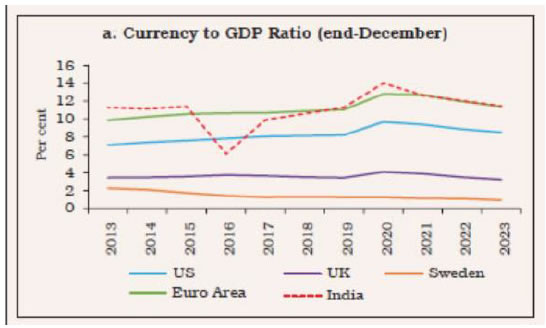 ‘Cash continues to remain relevant’. The Cash to GDP ratios of India and the G20 countries also signify the importance of cash which is exhibited in the charts below: Basic Glossary -
Currency in Circulation: Currency in Circulation includes bank notes in circulation, rupee coins and small coins. Rupee coins and small coins in the balance sheet of RBI include one-rupee coins issued since October 1969, two-rupee coins issued since November 1982, five-rupee coins issued since 1992, ten-rupee coin issued since 2005 and ₹20 coins issued since 2019. -
Notes in Circulation: The notes in circulation comprise the notes issued by the Government of India up to 1935, and by RBI since then, less notes held in the Banking Department, i.e. notes held outside the RBI by the public, banks treasuries etc. The Government of India one rupee notes issued since July 1940 are treated as rupee coins and hence are not included under this head. Being the sole authority to issue bank notes, it is obligatory on the RBI to ensure adequate and timely supply of clean notes in the system to cater to the demand for bank notes. Evolution of Paper Currency in the Country In India, coins of various design, form and material, have been used as a medium of exchange since ages. Paper currency made its appearance in the later part of the 18th century, when it was introduced in the form of promissory notes by the royal treasuries / banks. These paper currencies / notes were issued by Bank of Hindostan (1770-1832), General Bank of Bengal and Bihar (1773-75), Bengal Bank (1784-91), the Commercial Bank (1819-1828), etc. The responsibility of issuance of currency notes, which was dispersed amongst the private and the Presidency banks, was conferred solely upon the Government of India by the Paper Currency Act, 1861. After the consolidation of the issue function at the Currency Department of the Government, several currency circles were created to cater to the currency needs of the entire geographical area of the country. The Presidency banks were appointed as agents for issue and redemption. In 1913, the Office of Controller of Currency was established replacing the Currency Department in the Government. With the enactment of the RBI Act, 1934, the function of issue of bank notes was taken over by the RBI from the Controller of Currency in 1935. Since then the RBI is the nation's sole bank note issuing authority and responsible for the country's currency management (Section 22 of the RBI Act 1934). The initial notes were printed in England and the production of currency notes in India started with the establishment of the currency printing press at Nashik in Maharashtra in 1928. The same was augmented with the setting up of another government press at Dewas in Madhya Pradesh (MP) in 1974. Meanwhile, in 1968, Security Paper Mill with a capacity of 1500 metric tonne per year was established at Hoshangabad in MP. To bridge the gap in demand and supply of currency notes necessitated by the increasing currency requirements of growing economy, the RBI, in 1995 established a wholly owned subsidiary Bharatiya Reserve Bank Note Mudran Private Limited (BRBNMPL). In 1996, BRBNMPL established two currency presses - one in Mysuru in Karnataka and the other at Salboni in West Bengal to augment the country’s bank note production capacity. With the full capacity utilization of these two presses of BRBNMPL, the country has become self-reliant in bank note printing. BRBNMPL has contributed immensely to achieving strategic objectives in the field of currency management by indigenously designing the Mahatma Gandhi (New) Series banknotes and continuing with extensive automation and Enterprise Resource Planning. SPMCIL and BRBNMPL have jointly set up the Bank Note Paper Mill India Private Limited (BNPMIPL), an entity producing Cylinder Watermarked Bank Note (CWBN) paper required for banknote production. Similarly, BRBNMPL has also set up an ink factory Varnika at Mysuru with an annual production capacity of 1,500 metric tonnes, which has started its commercial production from August 2018. Consequently, offset, intaglio, numbering and colour shifting inks used in the printing of bank notes are being manufactured at the Mysuru ink factory. The BNPMIPL and the BRBNMPL ink factory are significant milestones achieved in the efforts towards ‘Make in India’ programme and indigenisation of production of new bank notes. Currency Management Architecture Currency Management is the process of managing the life cycle of the bank notes, which includes assessing the printing requirement of various denominations of bank notes, placing indents with the printing presses, supplying and distributing adequate quantity of currency throughout the country and ensuring the quality of bank notes in circulation by continuous supply of clean notes and timely withdrawal of soiled notes. Section 23 of the RBI Act, 1934, mandated that the function of issuance of bank notes is to be conducted by the RBI through a separate department called Issue Department. Hence, the RBI has separate Issue Departments at its Regional Offices to manage the operational part of the currency management function, while the overall management is carried out by the Department of Currency Management (DCM) located at its Central Office in Mumbai. In addition to the 19 Issue Offices (located at Ahmedabad, Bengaluru, Bhopal, Belapur, Bhubaneswar, Chandigarh, Chennai, Guwahati, Hyderabad, Jaipur, Jammu, Kanpur, Kolkata, Lucknow, Mumbai, Nagpur, New Delhi, Patna and Thiruvananthapuram), the RBI is supported in this function by a network of Currency Chests (CCs) and Small Coin Depots (SCDs), bank branches and ATMs spread over the country. Currency Chests / Small Coin Depots are storehouses of bank notes and rupee coins / small coins located at branches, mostly of commercial banks, though there are a few currency chests established at State Co-operative Banks, Regional Rural Banks, Urban Co-operative Banks and one at RBI (Kochi). The CCs are extended arms of RBI that help in the distribution as well as retrieval of currency from the system and are responsible for meeting the currency requirements of their respective regions. Designing of Notes The design, form and material of bank notes are decided by the Government of India based on the recommendations of the Central Board of RBI, as specified in Section 25 of the RBI Act, 1934. Special care is taken in the choice of the size, colour and design of the notes to enable the public to distinguish the notes of different denominations at a glance. At the same time, care is taken to incorporate improved security features in the bank notes thereby rendering it difficult to counterfeit them. Currently, bank notes of various denominations are issued in the Mahatma Gandhi (New) series. Mahatma Gandhi (New) Series Bank Notes In line with the international practice of periodically reviewing and upgrading the design and security features of bank notes, a new series (Mahatma Gandhi New Series) of bank notes in new design, dimensions and denominations, highlighting the cultural heritage and scientific achievements of the country, was introduced during the year 2016-17. Bank notes in the denominations of ₹10, ₹20, ₹50, ₹100, ₹200, ₹500 and ₹2000 have since been introduced. A few other elements added in these notes are numerals in Devanagari and the logo of Swachh Bharat. The new notes also have design elements in myriad and intricate forms and shapes. While the security features in the current series of bank notes, continue to remain, their relative positions have changed in the new design bank notes. | Denomination | Colour | Size | Motif | Identification mark | Bleed Lines | | 2000 | Magenta | 166 mm x 66mm | Mangalyaan | Horizontal Rectangle | Seven angular bleed lines | | 500 | Stone Grey | 150 mm x 66mm | Red Fort with the Indian flag | Circle | Five angular bleed lines | | 200 | Bright Yellow | 146 mm × 66 mm | Sanchi Stupa | H | Four angular bleed lines with two circles in between | | 100 | Lavender | 142 mm× 66 mm | Rani ki Vav | Triangle | Four angular bleed lines | | 50 | Fluoresce nt Blue | 135 mm x 66 mm | Hampi with Chariot | - | - | | 20 | Greenish Yellow | 129x 63mm | Ellora Caves | - | - | | 10 | Chocolate Brown | 123 mm x 63 mm | un Temple, Konark | - | - | Planning the Annual Requirement The quantity of notes that is required to be printed is decided by the RBI in consultation with GOI. The major drivers of currency demand are economic activity as proxied by the real GDP growth, inflation, interest rate, growth of digital payment etc. The projection of banknotes and coins are carried out to finalize the annual indent. As regard to the bank notes, the total demand is arrived at after consolidating two components viz., incremental demand (or transactional demand) and replacement demand. Incremental demand is estimated by combining different econometric models. The replacement demand is projected based on the denomination-wise estimated lifespan of bank notes. Replacement rates of bank notes are computed as reciprocal of average lifespan in years. Finally, the total demand projection is arrived at by adjusting for contingency demand (in case of emergency) keeping view of the existing stock of currency at RBI and CC. The demand for coins is forecasted separately using econometric model. In case of coins, only incremental demand is required to be considered on account of much longer life of coins. Distribution of Currency For distribution of currency, there are three currency distribution models prevalent in different countries of the world: -
Wholesale model – Under the wholesale model, as prevalent in Australia, the commercial banks purchase bank notes directly from the central bank. These banknotes are transported and stored by the banks at approved cash centres located throughout Australia. -
Retail model – Under the retail model, as practised in China and France, the central bank opens its own stocking points to take care of the currency needs of the public and other institutions. -
Semi-retail model – Like most central banks, India has adopted the semi- retail model under which its currency notes are made available to currency chest branches of banks at their doorsteps. The transportation and other moving costs are borne by the central bank. The banks are required to bear only the static cost of maintaining the currency chest. The notes and coins are distributed, in the semi-retail model, by the network of the RBI Issue Offices, CCs/SCDs, bank branches and ATMs in the following manner: To facilitate the distribution of bank notes and rupee coins across the country, the RBI has authorised select banks/branches of banks to establish currency chests. These currency chests, as mentioned earlier, are storehouses where bank notes and rupee coins are stocked on behalf of the RBI. It is ensured that the currency chests at bank branches, contain adequate quantity of notes and coins so that currency is readily accessible to the members of the public in all parts of the country. These currency chests are supplied with periodical remittances of fresh / re-issuable banknotes and rupee coins from Reserve Bank's Issue Offices/ directly from bank note presses. The Agency banks / linked bank branches draw upon them for meeting local requirements. Surplus and non-issuable notes (including ₹1 notes and coins) are deposited into the currency chests. The notes and coins are pushed into or taken out of circulation through the Issue Offices of RBI and the various currency chests. Currency chests are supervised by RBI under an onsite/ offsite supervisory framework. 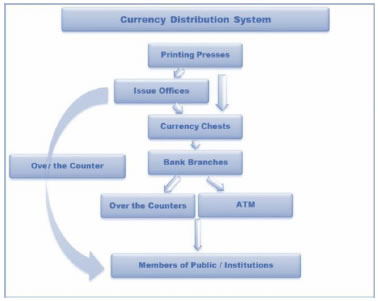 RBI is slowly withdrawing from the retail distribution of currency by ensuring easier access to exchange facilities to the customers through nearby bank branches. Banks have been advised to strengthen their distribution mechanism so as to cater to the growing needs of the currency for the general public. Clean Note Policy RBI has put in a mechanism wherein, notes that have become dirty / soiled / torn due to excessive usage, are taken out of circulation. RBI has a mandate as per the Section 27 of the RBI Act, 1934, to ensure that only clean notes are in circulation and to fulfil this mandate the soiled notes are taken out of circulation and are sent back to Issue Offices for further verification and processing before destruction. RBI uses the Currency Verification and Processing System (CVPS) for mechanised on-line examination, authentication, counting, sorting and destruction of notes received. After processing, the non-issuable notes are automatically sent from the CVPS to the Shredding and Briquetting System (SBS). The SBS after shredding the notes, converts them into briquettes. The mechanism in which the dirty or soiled notes are retrieved and processed from the system is as shown below: Exchange of Notes As part of its mandate to ensure that only clean notes are in circulation, RBI undertakes the responsibility of exchanging the soiled and torn banknotes both at its Issue Offices as well as at the bank branches, to whom the function has been delegated. Basically, there are two categories of notes which are exchanged by banks and the RBI – soiled notes and mutilated notes. While soiled notes are notes that have become dirty and limp due to excessive use and also includes a two-piece note pasted together wherein both the pieces presented belong to the same note, and form the entire note, a mutilated note means a note of which a portion is missing or which is composed of more than two pieces. Soiled notes can be tendered and exchanged at all bank branches. Similarly, the facility of exchanging mutilated / imperfect notes (a note which is wholly or partially obliterated, shrunk, washed, altered or undecipherable but does not include a mutilated note) under Reserve Bank of India (Note Refund) Rules (NRR, 2009), [as amended by Reserve Bank of India (Note Refund) Amendment Rules, 2018] is available at all the bank branches from January 2013 onwards. All branches of banks have been delegated powers under Rule 2(j) of Reserve Bank of India (Note Refund) Rules, 2009 for exchange of mutilated / defective notes. Small Finance Banks (up to two years from the commencement of their banking business) and Payment Banks may exchange mutilated and defective notes at their option. The procedure for such exchange has been amended in 2018. After adjudication as per the NRR, 2009, either full or no value is paid for notes of denominations up to ₹20, while notes of ₹50 and above would get full, half, or no value, depending on the area of the single largest undivided piece of the tendered note. Additionally, adjudication under Special Procedure exist at the RBI Issue Offices for notes which have turned extremely brittle or badly burnt, charred or inseparably stuck together and, therefore, cannot withstand normal handling. Dealing with Counterfeit notes / Fake Indian Currency Notes (FICNs) Counterfeit money refers to fake or imitation currency that is produced with an aim to deceive. Counterfeiting of currency is a crime that continuously poses a threat to a country's economy and is a source of financial loss to its citizens. Some of the ill-effects that counterfeit money has on society are reduction in the value of real money, increase in prices (inflation) due to more money getting circulated in the economy – an unauthorised artificial increase in the money supply, a decrease in the acceptability of paper money and losses for members of public whose counterfeit money is confiscated. In countries where paper money is a small fraction of the total money in circulation while the macroeconomic effects of counterfeiting of currency may not be significant, the economic effects, such as confidence in currency, may be large. In India, Section 178 – 182 of The Bharatiya Nyaya Sanhita, 2023 deals with counterfeiting currency notes or bank notes. Under the law, counterfeiting, trafficking and even possessing of counterfeit notes knowingly is liable for punishment. The definition of 'counterfeiting' in The Bharatiya Nyaya Sanhita, 2023 also covers currency notes issued by a foreign government authority as well. The Government of India has also framed Investigation of High-Quality Counterfeit Indian Currency Offences Rules, 2013 under Unlawful Activities (Prevention) Act (UAPA), 1967. The Third Schedule of the Act defines High Quality Counterfeit Indian Currency Note i.e. Presence of Watermark(s), Security thread and any one of the following features: (a) Latent image; (b) See through registration; (c) Print quality sharpness; (d) Raised effect; (e) Fluorescent characteristics; (f) Substrate quality; (g) Paper taggant; (h) Colour shift effect in OVI; (i) Colour shift effect in security thread. Activity of production or smuggling or circulation of Indian paper currency has been brought under the ambit of The Bharatiya Nyaya Sanhita, 2023. To combat the incidence of counterfeit notes, the RBI, in consultation with the Government of India, continuously and periodically reviews and upgrades the security features of the bank notes to deter counterfeiting. It also shares information with various law enforcement agencies to address the issue of counterfeiting. The RBI has taken certain measures to create public awareness about the security features of bank notes and to educate the general public to help prevent circulation of forged or counterfeit notes. Basic information on features of Indian Bank Notes is presently hosted on the microsite https://paisaboltahai.rbi.org.in. It has also issued detailed guidelines to banks on how to detect and impound counterfeit notes. It has also instructed the banks that: -
Bank notes tendered over the counter / received directly at the back office / currency chest through bulk tenders should be examined for authenticity through machines. -
Credit should not be given to customer's account for forged notes, if any, detected in the tender received over the counter or at the back-office / currency chest. -
In no case, the counterfeit notes should be returned to the tenderer or destroyed by the bank branches / treasuries. -
For cases of detection up to four counterfeit note pieces, in a single transaction, a consolidated report has to be made at the end of the month to the police authorities along with the suspect counterfeit notes. -
For cases of detection of five counterfeit note pieces or more, in a single transaction, the notes should be forwarded to the police station immediately for investigation by filing of FIR. Security Features of Indian Bank Notes Counterfeiting is one of the major issues plaguing the issuers of currency notes. Latest growth in computer technologies and photography, along with the accessibility to low-cost tools, has made the manufacturing of counterfeit money relatively easy. To prevent this menace and always stay one step ahead of the counterfeiters, RBI is updating its currency regularly by adding security features to the bank notes. These security features make the bank notes less prone to counterfeiting. The following are the various security features of the new MG series bank notes: i) Watermark: This consists of an image that is visible when the bank note is held up against the light, which is created during the manufacturing process such that it is an integral part of the paper. The bank notes contain the Mahatma Gandhi portrait with the denomination numeral (electrotype) watermark. ii) Security Thread: Colour shifting windowed security thread is present in denomination of ₹100 and above, the colour of which changes from green to blue when the note is tilted. The inscriptions ‘भारत’ ‘RBI’ is present in denominations of ₹100, 200, and 500. In ₹2000 the inscriptions are ‘भारत’ ‘RBI’ ‘2000’. For ₹10, 20 and 50 denominations, windowed demetalised security thread with inscriptions ‘भारत’ and ‘RBI’ is present. iii) Latent Image: The latent image is a security feature that is concealed within the note. It is visible only when it is held horizontally at eye level. In notes of denomination ₹100 and above, the latent image with the numeral of the denomination is visible at the bottom left-hand corner, when the note is held at 45 degree angle from the eye level. iv) Micro lettering: Micro lettering are minute inscriptions which can be only read under a microscope / magnifying lens of higher capacity. This feature appears on the left shoulder of the Mahatma Gandhi portrait with inscriptions ‘India’ and ‘भारत’. Micro letters can also be seen on the motifs in the reverse side of the notes. v) Intaglio Printing: Raised printing which are due to deposits of ink and can be felt on touch are called intaglio printing. In notes of denominations of ₹100 and above, the portrait of Mahatma Gandhi, the Ashoka Pillar Emblem, Guarantee clause, Governor’s signature, Promissory clause, RBI Emblem, bleed lines and the identification marks are in intaglio. vi) See through Register: The see-through register is a design that is printed partially on both sides of the note, exactly opposite of each other, and looks like one single design when seen against the light. vii) Fluorescence: This is a special security feature in which optical fibres and florescent ink is used which glows when exposed to ultraviolet light. The number panels of the notes are printed in fluorescent ink and the note also contains optical fibres, both of which glow when the note is held under an ultraviolet lamp. The optical fibres are dual coloured (i.e., each fibre shows two colours) and are in combination of red/yellow and blue/green. viii) Colour Shifting Ink: The rupee symbol and the denomination in the bank notes of denomination ₹200 and above is written in the obverse of the note in colour shifting ink (green to blue). ix) Ascending font of numbers: This is a new feature wherein the font size of the number (excluding prefix) in the number panel is increasing from left to right. x) Angular Bleed Lines: This feature is seen in the notes issued since 2016. It is a set of lines in raised prints at the left-hand corner of the note slightly above the Ashoka Emblem. The number and blocks/sets of these lines vary as per the denomination - 4 lines (in 2 sets of 2) in notes of ₹100, 4 lines (in sets of 2 separated by two circles) in notes of ₹200, 5 lines (sets of 2-1- 2) in ₹500, 7 lines (sets of 1-2-1-2-1) in ₹2000. Salient Features of a Bank Note Apart from the security features there are a few salient/essential features of a bank note. They are: -
Name of the Issuer – Name of the issuing authority, viz., the Reserve Bank of India in Hindi and English at the top of the note. -
Guarantee Clause – The clause which states that the note is guaranteed by the Government of India. -
Promissory Clause – The clause by which the signatory of the note promises to pay the bearer the sum of the amount mentioned in the note. -
Signature of the Issuer – The signature of the Governor of RBI. -
Number Panel - The unique number for each note which is a six digit one, prefixed by three alpha numerical digits. A special distinct font is used and the spaces between the numbers are evenly distributed. -
Denomination – The denomination of the currency in numerals. -
Portrait of Mahatma Gandhi – Portrait of Mahatma Gandhi at the centre. -
Language Panel – Denomination written in 15 languages on the reverse of the note. As mentioned earlier, the Reserve Bank is actively taking forward the process of introduction of new/ upgraded security features for banknotes. At the behest of the Reserve Bank, BRBNMPL is also establishing a Currency Research and Development Centre (CRDC) at its Mysuru campus for conducting advanced research in the domain of currency. As the first phase of this, an adversarial analysis laboratory has been operationalised at the Mysuru campus of BRBNMPL for conducting cutting edge research on bank notes to assess counterfeiting deterrence resistance through in-house simulation of bank note features by trained experts/technicians using commercially available materials and equipment. Demonetisation Demonetisation is the act of stripping a currency unit of its status as legal tender. It is the act or process of removing the legal status of currency unit. From the date of demonetisation, all currencies which are demonetised cease to be a legal tender. Such currency is no longer money and cannot be used to do any transaction. Many countries have adopted this process of demonetisation to overcome hyperinflation, to curb black money, to foster economic stability, to remove counterfeit currency, etc. In India, the first demonetisation took place in the year 1946, when higher denomination notes of ₹500, ₹1000 and ₹10000 notes were demonetised on January 12, 1946. However, subsequently ₹5000 was introduced and ₹1000 and ₹10000 notes were reintroduced. However, these three denominations were subsequently demonetised on January 16, 1978. Later in 2016 the legal tender character of bank notes in the denominations of ₹500 and ₹1000, referred to as Specified Bank Notes (SBNs), was withdrawn by Government of India vide Gazette Notification No. 3407 (E) of November 8, 2016. An ordinance on Specified Bank Notes (Cessation of Liabilities) was promulgated on December 30, 2016 (subsequently made into an Act), stipulating that SBNs shall cease to be liabilities of the RBI under Section 34 of the RBI Act and shall cease to have the guarantee of Central Government under sub-section (1) of Section 26 of the Act with effect from December 31, 2016. However, grace periods were provided for exchange of these notes by Non- Resident Indians and Resident Indians who were out of the country during the specified period vide various Gazette notifications subject to conditions specified therein. The Government of India also issued Specified Bank Notes (Deposit of Confiscated Notes) Rules, 2017 dated May 12, 2017, for deposit of SBNs confiscated / seized by law enforcement agencies before December 30, 2016. Central Bank Digital Currency (CBDC) In terms of Section 22A of the RBI Act, 1934, denominations as set out in Section 24 of the Act, do not apply to bank notes in digital form. Accordingly, the live-pilot of Digital Rupee-Retail (e₹-R) has been launched in denominations of 50 paise, ₹1, ₹2, ₹5, ₹10, ₹20, ₹50, ₹100, ₹200, ₹500 and ₹2000, while e₹-Wholesale (e₹-W) does not have any specific denomination. The live pilot of e₹-R, launched on December 1, 2022, gained momentum during the year 2023-24 and as on March 31, 2024, 237.8 lakh pieces of e₹-R are in circulation and together with value of ₹5.70 crore e₹-W (which will not have denomination) in circulation, the total value of e₹in circulation stood at ₹234.04 crore. Recent Developments MANI (Mobile Aided Note Identifier) Keeping in mind the concurrent circulation of both the MG Series and MG (New) Series, the Bank embarked upon exploring alternative technological solutions to help the visually challenged in identifying the denomination of bank notes. Accordingly, in January 2020, it launched the mobile application “MANI Mobile Aided Note Identifier” thereby making Indian banknotes more accessible for the visually impaired and facilitating their day-to-day transactions. In 2023-24, a pan India radio campaign through Akashvani/ Vividh Bharti/private FM radio channels was conducted to promote on the MANI App. The mobile application developed by RBI has the following features: -
Capable of identifying the denominations of Mahatma Gandhi Series and Mahatma Gandhi (New) series bank note by checking front or reverse side/part of the note including half folded notes at various holding angles and broad range of light conditions (normal light/day light/low light/ etc.). -
Ability to identify the denomination through audio notification in Hindi/English and non-sonic mode such as vibration (suitable for those with vision and hearing impairment). This was later improvised in 2022-23 to enable the app notify the banknote denomination in 11 regional languages apart from Hindi and English. -
After installation, the mobile application does not require internet and works in offline mode. -
Ability to navigate the mobile application via voice controls for accessing the application features wherever the underlying device & operating system combination supports voice enabled controls. -
The application is free and can be downloaded from the Android Play Store and iOS App Store without any charges/payment. -
This mobile application does not authenticate a note as being either genuine or counterfeit. Integration of Currency Management Functions with Core Banking Solution The earlier Integrated Computerised Currency Operations & Management System (ICCOMS) at the Reserve Bank and currency chests has been replaced with a new currency management module (CyM) in the Bank’s Core Banking Solution (e-Kuber). Some of the salient features of the new module include improved inventory management, near real time accounting of currency chest transactions, transit accounting and better tracking of CIC. The integration project is to be implemented in three phases. The Phase I and Phase II that involve on-boarding of all the active currency chests (CCs) in CyM along with all 19 Regional Offices (ROs), is already completed and with this, the accounting of currency transactions is reflected in the Reserve Bank’s books in near real time basis. Increasing Incentives for Distribution of Coins Currency Distribution and Exchange Scheme (CDES) for banks was reviewed wherein the incentive for distribution of coins was increased from ₹25 to ₹65 per bag. An additional incentive of ₹10 per bag will be payable for coin distribution in rural and semi-urban areas. While the need of engaging business correspondents (BCs) and cash in transit (CIT) companies by banks for distribution of coins was re-emphasised, banks were also advised to provide coins to bulk customers which was not permitted earlier. Procurement of New Shredding and Briquetting Systems (SBS) After replacement of the existing CVPS machines with new CVPS machines for increased processing speed, four-way orientation and other advantages, RBI is moving towards procurement of new shredding and briquetting systems for 21 regional offices by placing orders following due tendering process. Delivery and installation of these SBS machines will commence from Q1:2024-25 and is likely to be completed in the next two years for all the offices. Scheme of Penalty for Non-replenishment of ATMs A scheme of penalty for non-replenishment of ATMs was introduced in 2021-22 for banks/White Label ATM Operators (WLAOs) to ensure that sufficient cash is made available to the public through ATMs. Awareness Campaign on Exchange of Banknotes and Acceptance of Coins To create awareness and disseminate information on customer services, a campaign was undertaken on ‘Exchange of Banknotes’ through SMS, FM radio and digital media (website). With the objective of encouraging wider acceptance of coins by the public, the Reserve Bank undertook during the year, a campaign for dispelling misconceptions and allaying fears on coins of different designs of the same denomination in circulation. Mobile Coin Vans (MCVs) for Distribution of Coins – Expansion in Geographical Reach and Operational Scope To enhance distribution of coins, the scheme of MCVs operating in select states was initiated on a pilot basis from Oct 01, 2022 and has been extended now across the country. Additionally, the scope of services has been broadened to facilitate the exchange of lower denomination notes, which are unfit for circulation. These MCVs distribute coins and bank notes to the public located particularly in semi-urban, rural and remote areas. Pilot Project on QR Code-based Coin Vending Machine To enhance the accessibility of coins to the public, the Reserve Bank has conceptualized, in 2022-23, a pilot project on a dynamic Quick Response (QR) code-based coin vending machine (QCVM), which is a cashless coin dispensation system using the UPI. Report on currency network design; mechanisation and automation and scheduling and inventory management An action plan has been formulated for redesigning and modernising the currency management architecture through use of network optimisation, technological solutions, automation and business process re-engineering, for achieving higher efficiency in currency management. The project involving various stakeholders would be implemented in phases. Withdrawal of ₹2000 denomination bank notes The ₹2000 denomination bank note was introduced in November 2016 under Section 24(1) of Reserve Bank of India Act, 1934 (RBI Act) primarily with the objective of meeting the currency requirement of the economy in an expeditious manner after withdrawal of the legal tender status of all ₹500 and ₹1000 bank notes in circulation at that time. With fulfilment of that objective and availability of bank notes in other denominations in adequate quantities, printing of ₹2000 bank note was stopped in 2018-19. A majority of the ₹2000 bank notes was issued prior to March 2017 and are at the end of their estimated lifespan of 4-5 years. It was also observed that this denomination was not commonly used for transactions. In view of the above, and in pursuance of the “Clean Note Policy” of the Reserve Bank of India (RBI), it was decided to withdraw ₹2000 denomination bank note from circulation. Initially, the facility for deposit and / or exchange of the ₹2000 bank notes was available at all bank branches as well as under exchange route at Issue Offices of RBI in the country up to October 07, 2023. From October 09, 2023, RBI Issue Offices are also accepting ₹2000 bank notes from individuals / entities for deposit into their bank accounts. Further, members of the public from within the country are sending ₹2000 bank notes through India Post from any post office in the country, to any of the RBI Issue Offices for credit to their bank accounts. The total value of ₹2000 bank notes in circulation, which was ₹3.56 lakh crore at the close of business on May 19, 2023, when the withdrawal of ₹2000 bank notes was announced, has declined to ₹7409 crore at the close of business on July 31, 2024. Thus, 97.92% of the ₹2000 bank notes in circulation as on May 19, 2023, has since been returned. STAR series bank notes Survey on the usage of Notes and Coins In the evolving scenario of growth in retail digital payments coupled with continued increase in demand for cash, a survey was conducted in 2023 to understand the usage and preference for cash, coins, factors influencing demand and to assess the shortage/surfeit of cash and coins. Overall, the survey indicated that, while cash remained prevalent, the digital modes of payment were gaining traction among the public. A Box Item on the survey was published in the Annual Report of the Bank for 2023-24. Chapter 15: Banker to Banks and Governments The powers and range of functions of central banks vary from country to country. But there are certain functions like ‘Banker to Banks’ and ‘Banker to Governments’ which are commonly performed by the Central Banks. In our country too, RBI acts as the ‘Banker to Banks’ and the ‘Banker to Governments’. Banker to Banks Like individual consumers, businesses and organisation of all kinds, banks need their own mechanism to transfer funds and settle inter-bank transactions. As a banker to banks, the Reserve Bank fulfills this role. While discharging this role, RBI focusses on -
enabling smooth, swift and seamless clearing and settlement of inter-bank transactions -
providing an efficient means of funds transfer for banks -
enabling banks to maintain their accounts with the Reserve Bank for statutory cash reserve requirements -
acting as a lender of last resort in case of need As a lender of last resort, it can come to the rescue of a bank that is solvent but faces temporary liquidity problems by supplying it with much needed liquidity when no one else is willing to extend credit to that bank. The Reserve Bank extends this facility to protect the interest of the depositors of the bank and to prevent possible failure of the bank, which in turn may also affect other banks and institutions and can have an adverse impact on financial stability and thus on the economy. Legal Provisions -
Sec.17 of RBI Act, 1934 – Business which the bank can transact including transactions with banks. -
Sec.42 of RBI Act, 1934 – Maintenance of Cash Reserves by banks with RBI. Maintenance of current accounts of banks Banks and financial institutions which are eligible to open account with the Bank can normally open only a single Current Account. The entities having current account are required to maintain a minimum balance. The entities maintaining an account with the Bank fall into one of the following categories: -
Banks viz., Scheduled Banks & Non-Scheduled Banks. -
Indian Financial Institutions, viz., Primary Dealers, Insurance Companies, Mutual Funds, RBI Officer/ Staff Credit Cooperative Societies, etc. -
Foreign Institutions, viz., Foreign Central Banks, Supranational Institutions, International Organizations, etc. -
Any other entities as approved by the Bank. Purpose Current accounts are opened in the E-Kuber system (CBS) at the Regional Offices of RBI, where the Head Office / Corporate Office of the entity is located. The current accounts are used for the following purposes: -
Maintenance of CRR by banks -
Interbank settlements and other Inter-institutional funds transfer among the entities maintaining current accounts with RBI -
Making payments to RBI and Govt. Departments. Restrictions Third party transactions are not allowed in the current accounts. Overdrafts, including intra-day overdrafts are also not permitted in the current accounts. Special Purpose accounts Financial Institutions/banks maintaining current account with RBI may require an additional account for some specific purpose. Such special purpose accounts can be opened at any Regional Office depending on the request and with the approval of the Central Office Department concerned. RTGS Settlement accounts In addition to current account, the banks also maintain a separate ‘Settlement Account’ for RTGS transactions in RTGS system which is centrally maintained by Mumbai Regional Office (MRO). Accounts of Institutions incorporated outside India In terms of Section 17(13) of RBI Act 1934, RBI is authorised to act as agents/correspondents of banks and institutions incorporated outside India and can open Rupee Accounts for them. Such accounts are opened in any of the Regional Offices. The policy in respect of opening of such accounts, maintenance of minimum balances, types of debit and credit etc., is laid down by the Central Office Department concerned at whose request such accounts are to be opened. Following are some of the International Institutions that maintain current account with the RBI. -
International Monetary Fund (IMF) -
International Bank for Reconstruction and Development (IBRD) -
International Development Association (IDA) -
Asian Development Bank (ADB) -
African Development Fund (ADF) Operations in current accounts of foreign central banks, international institutions, supranational institutions will be guided by the instructions of the Central Office Department concerned. Granting loans and advances to banks and others The Bank is authorized to make loans, grant advances to and discount bills of scheduled banks, State Co-operative Banks and various other institutions, details of which are given in various sub-sections of Section 17 and 18 of the Reserve Bank of India Act, 1934. The types of loans and advances that can be granted and the entities to whom such loans and advances can be made are detailed in Sections 17 and 18 of the RBI Act, 1934. Accordingly, the banks can avail liquidity facility from RBI under Repo / Term Repo / Marginal Standing Facility (MSF) against the Government Securities as collateral. Apart from this facility, banks and other financial institutions such as NABARD, EXIM, SIDBI, etc., are eligible for loans and advances under various provisions of Section 17 of RBI Act, 1934. The Primary Dealers maintaining current accounts with RBI can also avail liquidity support facility and avail Repo/Term Repo. Banker to Governments Being the Banker to the government is one of the key functions of the RBI. Like individuals, businesses and banks, Governments need a banker to carry out their financial transactions in an efficient and effective manner, including the raising of resources from the public. Since its inception, the RBI has undertaken the traditional central banking function of managing the Government's banking transactions. The central bank also serves as an agent and adviser to the Government. As agent of the Government, it is entrusted with the task of managing the public debt and the issue of new loans and Treasury Bills on behalf of the Government. By acting as financial adviser to the Government, it advises the Government on important matters of economic policy such as deficit financing, devaluation of currency, trade policy, foreign exchange policy, etc. The conduct of Government business is also governed by the Central Government Treasury Rules, Treasury Rules of the State Government and instructions issued from time to time by Controller General of Accounts, Comptroller & Auditor General (C&AG) and other Departments of Central and State Governments. Legal Provisions: Under Sections 20 and 21 of the RBI Act, the RBI shall have an obligation and right respectively to accept monies for account of the Central Government and to make payments up to the amount standing to the credit of its account, and to carry out its exchange, remittance and other banking operations, including the management of the public debt of the Union. In terms of Sec.21A of the Act, the RBI can transact the banking business of State Government through an agreement with the respective State Governments. All State Governments, except the State of Sikkim, have entered into agreements with the RBI and the RBI performs the role of banker to these governments. For Sikkim, there is a limited agreement for management of its public debt. Sec.45 of the RBI Act, 1934, empowers RBI to appoint agency banks for conduct of Government Business as RBI has limited presence across the country. Banker to Central Government Under the administrative arrangements, the Central Government is required to maintain a minimum cash balance with the RBI. The following accounts of Central Government are maintained in E-Kuber (CBS) system in all the Regional Offices of RBI and the Principal account of these accounts are maintained at Central Accounts Section (CAS), RBI, Nagpur. -
Central Government - Civil; -
Railway Fund; -
Post Fund; -
Telecommunication Fund; -
Defence Fund; -
Departmentalised Ministries; -
Agency Transaction Account All receipts, payments /disbursements, clearing/remittance transactions take place through these accounts. Banker to State Governments The Principal account of all State Governments except Sikkim is maintained at CAS, Nagpur under the account titled “Government Deposit Account – State”. The minimum balance required to be maintained by each State varies from State to State depending on the relative size of the State budget and economic activity. A standardized e-Receipt and e- Payment model for State Governments has been rolled out by RBI that is discussed at the end of this Chapter. As on July 31,2024, 25 State Governments & 2 Union Territories are integrated with e-kuber for e-payments and 18 State Governments are integrated with e-kuber for e-receipts under agency bank reporting model and / or direct NEFT/RTGS model. Types of Accounts maintained Government departments will maintain one or more of the following types of accounts with RBI. Personal Ledger Account: These are in the nature of current account. Such accounts will be opened in the name of Government Officers specified, for the purpose of booking receipts and drawings on their behalf. The essential condition is that the drawings will be permitted to the extent of balances available in the account. -
Drawing Account: These accounts will be maintained for Government Officers who are permitted to operate on Government balances without limit of amount. Most of the government accounts maintained with the Bank pertain to this category. -
Assignment Accounts / Letter of Credit Account: These are only drawing accounts, which will be maintained by offices for Government Officers to whom a certain sum is allotted by the Pay and Accounts Officer/audit office concerned for a specified period. Payments on behalf of drawing and disbursing officers during the specified period will not exceed the amount of assignment or letter of credit. Appointment of Agency Banks Right from commencement of RBI's operations (April 1, 1935), the Imperial Bank of India functioned as the RBI's agent from day one (April 1, 1935) for the first two decades at centres where RBI did not have direct presence. The agency role then passed on to State Bank of India when it came into existence in July 1955. Under a scheme introduced in 1976, every ministry and department of the Central Government has been allotted a specific public sector bank for handling its transactions. Hence, the Reserve Bank does not handle Government’s day-to-day transactions except where it has been nominated as banker to a particular ministry or department. In terms of Section 45 of RBI Act, 1934, unless otherwise directed by the Central Government with reference to any place, RBI may, having regard to public interest, convenience of banking, banking development and such other factors which in its opinion are relevant in this regard, appoint the National Bank or the State Bank or a corresponding new bank constituted under section 3 of the Banking Companies (Acquisition and Transfer of Undertakings) Act, 1970, or a corresponding new bank constituted under section 3 of the Banking Companies (Acquisition and Transfer of Undertakings) Act, 1980, or any subsidiary bank as defined in the State Bank of India (Subsidiary banks) Act, 1959as its agent at all places, or at any place in India for such purposes as the Bank may specify. The Government of India had, in terms of Section 45(1) of the Reserve Bank of India Act, 1934, notified on April 17, 2000, that the Reserve Bank may appoint any scheduled bank or the Stock Holding Corporation of India Limited as its agent at any place in India. Accordingly, all the public sector banks and a few private sector banks have been appointed as agents to maintain accounts of Central Government and State Government for conducting their business. Further in 2021, RBI in consultation with the Department of Financial Services, Ministry of Finance, Government of India decided to make scheduled payments banks and scheduled small finance banks eligible to conduct Government agency business. As on date the Reserve Bank has appointed 12 public sector banks, 20 private sector banks and 01 foreign sector bank (WOS) as its agency banks for conducting Government banking business. While the Central Government account transactions are directly reported by the agency banks to CAS, Nagpur, and to Mumbai Regional Office [eg. GST, ICEGATE (Indian Customs EDI Gateway), TIN 2.0 (Direct Taxes), NTRP (Non-tax Receipt Portal collections) etc.], the State Government transactions are reported to the Regional Offices of RBI of the respective State, who maintain the account details under the account head ‘Agency Transaction Account-State’. The balance in these Central Government and State Government accounts are transferred to their respective PGDA accounts maintained in CAS, Nagpur on 1st and 5th respectively of every month except for the Annual Closing (i.e., in the month of April as the same is to be done as per the directions of Government). The agency banks are paid agency commission for the Government business work being handled by them. Inspection of these agency banks are also carried out at periodic intervals by RBI to assess their adherence to instructions on handling Government business. Reserve Bank does not receive any remuneration, other than holding their interest-free minimum balances, for performing ordinary banking functions for the Central and State Governments. Role of Government agencies The Government of India and the State Governments have various agencies responsible for the conduct of its banking and, therefore, continuously interact with the Reserve Bank of India. Two of the main institutions in this regard are the Offices of the Controller General of Accounts (CGA), and the Comptroller and Auditor General (C&AG). The accounting related work of non-civil ministries (Railways, Defence, Post, and Telecom) are undertaken by the respective accounting authorities, viz. Railway Board, Controller General of Defence Accounts, Postal Board and Telecommunications Board. The office of CGA and O/o C&AG take care of the accounting and auditing requirements of the Civil Ministries at the Central Government, and the entire banking activities of the State Governments, respectively. The same is divided as per the matrix as indicated below: | | Central Govt. (Civil) | Central Govt. (Non-Civil) | State Govt. | | Accounting | Controller General of Accounts (CGA) | Respective accounting authorities (Railways, Defence, Post, and Telecom) | Comptroller & Auditor General (C & AG) through its AG Offices | | Audit | Comptroller & Auditor General (C & AG) | Comptroller & Auditor General (C & AG) | Comptroller & Auditor General (C & AG) through its AG Offices | Provision for Safe Custody of Articles Articles for safe deposit are also accepted from Government Ministries/Departments of Central/ State Governments/ Union Territories who are banking with the RBI. Small boxes/sealed packets are accepted for safe custody and stored in the vault space for this purpose. Articles for safe custody will be accepted initially for a period of six years. However, if any government department desires to keep the article in safe custody for longer duration, they may withdraw the articles on or before the expiry of stipulated period of six years and apply to Regional Office for re-depositing the same, before expiry of six years. The Regional Office may permit the redeposit, at its discretion. No fees will be charged for safe custody of articles. Functions of Government Banking Division The Government Banking Division (GBD) carries out the core central banking function of being banker to the Government. Accordingly, it maintains the deposit accounts of Central and State Governments. The Division mainly attends to the following functions: (a) Receipts -
Receipt of money in cash, through clearing or by transfer for credit to Government account; -
Classification and recording thereof under major heads of each Government account; -
Issue of receipt in the form of receipted challans; and -
Balancing of accounts at the end of the day. (b) Payments -
Payment of cheques, interest warrants, etc., in cash, through clearing or by transfer. -
Classification and recording thereof under major heads for each Government account; -
Maintenance of drawing, assignment and personal ledger accounts; and -
Balancing of accounts at the end of the day. (c) Collection of Money Challans tendered with cheques, etc. drawn on clearing banks participating in the Cheque Truncation System (CTS) grid will be accepted at RBI for realization of the cheques and credit to the concerned Government account. Cheques, interest warrants and other instruments drawn on Reserve Bank or its sub-members and payable at the place where the Bank is situated would be received as Inward clearing instruments and under CTS the file containing the image of the cheques would be uploaded in CBS and cheque image would be scrutinized before being passed for payment. (d) Remittance of Money (e) Statement of Accounts: Preparation of statement of accounts under seven Main Accounts viz., State, Central (Civil), Railways, Post, Telecommunication, Defence, and Departmentalised Ministries Accounts and furnishing them to respective Audit / Controlling offices as also submission of periodical statements to the officials concerned. (f) Transfer of month-end balances in the Government deposit accounts to Central Accounts Section, Nagpur. (g) Conduct inspection of Government banking business in agency banks. (h) Making financial arrangements for the Indian Missions abroad as per the instructions issued by Government of India/Reserve Bank of India (Department of External Investments and Operations), reimbursement to State Bank of India under various programmes, etc. (i) Payment of agency commission to agency banks for handling Government banking / various schemes. (j) Production of documents as evidence in the courts and other allied matters, attending to prohibitory / attachment orders served by courts, etc. attaching Government balances. The GBDs at Regional Offices, handle the work relating to receipts and payments on behalf of Governments. Thus, they are at the front end of the chain for handling Government banking. In respect of States, GBDs settle the transactions reported by agency banks under the scheme of partial decentralisation of State Government accounts. However, with the introduction of RBI’s Core Banking Solution (e-Kuber) and implementation of standardised model for e-payments / e-receipts, GBDs have also started directly handling Government receipts / payments electronically through integration between Government’s systems and RBI’s e-Kuber system. e-receipts and e-payments for Governments As the banker to State Governments, RBI strives to continuously upgrade and enhance the process for Government banking so as to make them smooth and efficient. As part of these efforts, a Working Group was set up to bring in uniformity and standardisation in procedures/data structure of e-receipts/e- payments of State Governments, which submitted its report in February 2014. The major recommendations related to establishing treasury portals in each State and for functional integration with the banks, introduction of e-challans to make remittances to the Government, replacement of physical scrolls with e- scrolls, development of automatic and online reconciliation between banks and treasury, digital signing of information which flows online for strengthening legal standing of such transactions, among others. As a result, with effect from May 2015, the standardised e- receipts and e-payments model is being implemented for various State Governments and Union Territories. Integration with various Central Government Departments, including Goods and Services Tax (rolled out in July 2017) broadly follow the same model. The standardised e-payment model envisages complete straight through processing (STP) of electronic payments of State Governments by establishing interface with the Core Banking Solution of RBI (e-Kuber). State Governments are required to establish a Centralised Treasury System with requisite infrastructure to establish secured integration with e-Kuber. The completely automated process flow in this model ensures end-to-end message processing, accounting, generation and dispatch of scrolls seamlessly, and also facilitates system-based reconciliation. This allows the State Governments to make just-in-time payments thus enabling better control over its funds position. Similarly, the e-kuber e- payments module is also used by the Public Funds Management System (PFMS), under the aegis of CGA, for making Central Government payments (excluding non-Civil Ministries at present) to beneficiaries having accounts with other banks (using NEFT/RTGS payment mode) as well as those having accounts with RBI itself (internal transfer mode). O/o Controller General of Defence Accounts (CGDA) has also integrated their System for Pension Administration (Raksha) (SPARSH) system with e-Kuber for processing defence pension payments from November 2020. The standardised e-Receipt model envisages revenue collections through – -
Agency banks with online reporting of collections / receipts to RBI enabling State Governments to receive consolidated receipt scrolls from RBI instead of individual receipt scrolls from different agency banks. -
NEFT/RTGS mode of payment where collections are received directly in Government’s account maintained with RBI at RO on T+0 basis subject to payment made by taxpayer on a working day. This facilitates in the credit of funds to respective State Governments quicker than the system through agency bank collection and reporting. Goods and Services Tax (GST) A taxpayer can make GST payment through online payment modes (internet banking/debit/credit cards/UPI) or through direct NEFT/RTGS to RBI or use the Over the Counter (OTC) payment option after generating a Common Portal Identification Number (CPIN) from GST portal. After receipt of payment, a Challan Identification Number (CIN) is generated by the respective banks which is shared with taxpayer and GST portal. The funds are settled on T+1 basis by agency banks with RBI along with the transaction (Challan) details. RBI is the sole aggregator of all GST related transactions. Besides GST, the e-receipts module of e-kuber is also integrated with other Central Government systems / platforms such as ICEGATE for for other indirect taxes such as Excise, Customs duty etc. coming under the aegis of CBIC, TIN 2.0 for direct taxes under the aegis of CBDT, and the Non-Tax Receipt Portal (NTRP) under the aegis of O/o CGA for online collection of non-tax dues / revenues to the government account through NEFT/RTGS payment options. Functions of Central Accounts Section (CAS), Nagpur CAS, Nagpur maintains the Principal accounts of Central Government and State Governments and consolidates the balances in various accounts at the end of the day which is called as Daily Position (DP). The important functions being carried out by CAS, Nagpur are: -
Sending daily balance intimation after DP through e-mail to various Central Government Departments/Ministries and State Governments maintaining accounts with RBI. These intimations are also sent to select Central Office Departments. -
Keeping a watch over the minimum balances which are required to be maintained by the Central Government and all State Governments having accounts with the Bank under the terms of their respective agreements. -
Grant of Ways & Means Advances and OD to Central Government and Special Drawing Facility (SDF), WMA and OD to State Governments in case of deficit in maintaining the minimum balance. -
Investment of surplus funds of the Central Government over and above the prescribed minimum balance as agreed upon, in Govt. of India Dated Securities. -
Investment of surplus funds of the State Governments in 14 Day Intermediate Treasury Bills and rediscounting thereof in case of shortfall in the prescribed minimum balances. -
Uploading the data containing direct tax collection by various offices of RBI in OLTAS- NSDL portal. -
Registration of mandates issued by various States Governments /UTs (for availing loan under RIDF, MIF etc.) -
Ensuring recurring payments to Banks/ financial institutions from the concerned Stakeholders based on the mandates received. -
Daily settlement of funds between Agency Banks and Central Government. -
Recovery of floatation charges and management commission on the State Development Loans from the accounts of respective State Governments. (This function has now been transferred to PDO, Mumbai from FY 2024-25). -
Payment of Turn-over Commission on quarterly basis to Agency banks conducting Central Government business. -
Clearance of inter-Government transactions through Inter Government Advice. -
Administration of Consolidated Sinking Fund and Guarantee Redemption Fund28 for State Governments. -
Administration of Budget Stabilization Fund for State Government of Odisha. -
Settlement of funds for Relief Bonds and Savings Bonds between Agency Banks and Central Government. -
Making payment of brokerage and handling commission to agency banks for conducting Government of India Relief Bonds / Saving Bonds business. -
Other activities, which are not of a regular nature but are to be done as one-time activity or for a limited period of time. For instance, making apportionment of discharge value and interest payment in respect of bifurcated States, making payments to acquiring banks under Merchant Discount rate (MDR) reimbursement scheme on receipt of mandate from Ministry of Electronics & Information Technology (Meity) etc. -
Providing inputs to Central Government, State Governments, and Central Office Departments on policy matter on Government Business. -
The transactions pertaining to Direct Tax collections (TIN 2.0), Customs and Excise are now being handled and administered by Mumbai Regional Office New Initiatives Implementation of SNA SPARSH mechanism for release of Centrally Sponsored Scheme funds- SNA SPARSH (समयोचित प्रणाली एकीकृत शीघ्र हस्ाांतरण) is an alternative fund flow mechanism implemented, since August 1, 2023, for release of Centrally Sponsored Scheme funds at both Centre and State level through an integrated framework of Public Financial Management System (PFMS), State Integrated Financial Management and Information System (IFMIS) and e-Kuber system of RBI. In this model, RBI functions as primary banker to the Governments without involvement of agency bank. ‘Just in time release’ in respect of Government funds through this mechanism brings about more efficiency in Government cash management. Conclusion Though RBI carries out the traditional functions of a Central Bank by acting as banker to banks and Governments, it continuously strives to bring improvements in delivering these services smoothly and efficiently. Towards this end, RBI is leveraging the capabilities of e- Kuber by integrating the systems of Central Government and State Governments to bring efficiency in collection of receipts and disbursement of payments of the Government. At a policy level, business and operational efficiencies are also ushered in through a consultative approach with various stakeholders. Chapter 16: Internal Debt Management Background Sovereign debt management is the process of establishing and executing a strategy for managing the government’s debt in order to raise the required amount of funding, achieve its risk and cost objectives, and meet any other sovereign debt management goals the government may have set, such as developing a liquid and well-functioning domestic government securities market. As a debt manager, the Reserve Bank of India issues Government securities and manages government debt on behalf of the Governments, based on the statutory provisions in the case of the Central Government and as per the agreement with the State Governments and Union Territories. As part of the cash management function, the Bank provides Ways and Means Advances (WMA) to the Governments to meet temporary mismatches in their receipts and payments. The Bank also undertakes investment of surplus cash balances of the Governments. Management of public debt on behalf of the Central and the State Governments involves the issuance of Government Securities, payment of interest, repayment of securities, and other operational matters such as debt certificates and their registration. The public debt management function is carried out by the Internal Debt Management Department (IDMD) at the Central Office and the Public Debt Office (PDO) at the Offices of the Bank. Statutory Basis Article 292 of the Constitution provides for debt issuance by the Government of India (GOI) on the security of the Consolidated Fund of India. In terms of Section 20 and 21 of the RBI Act, it is incumbent upon the Central Government to entrust the Reserve Bank of India with its debt and cash management functions, and it is the responsibility of the Reserve Bank of India to conduct the debt and cash management functions of Government of India. The matters related to the issue and servicing of Government debt are dealt as per the provisions of the Government Securities Act (GS Act) 2006 and the Government Securities Regulation 2007 framed thereunder. Article 293 of the Constitution of India provides the financial borrowing powers to State Governments. It allows States to borrow within India upon the security of their Consolidated Funds, subject to limits set by their respective legislatures. Additionally, it requires States with outstanding loans from the Central Government to seek its consent for further borrowing. State Governments can enter into an agreement with RBI in terms of Section 21A of the RBI Act for their banking and debt management functions. As on date, all State Governments, along with the Union Territories of Puducherry and Jammu and Kashmir, have signed agreements with the RBI to manage their debt activities. With regard to banking agreement, barring Sikkim, RBI has banking agreements with all the State Governments and UT of Puducherry and Jammu and Kashmir. Medium Term Debt Management Strategy (MTDS) Over the years, government debt management has been guided by the three pillars of the Medium-Term Debt Management Strategy (MTDS), viz. cost optimisation, risk mitigation and market development. The MTDS aims to secure market borrowings in a cost-effective way over the medium to long term while maintaining risks at prudent levels to ensure a stable debt structure and develop a liquid and well-functioning domestic government securities market. The IDMD undertakes public debt management within the MTDS framework, factoring in domestic and global financial market developments. To improve the stability of the government debt portfolio, consolidation of the outstanding debt is carried out through both passive and active methods. Passive consolidation is primarily achieved through re-issuances, accounting for nearly 95 percent of bond issuances, while active consolidation is done through switches and buy-backs. Monitoring Group on Cash and Debt Management (MCGDM) The Monitoring Group on Cash and Debt Management (MCGDM), a standing committee co-chaired by the Secretary, Department of Economic Affairs, Ministry of Finance, GOI, and the Deputy Governor in-Charge of IDMD, RBI, meets periodically and decides on various policies and plans relating to management of the government’s market borrowing program including formulation of the half-yearly borrowing calendar. This arrangement is further complemented by regular discussions between the Ministry of Finance and the Reserve Bank of India. Role of RBI as Debt Manager IDMD manages the Market Borrowing Programme (MBP) of the Centre as well as States and Union Territories (UTs) and maintains the accounting/ reporting related to these operations. This involves issue and servicing aspects, i.e., retirement of rupee loans, interest payment on loans and handling operational issues concerning debt certificates and their registration. Taking into consideration the assessment of market demand, GOI’s budgetary and cash management needs, funding gap and market development, considerations, a calendar of weekly auctions is prepared. Issuance of the calendar of weekly auctions at half-yearly intervals enables institutional and retail investors to plan their investments efficiently leading to improved transparency of the issuance process and increased stability of the Government Securities Market. In the case of issue of Treasury Bills(T-bills) and State Government securities, indicative borrowing calendar is issued on quarterly and half-yearly basis, respectively. Weekly auctions are conducted for issuance of dated securities of State Governments (Tuesday), Treasury Bills (Wednesday) and dated securities of Central Government (Friday) with settlement on T+1 basis. Instruments of Market Borrowing RBI manages market borrowing on behalf of the government by issuing marketable securities in various forms, tailored to meet market demand. These borrowing instruments are categorized as follows: • Fixed rate bonds - They are debt securities that pay a fixed interest rate over their entire term. This interest, known as the coupon, is paid periodically, typically semi-annually or annually. At maturity, the bondholder receives the principal amount, providing a predictable income stream and reducing interest rate risk for investors. The typical nomenclature of a fixed rate bond would be, for instance 7.10% GS 2034 (a 10-year Government of India dated security bearing coupon of 7.10% with maturity in the year 2034). • Floating Rate Bonds (FRBs) - These bonds pay coupons based on some benchmark rate (generally linked to the yield of 182- treasury bills) and the coupon is reset at periodic intervals. • Zero Coupon bonds (Treasury Bills, Cash Management Bills) - Zero coupon bonds pay no periodic coupon, are issued at a discount and redeemed at full face value. The difference in discounted issue price and face value represents the return on these bonds. Treasury bills and cash management bills issued by the Government of India are money market instruments of such type. • Sovereign Gold bonds (SGB) - These are government-issued securities denominated in grams of gold, providing an alternative to physical gold investment. They offer periodic interest payments and the redemption value is linked to the prevailing market price of gold at maturity. SGBs provide a secure way to invest in gold while earning interest, without the concerns of storage and purity. • Floating Rate Savings bond, (2020) Taxable- FRSB 2020 (T) - These are interest bearing, non-tradeable bonds which are repayable on expiry of seven years from the date of issue. The coupon/interest rate is not fixed and is linked/pegged with the prevailing National Saving (NSC) rate with a spread of (+)35 bps over the NSC rate. The coupon would be reset on half-yearly basis, on July 01 and January 01 every year. • Inflation Indexed Bonds (Retail & Wholesale) - Such bonds provide protection from erosion of real returns due to inflation, wherein inflation is measured through inflation index such as the Consumer Price Index (CPI) and Wholesale Price index (WPI). These bonds are issued occasionally. • Bonds with call/put Options - Bonds with call & put option provide additional flexibility to the Issuer and the Investor respectively to better manage the interest rate risk. Government of India issues such bonds very rarely. • Special Securities - Special securities, such as, Oil bonds, fertilizer bonds, UDAY Re-capitalisation Bonds, etc., were issued by Government of India to specific entities for specific purposes. For example, power bonds (or UDAY Bonds) are issued as a result of restructuring of loans of Discoms through partial takeover of the liability by the States. Similarly, Oil Bonds & Fertilizer bonds were issued in lieu of subsidy payments by GoI to public sector oil marketing companies & fertilizer companies. • Sovereign green bonds (SGrBs) - These are debt instruments issued by Government of India to mobilise resources for green infrastructure. The proceeds from these bonds are deployed in public sector projects which help in reducing the carbon intensity of the economy. Primary Dealers In 1995, the Reserve Bank of India introduced the system of Primary Dealers (PDs) in the Government Securities Market. The objectives of the PD system are to strengthen the infrastructure in G-Sec market, develop underwriting and market making capabilities for G-Sec, improve secondary market trading system and to make PDs an effective conduit for open market operations. As on September 01, 2024, there are seven standalone PDs (standalone PDs are required to registered as NBFCs under Section 45 IA of the RBI Act, 1934) and fourteen bank PDs which undertake Primary Dealership activities departmentally. PDs are expected to play an active role in the G-Sec market, both in primary and secondary market segments, through fulfillment of various obligations like underwriting the Central Government Primary auction, predominance of investment in G-Secs, market making in G-Secs, achieving minimum secondary market turnover ratio and providing quotes to retail investors on RBI Retail Direct portal. An illustration of the Underwriting auction process is given in Chart 1. Investors in Government Securities Commercial banks in India are the largest investor class in Government securities, followed by Insurance Companies, Provident Funds, Pension Funds, and Mutual Funds. RBI has been pursuing the policy of opening the G-Sec market to foreign portfolio investors (FPIs) in a gradual and calibrated manner with an objective to broaden the investor base of government securities while mitigating the risks associated with potential volatility in the FPI investment flows. FPIs have also been allowed to trade in various interest rate derivative products in India for the purpose of hedging or otherwise. Role of RBI as Cash Manager to the Governments The Reserve Bank handles the cash management operations of the Government of India, ensuring that the government has sufficient liquidity to meet its daily expenditures while maintaining overall fiscal discipline. RBI also manages cash operations of State Governments. As on July 01, 2024, for cash management and systemic liquidity management purposes, daily variations in Governments’ cash balances are monitored and projections are made taking into account the historical trends in such variations and prevailing fiscal scenarios. The temporary mismatches between the Government’s revenue and expenditure are managed through Bank’s Ways and Means Advance (WMA) and Overdraft facilities. In case of surplus cash balance, the amount is invested in Bank’s variable rate repo (VRR) and/or fixed rate reverse repo (FRRR) in case of Central Government and in 14-day Intermediate Treasury Bills (non-auctioned discounted instrument at reverse repo rate -2%) in case of State Governments. Ways and Means Advances (WMA) To tide over temporary mismatches in the receipts and payments of Governments, Section17 (5) of the RBI Act empowers RBI to grant Ways and Means Advances to Central Government and State Governments, which is in the nature of uncollaterised advance. WMA is granted as and when required by the Governments (Central/State). • WMA for Central Government - The WMA limit is fixed by RBI, separately for each half year, in consultation with the Central Government. If the Government borrows over and above this limit, it amounts to Overdraft (OD). The Reserve Bank may trigger fresh floatation of market loans when the Government utilises 75 per cent of the WMA limit. The Bank retains the flexibility to revise the limit at any time, in consultation with the Government, taking into consideration the prevailing circumstances. Interest is charged at repo rate for three months and when the WMA limit is crossed, the Central government enters into an overdraft (OD) which has to be cleared within 10 consecutive working days. The interest rate on OD is currently the repo rate plus 2%. • WMA for State Governments - The limit of WMA varies from State to State and it was last revised on June 28, 2024 based on the recommendations of the Group constituted by the Reserve Bank and consisting of select State Finance Secretaries. In addition to WMA, State Governments are also eligible for a Special Drawing Facility (SDF), which is granted against collateral of Government Securities held by State Governments. SDF can be availed against the investment in Consolidated Sinking Funds (CSF)/ Guarantee Redemption Funds (GRF) at repo rate-2% and against Auction Treasury Bills (ATBs) at repo rate -1%. As SDF is a collateralised advance, the interest rate for SDF is less than that of WMA. State Governments have to exhaust the SDF limit before availing WMA. In case of WMA, interest charged will be on repo rate for a period of maximum three months, plus one per cent in case of more than three months. When the advances to the State Governments exceed their SDF and WMA limits, overdraft (OD) facility is triggered. State Governments can be in OD for a maximum of 14 consecutive working days and 36 days in a quarter. Consolidated Sinking Fund (CSF) and Guarantee Redemption Fund (GRF) State Governments maintain the Consolidated Sinking Fund (CSF) and the Guarantee Redemption Funds (GRF) with the Reserve Bank as buffers for repayment of their liabilities. These reserves are intended to provide a cushion to the State Governments in meeting the future repayment obligations. Consolidated Sinking Fund is maintained by states for amortisation of all loan including loans from banks, liabilities on account of NSSF, etc. “Guarantees” are contingent liabilities that may have to be invoked if an event covered by the guarantee occurs. Since guarantees result in increase in contingent liability, State Governments maintains a Guarantee Redemption Fund for redemption of guarantees whenever such guarantees are invoked. These two funds are maintained by RBI. Investment in CSF and GRF with RBI, is voluntary at present. Apart from these two funds, on a request received from the Government of Odisha, a Budget Stabilisation Fund has been established which would cater to the needs of the State in mitigating the risk of revenue shocks on the State budget. The fund aims at reducing the impact of volatile revenue on the State’s economy. RBI Retail Direct Scheme The RBI Retail Direct scheme was launched on November 12, 2021 with the objective to further ease the access of retail investors to the government securities market by allowing retail investors to directly participate in primary and secondary government securities market. This initiative enables individual investors to open their Retail Direct Gilt (RDG) account with RBI at its Retail Direct Platform and to buy and sell government securities through the RBI's Retail Direct platform, bypassing the involvement of intermediaries. It offers transparency, easy accessibility to retail investors to invest in government securities, including investment in Sovereign Gold Bond, floating rate savings bond (FRSB), and gives the retail investors flexibility to manage their investments. The scheme supports the RBI's broader goal of broadening the investor base of the government securities market. RBI Retail Direct can be accessed through the portal (https://rbiretaildirect.org.in) or through the mobile application. The mobile app can be downloaded from the Play Store for Android users and App Store for iOS users. To provide liquidity in the secondary market for retail investors, the Primary Dealers were required to present on the Negotiated Dealing System – Order Matching (NDS-OM) platform (odd-lot and request for quotes segment) throughout market hours and respond to buy/sell requests from RDG account holders. Chapter 17: Understanding RBI Balance Sheet “The balance sheet of the RBI reflects and in a way, influences the development in the economy - the external sector, the fiscal and, of course, the monetary areas – Dr.Y.V.Reddy: former Governor of RBI” The balance sheet of a central bank is, in many ways, unique in character and distinct from those of other commercial organisations, including banks. It portrays the financial outcome of its diverse roles and responsibilities in an economy. By the virtue of being the monetary authority, a central bank’s balance sheet reflects its exclusive feature of asset creation backing incurrence of monetary liabilities. A central bank is generally not only the sole currency issuance authority of a country, but also responsible for price and exchange rate stability in the economy and is often assigned special responsibilities as the banker to the Government and regulator of banking and financial system in the interest of financial stability. A central bank balance sheet typically centers around the three traditional central banking functions of (a) issuer of currency, (b) banker to government and (c) banker to banks. A stylised central bank balance sheet is presented in Table-I below. | Table - I: A Stylised Central Bank Balance Sheet | | Liabilities | Assets | | Currency | Gold | | Deposits of Governments Banks | Loans and Advances Government Banks | | Loans (including Securities) | Investments in Government Securities Foreign Assets | | Other Liabilities | Other Assets | | Capital Account Paid up Capital Reserves | | | Total Liabilities | Total Assets | | Source: IMF (2001) | RBI Balance Sheet The Reserve Bank of India (RBI) being the central bank of the country is the monetary authority of India and the sole authority vested with the power to issue currency notes, regulate the supply of currency and credit in the economy to secure monetary and price stability consistent with growth objectives. It is also vested with the responsibility of regulation & supervision of the banking sector with an eye on securing financial stability and financial inclusion. The activities undertaken by RBI to achieve these objectives influence its financials reflected in Weekly Statement of Affairs (WSA), Balance Sheet and Income Statement. These are in nature of general-purpose financial statements of RBI designed to provide information to the stakeholder and also the readers about the nature of assets and liabilities, as also the sources of its income and expenditure. However, unlike a commercial institution, the operations of RBI are not conducted for making any profit. Legal provisions In terms of section 53(1) of the RBI Act 1934, the Bank is required to prepare and transmit to the Central Government a weekly account of the Issue Department and of the Banking Department in such form as the Central Government may, by notification in the Gazette of India, prescribe. As per section 53(2) of the RBI Act 1934, the Bank is required to, within two months from the date on which the annual accounts of the Bank are closed, transmit to the Central Government a copy of the annual accounts together with a report by the Central Board on the working of the Bank throughout the year, to the Central Government.
The contents of the financial statements of the Reserve Bank are primarily based on the activities that the Bank can discharge under various provisions of Reserve Bank of India Act, 1934. While the format of WSA is notified by the central Government in terms of Section 53 (1) of RBI Act 1934; the format of Balance Sheet and Income Statement are laid down in the Reserve Bank of India General Regulations, 1949. The latest format of WSA was notified vide Gazette notification dated September 29, 2020; while the latest formats of Balance Sheet and Income Statement were notified vide Gazette notifications dated November 11, 2020. These also led to amendments in 2020 to Regulation 22(a), (b) and 23(v) of RBI General Regulations, 1949. Regulation 22(a) of the Reserve Bank of India General Regulations, 1949 provides the form and content of balance sheet, while Regulation 22(b) prescribes the form and content of the Profit & Loss Account, which was renamed as ‘Income Statement’ in the year 2014-15 based on the recommendations of Technical Committee-I (Chairman: Y H Malegam) that was formed to examine the various aspects of RBI Annual Accounts including the form and presentation of the financial statements of RBI. Regulation 23(v) prescribes the unit of presentation of financial statements of RBI. Format of Balance Sheet and Income Statement Section 23(1) of the RBI Act 1934 states that “the issue of bank notes shall be conducted by the Bank in an Issue Department which shall be separated and kept wholly distinct from the Banking Department and the assets of the Issue Department shall not be subject to any liability other than the liabilities of the Issue Department…”. This provision gave rise to two separate balance sheets and WSAs - one exclusively for currency function (Issue Department) and the other for the remaining functions of RBI (Banking Department). Intention behind having distinct balance sheet for Issue Department was mainly to create confidence in the minds of public for the currency notes (to be) issued by the Central Bank backed by an explicit promise to pay to the bearer the sum mentioned therein. Thus, the Bank was preparing two balance sheets, viz., for Issue Department (related to Notes issue) and Banking Department (other functions) separately till 2013-14. Then, based on the recommendations of the Technical Committee-I, the form and content of the WSA, the Balance Sheet and the Income Statement were revised from the year 2014-15 onwards. RBI General Regulations, 1949 was amended with the approval of Central Government and RBI has started preparing a single Balance Sheet. While WSA is prepared for each week ending on Friday, the Balance Sheet and Income Statement are prepared annually as the end of March 31 every year. Additionally, starting from the fiscal year 2020-21, the Reserve Bank of India changed its accounting year from July-June to April-March. The present format of combined RBI Balance Sheet & the Income Statement are given in Table-II & Table–III below: | Table - II: Format of RBI Balance Sheet | | Liabilities | Assets | | Capital | Notes, Rupee Coin, Small Coin | | Reserve Fund | Gold - BD | | Other Reserves | Investments-Foreign-BD | | Deposits | Investments-Domestic-BD | Risk Provisions - Contingency Fund
- Asset Development Fund
| Bills Purchased & Discounted | | Revaluation Accounts | Loans and Advances | | Other Liabilities | Investment in Subsidiaries | | | Other Assets | | Liabilities of Issue Department | Assets of Issue Department (ID)
(As backing for Notes Issued) | | Notes Issued | Gold – ID | | | Rupee Coin | | | Investments-Foreign-ID | | | Investments-Domestic-ID | | | Domestic Bills of Exchange and Other Commercial Papers | | Total Liabilities | Total Assets | | *BD – Banking Department; ID – Issue Department | In terms of Sec.33 of RBI Act, 1934, the Assets of Issue Department shall be subject to the Liabilities of Issue Department and Sec.34 of the Act states that the liabilities of the Issue Department shall be an amount equal to the total of the amount of the currency notes of the Government of India and bank notes for the time being in circulation. Hence, the liabilities of Issue Department and the corresponding matching assets are distinctly shown in the combined Balance Sheet of the Bank. | Table - III: Format of Income Statement | | Income | | Interest | | Other Income | | Expenditure | | Printing of Notes | | Expense on Remittance of Currency | | Agency Charges | | Employee Cost | | Interest | | Postage and Telecommunication Charges | | Printing and Stationery | | Rent, Taxes, Insurance, Lighting, etc. | | Repairs and Maintenance | | Directors’ and Local Board Members’ fees and expenses | | Auditors’ fees and expenses | | Law Charges | | Depreciation | | Miscellaneous Expenses | | Provisions | | Available balance | | Less: Contribution to Statutory funds | | Surplus payable to the Central Government | Wherever required, the individual items in the Balance Sheet and Income Statement are further explained in the corresponding Schedules to the Balance Sheet and Income Statement. Balance Sheet Components The major heads of the assets and liabilities forming part of Reserve Bank’s balance sheet along with relevant statutory provision (wherever applicable) are explained in Table – IV below: | Table – IV: RBI Balance Sheet components | | Item | Statutory provision under RBI Act | Remarks | | Capital | Sec.4 | The Reserve Bank was constituted as a private shareholders’ bank in 1935 with an initial paid-up capital of ₹5 crore. The Bank was nationalized with effect from January 1, 1949 and its entire ownership remains vested in the Government of India. The paid-up capital continues to be ₹5 crore. | | Reserve Fund | Sec.46 | The original Reserve Fund of ₹5 crore was created as contribution from the Central Government in the form of approved securities for the currency liability of the then sovereign Government taken over by the Reserve Bank. Thereafter, an amount of ₹6,495 crore was credited to this Fund out of gains on periodic revaluation of gold up to October 1990, taking it to ₹6,500 crore. The fund has been static since then as the unrealized gain / loss on account of valuation of gold and foreign currency is since being booked in the Currency and Gold Revaluation Account (CGRA) which appears under the head ‘Revaluation Accounts’. | | Other Reserves1 | | National Industrial Credit (Long Term Operations) Fund | Sec.46C | Created in 1964 with an initial corpus of ₹10 crore for providing assistance to financial institutions. Since 1992-93, a token amount of ₹1 crore is being contributed each year to the Fund. | | National Housing Credit (Long Term Operations) Fund | Sec.46D | Created in 1989 with an initial corpus of ₹50 crore for extending financial accommodation to National Housing Bank. Since 1992-93, a token amount of ₹1 crore is being contributed each year to the Fund. | | Deposits | | Central Government | Sec.20 & Sec. 21 | Obligatory for RBI to be banker to Central Government. Minimum balance stipulated is ₹10 crore on a daily basis and ₹100 crore on Fridays. For March 31, the minimum balance, as agreed between RBI and Central Government, is ₹5,000 crore. | | State Governments | Sec.21A | RBI acts as banker to State Governments through mutual agreements. Minimum balance is required to be maintained on a daily basis. | | Banks | Sec.42 | For the purpose of maintenance of Cash Reserve Ratio and for working funds to meet payment and settlement obligations. | | Financial Institutions outside India | Sec.17(12AB) | Repo borrowing and lending with financial institutions outside India was started in 2016-17. Repo borrowing and margin on Reverse Repo are reflected under this head. | | Others | | Includes deposits of domestic and international financial institutions, foreign central banks, mutual funds and deposits of banks placed with RBI under ‘Reverse Repo’, ‘Standing Deposit Facility’, ‘Depositor Education and Awareness Fund’ etc. | | Risk Provisions | | Contingency Fund (CF) | | Created in 1997-98 to meet unexpected and unforeseen contingencies, including depreciation in value of securities, risks arising out of monetary / exchange rate policy operations, systemic risks and any risk arising on account of the special responsibilities enjoined upon the Central Bank. | | Asset Development Fund (ADF) | | Created in 1997-98 to meet internal capital expenditure and make investments in subsidiaries and associated institutions. | | Revaluation Accounts | | Currency and Gold Revaluation Account | | Unrealised gains/losses on valuation of Foreign Currency Assets (FCA)2 and Gold are recorded in this account. | | Investment Revaluation Account (IRA) | | Unrealised gains / losses on mark-to-market valuation of Rupee Securities and Oil Bonds and foreign dated securities are recorded in IRA-RS and IRA-FS respectively | | Foreign Exchange Forward Contracts Valuation Account (FCVA) | | Unrealised gains/losses on mark-to-market valuation of outstanding forward contracts are recorded in this account | | Other Liabilities | | Provision for Forward Contracts Valuation Account (PFCVA) | | Contra entry for unrealised losses on FCVA | | Provision for payables | | This represents the year-end provisions made for expenditure incurred but not defrayed and income received in advance/payable, if any. | | Surplus transferable to the Central Government | Sec.47 | Represents the surplus transferable to the Central Government, every year after making all provisions for bad and doubtful debts, depreciation in assets, contribution to staff and superannuation funds and for all matters for which provisions are to be made by or under the Act or that are usually provided by bankers. | | Bills payable | | The balance under this head represents outstanding / unclaimed amounts pertaining to Demand Drafts / Payment Orders issued by the Bank. | | Miscellaneous | | This is a residual head representing items such as interest earned on earmarked securities, amounts payable on leave encashment, medical provisions for employees, global provision, amount payable for SBNs on account of demonetization, etc. | | Liability of Issue Department | | Notes Issued | Sec.34 | Total amount of currency notes of Government of India taken over by RBI and notes in circulation issued by RBI since April 1, 1935. The amount also includes value of notes issued to and kept with the Banking Department for day-to-day requirements of various departments. | | Assets of Banking Department | | Notes, Rupee Coin and Small Coin | | The value of Notes and coins kept in Banking Department for day-to-day requirements. The balance on Notes here is also part of the Liabilities of Issue Department. | | Gold - BD | | This represents Bank’s investment in physical gold held abroad and gold deposits. This physical gold is held overseas in safe custody with the Bank of England, Bank for International Settlements (BIS), Switzerland and held in India. This also forms part of Foreign Exchange Reserves of the country. | | Investments-Foreign-BD | | Includes Bank’s investments in foreign securities, deposits with foreign central banks, commercial banks, BIS, India Infrastructure Finance Company (UK) and shares held in Bank for International Settlements (BIS) and Society for Worldwide Interbank Financial Telecommunication (SWIFT). This also includes Special Drawing Rights (SDR - an unit of IMF account) acquired from Government of India that forms part of Foreign Exchange Reserves of the country. | | Investments-Domestic-BD | | Bank’s investments in Government of India Dated Securities, State Government Securities, Treasury Bills and Special Oil Bonds mainly acquired during the course of monetary policy operations are accounted here. | | Bills Purchased and Discounted | | Bank can purchase, sell and rediscount Bills of Exchange and Promissory Notes. However, this activity is not being carried out. | | Loans and Advances | | To Central Government | Sec.17(5) | Extended as Ways and Means Advances (WMA) & Overdraft (OD) to tide over temporary mismatches in their receipts and payments. The WMA limit is fixed from time to time in consultation with the GoI. The advances under WMA system is extended at a mutually agreed rate of interest and has to be repaid in full by the Government within three months. Over and above WMA, overdraft (OD) facility is also given to GoI. | | To State Governments | Sec.17(5) | Extended as Special Drawing Facility (SDF), WMA & OD to tide over mismatches in the cash flows of their receipts and payments. The WMA limit for individual State/ Union Territory is fixed based on the recommendations of Advisory Committee/ Group constituted for this purpose. While WMA and OD facilities are similar to that of Central Government, SDF is a facility which can be availed by them against collateral of Government Securities. | | To Commercial Banks and Co-operative Banks | Sec.17 (12) (AB) / 17(3A) / (3B) / (4) | Primarily extended through LAF Repo and Marginal Standing Facility (MSF). RBI may extend loans and advances against promissory notes of such bank, repayable on demand or on the expiry of fixed periods as stipulated in RBI Act. | | To NABARD | Sec.17 (4E) | Extended by way of short-term loans against securities / stocks repayable on demand or for a fixed period not exceeding 18 months. | | To Others | Sec.17 (4) | Includes all loans and advances extended to NHB, SIDBI, DICGC, liquidity support extended to Primary Dealers (PD) and outstanding Repo/ Term Repo conducted with the PDs. | | To Financial Institutions outside India | Sec.17(12AB) | Reverse Repo Lending and Repo Margin with financial institutions outside India was started in 2016-17. | | Investment in subsidiaries | Sec.17(8AA) | Includes investments in subsidiaries of RBI. While DICGC, BRBNMPL, ReBIT, IFTAS and RBIH are wholly owned subsidiaries, National Centre for Financial Education (NCFE) is an associate institution. | | Other Assets | | Includes Fixed Assets (net of depreciation), accrued income on loans and advances to employees, balances held in revaluation of forward contracts account, staff loans, security deposits, amount spent on projects pending completion and other miscellaneous items. | | Assets of Issue Department (as backing for Notes Issued) | | Gold - ID | Sec.33 | This represents Bank’s investment in physical gold held in India as backing for Notes issued. | | Rupee Coins | Sec.33 | A small portion is held that was purchased from Government of India. | | Investments-Foreign-ID | Sec.33 | Includes Bank’s investments in foreign securities, deposits with foreign central banks, commercial banks, BIS, India Infrastructure Finance Company (UK) and shares held in BIS and SWIFT. This also includes Special Drawing Rights (SDR - a unit of IMF account) acquired from Government of India that forms part of Foreign Exchange Reserves of the country. | | Investments-Domestic-ID | Sec.33 | Bank’s investments in Government of India Dated Securities, State Government Securities, Treasury Bills and Special Oil Bonds mainly acquired during the course of monetary policy operations are accounted here. | | Domestic Bills of Exchange and other Commercial Papers | Sec.33 | Though the Bank can purchase domestic bills of exchange and commercial papers, this activity has not been done for long. | Note: 1. In addition to the two funds listed under ‘Other Reserves’, RBI also contributes ₹1 crore each to two other Funds every year, viz., National Rural Credit (Long Term Operations) Fund and National Rural Credit (Stabilization) Fund that were constituted under Sec.46A of RBI Act, 1934. These two funds were set up in 1956 to meet the funding requirements of apex institutions in the area of agricultural credit and are maintained by NABARD. Hence these funds are not reflected in the balance sheet of RBI. 2. The Foreign Exchange Reserves (FER) of our country is the sum total of Foreign Currency Assets (FCA), Gold, SDR and Reserve Tranche Position (RTP) with IMF. Of these, FCA, Gold and SDR acquired from the GoI are accounted in RBI Balance Sheet, while SDR holdings remaining with GoI and RTP, which represent India’s quota contribution to IMF in foreign currency are not part of RBI’s balance sheet. 3. National housing Bank (NHB) 4. Small Industries Development Bank of India (SIDBI) 5. Deposit Insurance and Credit Guarantee Corporation (DICGC) 6. Bharatiya Reserve Bank Note Mudran Private Limited (BRBNMPL) 7. Reserve Bank Information Technology Pvt Ltd (ReBIT) 8. Indian Financial Technology and Allied Services (IFTAS) 9. Reserve Bank Innovation Hub (RBIH) Income Statement components The Profit and Loss account or Income Statement of an entity is the net outcome/ result of the operations undertaken by the entity during the accounting/ financial year. Central Banks are unique, and profit earning is not their objective. In that respect they are not comparable with commercial entities. However, a central bank’s profit / dividend is an important source of fiscal revenue for the Government. Since it is not the primary objective of the central banks to earn profits, the nomenclature ‘Profit & Loss Account’ tends to be a misnomer and therefore the nomenclature of ‘Profit and Loss account’ was changed to ‘Income Statement’ from the year 2014-15 onwards. The major items of income and expenditure of RBI is explained in Table - V below. | Table – V: Income Statement components | | Head | Contents | | Income Heads | | Interest | Interest from foreign sources include interest earned on holding of Foreign Securities, net Interest on foreign Repo / Reverse Repo transactions and interest on deposits kept overseas.
Interest from Domestic Sources include interest earned from Rupee Securities followed by net Interest on LAF (Repo and Reverse Repo) Operations, interest on SDF, interest on MSF operations and interest on loans and advances. | | Other Income | Income from foreign sources include income generated from amortization of premium/discount of foreign securities, Profit/Loss on sale and redemption of foreign securities, exchange gain/loss from foreign exchange transactions and miscellaneous income.
Income from domestic sources includes (i) Discount, (ii) Exchange, (iii) Commission, (iv) Amortization of Premium / Discount of Rupee Securities (v) Profit / Loss on Sale and Redemption of Rupee Securities (vi) Rent Realised (vii) Profit or loss on sale of Bank’s property, and (viii) Provisions no longer required and miscellaneous income.
Of the above, commission income mainly includes commission received from Central and State Governments for floatation of loans and management of public debt. | | Expenditure heads | | Printing of Notes | Expenditure incurred by RBI for printing of fresh notes. | | Expenses on Remittance of Treasure | Expenditure incurred for delivering the printed notes and coins obtained from presses/mints to the Currency Chests (CCs)/small coin depots; the expenditure on remittance of soiled notes from CCs to RBI; expenditure on diversions etc. | | Agency Charges | This consists of commission paid to agency banks for undertaking Central / State Governments receipts and payments; underwriting commission paid to Primary Dealers at the time of floatation of public debt of Central and State Governments; handling charges paid to banks for Relief / Savings Bonds subscriptions and fees paid to the custodians, etc. | | Interest | Interest paid on the balances of Dr. B. R. Ambedkar Fund and the Employees’ Benevolent Fund. While Dr. B. R. Ambedkar Fund is set up for giving scholarships to wards of employees of RBI, the Benevolent Fund is set up with the contribution from employees to assist the families of employees dying in harness. | | Employee Cost | This includes salaries, allowances, leave and retirement fare concession, medical expenses etc. paid to the serving and retired staff and contribution towards accrued liabilities of the Gratuity and Superannuation Fund and other funds based on the actuarial valuation. | | Postage and Telecom charges | Postage / courier charges, telecommunication charges, SWIFT / SMARTcard charges, maintenance of RBI websites, subscription towards online data services like Reuters, Bloomberg etc. are booked under this head. | | Printing and Stationery | This includes expenditure incurred on purchase of stationery, printing of registers, computer consumables, printing of RBI publications etc. | | Rent, Taxes, Insurance, Lighting, etc. | This includes rent, license fee and municipal taxes paid towards office and residential buildings, premium paid on insurance policies taken out in respect of premises and the movable assets of RBI, electricity charges, etc. | | Repairs and Maintenance | This consists of expenditure incurred on repairs and maintenance of property owned by RBI. | | Directors' and Local Board Members' Fees and Expenses | The fees paid to the Directors of Central Board and members of Local Board and the expenses incurred for holding the Board meetings are booked under this head. | | Auditors' Fees and Expenses | Audit fees and expenses incurred in connection with Statutory Audit of the RBI’s accounts, concurrent audit of all its Offices/branches and any | | Law Charges | Fees paid to Lawyers and expenses incurred for instituting and defending legal proceedings on behalf of the Bank are booked under this head. | | Depreciation | Depreciation on various fixed assets at prescribed rates are booked under this head. | | Miscellaneous Expenses | All other miscellaneous expenses not covered under above expenditure heads are reflected here. | | Provision | Provision made towards contribution to Contingency Fund and Asset Development Fund is reflected in this head. | Surplus transferable to the Government of India As per Sec.47 of RBI Act, 1934, after adjusting expenditure, making necessary provisions from income, and making appropriations towards contribution for the two statutory funds maintained by RBI and two funds maintained by NABARD, the surplus transferable to Govt. of India is arrived at. This surplus is transferred to Govt. of India after the accounts of the Bank are approved by the Central Board of the Bank in its meeting held in May every year. In terms of Sec.48 of RBI Act, 1934 RBI is totally exempt from Income Tax or Super Tax or any tax on income. Accounting principles and policies Though the basic accounting principles like double entry bookkeeping, distinction of real and financial assets, etc. are universally followed by all entities including central banks, central banks being unique institutions, there are no universally accepted accounting standards that all central banks follow. The accounting principles and policies forming basis for drawing the accounts of the Bank are disclosed as part of the Annual Accounts of the Bank every year under ‘Significant Accounting Policies’. Audit of books of accounts of RBI In terms of Sec.50 of RBI Act, 1934, not less than two auditors shall be appointed, and their remuneration is fixed by the Central Government. At present five auditors are being appointed by the central Government- two Statutory Central Auditors and three Statutory Branch Auditors for auditing the books of the Bank. In terms of Sec.51 of RBI Act, 1934, Central Government can appoint Comptroller and Auditor General of India any time to examine and report on the accounts of the Bank to Government of India. Conclusion The major functions of RBI, viz., (i) monetary policy operations through OMO, LAF, MSS, etc. (ii) currency management (iii) its role as bankers to bank and Governments and (iv) management of foreign exchange reserves, largely impact the balance sheet of RBI. The Central Banks have to keep abreast with the changing economic scenarios and respond to the situation accordingly using various tools at their disposal as indicated by some of its major functions above. The tools so used ultimately impact the financials of the Central Bank and the changes in its financials over time in turn reflect the evolving role of a Central Bank. Chapter 18: Foreign Exchange Management Exchange Control to Foreign Exchange Management • The British Government imposed exchange control in India under the Defence of India Rules on September 3, 1939, as part of their war efforts with a view to directing foreign exchange to nationally important objectives. Subsequently, the Foreign Exchange Regulation Act (FERA), 1947 was introduced after World War II, to ration the scarce Foreign Exchange for all external payments. It was primarily concerned with regulation of inflow of foreign capital into India and deployment of imported capital. • India faced an acute foreign exchange crisis in the 1960’s and the most critical use of foreign exchange at that time was for import of food grains. In this backdrop, FERA, 1947 was replaced by Foreign Exchange Regulation Act, 1973 the purpose of which (as stated in the preamble to Act) was “…. for the conservation of the foreign exchange resources of the country and the proper utilization thereof….”. and provided that contravention of the provision of the Act would be treated as a criminal offence which could be punishable with imprisonment. This Act empowered the Reserve Bank, and in certain cases the Central Government, to control and regulate dealings in foreign exchange payments outside India, export and import of currency notes and bullion, transfer of securities between residents and non- residents, acquisition of foreign securities, and acquisition of immovable property in and outside India, among other transactions. The control framework was essentially transaction based in terms of which all transactions in foreign exchange including those between residents and non-residents were prohibited, unless specifically permitted. • However, by the late 1970’s Green Revolution had addressed our dependence on imported food grains and buoyant remittances from diaspora Indians had blunted the urgency of foreign exchange scarcity. The liberalisation of the exchange control regime was started in the mid-1980 and gathered momentum in the 1990’s. After the Balance of Payments crisis of 1991, several liberalisation measures were introduced and extensive relaxations in the rules governing foreign exchange were initiated. The reform process also included the introduction of flexible exchange rate, starting with exchange rate adjustments in July 1991, continued with introduction of Liberalised Exchange Rate Management System in March 1992 and the implementation of completely market determined exchange rate system by March 1993. To ensure that the foreign exchange laws or regulations are responding to the evolving economic situation, the Foreign Exchange Management Act (FEMA) was enacted in 1999 to replace FERA, 1973 with effect from June 1, 2000. This enactment signalled the shift from conservation/restriction of foreign exchange transactions to their facilitation. • Keeping in view the changing times, the Reserve Bank amended (since January 31, 2004) the name of its department dealing with the foreign exchange transactions from Exchange Control Department (ECD) to Foreign Exchange Department (FED). Foreign Exchange Management Act (FEMA), 1999 Objective As enshrined in the preamble of the Act, the objective of FEMA, 1999 is to facilitate external trade and payments and to promote orderly development and maintenance of foreign exchange market in India. Applicability FEMA, 1999 extends to the whole of India. It is also applicable to all branches, offices and agencies located outside India, which are owned and controlled by a person resident in India and to any contravention committed outside India by any person to whom this Act applies. Types of Transactions FEMA, 1999 classifies all foreign exchange transactions into two broad categories viz. Current Account and Capital Account Transactions. As defined under FEMA, a “capital account transaction” is a transaction which: • Alters the assets and liabilities outside India of a person resident in India or • Alters the assets and liabilities in India of a person resident outside India. • Liabilities include contingent liabilities also. • Example - Foreign Direct investment, Foreign Portfolio Investment External Commercial Borrowings, Non-resident deposits, investment in immovable property, guarantees etc. A “current account transaction” is transaction other than a capital account transaction i.e., mostly of a revenue nature. Example - Exports, Imports, Personal remittances, Gift, Income etc. Type of Persons The applicability of FEMA, 1999 is generally dependent upon the residential status of a person and the nature of the transaction undertaken. A ‘person’ can be an individual, a HUF, a company, a firm, an association of persons etc. A ‘person’ under FEMA, 1999 is either a ‘person resident in India’ or a ‘person resident outside India’. The residential status of a person is not only based on the period of stay in India but also the intent to stay for a long/uncertain period. However, the residential status is independent of citizenship of a person. Person Resident in India (Resident): The definition of a resident as per FEMA, 1999 broadly includes a person residing in India for more than 182 days in the preceding financial year; any person or body corporate registered / incorporated in India; an office, branch or agency in India owned or controlled by a person resident outside India; an office, branch or agency outside India owned or controlled by a person resident in India. Person Resident outside India (Non-Resident): A person who does not fall under the definition of a resident is considered a non-resident. and includes persons who have gone out of India or who stay outside India for taking up employment or carrying on business or vocation or any other purpose which indicates his intention to stay outside India for an uncertain period. Non-Resident covers Non-Resident Indian (NRI) and Overseas Citizens of India (OCI). Authorised Persons (APs) FEMA, 1999 stipulates that all foreign exchange transactions are required to be routed only through person that are authorized by the Reserve Bank to undertake such transactions. In terms of Section 10(1) of the FEMA, 1999 Reserve Bank authorises entities designated as Authorised Persons to deal in foreign exchange which inter alia includes an Authorised Dealer or a Money Changer. The regulatory framework provided under FEMA, 1999 casts a great responsibility on the “Authorised Persons” who are the immediate and necessary counterparty to every participant for any foreign exchange transaction. The Reserve Bank, currently, issues authorisation under Section 10(1) of FEMA 1999, to: • select banks (as Authorised Dealers Category-I) • select entities (as Authorised Dealers Category-II) • select financial and other institutions (as Authorised Dealers Category-III) • select registered companies as Full-Fledged Money Changers (FFMC) | Table on categorisation | | Sl No. | License category | Eligible entities | Permissible activities | | 1 | Authorised Dealer Category-I | Commercial Banks, State Cooperative Banks, Urban Cooperative Banks | All current account transactions (unless restricted by Government in consultation with RBI) and permissible capital account transactions | | 2 | Authorised Dealer Category-II | Existing FFMCs, Urban Cooperative Banks, Regional Rural Banks, Small Finance Banks, Payments Banks, Systemically Important Non-Deposit taking Non-Banking Financial Company – Investment and Credit Companies (NDSI-NBFC- ICCs) | Specified non-trade related current account transactions as also all the activities permitted to Full Fledged Money Changers.
Any other activity as decided by the Reserve Bank. | | 3 | Authorised Dealer Category-III | Select financial and other institutions | To carry out specific foreign exchange transactions incidental to their business / activities. | | 4 | Full Fledged Money Changers (FFMC) | Select registered companies | Purchase of foreign exchange and sale of foreign exchange for private and business visits abroad | Reserve Bank also permits AD Cat – I Banks, AD Cat – II entities and FFMCs to enter into franchisee (also referred as agency) agreements at their option for carrying on Restricted Money Changing business i.e., conversion of foreign currency notes, coins or travellers' cheques into Indian Rupees. Compounding of contraventions The categorization of contravention as a civil offence rather than a criminal offence is one of the key differences between FEMA, 1999 and FERA, 1973. Failure to comply with any provision of the FEMA, 1999 or any rule/ regulation/ notification/ direction/ order issued in exercise of the powers under FEMA, 1999 or any condition subject to which an authorisation is issued by the RBI is construed as contravention of such provision of FEMA, 1999. In terms of section 13 of FEMA, 1999 any person contravening the provisions of FEMA, 1999 upon adjudication, be liable to a monetary penalty. Compounding is a mechanism wherein a contravention is regularized by way of voluntary admission and payment of amount imposed, by the person committing such contravention. Any contravention [except that of section 3(a) of FEMA] may, on an application made by the person committing such contravention, be compounded by officers of RBI in exercise of powers conferred under section 15 of FEMA, 1999. However, RBI does not compound any contravention on categorization of such contravention as ‘sensitive’ wherein wilful, malafide and fraudulent transactions are identified. The process of compounding a contravention is undertaken by RBI on basis of the Foreign Exchange (Compounding Proceedings) Rules, 2024. Where a contravention has been compounded by the Reserve Bank, no proceeding or further proceeding, as the case may be, shall be initiated or continued, as the case may be, against the person committing such contravention under that section, in respect of the contravention so compounded. Regulatory framework under FEMA 1999 Under the Foreign Exchange Management Act, 1999, with current account fully convertible, except the restrictions imposed by Central Govt in public interest and in consultation with RBI, the focus of the regulatory framework for forex transactions has mostly been on the capital account transactions. Current Account Transactions: Having accepted Article VIII of IMF and declared convertibility under current account, there is a minimal restriction on any person for buying or selling foreign exchange from or to an authorised person, if the transactions pertain to a current account transaction. FEMA empowers the Government to impose reasonable restrictions for current account transactions in public interest and in consultation with the Reserve Bank. The Government has prescribed the Foreign Exchange Management (Current Account Transaction) Rules, 2000 for the purpose. The Rules have three schedules appended. • Schedule I – Specifies transactions for which drawal of foreign exchange is prohibited such as remittance of lottery winnings, income from racing/riding etc., purchase of lottery tickets, banned magazines, sweepstakes, etc. • Schedule II – Specifies transactions for which drawal of foreign exchange requires prior approval of the Government such as cultural tours, remittance of freight of vessel chartered by a PSU, etc. • Schedule III – Specifies transactions for which drawal of foreign exchange requires prior approval of the Reserve Bank. For individuals, these transactions include drawal of foreign exchange above a certain monetary limit such as private visits to any country (except Nepal and Bhutan), gift or donation, emigration, maintenance of close relatives abroad, studies abroad etc. The limit for individuals is linked to the Liberalised Remittance Scheme (LRS). For non-individuals, the monetary limits are for remitting foreign exchange for consultancy services, donations etc. In addition to transactions mentioned in Schedule I, drawal of foreign exchange is also prohibited for travel to Nepal or Bhutan or a transaction with a person resident in Nepal or Bhutan. Capital Account Transactions: Following liberalisation and structural adjustment since 1991, India has embarked upon a policy of encouraging capital flows in a cautious manner. A hierarchy is established in the sources and types of capital flows. The priority has been to liberalise inflows relative to outflows. Amongst inflows, the strategy has been to encourage long-term capital inflows and discourage short-term and volatile flows with more preference to equity than debt. A distinction is made between residents and non-residents. Among residents, distinction has been made between corporates, individuals, and financial intermediaries. In the case of non-residents, the regime is relatively liberal i.e., fewer restrictions regarding inflows or outflows associated with the inflows. In the case of residents, the policy has provided a more liberal framework for corporate sector, a prudential framework for intermediaries and a window for overseas investments and diversification of the portfolio by individuals under the LRS. Some of the types of capital flows are described below: • Non-Resident Deposits – Deposit accounts for diaspora Indians was one of the earliest measures to strengthen capital inflows. It has served well when the other forms of capital flows were either non-existent or at best, weak. Though the importance of NRI deposits has relatively declined over time, a set of schemescontinue to encourage the diaspora to use the Indian banking system for their banking as well as savings needs. The various accounts that can be opened by non-residents are: • NRE Account – NRE or Non-Resident (External) Rupee Account can be opened by NRIs and PIO/OCIs. This account can be opened as savings, current, recurring, and fixed deposit and is denominated in Indian Rupees. These accounts are freely repatriable. • NRO Account – NRO or Non-Resident Ordinary Rupee Account can be opened by any non-resident. This account can be opened as savings, current, recurring, and fixed deposit and is denominated in Indian Rupees. Repatriation from this account is permissible only up to a limit of USD 1 Million per financial year. • SNRR Account – Special Non-Resident Rupee (SNRR) Account can be opened by any non-resident having a business interest in India for putting through bona fide transactions in Rupees. The account can be opened as a current account without any interest payment and is denominated in Indian Rupees. Debits and Credits to the account shall be specific/incidental to the business proposed to be done by the account holder. • FCNR(B) Account – FCNR(B) or Foreign Currency (Non-Resident) Account (Banks) can be opened by NRIs and PIO/OCIs. This account can be opened as a term deposit and in any freely convertible foreign currency. All credits and debits permissible in NRE accounts shall be permissible in these accounts also. • Foreign Currency Accounts by Resident Individuals: Residents can open foreign currency denominated accounts in India such as Exchange Earners Foreign Currency Account (EEFC), Resident Foreign Currency (Domestic) Account [RFC(D)], Resident Foreign Currency Account (RFC) etc. A Foreign Currency Account is an account held or maintained in currency other than the currency of India or Nepal or Bhutan. • Foreign Investment: Any investment made by a person resident outside India on a repatriable basis in equity instruments of an Indian company or to the capital of an LLP (Limited Liability Partnership) is known as foreign investment. All foreign investments are repatriable (net of applicable taxes) except in cases where the investment is made or held on non-repatriation basis. A person resident outside India may hold foreign investment either as Foreign Direct Investment (FDI) or as Foreign Portfolio Investment (FPI) in any Indian company. Foreign Direct Investment: Foreign Direct Investment (FDI) implies investment through capital instruments by a person resident outside India in an unlisted Indian company or in 10 percent or more of the post issue paid-up equity capital on a fully diluted basis of a listed Indian company. Fully diluted basis means the total number of shares that would be outstanding if all possible sources of conversion are exercised. Once an investment is made as Foreign Direct Investment, it will continue to be treated as Foreign Direct Investment even if the investment levels fall below ten percent. Foreign Direct Investment (FDI), characterized by lasting interest and some degree of management control by the investor, is positioned high in the hierarchy of capital inflows as it is resource augmenting and also brings in better technology and more efficient management and business practices usually. The framework for FDI, which gets legal sanctity under the rules framed by the Government i.e., Foreign Exchange Management (Non-Debt Instrument) Rules, 2019 under FEMA, 1999 in consultation with the Reserve Bank of India. The only restriction on FDI - motivated by strategic or socio-economic considerations, pertains to sectoral caps - the degree of control that can be ceded to a non-resident in sectors like defence, print media, insurance, banking, pension, commodity, and power exchanges etc. and to receiving FDI from countries sharing land border with India. The FDI policy followed has been to encourage investment in manufacturing and infrastructure. Except a handful of activities like investments in gambling, betting, Nidhi companies, lottery business etc. which are prohibited for foreign investment, a person resident outside India or an incorporated entity outside India can invest either with the specific prior approval of the Government of India or under the Automatic route. Investment under automatic route is permissible without approval of the Government or the Reserve Bank subject to the prescribed sectoral cap. The FDI Policy framework is not exactly static but is open to review. Foreign Portfolio Investment (FPI) refers to any investment made by a person resident outside India through equity instruments where such investment is less than ten percent of the post issue paid-up share capital on a fully diluted basis of a listed Indian company or less than ten percent of the paid-up value of each series of equity instruments of a listed Indian company. Sectoral cap is the maximum investment including both foreign investment on a repatriation basis by persons resident outside India in equity instruments of a company or the capital of an LLP and indirect foreign investment. This shall be the composite limit for the Indian investee entity. Indirect Foreign Investment means downstream investment received by an Indian entity from another Indian entity (IE) which has received foreign investment, and which is not owned and not controlled by resident Indian citizens or is owned or controlled by persons resident outside India. Downstream Investment implies an investment made by an Indian entity or an Investment Vehicle in the equity instruments or the capital, of another Indian entity. Total Foreign Investment means the total foreign investment and indirect foreign investment reckoned on a fully diluted basis. Foreign Portfolio Investors (FPIs) registered with SEBI and Non-resident Indians are eligible to purchase equity instruments of a listed Indian company on a stock exchange in India. Foreign Portfolio investments exhibit some volatility and hence are subject to certain limits. • Investment by individual FPIs should be less than 10 per cent of the paid-up capital of the Indian company on a fully diluted basis. The aggregate limit for investment by FPIs shall be the sectoral cap applicable to the Indian company with respect to its paid-up equity capital on a fully diluted basis. This aggregate limit may be decreased to a lower threshold limit with the approval of the board of directors of the Indian company. • Non- Resident Indian (NRIs) can purchase or sell equity instruments of Indian companies on the Stock Exchanges under the Portfolio Investment Scheme. An NRI can purchase shares up to 5 per cent of the paid-up capital of an Indian company on a fully diluted basis. All NRIs taken together cannot purchase more than 10 per cent of the paid-up value of the company. The aggregate limit of ten percent can be increased up to twenty four percent by passing a special resolution by the general body of the Indian company. • Other investment opportunities for persons resident outside India: Person’s resident outside India is also permitted to invest in units of Investment Vehicles like Real Estate Investment Trusts (REITs), Infrastructure Investment Trusts (InvIts) and Alternative Investment Funds (AIFs) regulated by Securities and Exchange Board of India. • External Commercial Borrowings: External Commercial Borrowings (ECBs) are loans and bonds raised from non-resident eligible lenders. These are commercial loans raised by eligible resident entities from recognised non-resident entities conforming to parameters such as minimum maturity, permitted and non-permitted end- uses, maximum all-in-cost ceiling, etc. The policy prescription for these borrowings has been that since the external liability of the economy should not be allowed to expand excessively, the ECBs need to be allocated to their most productive use. This objective is sought to be achieved through a regulatory regime comprising restrictions regarding quantum of loan, end use, tenor, lender credentials, and cost of borrowing. The ECBs can be raised as foreign currency denominated ECBs or Rupee denominated ECBs. ECBs can also be raised as FCCBs (Foreign Currency Convertible Bonds) and FCEBs (Foreign Currency Exchangeable Bonds). All entities eligible to receive Foreign Direct Investment are eligible to raise ECBs. Change of currency of ECB denominated in foreign currency from one foreign currency to any other foreign currency as well as to INR is freely permitted. However, for ECB denominated in INR, change of currency from INR to any foreign currency is not permitted. The proceeds of ECBs can also be parked abroad or domestically, with specific conditions prescribed. • New Overseas Investment (OI) Regime: The new Overseas Investment regime – by notification of Foreign Exchange Management (Overseas Investment) Rules, 2022 and Foreign Exchange Management (Overseas Investment) Regulations, 2022 on August 22, 2022, simplifies the framework for overseas investment by persons resident in India to cover wider economic activity and significantly reduces the need for seeking specific approvals. This is intended to result in a reduced compliance burden and associated compliance costs. Some of the significant changes brought about by the new rules and regulations includes enhanced clarity with respect to various definitions such as ‘overseas portfolio investment’, ‘net worth’, ‘step down subsidiary’, etc., introduction of the concept of ‘strategic sector’ to facilitate overseas investment in sectors of national interest, a mechanism of ‘late submission fee (LSF)’ for taking on record delayed reporting etc. • Overseas Investment (OI): Overseas Investment means financial commitment and Overseas Portfolio Investment by a person resident in India. Financial Commitment (FC) refers to the aggregate amount of investment made by a person resident in India by way of Overseas Direct Investment (ODI), debt other than Overseas Portfolio Investment (OPI) in a foreign entity(ies) in which the ODI is made and shall include the non-fund-based facility(ies) extended by such person to or on behalf of such foreign entity(ies) and overseas. • Overseas Direct Investment (ODI) by Residents: ODI includes investments, either under the Automatic Route (without prior approval of Reserve Bank) or the Approval Route (with prior approval of Reserve Bank), by way of acquisition of unlisted equity capital of a foreign entity, or subscription as a part of the memorandum of association of a foreign entity, or investment in ten per cent, or more of the paid-up equity capital of a listed foreign entity or investment with control where investment is less than ten per cent of the paid-up equity capital of a listed foreign entity. The case for ODI rests on permitting Indian entrepreneurs to explore avenues for profitable investment abroad. The Overseas Direct Investment has been an inalienable part of India’s progressive integration with the world economy, serving the strategic interests of the Indian economy. • Overseas Portfolio Investment (OPI) by Residents: OPI means investment, other than ODI, in foreign securities, including units of Exchange-traded Funds and depository receipts, which are listed on a recognized stock exchange outside India but not in any securities issued by a person resident in India (outside an IFSC). OPI by a person resident in India in the equity capital of a listed foreign entity shall, after its delisting, continue to be treated as OPI until any further investment is made in such foreign entity. • Limits for FC/OPI by Residents: For Indian Entity the total FC shall not exceed 400% of its net worth as on the date of the last audited balance sheet. A listed Indian company may make OPI including by way of reinvestment within the limit of 50 percent of its net worth as on the date of its last audited balance sheet. Resident individuals may make ODI and OPI within the overall limit for Liberalised Remittance Scheme (LRS). • Investment in Immovable Property: A person resident in India can hold, own, transfer or invest in any immovable property situated outside India if such property was acquired, held, or owned by him/ her when he/ she was resident outside India or inherited from a person resident outside India. A resident individual can send remittances under the LRS for purchasing immovable property outside India. Payment for acquisition of immovable property in India by the NRIs/PIOs/OCIs has to be received in the form of funds remitted to India through banking channels or through funds held in NRE/ FCNR(B)/ NRO accounts of the NRIs/ PIOs. They can also avail housing loan in Rupees from an Authorized Dealer or housing finance Institution in India subject to conditions. Foreign nationals of non-Indian origin resident in India (except some specified countries) can acquire immovable property in India. Foreign nationals of non-Indian origin resident outside India can acquire/ transfer immovable property in India, on lease not exceeding five years and can acquire immovable property in India by way of inheritance from a resident. NRIs/ PIOs can remit the sale proceeds of immovable property (other than agricultural land/ farmhouse/ plantation property) in India subject to conditions. Setting up of branches, offices, or other place of business in India by any non-resident: Setting up of branches, offices or other place of business in India by any non-resident in India is an activity regulated by the Reserve Bank. A foreign entity may establish its place of business in India either as a Liaison Office, Branch Office or Project Office. i) A Liaison Office means a place of business to act as a communication channel between the principal place of business or Head Office or by whatever name called and entities in India, but which does not undertake any commercial/ trading/ industrial activity, directly or indirectly, and maintains itself out of inward remittances received from abroad through normal banking channel. ii) A Branch Office in relation to a company, means any establishment described as such by the company. iii) A Project Office means a place of business in India to represent the interests of the foreign company executing a project in India but excludes a Liaison Office. Liberalised Remittance Scheme (LRS) Under the Liberalised Remittance Scheme, Authorised Dealers may freely allow remittances by resident individuals up to the limit prescribed by RBI. Currently, USD 2,50,000 per Financial Year (April-March) is the limit for any permitted current or capital account transaction or a combination of both. The Scheme is available to all resident individuals including minors. Remittances under the Scheme can be consolidated in respect of family members subject to individual family members complying certain terms and conditions. However, clubbing is not permitted by other family members for capital account transactions such as opening a bank account/investment if they are not the co-owners/co-partners of the overseas bank account/ investment. A resident cannot gift to another resident, in foreign currency, for the credit of the latter’s foreign currency account held abroad under LRS. The limit also includes/subsumes remittances for current account transactions (viz. private visit; gift/donation; going abroad on employment; emigration; maintenance of relatives abroad; business trip; medical treatment abroad; studies abroad) available to resident individuals. Release of foreign exchange exceeding the limit requires prior permission from the Reserve Bank of India. The permissible capital account transactions under the Scheme are overseas investments as per the Foreign Exchange Management (Overseas Investment) Rules, 2022 and its related regulations and directions, opening of foreign currency account abroad, purchase of immovable property abroad and extending loans to NRI relatives. Further, remittance under the Scheme can also be made to International Financial Services Centres (IFSCs) in India for availing financial services or financial products as per the International Financial Services Centres Authority Act, 2019 within IFSCs and for all permissible current or capital account transactions, in any other foreign jurisdiction (other than IFSCs) through a foreign currency account held in IFSCs. Capital Account Convertibility Reserve Bank adopts an approach of gradual liberalization of capital account transactions, with an aim to manage internal shocks such as inflation and to encourage investments in real sector to augment growth. The policy stance of Reserve Bank has been to treat the capital account liberalisation as a process and manage it keeping in view the vulnerabilities of the economy and the potential for shocks. Though full capital account convertibility is yet to be achieved in India, the capital account is managed in a way as to meet the needs of the economy in a non-disruptive manner. International Trade Settlement in INR An additional mechanism for settlement of trade transactions in INR to the existing mechanism to encourage trade payment and settlement in INR was introduced in July 2022 for invoicing, and effecting payment and settlement of exports/imports in INR by opening of Special Rupee Vostro Account (SRVA). Internationalisation of INR India’s external sector has shown remarkable progress in the last three decades after the economic liberalisation reforms were set in motion. Over the years, linkages of the Indian economy with the rest of the world in terms of trade and capital flows have increased. Meanwhile, the international monetary and financial system has moved towards being multipolar as reflected in the steadily decreasing share of USD in foreign exchange reserves of countries, the increasing usage of other currencies in trade invoicing and settlement, and the emergence of various bilateral and regional economic cooperation agreements. This, along with recent geopolitical developments, has set the stage for the emergence of various other currencies, including the INR, as prospective currencies for use in international transactions. An Inter-Departmental Group (IDG), which was set up to examine the prospects of internationalisation of INR had recommended a roadmap to achieve the same, through a set of time bound steps. Way Forward In keeping with the statutory mandate for the Reserve Bank under FEMA, the Foreign Exchange Department endeavors to continue promoting external trade through a simpler regulatory framework that would facilitate ease of doing business and at the same time minimize compliance cost. As part of this liberalisation, the Authorised Persons (APs) are expected to play a pivotal role in implementing FEMA where the broad contours of regulation are laid down by the Bank and the APs will interpret the same keeping in view the twin objectives of compliance and business promotion. The broad vision of the department will be to adopt a principle-based approach towards regulations and directions that would be implemented by the APs. Chapter 19: Foreign Exchange (Forex) Reserves The Reserve Bank of India Act 1934 contains the enabling provisions for the RBI to act as the custodian of foreign exchange reserves and manage reserves with defined objectives. Country's forex reserves are one of the four main components of global financial safety nets with the other three being bilateral swap lines, regional financing arrangements and IMF which provides insurance against economic crises. The foreign exchange reserves are kept in major convertible currencies and invested in very high-quality assets based on the considerations of safety, liquidity and return, in that order. Reserve management is a process that ensures that adequate official public sector foreign assets are readily available to and controlled by the authorities for meeting a defined range of objectives for a country or union. In this context, a reserve management entity is normally made responsible for the management of reserves and associated risks. Conceptually, a unique definition of forex reserves is not available as there is divergence of views in terms of coverage of items, ownership of assets, liquidity aspects and need for a distinction between owned and non-owned reserves. Nevertheless, for policy and operational purposes, most countries have adopted the definition suggested by the International Monetary Fund (Balance of Payments Manual, and Guidelines on Foreign Exchange Reserve Management, 2001); which defines reserves as: “External assets that are readily available to and controlled by monetary authorities for direct financing of external payments imbalances, for indirectly regulating the magnitudes of such imbalances through intervention in exchange markets to affect the currency exchange rate, and/or for other purposes.” Accretion to Forex Reserves Forex Reserves are mainly the end result of interplay between the current and capital account transactions. The level of foreign exchange reserves can change due to the mismatch in the inflow of foreign exchange vis-à-vis outflow of foreign exchange for both current and capital account transactions. While excess inflow leads to an increase in the level of foreign exchange reserve, excess outflow leads to a decrease in the levels. Operationally, the increase or decrease in the foreign exchange reserves can be primarily attributed to foreign exchange market intervention operations by the Reserve Bank of India. Post-independence, barring a few short periods, India has experienced deficit in the current account, which has been financed through inflows in the capital account. The excess inflows in the capital account, over and above required for financing the current account deficit accrue to the forex reserves. The level of forex reserves also changes on account of valuation changes in the forex assets and income accrued from deployment of the forex assets held by the RBI. Foreign Exchange Reserves Management: RBI’s Approach The Reserve Bank, as the custodian of the country’s foreign exchange reserves, is vested with the responsibility of managing their investment. The legal provisions governing management of foreign exchange reserves are laid down in the Reserve Bank of India Act, 1934. Until the balance of payments crisis of 1991, India’s approach to foreign exchange reserves was essentially aimed at maintaining an appropriate import cover. The approach underwent a paradigm shift following the recommendations of the High-Level Committee on Balance of Payments chaired by Dr. C Rangarajan (1993). The committee stressed the need to maintain sufficient reserves to meet all external payment obligations, ensure a reasonable level of confidence in the international community about India’s capacity to honour its obligations, and counter speculative tendencies in the foreign exchange market. Prior to 1993, the market exchange rate was determined by the central bank. After the introduction of system of market-determined exchange rates in 1993, the main objective of smoothening out the volatility in the exchange rates assumed importance. The overall approach to the management of foreign exchange reserves also reflects the changing composition of Balance of Payments (BoP) and liquidity risks associated with different types of capital flows. The adequacy of reserves is a matter of debate right from 1990s. In 1997, the Report of the Committee on Capital Account Convertibility under the chairmanship of Shri S.S. Tarapore, suggested alternative measures for adequacy of reserves. The committee, in addition to trade-based indicators, also suggested money-based and debt-based indicators. Similar views have been also held by the Committee on Fuller Capital Account Convertibility (Chairman: Shri S.S Tarapore, July 2006). The traditional approach of assessing reserve adequacy in terms of import cover has been widened to include several parameters such as size, composition, and risk profiles of various types of capital flows. The Reserve Bank also looks at the types of external shocks, including foreign exchange liquidity shocks, to which the economy is potentially vulnerable. The objective is to ensure that the quantum of reserves is in line with the growth potential of the economy, the size of risk-adjusted capital flows and national security requirements. Management of Foreign Exchange Reserves The Reserve Bank, as the custodian of the country’s foreign exchange reserves, is vested with the responsibility of managing their investment. The legal provisions governing management of foreign exchange reserves are laid down in the Reserve Bank of India Act, 1934. Until the balance of payments crisis of 1991, India’s approach to foreign exchange reserves was essentially aimed at maintaining an appropriate import cover. The approach underwent a paradigm shift following the recommendations of the High-Level Committee on Balance of Payments chaired by Dr. C Rangarajan (1993). The committee stressed the need to maintain sufficient reserves to meet all external payment obligations, ensure a reasonable level of confidence in the international community about India’s capacity to honour its obligations, and counter speculative tendencies in the foreign exchange market. Prior to 1993, the market exchange rate was determined by the central bank. After the introduction of system of market-determined exchange rates in 1993, the main objective of smoothening out the volatility in the exchange rates assumed importance. The overall approach to the management of foreign exchange reserves also reflects the changing composition of Balance of Payments (BoP) and liquidity risks associated with different types of capital flows. The adequacy of reserves is a matter of debate right from 1990s. In 1997, the Report of the Committee on Capital Account Convertibility under the chairmanship of Shri S.S. Tarapore, suggested alternative measures for adequacy of reserves. The committee, in addition to trade-based indicators, also suggested money-based and debt-based indicators. Similar views have been also held by the Committee on Fuller Capital Account Convertibility (Chairman: Shri S.S Tarapore, July 2006). The traditional approach of assessing reserve adequacy in terms of import cover has been widened to include several parameters such as size, composition, and risk profiles of various types of capital flows. The Reserve Bank also looks at the types of external shocks, including foreign exchange liquidity shocks, to which the economy is potentially vulnerable. The objective is to ensure that the quantum of reserves is in line with the growth potential of the economy, the size of risk-adjusted capital flows and national security requirements. Management of Foreign Exchange Reserves The foreign exchange reserves include Foreign Currency Assets (FCA), Special Drawing Rights (SDRs), Reserve Tranche Position (RTP) with the IMF and Gold. The Foreign Currency Assets are managed following the principles of portfolio management. The foreign currency assets comprise multi-currency assets that are held in multi-asset portfolios as per the existing norms, which are similar to the best international practices being followed. In deploying reserves, the main risks associated with managing the reserves are credit risk, market risk and liquidity risk. On account of these risks, the Reserve Bank pays close attention to currency composition, credit risk, interest rate risk and liquidity needs. All foreign currency assets are invested in assets of top credit quality and a good proportion is convertible into cash at a short notice. In assessing the returns from deployment, the total return (both interest and capital gains) is taken into consideration. One crucial area in the process of investment of the foreign currency assets in the overseas markets relates to the risks involved in the process, which is detailed at the end of the Chapter. The basic parameters of the Reserve Bank’s policy for foreign exchange reserves management are safety, liquidity and returns. While safety and liquidity are the twin-pillars of reserves management, return optimization is an embedded strategy within this framework. The Reserve Bank has framed policy guidelines stipulating stringent eligibility criteria for issuers, counterparties, and investments to be made with them to enhance the safety and liquidity of reserves. The Reserve Bank, in consultation with the Government, continuously reviews the reserves management strategy. The Reserve Bank’s reserves management function has in recent years grown both in terms of importance and sophistication for two reasons. First, the share of foreign currency assets in the balance sheet of the Reserve Bank has substantially increased. Second, with the increased volatility in exchange and interest rates in the global market, the task of preserving the value of reserves and obtaining a reasonable return on them has become more challenging. Within the overall framework of reserve management, the Reserve Bank focuses on: • Maintaining market’s confidence in monetary and exchange rate policies. • Enhancing the Reserve Bank’s intervention capacity to act in the event of undue volatility in the foreign exchange markets. • Limiting external vulnerability by maintaining foreign currency liquidity to absorb shocks during times of crisis, including national disasters or emergencies. • Providing confidence to foreign investors that all external obligations will be met, thus reducing the costs at which foreign exchange resources are available to market participants. • Adding to the comfort of market participants by demonstrating the backing of domestic currency by external assets. Investment Avenues The Reserve Bank of India Act, 1934 provides the overarching legal framework for deployment of reserves in different foreign currency assets and gold within the broad parameters of currencies, instruments, issuers and counterparties. In terms of Section 17 of the RBI Act, the forex reserves are generally invested in: • Deposits with other central banks and the Bank for International Settlements (BIS) • Deposits with commercial banks overseas • Debt instruments representing sovereign or sovereign-guaranteed liability of not more than 10 years of residual maturity • Other instruments and institutions as approved by the Central Board of the Reserve Bank in accordance with the provisions of the Act • Investment in certain types of derivatives Risk Management in Reserve Management The broad strategy for reserve management including currency composition and investment policy is decided in consultation with the Government of India (GoI). The risk management functions are aimed at ensuring development of sound governance structure in line with the best international practices, improved accountability, a culture of risk awareness across all operations, efficient allocation of resources and development of in-house skills and expertise. The risks attendant on deployment of reserves, viz., credit risk, market risk, liquidity risk and operational risk and the systems employed to manage these risks are detailed in the following paragraphs: Credit Risk The Reserve Bank is sensitive to the credit risk it faces on the investment of foreign exchange reserves in the international markets. The Reserve Bank's investments in bonds/treasury bills represent debt obligations of highly rated sovereigns, central banks and supranational entities. Further, deposits are placed with central banks, the BIS and overseas branches of commercial banks. RBI has framed requisite guidelines for selection of issuers/ counterparties with a view to enhancing the safety and liquidity aspects of the reserves. The Reserve Bank continues to apply stringent criteria for selection of counterparties. Credit exposure vis-à-vis sanctioned limit in respect of approved counterparties is monitored continuously. Developments regarding counterparties are constantly under watch. The basic objective of such an on-going exercise is to assess whether any counterparty's credit quality is under potential threat. Market Risk Market risk for a multi-currency portfolio represents the potential change in valuations that result from movements in financial market prices, for example, changes in interest rates, foreign exchange rates, equity prices and commodity prices. The major sources of market risk for central banks are currency risk, interest rate risk and movement in gold prices. Gains/losses on valuation of FCA and gold due to movements in the exchange rates and/or price of gold are booked under a balance sheet head named the Currency and Gold Revaluation Account (CGRA). The balances in CGRA provide a buffer against exchange rate/gold price fluctuations which in recent times have shown sharp volatility. Foreign dated securities are valued at market prices prevailing at the end of each business day and the appreciation/depreciation arising therefrom is transferred to the Investment Revaluation Account (IRA). The balance in IRA is meant to provide cushion against changes in the security prices over the holding period. • Currency Risk: Currency risk arises due to movements in the exchange rates. Decisions are taken on the long-term exposure to different currencies, depending on the likely movements in exchange rates and other considerations in the medium and long-term. The decision-making procedure is supported by reviews of the strategy on a regular basis. • Interest Rate Risk: The crucial aspect of the management of interest rate risk is to protect the value of the investments as much as possible from adverse impact of interest rate movements. The interest rate sensitivity of the portfolio is identified in terms of the benchmark duration and the permitted deviation from the benchmark. Liquidity Risk Liquidity risk involves the risk of not being able to sell an instrument or close a position when required without facing significant costs. The reserves need to have a high level of liquidity at all times in order to be able to meet any unforeseen and emergency needs. Any adverse development has to be met with reserves and hence, the need for a highly liquid portfolio is a necessary constraint in the investment strategy. The choice of instruments determines the liquidity of the portfolio. For example, in some markets, treasury securities could be liquidated in large volumes without much distortion of the price in the market and thus, can be considered as liquid. Except fixed deposits with the BIS, overseas branches of commercial banks and central banks and securities issued by supranational, almost all other types of investments are highly liquid instruments, which could be converted into cash at short notice. The Reserve Bank closely monitors the portion of the reserves, which could be converted into cash at a very short notice, to meet any unforeseen/ emergency needs. Operational Risk and Control System In tune with the global trend, close attention is paid to strengthen the operational risk control arrangements. Key operational procedures are documented. Internally, there is total separation of the front office, and the back-office functions and the internal control systems ensure several checks at the stages of deal capture, deal processing and settlement. The deal processing and settlement system, including generation of payment instructions, is also subject to internal control guidelines based on the principle of one-point data entry. There is a system of concurrent audit for monitoring compliance in respect of all the internal control guidelines. Further, reconciliation of accounts is done regularly. In addition to internal annual inspection, the accounts are audited by external statutory auditors. There is a comprehensive reporting mechanism covering significant areas of activity/operations relating to reserve management. These are provided to the senior management periodically, viz., on daily, weekly, monthly, quarterly, half-yearly and yearly intervals, depending on the type and sensitivity of information. The Reserve Bank uses SWIFT as the messaging platform to settle its trades and send financial messages to its counterparties, banks with whom Nostro accounts are maintained, custodians of securities and other business partners. All international best practices with respect to usage of SWIFT are ensured. Transparency & Disclosure The Reserve Bank of India publishes half-yearly reports on management of foreign exchange reserves for bringing about more transparency and enhancing the level of disclosure. These reports are prepared half yearly with reference to the position as at end-March and end-September each year. The Reserve Bank also publishes quarterly reports on Sources of Variation in Foreign Exchange Reserves in India. The Reserve Bank also makes available data/information in the public domain relating to foreign exchange reserves, its operations in foreign exchange market, position of the country’s external assets and liabilities and earnings from deployment of foreign currency assets and gold through periodic press releases of its Weekly Statistical Supplements, Monthly Bulletins, Annual Reports, etc. The Reserve Bank's approach with regard to transparency and disclosure closely follows international best practices in this regard. The Reserve Bank along with most other Central Banks has adopted the Special Data Dissemination Standards (SDDS) template of the IMF for publication of the detailed data on foreign exchange reserves. Such data are made available on monthly basis on the Reserve Bank's website. General Allocation of Special Drawing Rights by the IMF SDR holdings is one of the components of the FER of a country. IMF makes the general SDR allocation to its members in proportion to their existing quotas in the Fund. International Monetary Fund (IMF) has made an allocation of Special Drawing Rights (SDR) 12.57 billion (equivalent to around USD 17.86 billion at the latest exchange rate) to India on August 23, 2021. The total SDR holdings of India now stands at SDR 13.69 billion (equivalent to around USD 18.13 billion at the latest exchange rate) as on March 31, 2024. RBI announces the SAARC Currency Swap Framework for the period 2024 to 2027 The Reserve Bank of India with the concurrence of the Government of India has decided to put in place a revised Framework on Currency Swap Arrangement for SAARC countries for the period 2024 to 2027. Under this Framework, the Reserve Bank would enter into bilateral swap agreements with SAARC central banks, who want to avail of the swap facility. It may be recalled that the SAARC Currency Swap Facility came into operation on November 15, 2012 with an intention to provide a backstop line of funding for short term foreign exchange liquidity requirements or balance of payment crises of the SAARC countries till longer term arrangements are made. Under the Framework for 2024-27, a separate INR Swap Window has been introduced with various concessions for swap support in Indian Rupee. The total corpus of the Rupee support is fixed at ₹250 billion as of June 27, 2024. The RBI will continue to offer swap arrangement in US$ and Euro under a separate US Dollar/ Euro Swap Window with an overall corpus of US$ 2 billion. The Currency Swap Facility will be available to all SAARC member countries, subject to their signing the bilateral swap agreements with India. The Reserve Management function of Reserve Bank of India is handled by the Department of External Investments and Operations (DEIO). Chapter 20: Consumer Education and Protection Customer centricity is about providing solutions based on understanding of customers' needs, preferences, and behaviours (World Bank, 2014). Six common core outcomes emerge from the customer perspective (World Bank, 2020): (a) Suitability and appropriateness (i.e., having access to quality services that are affordable and appropriate); (b) Choice (i.e., having range of products/services); (c) Safety and security (i.e., money and information are kept safe, and service providers respect privacy of information); (d) Fairness and respect (i.e., treating with respect and safeguard clients' interest); (e) Voice (i.e., communication through easily accessible channel, with problems getting quickly resolved with minimal cost); and (f) Meets purpose (i.e., to be in a better position to manage financial products or shock or to attain other goals). In line with these core outcomes, the OECD/G20 'High-Level Principles on Financial Consumer Protection' were updated in 2022 and recommended 12 principles for government, oversight body and financial service providers (OECD, 2024). Reserve Bank of India (RBI) is committed to the critical facet of consumer protection. RBI’s mission and core purpose of safeguarding consumers and ensuring financial stability keep the Consumer Protection at the centre of its endeavour. RBI is, inter alia, entrusted with a responsibility under the Statute (Banking Regulation Act, 1949), which provide in detail the “Power of the Reserve Bank of India to give directions in the public interest; or in the interest of banking policy; or to prevent the affairs of any banking company being conducted in a manner detrimental to the interests of the depositors”. RBI derives similar powers under the RBI Act, 1934 for Non-Banking Financial Companies and Payment and Settlement Systems Act, 2007 for System Participants. This responsibility clearly places the protection of consumers’ and depositors’ best interests at the core of the functions of the RBI. The RBI discharges this function through regulatory intervention, supervisory oversight, moral suasion, consumer education and provision of avenue to customers of regulated entities to redress their grievances through RBI’s intermediation process. Over the years, the RBI has fine-tuned the customer service and protection of bank customers through these measures and also by leveraging the experience and knowledge of domain experts by setting up various Committees, which dates back to the Talwar Committee (1975), the Goiporia Committee (1990) and the Narasimham Committee (1991). The Narasimhan Committee Report not only stimulated the competition in banking sector through deregulation and entry of new private sector banks, but also ensured better customer service to the customers. Further, the Tarapore Committee (2003) and the Damodaran Committee (2010) reshaped the framework of Customer Service in Banks. RBI has been taking measures on an ongoing basis, for protection of customers’ rights, enhancing the quality of customer service and strengthening the grievance redress mechanism in banks and in RBI. In it’s endeavor to continuously bring about improvements in customer service provided by regulated entities a “Committee for Review of Customer Service Standards in RBI Regulated Entities” was set up under the chairmanship of Shri B.P. Kanungo, former Dy Governor, RBI, in March, 2022. The Committee had submitted its report in April 2023 and the same is available on Bank’s website. Currently, the recommendations are under implementation. A detailed institutional mechanism for customer service and protection in the banks starting from their Board level has been mandated. The important initiatives of RBI in this matter are a) mandating the Board of the banks to discuss the customer service aspects and the implementation of regulatory instructions on a half-yearly basis, b) advising banks to constitute a Customer Service Committee of the Board and include experts and representatives of customers as invitees to enable the bank to formulate policies and assess the compliance thereof to strengthen the corporate governance structure in the banking system and also to bring about ongoing improvements in the quality of customer service provided by the banks, c) mandating banks to set up Standing Committee on Customer Service cutting across various departments in the bank which can serve as the micro level executive committee driving the implementation process and providing relevant feedback, while the Customer Service Committee of the Board would oversee and review /modify the initiatives, d) advising banks for setting up of Customer Service Committees in branches to encourage a formal channel of communication between the customers and the bank at the branch level, e) requiring banks to designate Nodal department and Nodal officer in the bank for handling customer service and grievances of customers, f) mandating Board approved policies on Customer Service, Customer Rights, Deposits, Cheque Collection, Customer Compensation and Customer Grievance Redressal. RBI centralized the activities relating to customer service in banks and RBI, which were so far undertaken by different departments of the Reserve Bank and constituted a new department called ‘Customer Service Department (CSD)’ on July 1, 2006 in its endeavour to give a major fillip to the important issue of consumer protection. CSD was rechristened as “Consumer Education and Protection Department (CEPD)” during organizational restructuring of RBI in November 2014 and positioned in the ‘Supervision & Inclusion Cluster’ of the Bank. The major functions of erstwhile CSD included (i) Dissemination of instructions / information relating to customer service and grievance redress by banks and RBI; (ii) Overseeing the grievance redress mechanism in respect of services rendered by various RBI offices / departments; (iii) Administering the then Banking Ombudsman (BO) Scheme, 2006, (iv) Ensuring redress of complaints received directly by RBI on customer service in banks; (v) Liaison between banks, Indian Banks Association, Offices of Banking Ombudsman and RBI regulatory departments on matters relating to customer services and grievance redress and (vi) Compiling and publishing the Annual Report of the Ombudsman Scheme. The department was also earlier acting as a nodal department for the erstwhile Banking Codes and Standards Board of India (BCSBI). Besides the above enlisted functions and over the years, The CEPD has been entrusted with framing policy guidelines for protection of the interests of customers of REs of the Reserve Bank; monitoring the functioning of internal grievance redress mechanism of REs; undertaking oversight on the performance of the ombudsman offices as well as administering 'the Reserve Bank-Integrated Ombudsman Scheme, 2021' (RB-IOS); and creating public awareness on safe banking practices, as also on the avenues for redress of customer complaints. Banking Ombudsman Scheme (BOS): Recognising the imperative need for appropriate consumer protection for the bank customers, the Banking Ombudsman Scheme (BOS), an Alternate Grievance Redress (AGR) mechanism was introduced by the RBI in the year 1995 in India for expeditious and inexpensive redress of customers’ grievances against deficiencies in banking services. Over the years, the Scheme has gained wider acceptance among bank customers. The Scheme, till Nov 2021 before it was subsumed into RB-IOS, 2021, had undergone five revisions since its inception, the last being in July 2017. Ombudsman Scheme for Non-Banking Financial Companies, 2018: With a view to broad-base the consumer protection measures to the customers of Non-Banking Financial Companies (NBFCs), based on the need and requirement, RBI had set up a cost effective, expeditious and easily accessible alternate dispute resolution mechanism, in line with that of the banks, in the form of Ombudsman Scheme for customers of NBFCs. The Scheme that was notified under Section 45-L of RBI Act, 1934 was initially made applicable to all deposit taking NBFCs (NBFC- D) with effect from February 23, 2018 and then extended to all non-deposit taking NBFCs (NBFC-ND) having asset size of ₹100 crore and above and having customer interface with effect from April 26, 2019. A few categories of NBFCs viz., the Non-Banking Financial Company-Infrastructure Finance Company (NBFC-IFC), Core Investment Company (CIC), Infrastructure Debt Fund-Non-banking Financial Company (IDF-NBFC) and an NBFC under liquidation, were excluded from the ambit of the Scheme. In Nov 2021, this scheme was subsumed into RB-IOS, 2021. Ombudsman Scheme for Digital Transactions, 2019: RBI launched the Ombudsman Scheme for Digital Transactions (OSDT) vide Notification dated January 31, 2019 for redressal of customer complaints against System Participants as defined in the said Scheme. The Scheme, launched under Section 18 of the Payment and Settlement Systems Act, 2007, provided a cost-free and expeditious complaint redressal mechanism relating to deficiency in services for customers of non-bank entities regulated by RBI. Complaints relating to digital transactions conducted through banks continue to be handled under the BOS 2006. The offices of Ombudsman for Digital Transactions function from all the existing OBOs and handle complaints of customers from their respective territorial jurisdiction. From Nov 2021, this scheme was also subsumed into RB-IOS, 2021. Reserve Bank Integrated Ombudsman Scheme, 2021: To make the alternate grievance redress mechanism at RBI simpler and more responsive to the customers of entities regulated by RBI, the three Ombudsman schemes as discussed above (The Banking Ombudsman Scheme, 2006, The Ombudsman Scheme for Non-Banking Financial Companies, 2018; and The Ombudsman Scheme for Digital Transactions, 2019) have been integrated into the Reserve Bank - Integrated Ombudsman Scheme, 2021. The scheme was launched by the Hon’ble Prime Minister on November 12, 2021. The scheme adopted a “One Nation One Ombudsman” approach as opposed to jurisdiction-based approach in the erstwhile ombudsman schemes. Complaint has been defined as where there is deficiency in service with a small/limited list of exclusions compared to the earlier approach of defined grounds. As part of RB-IOS, 2021, a Centralised Receipt and Processing Centre (CRPC) has been set up at RBI, Chandigarh for receipt and initial processing of physical and email complaints in any language. The scheme has also provided for an additional level of approving authority, in addition to Ombudsman, in the name of Deputy Ombudsman, who has been given powers to approve the closure of certain types of non-maintainable complaints and complaints that can be resolved through facilitation. In addition to the entities which are covered in the earlier schemes, the RB-IOS, 2021, has also brought in, under its jurisdiction, Non-Scheduled Primary (Urban) Co-operative Banks with deposits size of Rupees 50 crore and above as on the date of the audited balance sheet of the previous financial year. Further, w.e.f. September 01, 2022, the scheme has been amended to include the Credit Information Company’ as defined in the Credit Information Companies (Regulation) Act, 2005, as a ‘Regulated Entity’ for the purpose of the Scheme. The updated scheme is available on the website of the Bank. Charter of Customer Rights: RBI, in its endeavour to augment the measures on consumer protection, in the year 2014-15, formulated a “Charter of Customer Rights”, which is in the nature of overarching principles of customer protection and primarily applicable for bank customers. The Charter consists of five rights that is: a) Right to Fair Treatment; b) Right to Transparency, Fair and Honest Dealings; c) Right to Suitability; d) Right to Privacy; and e) Right to Grievance Redress and Compensation The banks have also been advised to formulate, with the approval of their Boards, a Policy incorporating the five basic rights of the Charter and a ‘monitoring and oversight mechanism’ for ensuring adherence. Reserve Bank of India (Internal Ombudsman for Regulated Entities) Directions, 2023 The Reserve Bank institutionalised Internal Ombudsman (IO) mechanism for banks in 2018, non-bank system participants in 2019, select NBFCs in 2021, and CICs in 2022, with a view to strengthen the internal grievance redress system. The guidelines on IO framework for various categories of REs had similar design features, while carrying certain variations on operational matters. Based on the learnings from the implementation of the extant IO guidelines, it was decided to harmonise the instructions and accordingly, Master Direction on 'Reserve Bank of India (Internal Ombudsman for Regulated Entities), 2023' was issued on December 29, 2023, which brings uniformity in matters like timeline for escalation of complaints to the IO; exclusions from escalating complaints to the IO; temporary absence of the IO; minimum qualifications for appointing the IO; and updation of reporting formats. In addition, post of Deputy Internal Ombudsman was also introduced to assist the Internal Ombudsman so as to bring about improvement in the quality of disposal of the complaints. These instructions are expected to further strengthen the IO mechanism and in turn, the Internal Grievance Redress system in regulated entities. These directions are applicable to: a. Banks having 10 or more banking outlets in India, whether such bank is incorporated in India or outside India; b. Following NBFCs: Deposit-taking NBFCs (NBFCs-D) with 10 or more branches; Non-Deposit taking NBFCs (NBFCs-ND) with asset size of ₹5,000 crore and above and having public customer interface; c. All Non-Banking System Participants with more than one crore Pre-paid Payment Instruments outstanding as on March 31, 2023, or thereafter. However, the Scheme shall continue to be applicable even if the number of Pre-paid Payment Instruments outstanding falls below the threshold at a later date; d. All Credit Information Companies. Consumer Education and Protection Cells at ROs: During the year 2015-16, Consumer Education and Protection Cells (CEP Cells) were set up in all the Regional Offices of RBI to facilitate grievance redressal of customers with regard to grounds not covered under the Ombudsman Scheme and of entities regulated by the RBI but not covered under the Ombudsman Scheme. With the implementation of RB-IOS, 2021, the CEPCs will handle the complaints against those entities which are not covered under RB-IOS Scheme. As of now, 32 such CEPCs are working across the Offices of RBI. Consumer Education: RBI’s endeavour is to educate the consumers of entities regulated by it about the availability of customer protection (grievance redress) mechanism and cautioning the masses on the unsolicited dubious offers made in the name of the Bank. The awareness to consumers is provided in the form of Town Hall events, Awareness Campaigns, publishing awareness booklets, participating in important Melas, Exhibitions, Trade Fairs etc. Offices of Ombudsman organize town hall events with a view to creating awareness among the public about Ombudsman Schemes, security aspects of banking especially using ATM / Debit / Credit card, net banking, fund transfers, avenues for redressal of grievances, education loans, etc. These events are being conducted in local / vernacular language and in Hindi. Offices of Ombudsman have also been organizing awareness campaigns in the area of their jurisdiction. A large number of villagers, school & college students, bank customers, bank officials of public and private sector banks, representatives from Pensioners’ Association, Depositors’ Association participate in these awareness programmes. The salient features of the Ombudsman Schemes and the applicability of the Schemes are explained to the participants. These events are mainly being arranged in rural and semi urban areas. Offices of Ombudsman also participate in various Melas, Trade Fairs and Exhibitions by setting up stalls and displaying documentaries, informative brochures, etc. about the Ombudsman Schemes. Awareness booklets: The Reserve Bank published on its website, BE(A)WARE - a booklet on the common modus operandi used by fraudsters and precautions to be taken while carrying out various financial transactions. A 2nd booklet, namely, ‘Raju and the Forty Thieves’ was released to provide glimpses of the modus operandi on financial frauds and simple tips about do’s and don’ts as safeguards against such incidents. The third awareness booklet ‘The Alert Family’ was launched in March 2024. The booklet provides guidance to the members of the public on financial frauds and dispels common misconceptions regarding various banking services and facilities. The booklets are available in multiple regional languages in addition to Hindi and English. As a part of consumer education, advertisement campaign in print media, radio and television are also carried out with a view to create awareness amongst common public about the fictitious offers of cheap funds / lottery, customer protection regulations of RBI, safe digital banking and avenues for grievance redressal. The critical aspects of creating awareness amongst public on fictitious offers made in the name of public authorities including RBI has been reviewed by RBI and the banks have been advised to include the standard messages in all their promotional advertisements without detracting from the contents of the main advertisement. To augment the consumer education initiatives envisaged by the Bank, Ombudsmen and senior officers of the RBI participate in various awareness programmes across the country and respond to the queries raised by public / customers of banks on various aspects of the protection measures available for the consumers. ‘RBI Kehta Hai’: A Public Awareness Initiative of RBI: To further amplify the consumer education initiatives, a public awareness campaign has been launched by RBI through SMSes to educate the members of the public about various banking regulations and facilities available to them. To begin with, RBI started sending messages cautioning the people against falling prey to unsolicited and fictitious offers received through emails / SMSes / phone calls. The cautionary messages have been sent from RBI’s SMS handle ‘RBISAY’. In 2022, a pan-India awareness campaign was launched to ensure deeper percolation of the financial consumer awareness on safe banking practices, the Reserve Bank’s AGR mechanism and extant regulations for protection of consumer interests. The campaign was run as a multi-phased, multi-pronged financial awareness campaign in the wake of the “Azadi ka Amrit Mahotsav” and comprised of three phases, viz., Ombudsman speak events; talkathon by Top Management; and a month long nationwide intensive awareness programme (NIAP). Ombudsman Speak: From 2022 onwards, Reserve Bank on the World Consumer Rights Day (March 15), conducts an “Ombudsman Speak” programme in regional multi-media channels across the country to sensitize consumers/customers in the remotest areas on the Reserve Bank grievance redress mechanism as also on safeguards for protection against digital and electronic frauds. Talkathon by Top Management: Talkathon / Media Interaction by Senior Management of RBI on August 29, 2022, at New Delhi Office was held to generate awareness on AGR framework of RBI, inter alia, covering salient features of RB-IOS, 2021, procedure to lodge complaint, Do’s and Don’ts for filing a complaint, different modes of resolution of complaints, etc. Nationwide Intensive Awareness Programme (NIAP): The NIAP encompassed month long awareness events from November 1 to 30, 2022 in collaboration with the REs to leverage on their extensive reach across the nooks and corners of the country. During the campaign awareness messages were broadcast through print, multimedia channels, RBI website, ‘RBI-says’, interactive voice response system and ‘RBI Kehta Hai’, etc., in addition to various physical interactions / interface programmes with the common public. Several innovative strategies along with regular public awareness campaigns were deployed to reach out to the public, a few of which included, folk arts, nukkad nataks, puppet shows, skits, magic shows, street plays, sports competitions, flash mobs, rallies, half-marathons, cyclethon, formation of human chains, crosswords, etc. The Reserve Bank has also been alerting members of the public against fictitious offers through press releases (https://www.rbi.org.in/Scripts/RBICautions.aspx) issued from time to time. With the initiative of RBISAY, it is using the same media (SMS and emails) as those used by the fraudsters. Members of public can give a missed call to 14440 to get more information through Interactive Voice Response System (IVRS) on fake calls/emails as well as investing wisely and cautiously in chit funds. They can also send their feedback on the campaign by email. Complaint Management System: The RBI has launched a web-enabled Complaint Management System (CMS) on June 24, 2019 with a view to harnessing the benefits of Information Technology for managing the increasing volume of complaints being received. The web-based CMS has replaced the earlier Complaint Tracking System (CTS), which has served for over a decade. CMS helps the Bank not only to manage the complaints more efficiently but also provides a robust Management Information System. It also facilitates data analytics and helps to study the patterns of complaints and, where feasible. Further, it integrates the grievance redress mechanism in the Bank by bringing the Offices of Ombudsman, the CEP Cells and the banks on the CMS platform for efficient management of complaints with seamless flow of information. It supports the efforts to proactively pursue the complaint-prone areas in banking services to bring about a qualitative change in the resolution process. The CMS has also strengthened monitoring the performance of the regulated entities in the area of management and redressal of complaints. The 24X7 availability of CMS and the end-to-end digitisation of the grievance redress mechanism was leveraged upon for the functioning of the ombudsman and CEP Cells continued uninterrupted and efficiently, even during the pandemic induced lockdown. The CMS was revamped in 2021 to support the RB-IOS, 2021. In 2024, the CMS platform was enhanced with additional audio captcha functionality specifically designed for visually impaired consumers. Instituting a Disincentive cum Incentive Framework to Encourage Banks to Improve their Grievance Redress Mechanism With a view to strengthen and improve the efficacy of the internal grievance redress mechanism of banks, and to provide better customer service, a comprehensive framework has been put in place comprising certain measures. The measures include, inter alia, enhanced disclosures on customer complaints by the banks and the Reserve Bank; recovering the cost of complaints’ redress from banks when maintainable complaints are higher than their peer-group averages; intensive review of grievance redress mechanism; and supervisory/regulatory actions against banks that fail to improve their redress mechanism in a time bound manner. Centralised Receipt and Processing Centre: The centre was established as a precursor to the rolling of out of The Integrated Ombudsman Scheme at Chandigarh as a one-point reference for receipt of complaints through email, post or hand delivery. CRPC digitalizes physical complaints and initial processing and registration of physical and email complaints received at CRPC in the Complaint Management System, presently being received at ORBIOs and CEPCs. A Contact Centre has been set up at CRPC (14448) to manage inbound calls from complainants to provide them the status of their complaints, to address queries regarding grievance redressal mechanism at RBI and to enhance the awareness initiatives of RBI. Currently, the Contact Centre handles calls in English, Hindi and ten vernacular languages. Further, as a response to a surge in customer calls, the Reserve Bank's contact centre has undergone a strategic evolution aimed at improving customer satisfaction and operational efficiency. The existing standalone contact centre at Chandigarh was upgraded to a state-of-the-art facility, with additional facilities at Bhubaneswar and Kochi, positioned as DR and BCP facilities. The enhanced contact centre operates in hybrid mode of outsourced agents working under the Reserve Bank's supervision. Specialised roles like quality analysts and contact centre manager further contribute to elevating service quality, with emphasis on excellence in customer interactions. Satisfaction Survey on RB-IOS, CRPC and Contact Centre The Department conducted a satisfaction survey in the month of April-May 2022 for the customers who had approached the RBIO for redressal of their grievances regarding unsatisfactory disposal of their complaints by their financial service providers who are the REs of the Reserve Bank, including the level of satisfaction with the CRPC and the Contact Centre at Chandigarh. Nearly 60 per cent of respondents were satisfied with overall resolution provided by the Reserve Bank Ombudsmen and 58.7 per cent of respondents mentioned that the waiting time/attempts to reach a Contact Centre executive was reasonable. As per the survey findings, 60.1 per cent of respondents were satisfied with the overall process under RB-IOS, including registration, handling of complaint and resolution time. Incognito visits: Incognito visits are carried out across the bank branches in the country through regional offices of the Reserve Bank. The report submission has been digitalised for real time data availability and better data analysis. The checklists for incognito visits are also being regularly revised for effective data collection. The findings of the visits are now being actively used as feedback for supervisory and regulatory inputs. Chapter 21: Financial Inclusion and Development Financial inclusion has been defined as “the process of ensuring access to financial services, timely and adequate credit for vulnerable groups such as weaker sections and low-income groups at an affordable cost”. (Committee on Financial Inclusion - Chairman: Dr C Rangarajan, RBI, 2008). The Committee on Medium-Term Path to Financial Inclusion (Chairman: Shri Deepak Mohanty, RBI, 2015) has set the vision for financial inclusion as, “convenient access to a basket of basic formal financial products and services that should include savings, remittance, credit, government-supported insurance and pension products to small and marginal farmers and low-income households at reasonable cost with adequate protection progressively supplemented by social cash transfers, besides increasing the access of small and marginal enterprises to formal finance with a greater reliance on technology to cut costs and improve service delivery, ….” Financial inclusion is increasingly being recognized as a key driver of economic growth and poverty alleviation the world over. Access to formal finance can boost job creation, reduce vulnerability to economic shocks and increase investments in human capital. Without adequate access to formal financial services, individuals and firms need to rely on their own limited resources or rely on costly informal sources of finance to meet their financial needs and pursue growth opportunities. At a macro level, greater financial inclusion can support sustainable and inclusive socio-economic growth for all. For a sustainable and inclusive financial growth, Financial Inclusion and Financial Literacy are considered as twin pillars. Financial Inclusion acts on the supply side i.e., for creating access and Financial Literacy acts from the demand side i.e., creating a demand for the financial products and services. Consumer protection is the third pillar of sustainable and inclusive financial growth, as it is increasingly recognized that consumers of financial products and services need adequate financial education to be able to make informed decisions about important financial matters. Need for Financial Inclusion Financial Inclusion broadens the resource base of the financial system by developing a culture of savings among large segment of the population and plays its own role in the process of economic development. Further, by bringing low-income groups within the perimeter of formal banking sector, financial inclusion protects their financial wealth and other resources in exigent circumstances. It also mitigates the exploitation of vulnerable sections by the usurious money lenders by facilitating easy access to formal credit. Financial Inclusion is a much-cherished policy objective in India and the economic policy has always been driven by an underlying intent of a sustainable and inclusive growth. It has been a focus since the profound ILO Declaration of Philadelphia (1944) which states that “Poverty anywhere is a threat to prosperity everywhere.” Financial inclusion is a key enabler29 of the 2030 Sustainable Development Goals, where it is featured as a target in eight of the seventeen goals relating to poverty eradication, gender equality, promoting economic growth and reducing inequality, among other. The policy makers in India too i.e. Government of India and the RBI, had an early realization about the implications of poverty for financial stability and have endeavoured to ensure that poverty is tackled in all its manifestations and that the benefits of economic growth reach the poor and excluded sections of the society.30 Brief Background While financial inclusion as a term is of recent origin, India has a long history of attempting inclusive economic development through the banking sector. The steps taken in the banking sector at the behest of the Government, or the Reserve Bank has been in the form of mandates, creating alternate structures and innovations. The thrust towards inclusive growth of banking can probably be traced to the first phase of bank nationalization in 1969 and subsequently in 1980. In 1969, the Lead Bank Scheme was launched, and priority sector lending guidelines were issued in 1972. By 1975, there was a focus on building new infrastructure at the grassroots level for rural banking and the Regional Rural Banks (RRBs) were set up. The National Bank for Agriculture and Rural Development (NABARD) was established as an apex agency for agricultural and rural lending in 1982. In 1988, banks were encouraged to adopt the service area approach. The 1990s witnessed the setup of Local Area Banks (LAB) and the launch of SHG-bank linkage scheme. The turn of the century saw many initiatives including a focus on Financial Inclusion (FI) as a mainstream banking objective and the Business Correspondent (BC) model. Co-terminus with the above efforts, RBI also encouraged banks to adopt a structured and planned approach to financial inclusion with commitment at the highest levels through preparation of Board-approved Financial Inclusion Plans (FIPs). The first two phases of FIPs implemented over 2010-13 and 2013-16 were interspersed with the implementation of PMJDY by the Government of India during 2014-15, whereby the supply side efforts received an adequate impetus. To sustain the momentum of achieving the financial inclusion objectives by setting FIP targets for banks, the third phase of Financial Inclusion Plans for the three years 2016-19 focused on more granular monitoring of the progress made by banks. The fourth phase of Financial Inclusion Plans in India (2022-2024) focused on enhancing digital financial services, deepening access in underserved regions, improving financial literacy, and strengthening infrastructure for comprehensive financial inclusion. The fifth phase of Financial Inclusion Plans in India (2024-2026) focuses on achieving universal banking access, enhancing digital financial ecosystems, increasing credit availability to underserved sectors, improving financial literacy and consumer protection, fostering technological innovation, strengthening infrastructure, and promoting collaboration between banks, fintech companies, and other stakeholders for inclusive growth. Within the RBI too, the function has evolved to mirror the requirements of the external environment and stated public policy objectives. The Agricultural Credit Department (ACD) evolved into the Rural Planning and Credit Department (RPCD) in 1982 after NABARD was formed. Reflecting the focus of the Bank, the department has been rechristened as Financial Inclusion and Development Department (FIDD) in 2014. Legal Framework In terms of Sec. 54 of RBI Act 1934, the Bank may maintain expert staff to study various aspects of rural credit and development and, in particular, it may, tender expert guidance and assistance to NABARD and conduct special studies in such areas, as it may consider necessary to do so, for promoting integrated rural development. The major role and functions of RBI under this role are summarized as under:- -
Policy formulation relating to rural credit and priority sector lending with special emphasis on increasing credit flow to agriculture, micro and small enterprises and the weaker sections. -
Assessment of quantitative and qualitative performance of commercial banks in priority sector lending. -
Dealing with policies relating to contribution by commercial banks to various funds administered by NABARD/ NHB/ SIDBI/ MUDRA Ltd. on account of non-achievement of priority sector lending targets. -
Financial Inclusion initiatives and monitoring of Financial Inclusion Programmes -
Implementation and monitoring of Lead Bank Scheme -
Forming policies and guiding the flow of credit to the MSME sector -
Dealing with NABARD, based on various statutory provisions -
Promoting financial literacy Institutional Mechanism for promotion of Financial Inclusion As a multi-stakeholder approach is required for effective financial inclusion, RBI’s financial inclusion efforts have involved co-ordination with financial sector regulators, government, developmental FIs like NABARD and SIDBI and various agencies. This is essential considering the enormity of the task in terms of the numbers and the geographical size of the country. The institutional architecture includes: -
The Financial Stability and Development Council (FSDC) chaired by the Union Finance Minister and involving heads of all financial sector regulators that has financial inclusion and financial literacy as one of its important mandates. -
Considering the immense important of effective coordination amongst key stakeholders in the financial inclusion space, Technical Group on Financial Inclusion and Financial Literacy (TGFIFL), under the chairmanship of DG, RBI ensures focused and coordinated approach to financial inclusion initiatives besides monitoring of targets under National Strategy of Financial Inclusion. TGFIFL was set up in November 2011 based on the decision of the Sub Committee of Financial Stability and Development Council (FSDC-SC) and has representatives from all financial sector regulators as well as Dept of Economic Affairs and Dept of Financial services, Govt of India, and NABARD. -
A strong institutional mechanism at the level of banks through State Level Bankers’ Committees (SLBC) in all the States, District Consultative Committees (DCC) and District Level Review Committee (DLRC) in all the Districts, Block Level Bankers’ Committee (BLBC) in all the Blocks in the country. -
Coming to focused funding support for financial inclusion initiatives, PIDF (Payment Infrastructure and Development Fund) Scheme, operationalised by the Reserve Bank in 2021, subsidises deployment of Points of Sale (PoS) infrastructure (physical and digital modes) in tier-3 to tier-6 centres and north-eastern states of the country. Financial Inclusion Fund (FIF) administered by NABARD supports developmental and promotional activities including creating FI infrastructure across the country, capacity building of various stakeholders, creation of awareness to address demand side issues among others. -
Many Financial Literacy Centres (FLC) set up by banks and Centres for Financial Literacy (CFLs) set up with the aid of Financial Inclusion Fund (FIF) and Depositor’s Education and Awareness (DEA) Fund are imparting/facilitating financial literacy to complement the financial inclusion measures. -
Standing Advisory Committee (SAC) to review the flow of institutional credit to MSME sector, is an apex level forum constituted by RBI in 1986 under the Chairmanship of the Deputy Governor. The committee has representation from Ministry of Finance, Ministry of MSME, SIDBI, Khadi and Village Industries Commission (KVIC), select banks, IBA and MSME associations. -
Empowered Committees on MSMEs are constituted at the Regional Offices of Reserve Bank of India, under the Chairmanship of the Regional Directors with the representatives of SLBC Convenor, senior bank officials, representative from SIDBI, State Government and MSME Associations in the State to periodically review the progress in MSME financing as also revival and rehabilitation of stressed Micro, Small and Medium units. The committee also coordinates with other banks/financial institutions and the state government in removing bottlenecks, if any, to ensure smooth flow of credit to the sector. Business Correspondents With the objective of ensuring greater financial inclusion and increasing outreach of the banking sector, RBI, in January 2006 permitted banks to use intermediaries as Business Facilitators (BF) or Business Correspondents (BC) for providing financial and banking services. Accordingly, banks and their extended arms in the form of business correspondents due to their wide reach and people-connect remain the focal point of the initiatives undertaken under financial inclusion. The guidelines on the engagement of BCs have been updated from time to time31. The BCs are allowed to conduct banking business as agents of the banks at places other than the bank premises. The categories of entities that could act as BCs were also specified. The scope of activities may include identification of borrowers, collection and preliminary processing of loan applications including verification of primary information/data, creating awareness about savings and other products, education and advice on managing money and debt counselling, processing and submission of applications to banks, promoting, nurturing and monitoring of Self Help Groups (SHG) / Joint Liability Groups (JLG) /Credit Groups/others, post-sanction monitoring, follow-up for recovery, etc. The BCs are generally paid a commission/fee by the bank for their services. To support the BC structure, a web portal (BC Registry) containing details of the BCs (BC Registry) has been developed by IBA, which has a separate tracker for usage by public. This would not only ensure greater oversight on the functioning of BCs but would also provide more user-friendly information to the end customers. Given the importance of Business Correspondents (BCs) in effective delivery of financial services to the last mile thus contributing towards financial inclusion goals, it is important that skill sets of BCs are enhanced to meet the evolving requirements. Accordingly, capacity building of BCs through a uniform certification process was envisaged and introduced by the Reserve Bank through IBA. Training has been made mandatory as part of the BC certification process. Redefining branches and permissible methods of outreach With a view to facilitating financial inclusion and providing flexibility on the choice of delivery channel, branches and permissible methods of outreach were redefined in 201732 keeping in mind the various attributes of the banks and the types of services that are sought to be provided. The guidelines define ‘banking outlet – full time/ part time’. A ‘Banking Outlet’ for a Domestic Scheduled Commercial Bank (DSCB), a Small Finance Bank (SFB) and a Payment Bank (PB) is a fixed-point service delivery unit, manned by either bank’s staff or its Business Correspondent where services of acceptance of deposits, encashment of cheques/ cash withdrawal or lending of money are provided for a minimum of 4 hours per day for at least five days a week. It carries uniform signage with name of the bank and authorisation from it, contact details of the controlling authorities and complaint escalation mechanism. A banking outlet which does not provide delivery of service for a minimum of 4 hours per day and for at least 5 days a week will be considered a ‘Part-time Banking Outlet’. The bank should have a regular off-site and on-site monitoring of the ‘Banking Outlet’ to ensure proper supervision, ‘uninterrupted service’ except temporary interruptions due to telecom connectivity, etc. and timely addressing of customer grievances. The working hours/days need to be displayed prominently. National Strategy for Financial Inclusion National Strategy for Financial Inclusion (NSFI) 2019-202433, which sets forth the vision and key objectives of the financial inclusion policies in India to help expand and sustain the financial inclusion process at the national level through a broad convergence of action involving all the stakeholders in the financial sector, was formulated by RBI in consultation with various stakeholders under the aegis of the FSDC. The strategy aims to provide access to formal financial services in an affordable manner, broadening and deepening financial inclusion and promoting financial literacy and consumer protection. Further, to achieve the vision of ensuring access to an array of basic formal financial services, NSFI leveraging technology and adopting a multi-stakeholder approach for sustainable financial inclusion. NSFI focuses on six strategic objectives, namely, 1) universal access to financial services, 2) providing a basic bouquet of financial services, 3) access to livelihood and skill developments, 4) financial literacy and education, 5) customer protection and grievance redressal, and 6) effective coordination. NSFI has specified milestones with a defined timeline. The strategy provides the necessary direction and assists in identifying actions towards the desired objectives while mainstreaming the concept of multi stakeholder-led approach towards financial inclusion. Financial Inclusion Index The success of financial inclusion is measured in terms of three key dimensions, namely, Access, Usage, and Quality. The access aspect primarily looks at the availability of financial services, namely, access points, cost, a bouquet of products and services, etc. from a supply perspective. Usage refers to the extent of utilization of financial services. Finally, the Quality dimension looks at the effectiveness of financial inclusion initiatives by focusing on aspects such as geographical and demographic inequalities, grievance redressal mechanisms, financial literacy, and awareness, etc. Success in all three dimensions of financial inclusion, namely, Access, Usage, and Quality is essential for the effectiveness of financial inclusion initiatives. The Reserve Bank of India has constructed a composite Financial Inclusion Index (FI-Index) to capture the extent of financial inclusion across the country. The FI-Index has been conceptualised as a comprehensive index incorporating details of banking, investments, insurance and pension in consultation with Government and respective sectoral regulators. The value of FI Index which was 43.4 as on March 2017 (inception) has improved to 64.2 for March 2024, with growth across all sub-indices. Expanding and Deepening of Digital Payment Ecosystem (EDDPE) For expanding and deepening the digital payments ecosystem in the country, all State Level Bankers’ Committees (SLBCs)/Union Territory Level Bankers’ Committees (UTLBCs) were advised to identify district(s) in their respective states/UTs and allot the same to a bank having significant footprint, which would endeavour to make the district 100 per cent digitally enabled in order to facilitate every individual in the district to make/receive payments digitally in a safe, secure, quick, affordable and convenient manner. As on June 30, 2024, all districts across the country (except two districts from UT of Andaman and Nicobar Islands) have been identified for the purpose; as reported by the Regional Offices of the Reserve Bank,192 districts are 100 per cent digitally enabled. Financial Inclusion Dashboard – ANTARDRISHTI A Financial Inclusion Dashboard - ANTARDRISHTI - was launched in June 2023 to strengthen policy insights for assessing and monitoring the progress of financial inclusion by capturing broad parameters under the three dimensions of financial inclusion, viz., Access, Usage and Quality. The Dashboard aims to monitor the progress on relevant parameters at the national level with drill-down facility for regional, state and district level information. Some of the parameters captured by the dashboard include credit to deposit (CD) ratio, credit linkage of farmers and self-help groups (SHGs), credit disbursement to priority sectors and progress in financial literacy programmes. The dashboard has facilities in the form of colour-coded heat maps, quick tickers and trend charts to assess regional disparities in the availability of banking facilities and flow of credit in multiple dimensions so as to address factors leading to financial exclusion. The dashboard, therefore, serves as an effective management information tool, besides providing insights to front-line functionaries. Priority Sector Lending The description of the priority sectors was formalized in 1972 on the basis of the report submitted by an Informal Study Group on Statistics relating to advances to the Priority Sectors constituted by the Reserve Bank in May 1971. Although, initially, there was no specific target fixed in respect of priority sector lending, the banks were advised in November 1974 to raise the share of advances to these sectors in their aggregate advances to the level of 33 1/3 percent by March 1979. Subsequently, all commercial banks were advised to achieve the target of priority sector lending at 40 percent of aggregate bank advances by 1985. The objective of Priority Sector Lending (PSL) has been to ensure that vulnerable sections of society get access to credit and there is adequate flow of resources to those segments of the economy which have higher employment potential and help in making an impact on poverty alleviation. Thus, the sectors that impact large sections of the population, the weaker sections and the sectors which are employment-intensive such as agriculture and micro and small enterprises were included in priority sector. There are economic reasons why some sectors/borrowers do not receive adequate finance. At any given point of time, the lendable resources of institutions are limited and there is always a trade-off between how much time and effort can be put in and what kind of top line and bottom line the new businesses would generate. Given this sort of business dynamics, it is possible that the sectors which rightly deserve bank credit get excluded. This is precisely the motive behind the institution of priority sector lending norms. These guidelines are reviewed periodically to re-align it with the national priorities and financial inclusion goals of the country. The last comprehensive review was undertaken in 2020. The categories under priority sector are as follows: -
Agriculture -
Micro, Small and Medium Enterprises -
Export Credit -
Education -
Housing -
Social Infrastructure -
Renewable Energy -
Others Reserve Bank stipulates the overall priority sector target and the sub-targets for certain categories of priority sector to Scheduled Commercial Banks (SCBs), Regional Rural Banks (RRBs), Small Finance Banks (SFBs) and Urban Co-operative Banks (UCBs). To address regional disparities in the flow of priority sector credit at the district level, it was decided during the comprehensive review in 2020, to rank districts on the basis of per capita credit flow to priority sector and build an incentive framework for districts with comparatively lower flow of credit and a dis-incentive framework for districts with comparatively higher flow of priority sector credit. The list of districts was reviewed in FY 2024-25. Accordingly, with effect from FY 2024-25, a higher weight (125%) shall be assigned to the incremental priority sector credit in the identified districts where the credit flow is comparatively lower (per capita PSL less than ₹9,000), and a lower weight (90%) will be assigned for incremental priority sector credit in the identified districts where the credit flow is comparatively higher (per capita PSL greater than ₹42,000). The other districts will continue to have existing weightage of 100%. Further, to create a structured framework that enables collaboration between banks and NBFCs for the joint provision of credit, guidelines were issued on co-lending by banks and Non-Banking Financial Companies (NBFCs) to priority sector on November 05, 2020. The guidelines are issued in the form of Master Directions that can be accessed at https://www.rbi.org.in/Scripts/BS_ViewMasDirections.aspx?id=11959. Non-Achievement of Priority Sector targets The banks having any shortfall in lending to priority sector are allocated amounts for contribution to the Rural Infrastructure Development Fund (RIDF) established with NABARD and other funds with NABARD/NHB/SIDBI/ MUDRA Ltd., as decided by RBI from time to time. Priority Sector Lending Certificates To enable banks to achieve the PSL targets and sub-targets in the event of shortfall and at the same time incentivize the banks having surplus in their lending to different categories of priority sector, trading in Priority Sector Lending Certificates (PSLCs) was introduced in April 2016. PSLCs are denominated in 4 different categories, PSLC-General, PSLC-Agriculture, PSLC-Small & Marginal Farmers and PSLC-Micro Enterprises. The four types of certificates count for achievement under overall and specified sub-targets of PSL categories. The eligible sellers / buyers are Scheduled Commercial Banks, Regional Rural Banks, Local Area Banks, Small Finance Banks and Urban Co-operative Banks. Normally, PSLCs will be issued against the underlying assets. However, with the objective of developing a strong and vibrant market for PSLCs, a bank is permitted to issue PSLCs up to 50 percent of its previous year’s PSL achievement without having the underlying in its books. A platform to enable trading in these certificates by banks has been provided through the PSLC Module on the e-Kuber core banking system of RBI. The banks, which fall short of achievement can purchase these PSLCs at a market determined premium. There will be no transfer of risks or loan assets to the buyer of the certificate. All PSLCs will be valid till March 31st of the Financial Year in which they were issued and will expire on April 1st. In effect PSLCs do not represent specific loans. They represent achievement under PSL only. Interest Subvention Schemes
With the approval of Government of India, RBI announces Interest Subvention Schemes related to Agriculture. Such subvention schemes are thus aimed at bringing certain sections of society into formal banking channels thereby promoting financial inclusion. Govt. of India’s Modified Interest Subvention Scheme (MISS) for short term loans for Agriculture and Allied Activities through KCC MISS aims at providing short-term loans upto ₹3 lakh through KCC for agriculture and allied activities including animal husbandry, dairy, fisheries and bee keeping etc. at concessional interest rate. RBI is the nodal agency for implementation of the Scheme being administered through Public Sector Banks, Private Sector Banks, Small Finance Banks and computerized Primary Agriculture Cooperative Societies (PACS) ceded with Scheduled Commercial Banks (SCBs). This scheme ensures that farmers are encouraged and motivated to come into the fold of formal lending without relying on moneylenders who charge exorbitant interest rates. NABARD is the nodal agency for RRBs and RCBs. The salient features of MISS for the financial year 2023-24 are as below: -
Lending institutions provide short term loans to farmers @ 7% p.a. An Interest Subvention (IS) @ 1.5% is available to lending institutions on the loan amount from the date of disbursement/drawal to the date of repayment of the loan or upto the due date of loans fixed by the banks/PACS, whichever is earlier, subject to a maximum period of one year. -
Prompt Repayment Incentive (PRI) @ 3% per annum is provided to farmers who repay their loans in time i.e. from the date of disbursement upto the actual date of repayment or the due date fixed by the banks/PACS for repayment, whichever is earlier, subject to a maximum period of one year from the date of disbursement. This implies that the effective rate of interest for such farmers is 4% p.a. -
In order to discourage distress sale by farmers and to encourage them to store their produce in accredited warehouses, the benefit of IS for 6 months is available to banks for extending credit to small and marginal farmers against negotiable warehouse receipts. -
To provide relief to farmers affected by natural calamities, the applicable rate of interest subvention for that year is made available to banks for the first year on the restructured loan amount. Such restructured loans attract normal rate of interest from the second year onwards. -
However, to provide relief to farmers affected due to severe natural calamities, the applicable rate of interest subvention for that year is made available to banks for first three years/entire period (subject to a maximum of five years) on the restructured loan amount. Further, in all such cases, the benefit of prompt repayment incentive @3% per annum is also provided to the affected farmers. The grant of such benefit in cases of severe natural calamities shall, however, be decided by a High Level (HLC) based on the recommendations of the Inter-Ministerial Central Team (IMCT) and Sub Committee of National Executive Committee (SC-NEC). Relief Measures in areas affected by natural calamities Currently, the National Disaster Management Framework of the Government of India covers 12 types of natural calamities under its ambit, viz., cyclone, drought, earthquake, fire, flood, tsunami, hailstorm, landslide, avalanche, cloud burst, pest attack and cold wave/frost. Accordingly, RBI provides for relief measures to be undertaken by banks in areas affected by natural calamities by way of restructuring of loans without downgrade in asset classification and sanctioning of fresh loans. The relief measures ensure that the additional stress faced by borrowers due to calamity induced difficulties are addressed in an effective and speedy manner with the coordination of state authorities and other implementation agencies such as State Level Bankers’ Committees (SLBCs)/District Consultative Committees (DCCs). Kisan Credit Card (KCC) Scheme KCC scheme aims to provide adequate and timely credit support from the banking system to the farmers on the basis of their holdings to readily purchase agriculture inputs such as seeds, fertilizers, pesticides etc., draw funds for their production needs and avail credit for long term asset creation through term loans. KCC brings in a single window system where the credit limit for all short-term crop loans as well as loans for allied activities are determined through Scale of Finance thereby linking the credit with the production activity. In February 2019, the scheme was also extended to cover working capital requirement for Animal Husbandry and Fisheries (Allied Activities). NABARD is the implementing agency for KCC Scheme for RRBs and RCBs. New Banking Entities permitted in the Financial Inclusion Space RBI has granted in-principle approval to some entities to set up differentiated banks namely “Small Finance Banks” (SFBs) and “Payments Banks” (PBs) to further the cause of financial inclusion in the country. Other than serving as vehicles for savings, SFBs and PBs are expected to enhance the supply of credit to small business units, small and marginal farmers, micro and small industries and other entities in the unorganized sector and enable provisions for cost-efficient remittance services in a secured technology driven environment respectively. Small Finance Banks were allowed to participate in various fora under the Lead Bank Scheme i.e., SLBC, DCC/ DLRC and BLBC in their respective locations as regular members from Financial Year 2018-19 with also being part of the credit planning exercise whereas Payments Banks, due to their differentiated and limited mandate (viz. lending is not permitted by virtue of the licensing conditions), were included under the Lead Bank Scheme since May 2019 to give a further impetus to financial inclusion and financial literacy related initiatives without participation in the Annual Credit Plan (ACP) exercise under the Lead Bank Scheme. Also, considering the strong linkage between financial inclusion and the payment systems, RBI has taken several steps. Some of these include encouraging use of Mobile Banking, pre-paid instruments in the form of digital wallets and mobile wallets, operationalization of the Aadhaar Bridge Payment System (ABPS) and Aadhaar-Enabled Payment system (AEPS) etc. Financial Literacy OECD defines Financial Literacy as a combination of financial awareness, knowledge, skills, attitude and behaviour necessary to make sound financial decisions and ultimately achieve individual financial wellbeing. People achieve financial literacy through a process of financial education. OECD also defines Financial Education as “the process by which financial consumers/investors improve their understanding of financial products, concepts and risks and, through information, instruction and/or objective advice, develop the skills and confidence to become more aware of financial risks and opportunities, to make informed choices, to know where to go for help, and to take other effective actions to improve their financial well-being”. Financial Literacy is important to enable consumers of financial services to make informed choices and thereby enhance their financial well-being. Recognizing this, the Technical Group on Financial Inclusion and Financial Literacy (TGFIFL) of the FSDC sub-committee was set up to co-ordinate the efforts on financial inclusion and literacy at the policy level. The group is chaired by the Deputy Governor, Reserve Bank of India and has representatives from all regulators and the Finance Ministry. The Reserve Bank of India has come up with various policies to strengthen Financial Literacy in the country. A snapshot of the important initiatives that have been undertaken by RBI are as under: i. Instructions have been issued to banks to open and operationalize Financial Literacy Centres (FLCs) and also undertake financial literacy through the rural bank branches across the country. Financial Support for the same is also made available from the Financial Inclusion Fund managed by NABARD. The target group covered includes SHGs, Farmers, Small Entrepreneurs, Senior Citizens and School Children. ii. Creation of financial education literature which has been uploaded on the Financial Education website of RBI. The content is available in 13 languages which can be downloaded by banks and other stakeholders to create awareness about financial products and services, good financial practices, going digital and consumer protection. In addition, content has also been prepared for certain target group specific content for School Children, SHGs, Farmers, Small Entrepreneurs and Senior Citizens. FAME (Financial Awareness Messages) booklet has also been developed which intends to provide basic financial literacy messages for the information of the general public. iii. National Centre for Financial Education (NCFE) has been set up by the four financial sector regulators as a Section 8 (Not for Profit) Company to promote Financial Education across India for all sections of the population as per the National Strategy for Financial Education (NSFE). NCFE undertakes financial education campaigns across the country through seminars, workshops, conclaves, training programmes, campaigns, etc. to help people manage money more effectively and achieve financial wellbeing in the process. NCFE also pursues with Government of India and various state government’s education department to integrate financial education in school curriculum. As on July 31, 2024, 22 states have partially/fully integrated financial education in their school curriculum. iv. Mass Media campaigns to promote Financial Literacy. v. Observing Financial Literacy Week (FLW) every year since 2016 to propagate financial education messages on a particular theme across the country. vi. To bring together community-led innovative and participatory approaches to improve financial literacy, the CFL pilot project was initiated in 2017 in collaboration with banks and NGOs. Based on the experience gained from the pilot project and to promote financial literacy at the grass root level in a sustainable and participative manner, the project has been scaled up by setting up 2,421 CFLs, as on July 31, 2024, covering 7,225 blocks. In a period of three years, CFLs are required to target at least 30% of the population in 50% of the villages in the identified blocks and undertake financial literacy camps primarily for the rural population in the age group of 18-60 years while also facilitating certain end-outcomes in the form of availing financial services with the help of local banking authorities and/or Business Correspondents (BCs). vii. In order to bring about an attitudinal change in the mindset of the bankers while dealing with entrepreneurs from MSME sector, a special capacity building program named ‘National Mission for Capacity Building of Bankers for financing MSME Sector’ (NAMCABS) is conducted by RBI Regional Offices to familiarize bankers with the entire gamut of credit related issues of the MSME sector and developing entrepreneurial sensitivity amongst them. The workshop conducted by ROs are attended by bank officials posted at MSME branches and Central Processing Cells, dealing with MSME finance. The NAMCABS program also incorporates a train the trainer (ToT) module wherein the College of Agricultural Banking (CAB), Pune familiarises the officials posted at training institutes of banks and regional offices of Reserve Bank with aspects related to MSME credit. The program aims to cultivate a cadre of skilled professionals so as to effectively guide the bank officers dealing with MSMEs to cater to the diverse requirements of MSMEs and foster entrepreneurial sensitivity amongst them. The course content of the ToT module includes in-depth coverage of credit assessment methodologies tailored specifically for MSMEs, risk management strategies, Government schemes and enabling regulations of RBI. Moreover, the training emphasizes the importance of proactive engagement with MSME entrepreneurs to understand their specific needs, challenges, and growth aspirations. viii. In order to facilitate formalisation of informal micro enterprises (IMEs) which were not able to register on the Udyam registration portal due to lack of mandatory documents such as permanent account number (PAN) or goods and services tax identification number (GSTIN), the Ministry of Micro, Small and Medium Enterprises (MSMEs), Government of India (GoI) had launched an Udyam assist platform (UAP) on May 09, 2023. Accordingly, a circular was issued stipulating that IMEs with Udyam assist certificate shall be treated as micro enterprises under MSMEs for the purposes of priority sector lending (PSL) classification. ix. A revised circular on ‘General Credit Card (GCC) Facility - Review’ was issued on April 25, 2023 which stipulates that GCC may be issued to individuals/entities who are sanctioned working capital facilities for non-farm entrepreneurial activities which are eligible for classification under the priority sector guidelines. GCC shall be issued in the form of a credit card conforming to the stipulations in ‘Master Direction – Credit Card and Debit Card - Issuance and Conduct Directions’ dated April 21, 2022 (as updated from time to time). x. Regional Offices of RBI conduct 2-3 Town Hall meetings for MSMEs every year preferably in unbanked/ underbanked clusters to create awareness of banking facilities among the enterprises, linking them to the formal banking system and get feedback on the issues faced by them in accessing bank finance. It also involves a survey of clusters/ agglomerations/ area chosen for conducting the meeting and following up with banks for credit linkage on entrepreneurs post town hall meeting. National Strategy for Financial Education (NSFE) According to OECD, framework of National Strategy for Financial Education (NSFE) promotes a smoother and more sustainable co-operation between regulators and stakeholders, avoids duplication of resources and allows development of articulated and tailored roadmaps with measurable and realistic objectives, based on dedicated national assessments. In India, subsequent to completion of the period of the first NSFE (2013-2018), NCFE in consultation with the four Financial Sector Regulators and other relevant stakeholders has prepared the revised NSFE (2020-2025). The NSFE document intends to support the Vision of the Government of India and Financial Sector Regulators by empowering various sections of the population to develop adequate knowledge, skills, attitude and behaviour which are needed to manage their money better and plan for their future. The Strategy recommends adoption of a Multi-Stakeholder Approach to achieve financial well-being of all Indians. To achieve the vision of creating a financially aware and empowered India, the following Strategic Objectives have been laid down: -
Inculcate financial literacy concepts among the various sections of the population through financial education to make it an important life skill -
Encourage active savings behaviour -
Encourage participation in financial markets to meet financial goals and objectives -
Develop credit discipline and encourage availing credit from formal financial institutions as per requirement -
Improve usage of digital financial services in a safe and secure manner -
Manage risk at various life stages through relevant and suitable insurance cover -
Plan for old age and retirement through coverage of suitable pension products -
Knowledge about rights, duties and avenues for grievance redressal -
Improve research and evaluation methods to assess progress in financial education In order to achieve the Strategic Objectives laid down, the document recommends adoption of a ‘5 C’ approach for dissemination of financial education through emphasis on development of relevant Content (including Curriculum in schools, colleges and training establishments), developing Capacity among the intermediaries involved in providing financial services, leveraging on the positive effect of Community led model for financial literacy through appropriate Communication Strategy, and lastly, enhancing Collaboration among various stakeholders. The recommendations laid down in the Strategy under each of the ‘5 Cs’ are as under: Content -
Financial Literacy content for school children (including curriculum and co-scholastic), teachers, young adults, women, new entrants at workplace/entrepreneurs (MSMEs), senior citizens, persons with disabilities, illiterate people, etc. Capacity Community Communication -
Use technology, mass media channels and innovative ways of communication for dissemination of financial education messages. -
Identify a specific period in the year to disseminate financial literacy messages on a large/ focused scale. -
Leverage on Public Places with greater visibility (e.g. Bus Stands, Railway Stations, etc.) for meaningful dissemination of financial literacy messages. Collaboration -
Preparation of an Information Dashboard. -
Integrate financial education content in school curriculum, various Professional and Vocational courses (undertaken by Ministry of Skill Development and Entrepreneurship (MSD&E) through their Sector Skilling Missions and the likes of B.Ed./M.Ed. programmes. -
Integrate financial education dissemination as part of various on-going programmes. -
Streamline efforts of other stakeholders for financial literacy. The Strategy also suggests adoption of a robust ‘Monitoring and Evaluation Framework’ to assess the progress made under the Strategy. Chapter 22: Development of Institutions The Reserve Bank is one of the few central banks that has taken an active and direct role in supporting developmental activities in their country. RBI’s developmental role includes ensuring credit to productive sectors of the economy, creating institutions to build financial infrastructure, and expanding access to affordable financial services. Over the years, its developmental role has extended to institution building for facilitating the availability of diversified financial services within the country. With the changing development needs of the economy, RBI has been redefining its developmental role in institution building, encouraging efficient customer service throughout the banking industry, extension of banking service to all, through the thrust on financial inclusion, to name a few. Institutions to Meet Needs of the Evolving Economy A mature economy is characterized not only by a capable central bank but also by the institutional framework supporting it’s various functions. One of the unique functions that RBI performs is facilitating the germination of new institutions and enabling the development of market-oriented entities to perform various roles. This was crucial especially in the context of an underdeveloped and evolving financial system. In the absence of a well-developed capital market, RBI played a proactive role in setting up a number of specialised financial institutions at the national and regional level to widen the facilities for term finance to industry and for institutionalisation of savings - a novel departure for a central bank. The institutions that RBI has enabled to set up include: Institutions for deposit insurance and credit guarantee In 1962, Deposit Insurance Corporation was set up and in 1971, Credit Guarantee Corporation was set up. These two entities were merged in 1978 to form the Deposit Insurance and Credit Guarantee Corporation (DICGC), which is a wholly owned subsidiary of RBI. Development of Financial Institutions Many of the developmental financial institutions in the country trace their roots to RBI. In 1964, the Unit Trust of India (UTI) was set up to help channelize small investors into the stock market. In the same year, the Industrial Development Bank of India (IDBI) was set up, which subsequently converted itself into universal bank. To support two priority sectors of the economy, development finance institutions in the form of National Bank for Agriculture and Rural Development (NABARD) and Export-Import Bank of India (EXIM) Bank were set up in 1982. NABARD performs the role of the apex body for agriculture and rural development, taking over the functions of another entity, Agricultural Refinance Corporation, which was also set up by RBI in 1963. EXIM Bank was set up to ensure adequate availability of concessional bank credit to exporters. Further, National Housing Bank was set up in 1988 and Small Industries Development Bank of India (SIDBI) in 1990 to provide financial support to the housing sector and MSME sector respectively. NaBFID was established by the statute National Bank for Financing Infrastructure and Development (NaBFID) Act, 2021 as a Development Financial Institution (DFI) to support the development of long-term infrastructure financing in India. The Bank vide Press Release dated March 09, 2022 has notified that NaBFID shall be regulated and supervised as an All India Financial Institution (AIFI) by the Reserve Bank under Sections 45L and 45N of the Reserve Bank of India Act, 1934. Institutions for Research and Learning The role of RBI in promoting research and learning is often less recognized. In 1969, the Bank set up the National Institute of Bank Management (NIBM) at Pune. The Indian Institute of Bank Management (IIBM), Guwahati, was established in 1980, with RBI as one of the sponsors, to meet the capacity building needs of Banks and Financial Institutions, especially in the North Eastern Region. In 1987, the Indira Gandhi Institute of Development Research (IGIDR) was established and fully funded by RBI, which has become one of the respected institutions for economic and development research. Seeing a gap in banking technology, the Institute for Development and Research in Banking Technology (IDRBT) was set up in 1996 as a Wholly Owned Subsidiary (WOS) of RBI. Centre for Advanced Financial Research and Learning (CAFRAL) was set up in 2011, as an independent think-tank fully funded by RBI in the backdrop of India’s evolving role in the global economy to evolve a global center of excellence for research and advanced learning in banking and finance. Market Institutions Discount and Finance House of India Ltd. (DFHI) was set up in March 1988 by RBI jointly with Public Sector Banks and All India Financial Institutions to develop the money market and to provide liquidity to money market instruments. Securities Trading Corporation of India (STCI) was promoted by RBI in May 1994 with the objective of fostering an active secondary market in Government of India Securities and Public Sector Bonds. RBI’s stake in STCI was subsequently divested and it operates now as Middle Layer NBFC under the name STCI Finance Ltd. Financial Market Infrastructure For the critical infrastructure required to facilitate payment and settlement systems, two entities were set up at the instance of RBI. The Clearing Corporation of India Ltd. (CCIL) was set up in April 2001 to provide guaranteed clearing and settlement functions for transactions in Money, G-Secs, Foreign Exchange and Derivative markets. National Payments Corporation of India (NPCI) was set up as an umbrella organization for all retail payments in India in 2008. It was set up with the guidance and support of RBI and Indian Banks Association (IBA). Institutions for Information Technology (IT) related services Reserve Bank Information Technology Pvt Ltd. (ReBIT) was set up by in the year 2016 to take care of the IT requirements, including the cyber security needs of the Reserve Bank and its regulated entities. ReBIT will focus on IT and cyber security (including related research) of the financial sector and assist in IT systems audit and assessment of the RBI regulated entities, advise, implement and manage internal or system-wide IT projects (both the existing & the new) of the Reserve Bank as mutually decided between RBI and ReBIT. Indian Financial Technology and Allied Services (IFTAS), which was earlier a subsidiary of IDRBT was taken over by Reserve Bank of India in the year 2019. It is mandated to design, deploy & support IT-related services to the Reserve Bank of India, and all Banks and Financial Institutions in the country. IFTAS was established to facilitate the smooth functioning of banks, supporting them to innovate, and to craft unique digital banking experiences. Institution for Currency Management Bharatiya Reserve Bank Note Mudran Private Limited (BRBNMPL) was established by RBI as its wholly owned subsidiary in 1995 with a view to augmenting the production of bank notes in India to enable the RBI to bridge the gap between the supply and demand for bank notes in the country. The company manages two currency presses, one at Mysuru in Karnataka and the other at Salboni in West Bengal. In order to make India self-reliant in banknote paper production, Bank Note Paper Mill India Private Limited (BNPMIPL) has been incorporated and registered in 2010 in Mysuru, Karnataka. This company is a Joint Venture between Security Printing & Minting Corporation of India Limited (SPMCIL) and Bharatiya Reserve Bank Note Mudran Private Limited (BRBNMPL) and is engaged in production of Bank note papers with a capacity of 12000 TPA. Institution for Financial Education National Centre for Financial Education (NCFE) is a Section 8 (Not for Profit) Company that is jointly promoted by RBI, Securities and Exchange Board of India (SEBI), Insurance Regulatory and Development Authority of India (IRDAI) and Pension Fund Regulatory and Development Authority (PFRDA) with a vision of a financially aware and empowered India. The objectives of the company are: -
To promote financial education across India for all sections of the population as per the National strategy for Financial Education of Financial Stability and Development Council. -
To create financial awareness and empowerment through financial education campaigns across the country for all sections of the population through seminars, workshops, conclaves, trainings, programmes, campaigns, discussion forums with/without fees by itself or with help of institutions, organisations and provide training in financial education and create financial education material in electronic or non-electronic formats, workbooks, worksheets, literature, pamphlets, booklets, fliers, technical aids and to prepare appropriate financial literature for target based audience on financial markets and financial digital modes for improving financial literacy so as to improve their knowledge, understanding, skills and competence in finance. Institution for Innovations The Reserve Bank Innovation Hub (RBIH) is a wholly owned subsidiary of RBI set-up in 2022, to promote and facilitate an environment that accelerates innovation across the financial sector. It was set up with the aim to foster and evangelize innovation across the financial sector to enable access to suitable, sustainable financial products to a billion Indians in a secure friction-less manner. In addition, RBIH would create internal capabilities by building applied research and expertise in the latest technology. The hub will collaborate with financial sector institutions, policy bodies, the technology industry, and academic institutions and coordinate efforts for exchange of ideas and development of prototypes related to financial innovations. Chapter 23: Research, Surveys and Data Dissemination Research and Knowledge Dissemination Safeguarding price stability, financial stability and overall macroeconomic stability (with sometimes temporary trade-off) are the primary objectives of modern central banks. Towards this, policymakers in the fields of monetary policy and financial stability are deeply dependent on a stream of timely, relevant and reliable data with adequate analytical and innovative research. The RBI has developed its own research proficiencies across the domains of economics, finance and statistics and yields a number of research papers and empirical studies regularly. The Research undertaken mostly revolves around the contemporary issues having implications on the Indian economy. The key areas of research include estimating/ forecasting macroeconomic variables, monetary policy issues and challenges, its transmission mechanism, contemporary financial stability issues, innovative methods for information management and use of new analytical techniques including big data analytics. Along with these, proactive dissemination of research outputs and statistics with micro levels in some case adds to the transparency and credibility of the Bank on its various regulatory and monetary policy actions. The RBI disseminates research analysis carried out by its own employees through RBI Bulletin, RBI Occasional Papers and RBI Working Paper series. Under the Development Research Group (DRG) studies, research in collaboration with external experts and the staff of the RBI are published for wider circulation with a view to generating constructive dialogue among professional economists and policy makers on subjects of current interest. Further, the RBI releases resolutions of Monetary Policy Committee (MPC), minutes of the proceedings and the comprehensive Monetary Policy Reports in terms of Section 45-ZK, Section 45-ZL and Section 45-ZM of the RBI of India Act, 1934 respectively. The RBI is under legal obligation to publish two other reports every year - the Annual Report and the Report on Trend and Progress of Banking in India. The Annual Report, which provides detailed accounts on the working and operations of the Bank, is submitted to the Central Government in terms of Section 53(2) of the RBI of India Act, 1934. The Report on Trend and Progress of Banking in India submitted under Section 36(2) of the Banking Regulation Act, 1949, provides detailed accounts on the operations and performance of Scheduled Commercial Banks, Co-operative Banks and Non-Banking Financial Institutions. The Financial Stability Report reflects the overall assessment on the stability of India's financial system and its resilience to risks emanating from global and domestic factors. The Report also discusses issues relating to development and regulation of the financial sector. Besides these publications, the RBI releases several periodicals and occasional publications. Occasional publications include Manuals, Vision Documents, Guidelines, Working Group/Committee Reports, etc. Official press releases, notifications, articles, speeches and interviews of the top management which articulate the RBI's views on assessment and outlook of the economy, are also released to the public at large. RBI also publishes reports of various committees appointed to look into specific subjects, and discussion papers prepared by its internal experts. RBI has been using its website effectively for two-way communication i.e., any major change in policy, for instance, is first put out on its website as a draft and is issued as a final instruction to banks after receiving feedback from all stakeholders. Data Dissemination Policy and Methods The Bank receives large information from various sources as input for its regulatory and supervisory functions as well as for its policy making processes. In addition, considerable data are received through transaction and other processes. Data being a valuable asset used for public policy, need to be disseminated in public domain, to the level of aggregation which is non-sensitive for commercial confidence and other statutory prescriptions. The RBI has a long tradition of compiling and disseminating large volumes of macro- economic and financial sector statistics for researchers, market participants and for general public as per the best international practices. Within the RBI, the Department of Statistics and Information Management (DSIM) is entrusted with the responsibility to compile and disseminate high quality macroeconomic and financial statistics with a special focus on banking, monetary, corporate and external sectors as well as through dedicated surveys for monetary policy formulation. The monetary and balance of payments (BoP) statistics generated by the Bank conform to the special data dissemination standards (SDDS) and general data dissemination system (GDDS) of the International Monetary Fund (IMF). DSIM also provides statistical and analytical support for various functions of the Bank through information management as well as applied research. In this pursuit, the Department maintains a centralised database (Database on Indian Economy - DBIE) for the Bank and a range of information management related support services apart from undertaking other structured surveys to fill the data gaps. In addition to the data compiled by the Reserve Bank, the portal also disseminates data on certain macroeconomic variables compiled by other official agencies (e.g., national accounts statistics and price indices compiled by the National Statistical Office (NSO), Ministry of Statistics and Program Implementation, Government of India). Query functionality on Statistical Data and Metadata eXchange (SDMX)-based business elements is made available in the public data dissemination portal. Query functionalities include dimension, timeframe and frequency selection, as well as applying advanced options such as absolute and relative change. Multiple elements can be compared together and the final data can be viewed in short format or long format (cross-sectional format). The Bank collects micro-level data from regulated and unregulated entities through statutory and other returns and disseminates such data in the public domain, mostly at the aggregate level. As a public authority, the Bank proactively disseminates in public domain the aggregated and suitable disaggregated-level information that are useful for monitoring of macroeconomic, monetary and financial sector development and also provides other information as per the provisions under the Right to Information (RTI) Act, 2005, the Reserve Bank of India Act, 1934 [Section 43], the Banking Regulations Act, 1949 [Section 28] and the Foreign Exchange Management Act, 1999. In line with changing times, unit level data of Inflation Expectations Survey of Households (IESH) and the Consumer Confidence Survey (CCS) are also released after suitably masking the identity of the respondents to encourage the use of these data by researchers and analysts. The RBI has been committed to disseminating data at regular periodicity in the form of various publications, some of which are detailed below: -
RBI Bulletin is a monthly publication which contains important articles, speeches and statistics related to RBI Balance Sheet, Money and Banking, Public Finance, Financial Markets, External Sector, etc. The statistics portion of the Bulletin has around 50 tables. -
The Weekly Statistical Supplement (WSS) comprises of 14 tables, which is released every week, contains high frequency statistics covering areas such as RBI balance sheet items, monetary statistics, reserve position, commercial bank balance sheet items, key rates, etc. -
The Bank’s annual Handbook of Statistics on the Indian Economy serves as a single reference publication for most of the macroeconomic time series data furnished in 240 tables. A near real-time on-line version of this publication is also made available on the DBIE portal. -
RBI also publishes “Handbook of Statistics on Indian States” annually and “State Finances: A Study of Budgets.” -
‘Handbook of Statistics on Indian States’: Through this publication, a wide-ranging data on the regional economies of India is published. This publication covers sub-national statistics on socio-demographics, health, state domestic product, agriculture, environment, price and wages, industry, infrastructure, banking and fiscal indicators across Indian states over various time periods starting from 1951. The report contains data in over 150 tables. -
‘State Finances: A Study of Budgets’ provides information and analysis of the fiscal position of the state governments based on primary state level data. Monetary Statistics The RBI has a long tradition of compilation and dissemination of monetary statistics, since July 1935. Monetary aggregates are published on a regular basis in most of the major publications of RBI, such as Annual Report, Handbook of Statistics on the Indian Economy, Bulletin, Weekly Statistical Supplement, etc. The monetary statistics at present are compiled on a balance sheet framework with data drawn from the banking sector and postal authorities. The rationale and analytical foundations behind the compilation of monetary aggregates have been provided to the public through various reports, especially through the reports of the various working groups viz., the First Working Group on Money Supply (FWG) (1961), the Second Working Group (SWG) (1977) and the “Working Group on Money Supply: Analytics and Methodology of Compilation” (WGMS) (Chairman: Dr. Y.V. Reddy) (1998). Banking Statistics The banking system in India comprises of commercial, co-operative banks and the emerging categories of Payment Banks and Small Financial Banks. As a part of central banking activities, keeping the overall economic perspective of the country's banking system, RBI collects a vast amount of data on banking system through various statutory and non-statutory returns. The non-statutory statistical returns cover aspects of banking information like spatial distribution of deposits and credit, international banking, priority sectors lending, etc. -
As per Section 42(2) of RBI Act, 1934, each Scheduled Bank (commercial and co- operative bank) is required to furnish fortnightly return showing major items of its assets and liabilities in India at the close of business on Reporting Fridays. Based on these data, system-level banking aggregates are released on a fortnightly basis. -
Detailed banking statistics based on annual accounts of Scheduled Commercial Banks (SCBs) are released in the publication titled ‘Statistical Tables Relating to Banks in India’, which contains various performance aggregates and ratios: it is the only publication, which provides bank- level data as against other publications which provide system-level or bank-group level information. The Reserve Bank of India (RBI) systematically collects granular data on key parameters of financial intermediation by the banking sector under the Basic Statistical Return (BSR) system, established in December 1972 following the recommendations of the Committee on Banking Statistics. This system, which evolved from the earlier Uniform Balance Book (UBB) system, provides valuable insights into the sectoral and regional flow of bank credit in India. Key Aspects of the BSR System: Annual Web Publication: -
The RBI annually releases the ';Basic Statistical Return on Credit by Scheduled Commercial Banks (SCBs) in India'; on its Database on Indian Economy (DBIE) portal. This publication is based on data submitted by SCBs, including Regional Rural Banks (RRBs), under the BSR-1 system. It offers detailed information on various characteristics of bank credit, such as account type, organization, borrower occupation/activity, district, population group, interest rate, credit limit, and outstanding amount. -
The annual BSR-2 return contains detailed data on various dimensions of branch-wise data on deposit types (current, savings, term), institutional sector-wise ownership, age-wise distribution of individual deposits, maturity patterns of term deposits, size and interest rate-wise classification of term deposits and employee numbers. This data, which was previously collected through the BSR-4 survey until 2018, is crucial for understanding the dynamics of deposit flows within the banking sector. Quarterly Data Releases (excluding RRBs): -
The Quarterly BSR-1 on Outstanding Credit of Scheduled Commercial Banks captures various characteristics of bank credit, such as account type, organization, borrower occupation/activity, district, population group, interest rate, credit limit, and outstanding amount. -
The Quarterly BSR-2 on Deposits with Scheduled Commercial Banks (excluding RRBs) provides branch-wise data on deposit types (current, savings, term), institutional sector-wise ownership, age-wise distribution of individual deposits, maturity patterns of term deposits, size and interest rate-wise classification of term deposits and employee numbers. These publications are critical resources for stakeholders, providing in-depth analysis and monitoring of the banking sector's credit and deposit activities in India. To study global financial sector inter-linkages, RBI also collects detailed information on international claims and liabilities of banking system under the International Banking Statistics (IBS) system, which is coordinated by the Bank for International Settlements (BIS). The IBS system collects/compiles/provides information on international liabilities (e.g., non-resident deposits, foreign currency borrowings, international bonds issuances by banks) and claims (e.g., loan to non-residents, foreign currency loan to residents, foreign currency in hand, overseas investments) of banks. Most of the statistics compiled by the Bank are released through the DBIE and users can access these pre-formatted data tables of the respective publications in spreadsheet /pdf form. The Reserve Bank maintains the directory of all bank branches / offices / Non- Administratively Independent Offices (NAIOs) in India [earlier known as the “Master Office File” (MOF) system] since 1972. Consistent with the emerging needs of branch licensing and financial inclusion policies as well as the requisite coverage of additional dimensions / features, the comprehensive Central Information System for Banking Infrastructure (CISBI) has been operationalised in June 2019 to replace the legacy MOF system. In addition to commercial banks, CISBI also covers co-operative banks, ATMs and fixed-location BCs. All banks submit online information on their banking outlet details (such as, location, contact details) and are allotted BSR codes without manual intervention, after due validation. The system provides the mapping of BSR, IFSC and MICR and banks can also use CISBI portal for accessing their own information. The system also serves as an axis to generate various banking statistics with multiple dimensions. These data are used to update, a “Branch Locator” portal giving details of banking outlets is also provided on DBIE for meeting the requirements of common citizens. External Sector Statistics External sector statistics compiled and disseminated by the RBI includes Balance of Payments (BoP), international trade in services, external debt, foreign investment inflows, NRI deposits, international investments position (IIP), foreign exchange reserves, etc. The data on each of these components are compiled following the international best practices (especially, the guidelines contained in the IMF's Balance of Payments and International Investment Position Manual – Sixth Edition (BPM6)). A web-based Foreign Exchange Transactions Electronic Reporting System (FETERS) collects purpose-wise details of all foreign exchange sale/purchase transactions in the country from Authorised Dealers (ADs), which are used to generate Balance of Payments (BoP) statistics. Total flows and stocks of (a) external commercial borrowings (ECBs) and (b) Non- Residents Deposits [based on Non-resident deposits - Consolidated Single Return (NRD-CSR)] are maintained under dedicated systems and used for compilation of BoP and External Debt Statistics. The system has been further equipped to collect more details of international transactions using credit card / debit card / unified payment interface (UPI) along with their economic classification (merchant category code – MCC) through a new return called ‘FETERS-Cards’ The Annual Census on Foreign Liabilities and Assets of Indian Companies (FLA) has been notified under FEMA 1999 from 2011 onwards and it is to be mandatorily submitted by all India-resident companies/ LLPs / Others [include SEBI registered Alternative Investment Funds (AIFs), Partnership Firms, Public Private Partnerships (PPP)] which have received Foreign Direct Investment (FDI) and/ or made Overseas Direct Investment (ODI) in any of the previous year(s), including the current year. It has been facilitating India's participation in the IMF’s Co-ordinated Direct Investment Survey (CDIS) and half-yearly Co-ordinated Portfolio Investment Survey (CPIS) as well as provides items for compiling BoP and IIP. It focuses on cross-border financial collaboration through foreign direct investment and contains items of Foreign Affiliate Trade Statistics (FATS) as per the global prescriptions. Apart from these it also collects information on standardized financial parameters of companies and the data are collected through web- based Foreign Liabilities and Assets Information Reporting (FLAIR) portal. BoP statistics presents aggregate-level data, which often require to be supplemented through surveys for information on additional dimensions. As software-related exports, cross- border banking services and foreign technical collaboration are important areas, RBI conducts surveys on International Trade in Banking Services, Computer Software and Information Technology Enabled Services (ITES)/ BPO Services Exports, Foreign Liabilities and Assets of Mutual Fund Companies and Foreign Technical Collaboration (FCS) Survey. The survey results are disseminated on the RBI's website and articles based on the same are also published in the Bulletin. RBI reports foreign investment flows in accordance with the IMF definition on a monthly basis, using an international transactions reporting system (ITRS) as the principal source of information. Non-resident Indians (NRIs) are allowed to open and maintain bank account in India under special deposit schemes – both rupee denominated, and foreign currency denominated (such deposits are termed NRI deposits). Presently outstanding positions and flows of NRI deposits under FCNR (B), NRE, and NRO type accounts are compiled and disseminated by the RBI. RBI has been publishing the data on Foreign Exchange Reserves to fulfil statutory and international obligations as a member of International Monetary Fund (IMF). The Foreign Exchange Reserves consist of the following components –(i) Foreign Currency Assets (ii) Gold (iii) Special Drawing Rights and (iv) Reserve Tranche Position in IMF. Accordingly, RBI released the report namely ‘Half Yearly Report on Management of Foreign Exchange Reserves’. Since February 2004, RBI has been following this process of compiling half yearly reports and placing them in the public domain for bringing about more transparency and enhancing the level of disclosure in relation to management of the country’s foreign exchange reserves. Further, the RBI also publishes forex market related information such as exchange rates, market turnover and sale and purchase of foreign currency by the RBI. Corporate Statistics RBI compiles and disseminates corporate statistics on non-government non-financial companies and non-government NBFCs. The sources of data for corporate statistics include audited annual financial statements filed by companies through MCA-21 system of Ministry of Corporate Affairs which consists of two mutually exclusive systems, viz., Extensible Business Reporting language (XBRL) and Form AOC-4 (non-XBRL) platform. Under XBRL based system, all listed companies and unlisted companies above the threshold level of paid-up capital (PUC)/turnover submit their complete annual accounts, whereas remaining companies submit limited data through 'Form AOC-4 system'. Based on the abridged financial results of listed non-government non-financial (NGNF) companies, RBI prepares and publishes regular (quarterly and annually) data release on performance of private corporate sector on the RBI website. Data on private corporate sector is used by NSO, Ministry of Statistics and Programme Implementation, GoI for national accounts aggregates. Corporate performance studies also provide input for monetary policy. Regular analysis on investment intentions of the private corporate sector and annual forecast of their envisaged capex are disseminated based on the ex-ante phasing of their project proposals by banks and financial institutions involved in project financing. The Reserve Bank of India (RBI) is undertaking an initiative to improve the current credit information system in India and to bolster the credit culture within the economy. This effort involves the phased development of a Comprehensive Credit Information Repository (CCIR), which will serve as a detailed and verified database of granular credit information. Ultimately, the CCIR will support the RBI in its policy formulation, regulatory functions, and supervisory activities, thereby enhancing the overall credit information landscape. Monetary Policy Surveys Regular reporting by banks and other institutions through statutory or statistical (non- statutory) returns and macroeconomic indicators are supplemented by individual / industry perceptions on economic parameters, which are collected through structured surveys. Given the well-known lags in the transmission of monetary policy, increasing globalisation and greater liberalisation of the domestic financial system, the importance of quick and forward- looking information has increased. The Monetary Policy Committee reviews the results of the household and enterprise surveys to gauge consumer confidence, households' inflation expectations, corporate sector performance, credit conditions, the outlook for the industrial, services and infrastructure sectors, feedback from industry associations and the projections of professional forecasters. Such information, used for monetary policy formulation, are released in public domain immediately after the MPC resolution to ensure transparency of decision process. Survey of Professional Forecasters on Macroeconomic Indicators Forecasting of various key economic indicators is a pre-requisite for a forward-looking macroeconomic policy. Estimation of the future path of these indicators, such as output growth, inflation rate and exchange rate are important not only for the Central Bank, but also for the government, private businesses and individual households. The Bank has been conducting the Survey of Professional Forecasters (SPF) since September 2007 to supplement the internal analysis and macroeconomic forecasting exercises. The SPF panelists provide annual and quarterly forecasts of around 20 key macroeconomic indicators such as growth, inflation, banking sector indicators, external sector variables. Industrial Outlook Survey (IOS) IOS is forward looking quarterly survey being conducted since 1998 and targets a panel of manufacturing companies representing a good mix of size and industry-group, where the participation is voluntary. It captures the business sentiments for the current quarter and expectations for the ensuing quarter, based on qualitative responses on a set of parameters pertaining to demand conditions, financial conditions, employment conditions and price situation. The outlook on subsequent two quarters on select parameters is also being captured since 2020-21. Order Books, Inventories and Capacity Utilization Survey This quarterly survey is being conducted since 2008 to fill the data gap on capacity utilisation, order books and inventories in the Indian manufacturing sector. The survey collects actual quantities of new orders, backlog of orders, pending orders, breakup of work- in-progress, finished goods and raw material in total inventories and item-wise production in terms of both quantity and value vis-à-vis the installed capacity. These data provide estimates of capacity utilisation (CU). Inflation Expectation Survey Inflation expectations affect people's behaviour such as savings and purchasing power in ways that have long-term economic impact; they can influence and be influenced by the linkage between money, interest rates and prices. Measures of inflation expectations are important for central banks particularly those adopting inflation targeting framework. The Bank has been conducting Inflation Expectations Survey of Households (IESH) since September 2005. The survey elicits qualitative and quantitative responses from select households on expected price changes (general prices and prices of food, non-food, household durables, housing and cost of services) over three-month and one-year horizon, in addition to their assessments of current inflation based on their own consumption basket. The respondents include homemakers, financial sector employees, other salaried employees, self-employed, retired persons, daily workers, and others. The survey periodicity is aligned to the bi-monthly monetary policy. The survey follows a two-stage probability sampling design and targets 6,100 households in 19 cities in each round. Results of the survey rounds are released on the Bank’s website and unit-level data of the survey are made available on the Bank’s DBIE portal after a month of release of the policy. Consumer Confidence Survey The changes in consumer confidence have the potential to affect real economic activities through changes in business sentiments. The Bank is conducting its consumer confidence survey since 2010 to capture perceptions of consumers on the general economic situation, prices, employment, financial situation and their own income and spending for the current year as well as expectations for the ensuing year. The survey is designed using a two-stage probability sampling. The survey targets 6100 households in each round from 19 cities and its periodicity is aligned with the bi-monthly monetary policy. Results of the survey rounds are released on the Bank’s website and unit-level data of the survey are made available on the Bank’s DBIE portal after a month of release of the policy. Services and Infrastructure Outlook Survey Considering the importance of service and infrastructure sectors in the Indian economy, a forward-looking qualitative survey (in line with IOS) for these sectors was started in 2014. The survey captures qualitative assessment and expectations of Indian companies engaged in the services and infrastructure sectors on a quarterly basis on a set of business parameters relating to demand conditions, price situation and other business conditions. Bank Lending Survey Bank Lending Survey (BLS), earlier referred as Credit Conditions Survey (CrCS), is a forward-looking survey capturing qualitative assessment and expectations of major scheduled commercial banks (top 30 banks covering more than 90 per cent of SCBs total outstanding credit) done on quarterly basis on credit parameters (viz., loan demand as well as terms and conditions of loans) for major economic sectors. The survey is addressed to the senior officer in the Credit Department of SCBs (excl. RRBs) in India. Ad-hoc Surveys With a focus on conducting innovative surveys to fill the data gaps in emerging areas relevant to the Indian situation and to gauge activity and sentiment in new economic areas, the Bank conducts several one-time/follow-up surveys to get more insight into the behaviour of economic agents. These included: -
A pilot survey on the Indian Start-up Sector (SISS) will be used to create a profile of the start-up sector in India, including its dimensions relating to turnover, profitability, and workforce. -
Ad-hoc Survey for Assessing Sectoral Variation of Cash Transactions: Households and Enterprises. -
Survey on Retail Payment Habits of Individuals (SRPHi) to gauge customer habits on various aspects of payment systems to get an idea of digital modes of payment. -
Pilot Survey on Applications of Artificial Intelligence and Machine Learning (AI-ML) in Banks and Non-Banking Financial Companies in India. -
Follow-up Survey on Applications of Artificial Intelligence and Machine Learning (AI-ML) in Banks and NBFCs in India. The Department compiles the Organized Market Food Price Index (OMFPI) and Labor Market trends by using non-traditional data sources monthly. Compiling the Organised Market Food Price Index (OMFPI) is a supplement to track food and beverage costs. Based on the OMFPI data, monthly reviews are submitted to the top management. The objective of the OMFPI compilation is to provide advanced information on consumer prices that can be used as inputs for inflation analysis and the Bank’s policy purposes. The Department also collects job posting data from high-skilled and low-skilled jobseekers from different job portals. The objective of analysing the job posting data is to produce useful statistics based on online job market data that can be used as input for policy formulation. Indices Compilation and Dissemination House Price Index Changes in housing prices are related to real estate activities, credit market, household balance sheet and are, therefore, important for macroeconomic policy and maintenance of financial stability. The Reserve Bank compiles quarterly House Price Index (HPI) (base 2010- 11=100) at all India level and for ten major cities (viz., Ahmedabad, Bengaluru, Chennai, Delhi, Jaipur, Kanpur, Kochi, Kolkata, Lucknow, and Mumbai). This index is based on transaction-level data received from the registration authorities in ten major cities. The index is compiled using Laspeyres' Price index formula and disseminated through the RBI website with a lag of two months. Banking Services Price Index (BkSPI) As a follow up to the recommendation of the Government of India Expert Committee on Development of Business Service Price Index (BSPI) in India (Chairman Prof. C.P. Chandrasekhar; set up in April, 2007), the Reserve Bank has been compiling the experimental Banking Services Price Index (BkSPI). The services provided by the banking sector are classified into two broad categories, viz., Direct services (e.g., fees, commissions, brokerage) and financial intermediation services indirectly measured – FISIM (estimated as a margin between rates applied to depositors and borrowers). Currently, the Index is compiled with base year 2017-18 at monthly frequency using Laspeyres’ formula and forwarded to the Office of the Economic Adviser, Ministry of Commerce and Industries. Research and Analysis In pursuit of delivering quality research, DSIM undertakes several research and analysis using advanced forecasting and nowcasting techniques for assessment of macroeconomic indicators and media sentiments analysis on monetary policy issues, especially using Big Data analytics, Artificial Intelligence and Machine Learning techniques. The policy-oriented research on macroeconomic development continues in the overall ambit of the Inter-Departmental Group (IDG) on Inflation and Growth. The Data Science Lab (DSL) has been set up to harnessing the power of big data analytics for surveillance and domain specific early-warning detection capabilities for supporting operational functions of the Bank. A Granular Data Access Lab (GDAL) is being setup under the centralised information management system (CIMS) for seamless access to micro-level data to support research. Coordination and Information Sharing With the objective to disseminate information, facilitate research on economic and financial issues, to assist in formulation of public policies and promote co-operation and co-ordination among South Asian Association for Regional Cooperation (SAARC) countries, a dedicated SAARCFINANCE Database (SFDB) portal with automatic data uploads facility is being managed by the Reserve Bank and hosted through the DBIE portal. The time series data in the SFDB are presented sector-wise and frequency wise, both in respective national currencies and in the US dollar. -
DSIM co-ordinates the data exchange with government and other external agencies on a timely and periodic basis. The Bank reports around 175 data series on various domains to the Bank for International Settlements (BIS) with different frequency on a regular basis. -
DSIM contributes towards methodological and other developments in official statistics and information management and technical guidance through participation in the committees/working groups and membership in national / international organisations. As the economy of the country is increasingly dependent on external factors, there is renewed focus on availability of information and statistical gaps globally. The DSIM, RBI is actively engaged with other international bodies such as the IMF, G20, BIS and FSB in strengthening our financial statistics and adopting international best practice. The department coordinates for monitoring progress towards implementation of various recommendations set out by G20 Data Gaps Initiatives (DGI) with the objective to implement the regular collection and dissemination of reliable and timely statistics for policy use. Chapter 24: FinTech and RBI In general, FinTech stands for financial technology and describes technologically enabled financial innovations. The Financial Stability Board defines it as “technologically enabled financial innovation that could result in new business models, applications, processes or products with an associated material effect on financial markets and institutions and the provision of financial services.” Hence, FinTech represents the convergence of finance and technology to create innovative solutions for financial services. The evolution of FinTech in India can be traced back to the early 2000s when the country witnessed a surge in digital payments and mobile banking solutions. It gained further momentum with the proliferation of smartphone penetration and the rise of digital-native consumers. FinTech startups emerged across various verticals, including digital lending, wealth management, insurance technology (Insurtech), and blockchain-based solutions. The introduction of the Unified Payments Interface (UPI) by the National Payments Corporation of India (NPCI) in 2016 marked a significant milestone in India's FinTech journey, enabling seamless and instant money transfers between bank accounts. The FinTech ecosystem in India has tremendously improved the delivery of financial services by making them faster, cheaper, efficient and more accessible. India is currently the world’s third largest FinTech ecosystem in terms of the number of FinTech entities operating in the country. The adoption rate of FinTech in India is 87 percent, which is well above the global average of 67 per cent. India’s FinTech market is projected to reach USD 150 billion by 2025, a significant leap from USD 50 billion in 2021. Role of RBI in evolution of FinTech in India In India, technological innovations by FinTechs have been the result of interplay between the underlying (i) digital public infrastructure; (ii) institutional arrangements; and (iii) policy initiatives. While India Stack and the JAM trinity (Jan Dhan Yojana, Aadhar and Mobile) catalysed the growth of FinTech in India by providing a robust digital infrastructure and enabling ecosystem for innovation, the Reserve Bank played a significant role in so far as institutional arrangements and policy initiatives are concerned as detailed below: Institution building While the FinTech Department of RBI came into existence with effect from January 4, 2022, it was not RBI’s first foray into FinTech institution building which began as early as 1996 with the establishment of the Institute for Development and Research in Banking Technology (IDRBT). Further, within the organisation itself, a financial technology unit had been set up as far back as in 2018 which later became FinTech division of DPSS, CO before finally being carved out as a separate department in 2022. RBI’s initiatives in institution building for the FinTech sector, therefore, include: -
establishment of the Institute for Development and Research in Banking Technology (IDRBT), which has been playing a crucial role in shaping the digital transformation of the Indian banking industry since March 06, 1996; -
incorporation, in 2008, of the National Payment Corporation of India Ltd (NPCI), which has emerged as a pivotal organization driving the transformation of retail digital payments in India; -
setting up of the Indian Financial Technology & Allied Service (IFTAS) in 2015 under IDRBT to design, deploy and provide essential IT-related services, as required by the RBI, banks, and financial institutions and acquired it in 2019; -
setting up of the Reserve Bank Information Technology Pvt. Ltd. (ReBIT) in 2016 to strengthen cyber resilience of the Reserve Bank and that of the banking sector; -
establishment of the Reserve Bank Innovation Hub (RBIH) in 2022 to promote innovation in financial services; and -
formation of the FinTech department in RBI in 2022. Policy initiatives Timely and appropriate policy initiatives of RBI have been crucial in shaping the development of the FinTech sector. Given the extensive duration of its institution-building efforts, RBI has implemented a long series of policy initiatives which include: (i) Regulatory guidelines for payments banks: In 2014, RBI introduced regulatory guidelines for Payments Banks, aiming to enhance financial inclusion and promote digital transactions in underserved areas. Payments Banks were mandated to provide small savings accounts, payments/remittance services, and other basic banking facilities to individuals and small businesses, with a focus on leveraging technology to reduce costs and improve efficiency. These banks were restricted from engaging in lending activities but were permitted to issue ATM/debit cards and offer payment services, including internet banking. (ii) Regulatory guidelines for account aggregators: In 2016, RBI introduced regulatory guidelines for Account Aggregators (AA) to facilitate easier access and sharing of financial information between financial institutions and customers. This step kickstarted India’s approach to ‘Open Banking’ by enabling an intermediary responsible for the customers' consent management which were licensed as Non-Banking Financial Companies (NBFCs). AAs were mandated to act as intermediaries that would collect and consolidate financial data from various sources, with the customer's consent, and present it in a standardized format to authorized entities such as banks, NBFCs, and other financial institutions. This initiative aimed to enhance financial data portability, improve credit assessment processes, and enable individuals and businesses to access customized financial products and services more efficiently. The guidelines emphasized strict data privacy and security measures to protect customer information, along with regulatory oversight to ensure compliance and maintain trust in the financial ecosystem. (iii) Regulatory guidelines for pre-paid instruments: RBI has issued comprehensive regulatory guidelines for Pre-paid Instruments (PPIs) to streamline and enhance the security of digital payment mechanisms. These guidelines aimed to regulate entities issuing PPIs, such as mobile wallets, prepaid cards, and other electronic payment instruments, to ensure interoperability, consumer protection, and efficient grievance redressal mechanisms. The RBI mandated KYC (Know Your Customer) norms for users of PPIs to prevent money laundering and ensure the integrity of the financial system. Additionally, the guidelines required issuers to maintain escrow accounts and adhere to strict reporting requirements to RBI, promoting transparency and accountability in the operation of PPIs. (iv) Regulatory guidelines for peer-to-peer lending: In 2017, RBI introduced regulatory guidelines for Peer-to-Peer (P2P) lending platforms to oversee and foster the growth of this alternative lending sector. These guidelines mandated P2P lending platforms to operate as non-banking financial companies (NBFCs) and obtain necessary registration from RBI to ensure compliance with financial regulations. The framework aimed to protect the interests of investors and borrowers by imposing limits on transaction sizes and leverage ratios, thereby enhancing transparency and reducing systemic risks. Furthermore, stringent eligibility criteria and mandatory credit assessment processes were instituted to promote responsible lending practices and mitigate potential default risks. (v) Regulatory guidelines for invoice discounting: In 2018, RBI issued regulatory guidelines for Invoice Discounting under the Trade Receivable and Discounting System (TReDS) to address liquidity challenges faced by Micro, Small, and Medium Enterprises (MSMEs). TReDS is a payment system authorised under the PSS Act. It is a platform for uploading, accepting, discounting, trading and settling invoices / bills of MSMEs and facilitating both receivables as well as payables factoring (reverse factoring). MSME sellers, corporate and other buyers, including Government Departments and PSUs, and financiers (banks, NBFC-Factors and other financial institutions, as permitted) are direct participants in the TReDS and all transactions processed under this system are ';without recourse'; to MSMEs. The guidelines aimed to streamline the discounting process, improve cash flow for MSMEs, and reduce the incidence of delayed payments. RBI required TReDS platforms to operate as electronic platforms registered under the Companies Act, with strict eligibility criteria for participants and adherence to KYC norms. (vi) Regulatory Sandbox framework: The Regulatory Sandbox (RS) framework was created in 2019 to foster responsible innovation in financial services, promote efficiency, and benefit consumers. Within the sandbox, eligible entities can live test their innovative products or services in a controlled environment for which regulators may (or may not) permit certain regulatory relaxations for the limited purpose of the testing. The RS has run a few thematic cohorts focusing on financial inclusion, payments and lending, digital KYC, etc. The objective is to assess the viability and potential benefits of these innovations, while ensuring adequate safeguards for consumers and the financial system. Four theme-based cohorts on ‘Retail payments’, ‘Cross-border payments’, ‘MSME lending’ and ‘Prevention of financial frauds’ have been completed. Further, based on the learning experiences and feedback received from stakeholders, a theme ‘Neutral’ fifth cohort was announced by the Bank in October 2023. Theme neutral cohort has been introduced, to ensure that a diverse range of ideas find a nurturing environment within the sandbox. Also, ‘On Tap’ facility has also been opened under the RS, where applications may be submitted for previously closed cohorts. An Interoperable Regulatory Sandbox (IoRS), to facilitate testing of hybrid products/ services falling within the regulatory ambit of more than one financial regulator is also in place. Digital Lending Guidelines: In 2022, RBI introduced Digital Lending Guidelines to oversee and regulate the rapidly expanding digital lending sector. These guidelines focused on enhancing transparency, consumer protection, and systemic stability within the digital lending ecosystem. Key aspects included mandatory registration of digital lenders, stringent data security requirements, and guidelines on fair lending practices to protect borrowers from predatory practices. In 2023, RBI further refined its Digital Lending Guidelines to strengthen oversight and address emerging challenges in the digital lending landscape. New provisions were introduced to promote responsible lending practices, including stricter norms for loan recovery processes and enhanced disclosure requirements for loan terms and conditions. The guidelines also emphasized the importance of customer education and awareness to empower borrowers with the knowledge needed to make informed financial decisions in the digital lending space. (vii) HaRBInger: Reserve Bank launched its own global hackathon called HaRBInger, to find innovative solutions to the existing challenges in the financial landscape. The first HaRBInger was launched in 2021, and the initiative has continued to evolve, reflecting RBI's commitment to leveraging technology for financial innovation. Further, under the umbrella of India’s G20 presidency, on May 4, 2023, RBI and BIS Innovation Hub jointly launched the fourth edition of the G20 TechSprint, a global long-form hackathon series that the BIS Innovation Hub co-hosts annually with the G20 Presidency, focusing on ‘Technology solutions for cross-border payments’. (viii) Framework for Self-Regulatory Organisation: RBI’s approach to FinTech ecosystem has been facilitative and focused on ensuring ethical conduct, effective governance, risk management, and encouraging self-regulation by the FinTechs themselves by establishing a Self-Regulatory Organisation (SRO). To this end, RBI released the framework for recognising Self-Regulatory Organisations for the FinTech sector (SRO-FT) on May 30, 2024, which envisages that SRO-FT shall promote a healthy balance between innovation and regulatory compliance in a manner that protects consumer interest. (ix) Unified Payments Interface: One of the classic examples of FinTech in the payments space is the UPI platform, an application based electronic payment system enabled through a smart phone that uses a registered virtual address to make or receive payments which has revolutionised the mobile payments arena. UPI, with its ease of usage, safety and security, and real-time feature, has transformed the digital payments ecosystem in India. A fast payment system like UPI with features like instant transfer of funds (24X7), use of virtual payment address, facilitation of peer-to-peer (P2P) and peer-to-merchant (P2M) transactions is immensely useful to the users. The steady stream of innovations has enhanced its usefulness and ease of use, which has resulted in UPI becoming the single largest retail payment system in terms of volume of transactions. The Reserve Bank has supported addition of many new features in UPI to enrich product offering - for instance, UPI123Pay, UPI Lite on-device wallet, linking RuPay credit cards to UPI, processing mandates with single-block-and-multiple-debits. An innovative payment mode, viz., ‘Conversational Payments’ was enabled in UPI to allow users to engage in conversation with an artificial intelligence (AI)-powered system to initiate and complete transactions in a safe and secure environment. The scope of UPI was expanded by enabling transfer to/from pre-sanctioned credit lines at banks in addition to deposit accounts. In other words, UPI network will facilitate payments financed by credit from banks. (x) Interoperable Card-less Cash Withdrawal (ICCW) at ATMs: The Reserve Bank permitted banks, ATM networks and White Label ATM Operators (WLAOs) to provide an option of ICCW at their ATMs. Under this facility, UPI is used for customer authentication during ATM transactions with the settlement facilitated through the National Financial Switch (NFS) / ATM networks. The absence of need for a card to initiate cash withdrawal transactions would help contain frauds like skimming, card cloning and device tampering. (xi) Interoperable Payment System for Internet Banking Transactions: Internet banking transactions processed through PAs are not interoperable, i.e., a bank is required to separately integrate with each PA of different online merchants. As a result, there are delays in actual receipt of payments by merchants, which may result in settlement risks. The Reserve Bank gave approval for implementing an interoperable payment system for internet banking transactions to NPCI Bharat BillPay Ltd. (NBBL). The new system will facilitate quicker settlement of funds for merchants. Adoption of FinTech by RBI RBI has embraced FinTech innovations as pivotal tools to enhance financial inclusion, efficiency, and regulatory oversight within India's financial ecosystem. Notably, the RBI has been at the forefront of exploring Central Bank Digital Currencies (CBDCs), aiming to digitize currency issuance and transactions. Simultaneously, the Unified Lending Interface (formerly called ‘Public Tech Platform for Frictionless Credit), which is a platform that enables seamless and frictionless credit delivery, ensures digital access to information from diverse data sources, positioning itself as a pivotal Digital Public Infrastructure (DPI) in the lending space. Additionally, through Supervisory Technology (SupTech), RBI has leveraged advanced analytics and data-driven tools to strengthen its supervisory framework, ensuring robust oversight of financial institutions amidst evolving technological landscapes. Central Bank Digital Currencies (CBDCs) The introduction of Central Bank Digital Currency (CBDC) on a pilot basis in 2022 is the latest innovation which would provide a ‘more efficient and cheaper currency management system’34. CBDC aims to combine the benefits of digital currencies, such as fast and secure transactions, with the trust and stability of traditional fiat currencies. It is expected to complement cash and current payment systems. ‘Digital Rupee’ is the digital form of India’s currency, the Rupee, and is a legal tender issued by the Reserve Bank of India. It can be held as a store of value or used to carry out transactions. Based on usage, CBDCs can be classified into wholesale (CBDC-W) and retail (CBDC-R). While wholesale CBDC (CBDC-W) caters to institutional participants of the financial markets, retail CBDC (CBDC-R) is a risk-free digital medium of exchange for the retail consumers. The initial use cases for the pilot of CBDC-R included Person to Person (P2P) and Person to Merchant (P2M) transactions. The retail pilot has also introduced additional use cases using programmable and offline functionalities. Wholesale CBDC pilot includes secondary market transactions of Government securities and call money transactions. Further, CBDCs are considered as an opportunity to streamline and improve cross-border transactions. CBDCs could offer advantages by streamlining the cost of international remittances, minimising risks associated with multiple intermediaries, enhancing efficiency through faster settlement times, 24x7 availability and providing greater transparency in payment status (Auer et al., 2021). RBI is exploring multiple use cases for cross-border CBDC including bilateral partnerships and participation in multilateral BIS projects. Unified Lending Interface (ULI) The Unified Lending Interface (formerly called ‘Public Tech Platform for Frictionless Credit) is a platform that enables seamless and frictionless credit delivery. Unified Lending Interface (ULI) was conceptualised by the Reserve bank of India (RBI) and developed by Reserve Bank Innovation Hub (RBIH). The development of the ‘Public Tech Platform for Frictionless Credit (PTPFC) was announced as part of the 'Statement on Developmental and Regulatory Policies’ on August 10, 2023. Subsequently, the pilot commenced from August 17, 2023. ULI is an enterprise-grade open architecture platform, central to the operations of credit ecosystem. It ensures digital access to information from diverse data sources, positioning itself as a pivotal Digital Public Infrastructure (DPI) in the lending space. It brings together financial service providers and multiple data providers through a standardized, protocol-driven architecture and an open API framework. Operating on a plug-and-play model, ULI eliminates the need for complex one-to-one integrations between lenders and data providers, enabling lenders to connect to the Platform once and access a broad array of data necessary for efficient credit assessments and decision-making. This streamlined process ultimately benefits consumers by providing tailored credit options without the need for paper-based documentation or physical visits to bank branches, reducing both cost and time. As on date, 16 lenders are utilising over 50 data services through ULI. These services include digital land records of various states, GSTN data, Account Aggregation by Account Aggregators, house/property search data, Credit Guarantee through CGTMSE and more. These data sources facilitate twelve digital loan journeys, including Kisan Credit Card, Digital Cattle, MSME (unsecured), Housing, Personal, Tractor, Micro Business, Vehicle, Digital Gold, E-Mudra, Pension and Dairy Maintenance loans. ULI continues to expand with on-boarding of additional lenders, data service providers and new loan journeys. The Platform currently operates within the Business to Business (B2B) eco-system. Once stabilized, the second stage involves designing the platform for transition from a B2B model to a Business to Customer (B2C) model. Supervisory Technology (SupTech) Solutions SupTech solutions utilize data analytics, artificial intelligence, and machine learning to analyse large volumes of financial data, detect anomalies, and identify potential risks in the banking, securities, and insurance industries. These are increasingly being adopted by regulatory authorities to enhance oversight and monitoring of the financial sector. At RBI, SupTech has been in vogue for data collection and analysis. viz., Import Data Processing and Monitoring System (IDPMS), Export Data Processing and Monitoring System (EDPMS) and Central Repository of Information on Large Credits (CRILC), to name a few. Also, the risk-based supervision of banks is extensively data-driven and is an example of SupTech. Lately, the Advanced Supervisory Analytics Group (ASAG) has been set up to leverage ML models for social media analytics, know your customer (KYC) compliances and for gauging governance effectivenessi. The establishment of an advanced off-site supervisory monitoring system—DAKSH – is helping to digitalise supervisory processes. An Integrated Compliance Management and Tracking System (ICMTS) and a Centralised Information Management System (CIMS) are two major SupTech initiatives being implemented for seamless reporting by supervised entities for enhancing data management and data analytics capabilities, respectively. Facilitating Cross-Border Payments i. Project Nexus - The Reserve Bank of India has joined the Project Nexus, a multilateral international initiative to enable instant cross-border retail payments by interlinking domestic Fast Payment Systems (FPSs). Nexus, conceptualised by the Innovation Hub of the Bank for International Settlements (BIS), aims to connect the FPSs of four ASEAN countries (Malaysia, Philippines, Singapore, and Thailand); and India, who would be the founding members and first mover countries of this platform. The platform can be extended to more countries, going forward. The platform is expected to go live in 2026. Once functional, Nexus will play an important role in making retail cross-border payments efficient, faster, and more cost effective. ii. The Reserve Bank and the Monetary Authority of Singapore (MAS) operationalised linkage of their respective FPS, UPI and PayNow on February 21, 2023, enabling users of the two systems to make instant and low-cost cross-border peer-to-peer (P2P) payments on a reciprocal basis. The UPI-PayNow linkage is expected to further anchor trade, travel and remittance flows between the two countries. Further, acceptance of UPI through QR codes has been enabled in Bhutan, Singapore, and the UAE. Indian tourists travelling to these countries can use their UPI Apps to make payment at merchant sites. In February 2024, UPI connectivity between India and Mauritius was launched. With this connectivity, an Indian traveller to Mauritius will be able to pay a merchant in Mauritius using UPI apps. Similarly, a Mauritian traveller will be able to do the same in India using the instant payment system apps of Mauritius. Also, in February 2024, UPI connectivity between India and Sri Lanka was launched. This connectivity has enabled Indian travellers to make QR code-based payments at merchant locations in Sri Lanka using UPI apps. In conclusion, the RBI's FinTech endeavours underscore its role in institution-building and policy innovation. By embracing technologies like CBDC, enhancing supervisory frameworks through SupTech, facilitating seamless credit access via digital platforms and enabling more efficient cross-border payments, the RBI is paving the way for a future-ready financial ecosystem that balances innovation with stability. Chapter 25: International Relations Growing international economic integration caused, inter alia, by the growth in international trade, distributed production processes through global value chains, and cross-border financing in the past few decades, has led to the global financial architecture becoming much more interconnected than before. While this trend has resulted in increased global capital flows and consistent development of global regulatory standards, the increasing interconnectedness has also exposed the financial systems to bouts of financial instability. Modern international economic diplomacy has had a long history, since the establishment of the Bank for International Settlements (BIS) in 1930 for settling reparation payments imposed on Germany following the First World War and the Bretton Woods Conference in 1944, which led to the establishment of the International Monetary Fund (IMF) and the World Bank (WB) group institutions that aimed at reestablishing economic stability (IMF) and post-war reconstruction of economies (WB). In addition, the General Agreement on Trade and Tariffs (which later evolved into the World Trade Organisation) was established in 1947, with a view to promote international trade, which was seen an important driver of economic growth in the post-war period. While the process of economic integration progressed somewhat gradually in the initial three decades of establishing the Bretton Woods institutions, the economic growth across the world was uneven, with faster growth seen in countries with more liberalized economic regimes, such as the North America and the Western Europe. Further, fault lines in economic cooperation started to emerge after the oil crisis of 1973 and the collapse of Bretton Woods system after which the fixed exchange rate regime advocated by the IMF till then was disbanded. Subsequently, the IMF started advocating a shift to freely floating exchange rate regimes and other economic liberalization measures (including less fiscal expenditure and lesser government control on business), which were seen as being more pro-Advanced Economy policies. This led to some dissatisfaction with the IMF policy advice, especially in the aftermath of a series of debt crises involving Emerging Markets and Developing Economies (EMDEs) in the late 1990s, beginning with the Mexican peso crisis and followed by the 1997 Asian financial crisis and the 1998 Russian financial crisis. These events led to informal meetings of finance ministers and central bank governors (FMCBG) of the world’s 20 largest economies on the sidelines of IMF-World Bank meetings in 1999, to discuss possible areas of policy cooperation among them. This informal group later evolved into the Group of Twenty (G20). A similar informal meeting of the central bank governors of the South Asian economies also started in 1998, which later evolved into the SAARCFINANCE group. These events showed that in a rapidly globalising world, a broader and permanent group of major world economies as compared to the G7, which included the major EMDEs, would be a more appropriate forum to discuss the issues of global nature. Subsequently, in 2007-08, the global financial system witnessed the Global Financial Crisis (GFC). During the GFC, the disturbances in the US mortgage market quickly spread to other major economies through contagion and these spillovers led to what would become a financial crisis of a truly global scale. The GFC also demonstrated that financial instability can quickly lead to contagion into the real economic activity, and hence, underscored the need for a robust financial system in achieving stable economic growth. It also highlighted the need for implementation of somewhat politically difficult structural reforms to reestablish growth on a firm footing, and which were at times beyond the scope of finance ministries and central bank governors, Accordingly, after the GFC, the G20 FMCBG, which was hitherto an informal group of the FMCBGs was elevated into a formal group of national leaders, with a separate track (Sherpa track) emerging to discuss cooperation on issues beyond the scope of the FMCBGs under the Finance track. Moreover, with the recognition of the role of financial stability in maintaining real economic stability, the Financial Stability Board (FSB) was established as a successor to the Financial Stability Forum (FSF) in 2009, after the third G20 Pittsburgh Summit. Similarly, the need for cooperation among the largest EMDEs was also felt and resulted in the establishment of the BRICS35 grouping. The speed and scale of contagion during the GFC made it clear that given the interconnected nature of the global financial system, close cooperation between national authorities at a global level to identify emerging risks of a global nature, develop global regulatory standards and promote their consistent implementation, was imperative to obviate a recurrence of a crisis of global significance. Thus, the post-GFC period saw greater importance being placed on international financial diplomacy, with central banks, financial sector regulators and supervisors leading discussions on preservation of financial stability. In this background of post-GFC global discussions and to further promote a growing engagement with multilateral and regional institutions, a dedicated International Department (ID) was set up in the Bank on November 03, 2014. The Department acts as the Bank’s nodal point for international financial diplomacy to further India’s national interests and seeks to play a pivotal role in international coordination and global regulatory standard-setting. The Department aims to drive the Indian perspective in global policy agenda by articulating the Bank’s stance on international macroeconomic policy issues in various international fora and contribute to the development and implementation of global regulatory standards, with the ultimate objective of furthering national interests. The Department is currently the Bank’s nodal point for liaising with various country groupings like the G20 and BRICS, International Organisations (IOs) such as the International Monetary Fund (IMF), the Bank for International Settlements (BIS), the Financial Stability Board (FSB) and regional associations such as the South Asian Association for Regional Cooperation (SAARC). The Sections 1-7 that follow, bring forth the motivations of various international groupings that the Department represents the Bank in and charts out the role that the Department plays in such groupings to further the Bank’s interests. Section 8 details the efforts of the Department in strengthening bilateral ties with other central banks/public authorities. 1. G20: The Group of Twenty (G20) started as a group of 19 countries and the EU and plays an important role in shaping and strengthening global policy cooperation on all major international economic issues. It was founded in 1999 after the Asian Financial Crisis as a forum for the Finance Ministers and Central Bank Governors to discuss global economic and financial issues. The G20 members represent around 85 per cent of the global GDP, over 75 per cent of the global trade, and about two-thirds of the world population. Subsequently, the G20 has been expanded to include the African Union during India’s G20 presidency in 2023. The participation in G20 was elevated to the level of Heads of State/Governments in the wake of the GFC and in 2009, it assumed the role of the “premier forum for international economic cooperation”. The G20 initially focused largely on broad macroeconomic issues, but it has since expanded its agenda to inter-alia include issues like trade, sustainable development, health, agriculture, energy, environment, climate change, and anti-corruption. The G20 Presidency is a rotating position, and the Presidency steers the G20 agenda for one year and hosts the Summit. The G20 consists of two parallel tracks: the Finance Track and the Sherpa Track. FMCBGs lead the Finance Track while member countries’ Sherpas lead the Sherpa Track. The Sherpa Track discusses policy cooperation in issues such as agriculture, trade, health, environment and climate change, technology, and all such issues which are felt important by the members. G20 Finance Track discusses global economic and financial issues through its meetings of FMCBGs, their Deputies and various Working Groups. Some of the key issues dealt by the Finance Track include global economic outlook and monitoring of risks; reforms for a more stable and resilient global financial architecture; financing quality infrastructure; sustainable finance; financial inclusion and financial sector reforms. Role of the Department in the G20 work G20 Presidency: India took over the G20 Presidency from Indonesia on December 1, 2022, with the theme of “One Earth, One Family, One Future”, which draws upon the age-old belief of ';Vasudhaiva Kutumbakam';. With over 200 meetings across 60 Indian cities in all 28 States and 8 Union Territories, including Sherpa and Finance Track Working Groups, the size, scale and scope of India’s G20 Presidency was unprecedented. The substantive centrepiece of the G20 Summit during the Indian Presidency was the New Delhi G20 Leaders’ Declaration (NDLD), adopted unanimously by all G20 countries on the first day of the Summit. The NDLD was an action-oriented, decisive, inclusive and ambitious Declaration, which sets out the way forward on a wide range of prevailing global challenges. India’s Ministry of Finance, in coordination with the Bank (represented by the Department), hosted the Finance Track meetings and discussions. Within the Finance Track, the Department played a key role in shaping the discussions of various Working Groups/work areas during the Indian G20 Presidency. The contributions of the Department to the overall success of the Indian G20 Presidency are summarised in Box-1.
Box-1: Department’s contributions during the Indian G20 Presidency The Department’s role in Presidency related work began with contributions to the meetings of the Advisory Group set up in January 2022 by the Ministry of Finance to finalise priorities and deliverables for the G20 Finance Track (FT). Further, during the Indian G20 Presidency, the Department in coordination with several domain departments of the Bank, piloted the work on the G20 Finance Track priorities relating to Bank, under financial sector issues (FSI), international financial architecture (IFA), global partnership for financial inclusion (GPFI) work areas. The GPFI prioritised leveraging digital public infrastructure (DPI) to enhance financial inclusion and productivity gains, in addition to completion of the Financial Inclusion Action Plan (FIAP) 2020, that focused on digital financial inclusion and finance for small and medium enterprises (SMEs). The Department provided inputs for the preparation of FIAP 2023, which emphasised on providing quality access to financial services. In the IFA Working Group, the Department, in collaboration with the domain departments, piloted the work on (i) assessing macro-financial implications of central bank digital currencies (CBDCs); and (ii) strengthening financial resilience through sustainable capital flows. Within financial sector regulation, the Department contributed to the discussions on shaping a coordinated and comprehensive policy approach in G20 for crypto-assets, stablecoins, and decentralised finance (DeFi); strengthening of financial institutions’ ability to manage third-party risks and outsourcing, inter alia, arising from BigTech and FinTech; and creating a reporting framework for global cooperation to strengthen the financial sector’s cyber resilience. Further, the Department was closely involved in the discussions on sharing of information on national experiences and international initiatives on the interoperability of national fast payment systems for seamless flow of funds. Moreover, on the side lines of G20 FT meetings, the Department in coordination with domain departments, organised several seminars / panel discussions on diverse topics including, among others, green financing, CBDCs, cross-border payments, strengthening Global Financial Safety Net, capital flows, third-party risk management for G20 delegates. Adhering to a people-centric approach, the Department in close collaboration with the Bank’s Regional Offices (ROs), took the lead in organising “Jan Bhagidari” and domestic events to enhance public awareness about India’s G20 Presidency Finance Track priorities, evoking wide public participation across the country. These activities included, among others, special G20 sessions in schools/universities, G20 pavilions in major festivals, quiz contests, selfie competitions, workshops, marathons, awareness rallies and cleanliness drives. | Contributions in the G20 Working Groups: Within the G20, the Department contributes by analyzing the issues under deliberation, in collaboration with the respective domain departments of the Bank and preparing interventions and briefs for the Top Management for their participation in the FMCBG and FCBD meetings. This supports the Top Management in appropriately conveying the Bank's views on global issues in the G20 to effectively drive policy agenda in favour of the Bank's perspective. The Department is also involved in providing relevant inputs and comments on the draft versions of the G20 deliverables and the Communiqué of the FMCBG meetings, which spells out the outcomes of these meetings. Apart from this, the Department, along with the Ministry of Finance, participates in a number of Working Group meetings of the G20, with the aim of guiding the discussions favourably towards the Bank’s views on the issues. A brief description of the work undertaken by the G20 Working Groups/work areas in which the Department continues to contribute, is set out below: -
Framework Working Group (FWG)- FWG is co-chaired by India and discusses global macroeconomic issues of current relevance, monitors global risks and uncertainties, and identifies possible areas of policy co-ordination aimed at promoting Strong, Sustainable, Balanced, and Inclusive Growth (SSBIG) across the G20. -
International Financial Architecture Working Group (IFA WG)- IFA WG deals with issues related to international financial architecture such as global financial safety net (GFSN); matters related to development finance; managing debt vulnerabilities and enhancing debt transparency; capital flow management and promoting local currency bond markets. -
Sustainable Finance Working Group (SFWG)- SFWG deliberates on how to help focus the attention of the G20, international organisations and other stakeholders on key priorities of the sustainable finance agenda and form consensus on key actions to be taken. -
Global Partnership for Financial Inclusion (GPFI)- GPFI is co-chaired by India and works for advancing financial inclusion globally. To this end, it discusses ways to improve financial system infrastructure, pursue policies conducive to harnessing emerging technologies, facilitating remittance flows and reducing the cost of remittance transfers, promoting financial literacy and consumer protection, digital financial literacy and bridging the digital divide, among other issues. -
Financial Sector Issues (FSI)- FSI are discussed directly at the level of the G20 FCBD and FMCBG and there is no formal working group on the FSI under the aegis of the Finance Track. The key areas discussed under the financial sector issues include strengthening global financial system resilience, prudential oversight, improving risk management, enhancing cross-border payments, addressing structural vulnerabilities in non-bank financial intermediation (NBFI), climate-related financial risks, assessment of risks from crypto-assets, among other issues. 2. International Monetary Fund (IMF) In the aftermath of the Second World War, the IMF and the World Bank (WB) were established in 1944 by 44 countries, including India. The IMF membership has since then grown to 190 countries. The International Monetary Fund (IMF) works to achieve sustainable growth and prosperity for all its member countries by supporting economic policies that promote financial stability and monetary cooperation, which are essential to increase productivity, job creation, and economic well-being. The IMF aims at achieving these objectives by: (i) monitoring economic and financial developments in member countries and advising them on policy choices, as needed; (ii) providing financial assistance to member countries with balance of payments pressures; and (iii) providing technical assistance and training to help member countries implement sound economic policies. A core responsibility of the IMF, under Article IV of its Articles of Agreement, is monitoring the economic and financial policies of member countries and providing them with policy advice. As part of this process, the IMF identifies potential risks and recommends appropriate policy adjustments to sustain economic growth and promote financial stability. IMF monitoring typically involves annual visits to member countries, during which the IMF staff have discussions with government and central bank officials about exchange rate, monetary, fiscal, and financial policies, as well as structural reforms. Further, under its Financial Stability Assessment Program (FSAP), the IMF conducts a comprehensive and in-depth assessment of a country’s financial sector with a focus on assessing its resilience, the quality of its regulatory and supervisory framework, and the capacity to manage and resolve financial crises. The FSAP was established in 1999 and it assesses the compliance of the country’s financial system with global standards such as the Basel Core Principles, CPMI-IOSCO36 core principles, and International Association of Insurance Supervisors (IAIS) Insurance Core Principles, etc. In the aftermath of the GFC, undergoing the FSAP every 5 years was made mandatory for 25 systemically important jurisdictions in 2010. Currently, it is mandatory for 32 systemically important jurisdictions (including India) to undergo financial stability assessments under the FSAP every five years, while another 15 need to undergo mandatory FSAP every 10 years. In developing and emerging market economies, FSAPs are conducted jointly with the World Bank, which conducts a financial development assessment. Role of the Department in the IMF work: The Department primarily manages the IMF Article IV and FSAP missions in the RBI and provides briefs and interventions to the Top Management for their meetings in the International Monetary and Finance Committee (IMFC). Article IV Consultations: The Department manages the meetings of IMF Article IV consultations, in coordination with other departments of the Bank, with a view to ensure that the views of the Bank are effectively represented in these meetings. The Department compiles the Bank’s comments on the draft Article IV report, the draft concluding statement, the Buff statement, etc., and communicates the same to Government of India and Office of the Executive Director-India (OEDIN) at the IMF. Financial Sector Assessment Program (FSAP): India has undergone two FSAP exercises in 2011 and 2017 and the 3rd FSAP assessment of India is ongoing in 2024. The Department facilitates discussions of the IMF-World Bank team with relevant stakeholders by organising meetings and providing responses on questionnaires/data requests made by the FSAP team. The Department prepares the Bank’s comments on the FSAP reports and technical notes, on the basis of inputs received from the respective departments of the Bank and communicates the same to Government of India and IMF/WB team. The last FSAP conducted for India in 2017 observed that India had implemented almost all the recommendations of the FSAP 2011. The 2017 FSAP reaffirmed India’s high compliance with the international standards, testifying to a sound and vibrant financial system in India. In fact, India was judged as fully or largely compliant with all the Basel Core Principles (BCP), except two. International Monetary and Financial Committee (IMFC) Meetings: The IMFC of the IMF advises and reports to the IMF Board of Governors on the supervision and management of the international monetary and financial system, including on responses to unfolding events that may disrupt the system. It usually meets twice a year, at the IMF/WB Annual and Spring Meetings, at which the Top Management of the Bank participates. The Department assists the Bank’s Top during these meetings through preparation of briefs and inputs, with the aim of ensuring that the Bank’s stance is adequately emphasised during these meetings. Executive Board Papers: The Executive Board of the IMF is responsible for conducting the day-to-day business of the IMF. It meets at more frequent intervals throughout the year and carries out its work largely on the basis of papers prepared by IMF staff on policy issues, such as IMF quota and governance, surveillance, lending, capital flows management, monetary policy issues, financial sector regulation, etc. The Department provides the Bank’s stance on these papers which are discussed at these meetings. 3. Bank for International Settlements (BIS) Established in 1930, the BIS is the oldest international financial institution, which was created in the context of the Young Plan in 1930 at the Hague Conference. The Hague Conference intended to settle once and for all the question of reparation payments imposed on Germany by the Treaty of Versailles following the First World War and BIS facilitated the settlement of the reparation payments. As a consequence of the Great Depression of the 1930s, the reparations issue quickly faded. With the reparations issue out of the way, the BIS focused its activities on the technical cooperation between central banks (including reserve management, foreign exchange transactions, international postal payments, gold deposit and swap facilities) and on providing a forum for regular meetings of central bank Governors and officials. The BIS is today a forum for discussion and a platform for cooperation among central banks and other financial authorities in the pursuit of monetary and financial stability. The BIS functions through regular high-level meetings of senior monetary and financial officials via bimonthly meetings and other regular consultations. It also provides support for and collaboration with international groups pursuing financial stability via BIS committees and associations. The three principal bimonthly meetings of the BIS are the Global Economy Meeting (GEM), the Economic Consultative Committee (ECC) and the All Governors' Meeting, which monitor and assess developments, risks and opportunities in the world economy and the global financial system, and provide guidance to the Basel-based central bank committees37. Role of the Department in the BIS work: The Bank became a member of BIS with effect from September 09, 1996, and in 2015, Dr. Raghuram Rajan, former Governor of the Bank, became the first Indian to be elected the vice-chairman of the BIS board of directors. The Department has since its inception, been involved in representing the Bank at the BIS, through its following activities. BIS bi-monthly Meetings: Under the aegis of the BIS bi-monthly meetings, the Top Management of the Bank participates in the GEM, the ECC and the All Governors’ Meetings. The Department prepares briefs and inputs for the Top Management on the issues being deliberated in these fora. Further, on the sidelines of the bi-monthly meetings, the Top Management also participates in various meetings under the aegis of the BIS held at various frequencies, which include inter alia, the Central Bank Governors and Heads of Supervision (GHOS) meeting, Emerging Markets (EM) Governors’ meeting and the Asian Consultative Council (ACC) meeting. The Department also provides support to the Top Management in the form of briefs and inputs for these meetings. Country Papers: The Department prepares country papers, which are called for by the BIS on thematic issues at regular intervals. These papers highlight and detail the country-specific experiences on selected issues, which are then consolidated and published by the BIS. CGFS Secretariat: Under the BIS, the Committee on the Global Financial System (CGFS) monitors financial sector developments and analyses their implications for financial stability and central bank policy. The Department acts as the secretariat within the Bank for the CGFS activities and in collaboration with domain departments of the Bank, provides comments on the various interim and final reports circulated by the CGFS before publication. BIS Innovation Hub (BISIH): The BIS Innovation Hub develops public goods in the technology space to support central banks and improve the functioning of the financial system. Representatives of the Bank have been participating in various projects of the BISIH and the Department is the nodal point for coordination within the Bank for these BISIH related activities. 4. Financial Stability Board (FSB) The Financial Stability Board (FSB) is an international body that is mandated by the G20 to promote international financial stability by coordinating the work of national financial authorities and international standard-setting bodies, as they work toward developing strong regulatory, supervisory and other financial sector policies and encouraging the implementation of these policies across sectors and jurisdictions. In the aftermath of the GFC, at the Pittsburgh Summit of the G20, the Financial Stability Board (FSB) was established as a successor to the Financial Stability Forum (FSF)38, with an expanded membership as compared to the FSF, given the growingly interconnected nature of the international financial system. The FSB works towards the identification of systemic risk in the financial sector; the framing of financial sector policy recommendations that can address these risks; and the overseeing of implementation of those recommendations. The structure of the FSB consists of a Plenary Committee, which is the sole decision-making body; a Steering Committee to take forward operational work in between Plenary meetings; and Standing Committees/Regional Committees, as follows: -
the Standing Committee on Assessment of Vulnerabilities (SCAV), which is the FSB’s main mechanism for identifying and assessing risks in the financial system. -
the Standing Committee on Supervisory and Regulatory Cooperation (SRC), which is charged with undertaking further supervisory analysis or framing a regulatory or supervisory policy response to a material vulnerability identified by SCAV; and -
the Standing Committee on Standards Implementation (SCSI), which is responsible for monitoring the implementation of agreed FSB policy initiatives and international standards. -
the Standing Committee on Budget and Resources (SCBR), which provides oversight of the FSB’s resources and budget. -
Regional Consultative Groups (RCGs), which are country groupings of both FSB and non-FSB members and are the FSB’s mechanism to expand upon and formalise outreach activities beyond its membership. The FSB’s Standing Committees are assisted by issue-specific Working Groups, which analyse and deliberate upon issues pertaining to their mandate fixed by the respective Standing Committee. The results of such analysis and deliberations are put up to the Plenary/Steering Committee/Standing Committees, for their approval before publishing. Some of the Working Groups conduct surveys or send out questionnaires to the member jurisdictions and the member responses feed into their draft reports. Major work of the FSB has recently focused on analysis and policy recommendations to mitigate the implications of risks and vulnerabilities emanating from such diverse work-areas such as, inter alia, financial innovation and Fintech, artificial intelligence in finance, resolution reforms, climate change, cross-border payments, crypto-assets and global stablecoins, cyber threats and non-bank financial intermediation (NBFI). Role of the Department in the FSB work: FSB Meetings: The Department is the nodal point in the Bank for the preparation of briefs and inputs for the Top Management on the issues being deliberated in the Plenary, Steering Committee, SCAV, SRC and RCG-Asia meetings of the FSB. The interventions are prepared in collaboration with the domain departments of the Bank and are focused on the draft reports prepared by the various Working Groups; the work programme of the Standing Committees; and the periodic analysis presented by the FSB Secretariat on the financial stability outlook and emerging vulnerabilities. Surveys and Questionnaires: The Department, in collaboration with the respective domain departments of the Bank, is also involved in responding to the FSB Working Groups with the Bank’s position with respect to various surveys and questionnaires, which ultimately feeds into the final reports published by the FSB. Some of the major annual reports of the FSB, viz., the Global Monitoring Report; OTC Derivatives Market Reforms; Progress Report on Enhancing the Resilience of NBFI Reforms; and Progress Report on Climate-related Disclosures, etc., are published using the data/responses of member jurisdictions. FSB Country Peer Review: The FSB conducts country quinquennial reviews to assess the implementation and effectiveness of regulatory, supervisory or other financial sector policies in achieving the desired outcomes in a specific FSB member jurisdiction. They examine the steps taken or planned by national authorities to address IMF-WB FSAP recommendations as well as the policy issues not covered in the FSAP, but which are timely and topical for the jurisdiction itself, and for the broader FSB membership. India was peer reviewed by the FSB in 2016 on 2 topics- (i) the macroprudential policy framework, and (ii) the regulation and supervision of non-banking finance companies (NBFCs) and housing finance companies (HFCs). The Department was the focal point for coordination with the FSB during the peer review and in collaboration with the domain departments of the Bank, hosted the meetings for the same. The peer review report concluded that ‘although progress has been made in developing the macroprudential policy framework and in strengthening the regulation and supervision of NBFCs and HFCs in recent years, there is additional work to be done in both areas.’ The next FSB peer review of India is scheduled to take place in 2026. 5. South Asian Association for Regional Cooperation (SAARC) Under the aegis of SAARC, the SAARCFINANCE (SF) was established in 1998 at the SAARC Heads of States Summit, as a network of central bank governors and finance secretaries of the SAARC region. SF was constituted against the backdrop of the Asian Financial Crisis, with a view to opening dialogues on macroeconomic policies of the region and sharing mutual experiences and ideas. The Bank advances its efforts towards regional cooperation with other central banks through its participation in the SF. The major areas of cooperation under the SF, inter alia include: (i) the Framework on Currency Swap Arrangement for SAARC countries; (ii) capacity building efforts; (iii) SF Database; and (iv) work on financial inclusion. Role of the Department in the SAARCFINANCE work: Framework on Currency Swap Arrangement for SAARC countries: The SAARC countries decided to set up the Framework on Currency Swap Arrangement for SAARC countries in November 2012, to provide a back-stop line of funding to address short-term forex liquidity needs or balance of payment needs of member countries. Under the Framework, the Bank would offer swaps of varying sizes to each SAARC member country, within the overall corpus of USD two billion. The Framework allows the member countries to draw swaps in US Dollar, Euro or Indian Rupee. Under the Framework, the Department, in collaboration with the domain departments of the Bank, has piloted the provision of aggregate swap support of US$ 6.1 billion to various member countries. Out of these, the share of Sri Lanka is 62 per cent (US$ 3.8 billion), Bhutan is 26 per cent (US$ 1.6 billion) and Maldives is 12 per cent (US$ 0.7 billion). During the COVID-19 pandemic (2020-22), the Department was involved in the provision of swap support aggregating US$ 2.0 billion to Bhutan, Maldives and Sri Lanka, providing a significant help to these member countries to manage their external sector pressures. SF Governor’s Group Meeting (SFGGM): The SF is governed by the decisions of the SFGGM. For their interventions in the SFGGM, the Department provides support to the Top Management, in the form of briefs and inputs, so that the Bank’s position on the issues under deliberation is appropriately articulated. SF Database: During the 29th SFGGM held in 2014, the Bank agreed to develop and host a statistical database on the SAARC region. The SF Database was launched in the SF Governors’ Symposium organised alongside the 32nd SFGGM on May 26, 2016, in Mumbai. The Department was involved in the conceptualisation of the SF Database, which serves as a detailed data repository for the member countries. Presently, the database comprises 136 variables including socioeconomic variables and intra-SAARC region trade variables, collected in monthly, quarterly and annual frequencies. The database portal has recently been restructured in the Bank’s next-generation data warehouse the ‘Centralised Information Management System (CIMS)’. Capacity Building: The Bank provides training, technical assistance, and exposure visits, to all SAARC central banks and the Department is the nodal point within the Bank for such capacity building initiatives. The capacity building measures arranged by the Department include study tours, workshops, internships, secondments and training programs in the Bank’s Training Establishments. Apart from technical assistance and trainings, the Department also pilots the SF Scholarship Scheme for higher studies, which was introduced by the Bank in 2013, to further encourage research and capacity building in issues of relevance to central banking. The scheme is aimed at enhancing skills of officials in central banks and ministries of finance in the SAARC region. Under the scheme, four scholarships are offered per year in areas covering, inter alia, economics, banking, finance, statistics, mathematics and management. SF Sync Portal: The Governor inaugurated the SAARCFINANCE Sync, a closed user group communication portal for SAARC Central Banks, at the 40th SFGGM held on November 04, 2020. The SAARCFINANCE Sync portal is envisioned as a tool to be used by SAARC central banks to connect, communicate and collaborate under the SAARCFINANCE workstreams. The Department has been instrumental in the development of the portal as the structure and format of the portal was conceptualised by working closely with the Reserve Bank Information Technology Pvt. Ltd. (ReBIT) and Indian Financial Technology and Allied Services (IFTAS) for operationalising the portal. The portal also houses the directory of retired resource persons and the Financial Inclusion Platform, a repository of initiatives taken by the SAARC central banks to promote financial inclusion and financial literacy. SF Collaborative Studies: SAARC central banks conduct collaborative research studies as a part of the SAARCFINANCE mandate, on topics relevant to the central banks. The study is usually conducted by a team consisting of representative of all SAARC central banks with one central bank being the lead of the study. The SAARCFINANCE Cell in the Department coordinates the collaborative studies and the progresses are reported to the SFGGM meetings. Financial Inclusion Learning Series (FILS): The Governor proposed introducing a quarterly virtual knowledge-sharing series, called the Financial Inclusion Learning Series (FILS), to deepen the cooperation in the sphere of financial inclusion at the 45th SFGGM held on June 14, 2024 at Colombo, Sri Lanka. This series was envisaged to serve as a knowledge forum where SAARC central banks could share experiences, best practices, and challenges related to various aspects of financial inclusion. The topics of the FILS were aimed to cover a broad spectrum of topics such as consumer protection, digitalization, ombudsman schemes, and cybersecurity issues. These sessions would be open to all interested officers of the central banks and not restricted solely to the SAARCFINANCE cells. The inaugural session of the FILS was organised on August 21, 2024 with the Bank and the State Bank of Pakistan sharing experiences. SF Chair: The Bank took over the Chair of the SAARCFINANCE (SF) from October 2019 for a period of one year, which was extended till March 2021 in view of the COVID-19 pandemic. Under the Bank’s SF Chair, the Department engaged in enhancing the cooperation among the SAARC central banks through various initiatives, which are summarised in Box-2.
Box-2: Department’s contributions during the Indian SAARCFINANCE (SF) Chair One of the major initiatives under the Bank’s SF Chair included the work on development of SF Sync, a portal to facilitate a closed and secure channel for intra-SAARC central banks communication. Further, the SF scholarship scheme for higher studies for officials in central banks and ministries of finance in SAARC countries, which was instituted in June 2013, was revised in May 2020 under the Bank’s SF Chair. Under the revised scheme, inter alia, the ambit of eligible courses has been expanded and the scholarship amount and the number of scholarships that may be granted in a year have been enhanced. The Department arranged a number of technical support and exposure programmes for member central banks under the SF roadmap of cooperation. Further, under the Bank’s SF Chair, the Department was involved in achieving significant progress on the work towards standardising and enhancing the SF database. Under the Bank’s SF Chair, an SF collaborative study on ‘FinTech and Financial Inclusion’ was conducted, which enabled a stocktaking of work relating to fintech and financial inclusion amongst SAARC countries. Moreover, the Department was involved in the publishing of the maiden issue of the annual SF e-Newsletter, which was released in March 2021. The focus area of the Bank’s SF Chair was the use of technology in central banking functions. The Bank’s SF Chair culminated in the SF Governors’ Symposium on March 2, 2021, with a keynote session on ‘SupTech use in Central Banks’ and a panel discussion on ‘Cyber-security in Central Banks’. | 6. BRICS In September 2006, the BRIC (Brazil, Russia, India, China) group was formalised during the 1st BRIC Foreign Ministers’ Meeting, which met on the sidelines of the General Debate of the UN Assembly in New York City. BRIC group was renamed as BRICS (Brazil, Russia, India, China, South Africa) after South Africa was accepted as a full member at the BRIC Foreign Ministers’ meeting in New York in September 2010. Further, Iran, Egypt, Ethiopia, and the United Arab Emirates joined the BRICS on 1 January 2024. BRICS countries have been the main engines of global economic growth over the recent decades. The grouping brings together the major emerging economies of the world, comprising 41% of the world population, having 24% of the world GDP and over 16% share in the world trade39. The Finance Ministers of Brazil, Russia, India and China held their first meeting in 2009 to reflect on the causes of the GFC and address issues and reforms relating to the international financial institutions and global governance, as well as BRICS countries’ experiences and policy responses to financial developments. The BRICS cooperation in economy and finance is one of the most prominent pillars of cooperation among BRICS countries and initiatives under the financial cooperation are dealt with by the Ministers of Finance and Central Bank Governors at the Finance Ministers and Central Bank Governors (FMCBG) meetings. Role of the Department in the BRICS work: Finance Ministers and Central Bank Governors (FMCBG) and Finance and Central Bank Deputies (FCBD) meetings: The Department supports the Top Management in their participation in these flagship meetings, in the form of briefs and inputs that suitably articulate the Bank’s stance on the issues under deliberation. BRICS Contingent Reserve Arrangement (CRA): The BRICS CRA is a flagship initiative under its economic and financial cooperation track. At the sixth BRICS Summit in Fortaleza in 2014, the BRICS countries signed the CRA, which is an important cross-regional financing arrangement to meet short-term liquidity needs of member countries. The CRA came into force upon ratification of the treaty for the establishment of CRA by all BRICS countries in July 2015 and the subsequent signing of the Inter-Central Bank Agreement (ICBA). The Department has been involved in the design and operationalisation of the BRICS CRA. The CRA is a mechanism wherein the BRICS countries have established a self-managed contingent reserve pool to help address short term balance of payments crises by providing mutual swap support. The BRICS countries have committed to a total resource of US$ 100 billion under the CRA. Currently, the CRA is a USD based swap mechanism. The governance structure of the BRICS CRA consists of a Governing Council (GC) and a Standing Committee (SC), where the Top Management of the Bank participates. The Department prepares briefs and inputs for the Top Management, with a view to appropriately articulate the Bank’s stance in the GC and SC meetings of the BRICS CRA. Even though swap support has never been availed under the CRA so far, various engagements under the CRA has helped to intensify the cooperation among BRICS central banks. Since December 2017, the BRICS central banks have conducted seven test runs in order to maintain operational readiness and credibility of the CRA, in which the Department has been closely involved. BRICS Working Groups: Under the BRICS Finance Track, various working groups have been constituted, viz., BRICS Payment Task Force (BPTF), BRICS Information Security Council (BRISC), Transition Finance and Fintech. The Department contributes to the deliverables and coordinates with the relevant departments of the Bank to formulate the Bank’s stance on the issues being deliberated in these working groups. BRICS India Chair: After the formation of the Department, India took over the BRICS Chair in 2016 and 2021, and the Bank led the BRICS central bank workstreams during its Chair. A brief summary of the Department’s contributions during the BRICS Chair in 2021 is provided in Box-3. Box-3: Department’s contributions during the India BRICS Chair in 2021 Under the India BRICS Chair, the Department, in coordination with the Ministry of Finance, organised several BRICS high-level meetings of Finance Ministers and Central Bank Governors (FMCBG), Finance and Central Bank Deputies (FCBD), CRA Governing Council (GC), CRA Standing Committee (SC). Further, the Department contributed to the BRICS Economic Bulletin 2021 with the theme ‘Navigating the Ongoing Pandemic: The BRICS Experience of Resilience and Recovery’, which was published under the aegis of the BRICS CRA Research Group. The BRICS e-Booklet on ‘Information Security Regulations in Finance’, ‘Compendium of BRICS Best Practices on Information Security Risks: Supervision and Control’, and ‘BRICS Digital Financial Inclusion Report’ were the important publications during 2021, in which the Department contributed. The Department, in collaboration with Ministry of Finance, organised a BRICS Seminar on ‘Information Security and Consumer Protection’ in December 2021. The BRICS also deepened its cooperation by exchange of information on cyber threats and sharing of experience in countering cyber-attacks in the financial sphere. The Department was involved in the Bank’s initiatives of the BRICS Collaborative Study on ‘COVID-19: Headwinds and Tailwinds for Balance of Payments of the BRICS’ and a dialogue with the IMF under the BRICS CRA. Under the BRICS India Chair, the BRICS Payments Task Force (BPTF) Annual Report 2021 and the CRA Evaluation Report were produced, in which the Department contributed. | 7. Regional Capacity Building Arrangements (a) SARTTAC The IMF’s South Asia Training and Technical Assistance Center (SARTTAC) was inaugurated in New Delhi on February 13, 2017. SARTTAC is a collaborative venture between the IMF, the member countries40, and development partners. Its strategic goal is to help its member countries strengthen their institutional and human capacity to design and implement macroeconomic and financial policies that promote growth and reduce poverty in line with the 2030 Agenda for Sustainable Development. It provides hands-on technical advice to member countries on a range of macroeconomic and financial areas and training to member countries’ officials to strengthen their skills to formulate effective macroeconomic and financial policies. Role of the Department in SARTTAC The Department supports the Top Management, which represents the Bank as a member in the Steering Committee of the SARTTAC, by preparing briefs and inputs. The Steering Committee has an advisory role in the governance of SARTTAC. The major role of the Steering Committee is to provide strategic guidance to SARTTAC by contributing to setting of policies and priorities and by endorsing an indicative annual work plan. The Steering Committee is also a forum for discussing the coordination of training and technical assistance provided by SARTTAC on macroeconomic and financial analysis and policy design, including fiscal, monetary, and financial sector policies, and on macroeconomic statistics. (b) The South East Asian Central Banks (SEACEN) Research and Training Centre (The SEACEN Centre) In 1982, SEACEN Centre was established as a legal entity and it has since served its membership of central banks in the Asia-Pacific region through its learning programmes, research work, and networking and collaboration platforms for capability building in central banking knowledge. The SEACEN Centre’s programme offerings are currently focused in three central banking knowledge areas: Macroeconomic and Monetary Policy Management; Financial Stability Supervision and Payment and Settlement System; and Leadership and Governance. Role of the Department in the SEACEN Centre: The Department is the nodal point within the Bank for coordination with the SEACEN Centre on its capacity building exercises. Further, the administrative decisions for the SEACEN Centre are taken by the Board of Governors (BoG) and the Executive Committee (EXCO), in which the Top Management of the Bank participates. The Department prepares briefs and inputs for the Top Management, for their interventions in these meetings. Additionally, the Bank holds the Chair of the SEACEN Centre for 2024 and the Department has been involved in successfully organising the BoG and EXCO meetings of the SEACEN Centre. 8. Bilateral Engagements As India’s heft in the global economy grows, its bilateral financial engagements, in addition to its multilateral financial diplomacy, will ensure that India’s priorities are well recognised by the global economic fraternity. The Department has been the nodal point in the Bank for undertaking bilateral engagements with other central banks and other public sector authorities, with the aim of understanding country positions on various global issues as well as with the aim of exchanging capacity building measures with other authorities. Under this work area, the Department also provides issue-based inputs to the Government of India to support its bilateral discussions and negotiations with other sovereigns. The Department also supports the formulation of the Bank’s Memoranda of Understanding (MoU) with other central banks on common issues of relevance. Some of the specific channels of bilateral engagements, in which the Department contributes, are as follows: India-US Economic and Financial Partnership (EFP) and the India-UK Economic and Financial Dialogue (EFD): The Department, in collaboration with the Ministry of Finance, is involved in the formulation of the agenda of the EFP and the EFD, which appropriately reflects India’s expectations from these bilateral fora. These are ministerial-level bilateral fora in which the Top Management of the Bank participates, and the Department provides support by drafting briefs and inputs for the Bank’s Top Management. The Department, in collaboration with domain departments of the Bank, is also involved in multiple rounds of drafting of the Joint Statements, which are outcome documents of these meetings. Joint Technical Coordination Committee (JTCC): The Department organises the Joint Technical Coordination Committee (JTCC) meetings between the Bank and Nepal Rastra Bank (NRB), which is a permanent committee chaired by Executive Directors (EDs) from both sides, to discuss issues of bilateral importance. The Department acts as the secretariat of the JTCC and in this role, coordinates with the domain departments of the Bank towards resolution of the issues raised in the discussions. Under the JTCC, the Department organises training programmes, observational visits, etc., for NRB officials, and coordinates collaborative studies between the Bank and the NRB. Under the JTCC, the Department has piloted the formulation of the terms of engagement (ToE) on human resources cooperation between the Bank and the NRB, which was signed on April 23, 2024. The ToE encompasses, among others, exchange of officers on short-term secondment and trainings. Both central banks have agreed to mutually exchange officers to work on projects on mutually agreed topics for a period of three months to up to six months. Senior Level Dialogue (SLD) with Bank of Japan (BoJ): Under the Terms of Engagement (TOE) signed by the Bank of Japan (BoJ) and the Bank on November 4, 2019, an annual Senior Level Dialogue (SLD), is hosted alternately by the Bank and BoJ with an aim to deepen relations and to strengthen the exchange of information and cooperation in the field of central banking. Besides discussions on macro-economic, current and evolving financial market conditions and topical issues of mutual interest are covered. Bilateral Trade Negotiations: The Department supports the Government of India by providing the Bank’s comments on issues for discussion in various bilateral trade negotiations, such as the India-EU Free Trade Agreement (FTA), India-UK FTA negotiations, etc. Memorandum of Understanding/ Terms of Engagement: On issues of knowledge sharing and capacity building, the Department has in 2022 signed an MoU with the Bank Indonesia and in 2024, a Terms of Engagement (ToE) was signed with the National Bank of the Kyrgyz Republic. Other bilateral engagements: Apart from these specific channels of bilateral engagement, the Department also conducts bilateral meetings with other central bank officials on request. These include meetings between the Bank’s Top Management and top-level officials of other central banks as well as meetings between senior-level officials of other central banks and the Bank’s domain departments, on topics of mutual significance. These bilateral engagements ensure better understanding of the stance of other central banks on various outstanding issues and gives an opportunity for the Bank’s officers to exchange views with their counterparts at other central banks. Country Profiles: The Department prepares and updates country profiles for major economies, for use in bilateral discussions of the Bank’s Top Management. Capacity Building Efforts: Apart from the capacity building efforts under multilateral fora such as the SAARC, the Department also organises study visits for students of foreign and domestic universities and exposure visits/attachments/technical assistance for officials of foreign central banks and foreign financial institutions, with the aim of sharing best practices of central banking.
|