Banking sector in India remained resilient during 2024-25, supported by a strong balance sheet, sustained profitability and improved asset quality. Bank credit and deposit growth continued in double-digits, albeit with a moderation. Capital and liquidity buffers remained well above the regulatory requirements across bank groups. Strong banking sector fundamentals provide a buffer against risks, which together with prudent regulation create conditions for sustained credit flow. Introduction1 IV.1 The Indian commercial banking sector remained resilient during 2024-25, supported by double-digit balance sheet expansion. Deposits and credit of scheduled commercial banks grew in double digits, albeit with a moderation from last year. The transmission of policy rate easing during 2025 to deposit and lending rates continued. Profitability of scheduled commercial banks remained robust with an increase in return on assets. Banks maintained their strong capital position with capital to risk-weighted assets ratio and leverage ratio remaining well above the regulatory requirements. Asset quality strengthened further, with gross non-performing assets ratio declining to a multi-decadal low and slippage ratio falling for the fifth consecutive year. Liquidity buffers remained strong with liquidity coverage ratio and net stable funding ratio well above the regulatory requirements across bank-groups. Differentiated banks serving niche areas also witnessed a growth in their scale of operations, with performance indicators remaining broadly robust. IV.2 The volume and value of digital payments continued to register healthy growth, with a sustained pickup in unified payments interface (UPI) transactions. Advancement in digital payments ecosystem, in turn, is furthering financial inclusion. On October 1, 2025, the Reserve Bank proposed several measures to broaden the scope of banks' lending activities, promote ease of doing business, and enhance protection of consumers' interest, including bolstering the deposit insurance framework, for strengthening the resilience and competitiveness of the banking sector. IV.3 Against this backdrop, this chapter is organised into 17 sections. Balance sheet developments are analysed in Section 2, followed by an assessment of financial performance and soundness in Sections 3 and 4, respectively. Section 5 focuses on bank credit and its sectoral dynamics. Commercial banks' ownership pattern is discussed in Section 6, followed by corporate governance in Section 7. Operations of foreign banks in India and overseas operations of Indian banks are discussed in Section 8, followed by developments in payment systems (Section 9), technology adoption (Section 10), consumer protection (Section 11), and financial inclusion (Section 12). Developments relating to regional rural banks, local area banks, small finance banks, and payments banks are set out in Sections 13 to 16. An overall assessment of the domestic commercial banking system in Section 17 completes the chapter. 2. Balance Sheet Analysis IV.4 At end-March 2025, India's commercial banking sector consisted of 12 public sector banks (PSBs), 21 private sector banks (PVBs), 44 foreign banks (FBs), 11 small finance banks (SFBs), six payments banks (PBs), 43 regional rural banks (RRBs), and two local area banks (LABs).2 Out of these 139 commercial banks, 135 were classified as scheduled banks, while four were non-scheduled.3 IV.5 The consolidated balance sheet of scheduled commercial banks (SCBs) (excluding RRBs) increased by 11.2 per cent during 2024-25 as compared with 15.5 per cent during 2023-24 (Table IV.1 and Appendix Table IV.1). On the assets side, bank credit and investments increased by 11.5 per cent and 9.2 per cent, respectively, in 2024-25. On the liabilities side, deposits increased by 11.1 per cent in 2024-25. | Table IV.1: Consolidated Balance Sheet of Scheduled Commercial Banks | | (At end-March) | | (₹ crore) | | Item | Public Sector Banks | Private Sector Banks | Foreign Banks | Small Finance Banks | Payments Banks | Scheduled Commercial Banks | | 2024 | 2025 | 2024 | 2025 | 2024 | 2025 | 2024 | 2025 | 2024 | 2025 | 2024 | 2025 | | 1 | 2 | 3 | 4 | 5 | 6 | 7 | 8 | 9 | 10 | 11 | 12 | 13 | | 1. Capital | 72,877 | 75,209 | 32,832 | 33,781 | 1,18,319 | 1,37,462 | 7,844 | 8,307 | 5,001 | 5,303 | 2,36,873 | 2,60,063 | | 2. Reserve and Surplus | 9,56,917 | 11,32,923 | 12,14,000 | 14,19,882 | 1,79,507 | 2,05,019 | 32,957 | 36,339 | -2,365 | -2,141 | 23,81,016 | 27,92,021 | | 3. Deposits | 1,29,04,944 | 1,41,96,270 | 75,61,434 | 85,02,193 | 10,08,119 | 11,08,188 | 2,50,896 | 3,15,401 | 16,184 | 25,131 | 2,17,41,578 | 2,41,47,183 | | 3.1. Demand Deposits | 8,00,415 | 9,52,585 | 9,88,296 | 10,65,197 | 3,46,863 | 3,83,121 | 10,895 | 13,685 | 76 | 89 | 21,46,546 | 24,14,678 | | 3.2. Savings Bank Deposits | 41,83,455 | 43,18,072 | 20,23,907 | 21,41,306 | 57,827 | 63,020 | 59,691 | 68,666 | 16,108 | 25,042 | 63,40,988 | 66,16,106 | | 3.3. Term Deposits | 79,21,074 | 89,25,613 | 45,49,230 | 52,95,690 | 6,03,430 | 6,62,046 | 1,80,310 | 2,33,050 | 0 | 0 | 1,32,54,044 | 1,51,16,400 | | 4. Borrowings | 10,24,003 | 11,84,026 | 12,84,429 | 11,64,192 | 2,03,073 | 3,37,436 | 28,255 | 30,022 | 713 | 1,930 | 25,40,474 | 27,17,607 | | 5. Other Liabilities and Provisions | 5,34,493 | 5,53,322 | 4,28,932 | 4,62,542 | 1,96,692 | 2,63,798 | 15,328 | 15,394 | 5,135 | 6,320 | 11,80,579 | 13,01,376 | | Total Liabilities/Assets | 1,54,93,234 | 1,71,41,751 | 1,05,21,628 | 1,15,82,590 | 17,05,711 | 20,51,903 | 3,35,280 | 4,05,463 | 24,668 | 36,543 | 2,80,80,520 | 3,12,18,250 | | 1. Cash and Balances with RBI | 6,18,769 | 7,08,963 | 5,32,750 | 5,60,941 | 1,05,980 | 1,26,006 | 17,503 | 26,780 | 3,004 | 3,555 | 12,78,007 | 14,26,245 | | 2. Balances with Banks and Money at Call and Short Notice | 4,34,252 | 5,42,068 | 1,89,051 | 2,86,458 | 74,865 | 1,46,574 | 6,259 | 5,777 | 4,313 | 6,488 | 7,08,740 | 9,87,364 | | 3. Investments | 40,50,865 | 42,68,092 | 23,23,647 | 26,37,218 | 8,07,328 | 9,26,786 | 74,283 | 87,286 | 14,286 | 23,445 | 72,70,409 | 79,42,827 | | 3.1 In Government Securities (a+b) | 34,84,382 | 35,89,786 | 19,88,718 | 22,47,035 | 7,35,661 | 8,40,631 | 63,873 | 70,755 | 14,271 | 23,418 | 62,86,905 | 67,71,625 | | a) In India | 34,23,192 | 35,14,009 | 19,73,422 | 22,24,022 | 7,25,476 | 7,94,906 | 63,873 | 70,755 | 14,271 | 23,418 | 62,00,234 | 66,27,110 | | b) Outside India | 61,190 | 75,777 | 15,296 | 23,013 | 10,185 | 45,725 | 0 | 0 | 0 | 0 | 86,671 | 1,44,515 | | 3.2 Other Approved Securities | 5 | 149 | 0 | 0 | 0 | 0 | 0 | 0 | 0 | 0 | 5 | 149 | | 3.3 Non-approved Securities | 5,66,477 | 6,78,157 | 3,34,929 | 3,90,183 | 71,667 | 86,155 | 10,410 | 16,531 | 15 | 27 | 9,83,499 | 11,71,053 | | 4. Loans and Advances | 95,06,329 | 1,07,50,234 | 68,61,388 | 74,76,925 | 5,48,443 | 6,19,967 | 2,26,148 | 2,72,481 | 0 | 0 | 1,71,42,309 | 1,91,19,608 | | 4.1 Bills Purchased and Discounted | 3,57,393 | 4,04,154 | 1,50,663 | 1,54,634 | 85,242 | 88,163 | 1,444 | 3,097 | 0 | 0 | 5,94,742 | 6,50,048 | | 4.2 Cash Credits, Overdrafts, etc. | 33,64,717 | 39,02,589 | 19,59,717 | 23,25,667 | 2,38,921 | 2,71,680 | 26,945 | 38,359 | 0 | 0 | 55,90,301 | 65,38,295 | | 4.3 Term Loans | 57,84,218 | 64,43,492 | 47,51,009 | 49,96,625 | 2,24,280 | 2,60,124 | 1,97,758 | 2,31,024 | 0 | 0 | 1,09,57,266 | 1,19,31,265 | | 5. Fixed Assets | 1,18,864 | 1,28,705 | 56,768 | 65,826 | 5,956 | 6,042 | 3,353 | 4,205 | 1,189 | 1,354 | 1,86,130 | 2,06,132 | | 6. Other Assets | 7,64,154 | 7,43,689 | 5,58,022 | 5,55,220 | 1,63,139 | 2,26,527 | 7,733 | 8,936 | 1,876 | 1,701 | 14,94,925 | 15,36,073 | Notes: 1. Data for SCBs exclude RRBs.
2. Components may not add up to their respective totals as numbers have been rounded-off to ₹ crore.
3. Detailed bank-wise data on annual accounts are collated and published in Statistical Tables Relating to Banks in India, which is being released simultaneously with this Report and is available at https://data.rbi.org.in.
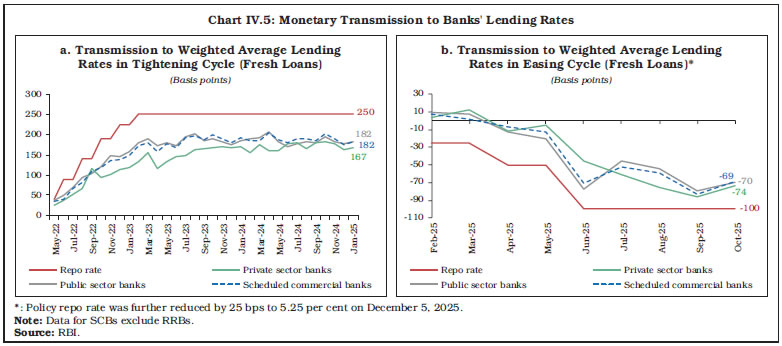
Source: Annual accounts of respective banks. | IV.6 Excluding the impact of merger, the growth in bank credit and investments was 12.5 per cent and 9.9 per cent, respectively, during 2024-25 as compared with 16.0 per cent and 11.6 per cent, respectively, in 2023-24. Deposit growth, excluding the impact of merger, was 11.4 per cent in 2024-25 as compared with 13.4 per cent a year ago (Chart IV.1). IV.7 The share of PSBs in the consolidated balance sheet of SCBs declined to 54.9 per cent at end-March 2025 from 55.2 per cent at end-March 2024. The share of PVBs also moderated marginally to 37.1 per cent from 37.5 per cent over the same period. In contrast, the share of FBs, SFBs and PBs increased during 2024-25. Further, the share of PSBs in total advances of SCBs increased to 56.2 per cent, while their share in total deposits decreased to 58.8 per cent. IV.8 The composition of consolidated balance sheet of SCBs in terms of deposits, borrowings, investments and loans during 2024-25, remained broadly similar to that of the previous year. The composition, however, varied across bank groups (Chart IV.2). The share of deposits in the total liabilities of PVBs increased amidst a reduction in the share of borrowings. The share of deposits in the total liabilities of PSBs declined. 2.1 Liabilities IV.9 Deposit growth of SCBs moderated in 2024-25, led by private and foreign banks (Chart IV.3a). Component-wise, the moderation was mainly driven by a slowdown in growth of term deposits. The weighted average term deposit rate of SCBs increased by 259 basis points (bps) against the cumulative increase in policy repo rate by 250 bps during the tightening phase (May 2022-January 2025). In the subsequent easing phase, weighted average term deposit rate of SCBs declined by 105 bps (up to October 2025) following a 100 bps cut in the policy repo rate (February-June 2025)4. Public sector banks exhibited relatively higher transmission to deposit rates than private sector banks (Charts IV.3b and c). 2.2 Assets IV.10 Bank credit growth moderated during 2024-25 across the bank groups (Chart IV.4). IV.11 The transmission of policy repo rate changes to lending rates varied during different phases and across bank groups. SCBs passed on 182 bps of the 250 bps increase in the policy repo rate (May 2022–January 2025) to the weighted average lending rate on fresh loans during the tightening phase. During the subsequent easing phase, transmission was 69 bps (up to October 2025) against a 100 bps policy repo rate cut (February-June 2025)5. Transmission has been asymmetric between PSBs and PVBs (Charts IV.5 a and b). 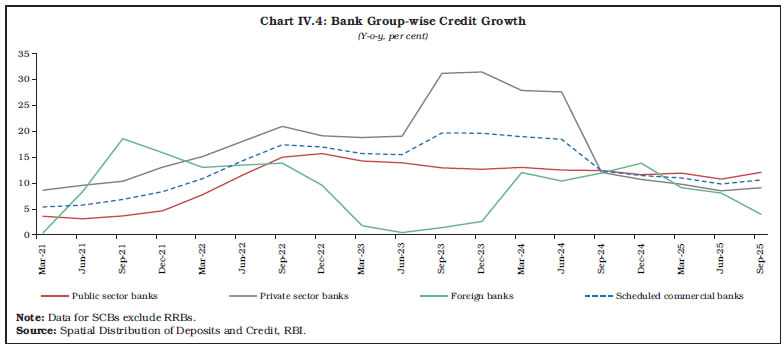
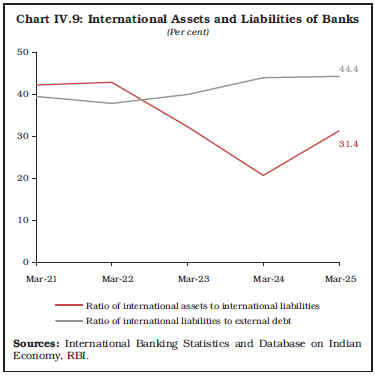
 IV.12 SCBs' investments growth decelerated during 2024-25 led by statutory liquidity ratio (SLR) investments. The share of SLR approved securities in SCBs' total investments declined to 80.8 per cent at end-March 2025 from 82.0 per cent a year ago (Chart IV.6a). Central government securities dominated SCBs' SLR investments, while non-SLR investments were majorly in debt securities. The share of state government securities and equities in SLR and non-SLR investments, respectively, increased during the year (Charts IV.6b and c). IV.13 The credit-deposit growth gap narrowed during 2024-25 as compared with the previous year (Chart IV.7). The credit-deposit ratio of SCBs, however, stood higher at 79.2 per cent at end-March 2025 as compared with 78.8 per cent at end-March 2024. At end-November 2025, credit-deposit ratio of SCBs stood at 80.5 per cent.6 2.3 Maturity Profile of Assets and Liabilities IV.14 Maturity mismatches between assets and liabilities are inherent to the banking system, as deposits — the main source of funds — are generally of short- to medium-term tenors, whereas loans are generally extended for the medium term. During 2024-25, maturity mismatch widened in the short-term7 bucket as compared to the previous year, although it remained low relative to the pre-pandemic levels (Chart IV.8). IV.15 At end-March 2025, the share of short-term deposits in total deposits increased across all bank groups. These deposits remained the dominant category for all bank groups, except payments banks. The share of short-term borrowings increased for SCBs, led by private and foreign banks. Loans and advances of both PSBs and PVBs were concentrated in the medium-term category. PSBs' investments were typically in long-term instruments, while all other bank groups preferred short-term exposures (Table IV.2). 2.4 International Liabilities and Assets IV.16 The ratio of international assets to liabilities of Indian banks increased in 2024-25, following two consecutive years of decline (Chart IV.9). The growth of international assets of Indian banks increased during the year on account of increase in NOSTRO balances and placements abroad, loans to non-residents, and foreign currency loans to residents. The growth of international liabilities of banks in India decelerated mainly due to a deceleration in growth of non-resident ordinary (NRO) rupee accounts and equities of banks held by non-residents (Appendix Tables IV.2 and IV.3). 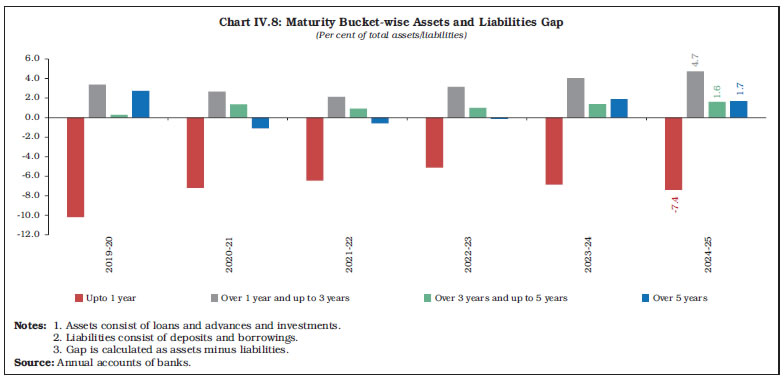
| Table IV.2: Bank Group-wise Maturity Profile of Select Liabilities/Assets | | (At end-March) | | (Per cent) | | Liabilities/Assets | PSBs | PVBs | FBs | SFBs | PBs | SCBs | | 2024 | 2025 | 2024 | 2025 | 2024 | 2025 | 2024 | 2025 | 2024 | 2025 | 2024 | 2025 | | 1 | 2 | 3 | 4 | 5 | 6 | 7 | 8 | 9 | 10 | 11 | 12 | 13 | | I. Deposits | | | | | | | | | | | | | | a) Up to 1 year | 38.4 | 39.6 | 39.3 | 39.4 | 62.2 | 63.3 | 49.0 | 55.7 | 22.6 | 29.1 | 39.9 | 40.8 | | b) Over 1 year and up to 3 years | 22.0 | 21.7 | 27.9 | 26.2 | 30.7 | 29.8 | 44.8 | 38.5 | 77.4 | 70.9 | 24.7 | 24.0 | | c) Over 3 years and up to 5 years | 11.0 | 10.8 | 8.3 | 8.9 | 7.1 | 6.9 | 4.5 | 3.9 | 0.0 | 0.0 | 9.8 | 9.9 | | d) Over 5 years | 28.7 | 27.9 | 24.5 | 25.4 | 0.0 | 0.0 | 1.7 | 1.8 | 0.0 | 0.0 | 25.6 | 25.4 | | II. Borrowings | | | | | | | | | | | | | | a) Up to 1 year | 58.1 | 53.1 | 33.8 | 44.7 | 82.8 | 89.8 | 51.3 | 48.5 | 100.0 | 93.3 | 47.7 | 54.0 | | b) Over 1 year and up to 3 years | 16.7 | 16.0 | 37.8 | 27.0 | 16.2 | 8.5 | 35.7 | 34.6 | 0.0 | 6.7 | 27.5 | 20.0 | | c) Over 3 years and up to 5 years | 6.9 | 7.4 | 9.9 | 9.8 | 0.4 | 0.4 | 7.3 | 9.1 | 0.0 | 0.0 | 7.9 | 7.6 | | d) Over 5 years | 18.3 | 23.6 | 18.6 | 18.5 | 0.6 | 1.4 | 5.8 | 7.7 | 0.0 | 0.0 | 16.9 | 18.5 | | III. Loans and Advances | | | | | | | | | | | | | | a) Up to 1 year | 28.0 | 28.4 | 27.3 | 28.6 | 59.5 | 58.7 | 37.7 | 38.1 | - | - | 28.9 | 29.6 | | b) Over 1 year and up to 3 years | 36.5 | 36.1 | 34.6 | 34.8 | 23.8 | 23.6 | 36.0 | 32.6 | - | - | 35.3 | 35.1 | | c) Over 3 years and up to 5 years | 12.1 | 11.5 | 12.5 | 12.3 | 8.2 | 8.7 | 10.1 | 11.6 | - | - | 12.1 | 11.7 | | d) Over 5 years | 23.4 | 24.0 | 25.6 | 24.3 | 8.5 | 8.9 | 16.3 | 17.7 | - | - | 23.7 | 23.5 | | IV. Investments | | | | | | | | | | | | | | a) Up to 1 year | 22.4 | 21.5 | 58.6 | 59.9 | 83.9 | 83.6 | 68.6 | 68.2 | 99.2 | 92.8 | 41.4 | 42.2 | | b) Over 1 year and up to 3 years | 16.2 | 13.5 | 17.2 | 15.1 | 10.4 | 9.9 | 25.9 | 25.1 | 0.4 | 2.6 | 16.0 | 13.7 | | c) Over 3 years and up to 5 years | 11.9 | 15.4 | 6.1 | 6.3 | 1.6 | 2.2 | 4.0 | 4.9 | 0.1 | 0.8 | 8.8 | 10.7 | | d) Over 5 years | 49.4 | 49.6 | 18.1 | 18.7 | 4.1 | 4.4 | 1.5 | 1.8 | 0.3 | 3.8 | 33.8 | 33.4 | - : Not applicable.
Notes: 1. Figures denote share of each maturity bucket in each component of the balance sheet.
2. The sum of components may not add up to 100 due to rounding off.
3. Data for SCBs exclude RRBs.
Source: Annual accounts of banks. |
 IV.17 The consolidated international claims of Indian banks on all the major economies, except Hong Kong, increased during 2024-25 (Appendix Table IV.4). The share of Indian banks' international claims on non-financial private sector moderated while the claims on banks and non-bank financial institutions increased (Chart IV.10a and Appendix Table IV.5). In terms of residual maturity, a majority of the international claims was short-term in nature, notwithstanding a decline in its share during 2024-25 (Chart IV.10b). 2.5 Off-Balance Sheet Operations IV.18 Growth in contingent liabilities of SCBs accelerated during 2024-25, primarily driven by growth in forward exchange contracts. The off-balance sheet exposure of SCBs, as a proportion of their balance sheet size, increased to 161.9 per cent at end-March 2025 from 138.6 per cent at end-March 2024 (Chart IV.11a and Appendix Table IV.6). Foreign banks accounted for more than half of the total off-balance sheet exposures of SCBs. The share of PVBs in contingent liabilities of the banking sector increased from 29.1 per cent at end-March 2021 to 32.5 per cent at end-March 2025, while that of PSBs fell from 18.8 per cent to 12.8 per cent at end-March 2025 (Chart IV.11b). 3. Financial Performance IV.19 Profitability of SCBs remained robust, with return on assets (RoA) increasing further to 1.4 per cent in 2024-25 from 1.3 per cent in the previous year. The return on equity (RoE) of SCBs at 13.5 per cent remained broadly stable. PSBs exhibited an improvement in RoA and RoE during 2024-25, while PVBs recorded a moderation. During H1: 2025-26, RoA and RoE of SCBs stood at 1.3 per cent and 12.5 per cent, respectively (Charts IV.12a and b).
IV.20 Net profits of SCBs increased during 2024-25, albeit at a slower pace compared to the previous year. This partly reflected the impact of moderation in growth of net interest income. Growth in operating expenses decelerated significantly, while provisions and contingencies expenditure increased during 2024-25 as against a decline in the previous year (Table IV.3). | Table IV.3: Trends in Income and Expenditure of Scheduled Commercial Banks | | (Amount in ₹ crore) | | Item | PSBs | PVBs | FBs | SFBs | PBs | SCBs | | 2023-24 | 2024-25 | 2023-24 | 2024-25 | 2023-24 | 2024-25 | 2023-24 | 2024-25 | 2023-24 | 2024-25 | 2023-24 | 2024-25 | | 1 | 2 | 3 | 4 | 5 | 6 | 7 | 8 | 9 | 10 | 11 | 12 | 13 | | A. Income | 12,12,665 | 13,65,244 | 9,41,870 | 10,70,709 | 1,29,838 | 1,46,580 | 45,400 | 54,223 | 7,102 | 6,937 | 23,36,876 | 26,43,694 | | | (24.8) | (12.6) | (36.4) | (13.7) | (20.1) | (12.9) | (34.3) | (19.4) | (19.0) | (-2.3) | (29.1) | (13.1) | | i) Interest Income | 10,66,243 | 11,89,294 | 7,96,578 | 9,10,560 | 1,06,045 | 1,20,478 | 39,647 | 46,782 | 1,416 | 1,694 | 20,09,929 | 22,68,809 | | | (25.3) | (11.5) | (36.8) | (14.3) | (27.3) | (13.6) | (33.0) | (18.0) | (64.6) | (19.7) | (29.9) | (12.9) | | ii) Other Income | 1,46,422 | 1,75,951 | 1,45,292 | 1,60,149 | 23,794 | 26,101 | 5,753 | 7,441 | 5,686 | 5,243 | 3,26,946 | 3,74,885 | | | (21.7) | (20.2) | (34.2) | (10.2) | (-4.1) | (9.7) | (43.8) | (29.3) | (11.4) | (-7.8) | (24.6) | (14.7) | | B. Expenditure | 10,71,463 | 11,86,881 | 7,66,573 | 8,81,498 | 1,02,953 | 1,16,665 | 39,181 | 50,727 | 7,103 | 6,743 | 19,87,273 | 22,42,514 | | | (23.6) | (10.8) | (35.3) | (15.0) | (32.0) | (13.3) | (32.2) | (29.5) | (21.5) | (-5.1) | (28.5) | (12.8) | | i) Interest Expended | 6,58,611 | 7,60,165 | 4,29,739 | 5,08,877 | 46,996 | 55,866 | 17,474 | 22,336 | 353 | 537 | 11,53,173 | 13,47,782 | | | (35.0) | (15.4) | (56.0) | (18.4) | (48.4) | (18.9) | (43.9) | (27.8) | (43.8) | (52.2) | (42.9) | (16.9) | | ii) Operating Expenses | 2,95,090 | 3,03,100 | 2,39,146 | 2,61,471 | 34,713 | 38,708 | 17,186 | 20,247 | 6,634 | 6,070 | 5,92,769 | 6,29,596 | | | (20.9) | (2.7) | (18.1) | (9.3) | (24.2) | (11.5) | (30.7) | (17.8) | (18.9) | (-8.5) | (20.2) | (6.2) | | of which: Wage Bill | 1,84,025 | 1,77,894 | 90,290 | 98,841 | 10,460 | 11,211 | 8,498 | 10,321 | 1,215 | 977 | 2,94,488 | 2,99,244 | | | (27.2) | (-3.3) | (27.9) | (9.5) | (3.9) | (7.2) | (26.8) | (21.4) | (32.9) | (-19.5) | (26.4) | (1.6) | | iii) Provision and Contingencies | 1,17,761 | 1,23,615 | 97,688 | 1,11,150 | 21,244 | 22,092 | 4,521 | 8,144 | 116 | 135 | 2,41,331 | 2,65,137 | | | (-12.8) | (5.0) | (10.5) | (13.8) | (15.8) | (4.0) | (3.8) | (80.1) | (488.4) | (16.9) | (-2.0) | (9.9) | | C. Operating Profit | 2,58,964 | 3,01,979 | 2,72,986 | 3,00,362 | 48,130 | 52,006 | 10,740 | 11,640 | 114 | 330 | 5,90,934 | 6,66,316 | | | (8.1) | (16.6) | (28.4) | (10.0) | (-0.8) | (8.1) | (26.1) | (8.4) | (-18.9) | (187.9) | (16.0) | (12.8) | | D. Net Profit | 1,41,202 | 1,78,364 | 1,75,297 | 1,89,211 | 26,886 | 29,915 | 6,219 | 3,496 | -1 | 194 | 3,49,603 | 4,01,180 | | | (34.9) | (26.3) | (41.2) | (7.9) | (-10.8) | (11.3) | (49.4) | (-43.8) | - | - | (32.8) | (14.8) | | E. Net Interest Income (NII) (Ai-Bi) | 4,07,632 | 4,29,128 | 3,66,839 | 4,01,683 | 59,049 | 64,612 | 22,173 | 24,446 | 1,063 | 1,157 | 8,56,756 | 9,21,027 | | | (12.2) | (5.3) | (19.5) | (9.5) | (14.4) | (9.4) | (25.5) | (10.3) | (72.9) | (8.9) | (15.7) | (7.5) | | F. Net Interest Margin (NIM) | 2.8 | 2.6 | 3.9 | 3.6 | 3.6 | 3.4 | 7.4 | 6.6 | 4.5 | 3.8 | 3.3 | 3.1 | -: Not applicable.
Notes: 1. Data for SCBs exclude RRBs.
2. NIM has been defined as NII as percentage of average assets.
3. Figures in parentheses refer to per cent variation over the previous year.
4. Percentage variations could be slightly different as absolute numbers have been rounded off to ₹ crore.
Source: Annual accounts of respective banks. |
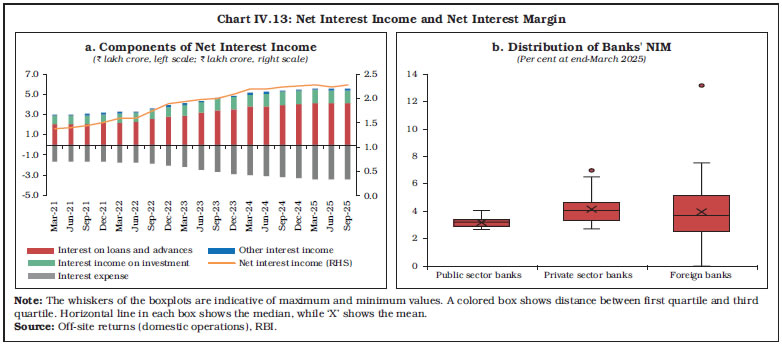 IV.21 The interest expense to interest income ratio of SCBs increased to 59.4 per cent in 2024-25 from 57.4 per cent in the previous year (Table IV.3 and Chart IV.13a). The net interest margin (NIM) of SCBs moderated to 3.1 per cent in 2024-25 from 3.3 per cent in the previous year. The median NIM remained highest for PVBs, followed by that of FBs and PSBs. PSBs exhibited relatively uniform NIMs with limited cross-bank variation, whereas FBs displayed highest dispersion in their NIMs followed by PVBs (Chart IV.13b). IV.22 The provision coverage ratio (PCR) (not adjusted for write-offs) of SCBs remained stable at 76.3 per cent at end-March 2025. During 2024-25, the PCR of PSBs increased to 78.5 per cent, while for PVBs it moderated to 72.6 per cent. At end-September 2025, PCR of SCBs stood at 76.0 per cent (Chart IV.14). 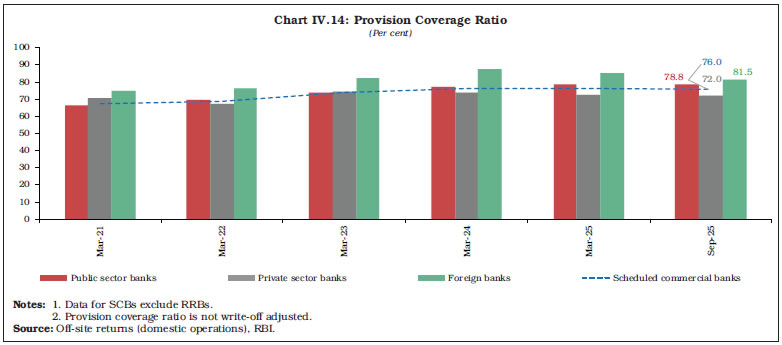
| Table IV.4: Cost of Funds and Return on Funds – Bank Group-wise | | (Per cent) | | Bank Group | Year | Cost of Deposits | Cost of Borrowings | Cost of Funds | Return on Advances | Return on Investments | Return on Funds | Spread (columns 8-5) | | 1 | 2 | 3 | 4 | 5 | 6 | 7 | 8 | 9 | | PSBs | 2023-24 | 4.8 | 7.3 | 5.0 | 8.5 | 6.7 | 8.0 | 3.0 | | | 2024-25 | 5.0 | 7.3 | 5.2 | 8.5 | 6.8 | 8.0 | 2.8 | | PVBs | 2023-24 | 4.8 | 9.2 | 5.4 | 10.4 | 6.8 | 9.5 | 4.1 | | | 2024-25 | 5.1 | 8.2 | 5.5 | 10.0 | 6.8 | 9.2 | 3.7 | | FBs | 2023-24 | 3.8 | 5.6 | 4.1 | 8.7 | 6.8 | 7.6 | 3.5 | | | 2024-25 | 4.0 | 5.1 | 4.2 | 8.5 | 6.7 | 7.4 | 3.2 | | SFBs | 2023-24 | 6.8 | 8.2 | 7.0 | 17.0 | 6.8 | 14.5 | 7.5 | | | 2024-25 | 7.1 | 8.1 | 7.2 | 16.2 | 6.8 | 13.9 | 6.7 | | PBs | 2023-24 | 2.0 | 11.2 | 2.4 | 10.0 | 7.6 | 7.6 | 5.2 | | | 2024-25 | 1.9 | 11.7 | 2.4 | 9.1 | 6.7 | 6.7 | 4.3 | | SCBs | 2023-24 | 4.8 | 8.1 | 5.1 | 9.4 | 6.7 | 8.6 | 3.5 | | | 2024-25 | 5.0 | 7.5 | 5.3 | 9.2 | 6.8 | 8.5 | 3.2 | Notes: 1. Data for SCBs excludes RRBs.
2. Cost of deposits = Interest paid on deposits/(Average of current and previous year's deposits).
3. Cost of borrowings = (Interest expended - Interest on deposits) / (Average of current and previous year's borrowings).
4. Cost of funds = Interest expended / (Average of current and previous year's deposits plus borrowings)
5. Return on advances = Interest earned on advances /(Average of current and previous year's advances).
6. Return on investments = Interest earned on investments /(Average of current and previous year's investments).
7. Return on funds = (Interest earned on advances + Interest earned on investments) / (Average of current and previous year's advances plus investments).
Sources: Annual accounts of banks and RBI staff calculations. | IV.23 During 2024-25, a moderation in the return on funds alongside an increase in the cost of funds resulted in narrowing of spread for SCBs. SFBs continued to record the widest spread, reflecting relatively higher interest rates on their advances (Table IV.4). 4. Soundness Indicators 4.1 Capital Adequacy IV.24 In India, the minimum regulatory capital to risk-weighted assets ratio (CRAR) requirement for banks is set at 9.0 per cent [11.5 per cent inclusive of capital conservation buffer (CCB)] and Tier 1 capital ratio requirement at 7.0 per cent, both one percentage point above the Basel III norms.8 At end-March 2025, all bank groups remained well-capitalised, with CRAR and Tier 1 capital ratio remaining well above the minimum regulatory requirements. The CRAR of SCBs rose to 17.4 per cent at end-March 2025, with an increase witnessed across PSBs and PVBs. The Tier 1 capital ratio of SCBs also improved to 15.5 per cent at end-March 2025 led by an improvement in PSBs and PVBs (Table IV.5). The CRAR of SCBs stood at 17.2 per cent at end-September 2025. IV.25 A wider dispersion in CRAR and common equity tier 1 (CET1) ratios was observed in case of PVBs as compared to PSBs in 2024-25. The mean as well as the median CRAR and CET1 ratio, of both PSBs and PVBs, recorded an increase during the year (Charts IV.15 a and b). | Table IV.5: Component-wise Capital Adequacy of SCBs | | (At end-March) | | (Amount in ₹ crore) | | | PSBs | PVBs | FBs | SFBs | SCBs | | 2024 | 2025 | 2024 | 2025 | 2024 | 2025 | 2024 | 2025 | 2024 | 2025 | | 1 | 2 | 3 | 4 | 5 | 6 | 7 | 8 | 9 | 10 | 11 | | 1. Capital Funds | 11,74,245 | 13,55,864 | 12,83,455 | 14,64,071 | 2,70,646 | 3,11,060 | 41,603 | 47,390 | 27,69,949 | 31,78,386 | | i) Tier 1 Capital | 9,94,510 | 11,66,550 | 11,55,051 | 13,42,472 | 2,43,842 | 2,82,833 | 37,330 | 41,475 | 24,30,733 | 28,33,330 | | ii) Tier 2 Capital | 1,79,735 | 1,89,314 | 1,28,404 | 1,21,599 | 26,804 | 28,227 | 4,273 | 5,915 | 3,39,216 | 3,45,056 | | 2. Risk Weighted Assets | 75,59,396 | 84,23,011 | 72,14,513 | 80,03,960 | 14,18,639 | 16,57,665 | 1,92,331 | 2,20,390 | 1,63,84,879 | 1,83,05,026 | | 3. CRAR (1 as % of 2) | 15.5 | 16.1 | 17.8 | 18.3 | 19.1 | 18.8 | 21.6 | 21.5 | 16.9 | 17.4 | | Of which: Tier 1 | 13.2 | 13.8 | 16.0 | 16.8 | 17.2 | 17.1 | 19.4 | 18.8 | 14.8 | 15.5 | | Tier 2 | 2.4 | 2.2 | 1.8 | 1.5 | 1.9 | 1.7 | 2.2 | 2.7 | 2.1 | 1.9 | Notes: 1. Data for SCBs exclude RRBs and PBs.
2. Figures in per cent might not add up to the total due to rounding off of numbers.
Source: Off-site returns, RBI. | IV.26 Resources raised by banks through private placement of debt, qualified institutional placement, and preferential allotment of equity in the capital market increased during 2024-25. The increase was largely driven by PSBs which recorded a growth of 36.6 per cent in total amount raised through private placements, mostly through debt instruments (Table IV.6). 4.2 Leverage and Liquidity IV.27 The leverage ratio is a non-risk based backstop measure complementing the Basel III risk-based capital framework. In India, the minimum leverage ratio requirement is 4.0 per cent for domestic systemically important banks and 3.5 per cent for other SCBs. The leverage ratio — the ratio of Tier 1 capital to total exposures — of SCBs' increased to 8.0 per cent at end-March 2025, with an improvement across PSBs and PVBs. The liquidity coverage ratio (LCR) — designed to withstand liquidity pressures in the short-term — requires banks to maintain high quality liquid assets to meet 30 days' net outgo under stressed conditions. For SCBs, the LCR improved to 132.6 per cent at end-March 2025. It remained well above the regulatory requirement of 100 per cent for all bank groups (Table IV.7). 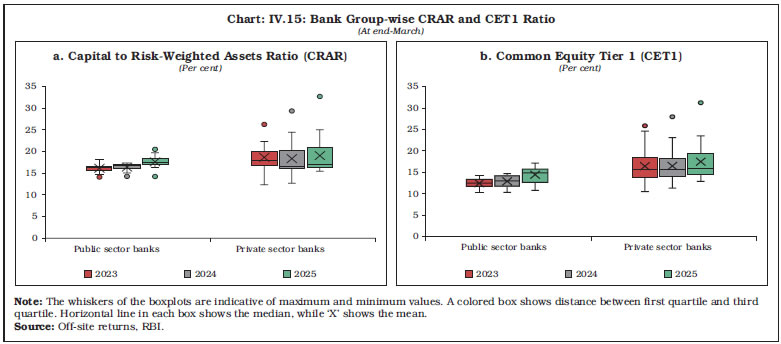
| Table IV.6: Resources Raised by Banks through Private Placements | | (Amount in ₹ crore) | | | 2022-23 | 2023-24 | 2024-25 | 2025-26 (Up to November) | | No. of issues | Amount raised | No. of issues | Amount raised | No. of issues | Amount raised | No. of issues | Amount raised | | 1 | 2 | 3 | 4 | 5 | 6 | 7 | 8 | 9 | | PSBs | 27 | 70,260 | 26 | 97,380 | 28 | 1,33,000 | 6 | 40,719 | | PVBs | 14 | 52,903 | 14 | 33,426 | 8 | 16,419 | 11 | 18,192 | | FBs | 2 | 224 | 0 | 0 | 0 | 0 | 0 | 0 | | Total | 43 | 1,23,387 | 40 | 1,30,806 | 36 | 1,49,418 | 17 | 58,912 | Notes: 1. Include private placement of debt, qualified institutional placement and preferential allotment.
2. Data for 2025-26 are provisional.
3. Figures may not add up to the total due to rounding off.
Sources: SEBI, BSE, and NSE. | IV.28 The net stable funding ratio (NSFR) seeks to ensure that a bank's available stable funding exceeds its required stable funding over a one-year horizon on an ongoing basis. The minimum NSFR that banks in India are required to maintain is set at 100 per cent, in line with international standards. At end-March 2025, NSFR of SCBs stood at 126.4 per cent, much above the regulatory requirement (Table IV.8). At end-September 2025, NSFR of SCBs stood at 124.7 per cent. 4.3 Non-performing Assets IV.29 The trend of improvement in asset quality of banks observed since 2018-19, measured by their declining GNPA ratios, continued during 2024-25. The GNPA ratio of SCBs declined further to a multi-decadal low of 2.2 per cent at end-March 2025 from 2.7 per cent at end-March 2024. During 2024-25, around 42.8 per cent of the reduction in GNPAs was attributable to recoveries and upgradations. The net NPA (NNPA) ratio also declined to 0.5 per cent at end-March 2025, partly reflecting higher provisioning (Table IV.9). As per supervisory data, at end-September 2025, the GNPA and NNPA ratios of SCBs stood at 2.1 per cent and 0.5 per cent, respectively. | Table IV.7: Leverage Ratio and Liquidity Coverage Ratio | | (Per cent) | | | Leverage Ratio | Liquidity Coverage Ratio | | Mar-24 | Mar-25 | Sep-25 | Mar-24 | Mar-25 | Sep-25 | | 1 | 2 | 3 | 4 | 5 | 6 | 7 | | PSBs | 6.0 | 6.3 | 6.2 | 129.3 | 132.1 | 133.7 | | PVBs | 9.7 | 10.2 | 10.3 | 127.1 | 128.6 | 122.1 | | FBs | 10.8 | 10.3 | 10.6 | 145.0 | 149.6 | 157.0 | | SFBs | 11.0 | 10.0 | 9.3 | 153.3 | 153.7 | 142.5 | | SCBs | 7.8 | 8.0 | 8.2 | 130.3 | 132.6 | 131.7 | Note: Data for SCBs exclude RRBs and PBs.
Source: Off-site returns, RBI. | IV.30 The slippage ratio of SCBs, which measures new accretions to NPAs as a share of standard advances at the beginning of the year, declined for the fifth consecutive year to 1.4 per cent at end-March 2025. Slippage ratio of both PSBs and PVBs declined, although it remained higher for PVBs (Charts IV.16a and b). For SCBs, slippage ratio further declined to 1.3 per cent at end-September 2025.
| Table IV.8: Net Stable Funding Ratio | | (At end-March 2025) | | (Amount in ₹ crore) | | | Available Stable Funding | Required Stable Funding | Net Stable Funding Ratio (Per cent) | | 1 | 2 | 3 | 4 | | PSBs | 1,22,35,851 | 96,31,010 | 127.0 | | PVBs | 82,16,358 | 65,85,675 | 124.8 | | FBs | 8,74,072 | 6,61,384 | 132.2 | | SFBs | 2,87,381 | 2,26,049 | 127.1 | | SCBs | 2,16,13,661 | 1,71,04,118 | 126.4 | Notes: 1. Data for SCBs exclude RRBs and PBs.
2. Constituent items may not add up to the total due to rounding off.
Source: Off-site returns, RBI. |
| Table IV.9: Non-Performing Assets by Bank Group | | (Amount in ₹ crore) | | | PSBs | PVBs | FBs | SFBs | SCBs | | 1 | 2 | 3 | 4 | 5 | 6 | | Gross NPAs | | | | | | | Closing Balance for 2023-24 | 3,39,541 | 1,29,164 | 6,523 | 5,590 | 4,80,818 | | Opening Balance for 2024-25 | 3,39,541 | 1,29,164 | 6,523 | 5,391 | 4,80,619 | | Addition during the year 2024-25 | 82,762 | 1,21,735 | 7,256 | 14,607 | 2,26,359 | | Reduction during the year 2024-25 | 1,38,653 | 1,18,224 | 8,458 | 10,009 | 2,75,344 | | i. Recovered | 33,630 | 29,320 | 2,779 | 1,963 | 67,693 | | ii. Upgradations | 13,847 | 30,360 | 3,322 | 2,559 | 50,087 | | iii. Written-off | 91,176 | 58,544 | 2,357 | 5,486 | 1,57,563 | | Closing Balance for 2024-25 | 2,83,650 | 1,32,674 | 5,321 | 9,989 | 4,31,634 | | Gross NPAs as per cent of Gross Advances* | | | | | | | 2023-24 | 3.5 | 1.9 | 1.2 | 2.4 | 2.7 | | 2024-25 | 2.6 | 1.8 | 0.9 | 3.6 | 2.2 | | Net NPAs | | | | | | | 2023-24 | 72,544 | 31,594 | 812 | 1,796 | 1,06,745 | | 2024-25 | 55,634 | 35,069 | 776 | 3,910 | 95,388 | | Net NPAs as per cent of Net Advances | | | | | | | 2023-24 | 0.8 | 0.5 | 0.1 | 0.8 | 0.6 | | 2024-25 | 0.5 | 0.5 | 0.1 | 1.4 | 0.5 | *: Calculated by taking gross NPAs from annual accounts of respective banks and gross advances from off-site returns (global operations).
Notes: 1. Data for SCBs exclude RRBs and PBs.
2. Closing balance for 2023-24 is not equal to opening balance for 2024-25 due to merger of one SFB into another effective April 1, 2024. The balance NPA pertaining to the merged SFB— amounting to ₹199.54 crores — has been incorporated under GNPA additions during the year 2024–25.
3. Net NPAs=Gross NPA - deductions; net advances=gross advances - deductions. Deductions include: i) provisions held in the case of NPA accounts as per asset classification; ii) DICGC / ECGC claims received and held pending adjustment; iii) part payment received and kept in suspense account or any other similar account; iv) balance in sundry account (interest capitalisation – restructured accounts), in respect of NPA accounts; and v) floating provisions.
4. Constituent items may not add up to the total due to rounding off.
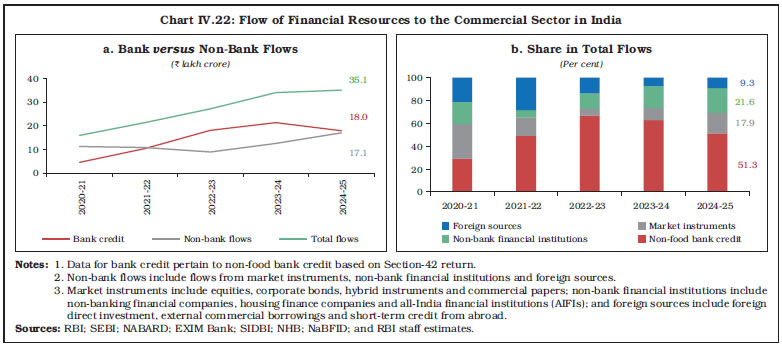
Sources: Annual accounts of banks and off-site returns (global operations), RBI. | IV.31 Reflecting these gains in asset quality, the proportion of standard assets in total advances increased for SCBs at end-March 2025, led by PSBs and FBs (Table IV.10). | Table IV.10: Classification of Loan Assets by Bank Group | | (Amount in ₹ crore) | | Bank Group | End-March | Standard Assets | Sub-standard Assets | Doubtful Assets | Loss Assets | | Amount | Per cent* | Amount | Per cent* | Amount | Per cent* | Amount | Per cent* | | 1 | 2 | 3 | 4 | 5 | 6 | 7 | 8 | 9 | 10 | | PSBs | 2024 | 84,24,922 | 96.3 | 58,576 | 0.7 | 1,78,483 | 2.0 | 83,681 | 1.0 | | | 2025 | 95,38,365 | 97.2 | 56,039 | 0.6 | 1,34,813 | 1.4 | 82,561 | 0.8 | | PVBs | 2024 | 66,96,942 | 98.2 | 44,199 | 0.6 | 52,944 | 0.8 | 26,397 | 0.4 | | | 2025 | 72,94,711 | 98.2 | 58,336 | 0.8 | 50,019 | 0.7 | 22,021 | 0.3 | | FBs | 2024 | 5,39,598 | 98.8 | 1,344 | 0.2 | 4,228 | 0.8 | 950 | 0.2 | | | 2025 | 6,12,992 | 99.1 | 1,520 | 0.2 | 2,629 | 0.4 | 1,172 | 0.2 | | SFBs | 2024 | 2,24,245 | 97.6 | 4,005 | 1.7 | 1,514 | 0.7 | 71 | 0.0 | | | 2025 | 2,68,585 | 96.4 | 8,423 | 3.0 | 1,498 | 0.5 | 68 | 0.0 | | SCBs | 2024 | 1,58,85,707 | 97.2 | 1,08,125 | 0.7 | 2,37,169 | 1.5 | 1,11,099 | 0.7 | | | 2025 | 1,77,14,653 | 97.7 | 1,24,317 | 0.7 | 1,88,959 | 1.0 | 1,05,822 | 0.6 | *: As per cent of gross advances.
Notes: 1. Data for SCBs exclude RRBs and PBs.
2. Constituent items may not add up to the total due to rounding off.
Source: Off-site returns (domestic operations), RBI. | IV.32 The share of large borrowal accounts9 in total advances of SCBs remained broadly unchanged at 43.9 per cent at end-March 2025. The special mention accounts-0 (SMA-0), special mention accounts-2 (SMA-2)10 and NPAs as a proportion of gross advances of SCBs declined for both overall and large borrowal accounts in 2024-25. The special mention accounts-1 (SMA-1) ratio for SCBs increased during 2024-25, driven by an increase in SMA-1 for PSBs (Chart IV.17). 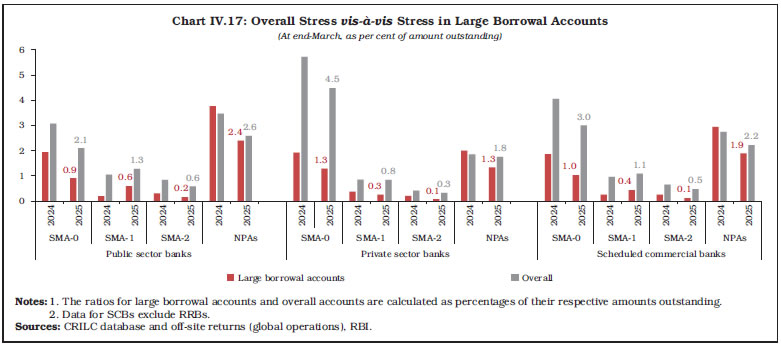 IV.33 Restructured accounts of SCBs had increased significantly in 2021-22 following the introduction of the resolution frameworks 1.0 and 2.0 in the aftermath of the pandemic. Subsequently, reflecting the expiry of deadlines for invocation of the restructured standard advances and also improvements in asset quality, the number of restructured accounts declined. Consequently, during 2024-25, restructured standard advances ratio declined for overall as well as for large borrowal accounts of SCBs, led by PSBs.11 PVBs had a lower share of restructured standard advances in gross advances compared to PSBs at end-March 2025 (Chart IV.18). 4.4 Recoveries IV.34 During 2024-25, the number of cases referred for resolution decreased under the Securitisation and Reconstruction of Financial Assets and Enforcement of Security Interest (SARFAESI) Act and Insolvency and Bankruptcy Code (IBC). The amount involved in referred cases for resolution under the SARFAESI Act decreased in 2024-25, while the recovery rate increased to 31.5 per cent. The recovery rate under the IBC also improved to 36.6 per cent in 2024–25. The IBC remained the dominant mode of recovery, followed by the SARFAESI route. The share of IBC in total amount recovered increased to 52.4 per cent in 2024-25 as compared with 49.5 per cent in the previous year (Table IV.11). Under the IBC, the realisable value stood at 170.1 per cent of liquidation value at end-September 2025 as compared to 161.1 per cent at end-September 2024. 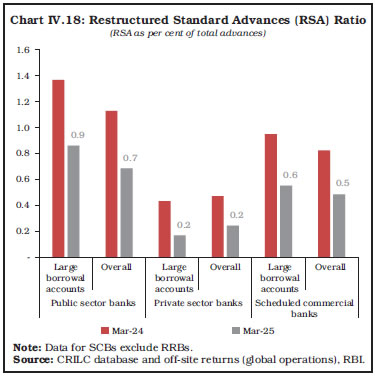
| Table IV.11: NPAs of SCBs Recovered through Various Channels | | (Amount in ₹ crore) | | Recovery Channel | 2023-24 | 2024-25 (P) | | No. of cases Referred | Amount involved | Amount recovered* | Col. (4) as per cent of Col. (3) | No. of cases Referred | Amount Involved | Amount recovered* | Col. (8) as per cent of Col. (7) | | 1 | 2 | 3 | 4 | 5 | 6 | 7 | 8 | 9 | | Lok Adalats | 1,23,41,783 | 1,81,934 | 3,308 | 1.8 | 1,49,12,705 | 1,97,907 | 4,742 | 2.4 | | DRTs | 30,806 | 79,414 | 13,527 | 17.0 | 34,430 | 1,29,516 | 12,363 | 9.5 | | SARFAESI Act | 2,16,571 | 1,19,554 | 30,416 | 25.4 | 2,15,709 | 1,03,180 | 32,466 | 31.5 | | IBC @ | 1,004 | 1,63,943 | 46,340 | 28.3 | 732 | 1,49,045 | 54,528 | 36.6 | | Total | 1,25,90,164 | 5,44,845 | 93,591 | 17.2 | 1,51,63,576 | 5,79,648 | 1,04,099 | 18.0 | P : Provisional. DRTs: Debt Recovery Tribunals.
* : Refers to the amount recovered during the given year, which could be with reference to the cases referred during the given year as well as during earlier years.
@ : Cases admitted by National Company Law Tribunals (NCLTs).
Sources: Off-site returns, RBI, and Insolvency and Bankruptcy Board of India (IBBI). | IV.35 Banks continued to clean up their balance sheets through sale of NPAs to asset reconstruction companies (ARCs). The ratio of asset sales to previous year's GNPAs for SCBs increased during 2024-25, even as banks continued to make recoveries through other channels (Chart IV.19a). In absolute terms, asset sales to ARCs increased for PVBs and foreign banks, while it declined for PSBs during 2024-25. The book value of assets acquired by ARCs grew at a faster pace than their acquisition cost, resulting in a decline in the acquisition cost-to-book value ratio at end-March 2025 (Chart IV.19b). IV.36 The outstanding book value of assets acquired by ARCs increased by 57.9 per cent, partly reflecting the impact of acquisition of Stressed Asset Stabilisation fund. Security receipts issued increased by 13.3 per cent during 2024-25 as compared with an increase of 15.0 per cent in the previous year. The ratio of security receipts issued to book value of assets acquired declined to 19.8 per cent at end-March 2025 from 27.6 per cent at end-March 2024. The share of banks' subscriptions to total security receipts decreased to 58.9 per cent at end-March 2025 from 59.1 per cent last year. The share of other investors (qualified institutional buyers) continued to increase to 13.8 per cent from 13.1 per cent in the previous year. During 2024-25, the security receipts completely redeemed as per cent of the previous year's outstanding security receipts, an indicator of recovery through this mode, improved to 41.8 per cent from 38.2 per cent during the previous year (Table IV.12). 4.5 Frauds in the Banking Sector IV.37 Frauds present multiple challenges by exposing financial institutions to reputational, operational and business risks, while also weakening customer trust. During 2024-25, based on date of reporting by banks, the total number of frauds decreased. However, the amount involved in frauds increased. This was mainly due to re-examination and reporting afresh of 122 fraud cases amounting to ₹18,336 crore after ensuring compliance with the judgement of the Hon'ble Supreme Court of India dated March 27, 2023 (Table IV.13 and Appendix Table IV.7).12 Based on the date of occurrence of frauds, during 2024-25, the share of card / internet frauds in the total stood at 66.8 per cent in terms of number of cases. In terms of amount, the share of advances-related frauds was 33.1 per cent (Table IV.14). 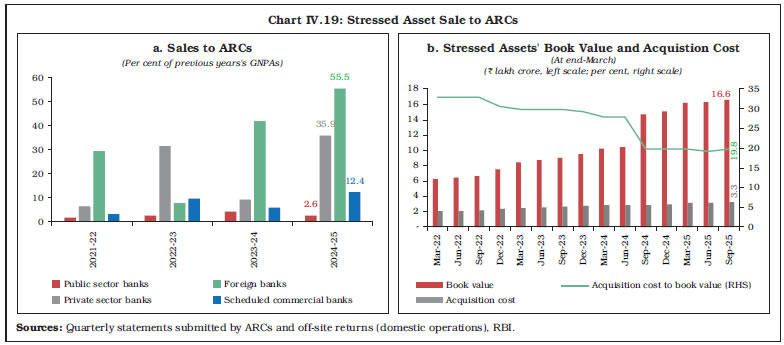
| Table IV.12: Details of Financial Assets Securitised by Asset Reconstruction Companies | | (At end-March) | | (Amount in ₹ crore) | | | 2023 | 2024 | 2025 | | 1 | 2 | 3 | 4 | | Number of reporting ARCs | 28 | 27 | 27 | | 1. Book Value of Assets Acquired | 8,39,126 | 10,25,429 | 16,19,124 | | 2. Security Receipt issued by ARCs | 2,46,290 | 2,83,323 | 3,20,887 | | 3. Security Receipts Subscribed to by | | | | | (a) Banks | 1,49,253 | 1,67,517 | 1,89,025 | | (b) ARCs | 49,519 | 57,283 | 64,656 | | (c) Financial Institutional Investors | 19,383 | 21,495 | 22,778 | | (d) Others (Qualified Institutional Buyers) | 28,135 | 37,027 | 44,427 | | 4. Amount of Security Receipts Completely Redeemed | 41,257 | 53,243 | 60,688 | | 5. Amount of Security Receipts Partially Redeemed | 65,610 | 84,938 | 1,06,875 | | 6. Security Receipts Outstanding | 1,39,422 | 1,45,140 | 1,53,323 | Notes: 1. Total as at end of quarter (cumulative/stock figures).
2. Constituent items may not add up to the total due to rounding off.
Source: Quarterly statements submitted by ARCs. | IV.38 In 2024-25, PVBs accounted for 59.3 per cent of the total number of frauds reported, while PSBs accounted for 70.7 per cent of the amount involved (Charts IV.20 a and b). Within PVBs, card/internet-related frauds accounted for the largest share by number, while frauds related to advances constituted the largest share by value in 2024-25. In contrast, PSBs reported the highest share of frauds related to advances, both in terms of number of cases and the amount involved. The share of card/internet frauds declined across all bank groups in both number and amount involved during 2024–25. The share of advances-related frauds, both in terms of number and amount, increased across all bank groups (except for PSBs in terms of amount), primarily due to a significant portion of reclassified frauds being associated with advances (Charts IV.21 a and b). | Table IV.13: Frauds in Various Banking Operations Based on the Date of Reporting | | (Amount in ₹ crore) | | Area of Operation | 2022-23 | 2023-24 | 2024-25 | 2024-25 (April-Sep) | 2025-26 (April-Sep) | | Number of frauds | Amount involved | Number of frauds | Amount involved | Number of frauds | Amount involved | Number of frauds | Amount involved | Number of frauds | Amount involved | | 1 | 2 | 3 | 4 | 5 | 6 | 7 | 8 | 9 | 10 | 11 | | Advances | 3,989 | 15,065 | 4,113 | 9,160 | 7,934 | 31,911 | 3,518 | 15,521 | 4,255 | 17,501 | | Card/Internet | 6,699 | 277 | 29,080 | 1,457 | 13,469 | 520 | 13,081 | 484 | 195 | 14 | | Cash | 1,485 | 159 | 484 | 78 | 306 | 39 | 205 | 18 | 116 | 27 | | Cheques/DDs, etc. | 118 | 25 | 127 | 42 | 122 | 74 | 49 | 54 | 51 | 8 | | Clearing Accounts, etc. | 18 | 3 | 17 | 2 | 6 | 2 | 3 | 1 | 2 | 6 | | Deposits | 652 | 259 | 2,002 | 240 | 1,207 | 521 | 934 | 363 | 222 | 131 | | Forex Transactions | 13 | 12 | 19 | 38 | 23 | 16 | 6 | 1 | 21 | 124 | | Inter-Branch Accounts | 3 | 0 | 29 | 10 | 14 | 26 | 3 | 0 | 19 | 19 | | Off-balance Sheet | 13 | 280 | 10 | 199 | 8 | 270 | - | - | 3 | 1 | | Others | 472 | 422 | 171 | 35 | 790 | 1,392 | 587 | 127 | 208 | 3,684 | | Total | 13,462 | 16,502 | 36,052 | 11,261 | 23,879 | 34,771 | 18,386 | 16,569 | 5,092 | 21,515 | -: Nil/negligible.
Notes: 1. Refers to frauds of ₹1 lakh and above.
2. The figures reported by banks and financial institutions are subject to change based on revisions filed by them.
3. Frauds reported in a year could have occurred several years prior to year of reporting.
4. Amounts involved are as reported and do not reflect the amount of loss incurred. Depending on recoveries, the loss incurred gets reduced. Further, the entire amount involved in loan accounts is not necessarily diverted.
5. As on September 30, 2025, 942 frauds amounting to ₹1,28,031 crore were withdrawn by banks and financial institutions due to non-compliance with the principles of natural justice as per the judgment of the Hon'ble Supreme Court of India dated March 27, 2023.
6. Data pertaining to 2024-25 includes fraud classification in 122 cases amounting to ₹18,336 crore, pertaining to the previous financial years, reported afresh during the financial year 2024-25 after re-examination and ensuring compliance with the judgement of the Hon'ble Supreme Court of India, dated March 27, 2023.
7. Post issuance of revised Master Directions on Fraud Risk Management dated July 15, 2024, the banks are reporting only those payment system related transactions which are concluded as fraud committed on bank(s).
Source: RBI. |
| Table IV.14: Frauds in Various Banking Operations Based on the Date of Occurrence | | (Amount in ₹ crore) | | Area of Operation | Prior to 2022-23 | 2022-23 | 2023-24 | 2024-25 | 2025-26 (April - Sep) | | Number of frauds | Amount Involved | Number of frauds | Amount Involved | Number of frauds | Amount Involved | Number of frauds | Amount Involved | Number of frauds | Amount Involved | | 1 | 2 | 3 | 4 | 5 | 6 | 7 | 8 | 9 | 10 | 11 | | Advances | 8,192 | 64,974 | 4,728 | 3,319 | 5,006 | 4,142 | 2,214 | 1,159 | 151 | 42 | | Card/Internet | 1,902 | 191 | 11,994 | 628 | 27,663 | 1,192 | 7,756 | 252 | 128 | 4 | | Cash | 584 | 61 | 1,057 | 121 | 473 | 72 | 219 | 40 | 58 | 8 | | Cheques/DDs, etc. | 79 | 31 | 113 | 24 | 103 | 39 | 98 | 52 | 25 | 3 | | Clearing Accounts, etc. | 12 | 4 | 15 | 1 | 13 | 2 | 1 | 1 | 2 | 6 | | Deposits | 559 | 325 | 762 | 222 | 1,994 | 255 | 701 | 325 | 67 | 24 | | Forex Transactions | 28 | 79 | 21 | 47 | 12 | 3 | 3 | 61 | 12 | 1 | | Inter-Branch Accounts | 15 | 5 | 22 | 1 | 12 | 37 | 13 | 11 | 3 | 1 | | Off-balance Sheet | 24 | 713 | 4 | - | 4 | 28 | 2 | 9 | - | - | | Others | 298 | 3,324 | 422 | 515 | 250 | 86 | 608 | 1,587 | 63 | 22 | | Total | 11,693 | 69,707 | 19,138 | 4,878 | 35,530 | 5,856 | 11,615 | 3,497 | 509 | 111 | Notes: 1. Refers to frauds of ₹1 lakh and above.
2. The figures reported by banks and financial institutions are subject to change based on revisions filed by them.
3. Data based on date of occurrence may change for a period of time as frauds reported late but having occurred earlier would get added.
4. Data in the table pertain to cases reported from FY 2022-23 till September 30, 2025.
5. Amounts involved are as reported and do not reflect the amount of loss incurred. Depending on recoveries, the loss incurred gets reduced. Further, the entire amount involved in loan accounts is not necessarily diverted.
6. As on on September 30, 2025, 942 frauds amounting to ₹1,28,031 crore were withdrawn by banks and financial institutions due to non-compliance with the principles of natural justice as per the judgment of the Hon'ble Supreme Court of India dated March 27, 2023.
7. Data pertaining to 2024-25 includes fraud classification in 122 cases amounting to ₹18,336 crore, pertaining to the previous financial years, reported afresh during the financial year 2024-25 after re-examination and ensuring compliance with the judgement of the Hon'ble Supreme Court of India, dated March 27, 2023.
8. Post issuance of revised Master Directions on Fraud Risk Management dated July 15, 2024, the banks are reporting only those payment system related transactions which are concluded as fraud committed on bank(s).
Source: RBI. |
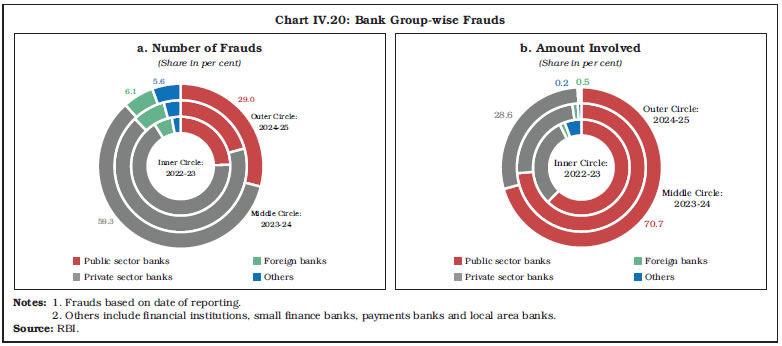
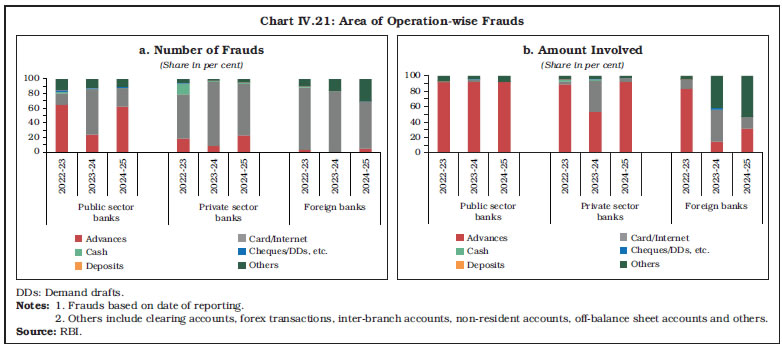 4.6 Enforcement Actions IV.39 Enforcement actions endeavour to ensure regulatory compliance, achieve credible deterrence and maintain stability and integrity of the financial system. During 2024-25, instances of penalty imposed by the Reserve Bank increased across all regulated entities, except PSBs, PBs and CICs.13 The penalty amount, however, fell compared to last year across all regulated entities, except Co-operative banks, SFBs, RRBs and HFCs (Table IV.15). 5. Sectoral Bank Credit: Distribution and Non-performing Assets IV.40 Bank credit growth moderated during 2024-25 reflecting deceleration across all sectors, although it remained in double-digit. The slowdown was most pronounced in the personal loans segment, followed by services, agriculture and industry. The shares of services and personal loans in total bank credit increased at end-March 2025, while that of industry and agriculture registered a decline. Within the industrial sector, medium industries witnessed an acceleration in credit growth, while micro and small, and large industries recorded a deceleration. In the services segment, growth was mainly contributed by trade and other services. Growth in housing loans remained the principal sub-segment driving the growth of personal loans at end-March 2025 (Table IV.16). At end-October 2025, bank credit growth accelerated across all sectors, except agriculture as compared with a year ago. | Table IV.15: Enforcement Actions | | Regulated Entity | 2023-24 | 2024-25 | | Instances of Imposition of Penalty | Total Penalty (₹ crore) | Instances of Imposition of Penalty | Total Penalty (₹ crore) | | 1 | 2 | 3 | 4 | 5 | | Public Sector Banks | 16 | 23.68 | 8 | 11.11 | | Private Sector Banks | 12 | 24.90 | 15 | 14.80 | | Co-operative Banks | 215 | 12.07 | 264 | 15.63 | | Foreign Banks | 3 | 7.04 | 6 | 3.52 | | Payments Banks | 1 | 5.39 | 1 | 0.27 | | Small Finance Banks | 1 | 0.29 | 2 | 0.72 | | Regional Rural Banks | 4 | 0.12 | 6 | 0.59 | | NBFCs/ARCs | 22 | 11.53 | 37 | 7.29 | | HFCs | 3 | 0.08 | 13 | 0.83 | | CICs | 4 | 1.01 | 1 | 0.02 | | Total | 281 | 86.11 | 353 | 54.78 | NBFCs: Non-banking financial companies, ARCs: Asset reconstruction companies, HFCs: Housing finance companies, CICs: Credit information companies.
Source: RBI. | IV.41 During 2024-25, notwithstanding a moderation in bank credit, total flow of financial resources to commercial sector increased, driven by a pick up in flow from non-bank resources. The increase in funding from non-bank sources during 2024-25 was largely driven by buoyant domestic capital markets, reflected in higher equity issuances and increased corporate bond placements amidst easing market conditions, enhanced credit flow by non-banking financial companies (NBFCs), and a rebound in short-term external credit (Charts IV.22 a and b). | Table IV.16: Sectoral Deployment of Gross Bank Credit by SCBs | | (Amount in ₹ crore) | | Sector | Outstanding as on | Per cent variation (y-o-y) | | Mar-23 | Mar-24 | Oct-24 | Mar-25 | Oct-25 | Mar-24 | Mar-25 | Oct-25 | | 1 | 2 | 3 | 4 | 5 | 6 | 7 | 8 | 9 | | 1. Agriculture and Allied Activities | 17,26,410 | 20,71,251 | 22,05,579 | 22,87,060 | 24,02,610 | 20.0 | 10.4 | 8.9 | | 2. Industry (Micro and Small, Medium and Large) | 33,66,406 | 36,82,393 | 38,12,250 | 39,85,660 | 41,92,700 | 9.4 | 8.2 | 10.0 | | 2.1. Micro and Small | 6,33,289 | 7,33,123 | 7,57,113 | 7,98,473 | 9,53,572 | 15.8 | 8.9 | 25.9 | | 2.2. Medium | 2,68,286 | 3,06,425 | 3,38,367 | 3,63,245 | 3,98,071 | 14.2 | 18.5 | 17.6 | | 2.3. Large | 24,64,831 | 26,42,844 | 27,16,770 | 28,23,942 | 28,41,057 | 7.2 | 6.9 | 4.6 | | 3. Services, of which | 37,18,805 | 45,47,237 | 47,29,329 | 50,93,565 | 53,45,246 | 22.3 | 12.0 | 13.0 | | 3.1. Transport Operators | 1,92,059 | 2,32,379 | 2,49,128 | 2,61,575 | 2,75,525 | 21.0 | 12.6 | 10.6 | | 3.2. Computer Software | 24,924 | 25,917 | 30,581 | 32,915 | 39,584 | 4.0 | 27.0 | 29.4 | | 3.3. Tourism, Hotels and Restaurants | 69,342 | 77,816 | 80,012 | 83,366 | 91,529 | 12.2 | 7.1 | 14.4 | | 3.4. Trade | 8,72,340 | 10,24,408 | 10,78,651 | 11,84,550 | 12,27,077 | 17.4 | 15.6 | 13.8 | | 3.5. Commercial Real Estate | 3,22,591 | 4,60,263 | 4,99,115 | 5,23,264 | 5,69,245 | 42.7 | 13.7 | 14.1 | | 3.6. Non-Banking Financial Companies (NBFCs)* | 13,42,539 | 15,23,054 | 15,35,999 | 16,35,102 | 17,03,567 | 13.4 | 7.4 | 10.9 | | 3.7 Other Services** | 7,20,969 | 9,85,815 | 10,15,601 | 11,23,459 | 11,80,689 | 36.7 | 14.0 | 16.3 | | 4. Personal Loans, of which | 41,82,767 | 53,46,691 | 56,64,806 | 59,71,696 | 64,55,946 | 27.8 | 11.7 | 14.0 | | 4.1. Consumer Durables | 20,985 | 23,445 | 23,415 | 23,201 | 23,646 | 11.7 | -1.0 | 1.0 | | 4.2. Housing (Including Priority Sector Housing) | 19,91,164 | 27,18,712 | 28,71,841 | 30,10,477 | 31,87,475 | 36.5 | 10.7 | 11.0 | | 4.3. Advances against Fixed Deposits (Including FCNR (B), NRNR Deposits etc.) | 1,22,484 | 1,25,082 | 1,27,906 | 1,41,842 | 1,50,287 | 2.1 | 13.4 | 17.5 | | 4.4. Advances to Individuals against share, bonds, etc. | 7,633 | 8,492 | 9,060 | 10,080 | 10,006 | 11.3 | 18.7 | 10.4 | | 4.5. Credit Card Outstanding | 2,04,708 | 2,57,016 | 2,81,392 | 2,84,366 | 3,03,073 | 25.6 | 10.6 | 7.7 | | 4.6. Education | 96,482 | 1,19,380 | 1,30,308 | 1,37,456 | 1,49,442 | 23.7 | 15.1 | 14.7 | | 4.7. Vehicle Loans | 4,87,597 | 5,73,391 | 6,01,970 | 6,22,793 | 6,77,349 | 17.6 | 8.6 | 12.5 | | 4.8. Loans against gold jewellery | 89,370 | 93,301 | 1,47,724 | 2,06,284 | 3,37,580 | 4.4 | 121.1 | 128.5 | | 5. Bank Credit | 1,36,75,235 | 1,64,32,164 | 1,74,19,532 | 1,82,43,972 | 1,93,90,500 | 20.2 | 11.0 | 11.3 | | 5.1 Non-food Credit | 1,36,55,330 | 1,64,09,083 | 1,73,89,477 | 1,82,07,441 | 1,93,20,128 | 20.2 | 11.0 | 11.1 | * : NBFCs include housing finance companies (HFCs), public financial institutions (PFIs), microfinance institutions (MFIs), NBFCs engaged in gold loan and others.
** : "Other Services" include mutual funds (MFs), banking and finance other than NBFCs and MFs, and other services which are not indicated elsewhere under services.
Notes: 1. Data are provisional. Bank credit, food credit and non-food credit data are based on fortnightly Section-42 return, which covers all scheduled commercial banks (SCBs), while sectoral non-food credit data are based on sector-wise and industry-wise bank credit (SIBC) return, which covers select banks accounting for about 95 per cent of total non-food credit extended by all SCBs pertaining to the last reporting Friday of the month.
Source: RBI. |
 IV.42 Sectoral GNPA ratios of SCBs varied across sectors at end-March 2025. The agriculture sector recorded the highest GNPA ratio, while it was the lowest in case of retail loans. Asset quality of industry and services sector improved further at end-March 2025 for both PSBs and PVBs. PSBs, however, had higher GNPA ratio across all sectors as compared to PVBs, except in the retail segment. At end-September 2025, the asset quality of SCBs continued to improve across all sectors (Chart IV.23). 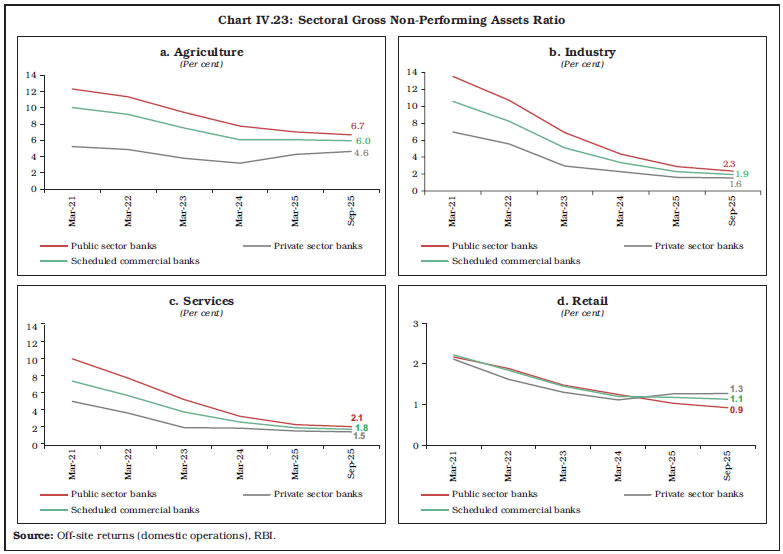 IV.43 Within retail loan segment, the GNPA ratio of consumer durables was the highest, followed by credit card receivables and education loans. Asset quality of education loans and housing loans improved, while it weakened for consumer durables, credit card receivables and vehicle loans at end-March 2025 (Chart IV.24a). In the services sector, asset quality improved across all sub-sectors, except for post and telecommunication segment, which recorded the highest GNPA ratio within the sector (Chart IV.24b). Asset quality improved across all industrial sub-sectors, except for beverages and tobacco. Leather and leather products industry continued to have the highest GNPA ratio within industries, despite an improvement (Chart IV.24c). 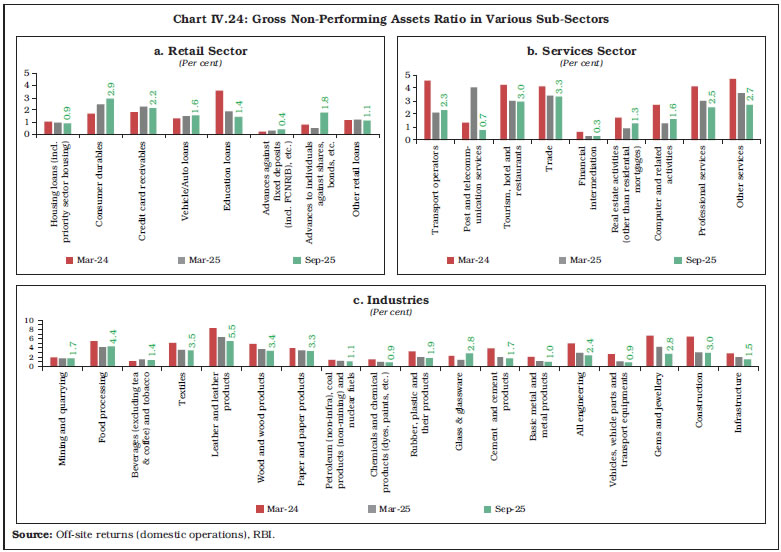 IV.44 At end-September 2025, housing loans and education loans witnessed further improvement in asset quality within the retail segment, while leather and leather products continued to have the highest GNPA ratio within industry, despite some improvement. In contrast, credit card receivables and post and telecommunication segment recorded an improvement in asset quality at end-September 2025 as compared to end-March 2025. 5.1 Credit to the MSME Sector IV.45 Credit growth of SCBs to micro, small and medium enterprises (MSME) sector decelerated in 2024-25, although it continued to remain in double digits. Among bank groups, PSBs' credit growth to MSME accelerated, while it moderated for PVBs (Table IV.17). MSME credit as a proportion of SCBs' total adjusted net bank credit stood at 19.0 per cent at end-March 2025 as compared with 19.3 per cent at end-March 2024. 5.2 Priority Sector Credit IV.46 The priority sector lending of SCBs increased by 12.5 per cent in 2024-25 as compared with an increase of 16.9 per cent a year ago. The moderation in growth was led by PVBs, while PSBs recorded a marginal increase. All bank groups managed to achieve their overall priority sector lending target (Table IV.18). The total amount outstanding under Kisan Credit Cards (KCCs) increased by 3.9 per cent during 2024-25 as compared with an increase of 10.8 per cent a year ago. The share of SCBs in total number and amount outstanding under KCCs was 37.5 per cent and 58.9 per cent, respectively, at end-March 2025. Region-wise, the southern region had the highest share of amount outstanding under total KCCs, while northern region had the highest share of SCBs' amount outstanding under KCCs (Appendix Table IV.8). | Table IV.17: Credit Flow to the MSME Sector by SCBs | | (Number of accounts in lakh, amount outstanding in ₹ crore) | | 1 | 2 | 3 | 4 | 5 | | | | 2022-23 | 2023-24 | 2024-25 | | PSBs | No. of accounts | 138.6 | 144.5 | 124.6 | | | | (-7.4) | (4.2) | (-13.7) | | | Amount outstanding | 10,84,954 | 12,22,687 | 14,15,994 | | | | (13.5) | (12.7) | (15.8) | | PVBs | No. of accounts | 58.0 | 89.4 | 79.8 | | | | (-35.2) | (54.2) | (-10.7) | | | Amount outstanding | 10,60,173 | 13,35,238 | 14,84,158 | | | | (12.7) | (25.9) | (11.2) | | SFBs | No. of accounts | 15.1 | 20.4 | 35.9 | | | | (-35.0) | (34.8) | (75.8) | | | Amount outstanding | 29,661 | 67,086 | 91,002 | | | | (1.2) | (126.2) | (35.6) | | FBs | No. of accounts | 1.6 | 2.7 | 2.8 | | | | (-26.3) | (72.5) | (4.1) | | | Amount outstanding | 85,349 | 1,00,261 | 1,17,808 | | | | (0.0) | (17.5) | (17.5) | | SCBs | No. of accounts | 213.3 | 257.0 | 243.2 | | | | (-19.4) | (20.5) | (-5.4) | | | Amount outstanding | 22,60,135 | 27,25,272 | 31,08,962 | | | | (12.4) | (20.6) | (14.1) | Notes: 1. Figures in parentheses indicate y-o-y growth rates.
2. Data for SCBs excludes RRBs and PBs.
3. Constituent items may not add up to the total due to rounding off.
Source: RBI. |
| Table IV.18: Priority Sector Lending by Banks | | (At end-March 2025) | | (Amount in ₹ crore) | | Item | Target/ sub-target (per cent of ANBC/ CEOBSE | Public Sector Banks | Private Sector Banks | Foreign Banks | Small Finance Banks | Scheduled Commercial Banks | | Amount Outstanding | Per cent of ANBC/ CEOBSE | Amount Outstanding | Per cent of ANBC/ CEOBSE | Amount Outstanding | Per cent of ANBC/ CEOBSE | Amount outstanding | Per cent of ANBC/ CEOBSE | Amount outstanding | Per cent of ANBC/ CEOBSE | | 1 | 2 | 3 | 4 | 5 | 6 | 7 | 8 | 9 | 10 | 11 | 12 | | Total Priority Sector Advances | 40/75* | 35,91,872 | 42.3 | 27,06,678 | 44.3 | 2,64,854 | 41.8 | 1,63,079 | 84.3 | 67,26,484 | 43.6 | | of which | | | | | | | | | | | | | Agriculture | 18.0 | 15,77,732 | 18.6 | 10,94,193 | 17.9 | 52,440 | 18.6 | 46,867 | 24.2 | 27,71,232 | 18.4 | | Small and Marginal Farmers | 10.0 | 9,46,088 | 11.1 | 6,12,276 | 10.0 | 32,658 | 11.6 | 31,334 | 16.2 | 16,22,355 | 10.7 | | Non-corporate Individual Farmers# | 13.8 | 12,62,213 | 14.8 | 8,41,598 | 13.8 | 41,658 | 14.8 | 44,678 | 23.1 | 21,90,147 | 14.5 | | Micro Enterprises | 7.5 | 7,64,969 | 9.0 | 5,33,164 | 8.7 | 24,762 | 8.8 | 65,972 | 34.1 | 13,88,867 | 9.2 | | Weaker Sections | 12.0 | 11,64,885 | 13.7 | 7,63,710 | 12.5 | 35,674 | 12.6 | 56,959 | 29.5 | 20,21,228 | 13.4 | ANBC: Adjusted net bank credit; CEOBSE: Credit equivalent of off-balance sheet exposure.
*: Total priority sector lending target for small finance banks is 75 per cent. The target has been revised to 60 per cent effective from April 1, 2025.
#: Target for non-corporate farmers is based on the system-wide average of the last three years' achievement. For 2024-25, the applicable system wide average figure is 13.8 per cent.
Notes: 1. Amount outstanding and achievement percentage are based on the average achievement of banks for four quarters of the financial year.
2. Data for SCBs excludes RRBs and PBs.
3. For foreign banks having less than 20 branches, only the total PSL target of 40 per cent is applicable.
4. Data are provisional.
5. Constituent items may not add up to the total due to rounding off.
Source: RBI. | IV.47 The total trading volume of priority sector lending certificates (PSLCs) increased by 36.4 per cent in 2024-25, led by PSLC-General and micro enterprises. Among the four PSLC categories, the small and marginal farmers (SMF) category recorded the highest trading volume. This reflects the concentration of lending to SMF by a few specialised banks and shortfall of others in achieving this sub-target through their direct lending (Chart IV.25). IV.48 Private sector banks remained the largest buyers and sellers of PSLCs in 2024-25. The share of PSBs as buyers of PSLCs increased, while their share as sellers of PSLCs fell. RRBs continued to be the second largest sellers of PSLCs, reflecting their focused loan portfolio and comparative advantage in rural lending (Chart IV.26a and b). IV.49 The weighted average premium on PSLC-Agriculture increased in 2024-25, following a steady decline in the previous three years, amidst a moderation in agriculture credit growth. Premium for PSLC-SMF also increased in 2024-25 and remained the highest amongst all the categories. Premiums on PSLC–Micro Enterprises and PSLC–General continued to decline for the third consecutive year in 2024-25 (Table IV.19).
| Table IV.19: Weighted Average Premium on Various Categories of PSLCs | | (Per cent) | | | 2020-21 | 2021-22 | 2022-23 | 2023-24 | 2024-25 | 2024-25 (Apr-Sep) | 2025-26 (Apr-Sep) | | 1 | 2 | 3 | 4 | 5 | 6 | 7 | 8 | | PSLC-Agriculture | 1.55 | 1.37 | 0.62 | 0.24 | 0.48 | 0.29 | 1.30 | | PSLC-Micro Enterprises | 0.88 | 0.95 | 0.16 | 0.04 | 0.01 | 0.01 | 0.01 | | PSLC-Small and Marginal Farmers | 1.74 | 2.01 | 1.68 | 1.74 | 1.95 | 1.94 | 2.77 | | PSLC-General | 0.46 | 0.60 | 0.19 | 0.02 | 0.01 | 0.01 | 0.01 | | Source: RBI. | IV.50 Continuing the improvement in asset quality of priority sector advances since 2021-22, the GNPA ratio declined to 4.0 per cent at end-March 2025 from 4.4 per cent a year ago. Nonetheless, the share of priority sector in total GNPAs of SCBs increased to 64.7 per cent in 2024-25 from 58.2 per cent in the previous year, as the non-priority sector NPAs fell. Agriculture sector accounted for the highest share of GNPAs in the priority sector (Table IV.20). | Table IV.20: Sector-wise GNPAs of Banks | | (At end-March) | | (Amount in ₹ crore) | | Bank Group | Priority Sector | Of which | Non-priority Sector | Total NPAs | | Agriculture | Micro and Small Enterprises | Others | | Amount | Per cent* | Amount | Per cent* | Amount | Per cent* | Amount | Per cent* | Amount | Per cent* | Amount | Per cent* | | 1 | 2 | 3 | 4 | 5 | 6 | 7 | 8 | 9 | 10 | 11 | 12 | 13 | | PSBs | | | | | | | | | | | | | | 2024 | 2,09,837 | 65.4 | 1,07,647 | 33.6 | 78,592 | 24.5 | 23,598 | 7.4 | 1,10,903 | 34.6 | 3,20,740 | 100 | | 2025 | 1,98,557 | 72.6 | 1,07,818 | 39.4 | 70,708 | 25.9 | 20,032 | 7.3 | 74,856 | 27.4 | 2,73,413 | 100 | | PVBs | | | | | | | | | | | | | | 2024 | 49,986 | 40.5 | 21,211 | 17.2 | 18,340 | 14.8 | 10,435 | 8.4 | 73,553 | 59.5 | 1,23,540 | 100 | | 2025 | 63,520 | 48.7 | 31,050 | 23.8 | 21,041 | 16.1 | 11,429 | 8.8 | 66,856 | 51.3 | 1,30,376 | 100 | | FBs | | | | | | | | | | | | | | 2024 | 1,796 | 27.5 | 162 | 2.5 | 1,315 | 20.2 | 318 | 4.9 | 4,728 | 72.5 | 6,523 | 100 | | 2025 | 1,659 | 31.2 | 147 | 2.8 | 1,235 | 23.2 | 277 | 5.2 | 3,662 | 68.8 | 5,321 | 100 | | SFBs | | | | | | | | | | | | | | 2024 | 4,030 | 72.1 | 1,878 | 33.6 | 1,179 | 21.1 | 973 | 17.4 | 1,561 | 27.9 | 5,590 | 100 | | 2025 | 7,602 | 76.1 | 3,978 | 39.8 | 2,254 | 22.6 | 1,370 | 13.7 | 2,387 | 23.9 | 9,989 | 100 | | SCBs | | | | | | | | | | | | | | 2024 | 2,65,649 | 58.2 | 1,30,898 | 28.7 | 99,426 | 21.8 | 35,324 | 7.7 | 1,90,744 | 41.8 | 4,56,393 | 100 | | 2025 | 2,71,338 | 64.7 | 1,42,992 | 34.1 | 95,238 | 22.7 | 33,108 | 7.9 | 1,47,761 | 35.3 | 4,19,099 | 100 | *: Per cent of total NPAs.
Notes: 1. Constituent items may not add up to the total due to rounding off.
2. Data for SCBs excludes RRBs and PBs.
Source: Off-site returns (domestic operations), RBI. | IV.51 PSBs extended 42.3 per cent of their adjusted net bank credit (ANBC)/ credit equivalent of off-balance sheet exposure (CEOBSE) to the priority sector, however, the sector accounted for 72.6 per cent of their total NPAs. In comparison, priority sector exposure of PVBs stood at 44.3 per cent, contributing 48.7 per cent to their total NPAs. For SFBs, the share of priority sector lending in their ANBC/ CEOBSE declined to 84.3 per cent at end-March 2025 from 90.6 per cent a year ago, while the proportion of priority sector NPAs in their total NPAs increased to 76.1 per cent from 72.1 per cent (Table IV.18 and Table IV.20). 5.3 Credit to Sensitive Sectors IV.52 Banks' exposure to the capital market and real estate is reckoned as sensitive in view of the risks inherent in asset price fluctuations. Based on annual accounts data14, at end-March 2025, SCBs' exposure to these sensitive sectors, as a share of their total loans and advances at 27.1 per cent remained broadly similar to the previous year (Appendix Table IV.9). IV.53 PVBs witnessed a steep deceleration in growth of exposures to sensitive sectors during 2024-25, following a sharp increase in the previous year, reflecting the merger impact. On the contrary, PSBs' exposure growth to capital markets accelerated, while it fell marginally in case of real estate sector (Charts IV.27 a and b). 5.4 Unsecured Lending IV.54 Unsecured lending, characterised by credit exposures not backed by tangible collateral, entails higher credit risk for banks in the event of default. At end-March 2025, the share of unsecured loans in SCBs' gross advances declined for the second consecutive year to 24.5 per cent. This partly reflects the impact of the Reserve Bank's risk containment measures announced in November 2023. Foreign banks continued to have the highest share of unsecured advances, while the share of public and private sector banks has gradually converged in recent years (Chart IV.28a). The mean, median as well as dispersion of bank-wise exposure to unsecured loans was the highest amongst foreign banks. In 2024-25, the mean exposure of PVBs to unsecured loans declined, while the median increased relative to the previous year. A similar, though less pronounced, pattern was observed for PSBs (Chart IV.28b). 6. Ownership Pattern IV.55 PSBs are majorly owned and controlled by the Government of India. During 2024-25, six PSBs witnessed a decline in Government's shareholding as they raised equity funds from the capital market. Among them, five banks had Government's shareholding of more than 75 per cent at end-March 2025 (Chart IV.29a and Appendix Table IV.10).15 IV.56 PVBs have a more diversified ownership pattern with a higher share of institutional and foreign investors (Chart IV.29b). The aggregate foreign investment limit is 74 per cent for PVBs and 20 per cent for PSBs.16 7. Corporate Governance IV.57 Good corporate governance is critical for efficiency in allocation of resources, protection of depositors' and other stakeholders' interests, and preservation of financial stability. 7.1 Composition of Boards IV.58 Independent directors contribute to the Board's deliberations by providing independent judgement especially on issues of strategy, performance, risk management, resources, key appointments, and standard of conduct. The Reserve Bank on April 26, 2021 issued instructions for the composition of certain committees of the Board; Chair and meetings of the Board; age, tenure and remuneration of directors; and appointment of the whole-time directors for robust and transparent risk management and decision-making in banks.17 At end-March 2025, the average share of independent directors in the Board was 63 per cent for PVBs and 67 per cent for SFBs (Table IV.21).18 | Table IV.21: Independent Directors on the Board and its Committees | | (At end-March) | | (Share in per cent) | | Bank Group | Board | Risk Management Committee of Board (RMCB) | Nomination and Remuneration Committee (NRC) | Audit Committee of the Board (ACB) | | 2024 | 2025 | 2024 | 2025 | 2024 | 2025 | 2024 | 2025 | | 1 | 2 | 3 | 4 | 5 | 6 | 7 | 8 | 9 | | Private Sector Banks | 65 | 63 | 70 | 69 | 85 | 86 | 87 | 89 | | Small Finance Banks | 67 | 67 | 73 | 75 | 79 | 80 | 82 | 84 | Note: Figures in the table represent the average for a particular bank group.
Sources: Annual reports; and websites of banks. | IV.59 Banks are required to constitute a Risk Management Committee of Board (RMCB), with a majority of non-executive directors. The Chair of the Board may be a member of the RMCB only if he/she has the requisite risk management expertise. The proportion of PVBs in which the Chair is not a member of the RMCB decreased to 33 per cent at end-March 2025 from 38 per cent at end-March 2024. In case of SFBs, the proportion increased to 36 per cent at end-March 2025 from 33 per cent at end-March 2024. 7.2 Executive Compensation IV.60 To maintain balance between short-term risk-taking and long-term stability, on November 4, 2019, the Reserve Bank issued revised guidelines on compensation of whole-time directors/ chief executive officers/ material risk takers and control function staff in banks.19 At end-March 2024, the average share of actual variable pay in total remuneration of Managing Directors (MDs) & Chief Executive Officers (CEOs) increased to 46 per cent for PVBs, while it decreased to 38 per cent for SFBs (Chart IV.30a). The average share of the non-cash component in the actual variable pay of MDs & CEOs increased for both PVBs and SFBs at end-March 2024 from a year ago (Chart IV.30b). 8. Foreign Banks' Operations in India and Overseas Operations of Indian Banks IV.61 At end-March 2025, the number of foreign banks operating through branch/ wholly-owned subsidiary mode in India declined to 44, following the exit of one bank during the year. The change in number of branches of foreign banks reflect their continuous re-alignment of global business strategy and business value optimisation. The number of foreign banks having representative offices in India remained unchanged during the year (Table IV.22). | Table IV.22: Operations of Foreign Banks in India | | (At end-March) | | Period | Foreign banks operating through branch/ wholly-owned subsidiary mode | Foreign banks having representative offices | | No. of Banks | Branches# | | 1 | 2 | 3 | 4 | | 2022 | 45 | 861 | 34 | | 2023 | 44 | 782 | 33 | | 2024 | 45 | 780 | 31 | | 2025 | 44 | 775 | 31 | #: Including branches of two foreign banks, viz., SBM Bank (India) Limited and DBS Bank (India) Limited which are operating through wholly-owned subsidiary mode.
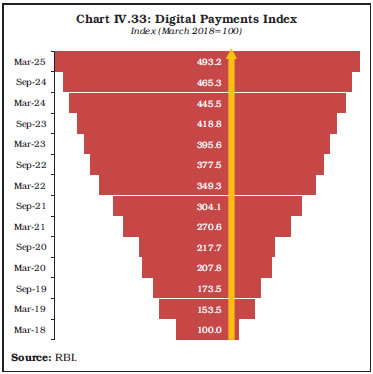
Source: RBI. | IV.62 Indian banks too maintained geographical presence abroad for conduct of their overseas operations through branches, subsidiaries, representative offices, joint venture banks, and other offices (Chart IV.31). PSBs had a wider overseas presence than their private sector counterparts (Appendix Table IV.11). 9. Payment Systems IV.63 India's payment systems have witnessed rapid strides in terms of acceptance infrastructure, availability, and user adoption, and are playing an integral role in supporting economic activity and fostering financial inclusion. Particularly, digital payment products have grown manifold aided by technological advancements, sound and supportive regulatory framework, and policy initiatives at promoting cashless transactions. In line with Payments Vision 2025, the Reserve Bank's policy initiatives focus on providing safe, secure, fast, convenient, accessible, and affordable e-payment options to every user. 9.1 Digital Payments IV.64 During 2024-25, digital payments grew by 17.9 per cent in value terms, accounting for 97.6 per cent of India's total payments. In contrast, payments through paper-based instruments (cheques) declined during the year, representing the remaining 2.4 per cent. In volume terms, growth in digital payments was much higher at 35 per cent amidst increasing usage of digital methods for small value payments. Consequently, the average value of retail digital payments decreased to ₹3,830 during 2024-25 from ₹4,382 during 2023-24 (Chart IV.32). IV.65 The unified payments interface (UPI) accounted for a majority share in the volume of transactions, while real time gross settlement (RTGS), which facilitates high value transactions, accounted for the largest share in value term. Furthermore, while the usage of debit cards has declined, payments through credit cards continued to increase in recent periods (Table IV.23). IV.66 The Reserve Bank of India-Digital Payments Index (RBI-DPI), launched in January 2021 and computed semi-annually, captures the extent of digitalisation of payments across the country. The index comprises of five broad parameters: payment enablers; payment infrastructure – demand-side factors; payment infrastructure – supply-side factors; payment performance; and consumer centricity. The index value for March 2025 increased to 493.2 from 445.5 a year ago, driven by significant growth in payment infrastructure and payment performance across the country (Chart IV.33). 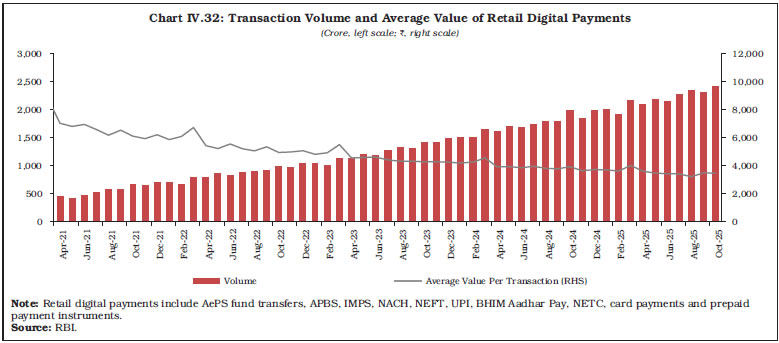
| Table IV.23: Payment Systems Indicators | | Item | Volume (lakh) | Value (₹ crore) | | 2022-23 | 2023-24 | 2024-25 | 2022-23 | 2023-24 | 2024-25 | | 1 | 2 | 3 | 4 | 5 | 6 | 7 | | 1. Large Value Credit Transfers – RTGS | 2,426 | 2,700 | 3,025 | 14,99,46,286 | 17,08,86,670 | 20,13,87,682 | | 2. Credit Transfers | 9,83,621 | 14,86,107 | 20,61,015 | 5,50,09,620 | 6,75,42,859 | 7,98,81,976 | | 2.1 AePS (Fund Transfers) | 6 | 4 | 4 | 356 | 261 | 190 | | 2.2 APBS | 17,834 | 25,888 | 32,964 | 2,47,535 | 3,90,743 | 5,54,034 | | 2.3 ECS Credit | 0 | 0 | 0 | 0 | 0 | 0 | | 2.4 IMPS | 56,533 | 60,053 | 56,250 | 55,85,441 | 64,95,652 | 71,39,110 | | 2.5 NACH Credit | 19,257 | 16,227 | 16,939 | 15,41,815 | 15,25,104 | 16,70,223 | | 2.6 NEFT | 52,847 | 72,640 | 96,198 | 3,37,19,541 | 3,91,36,014 | 4,44,61,464 | | 2.7 UPI | 8,37,144 | 13,11,295 | 18,58,660 | 1,39,14,932 | 1,99,95,086 | 2,60,56,955 | | 3. Debit Transfers and Direct Debits | 15,343 | 18,250 | 21,660 | 12,89,611 | 16,87,658 | 22,08,583 | | 3.1 BHIM Aadhaar Pay | 214 | 194 | 230 | 6,791 | 6,112 | 6,907 | | 3.2 ECS Debit | 0 | 0 | 0 | 0 | 0 | 0 | | 3.3 NACH Debit | 13,503 | 16,426 | 19,762 | 12,80,219 | 16,78,769 | 21,99,327 | | 3.4 NETC (linked to bank accounts) | 1,626 | 1,629 | 1,668 | 2,601 | 2,777 | 2,349 | | 4. Card Payments | 63,325 | 58,470 | 63,861 | 21,52,245 | 24,23,563 | 26,05,110 | | 4.1 Credit Cards | 29,145 | 35,610 | 47,741 | 14,32,255 | 18,31,134 | 21,09,197 | | 4.2 Debit Cards | 34,179 | 22,860 | 16,120 | 7,19,989 | 5,92,429 | 4,95,914 | | 5. Prepaid Payment Instruments | 74,667 | 78,775 | 70,254 | 2,87,111 | 2,83,048 | 2,16,751 | | 6. Paper-based Instruments | 7,109 | 6,632 | 6,095 | 71,72,904 | 72,12,333 | 71,13,350 | | Total Digital Payments (1+2+3+4+5) | 11,39,382 | 16,44,302 | 22,19,815 | 20,86,84,872 | 24,28,23,799 | 28,63,00,103 | | Total Retail Payments (2+3+4+5+6) | 11,44,065 | 16,48,234 | 22,22,885 | 6,59,11,490 | 7,91,49,461 | 9,20,25,771 | | Total Payments (1+2+3+4+5+6) | 11,46,491 | 16,50,934 | 22,25,910 | 21,58,57,776 | 25,00,36,131 | 29,34,13,453 | AePS: Aadhaar-enabled Payment System, APBS: Aadhaar Payment Bridge System, BHIM: Bharat Interface for Money, ECS: Electronic Clearance Service, IMPS: Immediate Payment Service, NACH: National Automated Clearing House, NEFT: National Electronic Funds Transfer, NETC: National Electronic Toll Collection, RTGS: Real Time Gross Settlement, UPI: Unified Payments Interface.
Note: Components may not add up to total due to rounding off.
Source: RBI. |
 9.2 ATMs IV.67 During 2024-25, the total number of automated teller machines (ATMs) declined moderately, driven by reduction in off-site ATMs even while on-site ATMs increased. Increase in digitalisation of payments has reduced the customers' requirement of transacting with ATMs. PSBs accounted for the highest share in the total number of ATMs, followed by PVBs, and white label ATMs – those owned and operated by non-bank entities, at end-March 2025 (Table IV.24 and Appendix Table IV.12). | Table IV.24: Number of ATMs* | | (At end-March) | | Bank Group | On-site ATMs | Off-site ATMs | Total ATMs | | 2024 | 2025 | 2024 | 2025 | 2024 (2+4) | 2025 (3+5) | | 1 | 2 | 3 | 4 | 5 | 6 | 7 | | Public Sector Banks | 77,033 | 79,865 | 57,661 | 53,679 | 1,34,694 | 1,33,544 | | Private Sector Banks | 45,438 | 47,713 | 34,446 | 29,404 | 79,884 | 77,117 | | Foreign Banks | 603 | 587 | 566 | 406 | 1,169 | 993 | | Small Finance Banks | 3,042 | 3,158 | 26 | 29 | 3,068 | 3,187 | | Payments Banks | 0 | 0 | 0 | 0 | 0 | 0 | | SCBs | 1,26,116 | 1,31,323 | 92,699 | 83,518 | 2,18,815 | 2,14,841 | | White Label ATMs | 0 | 0 | 34,602 | 36,216 | 34,602 | 36,216 | | Total | 1,26,116 | 1,31,323 | 1,27,301 | 1,19,734 | 2,53,417 | 2,51,057 | * Includes cash recycler machines.
Note: Data does not include ATMs of regional rural banks, local area banks, and co-operative banks.
Source: RBI. | IV.68 PSBs had a more even distribution of ATMs across population groups, while the presence of ATMs of other bank groups was towards metropolitan, urban, and semi-urban centres. In contrast, 79.4 per cent of the total white label ATMs were in rural and semi-urban centres at end-March 2025 (Table IV.25). | Table IV.25: Population Group-wise Distribution of ATMs of Bank Groups* | | (At end-March 2025) | | Bank Group | Rural | Semi-urban | Urban | Metropolitan | Total | | 1 | 2 | 3 | 4 | 5 | 6 | | Public Sector Banks | 28,481 | 39,630 | 33,589 | 31,844 | 1,33,544 | | | (21.3) | (29.7) | (25.2) | (23.8) | (100.0) | | Private Sector Banks | 7,569 | 20,811 | 18,945 | 29,792 | 77,117 | | | (9.8) | (27.0) | (24.6) | (38.6) | (100.0) | | Foreign Banks | 82 | 282 | 265 | 364 | 993 | | | (8.3) | (28.4) | (26.7) | (36.7) | (100.0) | | Small Finance Banks | 293 | 992 | 953 | 949 | 3,187 | | | (9.2) | (31.1) | (29.9) | (29.8) | (100.0) | | Payments Banks | 0 | 0 | 0 | 0 | 0 | | | (0.0) | (0.0) | (0.0) | (0.0) | (0.0) | | SCBs | 36,425 | 61,715 | 53,752 | 62,949 | 2,14,841 | | | (17.0) | (28.7) | (25.0) | (29.3) | (100.0) | | White Label ATMs | 16,578 | 12,164 | 4,733 | 2,741 | 36,216 | | | (45.8) | (33.6) | (13.1) | (7.6) | (100.0) | *: Includes cash recycler machines.
Notes: 1. Figures in parentheses indicate percentage share of population groups in total ATMs for bank groups.
2. Components may not add up to total due to rounding off.
Source: RBI. | 10. Technology Adoption IV.69 The Reserve Bank has been working to create an enabling regulatory environment for fostering innovation and ensuring financial system integrity. Among various emerging technologies, artificial intelligence (AI) is a transformational technology with potential for improving customer engagement, unlocking new forms of credit assessment and delivery, strengthening risk management and fraud detection. Towards this end, the Reserve Bank's Framework for Responsible and Ethical Enablement of AI (FREE-AI) seeks to encourage innovation in the financial sector while balancing risk mitigation. The Report on FREE-AI was placed on the RBI website on August 13, 2025. IV.70 A recent survey conducted by the Reserve Bank indicates that banks are increasingly viewing innovation as a structured component of long-term digital modernisation rather than an episodic experimentation (Box IV.1). Box IV.1: Evolving Technology and Innovation Priorities of Indian Banks20 To enhance understanding of how Indian banks are shaping, sequencing and operationalising technological modernisation within a prudentially regulated environment, the Reserve Bank undertook a survey during 2025. The sample included nine PSBs, 16 PVBs and six SFBs, accounting for around 66 per cent of total bank credit as on October 31, 2025. The surveyed banks are broadly aligned in recognising that innovation is central to sustaining competitiveness, strengthening resilience and enhancing customer experience. A number of banks view innovation as a catalyst for technology-enabled process re-engineering to deliver improved efficiency, service quality and risk management. Several banks view innovation as a capability-enhancing exercise for strengthening analytical depth, improving decision-making and enabling more agile service delivery, while others view innovation as an investment in strengthening the digital foundations for cybersecurity, operational resilience, and regulatory compliance. Technology spending directed specifically towards innovative or transformative capabilities has increased significantly across all bank groups between 2019-20 to 2023-24 (Chart IV.1.1a). The share of innovation-related technology delivered through outsourcing/ third party arrangements has also increased, suggesting expanding role for specialised external providers (Chart IV.1.1b). Predominant technologies adopted through third parties include cloud-hosted platforms, vendor-supported cybersecurity solutions and modular digital platforms. There is a substantial convergence on areas of innovation and transformative technologies receiving emphasis by banks. Cloud services, enterprise data and analytics platforms, AI/ML applications, and cybersecurity enhancements are increasingly shaping banks' longer-term technology strategies. Application programming interface (API)-based architectures and banking-as-a-service models feature prominently in the survey responses, while robotic process automation, digital identity systems, and distributed ledger technologies were also cited in several responses, though with relatively less emphasis. Overall, the survey findings highlight an increase in innovation-related spending across bank groups, suggesting that digital transformation has become a core strategic and operational priority rather than a peripheral initiative. | 11. Consumer Protection IV.71 Consumer protection is one of the key priorities of the Reserve Bank. The Reserve Bank promotes consumer education and protection by monitoring the internal grievance redressal mechanism in its regulated entities, and administering the alternate grievance redress mechanism – comprising the RBI Ombudsman, Consumer Education and Protection Cells and Consumer Education and Protection Department.21 As part of its customer-centric approach, state co-operative banks and central co-operative banks were brought under the ambit of the Reserve Bank – Integrated Ombudsman Scheme, 2021, effective November 1, 2025. 11.1 Grievance Redressal IV.72 During 2024-25, the Offices of the RBI Ombudsman (ORBIOs) received 2.96 lakh complaints22, an increase of 0.8 per cent over the previous year. Majority of the complaints at ORBIOs was received from metropolitan and urban centres (Chart IV.34a). Complaints against PVBs and PSBs accounted for 72.3 per cent of the total complaints received by ORBIOs during the year (Chart IV.34b). IV.73 Complaints relating to loans and advances, credit cards, mobile/ internet banking, and deposit accounts contributed to around four-fifths of the total complaints received by ORBIOs during 2024-25. The credit cards category witnessed the highest increase in the number of complaints during 2024-25 (Table IV.26). | Table IV.26: Number of Complaints Received by Offices of the RBI Ombudsman: Category-wise | | Item | 2022-23 | 2023-24 | 2024-25 | | 1 | 2 | 3 | 4 | | Loans and Advances | 59,762 | 85,281 | 86,670 | | Credit Cards | 34,151 | 42,329 | 50,811 | | Mobile/ Electronic Banking | 43,167 | 57,242 | 49,951 | | Deposit Accounts | 34,481 | 46,358 | 49,913 | | Others | 22,587 | 24,355 | 30,760 | | ATM/ Debit Cards | 29,929 | 25,231 | 18,082 | | Remittances | 2,940 | 4,101 | 3,702 | | Para-banking | 2,782 | 4,380 | 3,322 | | Pension Payments | 4,380 | 4,108 | 2,719 | | Notes and Coins | 511 | 539 | 391 | | Total | 2,34,690 | 2,93,924 | 2,96,321 | | Source: RBI. | IV.74 Among banks, PVBs accounted for the highest share in complaints related to loans and advances and credit cards, while a majority of complaints relating to mobile/electronic banking, deposit accounts, and ATM/debit cards were against PSBs (Chart IV.35).
IV.75 The ORBIOs disposed of a total of 2.91 lakh complaints out of 3.12 lakh handled complaints, maintaining a disposal rate of 93.1 per cent during 2024-25.23 11.2 Deposit Insurance IV.76 Deposit insurance is an important feature of the financial safety-net system as it bolsters public confidence in the banking system. In India, the Deposit Insurance and Credit Guarantee Corporation (DICGC), a wholly owned subsidiary of the Reserve Bank, administers deposit insurance covering all commercial banks, including RRBs, LABs, and co-operative banks. At end-March 2025, DICGC extended insurance to 1,982 banks, including 139 commercial banks and 1,843 co-operative banks, with the deposit insurance coverage limit of ₹5 lakh per depositor (Table IV.27). IV.77 The insurance coverage ratio in terms of the number of fully covered deposit accounts (i.e., accounts with deposit balance up to ₹5 lakh) was 97.6 per cent at end-March 2025. In terms of value of deposits, the coverage as measured by insured deposits ratio decreased to 41.5 per cent at end-March 2025 from 43.1 per cent a year ago. | Table IV.27: Bank Group-wise Insured Deposits | | (Amount in ₹ crore) | | Bank Group | As on March 31, 2024 | As on March 31, 2025 | | No. of Insured Banks | Insured Deposits | Assessable Deposits | IDR {(3) / (4)} | No. of Insured Banks | Insured Deposits | Assessable Deposits | IDR {(7) / (8)} | | 1 | 2 | 3 | 4 | 5 | 6 | 7 | 8 | 9 | | I. Commercial Banks (i to vii) | 140 | 86,66,416 | 2,06,73,077 | 41.9 | 139 | 92,39,260 | 2,28,57,103 | 40.4 | | i. Public Sector Banks | 12 | 56,47,846 | 1,15,76,001 | 48.8 | 12 | 59,53,830 | 1,26,11,152 | 47.2 | | ii. Private Sector Banks | 21 | 23,63,912 | 72,35,902 | 32.7 | 21 | 25,71,103 | 81,93,195 | 31.4 | | iii. Foreign Banks | 44 | 50,568 | 10,08,506 | 5.0 | 44 | 52,084 | 10,91,743 | 4.8 | | iv. Small Finance Banks | 12 | 89,532 | 2,15,426 | 41.6 | 11 | 1,07,719 | 2,70,601 | 39.8 | | v. Payments Banks | 6 | 16,794 | 16,937 | 99.2 | 6 | 26,142 | 26,294 | 99.4 | | vi. Regional Rural Banks | 43 | 4,96,827 | 6,19,010 | 80.3 | 43 | 5,27,364 | 6,62,709 | 79.6 | | vii. Local Area Banks | 2 | 937 | 1,295 | 72.4 | 2 | 1,018 | 1,409 | 72.2 | | II. Co-operative Banks (i to iii) | 1,857 | 7,46,290 | 11,79,084 | 63.3 | 1,843 | 7,72,805 | 12,48,939 | 61.9 | | i. Urban Co-operative Banks | 1,472 | 3,71,846 | 5,56,962 | 66.8 | 1,457 | 3,80,142 | 5,84,450 | 65.0 | | ii. State Co-operative Banks | 33 | 64,202 | 1,48,080 | 43.4 | 34 | 66,285 | 1,57,076 | 42.2 | | iii. District Central Co-operative Banks | 352 | 3,10,242 | 4,74,041 | 65.4 | 352 | 3,26,378 | 5,07,412 | 64.3 | | Total (I+II) | 1,997 | 94,12,705 | 2,18,52,160 | 43.1 | 1,982 | 1,00,12,065 | 2,41,06,042 | 41.5 | IDR: Insured Deposits Ratio. It is the ratio of insured deposits to total assessable deposits in per cent.
Note: Components may not add up to total due to rounding off.
Source: DICGC. | IV.78 The deposit insurance fund is constituted with DICGC to settle the claims of insured deposits in the event of (i) imposition of all-inclusive directions on bank by the Reserve Bank24; (ii) liquidation of bank; and (iii) merger/ amalgamation of bank, if the scheme requires payment to depositors in terms of DICGC Act, 1961. During 2024-25, DICGC settled claims amounting to ₹476 crore through the fund and made a total recovery of claims amounting to ₹1,309 crore.25 At end-March 2025, the balance in deposit insurance fund at ₹2.29 lakh crore recorded a y-o-y growth of 15.2 per cent, while insured deposits rose by 6.4 per cent. Consequently, the reserve ratio – the ratio of deposit insurance fund to insured deposits – improved to 2.29 per cent at end-March 2025 from 2.11 per cent a year ago. IV.79 Since inception, DICGC levied a flat rate premium on banks to fund the deposit insurance scheme, with the current applicable premium rate at 12 paise per ₹100 of assessable deposits. In December 2025, the Reserve Bank approved the risk-based deposit insurance framework for banks to incentivise sound risk management and promote financial stability. 12. Financial Inclusion IV.80 Financial inclusion is important for fostering inclusive and sustainable economic growth. The Government and the Reserve Bank's policy initiatives along with technology-driven innovations have played a pivotal role in empowering the underserved population by ensuring equitable access to financial services. India has complemented digitalisation with expansion of bank branch network and ATMs in furthering inclusion. This contrasts with most other countries where digitalisation is leading to a decline in traditional channels of accessing financial services. Furthermore, the penetration of bank branches in India is higher than most other EMDEs, while availability of ATMs per capita remains comparatively low in India (Charts IV.36a and b). 12.1 Financial Inclusion Plans IV.81 Financial Inclusion Plans (FIPs) capture banks' achievements on parameters such as the number of banking outlets (branches), business correspondents (BCs) outlets, basic savings bank deposit accounts (BSBDAs), overdraft facilities availed in these accounts, transactions in Kisan Credit Cards and General Credit Cards and transactions through the Business Correspondents - Information and Communication Technology channel.26 The number of BSBDAs increased by 2.6 per cent to 72.4 crore at end-March 2025, while the aggregate balance in these accounts increased by 9.5 per cent to 3.3 lakh crore. Further, a majority of BSBDAs continues to be channelised through the BC model, indicating their effectiveness at the grassroots level (Table IV.28). 12.2 Financial Inclusion Index IV.82 The Reserve Bank's Financial Inclusion (FI) Index tracks the progress of financial inclusion in the country. It captures data on 97 indicators pertaining to banking, investments, insurance, postal, and pension sector on three dimensions – access, usage and quality. These dimensions are represented through three sub-indices, viz., FI-access, FI-usage and FI-quality. The composite FI-Index value rose to 67.0 in March 2025 from 64.2 in March 2024 with all sub-indices registering an increase. Growth was mainly contributed by usage and quality dimension, reflecting deepening of financial inclusion and sustained financial literacy initiatives (Chart IV.37). | Table IV.28: Progress in Financial Inclusion Plan | | (At end-March) | | Item | 2015 | 2020 | 2024 | 2025 (P) | | 1 | 2 | 3 | 4 | 5 | | Banking Outreach | | | | | | 1. Banking Outlets in Villages - Branches | 49,571 | 54,561 | 54,198 | 56,829 | | 2. BC Outlets in Villages with Population > 2,000 | 90,877 | 1,49,106 | 12,66,756 | 10,38,208 | | 3. BC Outlets in Villages with Population < 2,000 | 4,08,713 | 3,92,069 | 2,80,922 | 2,72,764 | | 4. Total BC Outlets in Villages | 4,99,590 | 5,41,175 | 15,47,678 | 13,10,972 | | 5. Urban Locations Covered Through BCs | 96,847 | 6,35,046 | 3,06,658 | 3,09,182 | | Basic Saving Bank Deposits Account (BSBDA) | | | | | | 6. BSBDA - Through Branches (No. in lakh) | 2,103 | 2,616 | 2,768 | 2,751 | | 7. BSBDA - Through Branches (Amt. in ₹ crore) | 36,498 | 95,831 | 1,46,306 | 1,54,028 | | 8. BSBDA - Through BCs (No. in lakh) | 1,878 | 3,388 | 4,290 | 4,491 | | 9. BSBDA - Through BCs (Amt. in ₹ crore) | 7,457 | 72,581 | 1,53,489 | 1,74,243 | | 10. BSBDA - Total (No. in lakh) | 3,981 | 6,004 | 7,059 | 7,242 | | 11. BSBDA - Total (Amt. in ₹ crore) | 43,955 | 1,68,412 | 2,99,796 | 3,28,271 | | 12. OD Facility Availed in BSBDAs (No. in lakh) | 76 | 64 | 48 | 45 | | 13. OD Facility Availed in BSBDAs (Amt. in ₹ crore) | 1,991 | 529 | 564 | 564 | | Kisan Credit Card (KCC) and General Credit Card (GCC) | | | | | | 14. KCC - Total (No. in lakh) | 426 | 475 | 515 | 501 | | 15. KCC - Total (Amt. in ₹ crore) | 4,38,229 | 6,39,069 | 8,47,238 | 8,83,682 | | 16. GCC - Total (No. in lakh) | 92 | 202 | 23 | 21 | | 17. GCC - Total (Amt. in ₹ crore) | 1,31,160 | 1,94,048 | 34,340 | 37,563 | | Business Correspondents | | | | | | 18. ICT-A/Cs-BC-Total Transactions (No. in lakh) # | 4,770 | 32,318 | 36,390 | 39,676 | | 19. ICT-A/Cs-BC-Total Transactions (Amt. in ₹ crore) # | 85,980 | 8,70,643 | 13,11,078 | 14,46,451 | P: Provisional, BC: Business Correspondent, OD: Overdraft, ICT: Information and Communication Technology.
#: Transactions during the financial year.
Source: Financial Inclusion Plan returns submitted by PSBs, PVBs and RRBs. | 12.3 Pradhan Mantri Jan Dhan Yojana IV.83 Since its launch by the Government of India in 2014, the Pradhan Mantri Jan Dhan Yojana (PMJDY) has integrated unbanked individuals into the formal financial system and fostered financial inclusion. A large number of accounts opened under the PMJDY are in rural and semi-urban areas and for females. At end-March 2025, the total number of PMJDY accounts reached 55.2 crores, with 96.4 per cent being maintained by PSBs and RRBs. Total deposits in PMJDY accounts increased by 12 per cent to ₹2.6 lakh crore at end-March 2025 (Chart IV.38a). The average deposit in PMJDY accounts has increased by more than four times during March 2015 to March 2025 (Chart IV.38b). During July-October 2025, banks participated in a country-wide campaign for saturation of financial inclusion schemes, including conduct of re-KYC of bank accounts, at Gram Panchayat and Urban Local Bodies level. At end-November 2025, the total number of PMJDY accounts reached 57.1 crores with deposits of ₹2.7 lakh crore. 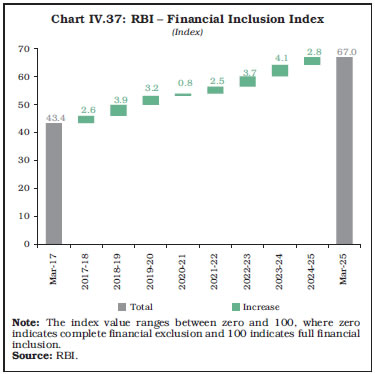
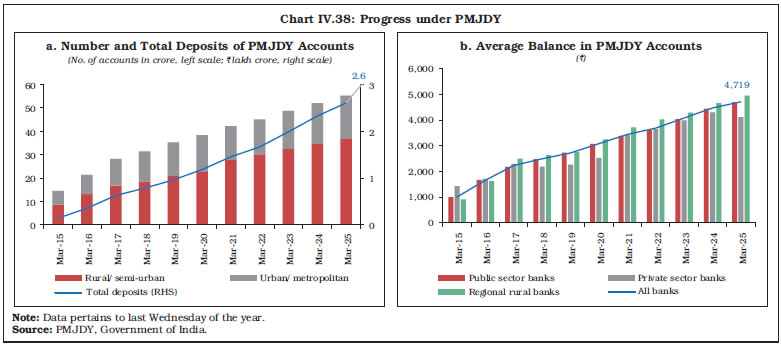 12.4 New Bank Branches by SCBs IV.84 Physical bank branches continue to expand alongside digitalisation for customer engagement. At end-March 2025, there were 1.64 lakh domestic branches of SCBs, an increase of 2.8 per cent over the previous year. New branch openings by SCBs, which had accelerated in the previous two years, moderated slightly during 2024-25. Nearly half of the new bank branches opened during the year were in Tier 1 (urban/ metropolitan) centres, with the remaining half in Tier 2-6 (semi-urban/ rural) centres (Table IV.29). IV.85 New bank branch openings by PSBs accelerated while there was a decline in branch openings by PVBs. Consequently, the share of PVBs in total new branches opened by SCBs declined to 51.8 per cent in 2024-25 from 65.5 per cent in 2023-24. Further, 67.3 per cent of the new branches of PSBs were opened in rural and semi-urban centres, while the proportion for PVBs was 37.5 per cent (Chart IV.39 and Appendix Table IV.12). 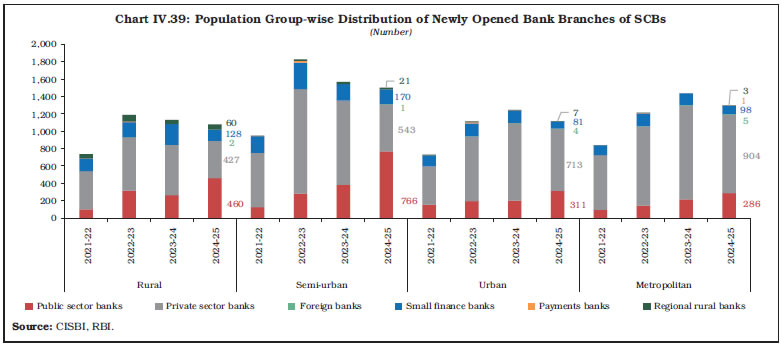
| Table IV.29: Tier-wise Distribution of Newly Opened Bank Branches of SCBs | | Tier | 2021-22 | 2022-23 | 2023-24 | 2024-25 | | 1 | 2 | 3 | 4 | 5 | | Tier 1 | 1,567 | 2,323 | 2,681 | 2,413 | | | (48.2) | (43.6) | (49.8) | (48.3) | | Tier 2 | 233 | 471 | 451 | 375 | | | (7.2) | (8.8) | (8.4) | (7.5) | | Tier 3 | 424 | 809 | 684 | 654 | | | (13.0) | (15.2) | (12.7) | (13.1) | | Tier 4 | 292 | 544 | 433 | 472 | | | (9.0) | (10.2) | (8.0) | (9.5) | | Tier 5 | 227 | 424 | 368 | 352 | | | (7.0) | (7.9) | (6.8) | (7.1) | | Tier 6 | 509 | 763 | 762 | 725 | | | (15.7) | (14.3) | (14.2) | (14.5) | | Total | 3,252 | 5,334 | 5,379 | 4,991 | | | (100.0) | (100.0) | (100.0) | (100.0) | Notes: 1. 'Tier 1' includes centres with population of 1,00,000 and above, 'Tier 2' includes centres with population of 50,000 to 99,999, 'Tier 3' includes centres with population of 20,000 to 49,999, 'Tier 4' includes centres with population of 10,000 to 19,999, 'Tier 5' includes centres with population of 5,000 to 9,999, and 'Tier 6' includes centres with population of less than 5,000. All population figures are as per census 2011.
2. Data exclude digital banking units and administrative offices.
3. Figures in parentheses represent the number of branches opened in a particular tier as per cent of the total.
4. Components may not add up to total due to rounding off.
Source: Central Information System for Banking Infrastructure (CISBI), RBI. CISBI data are updated based on information received from banks. | 12.5 Regional Banking Penetration IV.86 The southern region accounts for the largest number of bank branches, while banking penetration is highest for the northern region at end-March 2025.27 In recent years, the banking penetration has improved across all regions, with the sharpest improvement in north-eastern region (Chart IV.40). 12.6 Microfinance Programme IV.87 Microfinance serves as an effective instrument for advancing financial inclusion, entailing the delivery of financial services, including small-value credit, to the underserved and the unbanked segments of the population, thereby fostering social equity and empowerment. The Self-Help Group - Bank Linkage Programme (SHG-BLP), which aims at extending formal savings and credit facilities to the rural poor, has emerged as the world's largest micro-finance movement. The number of SHGs accessing credit from banks increased to 55.6 lakh in 2024-25 from 54.8 lakh in the previous year. However, the amount of loans disbursed by banks to SHGs moderated slightly on account of lower disbursements in the southern region (Chart IV.41). At end-March 2025, the savings balances of SHGs with banks increased by 9.7 per cent to ₹ 0.7 lakh crore, while their outstanding loans from banks increased by 17.2 per cent to ₹ 3 lakh crore. 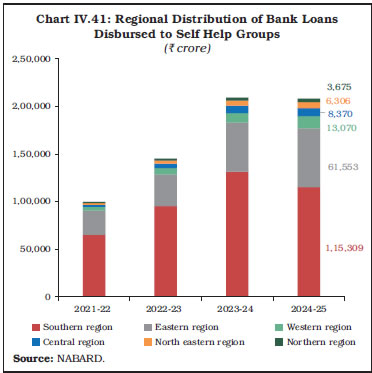 IV.88 The amount of loans disbursed by banks to joint liability groups (JLGs), which are informal credit groups of small borrowers, declined by 58 per cent during 2024-25 (Appendix Table IV.13). 12.7 Trade Receivables Discounting System (TReDS) IV.89 TReDS is an electronic platform for facilitating the financing / discounting of trade receivables of micro, small and medium enterprises (MSME) due from corporates and other buyers such as Government departments and public sector undertakings. TReDS gained further traction in 2024-25 with a sharp increase in both the number and amount of invoices uploaded and financed. The success rate, measured as the percentage of uploaded invoices that get financed, improved to 95.3 per cent in 2024-25 from 94.4 per cent in 2023-24 (Table IV.30). 13. Regional Rural Banks IV.90 Regional rural banks were established as professionally managed alternative channel for credit dispensation to small and marginal farmers, agricultural labourers, and socio-economically weaker sections of the population. Their functional focus areas have been agriculture, trade, commerce, and small-scale industries in the rural areas. At end-March 2025, there were 43 RRBs sponsored by 12 SCBs operating through 22,158 branches in 26 states and three union territories (Puducherry, Jammu & Kashmir, and Ladakh). | Table IV.30: Progress in MSME Financing through TReDS | | (Amount in ₹ crore) | | Financial Year | Invoices Uploaded | Invoices Financed | | Number | Amount | Number | Amount | | 1 | 2 | 3 | 4 | 5 | | 2021-22 | 17,33,553 | 44,112 | 16,40,824 | 40,309 | | 2022-23 | 27,24,872 | 83,955 | 25,58,531 | 76,646 | | 2023-24 | 44,04,148 | 1,51,343 | 41,58,554 | 1,38,241 | | 2024-25 | 64,04,936 | 2,47,796 | 61,01,384 | 2,33,711 | | Source: RBI. | IV.91 In line with their mandate, nearly 92 per cent of RRB branches were in the rural and semi-urban areas. The southern region has the highest number of RRBs, contributing 42.1 per cent of the total profits of all RRBs during 2024-25 (Appendix Table IV.14). Guided by the principle of 'One State-One RRB', the Government of India notified the Phase-IV amalgamation of RRBs on April 5, 2025.28 Accordingly, the total number of RRBs was reduced from 43 to 28 with effect from May 1, 2025. 13.1 Balance Sheet Analysis IV.92 The combined balance sheet of RRBs grew by 7.6 per cent in 2024-25 as against 8.9 per cent in the previous year. RRBs relied more on deposits and their owned funds to meet lending requirements as the borrowings contracted marginally during the year (Table IV.31). IV.93 Deposits accounted for 79 per cent of RRBs' total liabilities, although their deposit growth remained below that of other SCBs during 2024-25. Low-cost CASA deposits had a share of 53.5 per cent in RRBs' total deposits at end-March 2025, the highest amongst all categories of SCBs, except payments banks.29 The credit-deposit (CD) ratio of RRBs30 increased to 73.1 per cent at end-March 2025, its highest level in 35 years, as growth in loans and advances outpaced deposit growth. | Table IV.31: Consolidated Balance Sheet of Regional Rural Banks | | Item | Amount as at end-March (₹ crore) | Y-o-y growth (per cent) | | 2024 | 2025 | 2024 | 2025 | | 1 | 2 | 3 | 4 | 5 | | 1. Share Capital | 19,042 | 19,303 | 10.5 | 1.4 | | 2. Reserves | 46,659 | 53,060 | 16.3 | 13.7 | | 3. Deposits | 6,59,815 | 7,13,800 | 8.4 | 8.2 | | 3.1 Current | 11,952 | 13,375 | 0.1 | 11.9 | | 3.2 Savings | 3,47,193 | 3,68,574 | 8.6 | 6.2 | | 3.3 Term | 3,00,670 | 3,31,851 | 8.5 | 10.4 | | 4. Borrowings | 92,444 | 92,268 | 9.1 | -0.2 | | 4.1 NABARD | 77,166 | 77,455 | 5.5 | 0.4 | | 4.2 Sponsor Bank | 4,293 | 7,949 | 26.0 | 85.2 | | 4.3 Others | 10,986 | 6,864 | 34.2 | -37.5 | | 5. Other Liabilities | 22,120 | 25,495 | 5.9 | 15.3 | | Total Liabilities/Assets | 8,40,080 | 9,03,925 | 8.9 | 7.6 | | 1. Cash in Hand | 2,933 | 2,764 | 1.6 | -5.8 | | 2. Balances with RBI | 30,990 | 30,065 | 5.7 | -3.0 | | 3. Balances in Current Account | 8,173 | 9,752 | 14.3 | 19.3 | | 4. Investments | 3,19,099 | 3,21,213 | 1.8 | 0.7 | | 5. Loans and Advances | 4,45,286 | 5,02,434 | 15.1 | 12.8 | | 6. Fixed Assets | 1,581 | 1,979 | 12.4 | 25.2 | | 7. Other Assets, of which, | 32,019 | 35,718 | 5.6 | 11.6 | | 7.1 Accumulated Losses | 8,921 | 8,435 | -9.4 | -5.4 | Note: Data are provisional for end-March 2025.
Source: NABARD. | 13.2 Financial Performance IV.94 RRBs recorded a decline in profits during 2024-25. This was mainly on account of increase in wage bill following the implementation of the pension scheme and computer increment liability with effect from November 1, 1993 in pursuance of a directive from the Hon'ble Supreme Court of India (Table IV.32).31 RRBs' miscellaneous income registered a healthy growth primarily driven by the issuance of PSLCs leveraging their strong priority sector lending portfolio. | Table IV.32: Financial Performance of Regional Rural Banks | | Item | Amount (₹ crore) | Y-o-y growth (per cent) | | 2023-24 | 2024-25 | 2023-24 | 2024-25 | | 1 | 2 | 3 | 4 | 5 | | A. Income (i+ii) | 70,443 | 78,090 | 18.5 | 10.9 | | i. Interest Income | 61,341 | 67,422 | 14.4 | 9.9 | | ii. Other Income | 9,101 | 10,668 | 57.3 | 17.2 | | B. Expenditure (i+ii+iii) | 62,872 | 71,270 | 15.5 | 13.4 | | i. Interest Expended | 33,237 | 37,153 | 24.5 | 11.8 | | ii. Operating Expenses | 21,267 | 27,129 | -2.8 | 27.6 | | of which, Wage Bill | 15,305 | 20,200 | -8.3 | 32.0 | | iii. Provisions and Contingencies | 8,368 | 6,989 | 42.5 | -16.5 | | of which, Income Tax | 2,430 | 2,186 | 70.7 | -10.0 | | C. Profit | | | | | | i. Operating Profit | 15,938 | 13,809 | 47.0 | -13.4 | | ii. Net Profit | 7,571 | 6,820 | 52.2 | -9.9 | | D. Financial Ratios (Per cent) | | | | | | i. Operating Profit | 2.0 | 1.6 | | | | ii. Net Profit | 1.0 | 0.8 | | | | iii. Income (a+b) | 8.9 | 9.1 | | | | a. Interest Income | 7.8 | 7.9 | | | | b. Other Income | 1.2 | 1.2 | | | | iv. Expenditure (a+b+c) | 7.9 | 8.3 | | | | a. Interest Expended | 4.2 | 4.3 | | | | b. Operating Expenses | 2.7 | 3.2 | | | | of which, Wage Bill | 1.9 | 2.4 | | | | c. Provisions and Contingencies | 1.1 | 0.8 | | | | E. Analytical Ratios (Per cent)# | | | | | | Gross NPA Ratio | 6.2 | 5.4 | | | | CRAR | 14.2 | 14.4 | | | #: As at end-March.
Notes: 1. Data are provisional for 2024-25.
2. Financial ratios are calculated as per cent of average of current and previous year's total assets.
Source: NABARD. | IV.95 The consolidated GNPA ratio of RRBs declined to a 13-year low of 5.4 per cent at end-March 2025 (Chart IV.42). The improvement in asset quality was accompanied by higher provision buffers, resulting in a decline in NNPA ratio to 2.0 per cent at end-March 2025. Nonetheless, the number of loss-making RRBs increased to five during 2024-25 from three in the previous year largely on account of the one-off increase in wage bill mentioned earlier, and rise in state-specific NPA ratio (Appendix Table IV.14). IV.96 The consolidated CRAR of RRBs reached an all-time high of 14.4 per cent at end-March 2025 (Chart IV.43a). There has been a steady decline in the number of RRBs with CRAR below the regulatory minimum of 9.0 per cent since 2021-22 onwards consequent to their recapitalisation and improved profitability (Chart IV.43b). IV.97 Priority sector advances accounted for 84.7 per cent of the RRBs' total loan portfolio at end-March 2025 (Table IV.33). During 2024-25, all RRBs met their overall target of lending 75 per cent of their adjusted net bank credit/ credit equivalent of off-balance sheet exposure to the priority sector (Appendix Table IV.15). 14. Local Area Banks IV.98 Local Area Banks (LABs) are small, privately-owned banks established with the objective of functioning as low-cost entities to offer efficient and competitive financial intermediation services. LABs have a defined geographical area of operation, specifically targeting rural and semi-urban regions encompassing contiguous districts. At end-March 2025, there were two LABs with 79 branches in operation. IV.99 During 2024-25, the combined balance sheet size of LABs increased by 9.3 per cent, with both advances as well as deposits growing at a higher pace vis-à-vis previous year. With credit growth above deposit growth, the credit-deposit ratio increased to 85.6 per cent at end-March 2025 from 81.4 per cent a year ago (Table IV.34). | Table IV.33: Purpose-wise Outstanding Advances by Regional Rural Banks | | (At end-March) | | (Amount in ₹ crore) | | Purpose | 2024 | 2025 (P) | | 1 | 2 | 3 | | I. Priority (i to v) | 4,08,810 | 4,42,041 | | Per cent of total loans outstanding | 87.0 | 84.7 | | i. Agriculture | 3,16,671 | 3,42,253 | | ii. Micro, Small and Medium Enterprises | 57,639 | 58,784 | | iii. Education | 1,609 | 1,582 | | iv. Housing | 26,047 | 27,411 | | v. Others | 6,843 | 12,010 | | II. Non-priority (i to vi) | 61,300 | 79,872 | | Per cent of total loans outstanding | 13.0 | 15.3 | | i. Agriculture | 17 | 7 | | ii. Micro, Small and Medium Enterprises | 187 | 179 | | iii. Education | 343 | 442 | | iv. Housing | 13,620 | 16,627 | | v. Personal Loans | 17,788 | 17,720 | | vi. Others | 29,345 | 44,898 | | Total (I+II) | 4,70,109 | 5,21,913 | P: Provisional.
Source: NABARD. | 14.1 Financial Performance IV.100 Net profits of LABs declined during 2024-25. Profitability was lower on account of lower income growth vis-à-vis expenditure growth, as interest income growth more than halved and provisions and contingencies increased during 2024-25 (Table IV.35). | Table IV.34: Profile of Local Area Banks | | (At end-March) | | (Amount in ₹ crore) | | Item | 2024 | 2025 | | 1 | 2 | 3 | | 1. Assets | 1,584 | 1,731 | | | (7.5) | (9.3) | | 2. Deposits | 1,271 | 1,385 | | | (6.8) | (9.0) | | 3. Gross Advances | 1,034 | 1,186 | | | (7.2) | (14.7) | Note: Figures in parentheses represent y-o-y growth in per cent.
Source: Off-site returns (domestic operations), RBI. |
| Table IV.35: Financial Performance of Local Area Banks | | Item | Amount (₹ crore) | Y-o-y growth (per cent) | | 2023-24 | 2024-25 | 2023-24 | 2024-25 | | 1 | 2 | 3 | 4 | 5 | | A. Income (i+ii) | 197 | 209 | 10.1 | 6.1 | | i. Interest Income | 172 | 182 | 12.8 | 5.8 | | ii. Other Income | 25 | 27 | -5.7 | 8.8 | | B. Expenditure (i+ii+iii) | 162 | 180 | 13.7 | 11.2 | | i. Interest Expended | 79 | 88 | 25.9 | 11.9 | | ii. Operating Expenses | 68 | 72 | 14.6 | 6.9 | | of which, Wage Bill | 33 | 36 | 13.5 | 10.9 | | iii. Provisions and Contingencies | 15 | 19 | -26.0 | 27.0 | | C. Profit | | | | | | i. Operating Profit | 50 | 48 | -11.9 | -4.0 | | ii. Net Profit | 35 | 29 | -3.9 | -17.6 | | D. Net Interest Income | 93 | 94 | 3.7 | 0.5 | | E. Financial Ratios (Per cent) | | | | | | i. Operating Profit | 3.3 | 2.9 | | | | ii. Net Profit | 2.3 | 1.7 | | | | iii. Income (a + b) | 12.9 | 12.6 | | | | a. Interest Income | 11.3 | 11.0 | | | | b. Other Income | 1.6 | 1.6 | | | | iv. Expenditure (a+b+c) | 10.6 | 10.9 | | | | a. Interest Expended | 5.2 | 5.3 | | | | b. Operating Expenses | 4.4 | 4.4 | | | | of which, Wage Bill | 2.1 | 2.2 | | | | c. Provisions and Contingencies | 1.0 | 1.2 | | | | v. Net Interest Income | 6.1 | 5.6 | | | Note: Financial ratios are calculated as per cent of average of current and previous year's total assets.
Source: Off-site returns (domestic operations), RBI. | 15. Small Finance Banks IV.101 Small finance banks (SFBs) are specialised institutions set up to provide formal saving avenues to the unserved and underserved sections of the population, and supply credit to small business units, small and marginal farmers, micro and small industries and other unorganised sector entities through high technology and low-cost operations. At end-March 2025, 11 SFBs were operational with 7,403 domestic branches in India.32 15.1 Balance Sheet IV.102 SFBs' combined balance sheet size continued to increase in double-digits during 2024-25, outpacing the growth in other categories of SCBs. Term deposits accounted for 73.9 per cent of the total deposits of SFBs at end-March 2025. With deposit growth remaining higher than credit growth, the credit-deposit (CD) ratio of SFBs moderated to 86.4 per cent at end-March 2025 from 90.1 per cent a year ago (Table IV.36). 15.2 Financial Performance IV.103 Profitability of SFBs moderated during 2024-25 despite robust balance sheet growth. Net profits of SFBs declined due to a sharp increase in expenditure on provisions and contingencies. Asset quality of SFBs recorded a decline, with an increase in GNPA ratio to 3.6 per cent at end-March 2025. The SFBs, however, remain well-capitalised with the CRAR at 21.5 per cent and core CRAR (Tier 1 capital) at 18.8 per cent at end-March 2025 (Table IV.37). | Table IV.36: Consolidated Balance Sheet of Small Finance Banks | | Item | Amount as at end-March (₹ crore) | Y-o-y growth (per cent) | | 2024 | 2025 | 2024 | 2025 | | 1 | 2 | 3 | 4 | 5 | | 1. Capital | 7,844 | 8,307 | 0.4 | 5.9 | | 2. Reserves & Surplus | 32,957 | 36,339 | 39.9 | 10.3 | | 3. Deposits | 2,50,896 | 3,15,401 | 31.1 | 25.7 | | 3.1 Demand | 10,895 | 13,685 | 46.7 | 25.6 | | 3.2 Savings | 59,691 | 68,666 | 9.2 | 15.0 | | 3.3 Term | 1,80,310 | 2,33,050 | 39.5 | 29.2 | | 4. Borrowings | 28,255 | 30,022 | -9.4 | 6.3 | | 5. Other Liabilities and Provisions | 15,328 | 15,394 | 12.5 | 0.4 | | Total Liabilities/Assets | 3,35,280 | 4,05,463 | 25.3 | 20.9 | | 1. Cash and Balances with RBI | 17,503 | 26,780 | -1.9 | 53.0 | | 2. Balances with Banks and Money at Call and Short Notice | 6,259 | 5,777 | 38.2 | -7.7 | | 3. Investments | 74,283 | 87,286 | 27.9 | 17.5 | | 4. Loans and Advances | 2,26,148 | 2,72,481 | 27.1 | 20.5 | | 5. Fixed Assets | 3,353 | 4,205 | 22.6 | 25.4 | | 6. Other Assets | 7,733 | 8,936 | 19.6 | 15.6 | | Source: Annual accounts of banks. |
| Table IV.37: Financial Performance of Small Finance Banks | | Item | Amount (₹ crore) | Y-o-y growth (per cent) | | 2023-24 | 2024-25 | 2023-24 | 2024-25 | | 1 | 2 | 3 | 4 | 5 | | A. Income (i+ii) | 45,400 | 54,223 | 34.3 | 19.4 | | i. Interest Income | 39,647 | 46,782 | 33.0 | 18.0 | | ii. Other Income | 5,753 | 7,441 | 43.8 | 29.3 | | B. Expenditure (i+ii+iii) | 39,181 | 50,727 | 32.2 | 29.5 | | i. Interest Expended | 17,474 | 22,336 | 43.9 | 27.8 | | ii. Operating Expenses | 17,186 | 20,247 | 30.7 | 17.8 | | of which, Wage Bill | 8,498 | 10,321 | 26.8 | 21.4 | | iii. Provisions and Contingencies | 4,521 | 8,144 | 3.8 | 80.1 | | C. Profit | | | | | | i. Operating Profit | 10,740 | 11,640 | 26.1 | 8.4 | | ii. Net Profit | 6,219 | 3,496 | 49.4 | -43.8 | | D. Financial Ratios (Per cent) | | | | | | i. Operating Profit | 3.6 | 3.1 | | | | ii. Net Profit | 2.1 | 0.9 | | | | iii. Income (a+b) | 15.1 | 14.6 | | | | a. Interest Income | 13.2 | 12.6 | | | | b. Other Income | 1.9 | 2.0 | | | | iv. Expenditure (a+b+c) | 13.0 | 13.7 | | | | a. Interest Expended | 5.8 | 6.0 | | | | b. Operating Expenses | 5.7 | 5.5 | | | | of which, Wage Bill | 2.8 | 2.8 | | | | c. Provisions and contingencies | 1.5 | 2.2 | | | | E. Analytical Ratios (Per cent)# | | | | | | Gross NPA Ratio | 2.4 | 3.6 | | | | CRAR | 21.6 | 21.5 | | | | Core CRAR (Tier 1 Capital) | 19.4 | 18.8 | | | #: As at end-March.
Note: Financial ratios are calculated as per cent of average of current and previous year's total assets.
Sources: Annual accounts of banks; and off-site returns (domestic operations), RBI. | 16. Payments Banks IV.104 Payments banks (PBs) are specialised financial institutions established with the objective of enhancing financial inclusion by leveraging technological advancements. At end-March 2025, six payments banks were operational with 81 branches. 16.1 Balance sheet IV.105 During 2024-25, the combined balance sheet size of PBs recorded strong growth led by deposits on the liability side and investments on the asset side (Table IV.38). Deposits – savings and current – constituted 68.1 per cent of the total liabilities of PBs at end-March 2025. The assets side was dominated by SLR investments in accordance with the restriction on their lending activities. All PBs complied with the regulatory minimum CRAR of 15 per cent. 16.2 Financial Performance IV.106 PBs, which had registered losses in the initial years of their operations, remained profitable for the third consecutive year in 2024-25. Operating profits increased supported by a rise in interest income, even as non-interest income declined. Net profit remained positive, albeit with a marginal decline reflecting a rise in provisions and contingencies (Table IV.39). IV.107 Reflecting the decline in net profits, the return on assets and return on equity of PBs moderated during 2024-25. PBs' investments as a proportion of total assets increased, while their net interest margin moderated during the year. PBs continued to register efficiency gains as cost-to-income ratio declined further during 2024-25. | Table IV.38: Consolidated Balance Sheet of Payments Banks | | Item | Amount as at end-March (₹ crore) | Y-o-y growth (per cent) | | 2024 | 2025 | 2024 | 2025 | | 1 | 2 | 3 | 4 | 5 | | 1. Total Capital and Reserves | 3,440 | 3,584 | 17.1 | 4.2 | | 2. Deposits | 16,330 | 25,605 | 33.6 | 56.8 | | 3. Other Liabilities and Provisions | 6,385 | 8,403 | -23.8 | 31.6 | | Total Liabilities/Assets | 26,155 | 37,592 | 11.1 | 43.7 | | 1. Cash and Balances with RBI | 3,094 | 3,715 | 26.1 | 20.1 | | 2. Balances with Banks and Money Market | 4,350 | 6,636 | -13.1 | 52.6 | | 3. Investments | 14,627 | 24,037 | 18.0 | 64.3 | | 4. Fixed Assets | 1,266 | 1,339 | 125.3 | 5.8 | | 5. Other Assets | 2,819 | 1,865 | -9.6 | -33.9 | Note: Data pertains to six payments banks, including both scheduled and non-scheduled payments banks.
Source: Off-site returns (domestic operations), RBI. |
| Table IV.39: Financial Performance of Payments Banks | | Item | Amount (₹ crore) | Y-o-y growth (per cent) | | 2023-24 | 2024-25 | 2023-24 | 2024-25 | | 1 | 2 | 3 | 4 | 5 | | A. Income (i+ii) | 7,857 | 7,697 | 20.7 | -2.0 | | i. Interest Income | 1,441 | 1,733 | 64.3 | 20.3 | | ii. Non-Interest Income | 6,416 | 5,964 | 14.0 | -7.0 | | B. Expenditure (i+ii+iii) | 7,762 | 7,605 | -21.0 | -2.0 | | i. Interest Expended | 356 | 548 | 44.1 | 54.1 | | ii. Operating Expenses | 7,292 | 6,923 | 18.5 | -5.1 | | iii. Provisions and Contingencies | 115 | 134 | 688.6 | 16.7 | | of which, | | | | | | Risk Provisions | 11 | 0.3 | 185.3 | -97.3 | | Tax Provisions | 68 | 3 | 773.4 | -95.3 | | C. Profit | | | | | | i. Operating Profit | 209 | 226 | 97.0 | 8.2 | | ii. Net Profit | 94 | 92 | 3.0 | -2.2 | | D. Net Interest Income | 1,085 | 1,185 | 72.2 | 9.2 | | E. Analytical Ratios (Per cent) | | | | | | Return on Assets | 0.4 | 0.3 | | | | Return on Equity | 3.0 | 2.6 | | | | Investments to Total Assets# | 55.9 | 63.9 | | | | Net Interest Margin | 6.0 | 4.6 | | | | Cost-to-Income Ratio | 97.2 | 96.8 | | | | Operating Profit to Working Funds | 0.8 | 0.7 | | | | Net Profit Margin | 1.3 | 1.3 | | | #: As at end-March.
Note: Data pertains to six payments banks, including both scheduled and non-scheduled payments banks.
Source: Off-site returns (domestic operations), RBI. | 17. Overall Assessment IV.108 During 2024-25, scheduled commercial banks' balance sheet expanded at a healthy pace, driven by double digit growth in deposits and credit, albeit with some moderation. Profitability remained strong as reflected in an increase in their return on assets. Asset quality improved further as gross non-performing assets ratio declined to a multi-decadal low. Banks remain well-capitalised with leverage and liquidity ratios well above the regulatory minimum. These strong fundamentals provide a buffer against risks and support the banking sector's capacity to sustain credit expansion. IV.109 Going forward, banks will continue to face competition from non-bank sources in meeting the resource requirements of the commercial sector. Furthermore, rapidly changing technology and digitalisation could change the way people transact with banks for their savings and credit needs, while also exposing the banking system to newer risks including cyber risk. Strengthening risk assessment and improving operational efficiency through responsible technology adoption remain essential, with continued emphasis on financial inclusion, consumer education and protection. Robust corporate governance with strong risk management practices remains critical for banks' long-term success.
|