| This article reviews India’s merchandise trade performance
during April-March 2012-13 on the basis of the data
released by the Directorate General of Commercial
Intelligence and Statistics (DGCI&S). It also analyses
disaggregated commodity-wise and direction-wise details
during April-December 2012.
Highlights
The stress on the external sector persisted in
2012-13 as India’s trade deficit continued to grow.
While merchandise export performance remained
subdued, import growth decelerated. However, owing
to a sharp decline in exports, the trade deficit widened
to US$ 190.9 billion in 2012-13 as compared with US$
183.4 billion in 2011-12. The contraction in exports
was more on account of decline in exports of
manufactured goods, especially engineering goods and
labour intensive sectors such as gems and jewellery.
A major factor that weighed on India’s external
demand was the subdued global demand conditions
as export to destinations like EU and China declined
considerably. In the wake of subdued global trade
conditions, domestic policy efforts aimed at diversifying
exports to other emerging countries also did not seem
to have given much impetus to India’s exports. Major
highlights of India’s trade performance during 2012-13
are set out below:
-
India’s merchandise exports stood at US$ 300.6
billion in 2012-13, showing a decline of 1.8 per
cent as compared to a growth of 21.8 per cent in
2011-12 amounting to US$ 306.0 billion.
-
Commodity-wise disaggregated figures reveal that
the setback in merchandise exports in 2012-13
was led by decline in exports of manufacturing items like engineering goods, textiles, gems &
jewellery and also primary products like iron ore
and minerals.
-
Lackluster performance of India’s exports mainly
reflected the sluggish global demand as exports to
almost all the major destinations, particularly, EU,
UAE, US and China either declined or showed a
lower growth.
-
Imports during the year grew by 0.4 per cent to
US$ 491.5 billion as against a growth of 32.3 per
cent in 2011-12 (US$ 489.3 billion).
-
While the overall imports grew by only 0.4 per
cent, oil imports showed a rise of 9.3 per cent.
Other components such as gold and non-oil non
gold imports declined by 4.8 per cent and 3.4 per
cent, respectively.
I. India’s Merchandise Trade
Exports (April-March 2012-13)
India’s exports showed a decline of 1.8 per cent
in FY 2012-13. Owing to the global uncertainties and
weak external demand, export contraction was largely
evident in H1 of 2012-13. However, since December
2012, export growth has turned positive which may be
reflecting the modest increase in trade activities across
emerging markets and developing economies (EMDEs)
as well as the impact of promotional measures
undertaken by the Government (Box 1) and the Reserve
Bank of India during 2012-13 (Chart 1).
On a cumulative basis, however, merchandise
exports stood at US$ 300.6 billion, declining by 1.8 per
cent, in FY 2012-13 as compared to the export of US$
306.0 billion in FY 2011-12 (21.8 per cent) (Table 1).
Commodity-wise and Destination-wise Exports
(April-December 2012)
Disaggregated commodity-wise data show that
exports remained subdued across all major commodity
groups. Within manufacturing sector, which accounted for nearly 62 per cent of India’s exports, exports of
engineering goods, textiles & textile products and gems & jewellery showed a contraction while that of
chemicals & related products showed a decelerated growth during April-December 2012. Owing mainly to
the subdued demand conditions in the EU countries and the US, exports of engineering goods declined by
5.0 per cent as against a rise of 17.6 per cent a year ago.
Labour intensive sectors like gems and jewellery and
handicrafts also recorded a negative growth of 5.5 per
cent and 11.2 per cent, respectively in April-December
2012-13 as against a respective growth of 30.1 per cent
and 23.1 per cent in the corresponding period of
previous year.
Box 1: Recent Policy Measures to Promote India’s Exports
Global trade conditions remained subdued in 2012 and
India’s exports were severely impacted. Keeping in view
the reduced global demand in general and advanced
economies in particular, the Government of India took
additional measures during 2012-13 (June 5 and December
26). Measures announced in December 2012 mainly
included (i) extension of interest subvention scheme for
select employment oriented sectors (including SMEs in all
sectors) upto end-March 2014, (ii) introduction of pilot
scheme of 2 per cent interest subvention for project exports
through EXIM Bank for countries of SAARC region, (iii)
broadening the scope of Focus Market Scheme and Special
Focus Market Scheme, Market Linked Focus Product Scheme
(MLFPS) and (iv) incentive on incremental exports to USA,
EU and countries of Asia during the period January-March
2013 over the base period.
On April 18, 2013, a package of measures was announced
by the Ministry of Commerce and Industry as part of the
Foreign Trade Policy to revive investors’ interest in SEZs
and to boost exports. Besides, zero duty Export Promotion
Capital Goods (EPCG) scheme and 3 per cent EPCG scheme
have been combined into one scheme which will be zero
duty EPCG scheme covering all sectors subject to certain
conditions. Other major measures announced were the
following:
-
Export obligation for domestic sourcing of capital goods
has been reduced by 10 per cent to promote domestic
manufacturing of capital goods. Export obligation for
under EPCG scheme for units in Jammu & Kashmir has
been reduced.
-
Interest subvention scheme has further widened to
include items covered under Chapter 63 of ITC (HS)
(other made up textile articles, sets, rags) and additional
specified tariff lines of engineering sector items under
the scheme. These sectors would be able to avail benefit
under this scheme during the period from May 2013
March 2014.
-
Scope of Market and Product Diversification schemes
has been broadened. Norway has been added under
Focus Market Scheme and Venezuela has been added
under Special Focus Market Scheme. The total number
of countries under Focus Market Scheme and Special
Focus Market Scheme becomes 125 and 50 respectively.
-
Approximately, 126 new products have been added under
Focus Product Scheme. These products include items
from engineering, electronics, and chemicals,
pharmaceuticals and textiles sector.
-
About 47 new products have been added under Market
Linked Focus Product Scheme (MLFPS). These products
are from engineering, auto components and textiles
sector. 2 new countries, i.e., Brunei and Yemen have been
added as new markets under MLFPS.
-
The scope of Incremental Export Incentivisation Scheme
has been increased. This scheme, available for exports
made to USA, EU and Asia, has been extended for the
year 2013-14. The Government has also agreed to include
53 countries of Latin America and Africa to increase
India’s share in these markets.
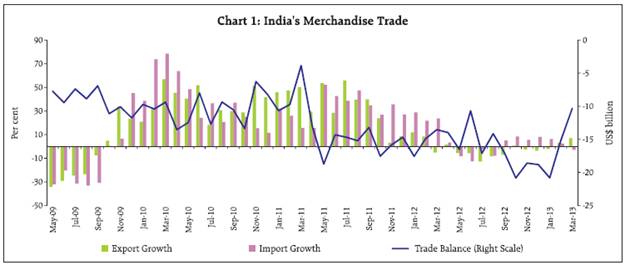
Table 1: India’s Merchandise Trade |
(US$ billion) |
Items |
April–March |
2011-12 R |
2012-13P |
1 |
2 |
3 |
Exports |
306.0 |
300.6 |
|
(21.8) |
(-1.8) |
Of which: Oil |
56.0 |
60.0 |
|
(35.1) |
(7.1) |
Non-oil |
249.9 |
240.6 |
|
(19.2) |
(-3.7) |
Gold |
6.7 |
6.5 |
|
(10.8) |
(-3.1) |
Non-Oil Non-Gold |
243.2 |
234.1 |
|
(19.5) |
(-3.8) |
Imports |
489.3 |
491.5 |
|
(32.3) |
(0.4) |
Of which: Oil |
155.0 |
169.4 |
|
(46.2) |
(9.3) |
Non-oil |
334.4 |
322.1 |
|
(26.7) |
(-3.6) |
Gold |
56.5 |
53.8 |
|
(39.2) |
(-4.8) |
Non-Oil Non-Gold |
277.9 |
268.4 |
|
(24.5) |
(-3.4) |
Trade Deficit |
-183.4 |
-190.9 |
Of which: Oil |
-98.9 |
-109.4 |
Non-oil |
-84.4 |
-81.6 |
Non-Oil Non-Gold |
-34.7 |
-34.4 |
Source: DGCI&S |
Among other major categories, exports of
petroleum products and primary products showed
substantially lower growth during April-December 2012
as compared with the corresponding period of 2011-12
(Table 2). Among the primary products, exports of iron
ore continued to decline attributing to increase in
freight charges, ban on mining activity in certain states,
coupled with the hefty export duty levied by the
government and differential freight rate imposed by
the railways. Some minor sectors, however, recorded a
positive growth during this year which mainly include
tobacco, processed mineral, manufacture of metals and
carpets.
Destination-wise export data reveal that there has
been a significant change in the composition of India’s trade during April-December 2012 (Table 3). Exports to
major destinations such as EU, UAE, US and China
showed either a decline or lower growth during this
period. Decline in exports to China was evident mainly
on account of substantial fall in exports of cotton, ores,
iron and steel and petroleum products. However,
export to countries like Iran, Iraq, Saudi Arabia, Russia
and some African countries, particularly, Egypt, Kenya
showed considerable uptrend. Exports to Saudi Arabia
increased by 75.5 per cent mainly reflecting growing
demand for items relating to mineral fuels, mineral
oils and products of their distillation, bituminous
substances, mineral waxes and organic chemicals.
Table 2: India’s Exports of Principal Commodities |
(Per cent) |
Commodity Group/ Period |
Percentage Share |
Relative Weighted Variation |
2011-12 |
2010-11 |
2011-12 |
2012-13 |
2011-12 |
2012-13 |
April-December |
April-December |
Primary Products |
15.0 |
13.3 |
13.9 |
15.1 |
4.8 |
0.6 |
Agriculture and Allied Products |
12.2 |
9.4 |
11.3 |
13.2 |
5.2 |
1.4 |
Ores and Minerals |
2.8 |
3.8 |
2.7 |
1.9 |
-0.4 |
-0.9 |
Manufactured Goods |
60.6 |
63.0 |
60.5 |
61.6 |
15.4 |
-1.4 |
Leather and Manufactures |
1.6 |
1.6 |
1.6 |
1.7 |
0.5 |
-0.01 |
Chemicals and Related Products |
12.1 |
11.7 |
12.0 |
13.5 |
3.8 |
1.0 |
Engineering Goods |
22.2 |
24.5 |
22.2 |
22.0 |
4.3 |
-1.1 |
Textiles and Textile Products |
9.2 |
9.7 |
9.1 |
9.0 |
2.1 |
-0.5 |
Gems and Jewellery |
14.7 |
14.6 |
14.7 |
14.4 |
4.4 |
-0.8 |
Petroleum Products |
18.3 |
16.2 |
18.7 |
20.2 |
8.0 |
0.7 |
Others |
6.1 |
7.5 |
6.9 |
3.1 |
1.4 |
-3.9 |
Total |
100 |
100 |
100 |
100 |
29.6 |
-4.0 |
Source: Compiled from DGCI&S data. |
Table 3: India’s Exports to Principal Regions |
(Percentage Shares) |
Region/Country |
2010-11 |
2011-12 |
2011-12 |
2012-13 |
April-March |
April-December |
1 |
2 |
3 |
4 |
5 |
I. OECD Countries |
33.2 |
33.8 |
33.7 |
34.6 |
EU |
18.3 |
17.2 |
17.5 |
16.8 |
North America |
10.6 |
12.0 |
11.9 |
13 |
US |
10.1 |
11.4 |
11.2 |
12.3 |
Asia and Oceania |
2.8 |
3.0 |
2.6 |
3 |
Other OECD Countries |
1.5 |
1.6 |
1.7 |
1.8 |
II. OPEC |
21.3 |
19.0 |
18.5 |
21 |
III. Eastern Europe |
1.1 |
1.1 |
1.1 |
1.3 |
IV. Developing Countries |
38.2 |
40.8 |
40 |
41.5 |
Asia |
27.9 |
29.7 |
29.1 |
28.3 |
SAARC |
4.6 |
4.4 |
4.2 |
5 |
Other Asian Developing Countries |
23.3 |
25.3 |
24.9 |
23.3 |
People’s Republic of China |
6.2 |
6.0 |
5.8 |
4.5 |
Africa |
6.3 |
6.7 |
6.5 |
8.1 |
Latin America |
4.0 |
4.4 |
4.4 |
5.1 |
V. Others / Unspecified |
6.2 |
5.3 |
6.7 |
1.6 |
Total Exports |
100 |
100 |
100 |
100 |
Source: Compiled from DGCI&S data. |
In terms of share in India’s total merchandise
exports, the share of EU and China declined significantly
during April-December 2012. In contrast, the share of
other important export destinations, viz. , the US and
UAE, exhibited increase in April-December 2012 over
the corresponding period of 2011-12. Similarly, the
share of Africa and Latin America also increased.
Table 4: Growth Performance of Major Trade
Partner Economies |
(Per cent) |
Period |
2011 |
2012 Q1 |
2012 Q2 |
2012-Q3 |
2012-Q4 |
2013-Q1 |
Country |
|
|
|
|
|
|
Japan |
-0.6 |
3.2 |
4.0 |
0.4 |
0.4 |
0.0 |
Euro area |
1.4 |
-0.1 |
-0.5 |
-0.7 |
-0.9 |
-1.0 |
United States |
1.8 |
2.4 |
2.1 |
2.6 |
1.7 |
1.8 |
China |
9.3 |
8.1 |
7.6 |
7.4 |
7.9 |
7.7 |
Hong Kong |
4.9 |
0.7 |
0.9 |
1.5 |
2.8 |
2.8 |
Singapore |
5.2 |
1.5 |
2.3 |
0.0 |
1.5 |
-0.6 |
Korea |
3.6 |
2.9 |
2.3 |
1.5 |
1.4 |
1.5 |
Indonesia |
6.5 |
6.3 |
6.3 |
6.2 |
6.1 |
6.0 |
Malaysia |
5.1 |
5.1 |
5.6 |
5.3 |
6.5 |
4.1 |
Brazil |
2.7 |
0.7 |
0.4 |
0.9 |
1.4 |
– |
South Africa |
3.5 |
2.4 |
2.8 |
2.6 |
2.3 |
– |
– : Not Available.
Note: Growth Rates are seasonally adjusted (except for Hong Kong,
Singapore and Malaysia).
Source: OECD, IMF, Singstat database, Monthly Statistical Bulletin Bank
Negara Malaysia. |
Country-wise analysis shows that impact on
India’s exports was more pronounced mainly in
countries where domestic growth was subdued in 2012,
except Indonesia and Malaysia where domestic growth
was broadly intact (Table 4). Moderation in exports to
these countries was mainly evident in petroleum
products; ships, boats and floating structures (only
Indonesia); chemical and related products; articles of
iron & steel and electrical machinery. Overall, EU and
countries in developing Asia accounted for nearly threefourth
of decline in India’s exports.
Imports (April-March 2012-13)
Merchandise imports in the FY 2012-13 recorded
a marginal growth of 0.4 per cent amounting to
US$ 491.5 billion compared to a growth rate of 32.3
per cent at US$ 489.3 billion. The decline was mainly
led by a fall in gold and non-oil non-gold imports. Fall
in non-oil non-gold was more on account of a slowdown
in domestic activity and dampened demand for export
related items. Notwithstanding a marginal decline in
the international prices of crude oil (Indian basket),
imports of POL items registered a growth of 9.3 per cent in 2012-13 reflecting growing domestic
consumption of petroleum products (Table 6).
Table 5: Region-wise Relative Weighted Variation in
India’s Export Growth |
(Per cent) |
|
2010-11 |
2011-12 |
2012-13 |
April- December |
EU |
4.0 |
4.9 |
-1.4 |
North America |
3.2 |
4.7 |
0.6 |
Other OECD |
0.6 |
0.7 |
0.0 |
OPEC |
7.1 |
3.4 |
1.7 |
Eastern Europe |
0.5 |
0.3 |
0.2 |
Developing Asia |
10.2 |
9.1 |
-1.9 |
Africa |
3.0 |
1.9 |
1.2 |
Latin America |
2.3 |
1.7 |
0.5 |
Others |
6.5 |
0.8 |
-5.2 |
Total Exports |
37.4 |
27.5 |
-4.3 |
Source: Compiled from DGCI&S data. |
Commodity-wise and Destination-wise Imports
(April-December 2012)
Disaggregated commodity-wise import data
available for April-December 2012 show that among the
principal commodities, ‘petroleum, petroleum and
related material’ and gold & silver accounted for about
34 per cent and 10.8 per cent of India’s merchandise
imports, respectively. A growth of 12.3 per cent in POL products was mainly on account of rise in quantum of
imports given a marginal decline in the international
price of crude oil (Indian basket). The decline in gold
demand was witnessed mainly in H1 of 2012-13 which
may be attributed to the rise in customs duty and
various other measures to curb gold demand undertaken by the Government and the Reserve Bank of India. Gold
imports, however, have shown a sharp pick up since
November 2012 (except in March 2013). Among other
components, imports of capital goods, accounting for
18.8 per cent of total merchandise imports, declined
by 7.1 per cent owing to the slower investment activity
in domestic economy. Import of export related items
like ‘pearl precious semi-precious stones, chemicals,
textile yarn and cashew nuts also recorded either a
decline or a lower growth during this period (Table 7).
Table 6: Trends in Crude Oil prices |
(US$/barrel) |
Period |
Dubai |
Brent |
WTI* |
Indian Basket** |
1 |
2 |
3 |
4 |
5 |
2005-06 |
53.4 |
58.0 |
59.9 |
55.7 |
2006-07 |
60.9 |
64.4 |
64.7 |
62.5 |
2007-08 |
77.3 |
82.3 |
82.3 |
79.2 |
2008-09 |
82.1 |
84.7 |
85.8 |
83.6 |
2009-10 |
69.6 |
69.8 |
70.6 |
69.8 |
2010-11 |
84.2 |
86.7 |
83.2 |
85.1 |
2011-12 |
109.4 |
113.9 |
96.8 |
111.9 |
2012-13 |
106.9 |
110.5 |
92.0 |
108.0 |
2012-13 (Q1) |
106.2 |
108.9 |
93.4 |
106.9 |
2012-13 (Q2) |
106.2 |
110.0 |
92.2 |
107.4 |
2012-13 (Q3) |
107.2 |
110.5 |
88.1 |
108.3 |
2012-13 (Q4) |
108.0 |
112.9 |
94.3 |
109.6 |
* West Texas Intermediate
** the composition of Indian Basket of Crude represents Average of Oman & Dubai for sour grades and Brent (Dated) for sweet grade in the ratio of
68.2: 31.8 for 2012-13.
Sources: International Monetary Fund, International Financial Statistics,:
World Gem data & commodity: Ministry of Petroleum and Natural Gas,
Government of India. |
Table 7: Imports of Principal Commodities |
(Per cent) |
Commodity Group/Period |
2011-12 |
Percentage Share |
Relative Weighted variation |
2010-11 |
2011-12 |
2012-13 |
2011-12 |
2012-13 |
April-December |
April-December |
1. Petroleum, Crude and Products |
31.7 |
27.9 |
30.5 |
34.3 |
13.3 |
3.8 |
2. Capital Goods |
20.3 |
21.7 |
20.2 |
18.8 |
5.7 |
-1.4 |
3. Gold and Silver |
12.5 |
11 |
12.6 |
10.8 |
6.1 |
-1.8 |
4. Organic and Inorganic Chemicals |
3.9 |
4.2 |
3.9 |
4 |
1 |
0.1 |
5. Coal, Coke and Briquettes, etc. |
3.6 |
2.9 |
3.7 |
3.3 |
2.1 |
-0.4 |
6. Fertilisers |
2.4 |
2.3 |
2.6 |
2.1 |
1.2 |
-0.5 |
7. Metalliferrous Ores, Metal Scrap, etc. |
2.7 |
2.7 |
2.8 |
3.0 |
1.1 |
0.1 |
8. Iron and Steel |
2.5 |
2.9 |
2.5 |
2.3 |
0.4 |
-0.2 |
9. Pearls, Precious and Semi-Precious Stones |
5.7 |
8.4 |
6.1 |
4.3 |
-0.2 |
-1.8 |
10. Others |
14.7 |
16 |
15.1 |
17.1 |
4.5 |
2.0 |
Total Imports |
100 |
100 |
100 |
100 |
35.2 |
-0.1 |
Source: Compiled from DGCI&S data. |
Destination-wise data for India’s imports show
that India’s imports from EU, China, US, Australia, Hong
Kong and Singapore declined during April-December
2012. In contrast, import from Saudi Arabia, UAE, Iraq
and Kuwait, mainly the oil exporters, remained
positive. Growth in imports from Latin American
countries was significantly higher during the period as
compared with corresponding period of 2011-12. For
instance, increase in imports from Brazil has mainly
on account of sugar and sugar confectionery, items
relating to animal or vegetable fats and oils.
Even though there was a decline in import from
China, it continued to be the main import source
accounting for 11.3 per cent of India’s merchandise
imports. Other major source countries for import
include UAE, Saudi Arabia, Switzerland and USA with
a share of 7.8 per cent, 6.8 per cent, 5.5 per cent and
5.1 per cent, respectively. While the share of countries
like USA, EU and Switzerland in India’s total imports
declined in April-December 2012, the share of OPEC
countries (including UAE) and Latin American showed
a rise compared to the corresponding period a year ago
(Table 8).
Trade Deficit
Sharper deceleration in merchandise export than
imports led to a widening of trade deficit which
increased to US$ 190.9 billion in 2012-13 as against US$
183.4 billion in 2011-12. POL and gold together
accounted for 45.4 per cent of India’s merchandise imports and 117 per cent of merchandise trade deficit
during this period. Even though gold imports have
shown decline in 2012-13, they were still at a high level
and thus a cause for concern for India’s high trade
deficit.
Table 8: Shares of Groups/Countries in
India’s Imports |
(Percentage Shares) |
Region/Country |
2010-11 |
2011-12 |
2011-12 |
2012-13 |
April-March |
April-December |
1 |
2 |
3 |
4 |
5 |
I. OECD Countries |
30.6 |
30.2 |
30.4 |
27.7 |
EU |
12.0 |
11.9 |
12.0 |
10.9 |
France |
1.0 |
0.9 |
0.8 |
0.8 |
Germany |
3.2 |
3.3 |
3.4 |
3.0 |
UK |
1.5 |
1.6 |
1.6 |
1.4 |
North America |
6.0 |
5.6 |
5.8 |
5.6 |
US |
5.4 |
5.0 |
5.2 |
5.1 |
Asia and Oceania |
5.4 |
5.7 |
5.7 |
5.2 |
Other OECD Countries |
7.2 |
7.0 |
6.9 |
5.9 |
II. OPEC |
33.6 |
35.5 |
34.4 |
38.6 |
III. Eastern Europe |
1.5 |
1.7 |
1.6 |
1.9 |
IV. Developing Countries |
33.0 |
32.3 |
33.2 |
31.5 |
Asia |
27.1 |
25.9 |
26.9 |
24.6 |
SAARC |
0.6 |
0.5 |
0.5 |
0.6 |
Other Asian Developing |
26.5 |
25.3 |
26.3 |
24.0 |
Countries |
|
|
|
|
of which: |
|
|
|
|
People’s Republic of China |
11.8 |
11.8 |
12.4 |
11.3 |
Africa |
3.6 |
4.0 |
4.1 |
3.8 |
Latin America |
2.4 |
2.4 |
2.3 |
3.1 |
V. Others / Unspecified |
1.3 |
0.3 |
0.3 |
0.3 |
Total |
100 |
100 |
100 |
100 |
Source: Compiled from DGCI&S data. |
II. Trends in Global Trade
As the global recovery slowed further in 2012, it
mirrored in decelerating world trade growth (Chart 2).
The world trade remained sluggish as the economic
slowdown in global import demand in EU countries
and some other major economies remained suppressed.
Subdued demand conditions in EU economies affected
not only intra-EU trade but also fed through other
advanced countries and EMDEs. However, the global
trade cycle has shown incipient signs of recovery across
few EMDEs since the terminal quarter of 2012 (Chart 3). Nevertheless, overall world trade volume
could grow by 2.5 per cent in 2012 as compared with
6.0 per cent in 2011. Going forward, trade prospects
are expected to improve moderately. According to the
IMF (2013), the world trade volume (goods and services)
is projected to grow by 3.6 per cent in 2013. Similarly,
the WTO projects a growth of 3.3 per cent in world
goods trade volume in 2013 (2.2 per cent in 2012). However, such forecasts are subject to risks that may
emanate from divergent economic outlook for the US
and EU.
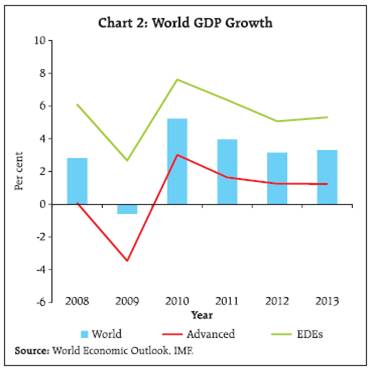 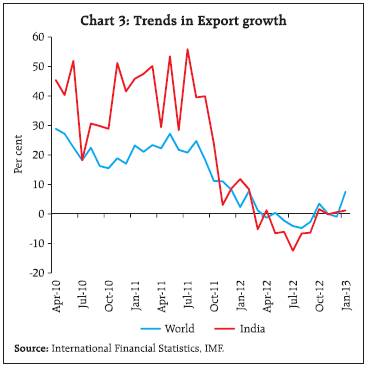 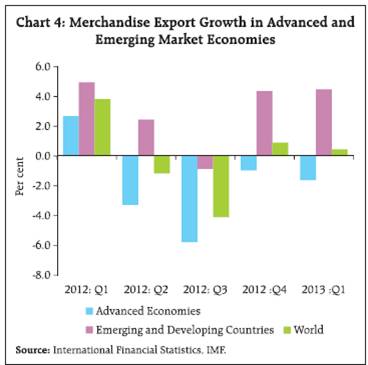 Chart 4 illustrates the divergent trade performances
of advanced and EMDEs economies over the course of
2012 and in Q1 of 2013. Slow growth in the advanced
economies (AEs) continued to remain a weak link in
global trade expansion, while EMDEs seem to be
contributing to global trade through increased intraindustry
and South-South trade. While the EMDEs
seem to have maintained export growth momentum
in Q1 of 2013, the decline in export growth in AEs has
become more pronounced as compared with the
previous quarter.
Even though there were incipient signs of
strengthening of some major economies, international
prices of most industrial commodities have eased since
mid-February 2013 (Chart 5). International crude oil
prices softened in Q1 of 2013 largely due to improved
supplies from the North Sea basin and slowing demand
from European refineries approaching their seasonal
maintenance cycle. Similarly, the prices of basic metal
have reversed their upward trend reflecting oversupply and growing inventories in recent months. Although
international food prices have followed mixed trends
in Q1 of 2013, better-than-expected global stocks
reported by the US Department of Agriculture and
improved production prospects of wheat led to easing
in grain prices in recent months.
III. Outlook
As mentioned earlier, India’s exports have shown
positive growth since December 2012. However, the
sustenance of the positive export growth momentum
would continue to depend on demand and growth
prospects of trading partner economies. According to
the WTO assessment on world trade prospects,
indicators of production and business sentiment in the
first quarter of 2013 present a mixed picture of current
economic conditions. Since the global growth is projected to pick up only marginally and key risks to
global economy still prevail, India’s export growth is
projected to pick up at a modest pace at best. Softening
trend in international prices of POL and gold,
supplemented by various measures undertaken by the
Government and the Reserve Bank to reduce imports
of these two items may bode well for containing import
growth. Since the signs of global recovery are not so
certain, sustaining Indian export recovery would be a
challenge that needs efforts to raise productivity-based
competitiveness.
Detailed information on monthly commodity-wise
and country-wise data on merchandise exports and
imports for 2011-12 and 2012-13 can be accessed at
http://www.rbi.org.in/scripts/BS_PressReleaseDisplay.aspx.
|