It is a pleasure to be back at the Business Standard BFSI Insight Summit. When I spoke here last year, my theme was the macroeconomic resilience of emerging markets (EMs), including India, which I attributed to the sound policy frameworks that these economies have adopted and adhered to. A year on, the resilience of the world economy has held. In today’s talk, I will reflect on the latest global outlook drawing on the recent publications of the IMF, how India is placed in this global context, and what policy priorities may be warranted for other EMs as well as India at this point in time. My observations are in four parts, one each on growth, inflation, public finances and the financial sector. 1. Growth rates seem resilient across countries The IMF’s latest World Economic Outlook (WEO, October 2026) projects the global economy to grow at 3.1 per cent in 2026 and 3.4 per cent in 2027. The projection for 2026 is 0.1 percentage point higher than in July, and that for 2027 is unchanged. While these numbers are below the pre-pandemic (2000–19) average of 3.7 per cent and the 2022–25 average of 3.5 per cent, they show continued resilience, given the underlying challenges the global economy has been facing.2 In fact, actual growth has turned out stronger than projected by the IMF in each of the past three years, even as shocks have accumulated and intensified. A few more features of the latest projection deserve attention. First, the latest upgrade is accounted for by advanced economies (AEs), whose growth projection for 2026 has been raised by 0.4 percentage point to 2.1 per cent. More than half of this upgrade for AEs comes from the group of “other AEs”, which includes technology exporters such as Korea, and whose projection has been raised by 1.4 percentage points, along with smaller upgrades in Europe, including Germany (0.6 percentage point). The projection for the United States is unchanged at 2.3 per cent.3 Second, the projection for emerging market and developing economies (EMDEs) has been marginally lowered by 0.1 percentage point to 3.7 per cent (Chart 1).4 Third, the projection for India in 2026-27 has been upgraded by 0.6 percentage point to 7.0 per cent. What explains this resilience? WEO attributes it to “a combination of circumstantial and institutional factors as well as offsetting forces”. The first set is circumstantial, starting with the financial cushions that households and firms built up in earlier years. The large fiscal support during the pandemic cushioned their finances, and many had shifted to longer-term borrowing at fixed rates while interest rates were low, which has shielded them from the recent rise in rates. In 2025, financial conditions were accommodative and fiscal stimulus also supported activity. The second is institutional: better policy frameworks. Central banks have earned credibility, which has kept inflation expectations in check, and frameworks for monetary, fiscal and financial policy have improved. In emerging markets in particular, central banks have become more independent, monetary policy is better implemented, and exchange rates are more flexible and better able to absorb shocks. According to the IMF, these improvements explain slightly more than half of the better output performance of emerging markets during global risk-off episodes, with favourable external conditions explaining the rest. The third is a set of offsetting forces and the ability to adapt. Tariffs turned out lower than first announced, firms found ways around trade barriers, investment in artificial intelligence (AI) picked up, and oil producers outside the Gulf raised output while inventories were released. Besides, the energy used per dollar of world GDP has fallen by about a third over the past two decades. All this has reduced the impact of the near closure of the Strait of Hormuz. The IMF estimates that the closure will take 0.3 percentage point off global growth in 2026, against 0.9 percentage point had oil supply been less flexible and energy use less efficient.5 Investment in AI has also supported growth. Large investments in data centres and computing equipment have boosted demand, well ahead of any visible gains in productivity. According to a recent IMF blog, AI could add about half a percentage point to annual world growth over the next decade.6 These gains, however, may take time and are likely to be unevenly distributed across countries. The risks to the outlook are seen as tilted to the downside. These include a prolonged or wider conflict in West Asia and Ukraine, which would push commodity prices higher; a reassessment of the expected gains from AI, whose supply chain is highly concentrated; extreme weather, made worse by El Niño; rising long-term borrowing costs in the major AEs; and renewed trade tensions. It also cautions that “the margins of adjustment are narrowing”, that the resilience so far has relied on governments drawing on their fiscal space, and that in most countries this space now needs to be rebuilt. While upgrading India, WEO has projected growth of 7.0 per cent in both 2026-27 and 2027-28, the highest among the 21 economies whose GDP exceeded US$1 trillion in 2025 (Chart 2). Looking further ahead, it notes that “India stands out with upward revisions, reflecting sustained momentum and growing evidence of stronger growth potential supported by favourable demographic dynamics, a large and expanding domestic market, and continued structural reforms.” 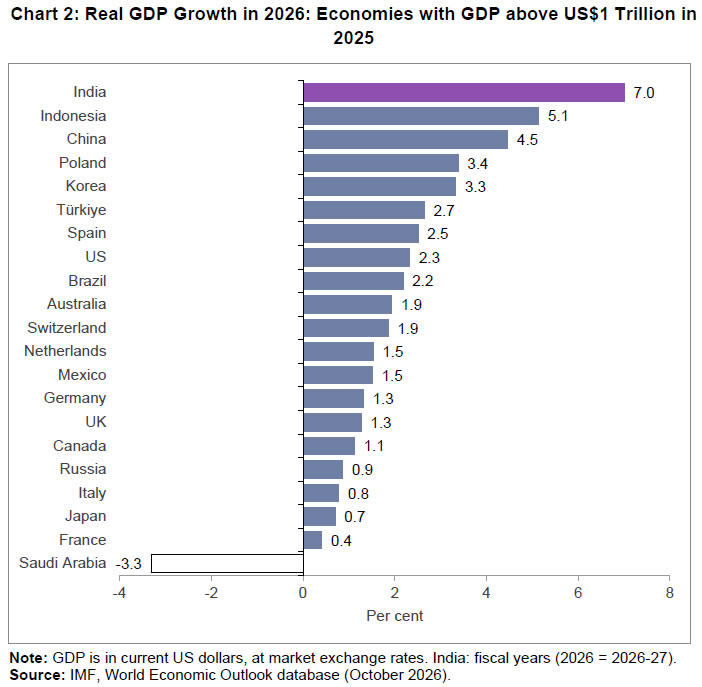 Defying multiple odds, the Indian economy grew by 7.8 per cent in 2025-26. Dynamism is on display this year too, when growth in the first quarter of 2026-27 (April–June 2026), after the conflict in West Asia broke out, was registered at 7.8 per cent, and was higher than expected. Growth was driven mainly by private consumption and fixed investment, with the latter growing by 11.9 per cent, its highest in the new GDP series.7 Exports of goods and services grew by 12.0 per cent in real terms, as merchandise exports picked up and services exports stayed strong. On the supply side, manufacturing grew by 9.2 per cent and services by 9.7 per cent. Growth is not just high but balanced as well. The economic momentum seems to have carried into July–September. Gross goods and services tax (GST) collections rose by more than 14 per cent in each month of the quarter. Industrial output was up 8.0 per cent in August. Merchandise exports have grown at double-digit rates for six months running, by 23.0 per cent in September. Both the manufacturing and the services Purchasing Managers’ Indices (PMIs) were above 55 in September. Bank credit grew by 19.4 per cent year on year as on September 30, and retail automobile sales rose by 31.8 per cent in September, with two-wheeler sales up 33.1 per cent (partly because purchases had been deferred a year earlier ahead of the GST rate cuts).8 At this point, the Monetary Policy Committee (MPC) expects growth of 7.1 per cent in 2026-27, 0.4 percentage point more than what was projected in August. What explains India’s ability to stand out? It is not that India has faced fewer shocks. In fact, over the past year and a half, India has been subjected to almost all the recent shocks at the same time: among the highest tariffs imposed by the US on any trading partner; an oil price shock, as a large net importer of oil; El Niño and a deficient monsoon; and capital outflows, as global investors favoured AI-related assets in other markets. Yet the economy has withstood them well. In my view, it is not due to good luck; four factors explain this. First, India is a large and diversified economy, with a vast domestic market. Its growth is spatially broad-based, diversified and underpinned by rising productivity, and it draws on domestic consumption as well as exports.9 As a result, even when particular sectors are hit by specific shocks, large parts of the economy remain relatively insulated. This stands in contrast to economies that rely on a narrower set of growth drivers, such as natural resources, agriculture, external demand rather than domestic markets, or remittances from outward migration, or that face unfavourable demographics. Second, India’s policy frameworks have improved, and so has their implementation, with a firm focus on macroeconomic and financial stability. The Fiscal Responsibility and Budget Management framework has anchored fiscal consolidation within a rules-based path; GST has unified the indirect tax system; flexible inflation targeting, adopted in 2016, has lowered both the level and the volatility of inflation; and banking regulation and supervision have been considerably strengthened. Third, due to conscious policy actions, the economy has become less sensitive to some of the shocks that used to hurt it in the past. Agricultural growth is less affected by deficient or erratic rainfall, owing to crop diversification, expanded irrigation and more accurate weather information. The economy now uses less oil for each unit of output, so that changes in oil prices have a smaller impact on the current account and on growth. Fourth is the manner in which the shocks have been managed: with policy certainty, deeper engagement with stakeholders, clearer communication and timely action. When the energy shock struck, the priority was to secure adequate supplies rather than pass the shock on to consumers, and rationing was largely avoided; higher prices were passed on gradually, once it became clear that they would remain elevated. Trade partners have been diversified, free trade agreements fast-tracked and diplomatic channels used, while the rationalisation of GST has supported consumption. At the same time, there was no attempt to stimulate demand beyond the economy’s productive capacity, and fiscal consolidation has stayed on track.10 2. Higher inflation across countries, resulting in tighter monetary policy WEO projects global headline inflation at 4.7 per cent in 2026, up from 4.1 per cent in 2025, and expects it to ease back to 4.1 per cent in 2027. Inflation in 2026 is projected to be above its pre-pandemic (2000–19) average of 3.9 per cent, though below the 2022–25 average of 6.3 per cent. Three factors are shaping the inflation outlook. The first is the re-escalation of the conflict in West Asia, which has pushed up the prices of energy and other commodities. The IMF now expects oil prices to average about US$96 a barrel in 2026, 16 per cent higher than it had assumed in April, and fertiliser prices to rise by 10 per cent. Higher costs of energy, fertilisers, transport and insurance are, in turn, projected to raise international food prices by 5 per cent. The second is El Niño which typically puts upward pressure on food and commodity prices. It also weighs on activity, especially in economies where food has a large weight in the consumption basket. Food prices have already been rising: the Food and Agriculture Organization (FAO) Food Price Index rose by 4.5 per cent during June–September, mainly because of transport disruptions and weather concerns. The third is the boom in AI-related investment. Large spending on data centres, chips and power infrastructure is a sizeable addition to demand, concentrated in a few economies, and in some sectors supply has not kept pace with it. So far, the effects on core inflation in the major economies appear limited, but where economies are already running close to capacity, prices could rise more widely. The first two are supply shocks, while the third is a demand impulse that is unevenly spread across countries. How much each country is affected depends on how much it relies on imported energy, the weight of food in its consumption basket, and the strength of its domestic demand. In AEs, in particular, inflation has been above their target in every year since 2022 (Chart 3).11 The IMF projects it at 3.1 per cent in 2026 and 2.7 per cent in 2027, returning close to 2 per cent only from 2028. In EMDEs too, inflation, at 5.7 per cent in 2026, is projected to be at the upper end of the 3–6 per cent range of their targets. For India, the IMF projects inflation to rise from 2.0 per cent in 2025-26 to 5.0 per cent in 2026-27, before moderating to 4.4 per cent in 2027-28. The current situation of external shocks and the resultant growth–inflation outlook raises the following questions about how countries may conduct their monetary policy. How should monetary policy respond to supply shocks, and distinguish temporary external price shocks from more persistent second-round effects? Are inflation-targeting frameworks adequately equipped to deal with repeated supply shocks? If not, how should they evolve as the frequency and nature of global shocks change? What role should communication play during periods of uncertainty? How should fiscal and monetary policy coordinate in managing external supply shocks? How may AI further change the macroeconomic environment, and therefore the monetary policy frameworks and policy choices? Finally, how may central banks in emerging economies navigate narrowing interest-rate differentials with AEs, given their implications for exchange rates, capital flows and monetary policy autonomy? Central banks generally look through the direct impact of temporary supply shocks but watch closely for signs of price pressures spreading across the economy. To do so, they strengthen their analytical tools and surveys. They distinguish between generalisation through input cost pressures and more persistent second-round effects through wages and expectations. For this, they track a range of indicators, including diffusion indices that measure the breadth of price pressures, the trajectory of wages, and inflation expectations. At the same time, policy makers may not always have the luxury of waiting for these effects to fully materialise and may instead take pre-emptive actions. The IMF has emphasised that monetary policy “should remain firmly focused on price stability”, with a policy stance restrictive enough to bring inflation back to target in a timely manner and prevent second-round effects.12 The flexibility built into inflation-targeting frameworks, including the tolerance band or an explicit or implicit mandate of growth or employment, has helped central banks adapt their response to the specific challenges and contexts. Central banks are communicating more and better. This has helped anchor expectations and preserve credibility despite not meeting the inflation targets for multiple years. The question, however, remains whether they can continue to anchor expectations for a much longer period without actually meeting their targets, as is the case currently for many AEs. One direct implication is that monetary policy may not have enough room to respond if current shocks persist or new shocks emerge, especially when countries have consistently breached their respective targets. The IMF makes a related point. Monetary policy can look through supply shocks only if they are temporary and second-round effects remain contained, and these conditions “are less likely to be satisfied when inflation is already above target and broader price pressures are expected to remain elevated, justifying a bias toward tightening”. Fiscal policy, together with closer coordination between monetary and fiscal authorities, also has a role to play in the current circumstances. As in India and elsewhere, it can help cushion the initial impact of supply shocks, through targeted supply-side measures. Such interventions, however, must be consistent with continued fiscal prudence and overall macroeconomic stability. As for AI, its overall implications for inflation and monetary policy are still being assessed. In the near term, the investment boom adds to demand, as noted earlier. Once AI raises productivity, it could lower costs and ease inflation, although inflation could pick up again later if higher demand comes to dominate. If it lifts investment demand and expected growth for a sustained period, it could also raise the neutral interest rate. And wider use of AI in pricing could allow firms to adjust prices more quickly, so that shocks pass through to inflation faster than in the past.13 Central banks in emerging economies are generally guided by domestic growth and inflation conditions, and the specific monetary policy frameworks or inflation-targeting frameworks that they have put in place rather than by interest-rate differentials with AEs. There are hardly any central banks that incorporate external conditions or the exchange rate directly into their inflation-targeting mandate.14 Most others factor external spillovers, financial market volatility and exchange rate developments into monetary policy decisions only to the extent that they transmit into domestic inflation or financial stability. Price pressures have built up in India from very benign levels in 2025-26. Headline CPI inflation increased to 4.8 per cent in August from 4.5 per cent in July. While the increase was mainly on account of food and fuel, core inflation also rose, to 4.2 per cent, indicating some widening of price pressures.15 In October, the MPC raised the policy repo rate by 25 basis points to 5.50 per cent. As Governor noted in his statement, “Inflationary pressures are, however, building up”, and therefore it was considered “appropriate to recalibrate the policy rate”. The stance was changed to calibrated tightening, “essentially signalling that rate cuts are off the table in the near term and policy action ahead can only be a rate hike or a pause, depending on the evolving circumstances and the outlook”.16 Inflation data for September, released after the policy meeting, were along expected lines: headline inflation rose to 5.5 per cent and core inflation to 4.3 per cent, so that the average for July–September, at 4.9 per cent, was the same as the MPC’s projection for the quarter. Over a longer period, India’s record on inflation has been rather strong. Since the adoption of flexible inflation targeting in 2016, annual inflation has declined from the previous years’ average, has become more stable, and has remained within the tolerance band of 2 to 6 per cent in all but two years (Chart 4). Even in those two years of exceptional external circumstances (Covid and the Russia–Ukraine war), it did not deviate too much from the upper limit, at 6.2 and 6.7 per cent, and declined subsequently. 3. Thinner buffers globally, especially fiscal, to respond to the current shock if it persists, or to address a new shock The fiscal situation of most countries seems to be stretched. Public spending rose sharply during the pandemic and the shocks that followed, and it has proven hard for most countries to rebuild their fiscal buffers. Of the 190 economies with data for both years in the IMF’s Fiscal Monitor database, 119 had a higher debt ratio in 2025 than in 2019. Global public debt was 94 per cent of GDP in 2025. It is projected to cross 100 per cent in 2030 and to reach close to 102 per cent in 2031. Debt ratios are projected to rise in both AEs and EMDEs, from 108 and 74 per cent of GDP, respectively, in 2025 to 115 and 84 per cent in 2031 (Chart 5). Higher debt leaves governments less room to respond to a new shock, particularly when interest costs are rising. 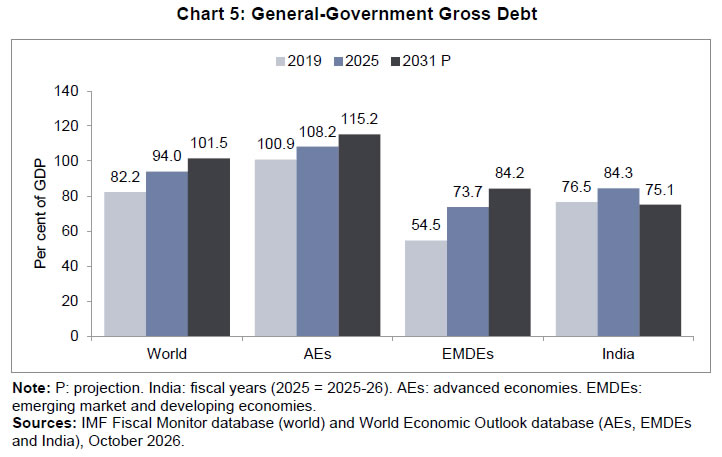 Borrowing costs have also risen, which makes high debt harder to service. Ten-year sovereign bond yields in the G7 increased, on average, by more than one percentage point between February and September 2026, to their highest levels in almost twenty years. This reflects several factors: the oil price shock, inflation that has proved persistent, stronger demand for investment, and expectations of faster growth from AI. Concerns about public finances have added to the pressure, given high debt, rising spending needs and the prospect of heavy bond issuance.17 This brings us to the question of debt sustainability. Whether the debt ratios across countries rise or fall depends on two things: the primary deficit (non-interest expenditure in excess of revenue), and the gap between the interest rate a government pays on its debt and the growth rate of nominal GDP. For the median advanced and emerging market economies, this gap was negative in every year from 2016 to 2025, except 2020. While remaining negative, it is projected to narrow over the next few years (Chart 6). As the gap narrows, governments will need to run smaller primary deficits to stabilise their debt ratios. Instead, the primary deficit is projected to rise from 2.5 to 3.0 per cent of GDP in AEs, and to fall only marginally, from 3.9 to 3.8 per cent, in emerging market economies. In each case, it will exceed the primary deficit that would stabilise the debt ratio. 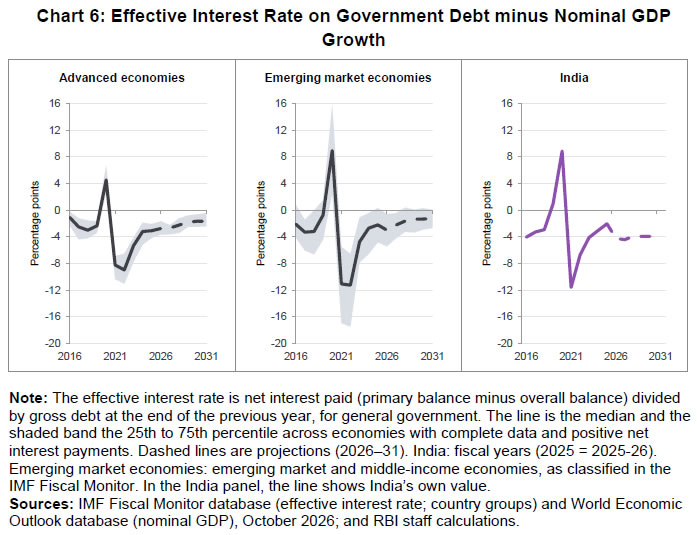 India’s projected debt path is different, and much more benign. General-government debt is projected to decline from 84.3 per cent of GDP in 2025-26 to 75.1 per cent by 2031-32. Nominal GDP growth, at about 11 per cent a year, is projected to stay well above the effective interest rate of about 7 per cent, leaving a gap of around -4 percentage points through 2031-32 (Chart 6). India’s primary deficit has also been much smaller than the global averages. The debt ratio therefore declines even though the primary deficit stays between 1.7 and 2.2 per cent of GDP.18 The IMF makes the same point about the largest advanced and emerging market economies: “In most of these economies, with India an exception, stabilising debt-to-GDP ratios at 2025 levels would require greater fiscal consolidation than currently envisaged under existing policies.” Indeed, among the nine emerging market economies with GDP above US$1 trillion, India is the only one whose debt ratio is projected to decline between 2025 and 2031.19 So how sustainable is India’s public debt? Sustainability can be assessed in different ways. One could assess the rollover risk, that is, whether the government may find it difficult or costly to refinance its maturing debt. Another is runaway risk, that is, whether the debt ratio may keep rising on its own momentum, because the interest rate on debt exceeds the growth rate of the economy. India has neither. Most of the public debt is long term, is denominated in local currency, and is held domestically (a large part of which is held by institutional investors), which limits rollover risk. And a favourable growth and interest-rate differential, along with fiscal consolidation, has put the debt ratio on a declining path. Fiscal consolidation has also been accompanied by more fiscal transparency and an improvement in the quality of expenditure. Capital expenditure of the general government has risen from about 13 per cent of total expenditure in 2020-21 to nearly 20 per cent in 2025-26 (budget estimates), and from about 4 per cent of GDP in 2019-20 to 5.8 per cent in 2025-26.20 Higher capital expenditure can itself help make debt sustainable by crowding in private investment and raising the economy’s growth and growth potential. India has not relied exclusively on fiscal measures to respond to shocks. An “all of system” approach has been used to manage the fallout of the shocks rather than resorting to fiscal measures as the first or only line of defense. The endeavour has been to remain fiscally prudent and fiscally sustainable. The IMF advises that rebuilding fiscal space is now urgent, given high debt and higher borrowing costs. It calculates that reforms addressing existing fiscal distortions together could lift GDP by several per cent over time. 4. Financial sector has held up well globally, but could face shocks With the changing global order and rapid transformation of the financial systems, safeguarding financial stability has become an ever more compelling priority. The Global Financial Crisis (GFC) of 2007–09 showed that financial instability can cost dearly in terms of economic growth, fiscal backstop, and rebuilding trust. The reforms that followed have strengthened bank regulation, supervision and risk management, and the capacity of banks to absorb shocks. As a result, the banking sector has become much more resilient. For the largest internationally active banks, the average common equity Tier 1 capital ratio nearly doubled, from 7.1 per cent in June 2011 to 13.3 per cent at the end of 2021. According to the Basel Committee’s evaluation, systemic risk declined after the reforms, with no considerable evidence of adverse effects on bank lending.21 The post-GFC reforms have strengthened the global financial system’s ability to withstand recurring shocks and periods of uncertainty, but the resilience also rested on exceptional monetary and fiscal support, and the rapidity of policy response. This helps explain why episodes such as the 2020 ‘dash for cash’, the UK’s 2022 liability-driven investment crisis and the sporadic 2023 events in US and European banks were contained promptly before they created wider repercussions. The question is whether this resilience will hold up against the shocks that lie ahead, which are likely to be different from those of the past. They may come from outside the financial system, such as geopolitics, AI, cyber attacks or climate events, rather than from a domestic credit boom. They may also originate in non-banks, markets and technology providers rather than in banks, spread faster, and affect several parts of the system at once. In addition, the latest edition of the IMF’s Global Financial Stability Report (GFSR) has identified three topical risks: a fall in the prices of AI-related assets, if investment and profits in AI prove weaker or less durable than expected; a sharp increase in sovereign bond yields, from renewed inflation or concerns about public finances; and cyber threats, which are becoming a systemic risk as financial services grow more digital and interconnected. GFSR notes, these “could be near-term catalysts for a sharp tightening of financial conditions and market turmoil”. Their impact could be amplified by leverage, concentrated exposures and liquidity mismatches, particularly among non-bank financial institutions. This could test the resilience of the global financial system at a time when policy space is narrowing. The overall assessment is that while financial markets have been resilient, risks to financial stability remain elevated.22 The GFSR therefore calls for containing excessive leverage, bringing public debt onto a sustainable path, preserving the capital and liquidity buffers of banks, improving data to assess risks across the system, putting credible backstops in place, and, in emerging markets, rebuilding fiscal and external buffers. How well placed is India to deal with these risks? On at least two of these three risks, India is better placed: its markets are not exhibiting a bubble-like situation, related to AI or otherwise; and its fiscal house is in order. As for cyber risks, it is working in line with global best practices. India also had its own cycle of vulnerabilities, to which policy responded swiftly, although it may not seem too well aligned with the global cycle mentioned above. Following a prolonged credit boom in the 2000s, India faced a twin balance-sheet problem involving banks and corporates in the 2010s, and institution-specific events in 2018–23. These challenges prompted reforms on three fronts: recognition of bad loans, through the Asset Quality Review; their resolution, through the Insolvency and Bankruptcy Code; and regulation, through a revised Prompt Corrective Action framework and scale-based regulation of non-banking financial companies (NBFCs).23 Countercyclical measures were undertaken too, as warranted (e.g. in November 2023, when regulatory measures on consumer credit and bank credit to NBFCs were implemented). The resilience of the Indian financial system is now amply evident: capital adequacy is 17.7 per cent, the common equity Tier 1 ratio is 15.3 per cent, and the liquidity coverage ratio is about 124 per cent. The gross non-performing asset (NPA) ratio of scheduled commercial banks has declined from 11.6 per cent in March 2018 to 1.8 per cent in March 2026, a multi-decadal low. RBI’s stress tests reinforce this assessment. The June 2026 Financial Stability Report included adverse scenarios built around a prolonged and wider geopolitical conflict. Even under the most severe scenario, the capital adequacy of the 46 major banks would remain at about 13 per cent by March 2028, well above the regulatory minimum of 9 per cent, while the gross NPA ratio would rise from 1.8 per cent to about 4 per cent.24 India has achieved strong compliance ratings under the Basel Committee’s Regulatory Consistency Assessment Programme for key elements of the Basel III framework, including risk-based capital requirements, the net stable funding ratio and the large-exposures framework, with the liquidity coverage ratio assessed as largely compliant.25 The Financial Stability Report has been a key instrument for assessing the resilience of our financial system. Over 16 years and 33 half-yearly editions, it has become a core part of our macroprudential toolkit. It helps us identify and communicate vulnerabilities, and test how the financial system would cope with shocks. It has also become more forward-looking over time, with better stress tests, a system-wide stress indicator, stability maps and thematic surveys. Preserving financial stability is a shared responsibility that extends beyond the central bank and requires coordinated action by all financial regulators and the government. India’s inter-agency framework serves this purpose. The Financial Stability and Development Council, chaired by the Finance Minister, and its Sub-Committee, chaired by the RBI Governor, provide an institutional platform for the government, the RBI and all financial sector regulators to exchange information, assess systemic risks and coordinate policy responses to safeguard financial stability. India’s financial resilience thus rests on several factors: healthy balance sheets, a strong regulatory framework that balances risk management with economic growth, supervision that is risk-based and makes good use of technology, countercyclical policies to prevent vulnerabilities from building up during periods of rapid growth, a broad regulatory perimeter that helps limit regulatory arbitrage, stress tests to assess the vulnerability to envisaged shocks, and all-encompassing forums to discuss such risks.26 5. Concluding thoughts The global economy has been resilient so far, but three risks could test this resilience. The first is energy security, with oil prices at around US$100 a barrel, and at times higher, while fuel and gas supplies from the Gulf remain disrupted. Besides the price of oil, shipping and insurance costs have risen manifold, and this is being reflected in the prices of other commodities too. High prices are likely to persist into 2027, while El Niño poses a risk to food security. The second is AI. It is proving to be an engine of global growth, through an investment boom, and holds productivity potential for years to come. But the investment is increasingly debt-financed and concentrated in a few firms and countries. Whether it is a bubble, and whether it will deflate, only time will tell. But it has reached a stage where even slight news or minor events can result in significant price reactions. The third is public debt and borrowing costs. Global public debt is heading above 100 per cent of GDP, bond yields have risen sharply, and EMDEs face costlier funding and more volatile capital flows. Let me bring these threads together for India. On growth, India stands out. It is the fastest-growing large economy, and unlike the EMDE aggregate, its growth projection has been revised up over the past year. That growth has rested more on domestic sources lately, particularly private consumption and public investment, but new drivers have emerged, including private investment and merchandise exports. The ballpark estimate that most agencies have for the next few years is 7 per cent or thereabouts. With some of the conditions normalising, and with continued policy attention, one could envisage growth moving up from 7 per cent towards 8 per cent. India’s track record on inflation over the last ten years has been equally credible. Since the adoption of flexible inflation targeting, inflation has declined structurally, has remained within the tolerance band in most years, and has become less volatile. The MPC and the RBI remain committed to the inflation-targeting framework. On public finances, India has stayed on the path of fiscal consolidation, even as deficits and debt have risen in many other countries. Its general-government debt is projected to decline by about 9 percentage points of GDP by 2031-32, and it faces neither rollover risk nor runaway risk. India’s financial sector is on a strong footing. Banks’ capital adequacy is at 17.7 per cent and the gross NPA ratio at a multi-decadal low of 1.8 per cent, and stress tests show that banks would remain well capitalised even under severe scenarios. We nevertheless remain watchful of spillovers from global financial markets, as well as of cyber and climate risks. All in all, the global economy has been resilient, but its buffers have thinned. India enters this phase in a stronger position than most: growth is strong, inflation is contained, public debt is on a declining path and the financial system is sound.
References Bank for International Settlements (2024), “Artificial Intelligence and the Economy: Implications for Central Banks”, Chapter III, Annual Economic Report 2024, June. Bank Indonesia (n.d.), “Monetary Policy”, Bank Indonesia website. Basel Committee on Banking Supervision (2012), Results of the Basel III Monitoring Exercise as of 30 June 2011, April. Basel Committee on Banking Supervision (2022a), Basel III Monitoring Report, September. Basel Committee on Banking Supervision (2022b), Evaluation of the Impact and Efficacy of the Basel III Reforms, December. Basel Committee on Banking Supervision (2026), Regulatory Consistency Assessment Programme: Basel III Adoption Progress Summary, September. Bolhuis, M., A. Roy, P. Schneider and Z. Zhang (2025), “Good Policies (and Good Luck) Helped Emerging Economies Better Resist Shocks”, IMF Blog, October 6. Dabla-Norris, E. and R. Valdés (2026), “Rising Sovereign Yields Raise the Fiscal Stakes”, IMF Blog, October 14. Eichengreen, B., P. Gupta and A. Ahmed (2024), “India’s Debt Dilemma”, India Policy Forum, 20(1), 1–62, National Council of Applied Economic Research (NCAER), New Delhi. Food and Agriculture Organization of the United Nations (2026), “FAO Food Price Index”, News Release, October 2. Georgieva, K. (2026), “The World Can’t Afford to Get AI Wrong”, IMF Blog, October 15. Gupta, P. (2025), “Policy Frameworks for Economic Resilience: The Case of Emerging Markets and India”, Address at the Business Standard BFSI Insight Summit, Mumbai, October 29. Gupta, P. (2026a), “Perspectives on India’s Growth: Last Four Decades to the Present”, 14th Foundation Day Lecture, Centre for Development Studies, Thiruvananthapuram, February 20. Gupta, P. (2026b), “The Indian Economy in an Ever More Volatile and Complex World”, Special Address at the 13th SBI Banking and Economics Conclave, Mumbai, September 23. International Monetary Fund (2025), World Economic Outlook, October. International Monetary Fund (2026a), “Taxing Better to Boost Growth”, Chapter 1, Fiscal Monitor, October. International Monetary Fund (2026b), Fiscal Monitor Database, October. International Monetary Fund (2026c), Global Financial Stability Report, October. International Monetary Fund (2026d), World Economic Outlook, April and October; World Economic Outlook Update, January and July; and World Economic Outlook and Historical Forecasts Database. Malhotra, S. (2026), “Preserving Financial Stability in an Evolving World”, Special Address at the Fifth Kautilya Economic Conclave, October 3. Ministry of Statistics and Programme Implementation (2026), “Press Note on New Series of Gross Domestic Product (GDP) Estimates with Base Year 2022-23”, Government of India, February 27. Reserve Bank of India (2025), Review of Monetary Policy Framework: A Discussion Paper, August. Reserve Bank of India (2026a), Financial Stability Report, June. Reserve Bank of India (2026b), “Minutes of the Monetary Policy Committee Meeting, October 5–7, 2026”, Press Release. Reserve Bank of India (2026c), “Resolution of the Monetary Policy Committee, October 5–7, 2026”, Press Release. Reserve Bank of India (2026d), “State of the Economy”, RBI Bulletin. Reserve Bank of India (various issues), Financial Stability Report. Tenreyro, S. (2026), “Global Economic Resilience Is Under Strain, Demanding Decisive Policy Action”, IMF Blog, October 13.
|