Since its inception Reserve Bank has been playing key role in the formulation of
monetary, banking and financial policies. No Department has witnessed the various
phases of transition of Indian banking system from a closed one to well-liberalized
one (particularly since mid-1990s) from closer quarters than the Department of Banking
Operations and Development - popularly called DBOD.To facilitate the transition
process and in order to effectively perform its varying roles in the changing banking
scenario, from ‘regulator’ to ‘facilitator’ over the period, Department has undergone
various organizational changes and so also in its activities, approach and functioning.
2. As varied segments within and without RBI interact with the Department on banking
and related issues/matters, we brought out a handbook of information on the Department
aptly christened as " This is…. DBOD" in February 2004 on the changing face
of the Department for their information and benefit. The handbook was placed on
RBI’s website and widely covered in Bank’s Newsletter. Encouraging response coupled
with certain important organizational developments has necessitated the revision
and updation of first edition.
3. The handbook’s language and style of presentation is in keeping in view the interests
of our cross-section of readers and users, whether our other departments / Offices,
colleagues, bankers, academicians or others. We hope that they would find it a useful
publication for the intended purpose and enrich it with their valuable suggestions.
4. The contributions of our colleagues to the publication are immensely appreciated
and gratefully acknowledged.
Reserve Bank of India ( C.R.Muralidharan)
Department of Banking Operations Chief General Manager-in-Charge & Development
Central Office
Mumbai
September 30, 2004
INTRODUCTION
Reserve Bank of India has been empowered under Banking Regulation Act, 1949 to conduct
the inspection of banks and regulate them in the interest of banking system, banking
policy and depositors/public. While the Department of Banking Operations and Development
exercises regulatory powers in respect of commercial banks and Local Area Banks
(LABs), Regional Rural Banks/District and State Co-operative Banks and Urban Co-operative
Banks are regulated by Rural Planning and Credit Department and Urban Banks Department,
respectively.
The Department of Banking Operations and Development is entrusted with the responsibility
of regulation of commercial banks and LABs under the regulatory provisions contained
in the Banking Regulation Act, 1949 and the Reserve Bank of India Act, 1934 and
other related statutes besides enunciation of banking polices. It's functions broadly
relate to prescription of regulations for compliance with various provisions of
Banking Regulation Act on establishment of banks such as licensing and branch expansion,
maintenance of statutory liquidity reserves, management and operations, amalgamation,
reconstruction and liquidation of banking companies. The other important activities
of the Department include approval for setting up of subsidiaries and undertaking
of new activities by commercial banks. The Department endeavours towards promoting
and fostering a sound, multi-faceted and competitive banking system by laying down
norms for prudential regulation of commercial banks. It is also responsible for
putting in place a pro-active environment for development of new products and consequently,
the Department has to keep itself abreast of developments domestically and globally
and formulate policy responses accordingly by suggesting amendments to the existing
laws/enactment of new legislation, regulation etc. Concomitant with the above statutory
obligation enjoined on it, the Department strives to bring the regulatory standards
of commercial banks on par with the international best practices. In order to achieve
its objective of establishing a world class banking system in India, it has to maintain
professionally skilled staff in a flexible organizational set-up with activities
in tune with the time.
2. The handbook provides basic information about the Department through two sections,
viz.
Section - I : Organizational set-up
Section - II : Major activities of various Sections/Cells
Section - I briefly throws light on the organizational set-up of the Department
reflecting its various functional groups with their allocations under respective
Chief General Managers. The statistical and other information furnished therein
is as on September 1, 2004 and is subject to changes.
Section - IIdescribes the major activities of individual Sections/Cells of
the Department in a brief manner. Besides those activities, these Sections/Cells
contribute material for Reserve Bank’s publications like Annual Report, Report on
Trend and Progress of Banking in India, Report on Currency and Finance, publications
of Government of India / International Organizations. They take follow-up action
on points emanating from meetings of Board for Financial Supervision (BFS), Central
/ Local Board of Directors and reports of various Committees / Working Groups. They
also attend to related Parliament questions, legal matters, court cases, references
from governments, trade bodies, public etc. The Department also brings out every
month a report on its important activities and submits half- yearly /yearly reports
for Board for Financial Supervision (BFS) and an annual report to the Central Board
of Directors. It places its bank circulars (including Master Circulars) and ‘Frequently
Asked Questions’ publication on RBI website for the benefit of bankers and others.
The Master Circulars are periodically updated / revised. The Department is also
represented in various Committees, Working Groups, Forums etc. of RBI, banks, governments,
etc. The intranet site of the Department which was launched on April 20, 2004 contains
comprehensive information relating to its functions and working, bank circulars,
monthly report on the important activities of the Department, Bank’s publications,
banking statutes, etc.
3. The Department functions in an environment supportive of consultative decision-making
process. Important policies are decided keeping in view the best international practices,
views/comments from the regulated entities, academia and other market participants.
ORGANISATIONAL SET-UP
The Department has pyramid - pattern organisational set-up. It is headed by Chief
General Manager-in-Charge, and has three other Chief General Managers. Besides,
there are 22 Senior Officers viz. 8 General Managers and 14 Deputy General Managers.
They look after their respective portfolios as shown in the chart. The working strength
of the Department as on September 1, 2004 is as under: Officers-110, Class III employees
– 107 and Class IV employees –77.
2. The Department comprises 19 Sections / Cells which attend to their respective
areas of work, viz. Anti-Money Laundering Cell, Appointments Section, Branch Licensing
Section, Banking Policy Section, Computer & Technology Cell, Directives Section,
Defaulters List Cell, Financial Services Cell, International Banking Section, Information
Section, Industrial and Export Credit Section, JPC Cell, Legislation Section, Private
Sector Banks Section, Parliament Cell, Reconstruction Section, Returns Section,
Rajbhasha Anubhag and Administration & Establishment Division.
3. The major activities of the above Sections/Cells have been described in Section
- II. Pursuant to the recommendations of the High Level Review Group constituted
by RBI in July 2002, the Department has since taken over the responsibility of regulating
Local Area Banks from Rural Planning and Credit Department. Following the recommendations
of the Committee on Job Consolidation / Re-alignment, the Regional Offices (ROs)
of the Department excepting Mumbai Regional Office (MRO) were merged with Regional
Offices of Department of Banking Supervision (DBS) with effect from May 10, 2004.
MRO was merged with DBOD, CO in the interest of operational expediency; consequently,
its certain activities are being attended to by Central Office. Further, the activities
of erstwhile Industrial and Export Credit Department relating industrial credit
policy, export credit policy and industrial rehabilitation were merged with DBOD,
CO for better synergy with effect from July 1, 2004.
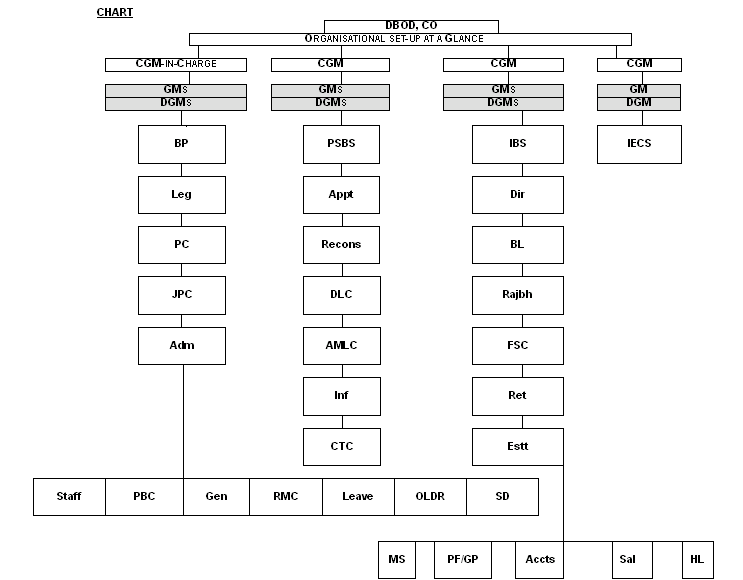
Notes:(1) The abbreviations 'CGM', 'GM' and 'DGM' stand for Chief General
Manager, General Manager and Deputy General Manager, respectively.
(2) The list of other abbreviations is given below:
Accts --- Accounts Section
Adm --- Administration Division
AMLC --- Anti-Money Laundering Cell
Appt --- Appointments Section
BL --- Branch Licensing Section
BP --- Banking Policy Section
CTC --- Computer & Technology Cell
Dir --- Directives Section
DLC --- Defaulter Lists Cell
Estt --- Establishment Division
FSC --- Financial Services Cell
Gen --- General Section
HL --- Housing Loan Section
IBS --- International Banking Section
Inf --- Information Section
IECS --- Industrial & Export Credit Section
JPC --- Joint Parliamentary Committee Cell
Leave --- Leave Section
MS --- Medical Section
Leg --- Legislation Section
OLDR --- Officers' Lounge & Dining Room
PC --- Parliament Cell
PBC --- Planning & Budget Cell
PSBS --- Private Sector Banks Section
PF / GP --- Provident Fund, Gratuity, Pension Cell
Recons --- Reconstruction Section
Ret --- Returns Section
RMC --- Records Management Cell
Rajbh --- Rajbhasha Anubhag
SD --- Staff Dispensary
Staff --- Staff Section - I, II, III
Sal --- Salary Section
INDEX
- Anti-Money Laundering Cell
- Appointments Section
- Branch Licensing Section
- Banking Policy Section
- Computer & Technology Cell
- Directives Section
- Defaulter Lists Cell
- Financial Services Cell
- International Banking Section
- Information Section
- Industrial and Export Credit Section
- JPC Cell
- Legislation Section
- Private Sector Banks Section
- Parliament Cell
- Reconstruction Section
- Returns Section
- Rajbhasha Anubhag
- Administration & Establishment Division
1. ANTI - MONEY LAUNDERING CELL
In the light of recent developments, there has been increasing recognition of the
need for strengthening of the financial system to prevent its use for laundering
proceeds of criminal activities. To address and tackle the issues involved, AML
Cell has been recently set up in the Department. Its main activities are:
- Study of International Best Practices and Codes on Anti - Money Laundering (AML)
and Combating Financing of Terrorism (CFT).
- Tracking domestic and global developments
in AML and CFT.
- Assessing India's position vis-à-vis international regulatory
and legal standards on AML/CFT formulated by Financial Action Task Force (FATF),
Bank for International Settlements (BIS), International Monetary Fund (IMF) &
Financial Stability Forum (FSF) on an ongoing basis.
- Correspondence with Government
of India and its agencies like Central Economic Intelligence Bureau and National
Security Council Secretariat, banks and other Departments of RBI on AML / CFT related
issues.
- Follow up of the decisions taken by the Inter-Ministerial Co-ordination
Forum for addressing issues relating to financing of terrorism such as Financial
Intelligence Unit, Suspicious Transactions Reporting etc.
- Acting as Secretariat
for 'Internal Co-ordination Committee on Prevention of Money Laundering and Financing
of Terrorism' of RBI.
- Review of guidelines issued to banks on Know Your Customer
(KYC) and 'Cash Transactions'
- Preparation of briefs for top management for meetings
at domestic and international level with various organisations / authorities.
-
Taking up issues with AML implications such as money transfer services with concerned
authorities/organisations/RBI departments.
- Study of the 'Prevention of Money
Laundering Act' and implications for Indian banks.
2.APPOINTMENTS SECTION
The key activity of the section, appropriately named as Appointments Section, relates
to the appointments of authorities in the commercial banks, and also of members/directors
on their Boards, which may be elaborated as under:
- Approval of proposals from the domestic private sector banks for appointment of
part-time Chairman/Managing Director/ whole-time Chairman and Chief Executive Officers,
as the case may be, as also of the terms and conditions governing their appointments
(Sections 10B & 35B of the Banking Regulation Act, 1949).
- Ensuring compliance
with the provisions of the Banking Regulation Act, 1949 with regard to the composition
of the Board of Directors of commercial banks in the private sector. (Sections 10A,
16 and 20 of the B.R. Act, 1949).
- Approval of proposals from foreign banks for
appointment of Chief Executive Officers (CEOs) in India (Section 35B of the B.R.
Act, 1949).
- Appointment of Chairman and Chief Executive Officer in banking companies under Section
10BB of the B. R. Act, 1949, where continuation of vacancy in the position is likely
to adversely affect the interest of the banking company.
- Appointment of observers in banking companies under Section 36(1)(d)(iv) of the
B. R. Act, 1949 where it becomes necessary.
- Removal of Chairman, Director, Chief Executive Officer of banking companies under
section 36AA of the B. R. Act, 1949, where it becomes necessary.
- Making recommendations to Government regarding constitution of the Central Board
and Local Boards of State Bank of India (Sections 19 and 21 of the State Bank of
India Act, 1955).
- Approval of proposals for appointment of Managing Directors and nomination of Directors,
and also appointment of Additional Directors and Alternate Additional Directors
on the Boards of the subsidiary banks of State Bank of India. [Section 25 of the
State Bank of India (Subsidiary Banks) Act, 1959]
- Making recommendations to Government regarding appointment of Executive Directors/Chairmen
& Managing Directors of public sector banks, fixation of their salaries, payment
of superannuation benefits and other allied matters. [Clause 8 of the Nationalised
Banks (Management and Miscellaneous Provisions) Scheme 1970/1980].
- Making recommendations to Government regarding appointment of non-official directors,
non-workmen directors and RBI Nominee Directors on the Boards of Nationalised banks.
[Section 9 of the Banking Companies (Acquisition and Transfer of Undertakings) Act,
1970/1980].
- Monitoring of compliance with the provisions of Section 10 of B.R.Act relating to
appointment of CEOs in respect of private sector banks under the jurisdiction of
erstwhile MRO viz. Maharashtra and Goa.
- Other items of work like clarifications on the issues relating to the composition
of bank’s Boards and their committees, follow up work relating to implementation
of the recommendations of the Report of the Consultative Group of Directors of Banks/Financial
Institiutions, etc.
3. BRANCH LICENSING SECTION
The activities of the Branch Licensing Section revolve around issue of authorisations
to Indian commercial banks including Local Area Banks for opening of branches in
pursuance to regulatory powers vested with Reserve Bank under the provisions of
Banking Regulation Act, 1949. Over the period, this regime has been considerably
liberalized, deregulated and decentralized. The Section mainly undertakes the following
activities:
- To scrutinize applications from Indian Commercial Banks for opening of branches,
to issue letters of authorisations to the concerned banks in this regard and advise
the concerned ROs of the DBS to issue necessary licences therefor.
- To consider requests received from banks for shifting/closure of offices in semi
urban/ rural areas, spinning off of business and conversion of general/specialised
branches, setting up of mobile offices and satellite offices, and substitution of
centres, and opening of Extension Counters (ECs) / upgradation of ECs when it does
not comply with prescribed norms.
- To consider requests from ROs regarding extension of validity period of licences/
/issue of fresh licences in lieu of the lapsed ones.
- To consider representations/complaints from institutions/VIPs and members of public
for opening /shifting/closure of bank offices.
- Review of branch licensing policy periodically
- Maintenance and updation of database on opening/substitution/closure/shifting of
branches, Extension Counters, ATMs, etc.
- Issue of licences to domestic banks for branches etc. in Maharashtra and Goa and
matters relating thereto.
- Issue of licences to foreign banks for branches etc. in the country and matters
relating thereto.
- Reconciliation of pending authorisations on half – yearly basis.
4. BANKING POLICY SECTION
Banking Policy Section mainly attends to the formulation of regulatory policy for
commercial banks in India. It undertakes various new policy initiatives and reviews
existing guidelines for progressive upgradation of prudential norms to move towards
best practices. A major element of financial sector reforms in India has been issue
of a set of prudential measures aimed at imparting strength to the banking system
as well as ensuring safety and soundness through greater transparency, accountability
and public credibility.
The major activities of the Section are as follows:
- Formulation of policy and issue of prudential guidelines pertaining to Capital adequacy;
Income recognition; asset classification and provisioning pertaining to advances
portfolio; Classification, valuation and operation of investment portfolio; and
Credit exposure limits
- Formulation of policy and issues regarding capital structure
of public sector banks, including raising of fresh equity, return of capital, recapitalisation.
- Formulation of policy and issuance of regulatory guidelines for implementation of
the Basel II framework.
- Policy guidelines / clarifications on integrated risk management systems including
Asset Liability Management and issue of guidance notes on various aspects.
- Formulation of accounting policies pertaining to areas not covered by the Accounting
Standards issued by the Institute of Chartered Accountants of India (ICAI).
- Rationalisation of existing disclosure norms and prescription of additional disclosures
to be made by banks in the "Notes on Accounts" to their balance sheets for greater
transparency and accountability.
- Clarifications on various accounting aspects and those relating to banks’ balance
sheets.
- Proposing policy initiatives for inclusion in the Policy statements of Governor
and co-ordinating work relating thereto.
- Formulation of proposals for inclusion in the Union Budget and follow-up on budget
announcements.
- Matters regarding delegation of powers to bank functionaries, reservation for SC/ST
in public sector banks (PSBs), tax matters concerning banks, Calendar of reviews
for public sector banks.
- Policy issues/ guidelines pertaining to compromise settlement of NPAs of banks.
- Attending to court cases pertaining to all aspects handled in the Section.
- Policy matters/ prudential guidelines pertaining to reconciliation of inter-branch
accounts, Nostro/Vostro/ Mirror accounts of banks, clearing differences etc.
- Preparation of Consolidated Report on working of Public Sector Banks for placing
before the Parliament as per provisions of RBI Act.
- Matters regarding Foreign Contributions Regulations Act – donations received by
organizations from abroad.
- Contribution of material for inclusion in the speeches of top management functionaries.
- Miscellaneous references on banking matters from banks/public, Government and other
departments of RBI.
- Preparation of discussion paper and providing secretarial support to the Standing
Technical Advisory Committee on Financial Regulation.
- Preparation of agenda notes and follow up pertaining to meetings of top management
with Chief Executives of banks, Bank Audit Committee Meetings.
- Compilation of material for meeting of Finance Minister with Chief Executives of
banks and follow-up action on action-points emanating therefrom.
- Providing background papers and material for discussions in meetings with officials
of IMF / World Bank and other international agencies, providing information sought
by such International Agencies.
5. COMPUTER & TECHNOLOGY CELL
Moving with the winds of time and international banking environment, the Department’s
function-base is steadily and rapidly shifting to IT platform. Computer & Technology
Cell has been set up to attend to its computerisation requirements. Cell’s main
activities are:
- Policy matters pertaining to Internet Banking and granting of approvals to banks’
request for offering Internet Banking Services to their clientele.
- Providing inputs to the Department for references relating to e-commerce, Internet
banking and other technology related issues.
- Approval on banks’ applications for membership of INFINET.
- Maintenance of the Departmental LAN. Supervising the maintenance of computer equipment,
which is looked after by CMC and others.
- Co-ordination with different user sections for implementation of software applications
development and monitoring the application modifications as per request of users.
-
Administration of Oracle database for CRR returns, inward-outward dak application
etc. including user creation, granting of permissions to users in the Department
and daily backups.
- Purchase of hardware such as PCs, Printers, Laptops, Modems, Scanners, Servers and
DLTs and software licenses like Win 2000, Bridge, Anti-Virus, Oracle, Domino
- Maintenance of Corporate and Internet e-mail facility to officers, of Internet Accounts
and Internet facilities, and of Bridge station facility.
- Implementation of Bank’s IT Projects such as SFMS, PKI, CDBMS etc. in the Department.
6. DIRECTIVES SECTION
Reserve Bank of India is authorized to issue directives to banks under Section 21
of Banking Regulation Act, 1949 in the interest of depositors, members of public
or banking policy. These directives issued by the Directives Section mostly pertain
to advances and deposits of banks. However, there has been progressive deregulation
over the past decade.
The main activities of the Directives Section relate to policy issues/guidelines/directives
on –
- Payment of Interest rates on various types of deposit accounts (including NRI deposit),
maintenance of deposit accounts, prohibitions in respect of S.B. Accounts, matters
relating to payment of additional interest and brokerage on deposits, appointment
of agents for soliciting deposits, giving gifts/incentives to depositors/staff members,
freezing of accounts, Resurgent India Bonds, Development Bonds, etc.
- Interest rates on various categories of advances, charging interest at quarterly
or longer rests, rebate in interest rate, penal interest, matters relating to Benchmark
Prime Lending Rate stipulations, modifications in loan documents, aggregation of
limits, spread etc.
- Capital Market Exposure of banks - advances against the security of shares, debentures,
bonds etc., investments in shares, debentures, mutual fund schemes, etc., matters
relating to rediscounting of bills, dematerialization of securities held as collateral,
bridge loans, etc.
- Matters relating to service Charges levied by the banks, donation by banks and selective
credit controls.
- Providing secretarial support to RBI-SEBI Standing Technical Committee, which looks
into areas of overlapping interest with special emphasis on capital market regulation
and endeavors for greater regulatory harmonization.
7. DEFAULTER LISTS CELL
The Cell was constituted to administer the defaulters list schemes of the RBI, pursuant
to the announcement by the then Hon’ble Finance Minister in his budget speech on
February 28, 1994 that Reserve Bank of India would be putting in place arrangements
for circulating among banks and financial institutions names of defaulting borrowers
above threshold limit. Its main items of work are:
- Collection and dissemination of information from/to banks and notified All-India
financial institutions (FIs) regarding defaulting borrowers with outstanding aggregating
Rs.1 crore and above, which have been classified by them as 'doubtful' or 'loss'
(non-suit filed accounts) on half-yearly basis viz., as on March 31 and September
30.
- Collection and dissemination of information from/to banks/FIs on cases of wilful
defaults (non-suit filed accounts) with outstanding aggregating Rs.25 lakh and above
on quarterly basis.
- Policy matters and issues relating to wilful defaulters and defaulter lists.
- Matters relating to Credit Information Bureau (India) Ltd. (CIBIL) and rendering
necessary assistance / guidance to CIBIL in the matter of collection / dissemination
of credit information from / to banks / FIs.
- Other items of work like complaints/representations from borrowers, directors of
borrowing entities, etc. about inclusion of their names in the Defaulter Lists,
etc.
2. RBI was also disseminating said defaulter lists of suit-filed accounts till the
year 2002. However, the work relating to collection and dissemination of credit
information for said defaulter lists of suit filed accounts as on March 31, 2003
and onwards has been transferred to Credit Information Bureau (India) Ltd. Hence,
RBI no longer deals with defaulter lists of suit-filed accounts.
8. FINANCIAL SERVICES CELL
Gradual deregulation of the banking system coupled with liberalisation of policies
of Government and Reserve Bank of India over the period, has led to a spurt in non-traditional
banking activities i.e. para - banking activities / financial services by the banks
in exploration of new and profitable business avenues through their extended arms
(subsidiaries) or departmentally. The major activities of the Cell are narrated
as under:
- The principal activity of the Cell continues to be formulation of policy guidelines
in respect of the diversified activities undertaken by commercial banks departmentally
or through subsidiaries such as Asset-Management/Mutual Funds, Money Market Mutual
Funds, Merchant Banking, Factoring, Venture Capital, Credit / Debit /Smart card
business, equity participation in Venture Funds/ Leasing/Financial Companies, Housing
Finance and Primary Dealers.
- Examining applications from banks to set up subsidiaries to undertake above-mentioned
para-banking activities.
- Operational matters relating to banks' investments in Govt. Securities.
- Examining applications from banks to introduce off-line debit cards, variants of
pre-paid cards, co-branded debit/smart/pre-paid cards in tie-up with non-bank entities,
etc.
- Formulation of policy on entry of banks into insurance and processing of applications
received from banks for entry into insurance business either by way of subsidiary
or Joint Venture (JV) on risk participation basis or for strategic investment for
agency business/referral arrangements on fee basis and for setting up of insurance
broking subsidiaries.
- Follow-up with banks on closure/merger of loss-making subsidiaries.
- Matters relating to introduction of rupee derivatives/currency futures and options.
- Processing of proposals of banks to act as settlement banks for Shared ATM Network,
sharing of ATMs among banks, etc.
- Processing of proposals of banks to become professional clearing members of Multi-Commodity
Exchange (MCX), National Commodity & Derivative Exchange (NCDEX), equity participation
of banks in Multi-Commodity Exchange (MCX), National Commodity & Derivative
Exchange (NCDEX) and Asset Reconstruction Companies, etc.
- Matters relating to rediscounting of bills by SEBI registered Mutual Funds, banks’
investment in Venture Capital Funds, Investment Advisory Services (IAS), etc.
9. INTERNATIONAL BANKING SECTION
The globalisation of the economy in early 1990s, open door policy of the Government
coupled with liberal policy of RBI, gave a tremendous boost to foreign banks presence
in the country and of Indian banks abroad. The activities of International Banking
Section revolve around these areas and could broadly be described as under:
I. Foreign banks operations in India.
- Policy formulation regarding entry and expansion of branches of foreign banks in
India, opening of representative offices by them in the country and their agency
arrangements with Indian firms/companies/individual etc. and examination of requests
/ proposal in this respect and grant of approval / licenses therefor.
- Examination of cases of foreign banks’ investments in immovable property in India.
- Monitoring of compliance by the foreign banks in respect of Section 11 of the Banking
Regulation Act, 1949, with capital adequacy norms, single / group borrower-limits
and dealing with requests for relaxation in norms and scrutiny of their NPA returns.
- Review of entitlement of foreign banks for engagement of expatriate staff and examination
of their applications for engaging expatriates over and above the entitlements.
- Dealing with references regarding shifting of bank premises by foreign bank branches,
cases of mergers /closures of their offices and issue of necessary notifications.
- Processing of applications for data processing abroad as well as in India in respect
of Indian operations by foreign banks operating in India and that of foreign bank
branches in India.
- Examination of regulatory issues emanating from Inspection Reports of foreign banks,
received from Department of Banking Supervision and follow-up thereof.
- Preparation of agenda papers for meetings of Inter-Departmental Committee (IDC)
of Government of India in respect of entry of foreign banks in India, preparation
of material for review notes on presence and working of foreign banks in India for
submission to Central Board of Directors and preparation of briefs on foreign banks
for Governor / Deputy Governor / Executive Director, etc., in connection with the
meetings with officials of foreign banks.
- Scrutiny and approval of applications made by Authorised Dealers regarding posting
of the Head of Treasury / Dealer / Chief Dealer.
- Approval of consultancy agreement and correspondent banking by foreign banks without
having any presence in India with Indian entities.
- Attending to references/cases received from foreign banks for approval for exceeding
single borrower / group borrower exposure norms, merger/amalgamation/acquisition
of foreign banks in India and abroad, etc.
- Scrutiny of applications and furnishing of comments to SEBI relating to registration
of Foreign Institutional Investors which are subsidiaries or associates of banks,
with SEBI in India.
II. Indian banks operations abroad
- Policy formulation and issue of guidelines regarding overseas operations of Indian
banks, examination of proposals and grant of approvals for opening their Joint Ventures
/ Representative Offices / branches and review of their overseas operations including
closure of branches / joint ventures / representative offices.
- Approval of Indian banks’ proposals for entering into Management Agreements and
correspondent banking arrangements with foreign entities.
- Preparation of proposals for submission before IDC of GOI regarding opening of branches
/ representatives offices of Indian banks abroad.
- Attending to cases received from Indian banks' branches abroad for approval for
exceeding single / group borrower limits.
- Processing of requests from Indian banks for remittance to comply with host country
regulations in regard to their branches abroad and
- handling of matters relating to compliance with various prudential requirements
of foreign branches of Indian banks.
- Applications for retention/transfer of profits abroad/India by Indian banks.
- Processing of monthly/quarterly reports received from Indian banks regarding their
overseas branches.
- Co-ordination with DBS regarding operations of Indian banks abroad.
III. Authorisation for dealing in precious metals
Policy matters relating to Gold Deposit and Gold Import Schemes and dealing with
references received from banks in this regard, issue and renewal of authorization
for banks for import of gold / silver / platinum and acceptance of gold under Gold
Deposit Scheme and collection of data relating to import of gold and Gold Deposit
Scheme and collection of data relating to import of gold and gold deposits by banks
in India.
IV. Offshore Banking Units
- Approvals for setting up of Offshore Banking Units (OBUs) and issue of policy guidelines
for the operation of OBUs in Special Economic Zones (SEZs).
- Correspondence with Government and other agencies relating to setting up of Special
Economic Zones, International Financial Services Centres.
V. Other activities
- Attending to references from GOI and others for banking / financial information
/ data etc. regarding Joint Commission Meetings, visit of PM / FM to foreign countries.
- Matters relating to India’s Financial Services under the General Agreement on Trade
in Services in World Trade Organization (WTO).
- Attending to references received from overseas regulators viz. Hong Kong Monetary
Authority, Monetary Authority of Singapore, Financial Services Authority U K, and
Federal Reserve Board USA in connection with appointments of officers of Indian
banks abroad.
- Residual items of work relating to Financial Sector Development Project like co-ordination
with the participating banks, IDBI, DEIOand DAD on half-yearly repayment of instalments
and assisting World Bank Team in finalizing Project Completion Report; and
- Approval of banks for soliciting deposits under the Liberalised Remittance Scheme
of USD 25000/- for resident individuals.
10. INFORMATION SECTION
As the name suggests, Information Section serves as a nodal point for inflow and
outflow of information and interaction with other Departments of the bank and others
in many areas. Its important activities are:
- Compilation and supply of material for -
- Bank’s various publications like Annual Report, Report on Trend and Progress of
Banking in India, Report on Currency and Finance and other reports like of Ministry
of Finance, GOI, International Monetary Fund, World Bank etc.
- Annual Report on activities of the Department for Central Board of Directors and
half-yearly and yearly report for Board for Financial Supervision.
- Meetings of Central Board of Directors, Local Boards, Governor’s/ DG’s visits to
states.
- Compilation of Monthly Report on the major activities of the Department.
- Revision / amendments of the Manual of instructions of the Department.
- Follow-up and compliance of the observations/directions emanating from the meetings
of BFS, Central Board of Directors, Local Boards, Regional Directors’ letters to
Governor, etc.
- Correspondence relating to Clearing House matters like membership etc.
- Management of Library and related activities.
- Supply of newspapers to Sections and Senior Officers of the Department.
- Other matters like sale of Department’s publications, issue of quarterly list of
circulars to banks.
11. INDUSTRIAL AND EXPORT CREDIT SECTION
The Industrial and Export Credit Section (IECS) focuses on credit delivery issues
concerning industrial, export, infrastructure, housing and NBFC Sectors. The industrial
credit segment has been considerably liberalized / deregulated over the period.
At present, various items of work currently undertaken by IECS are distributed amongst
three desks viz. (i) Policy Desk (ii) Export Credit Desk and (iii) Industrial Rehabilitation
Desk, as under:
(i) Policy Desk
- Issues relating to industrial credit including inter-institutional guarantees
- Issues relating to bank finance for infrastructure projects
- Matters relating to financing of activities of NBFCs by banks
- Macro-level policies for ensuring orderly growth of housing finance extended by
banks
(ii) Export Credit Desk
- Administration of the Export Credit Schemes (Pre and Post-shipment credit in Rupees
and Foreign currency), issue of instructions to banks regarding the operation of
Export Credit Scheme, and prescribing ceiling interest rates on export credit as
per the current policies of the Bank and proposing policy changes viz. deregulation
of interest rates.
- Reviewing the policies and schemes to suit the current needs of the exporters and
as per the statements made in the Bank’s Policy Statements / Exim Policy of the
GOI, Ministry of Commerce (MOC).
- Attending to the suggestions received from the MOC (GOI) and representations from
exporters / Export Organisations / Trade Bodies regarding changes in policy / procedures
for extending export credit.
- Taking up matters connected with export credit with other institutions such as ECGC,
EXIM Bank, IBA, FEDAI, and banks.
- Convening of half yearly meetings of the All India Export Advisory Committee as
per the recommendation of the Estimates Committee of Lok Sabha, for getting direct
feed back from exporters, Export
- Organisations and banks regarding export credit and Foreign Exchange related matters.
- Conducting quarterly seminars in centers of export concentration for dissemination
of information and to provide exposure to bank officials to the policies and procedures
connected with export credit and export related foreign exchange matters.
- Formulation and implementation of new schemes for the benefit for exporters viz.
(i) Social financial package for large value exporters and (ii) Gold Card Scheme
for Exporters.
- Addressing current issues concerning exporters viz. – Availability of Packing Credit
in Foreign Currency, Achievement of Export Credit target by banks.
- Attending to complaints received from exporters against banks with regard to timely
provision of adequate export credit.
- Conducting survey on level of satisfaction of exporters with service rendered by
banks and simplification of procedure for delivery of bank credit and taking following
action.
- Attending to WTO issues with reference to anti-dumping / countervailing duty investigation
by importing countries and furnishing information and attending investigation meetings.
(iii) Industrial Rehabilitation Desk
- Policy matters relating to rehabilitation of sick and weak non-SSI industrial units
including laying down broad parameters for grant of reliefs and concessions.
-
Correspondence with associations / federations representing various industries including
plantation/agro-based industries such as coffee, tea, jute, sugar, tobacco, marine
products etc.
- Monitoring of progress in implementation of rehabilitation packages specifically
approved by Reserve Bank of India.
12. JPC CELL
Pursuant to the constitution of a Joint Parliamentary Committee (JPC) to probe into
the Stock Market Scam and matters relating thereto by the Parliament in April 2001
and taking into account its terms of reference, a coordination cell viz. JPC Cell
was set up to ensure overall coordination with various departments of the RBI and
serve as a nodal point for mainly attending to:
- Collection of information from the respective departments and consolidation thereof,
topic-wise/question-wise for JPC.
- Preparation of appropriate replies to various questions raised by members of JPC.
- References to GOI for necessary guidance/approval on matters / issues relating to
it.
2. JPC submitted its report to Parliament on December 19, 2002. It has made in all
275 observations/recommendations, about one-third of which pertain to RBI. As a
follow-up measure, JPC Cell presently obtains comments/compliance on these paras/recommendations
of the report from respective departments in the Bank, co-relates them and periodically
submits compliance - progress reports to GOI as a co-ordinator and interacts with
GOI on the matters relating thereto.
13.LEGISLATION SECTION
Legislation Section, as the name suggests, deals with various legislative matters
relating to departmental work areas. Its main activities can be enumerated as under:
- Interpretation of the various provisions of the Banking Regulation Act, 1949, Reserve
Bank of India Act, 1934, etc.
- Examining and framing of rules/regulations and amendments thereto in terms of State
Bank of India Act, 1955 and SBI (Subsidiaries) Act, 1959 and dealing with references
relating thereto.
- Dealing with applications received from banks for exemptions from the various provisions
of the Banking Regulation Act, 1949, and Rules framed thereunder.
- Matters relating to contravention of the provisions of sections 5,7,8,9,12,19,20
and 49A of the Banking Regulation Act, 1949, and Rules framed thereunder.
- The matters connected with the settlement of dues through Lok Adalats and maintenance
of database in respect of the feedback received from banks.
- References / Work relating to declaration of holidays under Negotiable Instruments
Act, 1881, of Non-Public Business Working Day
- Periodical review of functioning of Debt Recovery Tribunals and related matters
and also maintenance of data base on quarterly basis.
- Matters relating to Administration of Section 19 of the Banking Companies (Acquisition
and Transfer of Undertakings) Act, 1970/80 covering Regulations relating to Officer
Employees' service, discipline and acceptance of jobs in private sector concerns
after retirement, bank employees' pension and Banks' General Regulations dealing
with shares, meetings of shareholders, election of directors, etc. framing of new
regulations, amendments to existing regulations, attending to petitions filed by
banks and private parties challenging/invoking the various provisions of these regulation
etc.
- Matters relating to customer service, viz. Implementation of Goiporia Committee
Recommendations and Citizen’s Charter related matters thereto, Review of performance
of Customer Service Centres and their extension to other centers, speedy grievance
redressal system, dealing with references/complaints regarding customer service/certain
complaints arising out of banking practices
- Follow-up on the recommendations of the Committee on Procedures and Performance
Audit on public services in banks (Tarapore Committee)
14. PRIVATE SECTOR BANKS SECTION
As the name reflects, Private Sector Banks Section deals with various matters relating
to domestic commercial banks in the private sector - their setting up, their functioning
and operations and winding up as well as to Local Area Banks. Its major activities
have been listed below:
- Approval for transfer of shares and investments in private sector banks.
- Approval for issue of shares viz. bonus shares, preferential shares and also for
public issues by private sector banks.
- Approval for declaration of dividend by private sector banks.
- Appointment of non-official directors / nominee directors on the boards of private
sector banks.
- Sanction for recruitment of additional staff in private sector banks where the banks
are under direction.
- Granting of approval to private sector banks for exceeding the prudential exposure
limits prescribed.
- Approval for setting up new banks in the private sector.
- Due diligence exercise on equity investors in private sector banks.
- All matters pertaining to Foreign Direct Investment on Automatic Route, Investment
by FIIs etc. in private sector banks.
- Approval for amalgamation of private sector banks.
- Approval for amalgamation of an NBFC with a private sector bank.
- Dealing with issues connected with take over bids on banks
- Initiating action against directors / Chairmen of banks and their removal, etc.
- Administering the provisions of Sections 7, 36AB, 44A and 45 of the Banking Regulation
Act, 1949.
- Issues relating to augmentation of capital by old private sector banks.
- Vetting of proposals received from private sector banks for opening of currency
chests.
- Handling matters relating to dilution of promoters' holding in the private sector
banks.
- Miscellaneous references on banking matters from private sector banks public / Government
and other department's of RBI.
- Matters regarding reservation for SC / ST in private sector bank, calendar of reviews
for private sector banks.
- Matters relating to prior concurrence for appointment / posting of forex dealers,
Treasury Heads, etc.
- Attending to all other policy matters in respect of private sector banks.
- Attending to all relevant matters relating to Local Area Banks.
15. PARLIAMENT CELL
The Parliament Cell, as the name suggests, deals with questions raised in Parliament
by Honourable Members of Parliament on banking matters and also redressal of grievances
on the department-related matters. Its activities may be enumerated as under: -
- Dealing with Parliament Questions – Coordination within and outside the department
for replies, processing and consolidation of material and replies and their transmission
to GOI and confirmation of such replies given by GOI to Parliament Questions.
- Attending to Government references, Assurance Questions, Oral evidence (replies),
observations / Questionnaire etc of. Estimate Committee / Standing Committee / Finance
Committee etc.
- Dealing with complaints/representations/suggestions received / published in the
Newspapers concerned with the functioning of the Department and sending a Monthly
status Report thereon to Department of Government and Bank Accounts.
16. RECONSTRUCTION SECTION
Financially and operationally weak banks are either reconstructed or amalgamated
with other banking institutions in the interest of depositors and the banking system
of the country as a whole. The banks are liquidated when reconstruction or amalgamation
is not feasible. Reconstruction Section deals with the matters in these areas as
detailed below:
- Schemes of Amalgamations of banks under Section 45 of the Banking Regulation Act,
1949,
- Scheme of voluntary amalgamation of banks under Section 44 A of the Act ibid.
- Scrutiny of yearly statements received from DBS’s Regional Offices in respect of
the progress made in the implementation of the schemes of amalgamations.
- References received from transferee banks for writing-off of debts or assets taken
to the collection accounts of transferor banks, for debiting collection accounts
of transferor banks with expenses not provided for in the scheme etc.
- Post-merger problems e.g. representations by employees of amalgamated banks regarding
fixation of salary / grade and other service conditions.
- Scrutiny of Final Valuation Statement of the Assets and Liabilities of transferor
banks and grant of approval for the same.
- Scheme of arrangements of banks and others under Section 44B of the Banking Regulation
Act, 1949.
- Winding up petitions to courts under Section 38 of the Act ibid in respect of banks
granted moratorium under Section 45, which cannot be reconstructed or amalgamated.
- Monitoring the progress in liquidation proceedings of banks placed in liquidation;
examination of statements received from Regional Offices showing progress in liquidation
proceedings and annual review statements, matters relating to misfeasance proceedings
involving directors / officers of erstwhile transferor banks, etc.
17. RETURNS SECTION
Returns Section deals with the returns of the banks relating to maintenance of cash
reserve and statutory liquidity ratios as required under Reserve Bank of India Act,
1934 and Banking Regulation Act, 1949 and other statements / returns. Its items
of work may mainly be described as under:
- Monitoring and scrutiny of Form A returns and monthly Net Demand and Time Liabilities
(NDTL) statements from DBS Regional Offices (ROs) and follow-up with them/banks
in case of discrepancies
- Payment of interest to Scheduled Commercial Banks (SCBs) on monthly basis on excess
of Cash Reserve Ratio (CRR) maintained above the minimum statutory level of 3% of
NDTL and upto the required level of CRR. Receipt of penalties from banks due to
shortfalls in maintenance of required level of CRR.
- Monitoring receipt of Annexure I and III to Form VIII returns from ROs for maintenance
of Statutory Liquidity Ratio (SLR) and follow up with ROs of DBS.
- Monitoring compliance with the provisions of Section 11(2)(b) of Banking Regulation
Act relating to statutory liquidity requirement in respect of foreign banks in Maharashtra
and Goa.
- Monitoring compliance with submission of various other statutory returns by banks
in Maharashtra and Goa.
- Charging of penal interest in cases of default in SLR in respect of banks in Maharashtra
and Goa and follow-up with banks and Regional Offices of DBS for recovery of penal
interest in case of default on maintenance of SLR.
- Reporting to Monetary Policy Department (MPD) of cases of waiver of penal interest.
- Attending to references received from DBS regarding position of defaults in maintenance
of CRR / SLR of banks.
- Monitoring submission of various statutory returns to monitor compliance with CRR
/ SLR requirements by banks – Preparation of fortnightly / monthly abstracts – Compilation
of information relating to Press Communiqué in respect of banks in Maharashtra and
Goa and receipt of Press Communiqué data (including Annexure A, B and C) from the
ROs of DBS and its consolidation for transmission to MPD / Department of Economic
Analysis and Policy (DEAP) and other user departments on fortnightly basis.
- Monitoring statements from banks on Saving Bank Accounts for time and demand liabilities
portions thereof.
- Monitoring and scrutiny of Statements on Average Daily Balances of Scheduled Commercial
Banks with RBI received from Department of Statistical Analysis and Computer Services
(DESACS).
- Issue of instructions and attending to correspondence with MPD/banks on various
issues relating to policy matters/clarifications on NDTL, eligibility of securities,
maintenance of CRR/SLR etc.
- Monitoring receipt of Form IX returns from ROs and scrutiny thereof and Consolidation
of Form IX in respect of all banks and submission of the consolidated data to Government.
- Issuing instructions and attending to correspondence regarding Telegraphic Transfers
(TT), discounting facilities and Remittance facilities.
- Monitoring receipt of Balance Sheets of Scheduled Commercial Banks as required under
Banking Regulation Act, 1949.
- Advising clearing houses / Department of Information Technology (DIT) regarding
fixing limit of cheque presentation by banks based on their deposit liabilities
data.
18.RAJBHASHA ANUBHAG
The Section attends to the matters pertaining to propagation of Rajbhasha Hindi
in the Department as well as in the public sector banks. It has the responsibility
to implement official language policy of Government of India (GoI) as required under
the Official Language Act, 1963 and the Official Language Rules, 1976 and comply
with the instructions issued in this regard by the GoI from time to time. Thus,
the activities of the Section revolve around to fulfil the statutory obligations
towards Rajbhasha and can be stated as under:
(A) Use of Hindi in the Department
- Translation of letters, circulars, notices, notifications, publications and reports
prepared in the Dept.
- Collecting quarterly progress reports on use of Rajbhasha from various Sections
/ Cells of the dept. and consolidation, analysis and review thereof for submission
to Central Office
- Submitting monthly Demi-Official (D.O.) letters on the progress of Hindi (in the
Department) to Central Office (Rajbhasha Department).
- Holding quarterly review meetings on the use and progress of Hindi in the Dept.
- Collection and consolidation of information from various sections regarding the
visit, assurance etc. given by RBI to the Committee of Parliament on Official Language,
for submission to GOI.
- Taking follow up action on the decisions of the Official Language Implementation
Committee (OLIC) of Central Office of the Bank.
- Arranging Hindi training to help the staff to do their work in Hindi including on
computers.
- Advising on purchase of Hindi books and magazines for Department’s Library and organising
‘Hindi Divas’ programmes in the Department.
- Maintaining roster of eligible employees who are required to undergo training under
compulsory Hindi Teaching Scheme of GoI and pass three exams., viz. Prabodh, Praveen
and Pragya.
(B) Use of Hindi in public sector banks
- Collection and consolidation of information from various public sector banks regarding
the visit, assurance etc. given by the banks and/or RBI to the Committee of Parliament
on Official Language.
- Arranging meetings of OLIC of banks, consolidation, analysis and review of quarterly
progress of public sector banks, bank-wise and region-wise, for submission in the
meetings and taking follow-up action on their decisions.
- Periodically monitoring progress of work in Hindi on computers in bank branches.
- Providing list of bank offices/branches, wherein 80% or more staff knows Hindi,
to the GOI for publication in the Gazette of India as required under Section 10(4)
of Official Language Rules, 1976.
- Providing necessary guidance and assistance to banks in implementation of OL Policy
including preparation and publication literature therefor like Computer Paribhasha
Kosh.
- Arranging the annual Rajbhasha Sammelans of public sector banks
and financial institutions and taking appropriate action on the proposals of the
Sammelans.
- Organising or assisting the public sector bank(s) to organize the seminars / lectures
/demonstrations / presentations etc. relating to IT and Rajbhasha.
- Collecting and providing the information to the GOI on Parliament questions, providing
necessary help and also taking the follow up action on the decisions of OLIC of
Banking Division, GoI, and attending to the work pertaining to the Town OLICs.
19. ADMINISTRATION & ESTABLISHMENT DIVISION
Administration and Establishment Division deals with administration and establishment
matters relating to the Department which are dealt through following major Sections
/ Cells:
- Staff Section (I, II, III)
- Planning & Budget Cell
- Leave Section
- Accounts Section
- Provident Fund / Gratuity / Pension Cell
- Housing Loan Section
- Medical Section
- Salary Section
- General Section
- Records Management Cell
The functions of the above sections / cells are reflected in their names themselves
and hence need no description. However, as DBOD is a separate accounting unit, Accounts
Section accounts for the vouchers emanating from various types of bills and other
payments in the Department. It also acts as the nodal point for all inter-office
transactions emanating in RBI General A/c and Central Office Transactions A/c. Planning
& Budget Cell, besides preparing the budget of the department, also does the
co-ordination work relating to compliance of Inspection / Audit Reports of the Department.
General Section attends to general administrative requirements including maintenance
of premises.
Besides, the Division attends to certain administrative and establishment functions
of Department of Banking Supervision and Department of Non-Banking Supervision and
also looks after Staff - Dispensary and Officers’ Lounge and Dining Room.
A few more words….
This handbook is intended to broadly familiarize the readers with the functions
and working of the Department, which has been instrumental in putting the banking
sector on reforms path backed with the 'open-door policy' of the Government, particularly
since 1990. The Department has a flexible set up and dynamic approach to meet the
emerging global challenges, changing banking environment and demands of the rapidly
growing economy. This necessitates an on-going process of readjustment of operational
areas amongst functional groups, streamlining of systems and procedures and review
of work-process. Hence, 'changes to meet challenges' is our motto as DBODians proudly
say.
|