4.1 The recent financial crisis has been very
severe in terms of both intensity and depth, as
reflected in the speed of transmission of its impact
across nations and the extent of the global
recession. In view of its wide-ranging impact as
detailed in the previous chapter, the regulatory,
supervisory, central banking and fiscal policy
responses have been unprecedented in scale, while
they were co-ordinated globally across various
jurisdictions. Within a span of a year or so, forceful
and co-ordinated policy actions were successful in
averting a global financial collapse and since then,
aided by a range of government programmes,
financial conditions have improved considerably
globally. However, even though the worst financial
and economic outcomes were avoided,
policymakers and academics are investing in the
design of appropriate policies to reduce the
probability and severity of any such future crises.
4.2 The recent financial crisis was
characterised by the failure of the financial system
to perform its core tasks of allocating savings,
financing investments, pricing assets and
transferring risk. It posed difficult challenges to
policy-making in terms of assessment and the
calibration of responses. Furthermore, in the light
of high inter-connectedness among economies, the
management of the crisis was found to be difficult
at the domestic level, but even more complex at
the global level. It was felt that policymakers should
not react superficially to the manifestations of the
crisis, but should have a longer-term view on how
to prevent the recurrence of such incidents. Thus,
after the emergence of the crisis, a well-sequenced
policy response assumed utmost importance as
that only could have restored normalcy at a faster
pace. In the absence of a well-orchestrated policy
response, the process of recovery could have been
prolonged, causing widespread economic distress.
4.3 Financial crises rarely replicate past
patterns. However, the lessons from crises over the
years and the wisdom from each successive crisis
have given some foresight about managing an
emerging crisis. The experience of the recent crisis
has, to a large extent, challenged established
premises of stable macroeconomic conditions
under low inflation and relatively higher growth.
Moreover, policy recommendations were bound to
be vastly different even for seemingly related
problems in different countries. There were several
forces at work, both long-term and short-term,
which created policy dilemmas.
4.4 In the case of the recent financial crisis, it was
observed that just as with the unfolding of the crisis,
its resolution has also displayed some distinguishing
features vis-à-vis previous such episodes. The
previous episodes had occurred without credit default
swaps, special investment vehicles or even credit
ratings. The present crisis brought to light severe
problems in the financial system. It is unique in the
speed at which its economic impact was transmitted
across countries due to the increased
interconnectedness of the world economy.
4.5 Another distinguishing feature of the recent
financial crisis is that, despite being global in nature,
there appears to be a clear divide between the
advanced countries and the emerging market
economies (EMEs) in terms of impact and policy
responses. For advanced countries, the policy
priority was to strengthen financial regulation and
supervision. In the EMEs, dealing with the collapse
of trade and the outflow of capital occupied policy
attention. In this context, it may be mentioned that
in the aftermath of the East Asian crisis, the policy
prescription for many EMEs was to initiate
measures to curb liquidity which led to decline in
economic growth. In contrast, in the recent crisis,
rate cuts and enhancement of liquidity were
recommended to invigorate growth in the advanced
economies. Moreover, for the first time, EMEs have
been invited to participate in the endeavour to find meaningful solutions to a global problem. The crisis
has, thus, highlighted the prominent role of EMEs
and brought them to the centre stage of the world
economic forum. The increasing engagement of
G20 is a case in point.
4.6 In this chapter, the measures taken by the
international community during the recent financial
crisis are discussed from the perspective of
conventional crisis management strategies. Section
I provides the policy responses to financial crisis
in a historical perspective. The monetary policy
responses are documented in Section II. The fiscal
policy responses to support the financial sector and
its active adoption as counter-cyclical measures are
dealt with in Sections III and IV, respectively. Section
V brings out the issues on fiscal monetary coordination.
The responses from multilateral
institutions are presented in Section VI. Section VII
deals with the actions being taken relating to
financial sector policies to reduce the chance of
the recurrence of a financial crisis of such a
magnitude. The final section provides the
concluding remarks in terms of emerging policy
challenges on the way forward.
I. POLICY RESPONSES DURING FINANCIAL
CRISES : HISTORICAL PERSPECTIVE
4.7 As discussed in Chapter 2, there have been
several banking and financial crises in the past.
The frequency of such crises compelled
policymakers and academics to think about the
broad lessons that emerged from previous crisis
resolution mechanisms to contain the crisis and
prevent a recurrence.
4.8 In responding to financial crisis, the
capitalist view talks of ‘no management’, while the
pragmatic approach involves a host of
miscellaneous devices. According to the capitalist
view, in the formative stage the market is rational.
Therefore, deflation and bankruptcy correct the
mistakes of the boom on their own. These ‘leave it
alone liquidationists’ view that the government must
keep its hands off and let the slump liquidate itself
(Hoover, 1952). However, in reality, financial crises
are never left alone. The authorities as well as individuals try to bring about orderly conditions in
the market using some instruments or the other.
The theoretical position that a crisis can take care
of itself is difficult to hold in practice as nobody has
the patience to let the panic bottom out naturally.
The authorities, in fact, act in the same direction,
i.e., intervene through one or more means to halt
the spread of bankruptcies and falling demand.
4.9 When the first signs of crisis appear,
authorities try to douse it through immediate and
temporary measures. For example, in the case of
a bank run, banks may try to buy time in paying
their depositors in hopes that something might turn
up in the intervening period. This may prove to be
a more pragmatic approach than a complete
shutdown of the market, which may add to the
panic. In such a case, a preferred option could be
to declare a legal holiday or a moratorium, which
also cannot be of a long duration. Another device
is designing a circuit-breaker (when the daily pricechange
limit is reached, the market is automatically
closed) for the scrip of the beleaguered bank.
These are, however, more in the nature of
immediate and temporary measures to be taken
when the first signs of a crisis have come to notice.
But once the crisis becomes full blown, a more
comprehensive and holistic policy is needed. Crisis
resolution policies have been classified into three
categories: through financial instruments such as
direct transfer to banks to address the immediate
problems, operational instruments, which focus on
improving governance, bank efficiency and
profitability, and structural instruments that address
underlying problems and focus on restoring
competition and stability (Dziobek, 1998).
4.10 Traditionally, the policy response to
financial crisis has followed a two-step approach.
In the first stage, traditional monetary policy
instruments such as policy rate cuts are combined
with injection of liquidity and ad hoc interventions
or rescues of individual institutions. In the second
stage, if the measures taken in the first stage fail
in shoring up the confidence in the market fail, a
comprehensive policy response in the form of a
rescue plan is implemented (Furceri and Mourougane, 2009a). Crisis management
strategies in previous episodes have usually
covered three main elements: (i) guaranteeing
liabilities; (ii) recapitalising the affected institutions;
and (iii) separating out the bad assets.
Recapitalisation of banks usually through
programmes with conditionality, blanket
guarantees, regulatory forbearance, and setting up
of bank restructuring agencies and asset
management companies have been features of
crisis management strategies (Laeven and
Valencia, 2008).
4.11 The successive crises have also supported
the wisdom of a lender of last resort (LOLR) rather
than relying completely on the competitive forces
of the market. Whether the LOLR is able to shorten
the business depression that follows the financial
crisis has been tested several times. During the crises of 1873, 1890, 1921 and 1929, the effective
presence of an LOLR was lacking. Therefore, the
depressions that followed them were much longer
and deeper than the others – those of 1870s and
1930s were both known as the Great Depression.
However, even in cases where the LOLR was opted
for, it was extremely difficult to judge the
effectiveness of the tool in reducing the severity of
the depression that followed the crisis
(Kindleberger, 2000). The wider claim made for
the LOLR functions is that they make it possible to
avoid a financial crisis altogether. This is illustrated
by the experience of Britain after 1866 and in the
US after 1929. The crises were less frequent and
less terrifying with the institution of LOLR. A group
of distinguished economists in the 1930s supported
the view that the existence of an LOLR could calm
anxieties when overtrading occurred (Box IV.1).
Box IV.1
Lender of Last Resort
The recent financial crisis has raised serious questions
about the role of a lender of last resort (LOLR) and the
appropriate role of monetary policy. Academicians and
policymakers have debated the extent to which central
banks should intervene in the marketplace, provide liquidity
and even purchase the non-performing assets of troubled
financial institutions. In fact, the recent events have
provided added impetus for central banks around the world
to revisit the adequacy of their LOLR facilities.
US history provides some insight into the importance of
an LOLR in dealing with a financial crisis, especially the
provision of liquidity by financial institutions to help cashstrapped
firms in the short run. Following the panic of 1907,
which was accompanied by one of the shortest but most
severe financial crises in American history, the US
Congress passed important pieces of legislation that
established a lender of last resort: (i) the Aldrich Vreeland
Act of 1908, which allowed banks to temporarily increase
the money supply during a financial crisis; and (ii) the
Federal Reserve Act of 1913, which replaced the Aldrich-
Vreeland Act and established a public central bank in the
US (Moen and Tallman, 2000).
The legislations were designed to increase the elasticity
of the money supply, which was largely fixed by the supply
of gold and the requirement that banks could only issue
notes, if they were sufficiently backed by US government
bonds. The money supply was especially inelastic during the fall harvest seasons when the financial markets tended
to be illiquid as cash moved from the central banks to the
interior to finance the harvesting of crops. The financial
stringency made the New York financial market vulnerable
to banking and financial crises in the fall season because
financial institutions were often forced to call in stock market
loans in response to large unexpected withdrawals of cash,
if there was a better-than-expected harvest. Indeed, several
of the largest financial crises of the National Banking Period
(1870-1913) occurred during the fall harvest season
including the 1870, 1890, 1893, and 1907 crises
(Kemmerer, 1910; Miron, 1986; Sprague, 1910).
Some studies show that an LOLR reduces financial
volatility. First, financial crises can have large economic
effects. Second, the provision of liquidity by an LOLR can
help contain the spread of a financial crisis that can have
significant macroeconomic effects. Third, the reduction in
uncertainty associated with an LOLR is likely to increase
investment and shorten the duration of recessions. Fourth,
though some studies provide insight into the importance
of containing a liquidity crisis, they have nothing much to
say about the role of an LOLR when the solvency of
financial institutions is uncertain (Asaf et al., 2008).
In line with the Bagehot tradition of a central bank acting
as LOLR, central banks should readily provide liquidity
access but at penal interest rates and against a good collateral. Central banks as a LOLR may choose to lend
to an institution facing short-term funding problems,
particularly if the institution concerned is systemically
important. In this context, several issues come to the fore.
The first is the assessment of the solvency of the institution,
as, in practice, such assessments are often difficult,
particularly during crisis conditions. The second issue is
the ability of the central bank to assess the quality of
collateral that is being offered. Such collateral may not be
liquid and the central bank is likely to be exposed to credit
risk. Third, there is the problem of the timing of the
disclosure of such assistance. Fourth, a loan of last resort
is likely to end up simply bridging finance, while a takeover
or major restructure of the institution is being organised.
Fifth, there is a need for an adequate range of tools to
ensure an orderly resolution of the failing institution, i.e.,
the ability of the authorities to take control of all or part of
a failing bank, to arrange for appropriate restructuring and
to provide appropriate financial support. Finally, when the
need for support arises, arrangements need to be already in place, which could include the government, the central
bank or the insurer provider covering depositors. It is also
important to have in place the right legal and institutional
structure to facilitate swift payout of depositors’ claims (G-
20 Study Group).
References
1. Moen, Jon and Ellis Tallman. 2000. “Clearing House
Membership and Deposit Contraction during the Panic
of 1907”. Journal of Economic History 60(1): 145-63.
2. Kemmerer, E.W. 1910. “Seasonal Variations in the New
York Money Market”. American Economic Review, 1(1):
33-49.
3. Miron, J. 1986., “Financial Panics, the Seasonality of
the Nominal Interest Rate, and the Founding of the
Fed”. American Economic Review 76(1): 125-140.
4. G-20 Study Group on Global Credit Market Disruptions
2008. Paper prepared by Australia.
4.12 There are several lessons that emerge from
past crises:
(i) Successful policy response to crisis requires
working with market participants’ incentives.
For instance, the establishment of the
Reconstruction Finance Corporation in 1932
in the US to provide financial aid to financial
institutions, business corporations, state and
public works and agriculture was important
in resolving the crisis. The case was similar
with the Punto Final Debt Relief Programme
(1998) in Mexico that targeted mortgage
holders, agri-business and SMEs.
(ii) The choice of instruments depends upon the
legal, regulatory, political institutions and the
economic structure. In this context, any
weaknesses in the regulatory, supervisory and
accounting frameworks need to be addressed
on a priority basis.
(iii) Identification of the causes and magnitude of
the crisis and prompt action to address them
need to be initiated (Calomiris et al., 2005;
OECD, 2002).
(iv) Well-designed policies with clarity and
transparency over the restructuring programmes may speed up the resolution
process and lower both the costs and future
risks. The policy measures have to be
comprehensive and credible, and capable of
addressing the immediate financial problems
of weak and insolvent financial institutions and
structural weaknesses, while avoiding the
problems of moral hazard.
(v) Capitalisation of banks, though an important
element for successful crisis resolutions,
should be limited to under-capitalised but
viable institutions.
(vi) Blanket guarantees, while necessary in the
case of widespread distress, should avoid
moral hazard and excessive risk-taking by
troubled institutions. And for them to be
credible, they should only be provided when
the government has the ability to pay (Furceri
and Mourougane, 2009b).
(vii) The crisis resolution mechanism that Finland,
Norway and Sweden used to deal with their
banking crises in the late 1980s and early
1990s indicated that the nature and size of the
banking problems should be recognised early.
The necessary policy intervention should follow promptly to avoid hidden deterioration
in underlying asset quality, which could
enhance the costs of the resolution.
(viii) Delays in adjustment to macroeconomic
imbalances resulting from financial crisis could
substantially increase the cost of the crisis, and
hurt the poor particularly. This was exemplified
by the experience of Peru in the 1980s (Lustig,
2000).
(ix) The policy intervention should be in-depth and
broad-ranging. After taking the measures
needed to stabilise the situation, the
authorities should ensure that losses are
booked, bad assets are disposed of, the
system is recapitalised and any excess
capacity is removed (BIS 2009).
4.13 Major lessons emerging with respect to
fiscal policy responses during financial crises are:
(i) Fiscal policy aimed at resolving the financial
crisis directly had been more successful than
a policy aimed at stimulating growth. In other
words, successful resolution of a financial
crisis had been a precondition for achieving
sustained growth, implying that solving the
problems of financial instability should precede
the solution of the macroeconomic crisis. This
was evident from the responses to the
Japanese and Korean financial crisis in 1997.
The Japanese government initially responded
to the crisis through a large fiscal stimulus
package to boost the economy without much
action to resolve the banking problems. The
economy did not respond to the fiscal stimulus
and continued to reel under recession. Later,
when large funds were provided to support the
troubled banks and were accompanied by
further stimulus packages, economic growth
rebounded. In contrast, the fiscal response of
the Korean government was focused on
improving the balance sheet of the financial
and corporate sectors. Few efforts were made
to directly support aggregate demand. The
Korean economy recovered much faster than
that of the Japanese economy.
(ii) When the financial crisis spills over to the
corporate and household sectors, fiscal
stimulus has been effective. It has been argued
that the economic downturn during the Great
Depression was prolonged due to lack of
sufficient fiscal stimuli. Even though
government expenditures were increased to
boost aggregate demand during the 1930s in
the US, they were accompanied by sharp
increases in tax rates (Brown, 1956). By the
time public spending in the US was raised
substantially in the early 1940s for war-related
purposes, the economy had already recovered
through the operation of strong self-corrective
forces (Bernanke and Parkinson, 1989).
(iii) Delays and allocating insufficient funds to resolve
financial sector problems can substantially
increase the fiscal cost of the crisis. This was
evident from the Savings and Loan (S&L) crisis
in the US of the 1980s and the 1990s. A large
part of gross fiscal cost estimated at about 3.3
per cent of GDP could have been avoided with
early recognition and response to the crisis.
(iv) The effect of fiscal response on aggregate
demand can be increased if specific features
of the crisis are properly accounted in the
response. The Nordic crisis of the early 1990s
warranted preventing the spillovers of weaker
economic activity into financial markets. Thus,
tax and transfer policies implemented in the
early part of the crisis could not stimulate
aggregate demand (Spilimbergo, et al., 2008).
4.14 The recent global crisis matches that of the
Great Depression in several respects. The US
economy was at the epicentre of the worldwide
financial contraction during both the crises. Liquidity
and funding problems played a key role in the
financial sector transmission in both episodes.
However, the policy responses have not been the
same. During the Great Depression, countercyclical
policy responses were virtually absent with
the exception of the sterling block. In contrast, in
the recent crisis, there was a strong and swift
recourse to macroeconomic and financial sector
policy support (Box IV.2).
Box IV.2
Policy Response during the Great Depression and the Recent Crisis
The recent crisis led to the most serious recession since
the Great Depression. There were similarities between the
two crises such as the fact that both started in the financial
sector and spread more broadly to the real sector. In both
the cases, financial institutions either defaulted or had to
be bailed out. Both crises originated with the bursting of a
bubble, bank credit dried up, and policy rates became
ineffective due to a lower zero bound. And both the crises
started in the US and subsequently spread to other
countries (Cukierman, 2009).
Today, there is consensus on three broad lessons that were
learnt from the Great Depression, viz., a) the collapse of
the financial system could have been averted, if the central
bank had realised its function as the LOLR for the shortterm
stabilisation of the financial system; b) deflation played
an important role in deepening the crisis. Hence, setting a
target of zero inflation for central banks may be dangerous;
and c) the gold standard as a method for supporting the
fixed exchange rate system was disastrous (Cecchetti,
1997). The lessons for the construction of financial
institutions involve putting in place a system of deposit
insurance and regulatory structures to assure that market
participants receive adequate information about the
riskiness of different financial instruments.
The Great Depression started prior to the Keynesian
revolution. Since then, Keynesian policy prescriptions have
been tried, criticised and synthesised into more practical
models of thinking and policymaking. As a result, today’s
world is better informed about the potential salutary impact
of expansionary monetary policies. There were substantial
differences in terms of policy responses and policy-making
institutions during the Great Depression and the recent
crisis. First, the monetary policy response during the recent
crisis was much swifter and more vigorous than that during
the first three years of the Great Depression. Second,
during the first three years of the Great Depression, the
Fed tolerated and even reinforced a substantial shrinkage
in the money supply; instead of pumping liquidity into the
financial system, it often withdrew funds from problematic
banks in default to shield its balance sheet from further
losses (Friedman and Schwartz, 1963). Conversely, during
the recent episode, there was massive injection of liquidity
into the system. Third, there was no banking deposit
insurance at the time of the Great Depression while, as
the recent crisis intensified, the ceiling on the insured
amount was raised. Had deposit insurance existed during the 1930-1933 period, many of the banking failures
experienced at that time and associated monetary
disruptions might have been averted. There were also no
bank capital requirements during that time as is the case
now (Cukierman, 2009). Fourth, during the Great
Depression due to the disappearance of a large number
of banks, there was destruction of banking ‘informational
capital’ about the creditworthiness of potential borrowers,
causing serious and protracted declines in the supply of
credit by banks. Acknowledging the role that investment
banks had played in the Great Depression, the passage of
the Glass-Steagall Act in 1933 (repealed later in 1999)
separated investment banking and commercial banking to
insure that investment bank speculation would not again
destabilise commercial banks as it had during the Great
Depression, leading to the loss of America’s savings. In
contrast, during the recent crisis, the authorities either took
over insolvent financial institutions themselves or arranged
their takeover by other institutions. As a result, the
associated adverse impact on the flow of credit was small.
However, there was destruction of such capital due to the
lack of transparency induced by the complicated structure
of mortgage-backed securities and other collateralised debt
obligations. Finally, the Great Depression was
characterised by beggar-thy-neighbour policies; the Smoot-
Hawley Tariff Act of June 1930 raised US tariffs to
historically high levels and other countries retaliated by
similar actions and competitive devaluations, leading to
large-scale contraction in international trade. Owing to the
adverse consequences of such policies, trading partners
did not engage in such actions during the recent crisis,
barring sporadic attempts to impose tariffs on select goods
by some countries reportedly on the consideration of quality
and health standards as well as for safety and security
reasons. In fact, there appeared to be better co-ordination
between countries in terms of various policy actions.
References
1. Cukierman, A. 2009. “The Current Crisis and the Great
Depression- How Similar are They?” Berglas School of
Economics and CEPR.
2. Cecchetti, S. G. 1997. “Understanding the Great
Depression: Lessons for the Current Policy”. NBER
Working Paper 6015, April.
3. Friedman, M. and A. Schwartz. 1963. “A Monetary History
of the US, 1867-1960”. Princeton University Press.
4.15 It is thus evident that financial crises have
never been left alone to correct on their own.
Policies have responded in one way or the other to
contain them. Not all the crises have been of the
same type. Therefore, policy responses have not been exactly the same even if the problems appears
to be similar. However, the experiences have shown
the virtue of having a lender of last resort in crisis
resolution. Early recognition of the problem,
identification of the causes and magnitude of the crisis, and prompt action have been crucial for the
successful resolution of a crisis. Further, monetary
policy has not only been at the core of policy
responses but has, more often than not, been the
first line of action in the strategy of crisis resolution.
4.16 In the recent crisis, reacting to funding
problems and incipient runs, the first round of
responses to the current financial crisis came
mostly from central banks and regulatory
authorities. The objective was to restore the
confidence of the public in the financial system and
thereby create a base for the stability of the financial
system. However, as the impact of the crisis began
to reflect on global growth, another round of
responses – including fiscal, monetary and
regulatory policies – were felt necessary to break
the vicious circle of recession translating into credit
losses and further impacting the banking industry.
To address the twin problems of financial crisis and
fall in aggregate demand – both feeding on to each
other – it was increasingly viewed that the policy
packages should have two components. One
component aimed at bringing the financial system
back to health and the other at reviving aggregate
demand, keeping in view the obvious interactions
and synergies between the two. International cooperation
in responding to the crisis has been at
an unprecedented level. Governments and central
banks have been remarkably flexible in recognising
that a hasty response in some countries had the
risk of increasing moral hazard in others, while, on
the other hand, a delay by some countries in joining
the others bore dangers of diluting the impact of
the response. The following sections of the chapter
discuss the monetary, fiscal and regulatory
responses and international co-ordination in
initiating these responses.
II. MONETARY POLICY RESPONSES
4.17 As the pressure on financial markets
mounted with the credit spreads widening to record
levels and equity prices crashing to historic lows
leading to widespread volatility across the market
spectrum, the turmoil transcended from credit and
money markets to other segments of the global
financial markets. The contagion also spilled over
to emerging markets. Amidst this global
environment, the central banks in several countries
embarked upon an unprecedented wave of both
conventional and unconventional policy measures
to contain systemic risk, shore up confidence in
the banking system and arrest economic slowdown.
Liquidity pressures were the primary focus of
policymakers in the early stages of the crisis
starting in August 2007. Central banks realised at
an early stage that they needed to act, and act
quickly given the sudden and rapid rise in the
market’s demand for liquid funds, for which they
are ultimately the only source of supply.
4.18 Monetary policy responses, which began in
terms of policy rate cuts by individual central banks,
became more co-ordinated afterwards. This was
reflected in the provision of cross-border liquidity
through swap arrangements by major central banks
as well as several rounds of policy rate cuts. Dealing
with the solvency risks being faced by systemically
important institutions together with funding liquidity
pressures in interbank markets became important
for policymakers. Central banks initially focused on
their own markets. But given the effects on crossborder
confidence as well as the need for foreign
currency liquidity in many markets, they rapidly
developed a number of channels of co-operation.
These included co-ordinated policy announcements
and foreign currency swap lines.
4.19 With the gradual unfolding of the crisis,
while the advanced economies co-ordinated their
efforts in the same direction, the response in many
EMEs was in sharp contrast. Initially, many EMEs
raised policy rates to counter threats mainly
emanating from their respective domestic
economies. However, following the failure of
Lehman Brothers in September 2008 and the
worsening of the crisis, EMEs also reduced their
policy interest rates.
Monetary Policy Response during the Recent
Crisis
4.20 Traditionally, under normal circumstances,
central banks focus on maintaining price stability,
by smoothing output in a manner consistent with
price stability. In some cases, they also intervene
to reduce volatility in foreign exchange markets.
During the recent financial market turmoil, however,
systemic financial stress greatly impeded the
monetary transmission. This led to a significant
easing of the monetary policy stance with respect
to the macroeconomic objectives of price stability
and output, and brought financial stability to the
forefront. The change in priorities has been
manifested in more than one way. The choice of
market for policy responses has been atypical and
in some cases unprecedented, which rendered
recent central bank actions “unconventional” (Disyatat, 2009). Depending upon the policy
objective and the key instruments of
implementation, the various responses can be
segregated into conventional and unconventional
measures (Table 4.1).
Advanced Economies
4.21 The monetary policy responses in the wake
of the recent global financial market turmoil can be
divided into three categories according to their
proximate objectives. In the first category are
measures that aim to ensure that the market rate is
consistent with the policy rate. The second involves
initiatives to alleviate strains in the wholesale interbank markets. The third consists of responses
aimed at supporting specific credit markets,
particularly the non-bank segments, and easing
financial conditions more broadly (BIS, 2009).
Table 4.1: Typology of Conventional and Unconventional Measures of Central Banks |
|
Measures |
Rationale |
Instruments |
1 |
2 |
3 |
4 |
I |
Conventional |
|
|
1. |
Open market operations (OMOs) and
standing facilities (SFs) |
To achieve nominal anchor |
Repos, lending and issuance of central
bank bills. |
2. |
Open market foreign exchange operations |
To achieve nominal anchor or smooth exchange rates |
Cash, swaps, derivatives. |
3. |
Direct instruments |
To complement OMOs and SFs |
Reserve requirements and credit ceilings. |
4. |
LOLR to institutions and markets |
To ease financial conditions or market liquidity stress |
Discretionary lending. |
II |
Unconventional |
|
|
A. |
Liquidity Easing Measures |
|
|
1. |
Direct instruments in money markets |
To improve monetary transmission and
restore market stability |
Reserve requirements and regulatory
liquidity ratios. |
2. |
Systemic domestic liquidity arrangements |
To enhance monetary transmission and
restore market stability |
Unlimited domestic liquidity provision,
broadening the list of counterparties and easing collateral requirements. |
3. |
Securities liquidity provision |
To improve monetary transmission and restore market stability |
Exchange of illiquid for liquid securities. |
B. |
Credit Easing Measures |
To enhance monetary transmission and
restore credit market functioning |
Purchase of targeted private securities,
direct credit provision, provision of liquidity to investors in targeted securities. |
C. |
Quantitative Easing Measures |
To enable monetary transmission when the
policy rate approaches the zero lower bound |
Unsterilised outright purchase of government
securities and foreign exchange. |
D. |
Foreign Exchange Easing Measures |
|
|
1. |
Foreign exchange liquidity injection |
To ease foreign exchange liquidity pressures |
Unlimited liquidity provision, broadening of collateral and counterparties. |
2. |
Cross-central bank currency swap
arrangements |
To support national banks’ foreign exchange
operations |
Swaps. |
Policy Rate Easing
4.22 Monetary policies in response to the drying
up of global liquidity were extremely responsive and
co-operative. On October 8, 2008, six major central
banks undertook the first-ever round of coordinated
action in policy rate cuts. Similar swift
action followed from other central banks as well.
By the end of May 2009, the Federal Reserve, the
Bank of Japan, the Bank of England, the Bank of
Canada and the Swiss National Bank had brought
policy rates close to zero. Between September 2008
and March 2009, the Federal Reserve cut its policy
rates by 200 basis points, the Bank of England by
450 basis points and the ECB by 275 basis points.
Thus, the softening of interest rates was broadbased
and across the spectrum (Table 4.2).
4.23 Not all central banks had room to lower
policy rates. A run on the currency forced the central
banks of Hungary, Iceland and Russia to tighten
policy in late 2008, despite declining inflation and
slowing real activity. However, they also began
reducing policy rates gradually over the course of
the following months.
4.24 Among the first category of measures was
anchoring short-term rates to the policy target. The
Bank of England and the Federal Reserve reduced the width of the effective corridor on overnight rates
by changing the rates applied on end-of-day
standing facilities. Concomitantly, central banks
were required to re-absorb excess reserves to
sterilise the impact on overnight interest rates of
the much-expanded operations. This was
implemented in a number of ways. The Bank of
England, the Swiss National Bank and Riksbank
began to issue central bank bills. The ECB and the
Reserve Bank of Australia relied increasingly on
accepting interest-bearing deposits. The Federal
Reserve accepted large amounts of deposits from
the Treasury and began to pay interest on reserves.
4.25 Notwithstanding the swift and sizeable
easing in policy rates, the limitations of interest rate
as a policy instrument came to surface in many
countries. With persisting strains in the financial
markets and the rise in credit and liquidity risk
premia, the transmission mechanism was greatly
hampered. Illustratively, despite sharp declines in
policy rates and yields on government bonds, yields
on corporate bonds increased. Though banks
generally passed reductions in their funding costs
on to their customers, they tightened credit standards
substantially, offsetting the impact of rate cuts on
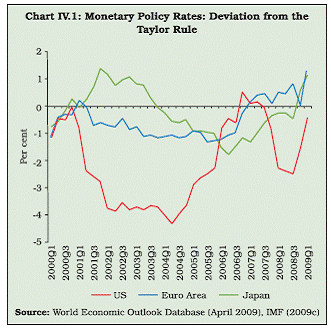
overall financial conditions. As policy rates reached
historically low levels in many advanced economies,
the zero lower bound became a binding constraint,
making it impossible to follow policy rules that called
for negative nominal interest rates in view of widening
output gaps and falling inflation rates (BIS, 2009)
(Chart IV.1).
Table 4.2: Policy Rate Cuts in Advanced Countries |
Country/
Region |
Key Policy Rate |
Policy Rate
(as on July 9, 2009) |
Change in Policy Rates
(basis points) |
Sept 08-
Jul 09 |
Apr 09-
Aug 09 |
Sept 09-
Apr 10 |
1 |
2 |
3 |
4 |
5 |
6 |
7 |
Australia |
Cash Rate |
3.00 |
(Apr. 8, 2009) |
(-) 400 |
(-) 25 |
125 |
Canada |
Overnight Rate |
0.25 |
(Apr. 21, 2009) |
(-) 250 |
(-) 25 |
0 |
Euro area |
Interest Rate on Main Refinancing Operations |
1.00 |
(May 13, 2009) |
(-) 275 |
(-) 50 |
0 |
Japan |
Uncollateralised Overnight Call Rate |
0.10 |
(Dec. 19, 2008) |
(-) 40 |
0 |
0 |
UK |
Official Bank Rate |
0.50 |
(Mar. 5, 2009) |
(-) 450 |
0 |
0 |
US |
Federal Funds Rate |
0.00 to 0.25 |
(Dec. 16, 2008) |
(-) 200 |
0 |
0 |
Source: International Monetary Fund and websites of respective central banks. |
 |
Liquidity Easing Measures
4.26 Amidst this complex and challenging
environment, central banks were forced to look
beyond the interest rate channel and explore all
possible ways to restore the functioning of the creditmarkets and ease financial conditions. Thus, the
second group of measures was undertaken. These
measures focused on reducing term interbank
market spreads, seen as an indicator of tensions
in the key market segment. This was circumvented
in two ways. The first was by directly providing more
term funding to offset some of the shortfall in market
supply. The second method was by indirectly
addressing impediments to the smooth distribution
of reserves in the system and ensuring access to
funding from the central bank (Table 4.3).
4.27 Many advanced country central banks
extended conventional liquidity easing measures
such as easing the terms and availability of existing
central bank facilities like standing lending windows.
Second, the access to central bank lending was
enhanced thereafter by extending the tenor of
financing and widening the range of counterparty
financial institutions. Third, several central banks
introduced or eased conditions for lending highly
liquid securities – typically sovereign bonds –
against less liquid market securities in order to
improve funding conditions in the money market.
Fourth, stipulations on the provision of reserves
were eased substantially by expanding the list of
eligible collateral and counterparty coverage, and
lengthening the maturity of refinancing operations.
For instance, in the US, collateral normally available
only at the discount window was made available
for open market operations. In the UK, additional
securities, including some well-rated asset-backed
securities and covered bonds were accepted in the
three-month repo operation. Fifth, several central
banks also undertook foreign exchange swaps or
loans with other central banks to alleviate severe
shortages of foreign exchange.
Table 4.3: Select Recent Central Bank Measures |
Category |
Objective |
No. |
Measure adopted |
FED |
ECB |
BoE |
BoJ |
BoC |
RBA |
SNB |
1 |
2 |
3 |
4 |
5 |
6 |
7 |
8 |
9 |
10 |
11 |
I |
Achieve |
A. |
Exceptional fine-tuning operations. |
Yes |
Yes |
Yes |
Yes |
Yes |
Yes |
Yes |
|
the official |
B. |
Change in reserve requirements |
|
|
Yes |
|
|
|
|
|
stance of |
C. |
Narrower corridor on overnight rate |
Yes |
Yes |
Yes |
|
|
|
|
|
Monetary Policy |
D. |
Payment of interest on reserves |
Yes |
|
|
Yes |
|
|
|
|
|
E. |
Increased treasury deposit |
Yes |
|
|
|
Yes |
|
|
|
|
F. |
Short-term deposit or central bank bill |
|
Yes |
Yes |
Yes |
|
Yes |
Yes |
II |
Influence |
A. |
Modification of discount window facility. |
Yes |
|
Yes |
|
|
|
|
|
wholesale |
B. |
Exceptional long-term operations |
Yes |
Yes |
Yes |
Yes |
Yes |
Yes |
Yes |
|
inter-bank |
C. |
Broadening of eligible collateral |
Yes |
Yes |
Yes |
Yes |
Yes |
Yes |
Yes |
|
market conditions |
D. |
Broadening of eligible counterparties |
Yes |
|
Yes |
Yes |
Yes |
Yes |
|
|
|
E. |
Inter-central bank FX swap lines |
Yes |
Yes |
Yes |
Yes |
Yes |
Yes |
Yes |
|
|
F. |
Introducing or easing conditions for securities lending |
Yes |
|
Yes |
Yes |
Yes |
|
|
III |
Influence |
A. |
CP funding/purchase/collateral eligibility |
Yes |
|
Yes |
Yes |
Yes |
Yes |
|
|
credit market |
B. |
ABS funding/ purchase/collateral eligibility |
Yes |
Yes |
Yes |
|
|
Yes |
|
|
and broader |
C. |
Corporate bond funding/purchase/collateral eligibility |
|
|
Yes |
Yes |
Yes |
|
|
|
financial |
D. |
Purchase of public sector securities |
Yes |
|
Yes |
Yes |
|
|
|
|
conditions |
E. |
Purchase of other non-public sector Securities |
|
|
|
Yes |
|
|
Yes |
Blank Space: No
Note : FED: Federal Reserve; ECB: European Central Bank; BOE: Bank of England; BOJ: Bank of Japan; BOC: Bank of Canada; RBA: Reserve Bank of Australia; SNB: Swiss National Bank.
Source : Adapted from BIS Annual Report, 2008-09. |
4.28 Though these liquidity-easing measures
were mostly in line with the standard central bank
LOLR function, their range and magnitude were
well above traditional levels. Major central banks
provided enhanced term funding to a wider range
of institutions and against wider collateral than in
the past. In some cases, they stepped in to provide
direct lending to distressed institutions and took
other exceptional measures to improve funding
conditions in credit markets. In the United States,
the Federal Reserve lengthened the maturity of
its refinancing operations. In addition, an
increasing share of the latter was lent to primary
dealers against a wide range of less liquid
securities to help improve their balance sheets via
the Fed’s Term Securities Lending Facility.
Similarly, the Bank of England (BoE) allowed
banks to swap less liquid securities against more
liquid ones under its Special Liquidity Scheme. The
BoE, the ECB and the Swiss National Bank (SNB)
substituted longer-term open market operations
(OMOs) for shorter-term operations. More
auctions were also conducted at a fixed rate with
full allotment. The maximum amounts of dollar
swap lines and related dollar liquidity-providing
transactions was significantly increased and
subsequently made unlimited.
Inter-Central Bank Swap Lines and
Collateralised Lending
4.29 The shortage of US dollars led to the
Federal Reserve using inter-central bank swap lines. With the intensification and spread of US
dollar shortages in mid-September 2008, swap
lines with the Federal Reserve grew in number, time
zone and geographical coverage and size. The
range of US dollar distribution operations on offer
at partner central banks also broadened. From
mainly longer-term (one- and three-month) offers,
it was expanded to include one-week and, for a
period, overnight offers as well and, from mainly
repos and collateralised loans, FX swaps were also
included (BIS, 2008).
Credit and Quantitative Easing Measures
4.30 As the crisis deepened and the interest rate
channel became ineffective, the central banks in
these countries were forced to go for quantitative
easing. This response was focused directly on
alleviating tightening credit conditions in the nonbank
sector and easing broader financial
conditions. There have been two approaches to this
quantitative easing. In the first approach, funds
were provided to non-banking institutions to
improve liquidity and reduce risk spreads in specific
markets, such as commercial paper, asset-backed
securities and corporate bonds. Public sector
securities were directly purchased in order to
influence benchmark yields more generally. In the
second approach, central banks purchased
government or government-guaranteed securities
from banks or other institutions in order to ease
liquidity conditions. The relative emphasis given to
private versus public sector securities and bank
versus non-bank markets differed across countries.
The quantitative easing involving government
securities tended to be more important in bankcentred
systems (Japan and the United Kingdom).
Credit easing with private securities generally
played a larger role in market-centred systems (the
United States) (BIS, 2009).
4.31 The Federal Reserve focused heavily on
non-bank credit markets as well as on operations
involving private sector securities such as the
Commercial Paper Funding Facility and the Term
Asset-Backed Securities Loan Facility. The Bank
of England, on the other hand, initially concentratedits Asset Purchase Facility primarily on purchases
of government bonds. The ECB focused on banking
system liquidity by conducting fixed rate fullallotment
refinancing operations with maturities of
up to 12 months and by purchasing covered bonds.
In the case of Bank of Japan, substantial efforts
were directed at improving funding conditions for
firms through various measures pertaining to
commercial paper and corporate bonds. The usage
levels of various unconventional central bank
market operations can be seen from Table 4.4.
Table 4.4: Major Crisis Interventions Introduced
by Central Banks |
|
Central Bank Interventions |
Maximum
Amount |
Amount
used as at
end-June
2009 |
1 |
2 |
3 |
4 |
I. |
US Federal Reserve (in billion US dollars) |
|
|
|
1. Short-term liquidity provision |
|
|
|
TAF |
** |
282 |
|
CPFF |
*** |
114 |
|
2. Long-term liquidity provision |
|
|
|
TALF |
1,000 |
25 |
|
3. Outright purchases of assets |
|
|
|
Agency mortgage-backed securities |
1,250 |
462 |
|
Agency debt |
200 |
97 |
|
Treasury securities |
300 |
184 |
II. |
Bank of England (in billion pounds) |
|
|
|
1. Outright purchases of assets |
|
|
|
Asset Purchase Facility# |
175 |
105 |
III. |
European Central Bank (in billion euros) |
|
|
|
1. Short-term liquidity provisions |
|
|
|
Long-term refinance operations@ |
Unlimited |
728 |
|
2. Outright purchases of assets |
|
|
|
Covered Bonds |
60 |
0 |
IV. |
Bank of Japan (in billion yen) |
|
|
|
1. Short-term liquidity provisions |
|
|
|
SFSOFCF^ |
Unlimited |
7,467 |
|
2. Outright purchases of assets |
|
|
|
Commercial Paper |
3,000 |
197 |
|
Corporate Bonds |
1,000 |
174 |
Note: TAF =Term Auction Facility; CPFF = Commercial Paper Funding Facility; TALF = Term Asset-Backed Securities Loan Facility; SFSOFCF = Special Funds-Supplying Operations to Facilitate Corporate Financing.
** : The amount is determined at each auction.
*** : There is a limit per issuer.
# : Purchasing commercial paper, corporate bonds, and gilts.
@ : Providing liquidity at a fixed rate, full allotment basis up to one year.
^ : Providing liquidity against collateral of private credit instruments at a fixed rate, allotment basis up to 3 months.
Source: Global Financial Stability Report, October, 2009. |
4.32 In a few cases, central banks directly
provided financing to corporate borrowers. Central
banks generally pre-announced upper limits on
credit-easing facilities rather than target levels, and
these upper limits were themselves adjusted in line
with changing conditions. As these measures
involved an important quasi-fiscal element, they
were normally carried out in close co-ordination with
the government. Irrespective of the approach
adopted, the quantitative easing led to manifold
expansion in the balance sheets of central banks
(Box IV.3).
Emerging Market Economies
4.33 Prior to September 2008, emerging market
economies (EMEs) were grappling with capital
inflows and inflationary pressures and were
tightening liquidity conditions by actually raising
policy rates. As the financial crisis engulfed the
EMEs, central banks in these countries embarked
on both conventional and unconventional measures
in response to the sudden tightening of global
liquidity conditions. EMEs undertook several
liquidity-easing and foreign exchange measures,
although their use of credit easing and quantitative
easing has been more limited (Table 4.5).
4.34 As exchange rates in these economies
came under pressure with the intensification of
stress in the global dollar markets and net capital
inflows began to reverse, they initiated foreign
exchange liquidity easing measures. It was only at
the beginning of November 2008 that policy interest
rates were reduced in many EMEs, indicating that
conventional domestic monetary policy easing
lagged behind unconventional measures (Ishi, et
al., 2009). Central banks in many EMEs resorted
to liquidity injections and frequent cuts in policy
rates, albeit, from a much higher level (Chart IV.2).
Domestic Liquidity Augmenting Measures in EMEs
4.35 Central banks in several EMEs resorted to
cuts in reserve requirement ratios, the introduction
of reserve averaging and hikes in exemption
thresholds with a view to ease domestic liquidity
shortages. Most of them also eased the terms of existing standing and market-based liquidity
providing facilities, viz., extension of maturities,
easing the collateral requirements, and increasing
the frequency of auctions. Several central banks
provided domestic liquidity to targeted institutions
for on-lending to market entities (Table 4.6).
Box IV.3
Quantitative Easing and Central Bank Balance Sheets
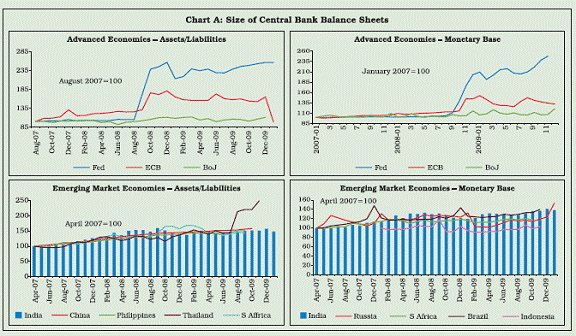
Quantitative easing expands the central bank balance
sheets, leading to expansion in reserve money. The assets
of the Fed and the BoE more than doubled in a matter of
weeks, while those of the ECB and the SNB increased by
more than 30 per cent. In the Fed’s case, this reflected direct
lending to banks and dealers through existing and new
lending facilities. It included providing indirect lending to
money market funds and purchasing commercial paper
through special purpose vehicles, and drawings by foreign
central banks on dollar swap lines. In Europe, there was
also some increase, albeit, moderately in the use of central
banks’ standing facilities. Most of the growth of central banks’
balance sheets reflected higher net amounts of domestic
and dollar liquidity-providing OMOs, representing mostly
term funding. These aggressive unconventional measures,
such as quantitative easing, resulted in expansion in the
reserve money and the size of the central bank balance
sheets in advanced countries (Chart A).
Beginning in September 2008, many emerging market
countries began to take measures to ease foreign exchange
and domestic currency liquidity conditions, but
unconventional measures have not played as important a
role for them as in advanced countries. The liquidity-easing
measures reinforced in some cases by foreign exchange
liquidity provided by reserve currency central banks seemed to have had some success in alleviating short-term liquidity
pressures. However, the size of emerging market country
central bank balance sheets did not expand by the same
magnitude as those of their advanced country counterparts
(GFSR October, 2009). The size of central bank balance
sheets in EMEs increased by much less due to the near
absence of quantitative and credit-easing measures and the
rundown in international reserves in many cases (Ishi, et
al., 2009).
It also reflects large cuts in cash reserve ratio (CRR) in EMEs
such as India and China. Reduction in CRR leads to more
liquidity with banks, even as it shows up as a reduction in
the size of the central banks’ balance sheet and reserve
money.
Implications of the Changes in Central Bank Balance Sheets
There could be several implications of the recent changes
in the central bank balance sheets. First, with the change in
composition, the risk profile of central bank balance sheets
underwent a change. The central banks’ purchase of assets
such as mortgage-backed securities and commercial paper
increased their credit and valuation risks. Broadening the
set of eligible securities that central banks accept as
collateral for extending credit through new facilities and also the number of eligible counterparties raised the counterparty
credit risk. Second, the income position of central banks
also underwent a change. While low returns on central bank
assets relating to bank notes and reserves reduced the
revenue, liquidity injections increased the amount of reserves
over which interest is received, thereby increasing central
bank profits. Third, going forward, an exit strategy may
require phased reduction in reserves as abrupt unwinding
of reserves could disrupt financial markets. Concomitantly,
if inflation expectations firm up, central banks may need to
increase the remuneration rate they pay on excess reserves
as a means to ensure the targeted policy rate. This, in turn, would entail additional cost for central banks; though to some
extent this would be offset by the extra income resulting
from expanded balance sheets, they face substantial income
risk (GFSR, October 2009).
 |
References
1. Ishi, Kotaro, Mark Stone, and Etienne B. Yehoue. 2009.
“Unconventional Central Bank Measures for Emerging
Economies”. IMF Working Paper WP/09/226.
2. Global Financial Stability Report. October 2009.
4.36 Central banks in EMEs eased the terms of
existing foreign exchange facilities, i.e., extending
maturities and broadening the collateral. They also
put in place new foreign exchange facilities, such
as dollar repo and swap facilities. The list of
counterparties was widened to include non-banking financial institutions and key non-financial
institutions (e.g. exporters or energy importers).
Foreign exchange liquidity limits were also relaxed,
covering removal of ceilings on bank purchases of
offshore foreign exchange and easing of capital
inflow limits. In addition, some central banks
lowered the required reserve ratio for bank foreign
currency liabilities and shifted the currency
structure of required reserves away from foreign exchange. In order to ease foreign exchange
liquidity conditions, central banks in countries like
Brazil, Korea, Mexico and Singapore had dollar
swap arrangements with the Federal Reserve.
Table 4.5: Select Unconventional Measures by EME Central Banks |
Type |
Country |
Measure |
1 |
2 |
3 |
I. |
Domestic Liquidity Easing |
|
|
| |
1. Direct money market instruments |
China Hungary Nigeria |
Reduction in reserve requirements |
2. Systemic domestic liquidity arrangements |
Philippines |
Expansion in the eligible collateral for standing repo facility to include foreign currency-denominated sovereign debt securities. |
Israel |
Central bank’s announcement to transact OMOs with government debt of different types and maturities. |
Chile |
Broadening the list of eligible collateral for monetary operations to include commercial papers. |
II. |
Foreign Exchange Easing |
|
|
| |
1. Foreign Exchange Liquidity Injection |
Brazil |
Central bank’s announcement to sell 1-month dollar liquidity lines. |
Philippines |
Central bank’s approval to open dollar repo facility. |
Turkey |
Introduction of daily dollar selling auctions. |
Indonesia |
Reduction in the foreign exchange reserve requirement for commercial banks. |
Serbia |
Reduction in the required reserves against foreign assets. |
2. Cross-Central Bank Currency
Swap Arrangements |
Brazil |
Temporary reciprocal swap lines with the Federal Reserve, Banco Central de Brazil, Banco de Mexico, Bank of Korea and the Monetary Authority of Singapore. |
Mexico |
Korea |
Singapore |
III. |
Credit and Quantitative Easing |
Korea |
Announcement of central bank financing (up to a limit) to a bond fund to purchase commercial papers. |
Israel |
Central bank announcement to purchase government bonds. |
Adapted from Ishi et al. (2009). |
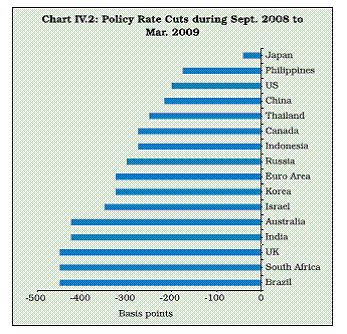 |
Table 4.6: Measures Implemented in Select EMEs (September 2008 - May 2009) |
Country |
Liquidity
Easing
Measures |
Foreign Exchange
Easing Measures |
Foreign
Exchange
liquidity
injections |
Cross-central
bank
currency
swap |
1 |
2 |
3 |
4 |
Brazil |
12 |
9 |
2 |
Mexico |
1 |
1 |
2 |
China |
4 |
1 |
|
Hong Kong SAR |
3 |
1 |
1 |
India |
5 |
7 |
1 |
Indonesia |
11 |
4 |
|
Korea |
5 |
4 |
5 |
Malaysia |
3 |
– |
– |
Philippines |
3 |
4 |
– |
Singapore |
– |
– |
2 |
Source: Ishi et al., (2009). |
4.37 Most major emerging market central banks
conducted outright sales of foreign exchange
reserves to help meet the local market’s demand
for foreign currency funding and to relieve pressure
on the exchange rate. In addition, some central
banks sought to offer foreign exchange reserves
to counterparties under repurchase agreements
(Brazil and the Philippines). Some central banks
announced modifications (widening of counterparty
eligibility, extension of term) to their existing FX
swap facilities to make the distribution of foreign
currency more efficient and flexible (Korea and
Indonesia). Others set up new swap facilities (Brazil,
Chile and Poland) or announced their readiness to
conduct swaps with counterparties as needed
(Hong Kong SAR) (BIS, 2008).
Credit and Quantitative Easing Measures
4.38 In respect of EMEs, the use of credit and
quantitative easing measures has been limited.
Illustratively, the Bank of Korea purchased
corporate debt and commercial paper, while the
Bank of Israel undertook quantitative easing during
March and August 2009.
4.39 While both developed economies and EMEs
resorted to unconventional monetary measures,
there were differences in terms of their timing, types
and magnitudes. (i) In the advanced economies,
the switchover was from conventional monetary
tools to unconventional measures due to policy
rates reaching zero or nearing zero. In contrast, in
many EMEs, unconventional foreign exchange
easing measures such as currency swap preceded
domestic liquidity-easing measures due to the
sudden tightening of global liquidity. Thereafter, the
conventional measures of loosening policy rates
followed. (ii) To ease liquidity, central banks in EMEs
relied mostly on direct instruments such as reserve
requirements. Advanced countries, on the other
hand, resorted to measures such as widening the
availability of counterparties and extending the maturity of liquidity providing operations. Central
banks in advanced countries also eased liquidity
through securities liquidity provision, i.e., swap of
illiquid private sector securities on their books for
liquid government securities held by counterparties.
Central banks in EMEs hardly resorted to this
securities liquidity provision measure. Furthermore,
the central banks in advanced countries extensively
used credit and quantitative easing measures, while
they were barely used in the EMEs. (iii) In view of
the extensive use of credit and quantitative easing,
the enlargement in the balance sheet of central
banks in the advanced countries was far greater
than those of the EMEs (Ishi et al., 2009).
Policy Effectiveness
4.40 The list of monetary policy instruments
available to central banks to stimulate the economy
when official rates are close to or at zero has been
fairly wide. They are: (i) “quantitative easing” policy,
i.e., expanding the money base beyond what is
strictly needed to keep the official rates at zero.
This has been aimed at reducing liquidity risks and
provide incentives for financial intermediaries to
expand their credit; (ii) measures to reduce longerterm
interest rates through direct purchase of longterm
government securities and/or carefully
designed communication to influence market
expectations; and (iii) the purchase of a wide range
of private assets, from securities to equity.
4.41 On the whole, such interventions by central
banks on a massive and unconventional scale
helped ease severe liquidity strains leading to
tangible improvements in a number of key markets.
They not only lowered interest rates on default-free
securities, but also helped lower credit spreads.
4.42 According to the IMF’s Global Financial
Stability Report (October, 2009)
:
(i) The announcement of interest rate cuts proved
effective, although only on a few occasions, in
terms of reduction (statistically significant) in
the economic stress index (ESI). In general,
low policy rates translated into low funding
costs to financial institutions that required
additional liquidity (Table 4.7).
Table 4.7: Effectiveness of Crisis Interventions |
Index/
Indicator |
Economic Stress Index |
Financial Stress Index |
Interest
rate cuts |
Liquidity
Support |
Interest
rate cuts |
Liquidity
Support |
1 |
2 |
3 |
4 |
5 |
Period I: Pre-Lehman
(June 1, 2007 to September 14, 2008) |
US |
x |
√ |
x |
x |
UK |
√ |
√ |
x |
√ |
Euro Area |
– |
x |
– |
x |
Japan |
– |
– |
– |
– |
Sweden |
– |
√ |
– |
x |
Switzerland |
– |
x |
– |
x |
Period II: Global Crisis 1
(September 15, 2008 to December 31, 2008) |
US |
x |
x |
√ |
x |
UK |
x |
x |
x |
x |
Euro Area |
x |
x |
√ |
√ |
Japan |
x |
x |
√ |
√ |
Sweden |
– |
x |
– |
x |
Switzerland |
√ |
x |
√ |
x |
Period III: Global Crisis 2
(January 1, 2009 to June 30, 2009) |
US |
x |
√ |
x |
x |
UK |
x |
– |
x |
– |
Euro Area |
x |
x |
√ |
x |
Japan |
– |
√ |
– |
√ |
Sweden |
– |
x |
– |
x |
Switzerland |
√ |
x |
√ |
x |
√ : denotes a statistically significant intervention at the 10 per cent level.
X : denotes statistically insignificant
– : denotes that there were fewer than two policy events during
the given sub-period.
The statistical significance of the short-term impact of intervention announcements is tested as follows: (1) interest rate cuts on the economic stress index; (2) liquidity support on the three-month LIBOR-overnight index swap (OIS) spread; and (3-5) financial sec-tor interventions on credit default swap spreads of local banks, weighted by the size of total assets.
Source: Global Financial Stability Report October, 2009. |
(ii) Even though most countries undertook liquidity
support measures, their announcement effect
was primarily effective during the initial phase
of the crisis in terms of reducing the LIBOROIS
swap spreads. The effectiveness of
liquidity injections was moderated in the later
stage of the crisis as credit risk rather than
liquidity risk became the main concern.
(iii) The long-term effects of various interventions on
the LIBOR-OIS spreads, however, showed
improvement. As at end-June 2009, spread levels
declined between 53 to 90 per cent from the
respective peaks in various countries (Table 4.8).
(iv) In the United States, the immediate positive
market response to liquidity support schemes,
such as the Term Auction Facility (TAF) and
Commercial Paper Funding Facility (CPFF),
revealed that there was a persistent decline in
LIBOR-OIS spreads from late 2008.
(v) The assessment of the impact on the financial
stress index revealed that announcements of
monetary easing were more effective in
reducing financial stress than economic stress.
4.43 Some of the early credit easing measures
helped alleviate pressures in commercial paper,
mortgage, and corporate bond markets. Many
market participants reported that the extended swap facilities improved term funding conditions.
Indeed, actual usage peaked in late October 2008
and gradually declined thereafter, with some central
banks never actually having drawn on the swap
lines. Foreign exchange swap market deviations
declined in particular in EUR/USD and CHF/USD,
and overall LIBOR-OIS spreads narrowed. While
many other policy actions were taken at the same
time, some of this improvement was due to the
introduction of central bank swap lines.
Table 4.8: 3-Month LIBOR-Overnight Index Swap Spread: Declines from Peak |
Item |
US |
UK |
Euro
Area |
Japan |
Sweden |
Switzer-
land |
1 |
2 |
3 |
4 |
5 |
6 |
7 |
LIBOR-OIS peak level (in basis points)* |
361 |
244 |
199 |
80 |
155 |
159 |
LIBOR-OIS spread decline as on June 30, 2009 (in basis points) |
-324 |
-166 |
-149 |
-43 |
-112 |
-127 |
In per cent of peak level |
-90 |
-68 |
-75 |
-53 |
-72 |
-80 |
In standard deviations from
peak level** |
-1.5 |
-1.8 |
-2.0 |
-3.4 |
-1.8 |
-0.5 |
* : The peaks of the LIBOR-OIS are specific to each country or region: Euro area (10/13/2008), Japan (12/18/2008), Sweden (11/27/2008), Switzerland (11/12/2008), the United Kingdom (12/4/2008), and the United States (10/10/2008).
** : The decline of the LIBOR-OIS spread series relative to their peak levels is expressed in terms of standard deviations from the median change in each sub-period weighted by the number of days in that sub-period (pre-Lehman, global crisis 1, and global crisis 2). Using such a standardised measure of changes in LIBOR-OIS spreads allows better comparability across sample countries (and helps quan-tify relative policy effectiveness over the longer term by allowing the different sub-periods to reflect the different lengths of periods).
Source: Global Financial Stability Report October, 2009. |
4.44 Gauging the effectiveness of unconventional
measures is difficult as its transmission to the
economy is complex and opaque. The success of
most unconventional measures hinges not just on
the design and magnitude of the measures, but also
on the willingness and ability of creditors to lend and
of borrowers to borrow. Further, unconventional
measures overlap; for example, a liquidity-easing
measure aimed at a particular class of financial
institutions may, if unsterilised, lead to an increase
in reserve money.
4.45 The effectiveness of central bank actions
in attenuating the impact of the crisis and restoring
the functioning of markets, however, depends on
the extent to which they have a catalytic effect on
private sector intermediation. Thus, the ultimate
success of central bank interventions depends on
the appropriate design and forceful implementation
of policies that directly address the fundamental
weaknesses in bank balance sheets.
Risks and Challenges
4.46 The unconventional measures of liquidity,
credit and quantitative easing entail several
challenges and risks (IMF, 2009).
(i) Unconventional measures may inadvertently
allocate credit to inefficient markets at the
expense of efficient markets, constraining
financial sector restructuring in the short run,
and impairing future economic growth.
(ii) The gradual replacement of high-quality and liquid
assets with illiquid claims on central bank balance
sheets reduces operational flexibility and thereby
may constrain future monetary management.
(iii) The quasi-fiscal nature of some unconventional
measures blurs the distinction between
monetary and fiscal policies and, together with
pressure to continue to provide financing, could
potentially compromise central bank
independence.
(iv) The inflation potential of expanding reserve
money amidst announcements of
unconventional measures by central banks may
destabilise inflation expectations.
(v) Though these unconventional monetary policy
instruments may be effective in boosting the
economy, when price stability is at stake, they
have their limits because of their broader
implications.
• First, as the effects of such policies are not
well-known, the conduct of monetary policy
is bound to be surrounded by much more
uncertainty than is normally the case. For
instance, it is unclear how far long-term rates,
and in particular the risk premia embedded
in those rates, can be brought down by
liquidity injections in a situation of widespread
uncertainty about economic prospects. Thus,
well-designed communication by central
banks may be crucial.
• Second, liquidity injections need not be
greatly effective when financial
intermediaries continue to remain unhealthy.
• Third, there could be a risk of introducing
distortions in financial prices without a
careful design of the measures.
• Fourth, unconventional measures may have
a more direct redistributive impact on
specific sectors of the economy or
categories in society than normal monetary
policy actions. This implies a high degree
of common understanding and co-operation
between fiscal and monetary authorities, as
part of a clear definition of respective
responsibilities and fields of action.
4.47 Some of these risks could be reduced
through transparency and effective communication.For the same, central banks and fiscal agents
engaging in quasi-fiscal measures should publicly
explain the objectives, expected effects, and
potential fiscal implications of unconventional policy
tools. Careful statement of central bank views on
the macroeconomic outlook would also facilitate the
eventual resumption of positive policy interest rates
and absorption of liquidity (IMF, 2009).
4.48 To sum up, the monetary policy response
to the crisis began with the conventional measure
of easing policy rates in advanced countries. This
was increasingly carried out in a co-ordinated
manner among the major central banks as the crisis
deepened. But the persistence of financial strains
even after the policy rate was brought down to zero
or near-zero levels led to unleashing of a number
of unconventional measures on a scale hitherto
unseen. In the EMEs, however, unconventional
measures of providing foreign exchange preceded
the conventional policy rate cuts, as the liquidity
constraints first surfaced in the foreign exchange
market. Other unconventional measures have been
used sparingly or on a much lower scale. As a
result, central bank balance sheets in the advanced
economies swelled much more than in the EMEs.
This could pose several policy challenges and risks
in the future. Yet, central bank actions across
countries managed to address the immediate
funding needs of the banks and restore some
normalcy. However, the monetary policy measures
could not stop solvency concerns of some
systemically important financial institutions. This led
to severe market dislocation with adverse
implications on the real sector. Thus, governments
were compelled to take several actions to prevent
the collapse by extending large-scale fiscal support
to financial institutions.
III. FISCAL SUPPORT TO THE FINANCIAL
SECTOR
4.49 The present global crisis, as in the past, has
been characterised by the twin problems of financial
instability and fall in aggregate demand feeding into
each other. Thus, the fiscal policy response has
consisted of two components with obvioussynergies between them. The first component has
been the crisis management strategy directed at
bringing the financial system back to health. The
strategy has involved providing direct financial
support and/or deposit insurance/guarantee to
troubled financial institutions in order to make them
solvent and stabilise the financial system. The
second step has been to activate discretionary
fiscal measures to support aggregate demand in
order to contain economic slowdown, which is dealt
with in the next section.
4.50 The need for fiscal support to financial
institutions was much larger in advanced countries
than in the EMEs. In the advanced countries, it was
initially the financial sector crisis which led to a
sharp slowdown of the real sector that, in turn, fed
back into the financial sector. Given the severity of
the financial crisis, it was found insufficient for the
central banks alone to provide the necessary
support to the financial sector. In the emerging
market economies, the transmission of the crisis
was primarily from the real sector to the financial
sector. The economic slowdown in the advanced
countries adversely impacted exports of goods and
services and the aggregate demand. This fed back
into the financial sector. The problem was
compounded by a sharp fall in capital inflows or
increase in outflows due to sell-offs in the equity
markets of EMEs by foreign investors. Capital flows
also reversed in search of safety or to redress the
financial solvency problems faced by parent
companies in the advanced countries. Thus, the
focus of fiscal policy was weighed towards countercyclical
measures to stimulate aggregate demand
rather than providing financial support to the
troubled financial institutions.
4.51 Fiscal support to the financial sector included
a combination of up-front government support by way
of capital injection and purchase of assets and
lending by the treasury, and providing guarantees
for bank deposits, interbank loans and bonds.
Capital injections were made to directly address the
solvency problem. Assets purchases were aimed
at repairing impaired assets. Treasury lending to
financial institutions was to ensure that these institutions were not starved of funds. Guarantees
on deposit and debt were provided with the intention
of providing assurance to depositors and lenders.
Direct Financial Support
4.52 The programmes initiated in the US, UK,
Switzerland and other European countries to address
bank illiquidity and insolvency involved a combination
of sales of distressed and illiquid assets and equity
injections by the government. Equity injections,
mainly through the issue of preferential shares, were
increasingly preferred. However, government exit
plans have been defined in only a handful of the
programmes. Participation in these programmes
involved conditions on management compensation
and profit distribution. Some countries like the UK
and the Netherlands have also introduced special
governance arrangements including board
representation, while others like the US intended to
remain passive investors. This reflected different
responses to the dilemma of penalising existing
shareholders and management versus avoiding
political interference in bank operations.
4.53 Most large-scale bank restructuring
programmes included two major components: asset
sales/bank recapitalisation; and the resolution of
problem assets. However, different countries have
adopted different approaches for resolving problem
assets. In some countries the government carved
out the bad loans from balance sheets, but they
signed a management contract with the originating
banks to recover the loans. Other countries have
adopted decentralised good bank/bad bank
approaches, which typically entail the transfer of
bad assets to bank subsidiaries. In other countries,
the resolution of problem assets has been handled
by a central agency. This agency typically pools all
the individual loans by type of debt, borrower, and
sector, and re-sells them (or the underlying
collateral) to investors.
4.54 The attempt to recapitalise UK and US
banks through publicly acquired preference shares
could not address the problem entirely. The banks
have merely used these infused funds to hold on
to their toxic assets. Thus, to restore them to health,
it was considered necessary to remove the toxic
assets from the balance sheets of the concerned
banks. The plans proposed to deal with the toxic
assets either involved partially nationalising the
banks, or keeping them private but nationalising
their toxic assets in a public ‘bad’ bank. In the US,
the Obama administration’s plan to rid banks of their
‘toxic’ assets was announced on March 23, 2009.
The Obama plan envisaged the establishment of a
public-private partnership to acquire loans and
securities from banks through a ‘Legacy Loans
Program’ and ‘Legacy Securities Program’. In the
first, pools of loans were to be auctioned to private
investors who would be provided with financing from
the Federal Deposit Insurance Corporation (FDIC)
to acquire the loans. Both government and the
private sector had to contribute to the initial capital.
If and when the loans are recovered or sold off, the
government would get a share of the profits. The
‘Legacy Securities Program’ was similar. The
objective was to enable banks to dispose of their
illiquid mortgage-backed securities to the new
special purpose entity. The entity will be funded by
the Fed under its existing Term Asset-backed
Securities Loan Program.
Guarantees
4.55 The US, European and other developed
country governments have provided extensive
assurances to bank depositors and creditors. In a few cases, these were extended to non-bank
financial institutions such as mutual funds. The
move was prompted by systemic stability and, in a
few cases, out of competitive concerns. Some of
these arrangements include blanket guarantees on
deposits and guarantees on new debt issues. The
scale of these arrangements had no historic parallel
and constituted a paradigm shift.
4.56 Expansion of deposit insurance beyond
normal limits, or the use of a blanket guarantee in
extreme conditions, could only be undertaken as a
temporary and emergency measure. And they were
carried out in a co-ordinated fashion across
countries. This was followed by a similar
announcement in several jurisdictions to guarantee
bank deposits. The objective was to counteract the
impact of the international market turmoil on their
banking systems and remove any uncertainty on
the part of counterparties and customers of the
credit institutions. The announcement of
government guarantees for bank deposits in a few
jurisdictions set off dynamics that put pressure on
other jurisdictions to respond. Otherwise, there was
a risk of disadvantaging and potentially weakening
their own financial institutions and financial sectors.
Some developed countries announced that the
guarantees on new debt issues would be extended
for 18-36 months. Some emerging countries have
matched these arrangements in order to prevent
capital outflows or a shift of deposits to state-owned
banks, which are perceived to be safer (Box IV.4).
Box IV.4
Measures Relating to Deposit Guarantee
To assuage the excessive reactions to the recent financial
crisis, some countries announced guarantees for bank
deposits for a short period and earmarked funds for the
purpose. Even though the banking system continued to be
sound and resilient, some governments decided to take
precautionary action to avoid an erosion of banks’ deposit
base and ensure a level international playing field for banks
in their jurisdiction.
The US
On October 3, 2008, the Congress temporarily increased
FDIC deposit insurance from $100,000 to $250,000 per
depositor up to December 31, 2009. With effect from October 14, 2008, all non-interest bearing transaction
deposit accounts at an FDIC-insured institution, including
all personal and business checking deposit accounts that
do not earn interest, have been fully insured for the entire
amount in the deposit account. This unlimited insurance
coverage is temporary and will remain in effect for
participating institutions until December 31, 2009.
In addition to the actions announced by the Treasury and
the Fed, the FDIC announced on October 14, 2008, a new
Temporary Liquidity Guarantee Program to unlock interbank
credit markets and restore rationality to credit spread.
Europe
The UK: With effect from October 7, 2008, the Financial
Services Authority (FSA) of the UK increased the
compensation limit on deposits with failed banks, building
societies and credit unions from £35,000 to a total of £50,000
per depositor under the Financial Services Compensation
Scheme (FSCS). Customers with joint accounts will be
eligible to claim up to £100,000 between them.
Denmark: The Danish Financial Supervisory Authority
guaranteed all bank deposits with effect from October 6,
2008, as part of a deal with banks to set up a 3.5 billion
DKK Liquidation Fund. Earlier the guarantee cover was
available up to 300,000 DKK per depositor, net of all loans
and other liabilities to the bank.
Germany: On October 6, 2008, the German government
offered a blanket guarantee for bank deposits, which would
cover some Euro 568 billion (US$ 785 billion) in savings
and checking accounts as well as time deposits, or CDs.
Prior to this, the compensation scheme of German banks
covered 90 per cent of the outstanding deposits and was
limited to Euro 20,000 per depositor.
Ireland: The government of Ireland decided to put in place a
guarantee arrangement to safeguard all deposits (retail,
commercial, institutional and interbank), covered bonds,
senior debt and dated subordinated debt (lower Tier II) with
six banks and such specific subsidiaries as may be approved
by the government. The guarantee was provided at a charge
to the institutions concerned and will be subject to specific
terms and conditions so that the taxpayers’ interests can be
protected. The guarantee will cover all existing
aforementioned facilities with these institutions and any new
such facilities issued from midnight on September 29, 2008
and will expire at midnight on September 28, 2010.
Austria: Austria’s parliament approved a Euro100 billion
(US$ 196.8 billion) bailout plan on September 20, 2008 to
stabilise the country’s banking sector. The package, inter
alia, includes unlimited protection to individuals’ bank
deposits until December 31, 2009. After that, the state
guarantee will be available only up to Euro 100,000 per
account. Bank deposits for business account holders will
be guaranteed up to Euro 50,000. Before the law was
passed, Euro 20,000 per individual/ business account was
protected.
Sweden: The Swedish government announced on October
6, 2008 that it will raise the limit for deposit insurance to
500,000 Kroner (US$ 71,000). Sweden previously had
deposit insurance for savings of up to 250,000 Kroner.
Greece: A bill to parliament was submitted on October 6,
2008 to raise the legal limit of deposit insurance to
Euro 100,000 from the existing Euro 20,000. The guarantee
is proposed to be in force for the next three years.
Euro Zone: The minimum deposit insurance provided by
euro area members under Euro laws was revised upward
from Euro 20,000 to Euro 50,000 on October 7, 2008.Co-insurance has been abandoned and the member
countries in the Euro Zone have taken/are taking action
accordingly.
Asia
Indonesia: The government increased the deposit
insurance cover to Indonesian Rupiah two billion.
Malaysia: On October 30, 2008, a blanket government
guarantee was extended through the Philippine Deposit
Insurance Corporation (PDIC) on all ringgit and foreign
currency deposits with commercial, Islamic and investment
banks, and deposit-taking development financial
institutions regulated by Bank Negara Malaysia, until
December 2010. The guarantee extends to all domestic
and locally incorporated foreign banking institutions; and
access to Bank Negara Malaysia’s liquidity facility will be
extended to insurance companies and takaful operators
regulated and supervised by the Bank.
Singapore: The Singapore government extended
guarantee to all Singapore Dollar and foreign currency
deposits of individual and non-bank customers in banks,
finance companies and merchant banks licensed by the
Monetary Authority of Singapore (MAS) until December
31, 2010. All depositors, big and small, corporates and
individuals, including those under the current Deposit
Insurance Scheme administered by the Singapore Deposit
Insurance Corporation would enjoy protection from the
government on the full amount of their deposits for the
duration of the guarantee. The government guarantee
would also be extended to deposits placed with credit cooperatives
registered with the Registry of Co-operative
Societies. The guarantee will be backed by S$ 150 billion
of the reserves of the Singapore government.
Hong Kong: The Hong Kong Monetary Authority (HKMA) on
October 14, 2008 issued a blanket guarantee for customer
deposits and offered to re-capitalise its banks. The guarantee
would be backed by the Exchange Fund of HKMA.
Others
Australia: On October 12, 2008, the Australian government
announced a blanket guarantee for all bank deposits,
covering around A$ 700 billion. Following wide criticism and
withdrawal of funds from cash management trusts and
mortgage funds, the government has considered modifying
the scheme. It considered providing a limit for the
government guarantee and stipulating an “insurance”
premium for large depositors to qualify for the full guarantee.
New Zealand: The government initially announced a
blanket guarantee for bank deposits under the “Crown
Retail Deposit Guarantee Scheme” but this was revised
on October 22, 2008. A cap of A$ 1 million per depositor
per guaranteed institution has been fixed, which will be
extended for two years.
Source: Websites of respective central banks.
4.57 In most of the leading economies, in order
to further raise the level of confidence in the
financial system, the above-mentioned rescue
packages were accompanied by statements that
the government would not allow systematically
important institutions to fail. Further, in Denmark,
the Netherlands, the UK and the US, the
governments either nationalised or acquired a
majority stake in some of the insolvent financial
institutions to protect depositors and contain any
contagion (BIS, 2009).
Scale of Financial Support and Utilisation
4.58 The intended upfront government support
to financial institutions in the advanced countries
had been much larger than in the EMEs. As on June
2009, it ranged from 0.7 per cent of GDP in Italy to
a high of 20.0 per cent in the UK, with the majority
of them providing far more than 5.0 per cent of GDP.
For the EMEs, the upfront government support
ranged from nil in a number of them to 3.5 per cent
of GDP in Hungary. The average support for the
advanced G-20 countries is estimated at about 5.5
per cent of GDP. For emerging G-20 countries, the
average is placed at 0.4 per cent of GDP. Guarantees
were also larger in the advanced economies, barring
Italy, Portugal and Switzerland. It ranged from 6.2
percent of GDP in Greece to as high as 198.1 per
cent of GDP in Ireland. In the EMEs, guarantees
have also been much smaller, with the highest being
Poland at 3.2 per cent of GDP. In contrast to
advanced economies, support to financial
institutions in EMEs had been mostly through
liquidity support by the central banks (Table 4.9).
4.59 The announced fiscal packages were quite
large in some of the countries compared to the
experience of previous major financial crises. Fiscal
costs arising from cleaning up financial markets
and/or protecting depositors and banks
stakeholders in a sample of 42 crisis episodes in
the past averaged around 13 per cent of GDP. But
in some of them it was over 31 per cent of GDP
(Table 4.10). The past experience also shows that
accommodative policy measures such as liquidity
support, blanket guarantees and forbearance from prudential regulations tended to increase the fiscal
costs while not necessarily accelerating the pace
of economic recovery (OECD, 2009a).
Table 4.9: Support to Financial Sector as on June,
2009 (as % of 2008 GDP) |
Countries |
Capital Injection |
Purchase
of Assets
and
Lending
by
Treasury |
Support
By
Central
Bank |
Guaran-
tees |
Total |
Upfront
Guaran
tees
Support |
1 |
2 |
3 |
4 |
5 |
6 |
7 |
Advanced Countries |
|
|
|
|
|
|
Australia |
0.0 |
0.7 |
0.0 |
8.8 |
9.5 |
0.7 |
Austria |
5.3 |
0.0 |
0.0 |
30.1 |
35.4 |
8.9 |
Belgium |
4.8 |
0.0 |
0.0 |
26.4 |
31.2 |
4.8 |
Canada |
0.0 |
10.9 |
1.5 |
13.5 |
25.9 |
10.9 |
France |
1.4 |
1.3 |
0.0 |
16.4 |
19.1 |
1.6 |
Germany |
3.8 |
0.4 |
0.0 |
18.4 |
22.2 |
3.7 |
Greece |
2.1 |
3.3 |
0.0 |
6.2 |
11.6 |
5.4 |
Ireland |
5.9 |
0.0 |
0.0 |
198.1 |
204.0 |
5.9 |
Italy |
0.6 |
0.0 |
0.0 |
0.0 |
0.7 |
0.6 |
Japan |
2.4 |
11.4 |
1.9 |
7.3 |
33.8 |
0.8 |
Korea |
2.3 |
5.5 |
6.5 |
14.5 |
26.8 |
0.8 |
Netherlands |
3.4 |
11.2 |
0.0 |
33.6 |
47.3 |
14.6 |
Norway |
2.0 |
15.8 |
0.0 |
21.0 |
32.5 |
15.8 |
Portugal |
2.4 |
0.0 |
0.0 |
12.0 |
14.4 |
2.4 |
Spain |
0.8 |
3.9 |
0.0 |
15.8 |
22.2 |
4.6 |
Sweden |
1.6 |
4.8 |
13.9 |
47.5 |
68.0 |
5.2 |
Switzerland |
1.1 |
0.0 |
24.9 |
0.0 |
25.5 |
1.1 |
United Kingdom |
3.9 |
13.8 |
19.0 |
53.2 |
81.8 |
20.0 |
United States |
5.2 |
1.5 |
8.1 |
10.6 |
25.8 |
6.9 |
Emerging Economies |
|
|
|
|
|
|
Argentina |
0.0 |
0.9 |
5.4 |
0.0 |
5.1 |
0.9 |
Brazil |
0.0 |
0.8 |
10.8 |
0.0 |
13.3 |
0.0 |
China |
0.0 |
0.0 |
22.5 |
0.0 |
21.3 |
0.0 |
India |
0.4 |
0.0 |
8.3 |
0.0 |
9.6 |
0.4 |
Indonesia |
0.0 |
0.0 |
1.2 |
0.1 |
1.4 |
0.1 |
Hungary |
1.1 |
2.4 |
13.6 |
1.1 |
20.3 |
3.5 |
Poland |
0.0 |
0.0 |
5.4 |
3.2 |
8.7 |
0.0 |
Russia |
1.2 |
1.2 |
11.6 |
0.5 |
17.2 |
2.3 |
Saudi Arabia |
0.0 |
1.2 |
30.6 |
– |
34.3 |
1.2 |
Turkey |
0.0 |
0.3 |
3.7 |
0.0 |
3.4 |
0.0 |
Note : 1. IMF Staff estimates indicating announced or pledged amounts, and not the actual uptake;
2. Support by central bank indicates the actual changes in central bank balance sheets from June 2007 to April 2009. While these changes are mostly related to measures aimed at enhancing market liquidity and providing financial sector support, they may occasionally have other causes, and also may not capture other types of support, including that due to
changes in regulatory policies.
Source: IMF Staff Position Note, Fiscal Affairs Department, International Monetary Fund, November 2009. |
Table 4.10: Fiscal Costs of Selected Crises in
the Past (as per cent of GDP) |
|
Gross Fiscal
Cost |
Net Fiscal
Cost* |
Output Loss |
1 |
2 |
3 |
4 |
Argentina, 1980 |
55.1 |
55.1 |
10.8 |
Chile, 1981 |
42.9 |
16.8 |
92.4 |
Indonesia, 1997 |
56.8 |
52.3 |
67.9 |
Japan, 1997 |
24.0 |
13.9 |
17.6 |
Korea, 1997 |
31.2 |
23.2 |
50.1 |
Sweden, 1991 |
3.6 |
3.4 |
30.6 |
Russia, 1998 |
6.0 |
6.0 |
0.0 |
United States, 1988 |
3.7 |
– |
4.1 |
Average 42 Episodes |
13.3 |
– |
20.0 |
* Defined as gross fiscal cost minus recovery proceeds.
Source: Laeven and Valencia (2008). |
4.60 During the recent crisis, the actual support
provided by the governments, however, has been
much lower than announced. For capital injection,
countries such as Switzerland and the UK have fully
utilised the allocated amount. However, in some
countries such as Italy and Norway they have not
been utilised at all. For the advanced economies,
the average utilisation of the allocated amount for
capital injection worked out to two-fifths only. The
utilisation of allocated amount at one-fifth was even
lower for purchase of assets and treasury lending.
The utilisation rates were no better in the EMEs,
even though the announced quantum was much
smaller than in the advanced countries. However,
unlike in the advanced countries, the utilisation
rates were much higher for purchase of assets and
lending by treasury than for capital injection (Table
4.11).
4.61 The low level of utilisation of the allocated
amount reflected a variety of factors such as the
precautionary nature of initial announcements,
indications of increasing stability and improved
bank liquidity, and lags in implementation of
programmes for recapitalisation and purchase of
assets. Even the central bank credit facilities
appeared to have been taken up only to a limited
extent, as conditions turned out to be less serious
than at the time of the announcement (Horton et
al., 2009).
Table 4.11: Financial Sector Support Utilised
Relative to Announcement
(as % of 2008 GDP) |
Country |
Capital Injection |
Purchase of Assets
and Lending by
Treasury |
Amount
Used |
In per cent
of Announ-
cement |
Amount
Used |
In per cent
of Announ
cement |
1 |
2 |
3 |
4 |
5 |
Advanced Countries |
|
|
|
|
Australia |
… |
… |
0.5 |
71.3 |
Austria |
1.7 |
32.7 |
… |
… |
Belgium |
4.7 |
97.6 |
… |
… |
Canada |
… |
… |
5.6 |
51.6 |
France |
0.8 |
57.0 |
0.4 |
26.5 |
Greece |
1.7 |
82.0 |
1.8 |
55.0 |
Ireland |
3.8 |
63.6 |
… |
… |
Italy |
0.0 |
0.0 |
… |
… |
Japan |
0.0 |
1.0 |
0.8 |
3.6 |
Korea |
0.8 |
33.0 |
0.3 |
4.8 |
Netherlands |
2.3 |
68.8 |
10.2 |
99.4 |
Norway |
0.0 |
0.0 |
4.8 |
30.3 |
Portugal |
1.5 |
62.5 |
… |
… |
Spain |
|
|
1.8 |
44.6 |
Switzerland |
1.1 |
100.0 |
… |
… |
United Kingdom |
3.9 |
100.0 |
3.4 |
24.4 |
United States |
2.2 |
41.9 |
0.7 |
53.8 |
Emerging Economies |
|
|
|
|
Brazil |
… |
… |
0.3 |
43.5 |
India* |
0.0 |
5.0 |
0.0 |
… |
Indonesia |
… |
… |
… |
… |
Hungary |
0.1 |
9.3 |
2.1 |
87.0 |
Russia |
0.5 |
40.6 |
0.4 |
31.0 |
| Saudi Arabia |
… |
… |
0.6 |
51.4 |
* In the fiscal measures announced by the Government of India on January
2, 2009, it was indicated that public sector banks in India will be recapitalised to the extent of Rs.20,000 crore over the next two years. As per the Budget 2009-10 and 2010-11, the Government provided an amount of Rs.595 crore in 2008-09 (revised estimates) towards recapitalisation of regional rural banks, while there was no provision made in the revised estimates for 2009-10 for bank recapitalisation.For 2010-11, the Budget makes a provision of Rs.15,000 crore for recapitalisation of public sector banks.
Source: IMF Staff Position Note, Fiscal Affairs Department, International
Monetary Fund, July 2009. |
4.62 In recapitalising the banks, the
governments have mostly bought preferred shares
which carry less risk but have no voting power. The
deposit and debt guarantee by governments
protected the sources of financing of the banks.
The issue of government guaranteed bonds in fact
remained the major sources of financing, at least
up to the first quarter of 2009. However, the takeup
of government debt guarantee was lower than expected due to stringent terms and costs, and the
complexities of the programmes and operation
issues. Nevertheless, the rescue packages
undertaken by the government in leading
economies managed to stem the insolvency of key
banks. However, they could not entirely dispel the
negative sentiments of common shareholders in the
banking sector, because the rescue package was
not designed to protect the interests of
shareholders. Banking stocks, after an initial rise,
declined and underperformed in the market. Within
banking stocks, banks receiving government
support underperformed banks without government
support. However, creditors responded to the
rescue packages more positively as CDS spreads
narrowed across countries, though they remain at
an elevated level. Further, the preconditions for a
sustainable recovery based on the experience of
historical episodes of crisis, viz., forcing the banking
system to take losses, dispose of non-performing
assets, eliminate excess capacity and rebuild its
capital base have not been made. The steps taken
so far have focussed on providing guarantees and
subsidised capital. Thus, there was significant risk
that the current stimulus could only lead to
temporary pick-up in growth followed by protracted
stagnation (BIS, 2009).
4.63 To summarise, the insolvency of
systematically important financial institutions,
despite unprecedented monetary policy measures,
compelled governments to provide large-scale
financial support. The support took the form of (i)
providing direct headline support by way of capital
injection, purchase of assets and lending, and (ii)
extending guarantees on bank deposits, inter-bank
loans and bonds. In both types of support, the scale
has been much larger in the advanced economies
than in the EMEs. This was for at least two reasons,
viz., (i) The financial crisis was more severe in the
advanced economies than in the EMEs; (ii) The
transmission of the crisis was from the financial to
the real sector in the advanced economies while it
was more from the real sector to the financial sector
in the EMEs. However, many of the countries have
not fully utilised the announced fiscal support. This non-utilisation reflected a number of factors
including the precautionary nature of the
announcements, improved stability and liquidity
conditions, and an implementation lag. On the
whole, these steps enabled governments to stem
the insolvency of financial institutions. However, due
to a large-scale fall in private sector demand,
economies continued to slide. Thus, governments
across the globe were prompted to simultaneously
activate discretionary counter-cyclical fiscal policy
measures on an unprecedented scale.
IV. COUNTER-CYCLICAL FISCAL POLICY:
KEYNESIAN MEASURES
Effectiveness of Counter-Cyclical Fiscal
Policy
4.64 The recent crisis has led to a resurrection
of fiscal policy as a counter-cyclical instrument of
macroeconomic stabilisation. In this context, before
documenting the counter-cyclical measures
undertaken across countries, it is pertinent to revisit
the debate on the effectiveness of counter-cyclical
fiscal policy.
4.65 In normal business cycles, the effectiveness
of discretionary fiscal policy as a counter-cyclical
measure has been debated, and by the 1980s was
largely discredited for a number of reasons. With
rule-based policy being the common practice,
monetary policy became the prime policy tool for
counter-cyclical policy. The only role of fiscal policy
for counter-cyclical measures was the operation of
automatic stabilisers, i.e., fall in revenue collection
and rise in expenditure on social safety nets during
an economic slowdown, leading to a rise in fiscal
deficit and vice versa (Box IV.5).
4.66 Given the severity and unprecedented
nature of the present crisis, the relevance of
discretionary fiscal policy as counter-cyclical
measures, however, has once again come to the
fore. It is argued that, in such situations, monetary
policy could be ineffective due to a liquidity trap
situation and the failure of the monetary
transmission mechanism arising from general lack
of confidence and dysfunctional credit markets. The size of automatic stabilisers would also be relatively
smaller compared to the decline in output. On the
other hand, several other factors could make
discretionary fiscal policy relevant. They include:
the possibility of targeted expenditure by the
government; the complementary role of monetary
and fiscal policy; greater appetite for government
securities helping government borrowing without
crowding out; and the irrelevance of implementation
lags in discretionary fiscal policy in view of the
prolonged nature of the downturn. These views that emphasise the increasing relevance of
discretionary fiscal policy in the current context,
however, have not gone uncontested (Box IV.6).
Box IV.5
Discretionary Fiscal Policy as Counter-Cyclical Measures
Due to several inter-related reasons, discretionary fiscal
policy for the purpose of macroeconomic stabilisation lost
its credence at the beginning of the 1980s. It was
increasingly viewed that the marginal propensity to save
out of temporary tax cuts would be high and, thus, fiscal
policy would be ineffective in raising aggregate demand.
Increase in government expenditure to raise aggregate
demand would also get ultimately nullified by the induced
rise in long-term interest rates. Increased globalisation of
economies, by raising the import propensity of
consumption, had increased the leakage to national
economic stimulus provided through fiscal policy. The
decline in the proportion of credit-constrained households,
following deregulation in the financial markets and easing
access to credit markets, has also reduced the multiplier
effect of fiscal policy. It was also considered not desirable
to compensate the low fiscal multiplier through a large dose
of fiscal policy since deadweight losses arising from the
burgeoning national debt would be large and could have a
destabilising effect on aggregate demand (Feldstein, 2002).
Due to the administrative and political process involved in
the pursuance of fiscal policy, there are several lags
involved, viz., recognition lags, implementation lags and
lag effect on aggregate demand. These lags increase the
uncertainty of the fiscal policy impact, which can have a
destabilising effect on the economy
On the other hand, monetary policy increasingly became
the first policy choice for counter-cyclical purposes for a
number of factors. First, in a typically short period of cyclical
downturns, monetary policy is more amenable to quicker
adjustments than fiscal policy. Second, monetary policy is
able to judge the timing and the magnitudes of the needed
stimulus better than fiscal policy. Third, policy-making
underwent a substantial change towards a rule-based
interest rate policy that systematically responds to changes
in both inflation and output gap. Taylor (2000), while
reassessing the role of discretionary fiscal policy,
concludes that only automatic stabilisers should play the . role of counter-cyclical fiscal policy. Discretionary fiscal
policy, which can interfere with the stabilisation role that is
systematically played by monetary policy, should focus only
on long-run issues such as tax reform and social security
reform.
There are views,which, however, support discretionary
fiscal policy over monetary policy under particular
economic situations. According to this view, in a sustained
downturn when aggregate demand and interest rates are
low and when prices are falling or may soon be falling,
discretionary fiscal policy can play a constructive role. The
required fiscal stimulus can also be achieved without
increasing the budget deficits but by providing an incentive
for increased private spending (Feldstein, 2002). Elmendorf
and Furman (2008) also argue that in rapidly deteriorating
economic conditions, a well-crafted discretionary fiscal
stimulus has the potential advantage of boosting economic
activity much faster relative to monetary stimulus. Further,
during a deep downturn with loss of confidence, not only
may monetary policy become ineffective due to policy rates
nearing zero but there could also be a disconnect in the
monetary policy transmission mechanism. Such a situation
would warrant a fiscal stimulus rather than any other
stimulus. Thus, combining fiscal and monetary stimuli can
reduce uncertainty about the total amount of stimulus to
the economy.
References:
1. Elmendorf, Douglas W. and Jason Furman. 2008. “If,
When, How: A Primer on Fiscal Stimulus”. The Hamilton
Project, Strategy Paper. January.
2. Feldstein, Martin. 2002. “The Role for Discretionary
Fiscal Policy in a Low Interest Rate Environment”.
NBER Working Paper 9203.
3. Taylor John B. 2000. “Reassessing Discretionary Fiscal
Policy”. Journal of Economic Perspectives. 14(3), 21-36.
4.67 Notwithstanding the contrasting views on
the need for activation of discretionary fiscal policy,
experiences have shown that many countries did
activate discretionary fiscal policy during previous
downturns. For the G-7 countries, discretionary
fiscal policy had been employed in 23 per cent of
economic downturns during the past four decades,
though with some lag from the beginning of the downturn. For the EMEs, fiscal response to
downturns had been half as frequent as in
advanced economies, but by larger doses when
they responded due to larger downturns (IMF,
2008). Daniel et al. (2009) compared the timeliness
and temporariness of the response between
discretionary fiscal and monetary policy during
downturns in the G-7 countries. They found that
discretionary fiscal policy response was weaker and
less quick than monetary policy. However, it was
timelier than conventional wisdom suggests.
Evidence based on cross-country data of 197
countries during the period 1960 to 2005 also
shows that fiscal stimulus can be more effective
during the rebound from a recession than at any
other stage of the business cycle. This was
particularly so for industrial countries in recovering
from recessions associated with a banking crisis
(Cerra, et al., 2009).
Box IV.6
Relevance of Fiscal Policy in the Recent Crisis
The recent global recession was expected to be much
deeper and last much longer than previous downturns.
Being a worldwide slowdown, export-led recovery at the
individual country level was not considered to be an option
for growth revival. The usual monetary policy of lowering
interest rates was also unlikely to succeed in reversing such
a sharp fall in private consumption demand. The lack of
confidence and the dysfunctional credit markets rendered
the transmission mechanism of monetary policy ineffective.
Furthermore, the scope for further easing of monetary
policy was very limited in many countries. Thus, there was
no alternative to counter-cyclical discretionary fiscal policy
to counter the economic downturn (Summers, 2008).
The arguments that were advanced for the need for fiscal
policy to complement monetary policy in the recent global
slowdown may be summed as follows. First, fiscal policy
when implemented acts faster than monetary policy.
Second, fiscal policy can target the beneficiaries and
directly promote job creation. Third, complete reliance on
monetary policy could lower interest rates to levels that have
adverse implications on exchange rate, commodity prices,
future asset prices and moral hazard. Fourth, when policy
impacts are uncertain, it would be prudent to rely on a
diversified set of stimulus measures. Fifth, the monetary
transmission mechanism has become ineffective in many
countries. Sixth, the complementary role between monetary
and fiscal policy during a deep downturn would be more
than during a milder one. Seventh, under weak demand
conditions and high underutilised capacity during a deep
recession, fiscal expansion may not carry the risk of
inflationary pressures. Eighth, the scope for conventional
monetary policy easing is already limited in many countries.
Ninth, with the current downturn expected to be a prolonged
one, the risk of fiscal policy turning out to be pro-cyclical
due to implementation lags is low. Tenth, as the increased
risk averseness of the private sector has boosted the
demand for government debt, the government can borrow
more at relatively lower cost without crowding out. Eleventh,
when the financial crisis spills over to the corporate and
household sectors, the earlier episodes of crises have
shown the necessity of fiscal stimulus. Twelfth, the operation
of automatic stabilisers would not be sufficient to counter
the downturn. Thirteenth, the proportion of creditconstrained
households that would respond to fiscal
stimulus measures has increased with rising unemployment
and the sharpened risk perception of financial market
participants. Fourteenth, if discretionary fiscal measures
are not undertaken, the sharp and prolonged increase in
the unemployment rate can lead to loss of human capital
and reduce potential growth in the medium to long term
(HM Treasury, 2008; Koehler-Toglhofer and Reiss, 2009;
Spilimbergo et al., 2008; Summers, 2008).
Contesting the above views is that policy responses to
global crisis should distinguish between the objective of
stabilisation and stimulation. In any crisis, adjustment
through stabilisation measures to mitigate pain is
inescapable. But, stimulation seeks to eliminate the
adjustment period which is untenable. As expectations
are important in a large-scale slowdown, the concerns
for long-term sustainability should be correctly
incorporated in current short-term policy actions. A large
discretionary fiscal stimulus involves three medium-term
risks. First, there is the risk of perpetuating or even
exacerbating current global economic imbalances.
Providing demand stimulus in low-saving countries would
prevent correction in their current account deficits which
would be inconsistent with global rebalancing through
higher domestic demand in high-saving countries.
Second, fiscal sustainability could be undermined and
produce a fiscal crisis when the markets start questioning
the sustainability of the fiscal position and credit quality.
Third, there is a risk of inflation through higher inflation
expectations by economic agents on account of debt
sustainability concerns and inflationary financing.
Excessive fiscal stimulus measures to stimulate demand
also run the risk of too few resources being available for
stabilising the financial system (Hannoun, 2009). Without
strong measures to further stabilise and strengthen the
financial system, fiscal actions are unlikely to promote
lasting recovery (Bernanke, 2009).
References
1. Bernanke, Ben S. 2009. “The Crisis and the Policy
Response”. Stamp Lecture, London School of
Economics. London, England.
2. Hannoun, Herve. 2009. “Long-term Sustainability
versus Short-term Stimulus: Is there a Trade-off”.
Speech Delivered at 44th SEACEN Governors’
Conference on Preserving Monetary and Financial
Stability in the New Global Financial Environment at
Kuala Lumpur. Bank for International Settlements.
3. HM Treasury. 2008. “The Case for a Concerted
International Fiscal Response”. November.
4. Kohler-Toglhofer, Walpurga and Lukas Reiss. 2009.
“The Effectiveness of Fiscal Stimulus Packages in
Times of Crisis”. Monetary Policy and the Economy
Quarterly Review of Economic Policy. Q1/09.
Oesterreichische National Bank.
5. Spilimbergo, A., S. Symansky, O. Blanchard and C.
Cottarelli. 2008. “Fiscal Policy for the Crisis”. IMF Staff
Position Note. International Monetary Fund. December 29.
6. Summers, Lawrence H. 2008. “Fiscal Stimulus Issues”.
Testimony before the Joint Economic Committee.
January 16.
4.68 A number of features have been proposed
to make fiscal policy effective as counter-cyclical
measures. The fiscal measures should be (i) timely,
given the urgent need for action; (ii) large enough,
since the drop in demand is large; (iii) lasting, since
the recession is expected to last longer; (iv) diversified,
as there is uncertainty regarding the effectiveness
of particular fiscal measures; (v) contingent, to
indicate that further action will be taken if needed;
(vi) collective among countries, given the severity
and global nature of the downturn; and (vii) sustainable,
in terms of no debt explosion in the long run, so that
there are no adverse effects in the short run
(Spilimbergo et al., 2008). While all the above
features would be important, collective action among
countries and sustainability concerns would have
added relevance in the current downturn. Further, it
is important for the monetary policy to be
accommodative (Box IV.7).
Box IV.7
Some Requirements for Fiscal Policy Effectiveness
Long-term sustainability of debt is an important
consideration for the effectiveness of fiscal policy. Primarily
due to debt concerns, fiscal stimulus had limited impact
on growth in the EMEs in the past episodes of crisis. When
there are debt concerns, interest rate risk premiums would
rise, making discretionary fiscal policy counterproductive
(IMF, 2008). Simulations with a multi-country structural
model have found that, if the enlarged fiscal deficit from
fiscal stimulus leads to perception of lack of fiscal discipline,
the impact of fiscal stimulus would be severely limited or
even have a negative impact (Freedman et al., 2009).
Thus, fiscal stimulus is likely to be effective if accompanied
by credible commitments to scale it back or even reverse it
once recovery takes place, thereby underscoring the
importance of strengthening medium-term fiscal
frameworks for ensuing fiscal sustainability. This would
require the announced fiscal measures to be reversible or
have clear sunset clauses contingent on the economic
situation; increasing the scope of automatic stabilisers; precommitment
to future policies that help improve fiscal
accounts and unwinding of measures either at a specific
date or on a contingent basis and strengthen fiscal
governance.
Given the global nature and magnitude of the downturn,
the other important consideration for effective discretionary
fiscal policy is a co-ordinated approach among countries.
In open economies, there are leakages to fiscal expansion
through imports and the leakage is greater with increasing openness of the economy. These leakages can be
neutralised through concerted fiscal stimulus among the
trading partners and substantially enhance the impact of
fiscal stimulus on domestic expansion. Further, a concerted
response can send a strong signal on governments’
willingness to co-operatively raise the level of confidence
among households and firms and counter the
contractionary forces emanating from the loss of
confidence.
When monetary policy is accommodative by keeping the
nominal interest rate fixed, the rise in inflation due to higher
demand would lead to a fall in real interest rates, thereby
raising the effectiveness of fiscal policy. Freedman, et al,
(2009) found that the multiplier for all types of fiscal
instruments, except reduction in income taxes, was much
higher with accommodative monetary policy than without it.
References
1. Freedman, C., M. Kumhof, D. Laxton and J. Lee. 2009.
“The Case for Global Fiscal Stimulus”. IMF Staff
Position Note. March 6.
2. HM Treasury. 2008.“The Case for a Concerted
International Fiscal Response”. November.
3. International Monetary Fund. 2008. “Fiscal Policy as a
Countercyclical Tool”. World Economic Outlook.
September.
Cross-Country Fiscal Stimulus Measures
4.69 In the cross-country context, virtually all
OECD countries have taken discretionary fiscal
measures during the current crisis, barring
Hungary, Iceland and Ireland. In these three
countries, due to very large budget deficits or crisisrelated
expenditure, problems were faced in placing
public debt. Consequently, the governments in
these three cases were forced to tighten fiscal
policy drastically. These actions were taken
simultaneously and for the same reason, which was
unprecedented. The average size of the fiscal
stimulus packages on account of direct response
to the crisis for those OECD countries carrying out
a stimulus package over the period 2008-10 is
estimated to be 3.5 per cent of area-wide GDP in
2008. However, there has been wide variation in
the size of the fiscal stimulus measures across
countries, partly reflecting divergence in the
severity of the crisis, the initial fiscal position and
the size of automatic stabilisers. Five countries
(Australia, Canada, Korea, New Zealand and the
US) have announced packages larger than 4.0 per
cent of GDP (Chart IV.3).
4.70 Similarly, the size of the fiscal stimulus also
differs among G-20 countries – from 0.2 per cent
of GDP (UK) to 2.4 per cent of GDP (Saudi Arabia).During 2009, all the G-20 countries announced
fiscal stimulus measures ranging from 0.2 per cent
of GDP (Italy) to 4.1 per cent of GDP (Russia), and
in about half of them the size was close to 2.0 per
cent of GDP or more. The fiscal stimulus packages
during 2009 are somewhat larger in emerging G-
20 countries than in the advanced G-20 countries.
The stimulus measures will be sustained in most
of the countries during 2010 as well, albeit with
some moderation. In countries such as France,
Germany, Korea and Saudi Arabia, however, fiscal
stimulus measures will be the largest during 2010
(Table 4.12).
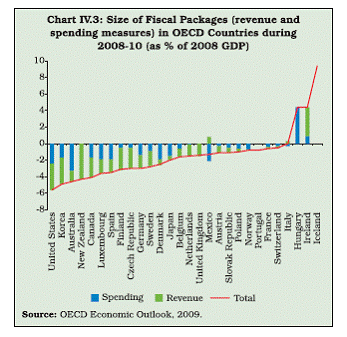 |
4.71 The need for discretionary fiscal policy, inter
alia, arises when the operation of automatic
stabilisers is weak. Therefore, given the negative
output gap during a downturn, it is expected that the
size of the discretionary fiscal stimulus will vary
inversely with the size of automatic stabilisers.
Among OECD countries, those with higher automatic
stabilisers have in general announced lower
discretionary fiscal stimulus measures (Chart IV.4).
Table 4.12: Size of Discretionary Measures in
G-20 Countries, 2008-10 |
Country |
Discretionary |
2008 |
2009 |
2010 |
1 |
2 |
3 |
4 |
Argentina |
0.0 |
1.5 |
0.0 |
Australia |
0.7 |
2.9 |
2.0 |
Brazil |
0.0 |
0.6 |
0.6 |
Canada |
0.0 |
1.9 |
1.7 |
China |
0.4 |
3.1 |
2.7 |
France |
0.0 |
0.7 |
0.8 |
Germany |
0.0 |
1.6 |
2.0 |
India |
0.6 |
0.6 |
0.6 |
Indonesia |
0.0 |
1.4 |
0.6 |
Italy |
0.0 |
0.2 |
0.1 |
Japan |
0.3 |
2.4 |
1.8 |
Korea |
1.1 |
3.6 |
4.7 |
Mexico |
0.0 |
1.5 |
1.0 |
Russia |
0.0 |
4.1 |
1.3 |
Saudi Arabia |
2.4 |
3.3 |
3.5 |
South Africa |
1.7 |
3.0 |
2.1 |
Turkey |
0.0 |
0.8 |
0.3 |
United Kingdom |
0.2 |
1.6 |
0.0 |
United States |
1.1 |
2.0 |
1.8 |
Source: IMF Staff Position Note, Fiscal Affairs Department, Inter-
national Monetary Fund, July 2009. |
4.72 It is also expected that given the size of
automatic stabilisers, the size of the stimulus
package would be explained by differences in the
magnitude of the downturn or negative output gaps.
For a select group of G-20 countries, this was the
case to a certain extent (Chart IV.5).
4.73 The capability of a government to provide
a particular dose of discretionary fiscal stimulus
would also be determined by the fiscal space available. An important indicator of this available
fiscal space is the level of initial debt. In this regard,
earlier crisis experiences have shown that due to
weak fiscal positions some developing countries
were forced to adopt a fiscal contraction policy,
making the cost of the crisis even higher (Perry,
Serven and Suescun, 2007). Among G-20
countries, the size of the discretionary stimulus
appears to have been constrained by the initial level
of public debt, i.e., the higher the level of initial
public debt, the lower the size of the discretionary
fiscal stimulus (Chart IV.6). However, for OECD
countries, no significant relationship between the
size of packages and the level of outstanding debt
was found (BIS, 2009). This implies that in OECD
countries debt sustainability concerns may have not
been given enough consideration in making
decisions to provide fiscal stimulus.
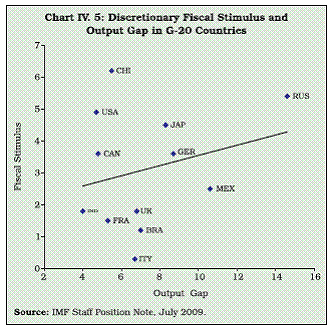 |
4.74 Besides the size of the stimulus measures,
their compositions have also differed across
countries. Among OECD countries, the majority
have given priority to tax cuts over boosting of
expenditure. Tax cuts have been on individuals,
business, consumption and social contributions.
Expenditure measures included spending on final
consumption, investment, transfers to households,
transfers to business and transfers to sub-national governments. Most of the countries have
concentrated their tax cuts on personal income tax
and, to a lesser extent, on business tax. Among
expenditure measures, a larger number of countries
have increased expenditure on investment
(infrastructure) and provision of safety nets through
transfers (Table 4.13).
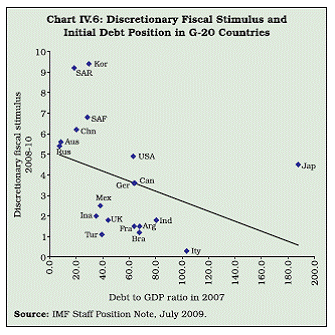 |
4.75 Past experience has shown that tax cuts
during an economic crisis tend to be less effective
as the propensity to save from these cuts increases
due to uncertainties. Thus, the emphasis on tax cuts
in the OECD countries could limit the impact on
GDP. However, the tax cuts have been concentrated more on personal taxes, which support
deleveraging of the household sector. This may
speed up the recovery further down the road,
despite a smaller impact on growth in the short term
(BIS, 2009). Experiences from Latin American
crises have shown that fiscal austerity induced by
crises often led to disproportionate curtailment of
expenditure on infrastructure projects, hampering
long-term growth prospects (Easterly and Serven,
2003). The OECD countries have given less
emphasis to increases in expenditure than to tax
cuts. However, the focus of spending on
infrastructure and the social safety net would
increase the impact on GDP and benefit the poor
who are more vulnerable during a crisis.
Table 4.13: Composition of Fiscal Packages in OECD Countries during 2008-10 (as % of GDP) |
Coun
tries |
Indivi
duals |
Tax Measures |
|
Final
Consump-
tion |
Spending Measures |
Total |
| Business |
Consump-
tion |
Social
contribu-
tions |
Total |
Invest
ment |
Transfers to to
House
holds |
Transfers
to
Business |
Govern-
ment
Transfers
to Sub-
national |
1 |
2 |
3 |
4 |
5 |
6 |
7 |
8 |
9 |
10 |
11 |
12 |
Australia |
-1.1 |
-0.2 |
0.0 |
0.0 |
-1.3 |
0.0 |
2.6 |
0.8 |
0.0 |
0.0 |
3.3 |
Austria |
-0.8 |
-0.1 |
0.0 |
0.0 |
-0.8 |
0.0 |
0.1 |
0.1 |
0.0 |
0.1 |
0.3 |
Belgium |
-0.3 |
-0.6 |
-0.1 |
0.0 |
-1.0 |
0.0 |
0.1 |
0.5 |
0.0 |
0.0 |
0.6 |
Canada |
-0.8 |
-0.3 |
-1.1 |
-0.1 |
-2.4 |
0.1 |
1.3 |
0.3 |
0.1 |
- |
1.7 |
Czech Republic |
0.0 |
-0.4 |
-0.1 |
-2.0 |
-2.5 |
-0.1 |
0.2 |
0.0 |
0.4 |
0.0 |
0.5 |
Denmark |
0.0 |
0.0 |
0.0 |
0.0 |
-0.7 |
0.9 |
0.8 |
0.1 |
0.0 |
0.0 |
1.9 |
Finland |
-1.9 |
0.0 |
-0.3 |
-0.4 |
-2.7 |
0.0 |
0.3 |
0.1 |
0.0 |
0.0 |
0.5 |
France |
-0.1 |
-0.1 |
0.0 |
0.0 |
-0.2 |
0.0 |
0.2 |
0.1 |
0.0 |
0.0 |
0.4 |
Germany |
-0.6 |
-0.3 |
0.0 |
-0.7 |
-1.6 |
0.0 |
0.8 |
0.2 |
0.3 |
0.0 |
1.4 |
Hungary |
-0.1 |
-1.5 |
1.6 |
0.0 |
0.0 |
- |
0.0 |
- |
- |
0.0 |
-4.4 |
Ireland |
2.0 |
-0.2 |
0.5 |
1.2 |
3.5 |
-0.7 |
-0.2 |
-0.1 |
0.0 |
0.0 |
-0.9 |
Italy |
0.0 |
0.0 |
0.1 |
0.0 |
0.3 |
0.3 |
0.0 |
0.2 |
0.1 |
0.0 |
0.3 |
Japan |
-0.1 |
-0.1 |
-0.1 |
-0.2 |
-0.5 |
-0.2 |
0.3 |
0.5 |
0.4 |
0.3 |
1.5 |
Korea |
-1.4 |
-1.2 |
-0.2 |
0.0 |
-3.2 |
0.0 |
0.9 |
0.1 |
0.5 |
0.2 |
1.7 |
Luxembourg |
-1.2 |
-0.5 |
0.0 |
0.0 |
-1.7 |
0.0 |
0.7 |
1.0 |
0.2 |
0.0 |
1.9 |
Mexico |
0.0 |
0.0 |
-0.4 |
0.0 |
0.8 |
0.0 |
1.1 |
0.3 |
0.4 |
0.0 |
2.0 |
Netherlands |
-0.2 |
-0.4 |
0.0 |
-0.8 |
-1.4 |
0.0 |
0.0 |
0.1 |
0.0 |
0.0 |
0.1 |
New Zealand |
-4.3 |
0.0 |
0.0 |
0.0 |
-4.3 |
0.1 |
0.6 |
-0.6 |
0.0 |
0.0 |
0.0 |
Norway |
0.0 |
-0.1 |
0.0 |
0.0 |
-0.1 |
0.0 |
0.3 |
0.0 |
0.0 |
0.3 |
0.7 |
Poland |
0.0 |
-0.1 |
-0.2 |
0.0 |
-0.4 |
0.0 |
1.3 |
0.1 |
0.0 |
0.0 |
0.6 |
Slovak Republic |
-0.6 |
-0.1 |
0.0 |
0.0 |
-0.6 |
0.0 |
0.0 |
0.0 |
0.5 |
0.0 |
0.5 |
Spain |
-1.6 |
0.0 |
0.0 |
0.0 |
-1.6 |
0.3 |
0.7 |
0.2 |
0.7 |
0.0 |
1.9 |
Sweden |
-1.5 |
-0.2 |
0.0 |
-0.2 |
-1.8 |
0.7 |
0.3 |
0.1 |
0.0 |
0.0 |
0.9 |
Switzerland |
-0.2 |
0.0 |
0.0 |
0.0 |
-0.2 |
0.3 |
0.0 |
0.0 |
0.0 |
0.0 |
0.3 |
United Kingdom |
-0.6 |
-0.1 |
-0.7 |
0.0 |
-1.5 |
0.0 |
0.1 |
0.1 |
0.0 |
0.0 |
0.0 |
United States |
-2.4 |
-0.8 |
0.0 |
0.0 |
-3.2 |
0.7 |
0.3 |
0.5 |
0.0 |
0.9 |
2.4 |
Note : Total columns are not the sum columns shown because some components either have not been clearly specified or are not classified in this breakdown.
Source : OECD Economic Outlook, Interim Report, March 2009, Organisation of Economic Cooperation and Economic Development. |
4.76 With regard to G-20 countries, more than
three-quarters of the announced fiscal stimulus
for 2009 represents expenditure measures and
around two-thirds in 2010. The expenditure
measures are also mostly temporary in nature, with
a focus on infrastructure spending, particularly in
the emerging G-20 countries. Infrastructure
spending is largely on the transportation network,
either directly by the central government or through
capital transfers to local governments. Many of
these countries have also announced plans to
protect vulnerable groups. A few others have taken
steps to support small and medium enterprises. A
few countries have also taken measures to
address long-term policy issues of improving the
quality of health and education and introducing
incentives for environment-friendly technologies.
On the other hand, the tax cuts announced on
personal income tax have been permanent in
almost all the G-20 countries. Indirect tax exemptions have been permanent in some and
temporary or self-reversing in others (Table 4.14).
4.77 The temporary nature of the expenditure
measures in the fiscal stimulus package in the G-
20 countries indicates that the impact on growth
could otherwise be larger. Being temporary, the
effect on deficit would also be temporary, thereby
reducing debt sustainability concerns in the medium
to long-term. Consequently, it will have less effect
on increasing long-term interest rates that could
dampen the impact of the stimulus. Further, the
focus of the spending on infrastructure would have
the additional benefit of increasing long-term supply
capacity and growth potential. Specific
announcements to protect the poor would also
lessen the adverse impact of the crisis on the poor
who often faced the brunt of earlier crises. On the
other hand, the permanent nature of the direct tax
cuts has the potential to increase consumption by
raising permanent disposable income. However, it
could lead to debt sustainability concerns as they
would have a permanent effect on deficit and debt. Therefore, tax reduction measures might be less
effective, particularly in a situation of deep
downturns where marginal propensity to consume
out of tax cuts is generally believed to be low.
Table 4.14: G-20 Stimulus Measures, 2008-10 |
Measure |
Argen
tina |
Austr
alia |
Brazil |
Can ada |
Chi na |
Fra nce |
Germ
any |
In dia |
Indo
nesia |
Italy |
Jap an |
Korea |
Mex
ico |
Rus
sia |
Saudi
Arabia |
Sp ain |
UK |
US |
1 |
2 |
3 |
4 |
5 |
6 |
7 |
8 |
9 |
10 |
11 |
12 |
13 |
14 |
15 |
16 |
17 |
18 |
19 |
Expenditure |
|
|
|
|
|
|
|
|
|
|
|
|
|
|
|
|
|
|
Infrastructure
investment |
T |
T |
|
T |
T |
T |
T |
T |
T |
|
T |
T |
T |
|
T |
T |
S |
T |
Support to SMEs
and/or farmers |
|
|
|
|
|
|
T |
|
|
|
T |
T |
|
|
|
|
|
|
Safety nets |
T |
T |
T |
T |
T |
T |
T |
|
T |
T |
T |
T |
T |
T |
|
T |
T |
T |
Housing/construction
support |
|
T |
T |
T |
T |
T |
T |
|
|
|
T |
|
|
T |
|
T |
T |
|
Strategic industries
support |
|
|
|
T |
T |
|
T |
T |
|
|
|
|
|
T |
|
T |
|
|
Increase in public
wage bill |
|
|
|
|
|
|
|
|
|
|
|
|
|
|
|
|
|
|
Other |
|
T |
|
T |
T |
T |
T |
|
|
|
T |
T |
T |
|
|
T |
T |
T |
Revenue |
|
|
|
|
|
|
|
|
|
|
|
|
|
|
|
|
|
|
CIT/depreciation/
incentives |
|
P |
P |
P |
|
P |
P |
|
P |
|
P |
P |
P |
P |
|
|
|
P |
PIT/exemptions/
deductions |
|
|
P |
P |
|
T |
P |
|
P |
|
P |
|
|
|
|
P |
P |
P |
Indirect tax reduction/
exemptions |
|
|
T |
|
P |
|
P |
T |
P |
|
|
|
|
|
|
S |
S |
|
Other |
|
|
|
|
|
|
|
|
|
|
P |
|
|
|
|
|
P |
|
T : Temporary measures (with explicit sunset provisions or time-bound spending)
S : Self-reversing measures (measures whose costs are recouped by compensatory measures in future years)
P : Permanent measures (with recurrent fiscal costs)
Source: International Monetary Fund (2009), “The State of Public Finances: Outlook and Medium-Term Policies After the 2008 Crisis”, March. |
4.78 Fiscal stimulus packages have also been
unveiled in a number of countries in the African
continent. In most of these packages, infrastructure
development has been emphasised. Some
countries have, however, responded only through
hikes in public sector pay, while in others a broadbased
approach involving a public investment
programme, expansion of public sector
employment opportunities, increase in social
spending and assistance to the private sector have
been adopted. On the other hand, due to declines
in the revenue of the government, some countries
have exercised fiscal restraint by cutting
expenditure on subsidies (UNESCECA, 2009)
Impact of Fiscal Stimulus on Growth
4.79 Assessing the impact of the discretionary
fiscal stimulus on economic activity is highly
complex and involves a lot of uncertainty. This is
reflected in the wide range of outcomes depending
upon the econometric models and specifications
to estimate the fiscal multipliers. A notable problem
is the difficulty of distinguishing passive changes
in taxes, transfers, and spending from those that
represent a true discretionary adjustment in fiscal
policy. Multipliers also depend on country
circumstances, including the type of instruments
used, trade openness, constraints on borrowing,
the response of monetary policy and long-term
sustainability (Box IV.8).
Box IV.8
Determinates of Fiscal Multiplier
The impact of fiscal stimulus measures on growth depends
on the fiscal multipliers. The fiscal multiplier is the ratio of
a change in output (ΔY) to an exogenous change in the
fiscal deficit with respect to their respective baselines
(Spilimbergo et al., 2009). Fiscal multipliers, in turn, depend
on the instrument used, the degree of monetary policy
accommodation and the type of economy. The multiplier
would be small for smaller and open economies, more
susceptible to financial markets constraints and subject to
offsetting monetary policy. On the other hand, it would be
large if the composition of the package takes into account
the specific features of the crisis. With loss of confidence,
fiscal multipliers, particularly for tax cuts, are likely to fall
due to an increase in the propensity to save. Thus,
government spending measures are likely to provide the
maximum short-run impact on aggregate demand rather
than tax cuts or lump-sum transfers. If tax cuts are to be
implemented, these should be targeted at those facing
liquidity constraints. It is found that targeted transfers to
poorer households have a multiplier which is two times
that of lump-sum transfers. Further, due to the higher share
of poorer households, multipliers are larger in emerging
Asia and other emerging economies (Freedman et al.,
2009). The criteria for selecting individual measures should
be those which raise aggregate demand in the short run
and raise the aggregate supply in the long run, such as
spending on infrastructure and active labour market policy and reduction of income tax particularly on low-income
earners (OECD, 2009). In the case of the US, Elmendorf
and Furman (2008) distinguish various options by
categorising them between more effective, less effective
and ineffective or counterproductive. More effective options
include temporary increase in unemployment benefits, food
stamps and issuing flat and refundable tax credits. The
effective options are increase in infrastructure investment
and temporary investment tax incentives. On the other
hand, options such as tax rate cuts that are permanent
could be counterproductive.
References
1. Spilimbergo, Antonio, Steve Symansky, and Martin
Schindler. 2009. “Fiscal Multipliers”. IMF Staff Position
Note, SPN/09/11. May 20.
2. Elmendorf, Douglas W. and Jason Furman. 2008. “If,
When, How: A Primer on Fiscal Stimulus”. The Hamilton
Project Strategy Paper. January.
3. Freedman, C., M. Kumhof, D. Laxton and J. Lee. 2009.
“The Case for Global Fiscal Stimulus”. IMF Staff
Position Note. March 6.
4. Organisation of Economic Cooperation and
Development. 2009. “The Effectiveness and Scope of
Fiscal Stimulus”. OECD Economic Outlook.
4.80 Besides the problems faced in estimating the
multiplier, the information on actual implementation
of the announced stimulus measures are not readily
available, barring a few countries such as Canada,
France and the United States. The rate of utilisation
in these three countries as on June 2009 ranged
from 41 per cent of the announced package in the
US to 81 per cent in Canada (Horton et al., 2009).
It is also important to note that fiscal multipliers
estimated during normal business cycles could be
highly misleading when applied during the period
of deep and prolonged crisis characterised by loss
of confidence. Given the above uncertainties, fiscal
multipliers are estimated in a range. For OECD
countries, it is found that spending measures have
a higher multiplier than revenue measures. Among
spending measures, infrastructure investment had
the highest multiplier followed by direct government
purchase of goods and government transfers.
Among revenue measures, a cut in personal
income tax has a higher multiplier than a cut in
indirect tax. For each component of stimulus
measures, the multiplier is higher in the second year
than the first year. The multiplier also diverges
among countries, with more open economies in
terms of trade-to-GDP ratio having lower multipliers
in general (Table 4.15).
Table 4.15: Multipliers in OECD Countries |
|
Consumption |
Investment |
Transfers |
Income Tax Cut |
Indirect Tax Cut |
Year 1 |
Year 2 |
Year 1 |
Year 2 |
Year 1 |
Year 2 |
Year 1 |
Year 2 |
Year 1 |
Year 2 |
1 |
2 |
3 |
4 |
5 |
6 |
7 |
8 |
9 |
10 |
11 |
USA |
0.7 |
0.8-1.1 |
0.9 |
1.1-1.3 |
0.5 |
0.8-0.9 |
0.3-0.5 |
0.5-0.9 |
0.2-0.3 |
0.3-0.5 |
Japan |
0.7 |
0.8-1.1 |
0.9 |
1.1-1.3 |
0.5 |
0.8-0.9 |
0.3-0.5 |
0.5-0.9 |
0.2-0.3 |
0.3-0.5 |
Germany |
0.4 |
0.5-0.8 |
0.8 |
1.1-1.2 |
0.3 |
0.5-0.7 |
0.2-0.3 |
0.3-0.7 |
0.1-0.2 |
0.2-0.4 |
France |
0.6 |
0.7-1.0 |
0.8 |
1.0-1.2 |
0.4 |
0.7-0.8 |
0.2-0.4 |
0.4-0.8 |
0.2 |
0.2-0.4 |
Italy |
0.6 |
0.7-1.0 |
0.8 |
1.0-1.2 |
0.4 |
0.7-0.8 |
0.2-0.4 |
0.4-0.8 |
0.2 |
0.2-0.4 |
UK |
0.5 |
0.6-0.9 |
0.8 |
1.0-1.2 |
0.4 |
0.6-0.8 |
0.2-0.4 |
0.4-0.8 |
0.2 |
0.2-0.4 |
Canada |
0.5 |
0.6-0.9 |
0.8 |
1.0-1.2 |
0.4 |
0.6-0.7 |
0.2-0.4 |
0.4-0.7 |
0.1-0.2 |
0.2-0.4 |
Australia |
0.3 |
0.4-0.7 |
0.7 |
0.9-1.1 |
0.2 |
0.4-0.6 |
0.1-0.2 |
0.3-0.6 |
0.1 |
0.2-0.3 |
Austria |
0.3 |
0.4-0.7 |
0.7 |
0.9-1.1 |
0.2 |
0.4-0.6 |
0.1-0.2 |
0.3-0.6 |
0.1 |
0.2-0.3 |
Belgium |
0.3 |
0.4-0.7 |
0.7 |
0.9-1.1 |
0.2 |
0.4-0.6 |
0.1-0.2 |
0.2-0.6 |
0.1 |
0.1-0.3 |
Czech Republic |
0.3 |
0.4-0.7 |
0.7 |
0.9-1.1 |
0.2 |
0.4-0.6 |
0.1-0.2 |
0.2-0.6 |
0.1 |
0.1-0.3 |
Denmark |
0.3 |
0.4-0.7 |
0.7 |
0.9-1.1 |
0.2 |
0.4-0.6 |
0.1-0.2 |
0.3-0.6 |
0.1 |
0.2-0.3 |
Finland |
0.4 |
0.5-0.8 |
0.8 |
1.0-1.2 |
0.3 |
0.5-0.7 |
0.2-0.3 |
0.3-0.7 |
0.1-0.2 |
0.2-0.4 |
Greece |
0.5 |
0.6-0.9 |
0.8 |
1.0-1.2 |
0.4 |
0.6-0.7 |
0.2-0.4 |
0.4-0.7 |
0.1-0.2 |
0.2-0.4 |
Hungary |
0.3 |
0.4-0.7 |
0.7 |
0.9-1.1 |
0.2 |
0.4-0.6 |
0.1-0.2 |
0.2-0.6 |
0.1 |
0.1-0.3 |
Israel |
0.4 |
0.5-0.8 |
0.7 |
0.9-1.1 |
0.3 |
0.5-0.6 |
0.2-0.3 |
0.3-0.6 |
0.1-0.2 |
0.2-0.3 |
Ireland |
0.3 |
0.4-0.7 |
0.7 |
0.9-1.1 |
0.2 |
0.4-0.6 |
0.1-0.2 |
0.2-0.6 |
0.1 |
0.1-0.3 |
Korea |
0.3 |
0.4-0.7 |
0.7 |
0.9-1.1 |
0.2 |
0.4-0.6 |
0.1-0.2 |
0.2-0.6 |
0.1 |
0.1-0.3 |
Luxembourg |
0.3 |
0.4-0.7 |
0.7 |
0.9-1.1 |
0.2 |
0.4-0.6 |
0.1-0.2 |
0.2-0.6 |
0.1 |
0.1-0.3 |
Mexico |
0.5 |
0.6-0.9 |
0.8 |
1.1-1.2 |
0.4 |
0.6-0.8 |
0.2-0.4 |
0.4-0.8 |
0.2 |
0.2-0.4 |
Netherlands |
0.3 |
0.4-0.7 |
0.7 |
0.9-1.1 |
0.2 |
0.4-0.6 |
0.1-0.2 |
0.2-0.6 |
0.1 |
0.1-0.3 |
New Zealand |
0.5 |
0.6-0.9 |
0.8 |
1.0-1.2 |
0.4 |
0.6-0.7 |
0.2-0.4 |
0.4-0.8 |
0.2 |
0.2-0.4 |
Norway |
0.5 |
0.6-0.9 |
0.8 |
1.0-1.2 |
0.4 |
0.6-0.8 |
0.2-0.4 |
0.4-0.8 |
0.2 |
0.2-0.4 |
Poland |
0.4 |
0.5-0.8 |
0.8 |
1.0-1.2 |
0.3 |
0.5-0.7 |
0.2-0.3 |
0.3-0.7 |
0.1-0.2 |
0.2-0.4 |
Taiwan |
0.4 |
0.5-0.8 |
0.8 |
1.0-1.2 |
0.3 |
0.5-0.7 |
0.2-0.3 |
0.3-0.7 |
0.1-0.2 |
0.2-0.4 |
Spain |
0.5 |
0.6-0.9 |
0.8 |
1.0-1.2 |
0.4 |
0.6-0.7 |
0.2-0.4 |
0.4-0.7 |
0.1-0.2 |
0.2-0.4 |
Sweden |
0.4 |
0.5-0.8 |
0.7 |
0.9-1.1 |
0.3 |
0.5-0.6 |
0.2-0.3 |
0.3-0.6 |
0.1-0.2 |
0.2-0.4 |
Turkey |
0.6 |
0.7-1.0 |
0.8 |
1.0-1.2 |
0.4 |
0.7-0.8 |
0.2-0.4 |
0.4-0.8 |
0.2 |
0.2-0.4 |
Source: OECD Economic Outlook, Interim Report, OECD, March 2009. |
4.81 Given the multipliers above, the growth
impact of the announced stimulus package in OECD countries is estimated to be rather small
(less than 1.0 per cent of GDP) compared to the
magnitude of the impending output gap. It ranged
from 0.1 per cent of GDP in Slovakia to 1.6 per cent
of GDP in Australia. In six countries, viz., Australia,
Canada, New Zealand, Poland, Spain and the United
States, the impact could be more than one per cent.
The average support to GDP from the fiscal stimulus
in OECD during 2009 and 2010 will be of the order
of 0.5 per cent only (OECD, 2009).
4.82 For G-20 countries also, the IMF estimates
a range of fiscal multipliers for different components
of fiscal stimulus measures. The range is from 0.3 to
0.6 for tax cuts; 0.5 to 1.8 per cent for investment in
infrastructure; and 0.3 to 1.0 for other measures.
These estimates take note of the simultaneous
measures taken across the countries, which thereby
reduces the leakage through imports. Given these
multipliers, if the announced fiscal stimulus measures
for 2009 and 2010 are fully implemented, the average
impact on growth for G-20 countries as a whole would
range from 0.7 to 2.8 per cent of GDP (Table 4.16).
Fiscal Risks
4.83 While the impact of fiscal stimulus on growth
may be uncertain, the level of deficit and debt would
increase substantially. On the assumption of a
stronger resumption in economic growth, the overall
fiscal deficit for the advanced G-20 countries in
2014 has been projected to be higher by 2.5
percentage points over the level of 2007. For
emerging G-20 countries, the same will be higher
by 1.5 percentage points. During the same period,
the debt ratios are expected to rise by 40 percentage points in the advanced G-20 countries.
For emerging G-20 countries, it is expected to
decline slightly after some initial increase (Horton
et al., 2009). Should the downside risks materialise,
the situation, however, would become even worse.
It is even maintained that given the prolonged
downturn, fiscal stimulus should go beyond the
measures already announced provided that there
is enough fiscal space (Freedman et al., 2009). This
has raised fiscal sustainability concerns and other
related implications in the medium to long-term. The
problem would be more serious in countries that
are already facing the looming challenges of
population ageing. The prospective cost in terms
of pensions and health care together could be more
than ten times the costs of the crisis. Therefore, a
credible exit strategy, with necessary institutional
arrangements, would be required.
Table 4.16: G-20 Countries- Impact of Fiscal
Expansion on Growth |
(in per cent of GDP and change in percentage points) |
|
2009 |
2010 |
Average |
1 |
2 |
3 |
4 |
Low-high range impact
G-20 total |
1.2 to 4.7 |
0.1 to 1.0 |
0.7 to 2.8 |
Advanced G-20 countries |
1.3 to 4.4 |
0.1 to 1.1 |
0.7 to 2.7 |
Emerging market G-20 countries |
1.1 to 5.0 |
0.0 to 0.8 |
0.6 to 2.9 |
Source: IMF Staff Position Note, July 2009. |
4.84 While the need for the exit of fiscal stimulus
packages is well recognised, it is difficult to identify
the right time to exit. This poses a policy dilemma.
Too early a withdrawal of the fiscal stimulus could
thwart any recovery. On the other hand, a delayed
withdrawal, by raising debt sustainability concerns,
could raise interest rates and reduce the
effectiveness of the stimulus itself. Even if the
stimulus measures are reversed quickly, the impact
of the financial rescue packages on public debt
would remain for a number of years. High public
debt, by pushing up the real interest rates, could
crowd out private investment (BIS, 2009). Further,
in contrast to the call for providing co-ordinated
stimulus measures, the timing of the exit may have
to differ across countries. There are significant
divergences across countries in terms of inflation,
growth and unemployment. In some countries there
are fears of deflation and output is still contracting;
in such countries, the exit may have to be cautious
and delayed. Similarly, the exit may have to be
delayed in countries with very high unemployment
rates. On the other hand, in countries with relatively
high inflation and growth, the exit may have to be
much earlier. Yet there are countries where growth
is picking up but the inflationary situation remains
highly comfortable.
4.85 Irrespective of the timing of the exit, the
quantum of adjustment is going to be very large,
particularly for high-debt advanced economies. This
would be so even under a strong recovery in
economic growth. For these countries, to stabilise
the debt ratio to 60 per cent over the period of 15
years beginning in 2014 would require improvement
in the primary balance by 5.4 percentage points
over the forecasted primary balance for 2014 by
the IMF. Though the adjustment required for the
EMEs are projected to be limited, some of the highdebt
emerging economies could face refinancing
challenges (Table 4.17).
Table 4.17: Debt Dynamics and Debt Stabilising Primary Balances |
(in per cent) |
|
Debt |
Primary
Balance |
Debt
stabilising
Primary Balance1 |
2009 |
2014 |
2009 |
2014 |
Advanced Economies |
High Debt |
101.8 |
121.7 |
-8.5 |
-0.9 |
4.5 |
Low Debt |
30.0 |
37.8 |
-2.8 |
1.1 |
0.4 |
Emerging Economies |
High debt |
64.7 |
60.0 |
-1.3 |
1.0 |
1.8 |
Low Debt |
18.7 |
18.6 |
-3.3 |
0.9 |
0.2 |
1. Average primary balance needed to stabilise debt at end-2014 level if the respective debt-to-GDP ratio is less than 60 per cent for advanced economies or 40 per cent for emerging economies (low-debt economies); or to bring the debt-to-GDP ratio to 60 percent in 2029 (high-debt countries), assuming an interest rate-growth rate differential of 1 per cent beyond 2014.
Source: Horton et al (2009), “The State of Public Finances: A Cross-country Fiscal Monitor”, IMF Staff Position Note, July. |
4.86 In brief, the severity and unprecedented
nature of the present crisis has led to the
resurrection of Keynesian fiscal policy. Countries
across the globe have activated counter-cyclical
fiscal policy simultaneously to overcome the
economic slowdown. However, the size,
composition and duration of the stimulus measures
have varied among the countries. The size of the
stimulus measures have partly depended on the
size of the automatic stabilisers, the magnitude of
the economic slowdown and the fiscal space for
providing the stimulus. Some countries have relied
more on expenditure measures than taxation measures. The emphasis on infrastructure or
consumption expenditure and the temporary or
permanent nature of the stimulus measures have
also varied. While the impact of the stimulus
measures on growth is expected to be positive, it,
however, cannot be gauged with any degree of
certainty. On the other hand, the deficit and debt of
many countries, particularly the advanced
economies, would substantially go up and remain
at an elevated level for a long time. Thus, debt
sustainability concerns in the medium to long term
have emerged as an important issue. Consequently,
there is the need for exit at an early date. But it is
difficult to identify the right time. In any case, the
quantum of fiscal adjustment would be very large,
particularly in advanced countries. The large-scale
fiscal expansion combined with an accommodative
monetary policy has also heightened the need for
active fiscal and monetary policy co-ordination.
V. FISCAL AND MONETARY POLICY CO-ORDINATION
4.87 Even though fiscal and monetary policies
are pursued by two different authorities, they are
not necessarily independent of each other. An
individual policy instrument has its impact on more
than one policy target. Thus, the effectiveness of
one policy is influenced by changes in the other
policy. In this interdependence, a conflict between
the two can arise, particularly when they pursue
different objectives. Thus, the need for policy coordination
arises, without which it may not be
possible to achieve the objectives of each of the
policies. The nature of the co-ordination, however,
would depend upon the stage of development of
the financial markets. Where there is no market for
government debt and fiscal deficits are financed
by the central banks, co-ordination would be in the
form of constraining excessive expansion of
domestic credit to avoid excessive inflation rates.
With some development in financial markets and
an increase in the signalling role of interest rates,
co-ordination would be required to avoid high
interest rates which could harm growth. In welldeveloped
financial market economies, where the
central banks have established credibility in keeping inflation under control, the lack of policy
co-ordination gives rise to the risk of high fiscal
deficit adversely impacting the targets on interest
rates, inflation and growth (Hasan and Isgut, 2009).
4.88 To elaborate further, the effect of fiscal
policy on monetary policy is largely determined by
the financing pattern of government expenditure. If
the monetary authority is not independent and the
government follows an expansionary fiscal policy,
there could be a strong temptation to monetise the
fiscal deficit, leading to involuntary expansion in
money supply. This can have the unintended effect
of fuelling inflation, real appreciation of the
exchange rate and, hence, balance of payment
difficulties. When the deficit is financed through
market borrowings, this could lead to a rise in
interest rates, raise the borrowing cost for the
private sector and crowd out private investment.
Financing government expenditure by raising
indirect taxes also has a direct impact on prices,
which can go against the monetary policy objective
of price stability. Perceptions and expectations of
large and on-going deficits may trigger a lack of
confidence in economic prospects and become a
destabilising factor in the financial markets. Thus,
under normal conditions, financial market
participants would expect the monetary policy to
react to fiscal expansion by raising short-term
interest rates, leading to higher expected long-term
interest rates. The result would be a crowding out
of household spending, private sector investment
and net exports to accommodate the increase in
public spending, without any significant net gain in
aggregate demand in the economy. Thus,
expansionary fiscal policy is not considered to be
an effective tool for economic stabilisation during
normal business downturns. Further, the
effectiveness of monetary policy depends on the
financial behaviour of economic agents, which can
get altered by the agents’ perception of fiscal
sustainability. When economic agents expect that
higher deficit today will lead to higher taxation in
the future (behave in a ‘Ricardian Equivalence’
manner), they may change their financial behaviour
by saving more now.
4.89 Expansionary fiscal policy can also
jeopardise the sustainability of the monetary policy
regime in an open economy during normal times.
Monetary policy would react to the inflationary
pressure and worsening of capital account caused
by expansionary fiscal policy by raising interest
rates. Rising interest rates, however, would attract
capital inflows, put pressure on the exchange rate
and further worsen the current account. Absorption
of capital inflows into reserves to reduce the pressure
on the exchange rate would lead to an expansion in
the monetary base and inflationary pressure. Though
inflationary pressure can be avoided through
sterilisation, there could be a limit to the cost of
sterilisation that a central bank can bear.
4.90 The current economic slowdown, however,
is characterised by a sharp fall in private sector
demand, limited scope for further reduction in policy
rates and dysfunctional credit markets due to loss
of confidence. The downturn is also large and
prolonged, which is associated with a deflationary
environment. In such a situation, the conflict
between the two policy objectives is likely to be
smaller, at least in the short term. Thus, market
participants are unlikely to expect monetary policy
to be reactive to fiscal policy. In fact, monetary policy
can be accommodative to the fiscal policy to make
the latter a more potent policy tool to provide a
sustained boost to economic activity. The fact that
expansionary monetary policy may have become
less effective also calls for support through
expansionary fiscal policy. Accommodative
monetary policy, by keeping the interest rate fixed
at an already low level, would lead to a decline in
real short-term interest rates if inflation
expectations rise due to a fiscal stimulus. Thus,
accommodative monetary policy can significantly
increase the effectiveness of fiscal actions to boost
economic activity in the short to medium term. In
other words, the two policy instruments can
reinforce each other in containing the downturn
without concerns about inflationary pressure, at
least in the short-term. Empirical estimates have
found that the impact of fiscal stimulus measures
is much larger (more than twice) with monetary
policy accommodation than without.
4.91 On the other hand, in countries where the
central banks have resorted to unconventional
monetary policy measures of quantitative/credit
easing, the fiscal implications of monetary policy
have increased substantially. This development has
underscored the need for greater co-ordination
between the two policies. The purchase of longterm
government securities and a wide array of nontraditional
assets, such as agency debt and
mortgaged-backed securities, by the central banks
had been aimed at holding down the intermediate
and long-term interest rates to boost the real
economy. This led to massive expansion of central
banks’ balance sheets. In other words, central
banks have assumed many responsibilities
involving using of public money to affect allocation
of resources, which the fiscal authority should take.
This has not only led to confusion about the
respective roles of the central bank and the fiscal
authority, but also exposed the balance sheet of
central banks to credit risk. Thus, the ability of the
monetary authority to pursue price stability, financial
stability and economic growth can potentially get
undermined. In this regard, it has been suggested
that the non-treasury assets and other loans in the
balance sheet of the central banks be transferred
to the government’s balance sheet by way of issuing
government securities to the central bank through
a co-ordinated approach (Plosser, 2009). However,
it is maintained that the change in the overall profile
of public sector debt following from large purchases
of government securities by the central banks also
heightens the need for closer co-operation between
the two authorities Further, when central banks take
greater credit and market risk by accepting more
private sector securities as collateral, closer cooperation
between the monetary and fiscal authority
is necessary to ensure that potential losses do not
impair the operational independence of central
banks (BIS, 2009).
4.92 In addition, large government support to
financial institutions and stimulus packages
announced have led to the ballooning of fiscal
deficit and debt across countries. This has severely
reduced the fiscal space, while entailing a large 4.92 In addition, large government support to
financial institutions and stimulus packages
announced have led to the ballooning of fiscal
deficit and debt across countries. This has severely
reduced the fiscal space, while entailing a large borrowing programme for the government. Large
government borrowing that leads to a rise in interest
rates can severely constrain the use of monetary
policy instruments. This would be particularly so
with the revival of growth and in countries where
the domestic financial markets are not well
developed. Central banks trying to ease the cost of
credit to support growth also run the risk of
inflationary pressure. This traditional tension
between the two policies appears to have already
resurfaced in many countries because of the large
fiscal deficit following the stimulus measures and
support to the financial sector. Though the fiscal
stimulus was necessary in the circumstances, to
avoid any conflict with monetary policy objectives,
there is a need to return to the path of credible fiscal
consolidation. But, due to demographic factors and
the sustained spurt in pension liabilities in many
advanced countries, fiscal deficits and government
borrowings are likely to remain at elevated levels.
Thus, the need for conduct of monetary policy in
co-ordination with fiscal policy is likely to continue
even after the crisis gets over (Subbarao, 2009).
4.93 From the perspective of financial stability
also, the co-ordination between the two policies is
essential. Expansionary fiscal policy accompanied
by monetary policy accommodation has the
potential to raise inflation expectations and the
interest rates on government securities. When that
happens, financial institutions, particularly the
banks, can incur substantial losses due to the markto-
market requirement, which can threaten financial
stability. Though both policies are required to revive
the growth slowdown, they will have to be tightened
at some point of time. However, if the exit of the
expansionary measures is not carried out in a coordinated
manner, there is the risk of perpetuating
financial instability.
4.94 For the EMEs, prolonged and sizable
liquidity easing could be counterproductive as they
are prone to large and potentially destabilising
capital inflows. As the tradeoffs between prices,
fiscal and financial stability objectives are sharper
in EMEs, the case for credit easing by central banks
is also weaker. Fiscal policy can handle the objectives of credit policy better. Quantitative easing
is also less appropriate for EMEs than advanced
countries. First, while the financial crisis is less
severe and inflation is higher, policy rates are far
from being zero. Secondly, the vulnerability of EMEs
to volatile capital flows would require keeping the
policy rate higher to compensate currency holders
for exchange risk. Otherwise, quantitative easing
could lead to capital outflows in these countries (Ishi
et al., 2009).
4.95 Summing up, the present crisis has
highlighted the need for a co-ordinated response
by monetary and fiscal policy. The large-scale
economic downturn and impairment of the
monetary transmission mechanism have warranted
the monetary policy to be accommodative to fiscal
policy. The massive expansion of central bank
balance sheets through some of the quasi-fiscal
functions of credit/quantitative easing undertaken
by them has also increased the need for closer cooperation
between the two authorities. Furthermore,
as a large fiscal deficit can potentially conflict with
the objectives of monetary policy and financial
stability in the near future, the need for co-ordination
would continue to remain. Besides the co-ordination
between the two policies in a country, the present
crisis has demonstrated the need for international
co-ordination. And for many of the developing
countries and EMEs, national policy supports have
not been enough, warranting support from
multilateral institutions.
VI. RESPONSE OF MULTILATERAL INSTITUTIONS
4.96 Multilateral institutions played a very active
role during this crisis. Even though a broad
consensus was reached on the need for
expansionary counter-cyclical macroeconomic
policies, a number of developing and emerging
market economies (DEEs) faced resource constraints.
Pursuing expansionary macroeconomic policies in
the resource-constrained developing and emerging
market economies depended crucially on the
provision of adequate external financing (Akyuz,
2009). The reform of international financial institutions
(IFIs) covering their mandates, scope and governance to reflect changes in the world
economy and the new challenges of globalization
is also in progress.
G-20 and the IMF
4.97 Recognising the severe resource
constraints faced by low income countries, a
number of initiatives have been taken by the G-20
and Bretton Woods institutions. These initiatives
are: i) increased funding for multilateral financial
institutions; ii) widening the access for developing
and emerging economies to multilateral funding;
and iii) improvements in the terms and conditions
of multilateral lending.
4.98 In the London Summit of the G-20 in April
2009, an additional international support of US$ 1.1
trillion was secured to increase the funding from
multilateral financial institutions to strengthen the
global financial safety net. This included: i) trebling
the resources available to the IMF to US$ 750 billion;
ii) mobilisation of an additional US$ 100 billion for
multilateral development banks (MDBs); and iii) US$
250 billion of trade financing from various public and
private institutions, including credit agencies.
4.99 With regard to widening the access of
DEEs to multilateral lending, the initiatives taken
included: (i) doubling the normal access limits in
the enhanced fund of the IMF; (ii) doubling the
borrowing limits for the low income countries eligible
for Poverty Reduction and Growth Facility (PRGF)
and Exogenous Shock Facility (ESF); (iii) a new
Flexible Credit Line (FCL) was established for crisis
prevention in the EMEs facing contagion from the
global crisis. The FCL has no cap, but would be
available to countries with strong fundamentals,
policies and track records of policy implementation
on which the IMF would make the assessment; and
(iv) under the umbrella of new Poverty Reduction
and Growth Trust, a new architecture of
concessional financing facilities has been
introduced. These are: Extended Credit Facility for
flexible medium-term support; Standby Credit
Facility to address short-term and precautionary
needs; and Rapid Credit Facility for emergency
support with limited conditionality.
4.100 The IMF has also taken steps to modernise
the conditionality to borrowers under its lending
framework to make it more flexible with fewer
conditions and to suit the specific conditions of a
given country. First, access to the FCL facility will
be based on ex ante conditionality rather than ex
post as in the past. Second, in all fund
arrangements including those with low-income
countries, the conditionality on structural
performance criteria will be discontinued. Third,
under the IMF’s concessional lending, low-income countries (LICs) will receive exceptional relief on
all interest payments through 2011.
4.101 While reaffirming the central role of the IMF
as a critical forum for multilateral consultation and
cooperation on monetary and financial issues as
well as in promoting international financial and
monetary stability, the G-20 members recognise
that the global financial crisis has highlighted the
urgency of accelerating changes to the IMF so that
it can more effectively fulfil its mandate (Box IV.9).
Box IV.9
G-20 Working Group 3: Reform of the IMF
Recognising the need to reform the International Financial
Institutions (IFIs), the Working Group 3 was entrusted with
advancing the actions covered in the November 2008
Leaders’ Declaration in the context of the reform of the
IMF. It noted that G-20 members reaffirm the central role
of the IMF as a critical forum for multilateral consultation
and co-operation on monetary and financial issues as well
as in promoting international financial and monetary
stability. It emphasised that the global financial crisis has
highlighted the urgency of accelerating changes to the IMF
so that it can more effectively fulfil its mandate. Such
changes should address any underlying deficits in
resources, lending instruments, and governance structures,
with a view to enhancing legitimacy, ownership and
efficiency, and clarifying the roles and responsibilities of
the Fund. The Action Plan put forth as immediate and
medium-term measures in reforming the Fund is as follows:
Immediate Measures
1) IMF to take a leading role in drawing lessons from the crisis
The IMF, given its universal membership and core macrofinancial
expertise, should, in close co-ordination with the
FSF and others, take a leading role in drawing lessons
from the current crisis, consistent with its mandate.
2) Review of the adequacy of IMF resources
Emphasising the need for reviewing the adequacy of
the resources of the IMF, the World Bank Group and
other multilateral development banks, the Group
recommended that we should stand ready to increase
their resources where necessary.
3) Review of IMF lending instruments and lending role
IFIs should also continue to review and adapt their
lending instruments to adequately meet their members’needs and revise their lending role in light of the
ongoing financial crisis. These include a substantial
increase in members’ access limits to Fund financing
as a proportion of their quotas as well as to review and
streamline conditionality, so that it is focused on areas
directly related to a program’s objectives while
safeguarding IMF resources. This review should also
examine the need for an increase in the Fund’s ability to
provide concessional financing to low-income countries
including a widening of donor support for its concessional
lending instruments. It also supports the IMF working
with the World Bank in restoring emerging and
developing countries’ access to credit and private capital
flows, and supporting the provision of finance for countercyclical
fiscal responses.
4) IMF/FSF collaboration
The IMF, with its focus on surveillance, and the expanded
FSF, with its focus on standard setting, should
strengthen their collaboration, enhancing efforts to better
integrate regulatory and supervisory responses into the
macro-prudential policy framework and conduct earlywarning
exercises.
Medium-term Measures
1) Strengthening Fund surveillance
The IMF should conduct vigorous and even-handed
surveillance reviews of all countries, as well as giving
greater attention to their financial sectors and better
integrating the reviews with the joint IMF/World Bank
financial sector assessment programs. On this basis,
the role of the IMF in providing macro-financial policy
advice would be strengthened.
2) Greater voice and representation in the IMF for emerging
markets and developing economies
It is underscored that the Bretton Woods institutions must
be comprehensively reformed so that they can more
adequately reflect changing economic weights in the world
economy and be more responsive to future challenges.
Emerging and developing economies should have greater
voice and representation in these institutions.
3) IMF involvement in capacity building
Advanced economies, the IFIs, and other international
organisations should provide capacity-building programs
for EMEs and developing countries on the formulation
and implementation of new major regulations, consistent
with international standards.
Additional Recommendations
1) With regard to reviewing the mandate and governance
of the IMF, the Group requested the G-20 Finance
Ministers to formulate additional recommendations,
including in the area of reviewing the mandates,
governance, and resource requirements of the IFIs. The
Group, however, points out that G-20 members
recognised the importance of the IMF ceasing to rely
primarily on the income of its lending activities to cover
its administrative expenses. In this regard, the Group
called for a swift activation of the IMF’s new income
model, including the speeding up of the process required
for the agreed sale of a limited amount of the IMF’s gold,
and taking the legislative steps required to expand the
IMF’s investment authority.
The World Bank
4.102 Reflecting the various policy initiatives, the
World Bank Group stepped up its financial
assistance to developing countries with a
commitment of US$ 60 billion in fiscal year 2009,
showing an increase of 54 per cent over the
previous year. International Development
Association (IDA) commitment increased by 25 per
cent to touch US$ 14 billion in the same year and
would deliver US$ 28 billion over the next two years.
Under the IDA Financial Crisis Response Fast-
Track Facility, procedures have been streamlined
and project restructuring and disbursement have
been facilitated. IDA will also be adjusting the
implementation of its Non-Concessional Borrowing
Policy (NCBP). In addition to funds mobilised for
crisis initiatives, the International Finance
Corporation (IFC) provided US$ 12.9 billion for
private sector development in 2009 and launched a
number of new crisis-response facilities in both
investment and advisory services. The Multilateral
Investment Guarantee Agency (MIGA) issued
guarantees of US$ 1.4 billion in 2009 and has
stepped up its support to important financial
institutions.
4.103 To mitigate the impact of the crisis on
developing countries, especially LICs, the World
Bank Group started with crisis-response initiatives
focusing on three themes: (i) protecting the most
vulnerable from the fallout of the crisis; (ii) maintaining
long-term infrastructure investment programmes;
and (iii) sustaining the potential for private sectorled
economic growth and employment creation,
particularly through SMEs and microfinance. These
themes are being addressed through three
operational platforms, viz., Vulnerability Financing
Facility, the Infrastructure Recovery and Assets
(INFRA) platform and the IFC-led private sector
platform mentioned above. The Vulnerability
Financing Facility is aimed at streamlining crisis
support to the poor and vulnerable through the
Global Food Crisis Response Programme (GPRF)
and the Rapid Social Response Programme (RSR).
On GPRF, which focuses on social protection and
priority food policy interventions, the total Bankfunded
projects amounted to US$ 1.2 billion in April
2009. The RSR is designed to help build
institutional capacities to address urgent social
needs stemming from the crisis.
The Asian Development Bank (ADB)
4.104 The ADB responded to the crisis by
substantially enhancing the volume of lending
under various windows and guarantees. The
commitments under non-concessional ordinary
capital resources (OCR) for lending to middleincome
countries, which include a counter-cyclical
support facility, were enhanced to US$ 26.1 billion
during 2009-10 from US$ 17 billion during 2007-08.
During the same period, the concessional
resources of the Asian Development Fund (ADF)
for providing concessional loans and grants to lowincome
countries was raised to US$ 6.2 billion from
US$ 4.9 billion. Similarly, co-financing was raised
from US$ 2.5 billion to US$ 4.5 billion and technical
assistance from US$ 524 million to US$ 567 million.
4.105 Lending and assistance are extended at
three levels, viz., sub-regional, public sector and
private sector. The sub-regional initiatives are
aimed at: building institutional capacity and support
policy to help cope with the crisis; knowledge
support to produce appropriate responses to the
crisis; and strengthening of economic surveillance
and crisis monitoring. Support to the public sector
included: demand-based support for fiscal
expansion, social protection, maintaining
development momentum and strengthening
national monitoring and surveillance; countercyclical
support facility; and expanding
infrastructure development. For the private sector,
the approach has been: demand-based support for
easing liquidity constraints and building business
confidence; supporting trade under the Trade
Finance Facilitation Programme (TFFP); and
financing infrastructure development.
4.106 The current crisis has also led to a
rethinking on the future role and reforms of Bretton
Woods institutions. Multilateral financial institutions
have not only scaled up their financing to
developing countries and EMEs, but also
substantially eased the financing conditions. This
has been enabled by substantial enhancing of the
funds provided by member countries to these
institutions. The process is also on to reform these
institutions so as to increase their participation and
benefits to poorer countries. Meanwhile, steps have
been undertaken as an ongoing process to scale
up co-ordination among central banks, multilateral
institutions and supervisors in ensuring global
financial and economic stability and supporting
growth and development.
VII. FINANCIAL SECTOR POLICIES
4.107 Major regulatory and supervisory failures,
along with excessive risk-taking by banks and
other financial institutions, were among the
fundamental causes of the crisis. Banks are
systemically important because their deposits are
a key part of the payment mechanism for households
and non-financial corporations. Banks also play an
important role in the clearing and settlement of
large-value transactions. Globalisation and greater
consolidation of the banking system the world
over have substantially enhanced the contagion and
domino effect of a financial crisis. Consequently, the
collapse of some large global financial institutions
had severe repercussions on the world economy.
4.108 The present crisis has, thus, demonstrated
the urgent need for effective financial regulation and
supervision. The imminent requirement to restore
confidence and rebuild trust in the financial system
gave way to a broad-based initiative towards financial
reforms. A reassessment of crisis management
arrangements has been undertaken, apart from
potential medium-term changes in the conduct of
financial sector policy. The medium-term changes
are mainly in the area of minimal capital
requirements, liquidity requirements, other prudential
constraints on permissible liabilities and assets,
reporting requirements and governance
requirements. Certain other areas of the regulatory
framework, such as the treatment of certain aspects
of liquidity risk and the securitisation framework, have
also been revisited. In developing financial sector
initiatives, there is a broad underlying consensus
among authorities regarding the goal to create a
financial system that is less leveraged, better
capitalised and more transparent, and features
stronger incentives for all participants in the system.
The focus of the financial sector reforms has been
on building a stronger, globally more consistent
supervisory and regulatory framework for the
financial sector in future, which will support
sustainable global growth1. It has been emphasised
that regulation and supervision of financial institutions should take into account the increasing
inter-linkages in the financial sector, as also the,
greater need to contain systemic risks. The focus is
on better and effective regulation rather than on
tighter regulation.
4.109 Supervisors the world over have been
actively reviewing prudential standards and
supervisory approaches to incorporate the lessons
from the crisis. This has produced the most
comprehensive financial sector review in modern
times, which is documented in numerous official
reports. Prominent among these are: the G-30
(January 2009); the Geneva Report (Brunnermeier
et al., January 2009); the de Larosière Group (EU,
February 2009); the Turner Review (FSA, March
2009); Communiqué of the G-20; the UN
Commission of Experts on Reforms of International Monetary and Financial System (2009), the Obama
administration’s “Financial Reform Plan” of July
2009, and others. The series of reports/reviews
provided an important analysis of the unfolding
events during the crisis and useful insight in charting
the roadmap for finding solutions to the crisis.
4.110 In July 2008, a steering committee of the
Group of Thirty (G-30) led by chairman Paul Volcker
examined the global financial crisis and suggested
18 specific recommendations highlighting the need
for legislation, regulation and supervision. Rather
than dealing with questions about the appropriate
focus and nature of national administrative
arrangements, the Report focuses on how the
financial system might reasonably be organised
once the present crisis has passed, to better assure
a reasonable degree of stability (Box IV.10).
Box IV.10
G-30 Report on Financial Reform: A Framework for Financial Stability
In July 2008, the Group of Thirty (G-30) launched a project
on financial reform under the leadership of a Steering
Committee chaired by Paul A. Volcker, with Tommaso Padoa-
Schioppa and Arminio Fraga Neto as its Vice Chairmen. The
report of the G-30 Group, released in January 2009, focused
on how the financial system might reasonably be organised
once the present crisis has passed, to better assure a
reasonable degree of stability. The core recommendations
of the report are briefly set out below:
• Core Recommendation I: Gaps and weaknesses in
the coverage of prudential regulation and
supervision must be eliminated. All systemically
significant financial institutions, regardless of type, must
be subject to an appropriate degree of prudential
oversight. The largest and most complex banking
organisations should be subject to particularly close
regulation and supervision, meeting high and common
international standards. Large, systemically important
banking institutions should be restricted in undertaking
proprietary activities that present particularly high risks
and serious conflicts of interest. A framework for
national-level consolidated prudential regulation and
supervision over large internationally active insurance
companies should be established. Managers of private
pools of capital that employ substantial borrowed funds
should be required to register with an appropriate
national prudential regulator.
• Core Recommendation II: The quality and
effectiveness of prudential regulation and
supervision must be improved. This will require betterresourced
prudential regulators and central banks
operating within structures that afford much higher levels
of national and international policy co-ordination. In all
cases, countries should explicitly reaffirm the insulation
of national regulatory authorities from political and
market pressures and reassess the need for improving
the quality and adequacy of resources available to such
authorities. National regulatory authorities and finance
ministers are strongly encouraged to adapt and enhance
existing mechanisms for international regulatory and
supervisory co-ordination. The focus of needed
enhancements should be to: (i) better co-ordinate
oversight of the largest international banking
organisations, with more timely and open information
sharing, and greater clarity on home and host
responsibilities, including in crisis management; (ii)
move beyond co-ordinated rule making and standard
setting to the identification and modification of material
national differences in the application and enforcement
of such standards; (iii) close regulatory gaps and raise
standards, where needed, with respect to offshore
banking centres; and (iv) develop the means for joint
consideration of systemic risk concerns and the
cyclicality implications of regulatory and supervisory
policies. The appropriate agencies should strengthen
their actions in member countries to promote
implementation and enforcement of international standards. Furthermore, in respect of role of central
banks, it was recommended that:
a. Central banks should accept a role in promoting and
maintaining financial stability. The expectation should
be that concerns for financial stability are relevant not
just in times of financial crisis, but also in times of rapid
credit expansion and increased use of leverage that may
lead to crises.
b. In countries where the central bank is not the prudential
regulator, the central bank should have (i) a strong role on
the governing body of the prudential and markets
regulator(s); (ii) a formal review role with respect to
proposed changes in key prudential policies, especially
capital and liquidity policies and margin arrangements; and
(iii) a supervisory role in regard to the largest systemically
significant firms, and critical payment and clearing systems.
c. A sharp distinction should be maintained between those
regulated banking organisations with normal access to
central bank liquidity facilities and other types of
financial institutions whose access, if any, should be
limited to extreme emergency situations of critical
systemic importance.
d. Central bank emergency lending authority for highly
unusual and exigent circumstances should be preserved,
but should include, by law or practice, support by
appropriate political authorities for the use of such
authority in extending such credit to non-bank institutions.
e. Central bank liquidity support operations should be
limited to forms that do not entail lending against or the
outright purchase of high-risk assets, or other forms of
long-term direct or indirect capital support. In principle,
those forms of support are more appropriately provided
by directly accountable government entities. In practice,
to the extent the central bank is the only entity with the
resources and authority to act quickly to provide this
form of systemic support, there should be subsequent
approval of an appropriate governmental entity with the
consequent risk transfer to that entity.
• Core Recommendation III: Institutional policies and
standards must be strengthened, with particular
emphasis on standards for governance, risk
management, capital, and liquidity. Regulatory
policies and accounting standards must also guard maintaining prudent business practices. Regulatory
standards for governance and risk management should
be raised, with particular emphasis on: (i) strengthening
boards of directors with greater engagement of
independent members having financial industry and risk
management expertise; (ii) co-ordinating board
oversight of compensation and risk management
policies; (iii) ensuring systematic board-level reviews
and exercises aimed at establishing the most important
parameters for setting the firm’s risk tolerance and
evaluating its risk profile relative to those parameters;
(iv) ensuring the risk management and auditing
functions are fully independent; (v) conducting periodic
reviews of a firm’s potential vulnerability to risk arising
from credit concentrations, excessive maturity
mismatches, excessive leverage, or undue reliance on
asset market liquidity; and (vi) ensuring that all large
firms have the capacity to continuously monitor, within
a matter of hours, their largest counterparty credit
exposures on an enterprise-wide basis and to make that
information available, as appropriate, to its senior
management, its board, and its prudential regulator and
central bank. Other areas of reform are:(i) regulatory
Capital Standards to address tendencies toward
procyclicality; (ii) standards for Liquidity Risk
Management for maintaining a sizable diversified mix
of long-term funding and an available cushion of highly
liquid unencumbered assets; and (iii) re-evaluation of
fair value accounting with a view to developing more
realistic guidelines for dealing with less liquid
instruments and distressed markets.
• Core Recommendation IV: Financial markets and
products must be made more transparent, with
better aligned risk and prudential incentives. The
infrastructure supporting markets must be made much
more robust and resistant to potential failures of even
large financial institutions. In particular, emphasis
should be on (i) restoring confidence in securitised
credit markets, (ii) rating agency reforms, (iii) the
oversight of credit default swaps (CDS) and Over-the-
Counter (OTC) Markets, (iv) a resolution mechanism
for financial institutions, (v) improving transparency of
structured product markets, and (vi) sharing market
activity and valuation information.
4.111 While reviewing the work underway, the
G-20 in March 2009 made recommendations to
strengthen international regulatory standards,
enhance transparency in global financial markets and ensure all financial markets, products and
participants are appropriately regulated or subject
to oversight, depending on their circumstances
(Box IV.11).
Box IV.11
Report of G-20 Working Group 1 on Enhancing Sound Regulation and
Strengthening Transparency: Major Recommendations
During the Washington Summit (November 15, 2008) on
the international response to the global financial and
economic crisis, G-20 Finance Ministers were entrusted
to take forward work in the following five areas:
(i) strengthening transparency and accountability,
(ii) enhancing sound regulation, (iii) promoting integrity in
financial markets, (iv) reinforcing international co-operation
and (v) reforming international financial institutions.
Accordingly, it was decided to set up four working groups
to examine these issues. The G-20 Working Group I
(Co-Chairs: Tiff Macklem and Rakesh Mohan) on
enhancing sound regulation and strengthening
transparency focused on strengthening microprudential
policy while supplementing it with a greater emphasis on
a system-wide approach to regulation, so as to better
mitigate the build-up of systemic risks. The Final Report
(March 25, 2009) set out 25 recommendations that will
support the vital role of the financial system in promoting
economic growth while, at the same time, reducing the
likelihood of a similar crisis in the future and mitigating the
consequences of future periods of financial stress. The
key recommendations are summarised below:
(i) System-wide Approach to Regulation
• It was recommended that as a supplement to their core
mandate, the mandates of all national financial
regulators, central banks, and oversight authorities, and
of all international financial bodies and standard setters
(IASB, BCBS, IAIS and IOSCO) should take account of
financial system stability.
• Within each country, there should be an effective
mechanism for appropriate domestic financial sector
authorities to jointly assess systemic risks across the
financial system and to co-ordinate the domestic policy
response to limit the build-up in systemic risk. The
structure of this co-ordinating mechanism should be
transparent, with clear assignments of roles,
responsibilities and accountability for each authority.
• Financial sector authorities should have suitable
macroprudential tools to address systemic vulnerabilities.
• The expanded FSF, together with the IMF, should create
an effective mechanism for key financial authorities in each
country to regularly come together around an international
table to jointly assess the systemic risks across the global
financial system and to co-ordinate policy responses.
(ii) Scope of Regulation
• All systemically important financial institutions, markets
and instruments should be subject to an appropriate degree of regulation and oversight, applied consistently
and proportionate to their local and global systemic
importance.
• The IMF, in consultation with the BIS and the expanded
FSF and other bodies, should jointly develop a common
international framework and guidelines to help national
authorities assess whether a financial institution, market
or an instrument is systemically important as
consistently as possible across jurisdictions. This
framework should strive to treat similar activities more
similarly for regulatory or oversight purposes regardless
of the legal form of the institution, so as to avoid
regulatory arbitrage.
• The boundaries of the regulatory framework should be
reviewed periodically within national jurisdictions, in light
of financial innovation and broader trends in the financial
system. International bodies will promote good practice
and consistent approaches in this area.
• All credit rating agencies whose ratings are used for
regulatory purposes should be subject to a regulatory
oversight regime that includes registration and that
requires compliance with the substance of the IOSCO
Code of Conduct Fundamentals. National authorities
should obtain the authority to enforce compliance and
required changes to a rating agency’s practices and
procedures. Given the global scope of some credit rating
agencies, the oversight framework should be consistent
across jurisdictions with appropriate sharing of
information between national authorities responsible for
the oversight of credit rating agencies.
• Given the interconnectedness of private pools of capital,
including hedge funds, with other parts of the financial
system, they or their managers should be required to
register with financial authorities and disclose
appropriate information to assess the risks they pose.
(iii) Transparent Assessment of Regulatory Regimes
• All G20 members should commit to undertake a
Financial Sector Assessment Program (FSAP) report
and to publish its conclusions. National authorities may
also periodically undertake a self-assessment of their
regulatory frameworks based on internationally agreed
methodologies and tools. The FSAP process, the basis
upon which countries are assessed, should be expanded
to encompass macroprudential oversight, the scope of
regulation, and supervisory oversight of the influence of the structure of compensation schemes at financial
institutions on risk taking.
• The FSF and other bodies, particularly the BCBS, should
develop and implement supervisory and regulatory
approaches to mitigate pro-cyclicality in the financial
system by promoting the build-up of capital buffers during
the economic expansion and by dampening the adverse
interaction between fair valuation, leverage and maturity
mismatches in times of stress.
• Accounting standard setters should strengthen
accounting recognition of loan loss provisions by
considering alternative approaches for recognising and
measuring loan losses that incorporate a broader range
of available credit information.
• Once conditions in the financial system have recovered,
international standards for capital and liquidity buffers
will have to be enhanced, and the build-up of capital
buffers and provisions in good times should be
encouraged so that capital can absorb losses and be
drawn down in difficult times such as the current period.
In this context, the BCBS should develop standards to
promote the build-up of capital buffers in good times
that can be drawn down in periods of stress.
(iv) Liquidity
• Prudential supervisors and central banks should deliver
a global framework for promoting stronger liquidity
buffers at banks, including cross-border institutions, to
ensure that they can withstand prolonged periods of
market and funding liquidity stress.
(v) Infrastructure for OTC Derivatives
• Financial institutions should continue to strengthen the
infrastructure supporting OTC derivatives markets.
• Central counterparties should be subject to transparent
and effective oversight by prudential supervisors and other
relevant authorities, including central banks, and meet
high standards in terms of risk management, operational arrangements, default procedures, fair access and
transparency. The CPSS and IOSCO should review their
experiences in applying their recommendations for central
counterparties to derivatives.
(vi) Compensation Schemes and Risk Management
• Large financial institutions should ensure that their
compensation frameworks are consistent with their longterm
goals and with prudent risk-taking.
• In order to promote incentives for prudent risk taking,
each financial institution must review its compensation
framework to ensure it follows sound practice principles
developed by the FSF.
(vii) Accounting Standards
• Accounting standard setters should accelerate efforts
to reduce the complexity of accounting standards for
financial instruments and enhance presentation
standards to allow the users of financial statements to
better assess the uncertainty surrounding the valuation
of financial instruments.
• The IASB should enhance its efforts to facilitate the
global convergence towards a single set of high-quality
accounting standards by sharing the experience of
countries that have completed this process and by
providing technical assistance.
(viii) Enforcement
• The effective enforcement of regulation should be a
priority of all financial regulators.
• Recognising that the degree of development of financial
systems varies considerably across the G-20, national
authorities should commit to assist each other in
enhancing their capacity to strengthen regulatory
frameworks. In addition, IOSCO, the IAIS and the BCBS
should have the appropriate capacity to provide
technical assistance. The needs of EMEs deserve
particular consideration.
4.112 In the UK, the Chairman of the Financial
Services Authority (FSA), Lord Turner, was
entrusted by the Chancellor of the Exchequer to
review the events that led to the financial crisis
and to recommend reforms. The Turner Review
of global banking regulation identifies three
underlying causes of the crisis – macro-economic
imbalances, financial innovation of little social value and important deficiencies in key bank
capital and liquidity regulations. These were
underpinned by an exaggerated faith in rational
and self-correcting markets. It stresses the
importance of regulation and supervision being
based on a system-wide “macro-prudential”
approach rather than focussing solely on specific
firms (Box IV.12).
Box IV.12
Turner Review: Major Recommendations
The Turner Review was submitted in March 2009. Focusing
on banking and bank-like institutions, the Turner Review
made the following recommendations on the changes in
regulation and supervisory approach which are needed to
create a more robust banking system for the future:
• A systemic approach: Many of the most important
challenges in banking regulation are systemic rather
than idiosyncratic. There was inadequate focus on the
analysis of systemic risk and of the sustainability of
whole business models and a failure to design regulatory
tools to respond to emerging systemic risks. The future
approach to banking regulation and supervision needs
to be rooted in the fact that the risks involved in
performing bank or bank-like functions are different not
only from those involved in non-financial activities, but
also from those which arise in performing non-bank
financial activities, such as life insurance.
• Fundamental changes in regulatory approach -
capital, accounting and liquidity: Seven key measures
on capital adequacy, accounting, and liquidity policies
are: (i) increasing the quantity and quality of bank capital,
(ii) significant increases in trading book capital: and the
need for fundamental review, (iii) avoiding pro-cyclicality
in Basel II implementation, (iv) creating counter-cyclical
capital buffers, (v) offsetting pro-cyclicality in published
accounts, (vi) a gross leverage ratio backstop and (vii)
containing liquidity risks in individual banks as well as
at the systemic level.
• Institutional and geographic coverage - economic
substance, not legal form: One crucial factor in the
origin of the crisis was the development of major
institutions and financial devices – sometimes labelled
near-banks or shadow banks – which performed banklike
functions, but which were not regulated as banks.
The essential principle which needs therefore to be
agreed on and implemented internationally is that
regulation should focus on economic substance and not
legal form. Prudential oversight of financial institutions
should ideally be co-ordinated in integrated regulators
(covering banks, investment banks and insurance
companies), reducing the dangers of inconsistency and
arbitrage between different authorities within one
country. Global agreement on regulatory priorities
should include the principle that offshore centres must
be brought within the ambit of internationally agreed
financial regulation (whether relating to banking,
insurance or any other financial sector).
• Deposit insurance and bank resolution: The system
of bank regulation and supervision needs to be
buttressed by arrangements for retail deposit insurance (to protect depositors in the event of default) and for
bank resolution (to ensure orderly wind up and avoid
knock-on effects to the rest of the banking system).
• Other important changes - Credit Ratings: There
should be a fundamental review of the use of structured
finance ratings in the Basel II framework. Regulation
can and should address issues relating to the proper
governance and conduct of rating agencies and the
management of conflict of interest. Remuneration:
Remuneration policies should be designed to avoid
incentives for undue risk-taking; risk management
considerations should be closely integrated with
remuneration decisions. This should be achieved
through the development and enforcement of UK and
global codes. Achieving international agreement on
mechanisms to ensure application of the principles by
all major supervisory authorities will be a crucial
subsequent step. Counterparty Risks: Clearing and
central counterparty systems should be developed to
cover the standardised contracts which account for the
majority of CDS trading.
• Macro-prudential analysis and intellectual
challenge: Macro-prudential analysis needs to identify
the trends in the economy and in the financial system
which have implications for financial stability and, as a
result, for macroeconomic stability, and to identify the
measures which could be taken to address the resulting
risks.
• A new approach to supervision - more intrusive and
more systemic: In the context of the UK, since the
launch of the Supervisory Enhancement Programme
(SEP) programme in April 2008, a new approach termed
‘intensive supervision’ is being followed. However, the
crisis illustrated the need for changes that go beyond
those initially outlined in the SEP. Two issues are
particularly important, viz., (i) macro-prudential as well
as sectoral analysis and (ii) a major shift in the role which
the FSA plays in relation to published accounts and
accounting judgements, with far more intense contact
with bank management and auditors on these issues.
Furthermore, the crucial changes needed in the
approach are : (i) changes in supervisory approach
already planned and being implemented, significantly
increasing the intensity of supervision but without
progressing to a bank-examiner model; (ii) further steps
to intensify supervision in particular high impact areas,
e.g., oversight of accounting judgements; (iii) more
macro-prudential analysis, and more analysis of and
willingness to make judgements on business models; and (iv) the more effective design and use of a small
number of high-impact prudential levers, in particular
those relating to capital, liquidity and accounting
policies.
• Risk management and governance - firm skills,
responsibilities and structures: An analysis of the
causes of the crisis suggests that there is a limit to the
extent to which risks can be identified and offset at the
level of the individual firm. But improvements in the
effectiveness of internal risk management and firm
governance are essential. The key dimensions of
required improvement are likely to be: i) improved
professionalism and independence of risk management
functions; ii) risk management considerations
embedded in remuneration policy; iii) improvements in
the skill level and time commitment of non-executive
directors, and iv) shareholder discipline over corporate
strategies.
• The regulation of large complex banks - ‘utility
banking’ versus ‘investment banking’: Although the
narrow banking versus investment bank debate raises
important issues requiring a regulatory response, it does
not seem practical to work on the assumption that we
can or should achieve the complete institutional
separation of ‘utility banks’ from ‘investment banks’.
• The regulation and supervision of cross-border
banks: The appropriate response needs to combine both
greater international co-ordination and actions focused
on specifically national concerns. The effective
supervision of large cross-border institutions can be
improved by maximising the flow of information between
home and host country supervisors, sharing insights into
the risks which firms are running. In fact, the FSF has
defined the objective that all major cross-border financial
institutions should be covered by a ‘college of supervisors’.
Alongside enhanced international co-operation, it is
inevitable and appropriate that supervisory authorities
throughout the world will increase their focus on the
resilience of local legal entities.
The Turner Review also sets out a wider set of policy
changes which might be appropriate, but where debate on
principles is required with regard to the role of regulators
of banks and markets regarding: i) product regulation, in
either retail or wholesale markets, ii) using other tools in
addition to the variation of capital and liquidity requirements
to achieve counter-cyclical effects or at least offset procyclicality
and iii) whether approaches to the regulation of
markets need more overtly to recognise tradeoffs between
the benefits of technical efficiency and liquidity and the
potential for harmful irrational momentum effects.
4.113 While in the UK the Turner Report set the road
map for wide-ranging reforms, the High-Level Group
on Financial Supervision in the EU (Chairman: Jacques
de Larosière) was appointed by the European
Commission to advise on the future of European
financial regulation and supervision. The Report
observed that it was not appropriate to blame the Basel
II rules per se for being a major cause of the crisis.
However, the report emphasised a fundamental review
of the Basel II framework (Box IV.13).
Box IV.13
Recommendations of the High-Level Group on Financial Supervision in the European Union
The European Commission constituted a High-Level
Group on Financial Supervision (Chairman: Jacques de
Larosière) to give advice on the future of European
financial regulation and supervision. The report of the
Group released on February 25, 2009 laid out a framework
to take the European Union forward towards a new
regulatory agenda, stronger co-ordinated supervision and
an effective crisis management procedure. The major
recommendations of the report are set out below:
Correcting Regulatory Weaknesses
• Basel II rules need a fundamental review with a view to
gradually increase minimum capital requirements;
reduce pro-cyclicality by, for example, encouraging
dynamic provisioning or capital buffers; introduce stricter
rules for off-balance sheet items; tighten norms on liquidity management; and strengthen the rules for
banks’ internal control and risk management, notably
by reinforcing the “fit and proper” criteria for
management and board members.
• A common definition of regulatory capital should be
adopted in the EU, clarifying whether and, if so, which
hybrid instruments should be considered as Tier 1
capital with the confirmation by the Basel Committee.
• A strengthened Committee of European Securities
Regulators (CESR) should be in charge of registering and
supervising credit rating agencies. The report also
emphasised (i) a fundamental review of their business
model, financing and the scope for separating rating and
advisory activities; (ii) lower dependence on ratings in financial regulations over time; and (iii) transformed
ratings for structured products introducing distinct codes.
• With respect to accounting rules, a wider reflection on
the mark-to-market principle is needed. It was
recommended that (i) expeditious solutions should be
found for the remaining accounting issues concerning
complex products, (ii) accounting standards should not
bias business models, promote pro-cyclical behaviour
or discourage long-term investment; and (iii) the IASB
and other accounting standard setters should clarify and
agree on a common, transparent methodology for the
valuation of assets in illiquid markets where mark-tomarket
cannot be applied.
• The Solvency 2 directive – setting out new, strengthened
EU-wide requirements on capital adequacy and risk
management for insurers with a view to reducing the
likelihood of an insurer failing – must be adopted for
setting-up harmonised insurance guarantee schemes.
• Competent authorities in all Member States must have
sufficient supervisory powers, including sanctions, to
ensure the compliance of financial institutions with the
applicable rules and should also be equipped with
strong, equivalent and deterrent sanction regimes to
counter all types of financial crimes.
• Concerning the ‘parallel’ banking system, it is
recommended to (i) extend appropriate regulation to all
firms or entities conducting financial activities of a
potentially systemic nature, even if they have no direct
dealings with the public at large; (ii) improve transparency
in all financial markets by imposing registration and
information requirements on hedge fund managers,
concerning their strategies, methods and leverage,
including their worldwide activities; and introduce
appropriate capital requirements on banks owning or
operating a hedge fund or being otherwise engaged in
significant proprietary trading and to closely monitor them.
• There is a need to simplify and standardise over-thecounter
derivatives, and introduce and require the use
of at least one well-capitalised central clearing house
for credit default swaps.
• Common rules for investment funds concerning
definitions, codification of assets and rules for delegation
need to be further developed and accompanied by tighter
supervisory control over the independent role of
depositories and custodians.
Equipping Europe with a Consistent Set of Rules
• Member States and the European Parliament should avoid
in the future legislation that permits inconsistent
transposition and application. This would improve the
functioning of the single financial market; reduce distortions
of competition and regulatory arbitrage; or improve the
efficiency of cross-border financial activity in the EU.
Corporate Governance
• Compensation incentives must be better aligned with
shareholder interests and long-term firm-wide
profitability based on the recommended principles.
Supervisors should oversee suitability of financial
institutions’ compensation policies, require changes
where compensation policies encourage excessive risktaking
and, where necessary, impose additional capital
requirements under Pillar 2 of Basel II.
• Internal risk management must be made independent
and responsible for effective, independent stress testing.
Internal risk assessment and proper due diligence must
not be neglected by over-reliance on external ratings.
Supervisors should be called upon to frequently inspect
financial institutions’ internal risk management systems.
Crisis Management and Resolution
• A transparent and clear framework for managing crises
should be developed by equipping all relevant
authorities in the EU with appropriate and equivalent
crisis prevention and intervention tools, and removing
legal obstacles for using the tools.
• Deposit Guarantee Schemes in the EU should be
harmonised and preferably be pre-funded by the private
sector and provide high, equal protection to all bank
customers.
Supervisory Repair
• A European Systemic Risk Council (ESRC) should be
set up under the auspices of the ECB in order to pool
and analyse all information relevant for financial
stability that pertains to macroeconomic conditions
and to macro-prudential developments in all the
financial sectors.
• An effective risk-warning system should be put in place
under the auspices of the ESRC and the Economic and
Financial Committee (EFC).The ESRC should prioritise
and issue macro-prudential risk warnings with mandatory
follow-up and, where appropriate, action shall be taken
by the relevant competent authorities in the EU.
• The European System of Financial Supervisors (ESFS)
should be set up on a decentralised network. Three new
European Authorities would be set up, replacing CEBS,
CEIOPS and CESR, to co-ordinate the application of
supervisory standards and guarantee strong co-operation
between the national supervisors; colleges of
supervisors would be set up for all major cross-border
institutions. The ESFS will need to be independent of
the political authorities, but be accountable to them.
Global Repair
• The Financial Stability Forum (FSF), in conjunction with
international standard-setters like the Basel Committee of Banking Supervisors, should be put in charge of
promoting the convergence of international financial
regulation to the highest level benchmarks as it is
important that the FSF is enlarged to include all
systemically important countries and the European
Commission. It should receive more resources and its
accountability and governance should be reformed by
more closely linking it to the IMF. The FSF should
regularly report to the IMF’s International Monetary and
Financial Committee (IMFC) about the progress made
in regulatory reform in implementing the lessons from
the current financial crisis. The IMFC should be
transformed into a decision-making Council, in line with
the Articles of the IMF Agreement.
Enhancing Co-operation among Supervisors
• The colleges of supervisors for large complex crossborder
financial groups currently being set up at the
international level should carry out robust
comprehensive risk assessments and pay greater
attention to banks’ internal risk management practices
and should agree on a common approach to promoting
incentive alignment in private sector remuneration
schemes via Pillar 2 of Basel II. The FSF should ensure
coherent global supervisory practice between the
various colleges and promote best practices.
Macroeconomic Surveillance and Crisis Prevention
• The IMF, in close co-operation with the FSF, the BIS,
central banks and the European Systemic Risk Council (ESRC), should be put in charge of developing and
operating a financial stability early warning system,
accompanied by an international risk map and credit
register. All IMF member countries should commit
themselves to support the IMF in undertaking its
independent analysis (including the FSAP).
• The IMF and the FSF, in co-operation with other
relevant international bodies, should assess the
existing regulatory standards in financial centres,
monitor the effectiveness of existing mechanisms of
enforcing international standards and recommend
more restrictive measures where standards are
considered to be insufficient.
Crisis Management and Resolution
• EU Member States should show their support for
strengthening the role of the IMF in macroeconomic
surveillance and contribute towards increasing the IMF’s
resources in order to strengthen its capacity to support
member countries facing acute financial or balance of
payment distress.
European Governance at the International Level and
Deepening the EU’s Bilateral Financial Relations
• A coherent EU representation in the new global
economic and financial architecture should be
organised. This could imply a consolidation of the EU’s
representation in the IMF and other multilateral fora. In
its bilateral relations, the EU should intensify its financial
regulatory dialogue with key partners.
4.114 The European Commission on September
23, 2009 unveiled the final version of its ambitious
reforms for the region’s regulatory and supervisory
framework based on the proposals made by the de
Larosière report of February 2009. The European
Commission is currently reviewing the Lamfalussy
Process and the banking supervisory
arrangements. The European Parliament is closely
monitoring all ongoing developments in different
fora and a number of legislative proposals are
already lined up.
4.115 The report of the Commission of Experts
of the President of the United Nations General
Assembly on Reforms of the International
Monetary and Financial System (September 2009)
identified that much of the effort to co-ordinate
international economic policy has focused on
putting constraints on countries whose behaviour
is not systemically significant, while doing little
about countries whose policies can have
systemically significant consequences (Box IV.14).
Furthermore, it was emphasised that international
liquidity has to become gradually less dependent
on the monetary policies of a few countries that
issue reserve currencies. Developed countries, in
particular, need to become aware of the
consequences of their negative externalities, and
developing countries need frameworks to help
protect them from regulatory and macroeconomic
failures in the major industrialised countries.
4.116 The global financial crisis demonstrated that
the collective response must occur in a coordinated
and timely fashion that will not harm market or
confidence. In this context, the G-20 Working
Box IV.14
Report of the Commission of Experts of the President of the United Nations General Assembly on
Reforms of the International Monetary and Financial System (Chairman: Joseph E. Stiglitz)
Following the outbreak of the financial crisis in 2008, the
President of the United Nations General Assembly
established a Commission of Experts whose mandate was
to reflect on the causes of the crisis, assess impacts on
all countries and suggest adequate responses so as to
avoid its recurrence and restore global economic stability.
The Report released in September 2009 provides an
outline of some of the reforms that will help to move in the
right direction for global economic governance. In the
context of reforms in international institutions, the salient
points emerging from the Report are as follows:
• Attention needs to be paid to the policies and
philosophies underlying the operations of international
institutions. Without substantial reform of international
institutions, it will be difficult to ensure financial stability.
• In addition to the need for substantial reforms in existing
institutions, there is also a need to create a new institution
in the longer term, viz., the Global Economic Coordination
Council (GECC), to be supported by an
International Panel of Experts. The Council could be at a
level equivalent with the UN General Assembly and the
Security Council. Its mandate would be to assess
developments and provide leadership in addressing
economic issues that require global action, while taking
into account social and ecological factors. Based on this
mandate it would promote development, seek consistency
of policy goals and policies of major international
organisations, and support consensus building among
governments on efficient and effective solutions for global
economic, social, and environmental issues. Its work
would go beyond simply the co-ordination of existing
institutions. With the support of the Panel of Experts, the
GECC could also promote accountability of all
international economic organisations, identify gaps that
need to be filled to ensure the efficient operation of the
global economic and financial system, and make
proposals to the international community for remedying
deficiencies in the current system.
• As an immediate step, the International Panel of Experts
should be tasked with the assessment and monitoring
of both short-term and long-term systemic risks in the
global economy. The panel could serve as an
internationally recognised source of expertise in support
of better coherence and effectiveness in the global
governance system, fostering dialogue between
policymakers, the academic world, international
organisations, and recognised social movements. The
Panel should establish criteria for the identification of
systemic risks and issue recommendations as to
preventive measures and sound economic
policymaking. The panel could thereby also play an
important “early-warning function”, the need for which has been noted by the G-20 and others.
• The current crisis reflects problems that go beyond the
conduct of monetary policy and regulation of the
financial sector. It has been made clear that
globalisation of trade and finance need enhanced global
co-operation and global regulation.
• Given the greater scope of externalities due to greater
economic globalisation, there is a need for global
collective action to address not only the issues of global
‘externalities’ but also the provision of global public
goods. Among the global public goods are the stability
of the global economic system and fair trading rules.
• While the financial crisis has brought to the fore severe
structural lacunae in the existing global economic
governance structure, in particular the lack of incentives
for global collective action and the failure of the institutional
framework to ensure consistency in global policy making,
many of the problems have long been apparent. There is
a pressing need for a substantial improvement in the coordination
of global economic policy.
• The IMF and the Multilateral and Regional Development
Banks continue to have a very important role in the
international economic financial architecture. For the
IMF to be fully effective, both in addressing the crisis in
the short run and in promoting growth and stability in
the long run, there have to be substantial reforms, not
only in governance but also in the policies that it has
traditionally espoused.
• There is a need for independent and even-handed
macroeconomic surveillance. The IMF has not
implemented its mandate consistently and evenhandedly.
Surveillance should pay special attention to
those countries and sectors that are systemically
important, including the financial sectors in the U.S. and
Europe. It should also address the adequacy of the
“circuit breakers” that might prevent the contagion of a
problem in one country from spreading to another.
• The governance reforms have to be based on a joint
understanding of the respective mandates and a
common understanding of the strategic directions of the
respective institutions. Better voice and representation
of developing countries in IFIs must, therefore, be high
on the agenda. Governance reform must strengthen, in
particular, the weight of low-income countries.
• In order to address the issue of voting imbalance in the
IMF, double majority voting (e.g., shares and chairs)
should be extended to the selection of the Managing
Director and the chair of the IMF Committee, as well as
for key policy decisions and approval of access to lending operations. At the same time, the reform must consider
eliminating effective veto powers over decisions to amend
the Articles of Agreement. Consideration should be given
to alternative forms of double majority (e.g., developed
and developing countries).
• As regards the governance reforms in the World Bank,
the first stage of voice reform should be implemented
rapidly. The doubling of basic votes and a third African
seat on the Board will increase the influence of
developing countries. The second stage, focusing on a
reform of quotas, should be accelerated and completed
by the Spring Meetings in 2010.
• In April 2009, the Financial Stability Forum (FSF) was
re-established as the Financial Stability Board (FSB)
and needs a marked departure from the stance of the
FSF. Making marginal changes to the regulatory
structure would neither ameliorate the current situation
nor be effective in preventing future crises. Deeper
reforms in the FSB must, accordingly, address
deficiencies in its governance, mandate, and economic
perspectives.
• The task of ensuring coherence in regulatory principles
among national authorities must be undertaken by international standard-setting bodies. International
financial regulation will require co-ordination beyond
central banks (the major constituency of the BIS) and
must include securities and corporate regulators as well
as accounting standards among its key priorities.
• The lack of accountability of important, private standardsetting
bodies is an additional area of concern. Private
entities such as the International Accounting Standards
Board (IASB) and the International Organization of
Securities Commissions (IOSCO) develop, for instance,
standards for cross-border regulation that have systemic
impacts on the international financial system, yet they
are exempt from any political accountability. .
• Taking cognisance of protectionist measures
undertaken by many countries in the wake of the crisis,
it is necessary that the WTO should systematically
assess the policies conducted by member States in the
framework of their stimulus and recovery packages,
giving adequate attention to the consistency of the letter
and spirit of WTO agreements, the exigencies of the
situation, and adverse effects, especially on developing
countries. We need to avoid at all costs a return to the
beggar-thy-neighbour policies that the creation of the
WTO was intended to prevent.
Group 2 submitted its report on March 10, 2009
highlighting various areas of international policy
co-ordination which need to be addressed in a
short- to medium-term perspective (Box IV.15).
4.117 While the epicentre of the crisis was
continuously making efforts to come to grips with
the emerging situation, the gaps and weaknesses
in the supervision and regulation of financial firms
presented challenges to the US government’s
ability to monitor, prevent, or address risks as they
built up in the system. Though measures were being
announced continuously, a comprehensive financial
sector plan was unveiled by the US as late as June
2009 (Box IV. 16).
Box IV.15
G-20 Working Group 2: Reinforcing International Cooperation and Promoting
Integrity in Financial Markets
The Working Group 2 was tasked by the G-20 troika to
develop proposals to enhance international cooperation and
co-ordination in the regulation and oversight of international
financial markets, improve the management and resolution
of cross-border financial crises and protect the global
financial system from illicit activities and non-cooperative
jurisdictions. Working Group 2 was asked to undertake work
on: i) regulatory and supervisory cooperation, ii) IMF/FSF
collaboration and iii) promoting market integrity.
Regulatory and supervisory cooperation
Immediate actions:
Supervisory colleges: Supervisors should collaborate to
establish supervisory colleges for all major cross-border
financial institutions, as part of efforts to strengthen the surveillance of cross-border firms. Major global banks
should meet regularly with their supervisory college for
comprehensive discussions of the firm’s activities and
assessment of the risks it faces.
Information sharing arrangements: National and regional
authorities should work to promote information sharing
about domestic and cross-border threats to market stability
and ensure that national (or regional, where applicable)
legal provisions are adequate to address these threats.
Cross-border crisis management: Regulators should take
all steps necessary to strengthen cross-border crisis
management arrangements, including on co-operation and
communication with each other and with appropriate authorities, and develop comprehensive contact lists and
conduct simulation exercises, as appropriate. In
accordance with the action plan item, the Financial Stability
Forum (FSF) has agreed on a set of principles for crossborder
co-operation on crisis management.
Medium-term actions:
Resolution regimes and bankruptcy laws: National and
regional authorities should review resolution regimes and
bankruptcy laws in light of recent experience to ensure
that they permit an orderly wind-down of large complex
cross-border financial institutions. It is underscored to
develop an international framework for cross-border bank
resolutions, and to address the issue of ring-fencing and
financial burden-sharing. It is also recommended that the
FSF and the BCBS explore the feasibility of common
standards and principles as guidance for acceptable
practices for cross-border resolution schemes, thereby
helping reduce the negative effects of uncoordinated
national responses, including ring-fencing.
Convergence in regulatory practices: Authorities, drawing
especially on the work of regulators, should collect information
on areas where convergence in regulatory practices such as
accounting standards, auditing, and deposit insurance is
making progress, is in need of accelerated progress, or
where there may be potential for progress.
Exit strategies: Authorities should ensure that temporary
measures to restore stability and confidence have minimal
distortions and are unwound in a timely, well-sequenced
and co-ordinated manner.
The Role of International Bodies: IMF/FSF collaboration:
Immediate actions:
FSF membership: The FSF should expand to a broader
membership of emerging economies. It is important that
the FSF continues to be effective in promoting international
financial stability. Thus, the mandate of the expanded FSF
should be enhanced, in particular, to monitoring the
implementation of the FSF and G-20 recommendations in
close cooperation with the IMF.
IASB governance: With a view to promoting financial
stability, the governance of the international accounting
standard-setting body should be further enhanced,
including by undertaking a review of its membership, in
particular in order to ensure transparency, accountability,
and an appropriate relationship between this independent
body and the relevant authorities.
IMF-FSF collaboration: The IMF, with its focus on
surveillance, and the expanded FSF, with its focus on
standard setting, should strengthen their collaboration,
enhancing efforts to better integrate regulatory and supervisory responses into the macro-prudential policy
framework and conduct early warning exercises.
Drawing lessons: The IMF, given its universal membership
and core macro-financial expertise, should, in close coordination
with the FSF and others, take a leading role in
drawing lessons from the current crisis, consistent with
its mandate.
Medium-term actions:
Regulatory responsiveness to financial innovation:
International standard-setting bodies, working with a broad
range of economies and other appropriate bodies, should
ensure that regulatory policy makers are aware and able
to respond rapidly to the evolution and innovation in
financial markets and products.
Asset prices: Authorities should monitor substantial
changes in asset prices and their implications for the
macro-economy and the financial system.
Promoting market integrity
Immediate actions:
Protection against market manipulation and fraud: National
and regional authorities should also review business
conduct rules to protect markets and investors, especially
against market manipulation and fraud and strengthen their
cross-border cooperation to protect the international
financial system from illicit actors. In case of misconduct,
there should be an appropriate sanctions regime. It is
encouraged that the IOSCO continue its work on crossborder
enforcement-related co-operation through its
Multilateral Memorandum of Understanding Concerning
Consultation and Cooperation and the Exchange of
Information (IOSCO MMoU) and also urge all firms to
uphold high standards of business conduct.
Medium-term actions:
Uncooperative and non-transparent jurisdictions that pose
risks of illicit financial activity: National and regional
authorities should implement national and international
measures that protect the global financial system from
uncooperative and non-transparent jurisdictions that pose
risks of illicit financial activity.
Financial Action Task Force: The Financial Action Task Force
should continue its important work against money laundering
and terrorist financing, and it is by supported the efforts of
the World Bank – UN Stolen Asset Recovery (StAR) Initiative.
Tax information exchange: Tax authorities, drawing upon
the work of relevant bodies such as the Organisation for
Economic Cooperation and Development (OECD), should
continue efforts to promote tax information exchange. Lack
of transparency and a failure to exchange tax information
should be vigorously addressed.
Box IV.16
US Administration’s Financial Sector Plan
On June 17, 2009, the Obama administration outlined its
much-anticipated framework for financial regulatory reform
(the “Financial Reform Plan” or “Plan”) in its release “Financial
Regulatory Reform, A New Foundation: Rebuilding Financial
Supervision and Regulation” and the accompanying fact
sheets. Introducing the Plan, President Obama emphasised
on creating a framework in which markets can function freely
and fairly, without the fragility in which normal business
cycles suddenly bring the risk of financial collapse. The major
highlights of the plan include greater focus on systemic risks,
higher capital and liquidity requirements for financial
institutions, tougher regulation of systemically important
financial institutions, expanded “resolution authority” for
regulators to take over troubled financial institutions, modest
consolidation of regulatory functions, new regulations for
securitisations and derivatives, stronger consumer
protections led by a new Consumer Financial Protection
Agency and greater international co-ordination.
Systemic regulation: In order to address perceived gaps
in the consolidated oversight of the financial industry, the
first part of the Financial Reform Plan focuses on reforming
the current oversight structure by, inter alia, (i) creating a
new Financial Services Oversight Council, (ii) providing new
authority to the Board of Governors of the Fed to regulate
systemically important financial institutions, regardless of
whether those institutions own banks or other insured
depository institutions, (iii) consolidating the Office of the
Comptroller of the Currency (OCC) and the Office of Thrift
Supervision (OTS) into a single National Bank Supervisor
(NBS), (iv) requiring advisers to hedge funds and other
private pools of capital to register with the Securities and
Exchange Commission (SEC), (v) revising the regulation of
money market mutual funds to avoid circumstances that can
create runs on such funds and (vi) creating a new Office of
National Insurance (ONI) to work toward international cooperation
in the regulation of the insurance industry.
Higher capital and other prudential requirements: With
respect to capital requirements, the Plan proposed to
review issues including reducing pro-cyclicality, increases
on capital requirements for high-level investments and
exposures, with simpler leverage measures with respect
to supervision of banks and BHCs.
Tougher regulation of systemically important financial
institutions: A newly designated group of Tier 1 Financial
Holding Companies (Tier 1 FHCs) as ‘any firm whose
combination of size, leverage and interconnectedness could
pose a threat to financial stability if it failed’ would be
established by the Fed, in consultation with the FSOC.
These entities would be required to hold more capital and
bear additional restrictions not applicable to other financial
institutions.
New regulations for securitisations and derivatives:
The Financial Reform Plan recommends a number of significant changes relating to the asset-backed securities
market. The federal banking agencies would be required
to mandate that loan originators or sponsors retain 5 per
cent of the credit risk of securitised exposures. The
administration proposes that the compensation of brokers,
originators, sponsors, underwriters and others involved in
the securitisation process should be linked to the longerterm
performance of the securitised assets, rather than
only to the production, creation or inception of those
products. The issuers of asset-backed securities would also
be required to disclose loan-level data as well as the nature
and extent of broker, originator and sponsor compensation
for each securitisation.
Stronger consumer protections: The administration has
proposed creating a new federal agency – Consumer
Financial Protection Agency (CFPA) – responsible for all
aspects of regulation of mortgages, credit cards, and other
consumer-focused financial products, with a few
exceptions, such as mutual funds, which are left with the
SEC. Agencies that currently have rule-making power,
other than the Federal Trade Commission (FTC), would
be stripped of that authority.
Expanded resolution authority: Federal regulators have
much less authority to deal with troubled financial
institutions other than bank-holding companies, with the
level of authority falling to zero for insurers or hedge funds.
While the Financial Reform Plan indicates that the regime
should be modelled on the FDIA scheme for the resolution
of insured depository institutions, it does not provide any
details beyond that.
Greater international co-ordination: Finally, the Plan
also highlighted the need for greater international
regulatory co-operation.
The proposals are comprehensive, though in certain areas
they stop short of a full solution. Nonetheless, these
proposals could prove vital for reviving the financial system
of the US which has been attributed with the genesis of
the financial crisis.
References:
1. Financial Reform Plan available at http://
www.financialstability.gov/docs/regs/FinalReport_web.pdf
2. President Obama’s speech on 21st Century Financial
Regulatory Reform on June 17, 2009 available at:
www.whitehouse.gov/the_press_office/Remarks-ofthe-
President-on-Regulatory-Reform/
3. Eckland, William S., Denis C. Hensley and Norman D.
Slonaker. 2009. “The Administration’s Financial
Regulatory Reform Proposals”. Financial Fraud Law
Report. September.
4.118 The crisis has had an impact on the
formulation of financial sector policies and the design
of regulatory frameworks, not only in advanced
countries, but also in EMEs. This was mainly due to
the direct knock-on effects of the crisis on EMEs,
changes to the ‘rules of the game’ introduced by
standard-setting bodies (FSF, BCBS, IAIS, IASB,
IOSCO, etc.) and demonstration effects related to
the policy measures being implemented by
developed countries (World Bank, 2008). The
progress so far in revisiting the financial sector
policies is discussed in separate sub-sections below.
Capital Adequacy and Risk Management
4.119 The recent crisis has reinforced the
importance of maintaining strong capital positions
at banks and other key financial institutions, and
improving their risk management practices. The
capital levels of banks took a beating in the postcrisis
period, especially in advanced countries. The
bail-out packages, however, helped in restoring their
capital and, by October 2009, banks in almost all
regions have achieved a degree of stability in their
capital positions (GFSR, October 2009). Following
the stress test conducted by US authorities, capital
markets were re-opened to US banks. Around US$
104 billion of capital was raised during the first half
of 2009, taking their Tier 1 capital to around 11.5
per cent of risk-weighted assets (RWA).
4.120 The review of the current regulatory capital
framework has been carried forward to ensure that
banking organisations have a level of capital
sufficient to facilitate lending, while also ensuring
safe and sound operations throughout the economic
cycle. As far as capital adequacy is concerned, the
key issues being examined in various international
fora are: (i) increasing the quantity and quality of bank
capital; ii) significant increases in trading book capital;
iii) avoiding pro-cyclicality in Basel II implementation;
iv) creating counter-cyclical capital buffers; v)
offsetting pro-cyclicality in published accounts; vi) a
gross leverage ratio backstop; and vii) containing
liquidity risks in individual banks and at the systemic
level. While the future design of prudential norms for
banks and financial institutions is being contemplated, the progress in adopting Basel II into
national regulatory frameworks continues at a
reasonable pace. The Basel Committee on Banking
Supervision (BCBS) remains on schedule to issue
a fully calibrated, comprehensive set of proposals
by the end of 2010. In July 2009, the BCBS proposed
enhancements under Pillar 1, Pillar 2 and Pillar 3
with a view to improving resilience to future episodes
of stress (Box IV.17). Following the release of the
July 2009 trading book reforms, the BCBS has also
initiated a fundamental review of the trading book,
with a view to issuing concrete proposals for public
consultation in the first half of 2011. The BCBS is
developing concrete proposals to substantially
strengthen the quality, consistency and transparency
of capital, which will be finalised by end-2010.
4.121 As regards the pro-cyclicality of capital
standards, work is underway to develop an
approach that would allow banks to retain more
capital in good economic times and to allow this
excess or buffer to be reduced as the economic
cycle worsens. The goal is to have a level of capital
that is sufficient to support lending, while
maintaining safety and soundness. The FSB has
initiated different work streams directed at reducing
pro-cyclicality in the financial system. An
agreement was also reached by the BCBS in
September 2009 to introduce a framework for
counter-cyclical capital buffers over and above the
minimum requirement. The framework will include
capital conservation measures, such as constraints
on capital distributions, and review of an
appropriate set of indicators, such as earnings and
credit-based variables, as a way to condition the
build-up and release of capital buffers.
4.122 The BCBS has strengthened guidance for
use in the Pillar 2 supervisory review process of
the Basel II framework to address key lessons of
the crisis. The BCBS issued principles for sound
stress-testing practices and supervision in May
2009. National authorities have also strengthened
their guidelines for risk management practices
following the shift to Basel II. They are also taking
steps to encourage firms to improve and develop
risk management and stress-testing.
Box IV.17
Enhancements to the Basel II Framework
The Basel Committee on Banking Supervision (BCBS)
announced proposals for enhancing the Basel II framework
on July 13, 2009. The Committee announced strengthening
the treatment for certain securitisations in Pillar 1 (minimum
capital requirements). It also introduced higher risk weights
for resecuritisation exposures to better reflect the risk
inherent in these products and has proposed that banks
conduct more rigorous credit analyses of externally-rated
securitisation exposures.
The supplemental Pillar 2 (supervisory review process)
guidance addresses several notable weaknesses that have
been revealed in banks’ risk management processes
during the financial turmoil that began in 2007. These
include: firm-wide governance and risk management;
capturing the risk of off-balance sheet exposures and
securitisation activities; managing risk concentrations;
providing incentives for banks to better manage risk and
returns over the long term; and sound compensation
practices.
The Pillar 3 (market discipline) requirements have been
strengthened in several key areas, including securitisation
exposures in the trading book; sponsorship of off-balance
sheet vehicles; resecuritisation exposures; and pipeline
and warehousing risks with regard to securitisation
exposures.
Banks and supervisors are expected to begin implementing
the Pillar 2 guidance immediately. The new Pillar 1 capital
requirements and Pillar 3 disclosures should be
implemented no later than December 31, 2010.
The Group of Central Bank Governors and Heads of
Supervision (GHOS), the oversight body of the BCBS, met
on September 6, 2009 to review a comprehensive set of
measures to strengthen the regulation, supervision and
risk management of the banking sector with a view to
substantially reduce the probability and severity of
economic and financial stress. The GHOS reached
agreement on a number of key measures to strengthen
the regulation of the banking sector, such as raising the
quality, consistency and transparency of the Tier 1 capital
base, introducing a leverage ratio as a supplementary
measure to the Basel II risk-based framework with a view
to migrating to a Pillar 1 treatment based on appropriate
review and calibration, ensuring comparability fully adjusting for differences in accounting, introducing a
minimum global standard for funding liquidity that includes
a stressed liquidity coverage ratio requirement
underpinned by a longer-term structural liquidity ratio, and
introducing a framework for counter-cyclical capital buffers
above the minimum requirement.
The GHOS endorsed the following principles to guide
supervisors in the transition to a higher level and quality
of capital in the banking system:
• Building on the framework for counter-cyclical capital
buffers, supervisors should require banks to strengthen
their capital base through a combination of capital
conservation measures, including actions to limit
excessive dividend payments, share buybacks and
compensation.
• Compensation should be aligned with prudent risktaking
and long-term, sustainable performance, building
on the Financial Stability Board (FSB) sound
compensation principles.
• Banks will be required to move expeditiously to raise
the level and quality of capital to the new standards,
but in a manner that promotes stability of national
banking systems and the broader economy.
The framework would include capital conservation
measures such as constraints on capital distributions.
BCBS would review an appropriate set of indicators, such
as earnings and credit-based variables, as a way to
condition the build-up and release of capital buffers. In
addition, the Committee would promote more forwardlooking
provisions based on expected losses. The
Committee would also assess the need for a capital
surcharge to mitigate the risk of systemic banks.
Supervisors would require to ensure that the capital plans
for the banks in their jurisdiction are consistent with these
principles.
References:
1. BIS. 2009. “Comprehensive Response to the Global
Banking Crisis”. Press Release dated September 7.
2. BIS. 2009. “Basel II Capital Framework Enhancements
Announced by the Basel Committee”. Press Release
dated July 13.
4.123 The Basel Committee’s revised principles for
sound liquidity risk management (2008), are being
incorporated into new inter-agency guidance in the
US that re-emphasises the importance of rigorous
stress testing to determine adequate liquidity buffers.
Two major consultation papers were published in
December 2009 on International Framework for
Liquidity Risk Measurement, Standards and
Monitoring and Strengthening the Resilience of the
Banking Sector. Alongside the consultation, the
BCBS is undertaking a comprehensive “bottom-up”
quantitative impact assessment (QIS) of how much minimum capital requirements will increase due to
the reform proposals, as well as a detailed “topdown”
assessment, which will determine the overall
calibration of the new regulatory standards for capital
and liquidity. Reports on the bottom-up QIS and the
top-down calibration assessments will be reviewed
by the BCBS in mid-July 2010. In addition, a joint
FSB-BCBS Macroeconomic Assessment Group has
been established under the chairmanship of BIS to
assess the macroeconomic implications of the
implementation of the reform proposals, in close
collaboration with the IMF. The macroeconomic
impact study will inform the development of the
phase-in period of the new standards such that it
does not impede the recovery of the real economy.
4.124 Internationally, the Financial Stability Board
has called for significantly stronger capital
standards, and the G-20 has committed to
developing rules to improve both the quantity and
quality of bank capital. Reforming the accounting
standards and making it consistent across nations
emerged as another priority task.
Accounting Standards
4.125 The role that accounting played during the
crisis has been widely analysed and
recommendations to strengthen accounting
standards and the standard-setting process have
been put forward. Although accounting conventions
were not the cause of the financial crisis, certain
accounting measures, such as the use of fair value
accounting for illiquid financial instruments and the
impairment model for loans and debt securities,
have been viewed as weak areas. Standard setters
responded by providing guidance on the
determination of fair values in the stressed market
environment and the determination of financial
instrument impairment (Box IV.18). On the issue of financial accounting, a broad consensus is
emerging that it should be simplified and made to
converge globally.
Box IV.18
FASB and IASB Approaches
Standard setters are now actively engaged in a discussion
of the appropriate accounting principles for measuring
financial instruments. The Generally Accepted Accounting
Principles (GAAP) includes the US Financial Accounting
Standards Board (FASB), and the International Accounting
Standards Board (IASB), which issues International
Financial Reporting Standards (IFRS). Many other countries
have instituted local standards resulting in a local country
GAAP. Currently, FASB and IASB are pursuing measurement
approaches that diverge in important ways.
As regards fair value measurement, the IASB and FASB
have initiated work to arrive at a convergence. In November
2009, the IASB issued IFRS 9, Financial Instruments, on
classification and measurement of financial assets that
establishes a mixed amortised cost and fair value accounting
model. In response to comments from stakeholders, the
IASB made changes to the approach set forth in its July
2009 exposure draft (ED). IASB has also issued an Exposure
Draft on Classification and Measurement of Financial
Liabilities in May 2010. Although the two standard setters
are developing separate proposals for their revised financial
instruments standards, they have expressed the intention
of collaborating in their work. FASB and the IASB will
consider together the comments received on the financial
instruments EDs issued by the two Boards.
As regards expected loss provisioning for financial assets,
the IASB also issued for public comment an ED. The FASB
will explain its credit loss impairment approach in its
comprehensive ED in the second quarter of 2010. However, the approach towards expected loss provisioning by both
the Boards are also not similar in nature. In view of the above,
the two bodies have established an Expert Advisory Panel
(EAP) on impairment to assist the Boards in addressing a
number of practical issues associated with their respective
credit impairment (provisioning) approaches.
The BCBS has been discussing with the IASB and EAP ways
to further enhance the IASB’s proposed expected loss
approach in a manner that seeks to better integrate expected
loss estimation processes with bank risk management
systems, draw from information used for Basel II purposes,
improve the quality of the expected loss estimates and
mitigate risks of procyclicality while reducing undue burden
on banks.
Thus, the evolution of a single set of global accounting
standards is not an easy task though efforts towards this
direction have been initiated by both IASB and FASB
References
1. Duke, Elizabeth A. 2009. “Regulatory Perspectives on
the Changing Accounting Landscape”. AICPA National
Conference on Banks and Savings Institutions.
Washington D.C. September 14.
2. Financial Stability Board. 2010. “Progress since the St
Andrews meeting in Implementing the G20
Recommendations for Strengthening Financial
Stability”. April.
4.126 In 2006, the IASB and the US Financial
Accounting Standards Board (FASB) agreed a
Memorandum of Understanding (MoU) that
described a programme to achieve improvements
in accounting standards, and substantial
convergence between IFRSs and US generally
accepted accounting principles (GAAP). The MoU
was updated in 2008, and in November 2009 the
two boards issued a further statement outlining
steps for completing their convergence work by
June 2011.
Compensation Reforms
4.127 Compensation practices, especially of large
financial institutions, were one of the factors which
contributed to the recent global financial crisis. The
FSB brought out the Principles for Sound
Compensation Practices (April 2009) and their
Implementation Standards (September 2009) and
launched in December 2009 a review of the steps
taken by FSB member jurisdictions to implement
the Principles and Standards. The review also
covered progress to date in implementation by
significant financial institutions. The review was
concluded and published in March 2010. To
maintain momentum, the FSB will conduct a further
and more detailed review of implementation in the
second quarter of 2011.
4.128 The BCBS issued Compensation Principles
and Standards Assessment Methodology on
January 22, 2010. The Methodology seeks to foster
supervisory approaches that are effective in
promoting sound compensation practices at banks
and help support a level playing field.
The Securitisation Framework
4.129 The modern financial system has become
dependent upon securitisation as an important
intermediation tool. During the sub-prime crisis,
most of the off-balance sheet vehicles (OBSVs)
were motivated primarily by regulatory arbitrage, while others were created for tax avoidance
reasons or to address the needs of governments
and other public authorities for off-budget and offbalance
sheet finance, generally to get around
public deficit or debt limits (Buiter, 2008). The crisis
highlighted the imperative of reforming the
securitisation framework with a view to ensure:
i) rigorous due diligence at the credit appraisal
stage so as to rightly assess the amount of credit
risks on low-quality/sub-prime counterparties; ii) the
need to consider market disruption scenarios as well
as institution-specific scenarios in liquidity planning;
iii) the importance of reliable valuations and
transparency of risk exposures; iv) sufficient
recognition of residual risks in the structured products;
and v) sufficient transparency and disclosure.
4.130 In July 2009, the BCBS issued final
standards to raise capital requirements for
re-securitisations, and enhanced risk management
requirements around structured products and
off-balance sheet activities. The BCBS is working to
ensure that capital requirements for OTC derivatives
adequately reflect the risks of derivatives, taking into
account the benefits of central clearing and the
impact of collateralisation and other counterparty
credit risks. The new standards are expected to be
issued by end of 2010.
4.131 The International Organisation of Securities
Commissions (IOSCO) published a report on
regulatory issues in September 2009 related to
securitised products and credit default swaps (CDS).
The report recommended regulatory approaches to
be implemented in the securitisation markets. IOSCO
also finalised in June 2009 its report on Good
Practices in relation to Investment Managers Due
Diligence when investing in Structured Finance
Instruments. The recent G-20 agreement proposed
retention of risk, or “skin-in-the-game” approach for
asset securitisations. National and regional
initiatives are also underway in some jurisdictions
to introduce quantitative retention requirements for
originators/sponsors of securitisations.
4.132 As for CDS standardisation, some of the
major issues have already been addressed by the
industry. The International Swaps and Derivatives Association published two supplements to its 2003
Credit Derivatives Definitions (the “Big Bang” and
“Small Bang” protocols) in April and in July 2009.
Initiatives to promote the establishment of central
clearing counterparties for CDS contracts is
gathering pace, with an initial focus on CDS indices.
A number of CDS clearinghouses have already
begun operations.
4.133 The OTC Derivatives Regulators’ Forum was
established in September 2009, thus putting on a
more formal basis the arrangements already
underway for cooperation and information sharing
on OTC derivatives, central counterparties and trade
repositories, including promoting globally consistent
oversight. With a view to better address risks
associated with the central clearing of OTC
derivatives, the Committee on Payment and
Settlement Systems (CPSS) of BIS and IOSCO have
created a joint working group that is revising the
standards set out under the Recommendations for
Central Counterparties which was jointly published
in March 2004. Centralised reporting platforms such
as Trade Information Warehouse (TIW) of the
Depository Trust and Clearing Corporation (DTCC)
have been set up to collect the information relating
to OTC derivatives to enable higher transparency.
The New York Fed has long spearheaded efforts to
create a global central counterparty for the industry.
The European Union is also pushing for a separate
OTC derivatives counterparty for the region.
4.134 Apart from the securitisation framework,
the role of credit rating agencies in understating
the risk of many financial products and papers, and
misleading investors came under severe criticism
during the crisis.
Reforming the Credit Rating Agencies
4.135 The complexity of financial instruments and
their pace of issue – specially asset-backed
securities and structured finance products – over
the past decade made the rating business more
profitable, but also more difficult. In the end, the
rating agencies inadvertently contributed to the
build-up of systemic risk by issuing unrealistically
high ratings (BIS, Annual Report, 2009).
4.136 National and regional initiatives are
ongoing to strengthen oversight of credit rating
agencies (CRAs). The European Commission (EC)
has taken steps to supervise CRAs in Europe. The
EC proposals constitute a first and necessary step
towards global supervision of credit rating agencies
in the years to come. The updated provisions of
the IOSCO Code of Conduct Fundamentals for
CRAs published in March 2009 have been adopted
by several CRAs into their codes of conduct.
Regulators are working, including through IOSCO,
to evaluate whether national and regional
regulatory initiatives are consistent with the IOSCO
Principles and Code of Conduct Fundamentals.
They are also identifying whether divergences
between initiatives might cause conflicting
compliance obligations for credit rating agencies
working together towards appropriate and globally
compatible solutions by 2010.
4.137 In response to the FSB and G20
recommendations to review the use of ratings in
the regulatory and supervisory framework, the
BCBS is working to address a number of
inappropriate incentives arising from the use of
external ratings in the regulatory capital framework.
4.138 The G-30 has proposed revision in
regulatory policies with regard to Nationally
Recognised Securities Rating Organisations
(NRSROs) and the use of ratings, with a view to
achieving the following: (i) users of risk ratings,
most importantly regulated users, should be
encouraged to restore or acquire the capacity for
independent evaluations of the risk of the credit
products in which they are investing; (ii) risk ratings
issued by the NRSROs should be made more
robust to reflect the risk of potential valuation losses
arising not just from default probabilities and loss
in the event of default, but also from the full range
of potential risk factors (including liquidity and price
volatility); and (iii) regulators should encourage the
development of payment models that improve the
alignment of incentives among the providers of risk
ratings and their clients and users, and permit users
to hold NRSROs accountable for the quality of their
work product.
4.139 Apart from the insufficient regulation and
supervision of the structured products and credit
rating agencies, the build-up of excessive systemic
risk has been identified as a prominent cause of
the crisis. The focus has been on institution-wide
risk at the expense of systemic risk.
Addressing Systemic Risk
4.140 The starting point for building a
comprehensive framework that safeguards financial
stability is to identify the sources of systemic risk
in each of the three elements of the financial
system, viz., instruments, markets and institutions.
In order to deal with the problem of a porous
regulatory perimeter, no part of the financial system
should be allowed to escape appropriate regulation.
From a supervisory perspective, the unregulated
segments were huge ‘black holes’, including what
has been called a ‘shadow banking system’ where
most of the excesses of securitisation took place
(Dewatripont et al., 2009). The regulatory gaps in
which the unregulated entities operate are being
identified so that the systemically-important regulated entities are not put to undue risk by the
activities of the unregulated entities (Box IV.19).
4.141 Two important themes have emerged from
these efforts. First, the importance of effective
consolidated supervision, particularly at large,
complex organisations, has been reaffirmed so that
supervisors can properly understand risks and
exposures that cross legal entities and business
lines. Second, the significance of a system-wide,
or macro-prudential, perspective with firm-specific
risk analysis to better anticipate problems that may
arise from the interactions of firms and markets has
been recognised. To support these approaches, the
supervisory processes are being restructured to
include analyses that draw on multiple disciplines,
updated surveillance tools and more timely
information, so that supervisors can identify
emerging risks sooner and respond more effectively.
Systemically Important Financial Institutions (SIFIs)
4.142 The FSB has been working with its
members to develop in a comprehensive and
consistent framework to address the moral hazard arising from SIFIs. The IMF/BIS/FSB joint paper
issued in October 2009 set out a framework for
assessing the systemic importance of a firm. The
FSB will provide an interim report on this project
including likely policy options in June 2010 and
final recommendations in November 2010. Three
main work streams identified in this regard relate
to: (i) reducing the probability and impact of failure;
(ii) improving the capacity to resolve firms in crisis;
and (iii) reducing interconnectedness and contagion
risks by strengthening the core financial
infrastructures and markets. A private sector task
force will release a report with recommendation on
how to mitigate risks related to tri-party repo
transactions in the first half of 2010.
Box IV.19
Expanding the Scope of Financial Regulation
The Joint Forum, composed of the BCBS, IAIS and IOSCO,
is analysing regulatory gaps in order to help ensure that the
scope and the nature of financial regulation are appropriate.
In January 2010, the Joint Forum, composed of the BCBS,
IAIS and IOSCO, published its report on the Differentiated
Nature and Scope of Financial Regulation. While the report
covers a broad waterfront, the recommendations are focused
on five key areas: (i) Key regulatory differences across the
banking, insurance and securities sectors; (ii) Strengthening
supervision and regulation of financial groups; (iii) Promoting
consistent and effective underwriting standards for mortgage
origination; (iv) Broadening the scope of regulation to hedge
fund activities; and (v) Strengthening regulatory oversight of
credit transfer products.
For the insurance sector, the International Association of
Insurance Supervisors (IAIS) published on April 12, 2010, a
guidance paper on treatment of non-regulated entities in
group-wide supervision sector. The IAIS is also researching
the design and practicality of a common assessment
framework for insurance group supervision. Finally, the IAIS
is currently preparing a new Roadmap for standard setting
within the framework for insurance supervision which aims at setting out the policy direction and priorities for all IAIS
standard-setting activities within the Framework for Insurance
Supervision over the two-year period commencing January
1, 2010. The IAIS has launched a consultation process among
its members in order to raise the issue of what standardsetting
initiatives should be undertaken in respect of
supervisory review, reporting and assessment within the
timeframe of this Roadmap.
IOSCO, which is a member body of the FSB, published in
June 2009 a set of high-level principles for hedge fund
regulation. The six principles include requirements on
mandatory registration, regulation and provision of information
for systemic risk assessment purposes. They also state that
regulators should co-operate and share information to
facilitate efficient and effective oversight of globally active
hedge fund managers/hedge funds. IOSCO will continue its
work in this area. National and regional initiatives are also
underway in key jurisdictions.
A number of initiatives are also underway at the national level
to review the adequacy of domestic regulation and fill identified
regulatory gaps, including as part of broader financial sector
reform proposals.
Macro-prudential Regulation
4.143 The need for a wider range of macroprudential
tools, particularly those that will tend to
limit ex ante the scope of systemic risk in timeseries
and cross-sectional terms, has come into
prominence following the recent financial crisis.
Since its origin in the late 1970s, the term
‘macroprudential’ has always denoted concerns
over the financial system’s stability and its link with
the macroeconomy. In a narrow sense,
macroprudential regulation refers to the use of
prudential tools with the explicit objective of
promoting the stability of the financial system as a
whole, not necessarily of the individual institutions
within it. It is, however, important to ensure an
adequate balance between macro-prudential and
micro-prudential regulation to control risks, and to
develop the tools necessary to monitor and assess
the build-up of macro-prudential risks in the
financial system. Central banks and supervisors
have responded to the crisis by strengthening
micro-prudential regulation, in particular the
Basel II framework, and work is ongoing towards
the introduction of a macro-prudential overlay which
includes a counter-cyclical capital buffer, as well
as practical steps to address the risks arising from
systemic, interconnected banks. Efforts to establish
system-wide oversight and macro-prudential policy
arrangements are ongoing at the national level, for example, through changes to institutional
arrangements and reviewing the powers of relevant
authorities. The BCBS has established a working
group on macro-prudential supervision that will
cover, inter alia, supervisory tools to address the
externalities of systemically important banks.
4.144 The FSB and its members are developing
quantitative tools to monitor and assess the buildup
of macro-prudential risks in the financial system.
These tools aim to improve the identification and
assessment of systemically important components
of the financial sector and the assessment of how
risks evolve over time. The use of macro-prudential
tools will require that authorities expand data
collection on the financial system. The IMF and FSB
have launched a joint initiative to identify and
address data gaps and submitted a report outlining
priorities and work plans to G-20 Finance Ministers
and Central Bank Governors in November 2009.
Single versus Multiple Regulators
4.145 In light of the crisis, it is argued that there
has been a downplaying of the importance of
financial regulation in many advanced countries by
divesting the central bank of the powers of
regulation and supervision and bestowing those
powers on a separate entity such as the Financial
Services Authority (FSA) as in the UK. While the
debate on the merits of single versus multiple
regulators is still not settled, it needs to be
recognised that market participants can sometimes
arbitrage by providing different sets of information
to different regulators, thus exploiting the
information asymmetry problem among regulators.
In the aftermath of the sub-prime crisis, there is an
emerging view that if central banks have to
discharge LOLR responsibilities in bailing out errant
institutions that have shown ‘irrational exuberance’
in extending credit, they ought to have supervisory
and regulatory powers over the balance sheets of
these institutions. Even if the central bank does not
have regulatory and supervisory responsibilities, it
needs to have access to different sources of
information across regulators such that the quality
and accuracy of information can be monitoredregularly, even if it entails some duplication in terms
of reporting to different regulators. As monetary
stability and financial stability are mutually
reinforcing, a single super-regulator can have an
inherent advantage over multiple regulators working
at cross-purposes.
4.146 In view of the above, Germany announced
on October 9, 2009 that it would appoint the
Bundesbank as the sole banking regulator, divesting
the existing regulator BaFin of its responsibility for
banking supervision. The National Bank of Georgia
also regained supervision in December 2009 – 20
months after the establishment of the Georgian
Financial Supervisory Agency in April 2008. On June
16, 2010 a major overhaul of the financial regulatory
apparatus in the UK was announced which would be
completed by 2012. Accordingly, the prudential
oversight wing of the FSA will move inside the Bank
of England, and a new Consumer Protection and
Market Authority will be created.
4.147 The reforms in Europe’s supervisory
framework, which is outlined in the European
Commission’s communication of May 27, 2009, will
see the creation of two new authorities: a European
Systemic Risk Council (ESRC) and a European
System of Financial Supervisors (ESFS). The
ESRC, which will comprise the heads of each of
the European Union’s central banks and financial
regulators, will conduct macro-prudential
supervision to monitor and assess risks to the
stability of the financial system as a whole,
addressing the exposure of the financial system to
interconnected, complex, sectoral and crosssectoral
systemic risks as highlighted by the crisis.
The ESFS will be charged with firm-level or micro
prudential supervision. According to the plan, the
new framework would comprise a network of
national financial supervisors working together with
the new European supervisory authorities. The
reforms will scrap the Committee of European
Banking Supervisors, the Committee of European
Insurance and Occupational Pensions Committee
and the Committee of European Securities
Regulators, with the new agencies performing their
existing functions. The ESFS shall be responsible for linking national supervisors to form an
operational European network.
Co-ordination in Strengthening the Global
Financial Architecture
4.148 The recent turmoil in financial markets
underscored the need for a higher degree of
co-ordination among central banks and
supervisors. From the start of the current crisis, it
was clear that short-term measures to address
liquidity and solvency have had to be
complemented by actions to strengthen the system
in the longer term. There are critical externalities
in both the short-term and long-term response
measures that call for international co-ordination.
These longer-term actions have needed to address
the cross-border effects of regulatory policies in
order to assure the maintenance of a level playing
field. The work to strengthen global systemic
resilience has been proceeding with a degree of
international co-operation and at a speed that would
have been unthinkable only a year ago.
4.149 The FSF and the Bank for International
Settlement (BIS) also made a series of
recommendations for mitigating the impact of the
crisis and improving the global financial system. In
early April 2008, the G-7 countries ratified a
comprehensive proposal made by FSF to be
implemented over the next 100 days. The proposal
covered steps to be taken on accounting and
disclosure standards for off-balance sheet entities;
and strengthening of risk management practices,
supported by supervisors’ oversight, including
rigorous stress testing; and strengthening of capital
positions as needed. In addition, the FSF made
certain proposals for implementation by end-2008
which were supported by the International Monetary
and Financial Committee (IMFC). Furthermore, the
Economic and Financial Affairs Council (Ecofin)
endorsed a programme of work on the recent
market turbulence, focusing on broadly the same
issues as the FSF. In addition, in May 2008, the
Committee of European Securities Regulators
(CESR) proposed the establishment of an
international Standard Setting and Monitoring Body (SSMB) at IOSCO to set standards of agencies
together with the regulators. Compliance with these
standards was to be monitored by the SSMB, albeit
without the involvement of the agencies. This
approach is claimed to be virtually a midway
solution between self-regulation and sovereign
regulation. A considerable degree of international
consensus seems to be emerging on the key issues
raised by the recent events.
4.150 The Financial Stability Board (FSB)2 held
its inaugural meeting on June 26-27, 2009, and has
set up the internal structures needed to address its
mandate. These new structures include a Steering
Committee and three Standing Committees – for
Assessment of Vulnerabilities; Supervisory and
Regulatory Cooperation; and Standards
Implementation. The FSB also established a Crossborder
Crisis Management Working Group, and an
Expert Group on non-cooperative jurisdictions.
These groupings have all begun their work on the
development of a mechanism for peer reviews,
drawing on the experiences of other organisations
and bodies, as well as the identification of priority
themes and countries.
4.151 It has been realised that systemic risk
associated with the operations of cross-border
banks could be reduced only through international
co-operation. Thus, work is in progress to
implement the FSF Principles for Cross-border
Cooperation on Crisis Management. Firm-specific
cross-border contingency planning discussions
took place in 2009 and are scheduled in the first
half of 2010. The FSB Cross-border Crisis
Management Working Group is preparing a list of
the main elements to be included in contingency
planning discussions, including a template for ‘derisking’
plans to be prepared by the firms. De-risking
plans will cover options the firms would need to
consider to exit risky positions and scale back their
activities in an orderly fashion and without
government intervention.
4.152 The IMF, BIS and FSB have been working
jointly on this aspect of response to the crisis. The
objective has been ensuring that all systemicallyimportant
institutions, markets and instruments are
subject to an appropriate degree of oversight and
regulation. The FSB has developed a work program
to propose by the end of October 2010 on possible
approaches to address the “too big to fail” problems
associated with systemically important financial
institutions. It provided an interim report on this
project, including likely policy options, to the June
2010 Summit of the G 20.
4.153 Two major international initiatives on bank
resolution frameworks are also underway. The first
is the Cross-Border Bank Resolution Group
(CBRG) of the BCBS, and the second is the
initiative by the IMF and the World Bank on the
legal, institutional and regulatory framework for
national bank insolvency regimes. The CBRG of
the BCBS released its recommendations on crossborder
bank resolution in March 2010. In parallel,
the IMF is currently examining the principal legal
and policy issues that arise in the insolvency of
cross-border financial groups, and the approaches
that could be taken in addressing them, and plans
to lay out proposals for the design of an
international framework guiding the insolvency of
a cross-border financial group in early July 2010.
4.154 Supervisors have agreed to co-operate
more closely in overseeing internationally active
banks through such vehicles as supervisory
colleges. So far, supervisory colleges have been
established for more than 30 large complex
financial institutions identified by the FSB as
needing college arrangements. In March 2010, the
BCBS released a consultative document on good
practices on supervisory colleges to help both home
and host supervisors by outlining expectations in
relation to college objectives, governance,
communication and information sharing. The FSB is reviewing the merits of developing overarching
cross-sectoral principles to guide and improve the
operation of supervisory colleges.
4.155 The financial sector reforms under progress
in various countries is thus being worked on a very
wide canvas encompassing not only a revamp of
the prudential standards, accounting practices and
transparency norms, but also challenging the
present philosophy as well as the existing structure
of the regulatory and supervisory framework.
Co-ordinated Response to the Greek Crisis
4.156 More recently, in the wake of the financial
stress triggered by Greece, comprehensive
support measures have been announced focusing
on preserving economic and financial stability
within the euro area. Measures announced since
early May 2010 include: a joint euro area - IMF
package of Euro 110 billion for Greece based on
strong conditionality; accelerated fiscal
consolidation by a number of Member States; and
the creation of a European Stabilisation Mechanism
(ESM) and a European Financial Stability Facility
(EFSF) with a total value of up to Euro 500 billion.
The ESM incorporates strong conditionality and has
two components. The first permits the European
Commission to provide up to Euro 60 billion of
emergency assistance to an EU Member State
facing a severe deterioration in borrowing
conditions due to factors beyond its control. The
second is a voluntary inter-governmental
agreement of Member States to complement the
European Commission’s mechanism through a
temporary Special Purpose Vehicle (SPV) worth up
to Euro 440 billion over a period of three years.
The EU has made clear that in both cases financial
assistance will be provided in partnership with the
IMF. Under these arrangements, the IMF has
indicated that it is prepared to contribute on a
country-by-country basis and broadly in proportion
of the IMF’s recent European arrangements.
4.157 In parallel with the announcement of the
ESM, the ECB took action to ensure the effective functioning of the monetary policy transmission
mechanism. This involved actions to address
strains in some segments of the euro area debt
securities markets, through sterilised purchases of
sovereign debt of certain countries, without
amending the monetary policy stance. The Federal
Reserve, ECB, Bank of England, Bank of Canada,
Swiss National Bank and Bank of Japan also
decided to reactivate bilateral dollar swap lines.
VIII. CONCLUDING OBSERVATIONS
4.158 The severity of the financial crisis called
for responses which included varying combinations
of deposit guarantees, debt guarantees, capital
injections, asset purchases, and monetary and
fiscal measures to stimulate the economy and
which were co-ordinated globally on an
unprecedented scale. Despite the interlinkages
between markets getting more intricate and
complex with feedback into the real economy that
was capable of spilling wide-spread disaster, the
timely and co-ordinated responses were forceful
enough to extinguish the initial damage and stop
the crisis from spreading further. However,
policymakers face the challenge of continuing or
withdrawing the stimulus measures at the
appropriate time, as well as carrying forward the
task of restructuring the financial systems in a
manner that fosters financial stability and growth.
The global crisis has offered the opportunity to
revisit the conventional wisdom in many areas, and
the future approach to financial sector reforms as
well as supervision must be guided by the primary
objective of making the financial sector serve the
needs of the real economy (Chakravarty, 2009).
4.159 Monetary authorities in much of the
industrial world were forced to cut policy interest
rates to record lows. These measures proved
insufficient to contain the crisis of confidence. Thus,
central banks moved to ease financial conditions
even further by using their balance sheets in
unconventional ways. The unconventional
measures, while helping to stabilise the financial
system, have posed several challenges and risks.
The mitigation of these challenges and risks would, interalia, require transparency and effective
communication from the authorities. In emerging
economies, the tasks are complicated by the need
to sustain external stability in the face of highly
fragile financing flows and mismatches in the
balance sheet due to domestic borrowing in foreign
currencies.
4.160 The present financial crisis has tested the
ability of central banks to act as the LOLR. A key
issue that emerged was the need for an adequate
array of policy tools to contain the stresses in the
financial markets. Another challenge that central
banks faced was the need to provide sufficient
liquidity to the market without undermining the
monetary policy setting.
4.161 Governments across countries responded
to the present crisis through large-scale fiscal
support to the financial system. These actions have
largely helped to contain the problem of insolvency
of financial institutions and to stabilise the financial
system. The unprecedented scale of economic
slowdown accompanying the financial crisis also
led to the activation of counter-cyclical fiscal policy
of magnitudes unobserved hitherto. The stimulus
measures are expected to have a positive impact
on growth, as they have been undertaken
simultaneously across countries and, therefore,
reduce leakages. Furthermore, the monetary
policies have been accommodative. However, their
precise impact is uncertain, while the deficit and
debt across the countries, particularly in the
advanced economies, have increased substantially.
These countries are already facing the fiscal stress
that would arise from population ageing in the near
future and beyond. Loan losses and credit defaults
may rise further as the crisis prolongs. This could
entail further government support to financial
institutions and thus higher government deficits.
4.162 The high deficit and debt has thus raised
concerns about fiscal sustainability, financial
stability and other longer-term issues. Concern
about unsustainable fiscal policy could lead to a
rise in long-term interest rates and crowd out the
private sector, thereby thwarting a sustained revival of growth. High fiscal deficit leading to higher
inflation and interest rates can induce substantial
losses to the banks due to mark-to-market
requirements, thereby threatening financial stability
(Subbarao, 2009). Government support to banks
also raises several long-term concerns. First, shortterm
actions that delay adjustment and the
stimulation of aggregate demand may not be
compatible with the deleveraging of banks’ balance
sheets in the medium-term. Second, rescue
packages for ‘too large to fail’ banks or too
interconnected banks raise moral hazard problems.
Third, the rescue packages and governmentassisted
sale of failed banks can unintentionally
create larger financial institutions, which can
increase systemic risk. Fourth, an uncoordinated
response in terms of difference in coverage and
cost, by distorting competition risks can create an
uneven playing field for global banks (BIS, 2009).
4.163 Ensuring fiscal solvency would thus be
paramount in the near future. This would require: i)
firm commitment and a clear strategy to contain
ageing-related expenditure; ii) structural reforms to
enhance growth; and iii) medium-term fiscal
frameworks with identified policies and supportive
institutional arrangements that envisage
commitment to fiscal correction once economic
conditions improve (IMF, 2009a).
4.164 The lack of well-articulated exit strategies
for the monetary, fiscal and financial repair
programmes could hinder rather than support the
necessary macroeconomic adjustments. A
comprehensive exit strategy is crucial. The strategy
should encompass the resuscitation of financial
markets displaced by unconventional measures, as
well as the resumption of fully market-based
monetary operations. More importantly, a plan for
the gradual winding down of liquidity and crediteasing
measures, which can include a tightening
of funding conditions, traditional mopping-up
operations, and adjustment of the reserve
requirement framework, needs to be put in place.
In addition, it would be helpful to develop tools to
facilitate a smooth unwinding of the significantly
expanded central bank balance sheets. In some cases, amendments to central bank legislative
frameworks may be needed to provide the
necessary instruments.
4.165 As the work towards securing a sustained
economic recovery progresses, the need to reorient
the supervisory approach and to strengthen
our regulatory and legal framework to help prevent
a recurrence of the events of the past two years
cannot be ignored. Post-crisis, there was a natural
effort to understand and assess the nature of
various inexactitudes which had earlier been
missed and incorporate these in the policy
frameworks. Supervisors and standard-setting
bodies have been actively engaged in
strengthening the standards that govern bank
capital, liquidity, risk management, incentive
compensation, and consumer protection, among
other areas. The work on improving supervision and
giving it a greater macro-prudential focus through
enhanced consolidated supervision and the
development of new supervisory tools – including
comprehensive horizontal reviews, off-site
quantitative evaluations, and more extensive
information gathering – is also gaining momentum.
Regulators and supervisors can do a great deal,
but comprehensive financial reform requires action
by the government through the introduction of an
appropriate legal framework.
4.166 During the past two years, a co-ordinated
effort by industrialised and emerging countries alike
has brought most important financial actors under
the umbrella of supervision. Principles and rules
have been enacted for rating agencies to deal with
their conflicts of interest, enhance their rating
process, and increase transparency and their
oversight through compulsory registration. Hedge
funds would go through a process of licensing and
oversight and would have to meet transparency
requirements towards both investors and
regulators. Furthermore, off-balance sheet
activities would be consolidated and disciplined
through changes in the accounting and prudential
frameworks. Goodhart and Persaud (2008) recommend establishing a list of systemically
important instruments and requiring them to be
registered and, where appropriate, exchangetraded
and centrally cleared.
4.167 The need for balancing innovation and
safety in financial instruments requires some form
of product registration that limits investor access to
instruments according to their degree of safety. There
must be a mechanism for holding securities issuers
accountable for the quality of what they sell. This will
mean that issuers bear increased responsibility for
the risk assessment of their products. As
policymakers work to create a new framework for
securitisation, the impact of the new accounting rules
and the new regulatory capital regime on
securitisation activities needs to be taken into
account as banking organisations implement the new
standards. Rather than being too stringent on this
particular tool, it is crucial to focus on providing the
appropriate incentives, oversight, and accountability.
4.168 Strengthening consolidated supervision,
setting up a mechanism (such as a systemic
oversight council) to identify and monitor risks to
financial stability, and creating a framework that
allows the safe unwinding of failing, systemically
critical firms are among the essential ingredients
of a new system that will reduce the probability of
future crises and greatly mitigate the severity of any
that occur (Bernanke, 2009).
4.169 It is critical that policymakers work to
build a system that is as efficient as possible for
the maximum tolerable level of risk they choose.
Broadly, two kinds of policy responses are being
debated: (i) reducing the probability and impact of
failure of a systemically important institution and
(ii) making the financial system better able to deal
with such a failure (Gopinath, 2009). The onus on
the authorities is also to be vigilant so as to be
able to constantly scan the horizon and recognise
that a problem is brewing, and take pre-emptive
action before the problem becomes disruptive
(Thorat, 2009).
1 The official communiqué issued at the close of the G-20 London Summit, ‘Global Plan for Recovery and Reform’ April 2, 2009.
2 G-20 Leaders at the London Summit in April 2009 transformed the FSF into the Financial Stability Board (FSB), with an expanded
membership and a broadened mandate to promote financial stability. |