VIII. TRANSACTIONS WITH THE
INTERNATIONAL MONETARY FUND (IMF)
6.103 The Financial Transaction
Plan (FTP) of the IMF essentially reflects the cooperative spirit underlying
the financial transactions with its members. Under the FTP, members with strong
balance of payments (BoP) and foreign exchange reserves enable the IMF to finance
the BoP needs of countries with BoP imbalances. Thus, the position of an IMF
member could, over time, change from one of debtor to creditor vis-à-vis
the IMF, depending on the member’s BoP and foreign exchange reserve position.
Participation in FTP as a creditor has a positive signalling effect at the international
level. In a way, it amounts to international recognition of the strength and
resilience of a country’s external sector. Moreover, participation in FTP does
not alter either the total quota contribution or the total foreign exchange
reserves of a country, but only the composition of quota and foreign exchange
reserves.
6.104 India became a member of
the IMF’s FTP from the quarter September-November, 2002 in view of its strong
BoP and comfortable foreign exchange reserve position. Depending on the extent
of its participation in the FTP, India’s Reserve Tranche Position (RTP) in the
IMF would increase on which the IMF would pay remuneration at market related
rates. Based on the expected purchase (borrowing) needs of the members, IMF
prepares a quar terly FTP indicating the expected total amount that all creditor
countries may have to provide during any quarter. The actual transfers are generally
less than what is planned. In the quarters September-November 2002 and December
2002-February 2003, India was allocated SDR 156 million and SDR 128 million,
respectively. As the actual demand from the borrowing members was much
less than what was planned under the FTP for both the quarters, India was not
required to effect any actual transfer during those two quarters. This situation
changed in the subsequent quarters. India was allocated SDR 140 million for
the quarter March-May, 2003 but the actual utilisation was only SDR 5 million
effected on May 07, 2003 for the first time. During June-August 2003, India
was allocated SDR 303 million of which the actual transfer for India was SDR
200 million. During September-November 2003, India was allocated SDR 304 million
and the actual transfer for India was SDR 150 million. India has, thus, become
a creditor to the IMF – a long way from the situation in 1981 when it was the
largest borrower.
IX. SURGES IN CAPITAL FLOWS AND
CONDUCT OF MONETARY POLICY
6.105 Reflecting the progressive
globalisation of the Indian economy since the 1990s, capital flows increased
from an average of US $ 5.8 billion per annum (Rs. 8,225 crore) during the second
half of the 1980s to US $ 9.1 billion (Rs. 35,354 crore) billion during the
second half of the 1990s and further to US
$ 12.1 billion (Rs.58,506 crore)
during 2002-03. At the same time, the current account deficit declined significantly,
before turning into a surplus in 2001-02 and 2002-03, in turn, resulting in
a large and growing surplus in the overall balance of payments. The concomitant
excess supply in the foreign exchange market has been absorbed by the Reserve
Bank in line with its stance on exchange rate management and with a view to
building-up foreign exchange reserves. In the process, the net foreign assets
of the Reserve Bank increased multifold from Rs. 6,068 crore at end-March 1990
to Rs. 4,68,745 crore by January 16, 2004. As a result, the share of net foreign
assets (NFA) in reserve money increased from 7.8 per cent to more than 100 per
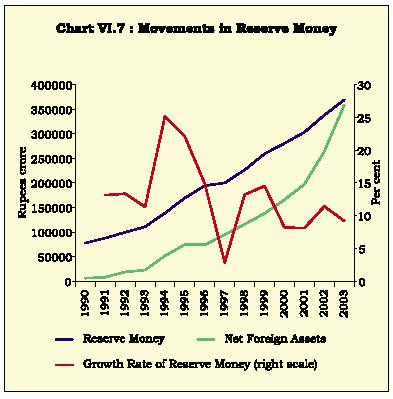
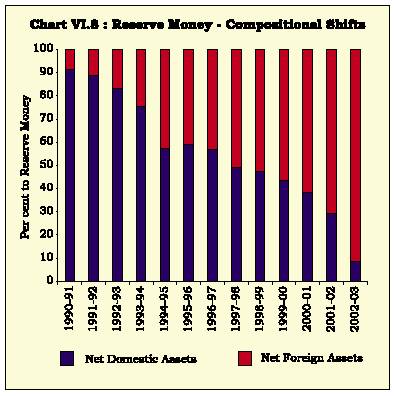
cent (119 per cent) over the same period (Charts VI.7 and VI.8).
6.106 The absor ption of these
flows has expansionar y impact on money supply with implications for price as
well as financial stability. This necessitates the neutralisation of the expansionary
impact of external flows (see Chapter III). In general, apart from exchange
rate flexibility and foreign exchange market intervention there are several
other
policy responses that can be used
to manage large capital inflows. These include: (i) trade liberalisation leading
to a higher trade and current account deficit which would enable the economy
to absorb the capital inflows; (ii) investment promotion through measures designed
to facilitate greater investment in the economy; (iii) liberalisation of the
capital account; (iv) management of external debt through pre-payment and moderation
in the access of corporates and intermediaries to additional external debt;
(v) management of non-debt flows like foreign direct investment (FDI) and portfolio
investments; (vi) taxation of inflows such as the imposition of a 'Tobin'
type tax; and, (vii) use of foreign exchange reserves for productive domestic
activities through on-lending in foreign currencies to residents (RBI, 2003c).
6.107 In India, a number of steps
have been taken to manage the excess supply in the foreign exchange market.
These include a phased liberalisation of the policy framework in relation to
current as well as capital accounts. Efforts to moderate capital flows have
been focused on a number of measures, as discussed earlier in this chapter,
such as minimum maturity prescriptions and interest rate ceilings on non-resident
rupee deposits. In regard to capital outflows, the automatic route of FDI abroad
has been substantially expanded. Similarly, corporates have been provided greater
flexibility with regard to the prepayment of their external commercial borrowings.
Surrender requirements for exporters have been liberalised to enable them to
hold up to 100 per cent of their proceeds in foreign currency accounts; foreign
currency account facilities have
been extended to other residents; and banks have been allowed to liberally invest
abroad in high quality instruments. A significant step in this process was the
pre-payment of a part of the debt owed to multilateral and bilateral agencies
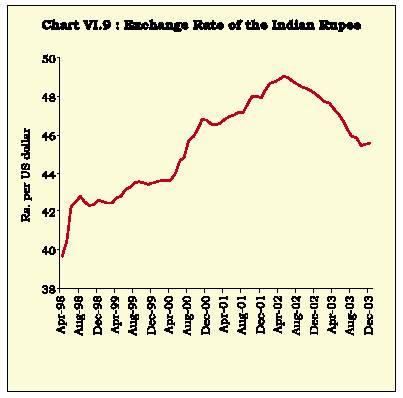
by the Government of India. Furthermore, in 2002-03, the exchange rate of the
rupee vis-à-vis the US dollar appreciated, an event unprecedented
in the recent monetary history of India (RBI 2003). The appreciation of rupee
vis-à-vis the US dollar has continued during 2003-04 so far (Chart
VI.9).
6.108 Notwithstanding the measures
undertaken by the Reserve Bank, the overall balance of payments surplus has
continued to increase in the last few years. The net foreign assets of the Reserve
Bank have also increased sharply. As a result, the major instrument of managing
capital flows in India has been sterilisation - open market operations involving
sale of Government of India securities from the Reserve Bank’s portfolio and
repo transactions - in order to offset the liquidity created by the purchases
of foreign currency from the market (Table 6.20). Accordingly, the share of
net domestic assets in reserve money declined throughout the 1990s. In particular,
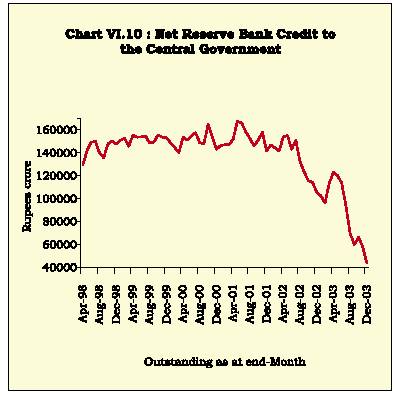
the stock of the Government of India securities - the main instrument of sterilisation
- declined from Rs.1,46,534 crore at end-March 2001 to Rs.36,919 crore by January
16, 2004 (Chart VI.10).
6.109 The cross-country experience
with regard to the management of capital flows suggests a menu of possible approaches
ranging from liberalization
of outflows to punitively high
non-remunerated reserve requirements. These measures can broadly be classified
into (i) use of market-based instruments (i.e., instruments of sterilisation)
and (ii) non-market based measures involving, inter alia, control on
inflows and liberalisation of outflows (RBI, 2003c). Besides making use of well
known instruments of sterilisation such as open market operations (including
repos) with the help of government securities and foreign exchange swaps, there
exists a wide variety of other instruments, ranging from provision for remunerated/uncollateralised
deposit facilities for financial intermediaries with central banks (viz.,
China, Taiwan and Malaysia), issuance by the central bank of money stabilisation
bonds/ central bank bills (viz., Korea, China, Malaysia, Indonesia, Thailand,
Sri Lanka, Poland and Peru), and Government/Public Sector deposits with the
central bank (viz., Indonesia,
Malaysia, Singapore, Thailand and Peru). Countries have also used Cash Reserve
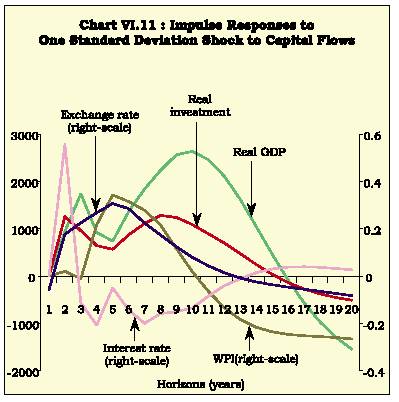
Ratio (CRR) on domestic/foreign deposits (on remunerated/non-remunerated basis)
to absorb liquidity (China and Taiwan). There are several countries that have
liberalised capital outflows (China and Taiwan). Among the countries that have
imposed capital control on short term capital inflows, mention may be made of
Thailand, China, Taiwan and Malaysia. Latin American countries, such as, Chile
and Colombia adopted the policy of unremunerated reserve requirements. Countries
have also used variants of 'Tobin' taxes on capital inflows (viz.,
Brazil and Chile) (Box VI.7).
6.110 With the continued surges
in capital flows in the recent period, countries like Thailand, China and Taiwan
have undertaken several measures to manage them (Box VI.8).
6.111 As noted above, sterilisation
operations have been the principal instrument of managing capital flows in India.
Unsterilised intervention in foreign exchange markets could lead to an alignment
of domestic interest rates with international interest rates which could have
beneficial effects on investment and growth (RBI, 2003c). In the short run,
however, unsterilised intervention could lead to asset price volatility, imprudent
lending and adverse selection which could have inimical effects on the real
economy with possibilities of capital flow reversals. There is a broader agreement
on the policy response of sterilisation as a temporary measure since it addresses
temporary inflows effectively, and can be implemented quickly. Moreover, if
the inflows are more enduring in nature, it provides some breathing space to
formulate a longer term response. Even in the case of mixed flows – enduring
and short term – some degree of sterilisation is often considered necessary.
The arguments in favour of sterilisation are that it
Box VI.7
Management of Capital Inflows: Restrictions
and Prudential Requirements – Country Experiences
Indonesia (1990)
• Measures imposed to discourage
offshore borrowing, including limits on banks’ net open-market foreign exchange
positions and on off-balance-sheet positions. The three-month swap premium
raised by 5 percentage points.
• All state-related offshore
commercial borrowing made subject to prior approval and annual ceilings were
set for new commitments over the next five years.
Malaysia (1989)
• Limits on non-trade-related swap transactions
imposed on commercial banks.
• Banks subjected to a ceiling on their non-trade-
or non-investment-related external liabilities.
• Residents prohibited from selling short-term
monetary instruments to non-residents.
• Commercial banks were required
to place with Bank Negara the ringgit funds of foreign banking institutions
(Vostro accounts) held in non-interest-bearing accounts. During January-May
1994, these accounts were considered part of the eligible liabilities base
for the calculation of required reserves, resulting in a negative effective
interest rate on Vostro balances.
Philippines (1992)
• Bangko Central begins to discourage forward
cover arrangements with non-resident financial institutions.
Thailand (1988)
• Banks and finance companies
(a) net foreign exchange positions not to exceed 20 per cent of capital (subsequently
increased to 25 per cent) and (b) net foreign liabilities not to exceed 20
per cent of capital.
• Residents disallowed from holding foreign
currency deposits except only for trade-related purposes.
• Reserve requirements, to
be held in the form of non-interest-bearing deposits at the Bank of Thailand,
on short-term non-resident baht accounts raised from two to seven per cent.
The seven per cent reserve requirement extended to finance companies short-term
(less than one year) promissory notes held by nonresidents. Offshore borrowing
with maturities of less than one year (excepting loans for trade purposes)
by commercial banks, finance companies, and finance and security companies
also subjected to 7 per cent minimum reserve requirement.
investment in the stock market, (b) tax
on Brazilian companies issuing bonds overseas raised from 3 to 7 per cent of
the total and (c) tax paid by foreigners on fixed-interest investments in Brazil
raised from 5 to 9 per cent.
Chile (1990)
• Non-remunerated 20 per cent
(subsequently increased to 30 per cent) reserve requirement (to be deposited
at the central bank for a period of one year) on liabilities in foreign currency
for direct borrowing by firms.
• The stamp tax of 1.2 per
cent a year (previously paid on domestic currency credits only) applied to
foreign loans as well (excepting trade loans).
Colombia (1991)
• A 3 per cent withholding
tax imposed on foreign exchange receipts from personal services rendered abroad
and other transfers (but allowed to be claimed as credit against income tax
liability).
• Banco de la Republica increased
its commission on its cash purchases of foreign exchange from 1.5 to 5 per
cent.
• Non-remunerated reser ve
requirement to be deposited at the central bank on liabilities in foreign
currency for direct borrowing by firms. The reserve requirement to be maintained
for the duration of the loan and applied to all loans with a maturity of five
years or less, except for trade credit with a maturity of four months or less.
The percentage of the requirement declined as the maturity lengthened, from
140 per cent for funds that are 30 days or less to 42.8 per cent for five-year
funds.
Czech Republic (1992)
• The central bank introduced
a fee of 0.25 per cent on its foreign exchange transactions with banks, with
the aim of discouraging short-term speculative flows.
• Limit on net short-term (less than one year)
foreign borrowing by banks introduced.
• Each bank to ensure that
its net short-term liabilities to non-residents, in all currencies, do not
exceed the lower of 30 per cent of claims on non-residents or Kc 500 million.
• Administrative approval procedures imposed
to slow down short-term borrowing by non-banks.
Mexico (1990)
• Foreign currency liabilities
of commercial banks limited to 10 per cent of their total loan portfolio.
Banks had to place 5 per cent of these liabilities in highly liquid instruments.
Eastern Europe and Latin America
Brazil (1992)
• Between October 1994 and March 10, 1995,
following measures imposed: (a) one per cent tax on foreign
Note : Dates in brackets refer to the first
year of the surge in inflows Source : Reinhart and Smith (1998).
Box VI.8
Management of Capital Inflows: Recent Experience
of Thailand, China and Taiwan
In the latest episode of surges
in capital flows, Thailand has imposed a variety of measures including restrictions
to limit speculative short-term capital flows, liberalisation of capital outflows,
resort to massive pre-payment of external debt, tightening of fiscal policy
and a flexible exchange rate. Restrictions on interest payments have been imposed,
effective October 14, 2003, on short-term borrowing in Baht from non-residents
to prevent Thai Baht speculation. These include: (i) non-residents can maintain
only current or saving accounts for settlement of international trade and investment
transactions; deposits for other purposes must have maturity of at least six
months; (ii) a deposit ceiling of 300 million Baht (equivalent of around US
$ 7.5 million) per non-resident account; and (iii) financial institutions not
to pay interest to overseas holders of Thai cheque and savings accounts. The
liberalisation measures include: (i) permission to institutional investors to
invest in overseas securities; (ii) encouragement to mutual funds to invest
on behalf of local residents in Asian bonds issued by sovereign and quasi-sovereign
entities; and (iii) increase in the holding period of foreign currency deposits
from 3 to 6 months. The external debt more than halved from a peak of US $ 112
billion in June 1997 to US $ 52 billion by July 2003. Furthermore, substantial
fiscal correction – public debt/ GDP ratio has declined from 57 per cent to
50 per cent of GDP during 2003 – has also been witnessed (Devakula, 2003).
China has managed capital flows
through increase in base money as well as sterilisation by issuing its own bills.
From April 22, 2003 the People’s Bank of China (PBC) started outright issue
of central bank bills with maturities up to one year. By the end of September
2003, 42 issues cumulating to RMB 545 billion yuan had been made. The
outstanding issues reached RMB
425 billion yuan (about 4 per cent of GDP). In the context of sustained capital
flows, the PBC decided to coordinate the issue of central bank bills with a
one percentage point increases in the cash reserve ratio to 7 per cent effective
September 21, 2003. Moreover, the PBC liberalised capital outflows through measures
such as reforming the current account administration, allowing enterprises to
retain more foreign exchange, lifting the limits for individuals to buy and
carry foreign currencies when traveling abroad. Furthermore, it carried out
a pilot programme on foreign exchange administration of overseas investment
to widen channels for outward capital flows. International financial institutions
have also been permitted to issue local currency RMB bonds in the domestic market.
Taiwan has sterilised capital flows
through open market operations (OMOs) by employing government securities and,
in the recent period, through issue of its own negotiable cer tificates of deposits
(NCD). These instruments are issued or sold on outright basis as well as under
repurchase agreements. In addition, Taiwan has absorbed liquidity through redeposits
from financial institutions and depositing a part of the foreign exchange reserves
in the overseas branches of domestic banks to promote their international financial
activities and to support Taiwanese firms operating overseas. Capital outflows
have been encouraged by permitting (i) international financial institutions
such as the European Bank for Reconstruction and Development (EBRD), the European
Investment Bank and the Inter-American Development Bank to issue local currency
bonds and (ii) domestic securities investment and trust companies to raise funds
from the domestic market to invest in foreign securities under an aggregate
ceiling.
keeps base money and money supply
unchanged, thereby avoiding the undesirable expansionary effects of capital
inflows. Furthermore, foreign exchange market intervention accompanied by sterilisation
allows the monetary authority to build up international reserves that could
help to withstand future shocks, and provide comfort and confidence to market
participants. On the other hand, prolonged sterilisation may exert an upward
pressure on interest rates, which could, in turn, attract further foreign exchange
inflows neutralising the impact of sterilisation. Sterilisation also has its
financial costs: if it is conducted through OMO, the net cost of sterilisation
to the central bank is the difference between the interest rate on domestic
securities and the rate of return on foreign exchange reserves adjusted for
any exchange rate change. The magnitude of the cost varies with the extent of
sterilisation and the yield differentials. These are
termed 'quasi-fiscal'
costs since the costs to the central bank are passed on to the sovereign through
a lower transfer of profits. Similarly, when sterilisation is effected through
an increase in reserve requirements, this could adversely affect the profitability
of the financial system as it is a tax on banks and could give rise to dis-intermediation.
Sterilisation as a process, therefore, involves a range of costs and benefits.
On balance, there must be adequate preparedness to undertake sterilisation operations,
which includes availability of instruments. The need for and size of such operations
is, however, governed by several larger policy considerations. At the same time,
it must be stressed that sterilisation is essentially a means of buying time
since, in the ultimate analysis, only durable and consistent policies enhance
a country’s capacity to absorb capital flows (RBI, 2003c).
6.112 In recent years, the declining
stock of the Government of India securities with the Reserve Bank has brought
into a sharp focus the limitations on the Reserve Bank’s ability to sterilise
capital flows in the future. An internal Working Group on Instruments of Sterilisation
constituted by the Reserve Bank reviewed the various instruments used in India
and in other countries and deliberated on the suitability of various instruments
to the current conditions in India and possibility for deployment in the future.
The Group felt that the appropriate mix of the instruments would depend on the
prevailing circumstances, the associated costs and benefits, and the opportunity
cost of not using sterilisation as a policy option (Box VI.9).
6.113 In the context of sterilisation operations,
it is also important to examine whether capital inflows
reflect higher money demand by
residents. In other words, it is debatable whether it is the reduction in net
domestic assets that caused subsequent capital inflows or whether the reduction
in NDA offset the previous capital inflows. For instance, contraction of NDA
through open market sales to sterilise initial capital flows could place upward
pressure on interest rates attracting, in turn, further capital inflows. The
size of inflows depends on the degree of substitutability between domestic and
foreign assets. If the assets are perfect substitutes, even a small rise in
domestic interest rates would attract large capital inflows rendering monetary
policy sterilisation operations ineffective (Kouri and Porter, 1974; Schadler
et al., 1993). A key issue, therefore, is the ability of the monetary
authority to sterilise the capital inflows and yet retain control over money
supply so
Box VI.9
Recommendations of the Report of the Working Group
on Instruments of Sterilisation
Against the background of international
experience with various instruments of sterilisation and application of available
instruments with the Reserve Bank within the existing financial and legal structure,
the Group felt that there was a need for a two-pronged approach: (i) strengthening
and refining the existing instruments; and (ii) exploring new instruments appropriate
in the Indian context. The Group examined the option of sterilisation of inflows
by using/refining the existing instrument without changing the legal framework.
These instruments included: (i) Liquidity Adjustment Facility (LAF); (ii) Open
Market Operations (OMO); (iii) Balances of the Government of India with the
Reserve Bank; (iv) Forex Swaps; and, (v) Cash Reserve Requirements. The Group
also considered the introduction of cer tain new instruments which would involve
amendments to the RBI Act: (i) Interest Bearing Deposits by Commercial Banks;
and (ii) Issuance of Central Bank Securities. Moreover, the Group explored the
possibility whether the Government could issue Market Stabilisation Bills /
Bonds for sterilisation purposes if the existing instruments are found to be
inadequate to meet the size of operations in future. The major recommendations
of the Group for use of various instruments were as follows:
Existing instruments not requiring amendment to
the Reserve Bank of India Act
• It is not desirable to use
the LAF as an instrument of sterilisation on an enduring basis; however, for
limited periods, it can be used in a flexible manner along with other instruments.
• Open market operations of
outright sales of government securities should continue to be an instrument
of sterilisation to the extent that securities with the Reserve Bank can be
utilised for the purpose.
However, as the OMO sales entail
the permanent absorption of the liquidity and transfer market risk to participants,
the alternative of using the existing stock of securities for longer-term
repos (up to 3 to 6 months) as an option can also be considered.
• Surplus balances of the
government may be maintained with the Reserve Bank without any payment of
interest so as to release securities for OMO. This would entail a review of
the 1997 agreement between the Government of India and the Reserve Bank.
• Use of CRR as an instrument
of sterilisation, under extreme conditions of excess liquidity and when other
options are exhausted, should not be ruled out altogether by a prudent monetary
authority ready to meet all eventualities.
New instruments requiring amendment to the Reserve
Bank of India Act
• The RBI Act may be amended
to provide for flexibility in determination/remuneration of CRR balances so
that interest can be paid on deposit balances actually maintained by scheduled
banks with the Reserve Bank.
• In the context of current
fiscal situation and considerations of market fragmentation, it is not desirable
to pursue the option of issuance of central bank paper.
New instrument not requiring amendment to the Reserve
Bank of India Act
• The Government may issue
Market Stabilisation Bills/ Bonds (MSBs) for mopping up liquidity from the
system. The amounts so raised should be credited to a fund created in the
Public Account and the Fund should be maintained and operated by the Reserve
Bank in consultation with the Government.
as to pursue its stated objectives.
Following Kouri and Porter (op cit), this can be examined empirically
by analysing the behaviour of the central bank’s NDA and its net foreign assets
(NFA). In specific terms, the direction of causality between NDA and NFA needs
to be established. For most countries, both lines of causality could be operational
depending upon the degree of capital account liberalisation and sensitivity
of foreign flows to interest rate differentials. The 'offset' coefficient
– the response of net foreign assets to net domestic assets –measures the degree
to which capital inflows offset the effect of a change in NDA on money supply.
An offset coefficient close to unity would imply that the efforts of the monetary
authority to tighten monetary policy would induce equal and offsetting foreign
inflows leaving no scope for independent monetary policy. In contrast, an offset
coefficient of zero would provide the monetary authority with complete control
over money supply and, therefore, discretion in the conduct of monetary policy.
6.114 Using quarterly data for
the period 1976-1991 for a sample of six countries, Schadler et al (1993)
found that the offset coefficient ranged ranging between (-) 0.1 and (-) 0.5
for Colombia, Egypt, Mexico and Spain indicating sufficient scope for an independent
monetary policy. The offset coefficient was found to be less than (-) 0.5 for
Indonesia, Korea and Spain (Lee, 1996). For Thailand, the offset coefficient
was close to unity suggesting little scope of pursuing an independent monetar
y policy (Schadler, et al, 1993; Lee 1996). On the other hand, the offset
coefficient for Thailand was only (-) 0.33 during 1984-95, once the simultaneity
bias between NDA and capital flows is taken into account, indicating some scope
for sterilisation and an independent monetary policy. Moreover, consistent with
the hypothesis of increasing capital mobility in the 1990s and the consequent
declining monetary
policy independence, the magnitude
of the offset coefficient increased from (-) 0.21 (1984-89) to (-) 0.33 (1990-95)
for Indonesia and from (-) 0.21 (1984-87) to (-) 0.41 (1988-95) for Thailand.
6.115 For India, the offset coefficient
was estimated to be (-) 0.3 over the period April 1993 to March 1997, suggesting
that sterilisation operations conducted during this period enabled sufficient
independence for monetary policy to pursue domestic goals (Pattanaik, 1997).
In the subsequent period, net foreign assets have increased rapidly. Over the
sample period April 1994 to September 2003, Granger causality tests indicate
a uni-directional causality from changes in NFA to net domestic assets (NDA).12
Thus, over the sample period, capital inflows were not induced by domestic monetary
conditions. The extent of sterilisation can be examined by estimating the central
bank reaction function which studies the behaviour of central bank’s net domestic
assets in response to variations in its net foreign assets. For India, the sterilisation
coefficient - the response of change in NDA to that in NFA - is found to be
(-) 0.92, i.e., an increase of Rs.100 in NFA induced a policy response
of sterilisation that drained away NDA worth Rs.92 from the system.13
As a result, the Reserve Bank was able to offset the expansionary effect of
foreign capital flows on domestic money supply, consistent with its macroeconomic
objectives.
6.116 All accretions to NFA do
not have a monetary impact; for instance, aid receipts, revaluation and the
Reserve Bank’s income on its foreign assets contribute to NFA but have no monetary
impact, obviating the need for sterilisation to that extent. As such, an appropriate
measure to study the degree of sterilisation in India would be to examine the
impact of the Reserve Bank’s net market purchases/ sales of foreign currency
from/to authorised dealers
12 In a bivariate VAR of net
foreign exchange assets (NFA) and net domestic assets (NDA) of the Reserve
Bank (with both variables in first-difference) over the period April 1994
to September 2003, the null hypothesis of Granger non-causality of NDA can
not be rejected (chi-square of 0.002 at p-value of 0.97). On the other hand,
the null hypothesis of Granger non-causality of NFA can be rejected at 10
per cent level of significance (chi-square of 3.05 at p-value of 0.08). The
VAR was estimated with one lag based on Schwarz Bayesian Information Criterion
(SBIC).
13 The estimated equation, using monthly data
from April 1994 to September 2003, is: DNDA = - 607 – 0.92 DNFA +158.7 DIIP{-1}
+ 5755 DCRRAVG.
(1.4) (13.3)*** (2.0)** (11.4)*** –R2
= 0.81 DW = 2.0
The figures in brackets are t-values;
***, ** and * denote significance at 1, 5 and 10 per cent level, respectively.
DNDA, DNFA, DIIP and DCRRAVG denote monthly variations in net domestic assets,
net foreign assets, index of industrial production and average CRR, respectively.
In addition, monthly dummies for March, April, May, October and November turned
out to be significant and were included in the estimated equation. The variable
DCRRAVG was included in the regression to capture the reduction in NDA over
the sample period that was due to the lowering of CRR.
(ADSALES) on the Reserve Bank credit
to the Centre (RBICC), and not the entire NDA. For India, data on market sales/purchases
are available effective October 1995. For instance, during 2002-03, net market
purchases of foreign currency contributed Rs.75,661 crore out of a total increase
of Rs.94,275 crore in NFA. As in the previous case, Granger causality tests
indicate a uni-directional causality from changes in foreign exchange purchases
to reduction in net Reserve Bank credit to the Centre.14 The sterilisation
coefficient is 0.65, i.e., Rs.100 increase in foreign currency purchases
from ADs induces sterilisation operations involving sales of Government securities
wor th Rs.65 from the Reserve Bank.15
6.117 It is wor th stressing that
sterilisation operations notwithstanding, there has been no hardening of domestic
interest rates as is normally feared. On the contrary, interest rates have continued
to soften in recent months. Sterilisation operations have so far been successful
in keeping the monetary aggregates close to the desired trajectory thus enabling
a softer interest rate regime.
X. CAPITAL FLOWS AND DEMOGRAPHY
6.118 As noted in the previous
paragraphs, large capital flows and overall surpluses in the balance of payments
in respect of several emerging market economies have posed serious problems
of monetary management. The evolving patterns of demography across nations could
exacerbate the challenges to monetary policy formulation over the longer term
(Mohan, 2003). In general, economies pass through three stages of demographic
transition - (i) high youth dependency (large proportion of population in the
0-14 years group), (ii) rise in working age population (15-59 years) relative
to youth dependency and (iii) rise in elderly dependency (60+ years) relative
to working age population. The second stage is regarded as the most productive
from the point of view of
secular growth since it is associated
with the high rates of saving and work force growth relative to the other stages.
Over the next half-century, the population of the world will age faster than
during the past half-century as fertility rates decline and life expectancy
rises. Developed regions like Europe, North America and Japan have been leading
the process of population ageing and are likely to be deep into the third stage
of demographic transition. These regions will switch to importing capital. On
the other hand, high performers of East Asia and China are in the second stage
of the demographic cycle. East Asia could increasingly become an important supplier
of global savings up to 2025; however, rapid population ageing thereafter would
reinforce rather than mitigate the inexorable decline of global saving. Increasingly
it would be the moderate and the low performers among the developing countries
which would emerge as exporters of international capital. India is entering
the second stage of demographic transition and over the next half-century, a
significant increase in both saving rates and share of working age population
is expected. The regional pattern of global population ageing is expected to
bring about changes in the behaviour of global saving and investment balances
which would be reflected in the magnitude and direction of international capital
flows with implications for the conduct of monetary policy.
XI. CAPITAL FLOWS AND GROWTH: THE INDIAN EXPERIENCE
6.119 Access to international capital
enables a country to supplement domestic savings and smoothen inter-temporal
consumption. This could strengthen the growth process and foster employment
generation in the recipient country. The actual impact of capital flows on economic
growth is undoubtedly an empirical issue and varies widely across countries.
An increase in capital flows is expected to augment domestic savings/investment,
boost aggregate demand and lead to an increase in aggregate output/
14 In a bivariate VAR of net
monthly sales/purchases of foreign exchange from ADs (ADPURC) and monthly
variations in net Reserve Bank credit to Centre (DRBICCG) over the period
October 1995 to September 2003, the null hypothesis of Granger non-causality
of DRBICCG can not be rejected (chi-square of 0.03 at p-value of 0.87). On
the other hand, the null hypothesis of Granger non-causality of ADPURC can
be easily rejected (chi-square of 5.90 at p-value of 0.02). The VAR was estimated
with one lag based on Schwarz Bayesian Information Criterion (SBIC).
15 The estimated equation, using monthly data
over October 1995 to September 2003, is: DRBICCG = 1066 – 0.65 ADPURC - 200.1
DIIP{-1} + 5555 DCRRAVG.
(1.5) (5.2)*** (1.7)* (6.4)*** –R2
= 0.55 DW = 2.46
The figures in brackets are t-values;
*, ** and *** denote significance at 10, 5 and 1 per cent level, respectively.
DRBICCG, ADPURC, DIIP and DCRRAVG are defined as before. In addition, monthly
dummies for March, April, May, October and November turned out to be significant
and were included in the estimated equation.
income. At the same time, capital
flows induced appreciation of the exchange rate could adversely affect expor
ts and increase imports thereby dampening the impact on aggregate demand and
lead to a deterioration in the current account. The policy response to the loss
of external competitiveness may entail a softer interest rate environment to
prevent appreciation of the exchange rate and to strengthen growth prospects.
6.120 In order to gauge the impact
of capital flows on macro aggregates, an unrestricted vector autoregression
(VAR) model was formulated based on annual data for the period 1951-2002 in
respect of gross domestic product (GDP), gross domestic capital formation (GDCF),
wholesale price index (WPI), interest rate, capital flows and exchange rate.
The appropriate lag length of the model was found to be 2 years.16
The results were in line with a priori expectations (Chart VI.11). A
positive shock to capital flows resulted in higher investment and higher output
in the medium to long-run. Prices did not increase immediately in the short-run,
although a positive effect could be discernible over the medium-run. The exchange
rate appreciated while the interest rate declined.
XII. CONCLUDING OBSERVATIONS
6.121 Net capital flows to developing countries
increased sharply during 1990-96 but declined in the
later part of the 1990s in the
aftermath of the East Asian crisis. The composition of flows in respect of emerging
market economies also altered significantly, with private flows exceeding official
flows by the end of the 1980s. Furthermore, while bank lending was the major
component of capital flows to emerging markets in the 1970s, equity and bond
investors became dominant from early 1990s. Although portfolio flows became
important, it was FDI which accounted for the bulk of private capital flows
to emerging market economies - witnessing a six-fold jump between 1990 and 1997.
Most FDI flows, however, are concentrated in handful of emerging market economies.
Cross-country studies have identified a large regional bias in portfolio investment
flows, particularly in Latin America and Asia.
6.122 Notwithstanding their potentially
favourable impact on growth prospects, highly volatile nature of capital flows,
especially portfolio flows and short-term debt, underscores the need for efficient
management of these flows. While managing capital flows, clear distinction should
be made between debt and non-debt creating flows, private and official flows
and short-term and long-term capital flows. An overbearing objective of external
sector policies of developing countries has been to devise strategies so as
to maximise the benefits of capital inflows while limiting their adverse impact.
At an individual country level, an appropriate response would be to build a
resilient and robust financial sector which could appropriately intermediate
large capital flows. It is imperative that such capital flows are absorbed smoothly
in real sector embodying growth impulses. Adoption of proper macroeconomic policies,
particularly in respect of exchange rate management and monetary stance also
assumes significance in dealing with large capital flows. The volatility and
the possibility of reversals associated with capital flows were brought out
quite strikingly by the East Asian and the subsequent financial crises.
6.123 Until the 1980s, India’s
development strategy was focused on self-reliance and import-substitution. There
was a general disinclination towards foreign investment. As a result, the magnitude
of capital flows was not large to India as compared to other East Asian countries.
Since the initiation of the reform process in the early 1990s, India’s policy
stance has changed substantially. India has encouraged stable capital flows
from the viewpoint of macroeconomic stability. The importance of official flows
is declining. A cautious
approach has been pursued for management
of capital account liberalisation. India’s approach to managing capital flows
during the 1990s, as reflected in a revealed preference for non-debt creating
flows and long-term debt flows while de-emphasising short-term flows, has been
successful in its objective of attracting stable flows. All the key indicators
of external debt sustainability have, in fact, significantly improved during
the 1990s. In the recent period, significant relaxations have been allowed for
capital outflows.
6.124 The experience with capital
flows suggests that these flows are highly beneficial if they are absorbed.
However, if the current account deficits are too large and unsustainable then
the reversal of capital flows could cause major problems. The speed of reversals
of capital flows could be quite high. The large and volatile capital flows combined
with sharp rise in current account deficits played a significant role in exacerbating
the vulnerabilities leading to the Asian crisis. Moreover, capital movements
have rendered exchange rates significantly more volatile than before, which
could lead to macro management problems. The large movements in capital flows
cause sharp movements in exchange rate which are not in alignment with macroeconomic
fundamentals. In this context, the next chapter on 'Foreign Exchange Reserves,
Exchange Rate and External Debt Management' dwells on these issues in detail.
6.125 In the context of managing large capital
inflows, the key issue that emerges is the efficacy
and extent of sterilised foreign
exchange market intervention. It is evident that sterilisation operations are
undertaken as part of a package encompassing exchange rate policy, level of
reserves, interest rate policy, along with considerations relating to domestic
liquidity, financial market conditions, and the degree of openness of the economy.
India’s approach to sterilisation has ensured monetary stability without any
adverse impact on interest rates.
6.126 Empirical exercises in the
Indian context indicate that (i) growth in world income has a favorable impact
on the capital flows, underscoring the significance of 'push' factors;
(ii) outflows of foreign direct investments increase with the increase in the
level of openness of the economy; (iii) a strong unidirectional causal relationship
running from FDI to export growth exists; (iv) FII investments in India are
positively related to risk on Nasdaq; (v) interest rate differential between
India and abroad is an important factor determining inflows under non-resident
deposits; and, (vi) capital flows have a favorable impact on the growth prospects
of the Indian economy. It is also expected, that given the favorable demographic
structure, saving rates in India would increase over the next half of this century.
The key challenge for macroeconomic policies would be to ensure that the anticipated
expansion in saving is productively utilised within the economy and not exported
abroad. Accordingly, it is vital to ensure that the investment rate rises in
close co-movement with the saving rate.