The global economy is recovering from the crisis but some existing concerns remain and new concerns have
emerged. Several advanced and other economies suffer from slow growth and high sovereign debt. Some
measures taken by advanced economies like large interest rate cuts, maintenance of near-zero rates and
injections of liquidity are leading to large capital inflows to emerging market economies (EMEs) and to
higher commodity prices. The full recovery of trade as well as confidence at the global level is contingent upon
recovery of all economies, particularly the advanced economies.
Business cycle synchronisation of the Indian economy with most of the advanced economies and EMEs has
increased over time. Thus, deterioration of global risks, uneven recovery in growth and employment, elevated
commodity, particularly food prices, and global imbalances have a stronger impact on India than before. On
the domestic front, a large share of volatile components in financing of current account deficit (CAD), limited
fiscal manoeuvrability and a sharp rise in asset prices too have implications for financial stability. The performance
of retail credit has improved but the rise in asset prices, particularly that of housing, is emerging as a concern.
Role of Macroeconomic Risks
2.1 Macroeconomic risks affect financial stability
through multifarious channels. The outlook for growth
and employment at the global and domestic levels
impact the ability of debtors to pay back borrowed funds
and perceptions of credit risk. Inflation/deflation risks
determine real debt burdens and impact fixed income
markets. Fluctuations in asset prices impact the value
of collaterals and the ability of debtors to meet their
obligations. Macroeconomic imbalances or shocks and
unsustainable fiscal and external debt burdens provide
fertile ground for triggering disruption of the financial
system. The process of economic rebalancing too has
implications for the financial system. During internal
rebalancing, fiscal consolidation needs to be
accompanied by enhancement of private demand
through larger and cheaper flow of credit. On the other
hand, during external rebalancing, many advanced
countries may have to increase their reliance on net
exports while several EMEs have to enhance their
dependence on domestic demand. This entails, among
others, some readjustment of the exchange rates and
reorientation of the financial system.
Overall Macroeconomic Risk Scenario in India –
Comparative Position
2.2 As compared to our previous assessment in the
first Financial Stability Report (FSR) published in March 2010, there has been deterioration in global and capital
flows risks. Both household and corporate sectors
continue to remain healthy and their risk levels remain
unchanged. Inflation risks have abated, although they
still remain high. Fiscal conditions too, though
stretched, have improved with initiation of
consolidation measures (Chart 2.1)
Global Developments
Global Risks Worsen
2.3 Business cycle synchronisation (in terms of GDP)
of the Indian economy with most of the advanced and
EMEs has increased over time, particularly during
recent periods,1 thereby enhancing the influence of
global developments. The Global Financial Stability
Report (IMF, October 2010) highlights increases in risks
to financial stability as compared to its assessment in
April 2010. Aggravation of sovereign debt and deflation
concerns contributed to increase in macroeconomic
risks. Risks associated with banking sector also went
up during this period. However, due to stronger
corporate sector, the overall credit risks remained
unchanged. Risks associated with emerging markets
recorded some improvement due to strong
fundamentals and better growth outlook.
Global Growth is uneven and uncertain …
2.4 The IMF has projected that the current calendar year
may witness a global recovery followed by modest
deceleration in the following year (Chart 2.2). Data on
Purchase Managers Indices (PMIs) for manufacturing in
the U.S. and Eurozone though above 50, are currently
lower than the peak of 60 reached in April 2010, thereby
indicating possible prolongation of slow growth (Chart 2.3).
2.5 Rebalancing in favour of domestic economies by
some countries may inhibit full recovery of world trade.
In the U.S., a major trading partner of India, while there
is a positive push with the liquidation of inventories,
persistence of high unemployment, low growth in
consumer spending and dormant housing sector point
towards prolonged recovery. Further, the current
deleveraging is expected to be a protracted process. And
as Japan has experienced, these are difficult conditions
to offset with monetary and fiscal policies.
… Unemployment remains high among advanced
economies
2.6 High unemployment among advanced
economies is a concern as it is expected to a have a
more persistent impact on global demand (Chart 2.4).
Structural employment may take longer to reach its pre- crisis levels and may drag down productivity over the
medium-term.
Sovereign debt high and resolution to be prolonged
2.7 The sovereign debt crisis has made the link
between debt management and financial stability more
explicit suggesting the need for closer coordination
with fiscal, monetary and financial stability authorities.
It is well recognised that government debt cannot grow
on a sustained basis well above the growth rate of
nominal GDP without causing severe disruptions to the overall economic system. The large share of fiscal
resources needed to service higher public debt might
crowd out productive expenditures and could also lead
to higher distortionary taxation. In the long run,
persistently high debt makes economies more
vulnerable to adverse shocks, reduces their long-run
growth potential and impacts monetary and financial
stability. High levels of public debt also tend to
undermine the credibility of monetary policy. The
sovereign debt crisis and its management provides
useful experiences and lessons (Box 2.1).
Box 2.1: Sovereign Debt Crisis
The macroeconomic imbalances and structural weaknesses of
the Greek economy surfaced under the pressure of the
economic and financial crisis characterised by large fiscal
deficit, enormous public debt and consistently eroding
competitive position manifested in a gradually deteriorating
current account balance. Large holdings of sovereign debt paper
with European banks sparked off systemic concerns. Similar
concerns in other EU economies namely Portugal, Ireland, Italy
and Spain added to these concerns. Heavy selling of the
sovereign debt of vulnerable euro area economies took a toll
on their banking system. This caused a significant depreciation
of the euro and a broader decline in stock prices in the Euro
zone but also transmitted volatility to other financial markets
across the world. Risk premiums on corporate bonds widened,
and corporate bond issuances slowed to a trickle in May.
Issuance in emerging markets also dropped sharply.
To assist Greece, on May 2, 2010, Euro Area and IMF pledged
US$145 billion in bilateral loans and Stand-by arrangement.
Subsequently, the Economic and Financial (Eco-Fin) Council
of the European Union (EU) announced stabilisation measures
on May 10, 2010. These measures included creation of a
European Stabilisation Mechanism (ESM) which incorporates
strong conditionality and has two components: (i) the first
permits the European Commission to provide up to €60 billion
(US $ 79 billion) balance of payments facility for Euro zone
members that are facing a severe deterioration in borrowing
conditions due to factors beyond their control. This will carry
IMF conditionality and will be financed by the issuance of EU
bonds; and (ii) the second is a voluntary intergovernmental
agreement of Member States to compliment the Commission
resources through a Special Purpose Vehicle (SPV) called
European Financial Stability Fund (EFSF) and worth up to €440
billion (US$ 580 billion) over a period of three years. The IMF
decided to participate in the financing arrangements and would
provide at least half of the funding requirements. This would
be guaranteed proportionately by participating Euro zone
members, and also subject to strong conditionality.
In parallel with the announcement of the ESM, the European
Central Bank took action to stabilise euro area sovereign debt
markets through sterilised purchases of sovereign debt of
certain countries. The ECB announced security markets programme with interventions in both public and private debt
securities markets. The G7 also announced the reactivation of
bilateral dollar swap lines between the Federal Reserve and
ECB, Bank of England and SNB. Temporary swap facilities with
the US Federal Reserve were reactivated using ECB-eligible
collateral. European policy initiatives and frontloading of fiscal
adjustment, led to reduction in tail risks and improvement in
financial conditions. However, underlying sovereign and
banking vulnerabilities remain a significant challenge amid
lingering concerns about risks to the global recovery.
Even as the Greek crisis was going into the backburner, the
Irish debt situation has surfaced. Recently the Irish
government declared that its recapitalisation commitment to
its banking system was going to be higher than previously
estimated (from €33 billion to €46 billion i.e. from 20 per cent
to 28 per cent of GDP). This immediately raised concerns for
the sustainability of Ireland’s sovereign debt. The Irish
government has stated that its funding needs until mid-2011
are met and initially resisted accepting bailout funds. The
Credit Default Swaps on its sovereign debt have risen manifold
while the market for its debt is virtually shut.
Prior to the crisis, the Irish fiscal situation was very sound.
Low corporate taxes, and interest rates (owing to introduction
of Euro) have fuelled a bank finance led housing and
commercial real estate boom. Taxes associated with asset
booms like estate and capital gains tax became a large
component and eventually evaporated when the cycle turned
during the crisis.
In monetary unions like the euro system member countries
pursue independent fiscal policies but do not have recourse
to exchange rate or monetary policy levers to make the
adjustment needed. This underscores the importance of sound
and credible fiscal policies by member countries to ensure the
independence and credibility of their collective monetary
policy, in the absence of which, monetary policy could become
hostage to fiscal excesses of individual members.
Developments in the Euro area following the sovereign debt
crisis in Greece also underscore the need for and significance
of timely fiscal exit, with an emphasis on the quality of
adjustment, for ensuring sustainable robust growth in the
medium-run.
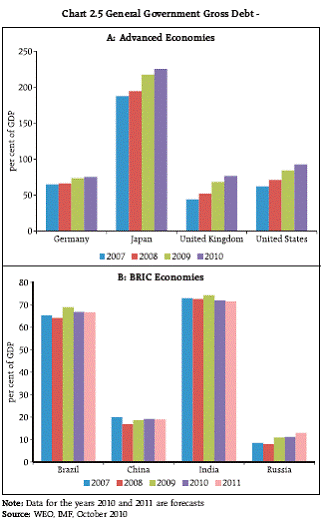
2.8 Rise in fiscal deficit during and after the crisis is
reflected in the increase in public debt in major
economies (Charts 2.5A and 2.5B). Aggregate public
debt of the advanced economies is projected to rise from
76 per cent of GDP in 2007 to more than 100 per cent
in 20112 . It has been observed in the previous crises
that the real stock of debt nearly doubles three years
after the crisis which implies that we may see further
deterioration in public debt ratios. Moreover, “the
average length of time a country spends in a state of
sovereign default is far greater than the average amount
of time spent in financial crisis.” 3
 |
2.9 Debt consolidations also pose severe challenges.
An analysis of 100 episodes of banking crises during
1980–20084 has revealed that: (a) debt consolidation
is less successful when countries are hit by longerlasting
banking crises; (b) debt consolidations are more
likely to be successful when they are based on cuts in
current expenditures; (c) raising tax revenues is
important for debt reduction in countries with large
consolidation needs; and (d) fiscal adjustment can be
complex in the aftermath of banking crises, requiring
supporting actions to revive growth through
implementation of structural reforms to enhance
productivity as well as measures to reduce economic
distortions in the economy.
Twin Deficits complicate the position further
2.10 In addition to fiscal deficits, current account
imbalances continue to persist, particularly in advanced
economies, though they are expected to moderate in
2011. While excessive fiscal and external imbalances
are undesirable individually, the simultaneous
occurrence of both deficits poses a more serious
concern.5
2.11 Some of the major advanced economies have
been recording twin deficits before and after the crisis (Chart 2.6). Resolution of twin deficits through inward
or domestic orientation by the afflicted economies
would inhibit the recovery of world trade. Since the
U.S. and Europe account for a major share of exports
from India, the recovery in Indian exports is expected
to be slow in such a scenario.
Economic Rebalancing too slow
2.12 To prevent reemergence of global imbalances
with recovery, both internal and external imbalances
need to be corrected by several countries. These two
rebalancing acts are taking place too slowly. IMF (WEO,
October 2010) has expressed the view that rebalancing
from public to private demand in advanced economies
and rebalancing from external to domestic demand in
key emerging economies are closely related and a robust
recovery requires that they move ahead together.
2.13 There are costs associated with different
solutions to corrections of fiscal and current account
imbalances. WEO has estimated that a fiscal
consolidation equal to 1 per cent of GDP typically reduces
GDP by about 0.5 per cent within two years and raises
the unemployment rate by about 0.3 percentage point.
Domestic demand—consumption and investment—falls
by about 1 per cent. Further, postponing fiscal
consolidation in advanced economies until emerging
economies have boosted internal demand increases
downside risks in the form of an unfavorable market
reaction which raises advanced economies’ sovereign
and corporate spreads. This, in turn, forces these
economies into large, frontloaded, and ill-targeted fiscal
consolidation that takes many years to become credible
and to bring spreads down.
2.14 Use of very large exchange rate changes which
are effected in a short period for correction of current
account imbalances can undermine growth and can
have adverse socio-economic and political
consequences. But moderate real exchange rate
adjustments are generally useful to keep current
account imbalances within reasonable bounds and are
especially important in present circumstances to assure
a balanced global recovery.
2.15 For faster and robust recovery, policymakers
need to agree to a common path on managing currencies
and demand imbalances.
Global trade revival need to strengthen further
2.16 In addition to its direct contribution as reflected
in national accounts, trade also contributes through
knowledge spillovers, externalities and learning. The
global crisis has not reduced the stock of global
knowledge.
2.17 During 2009 world trade volume contracted by
11.0 per cent (WEO, October 2010). The contraction in
exports of advanced economies (-12.7 per cent) was
greater than that of emerging and developing
economies (-8.2 per cent). During the current year,
the loss of the previous year is expected to be almost
fully recouped. However, the persistence of Baltic Dry
Index at lower levels indicates continuance of
sluggishness in the recovery of world trade (Chart 2.7).
Domestic Developments
Growth in GDP- Contribution of Demand and Supply
Side
2.18 The global financial crisis had depressed demand
conditions in 2008-09. Private final consumption and
fixed investment witnessed a drag. As a result, large
fiscal stimulus measures were undertaken to augment
domestic demand in the economy. Despite fiscal
stimulus, weak demand conditions persisted till the
first half of 2009-10. Growth rebounded during the
second half of 2009-10 led by strong growth in fixed
investment and recovery in private demand. In the first
half of 2010-11, fixed investment and private
consumption continued to remain the key contributors
to overall growth (Chart 2.8).
2.19 From supply side, the industry and services
have emerged as the prime drivers of growth. The
industrial sector, which got most impacted by the crisis
through the trade channel, has recorded significant
recovery.
2.20 The outlook of growth in GDP has substantially
improved (Charts 2.9 – 2.10). The PMIs for both
manufacturing and services, which were in
contractionary mode till March 2009, have been in
expansionary mode since then and strengthening over
time. Business confidence has also been on the upswing. Select leading indicators of the services sector
also indicate resurgence in the sector (Table 2.1).
Table 2.1: Services Sector Indicators |
(Per cent) |
|
2007-08 |
2008-09 |
2009-10 |
2010-11 |
Commercial vehicles production |
4.8 |
-24.0 |
35.9 |
53.6 |
Power Generation [Surplus/Deficit (-)] |
-9.9 |
-11.1 |
-10.1 |
-11.1 |
2.21 It may be noted that unlike the growth path
traversed by present day advanced economies, India
has experienced a service dominated growth. The
share of manufacturing sector has remained modest
(Chart 2.11). Stability and sustenance of higher levels
of growth will hinge on greater contribution from the
manufacturing sector. The growth in infrastructure
sector, in particular, needs to be further enhanced for
stable growth.
2.22 While industrial production has seen a steady
recovery since the second quarter of 2009-10 as
compared to low growth in 2008-09 in the aftermath of
the Lehman collapse, the volatility in growth rates in
the past few months complicates an accurate
assessment of underlying macroeconomic conditions
(Chart 2.12).
Persistence of Inflation
2.23 While the risks to growth have receded,
inflation risks have come to the fore. Inflationary
pressures persist both from higher global commodity
prices and domestic demand. Global prices of major
commodities, including crude oil, gold, iron ore, silver
and farm goods like cotton have risen sharply. This
can largely be attributed to excess liquidity maintained
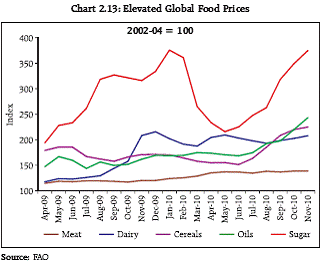
by central banks. The FAO Food Price Index has also
risen close to its pre-crisis peak. Upswing in food
prices, particularly of sugar, cereals and edible oil at
the global level (Chart 2.13) is of concern to India as it
limits the use of food imports as a tool for curbing
domestic food inflation which continues to rule at
elevated levels.
 |
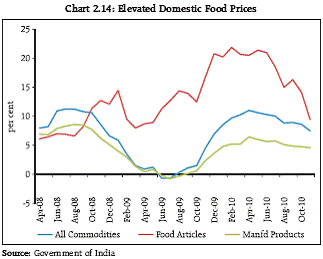
2.24 Structural demand-supply mismatches in several
commodities have contributed to high domestic food
price inflation (Chart 2.14). In particular, prices of
protein-rich foods like eggs, milk, pulses, meat and fish
as well as fruits and wheat in India has been ruling at high levels. The causative factors include rising income,
changing consumption pattern, stagnant agricultural
productivity and rising global prices.
 |
2.25 The monetary policy response has been
calibrated based on domestic growth-inflation scenario
and global developments. Since October 2009, the
Reserve Bank has cumulatively raised the cash reserve
ratio (CRR) by 100 basis points, and the repo and reverse
repo rates under Liquidity Adjustment Facility (LAF)
by 150 and 200 basis points, respectively. Recently,
statutory requirement of investment in SLR securities
has been reduced by one percentage point and open
market purchase of government securities worth
`48,000 crore has been announced to ameliorate the
shortage of liquidity. The increased frequency of policy reviews should help in managing expectations and
reducing uncertainties.
Savings and Investment – the shortfall widens
2.26 The rate of gross domestic savings (GDS) was
lower in 2008-09 reflecting the impact of sharp fall in
the rates of savings of the public sector and marginal
fall in that of private corporate sector. The rate of saving
of the household sector remained unchanged at the
previous year’s level (Chart 2.15).
2.27 The gross domestic investment rate declined
consequent to a fall in private corporate investment.
However, the fall in investment was less than that of
savings and the shortfall was reflected in the widening
of current account deficit.
Fiscal situation still stretched
2.28 Use of countercyclical fiscal measures and the
recent sovereign debt crisis underscores the importance
of fiscal conditions for financial stability. In India, apart
from enabling output stabilisation on a high growth path,
fiscal measures have been used for limiting the impact
of temporary but large supply shocks on headline
inflation. The extraordinary fiscal policy measures
undertaken in India during 2008-09 and 2009-10, to a
large extent, achieved the short-term objective of
containing the economic slowdown and stimulating the
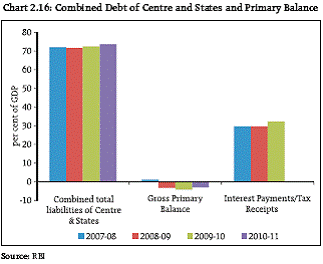
economy thereafter. The public debt, as a result, rose in
2009-10 and is expected to cross 73 per cent of GDP in
the current year (Chart 2.16).
 |
2.29 Though India has a relatively high level of deficit
and debt among emerging market countries, the
sovereign has not committed the ‘original sin’6 of high
borrowing in foreign currency. Most of the country’s
public debt is denominated in domestic currency and
held domestically. The Government does not borrow in
external commercial markets. However, investment by
FIIs has been allowed subject to macroprudential caps
on such investment.
2.30 The maturity profile of debt7 also compares
favourably with other countries. The average maturity of outstanding debt and share of debt maturing in
the next few years for India is comfortable vis-à-vis
some select countries (Charts 2.17 and 2.18). The
funding structure also shows no extreme risk
(Chart 2.19).
2.31 Nevertheless, the current debt level hovering
above 70 per cent for the past three years is much above
the historical averages of 55 per cent in the 1980s and
63 per cent in the 1990s. As a result of the high debt,
the interest payments have been rising and account
for almost one-third of the total tax receipts. Lowering
of debt would provide room for fiscal manoeuverability
and send a strong signal of the government’s
commitment to fiscal consolidation.
2.32 This year, government revenues have been
buttressed by one-time receipts especially telecom
receipts and divestment proceeds. Going forward, fiscal
consolidation should focus on ‘quality of adjustment’
underpinned by revenue-led correction and
reprioritisation of expenditures with a focus on
outcomes.
Widening of Current Account Deficit and Resurgence
of Capital Flows
2.33 Notwithstanding some fiscal consolidation, the
current account has been widening accompanied by
rise in capital flows. Studies on cyclical synchronisation
and variance decomposition studies have highlighted
the growing importance of financial channels of
transmission of global developments in recent
periods8 . Moreover, the probability of a banking crisis
conditional on a capital flow bonanza has been found
to be higher than the unconditional probability9 .
Thus, the rise in capital flows needs to be closely
monitored.
2.34 The absorptive capacity of capital flows as
reflected in the magnitude of the CAD has increased
in the recent years from 2.4 per cent of GDP in 2008-09
to 2.9 per cent of GDP in 2009-10, which reflected the
recovery in growth (Chart 2.20). The uncertain and
uneven global recovery, particularly in advanced
economies, could have an adverse impact on exports from India. Hence, during 2010-11, the CAD/GDP ratio
could rise further. While capital flows to the country
are expected to be robust, an increase in the share of
lumpy and volatile capital flows in funding widening
deficit raises the risks of the destabilising impact of
sudden stops or reversal of capital flows. Excess capital
flows also pose challenges for exchange rate, interest
rate and inflation environment. These are discussed
in Chapter III of the Report.
International Investment Position
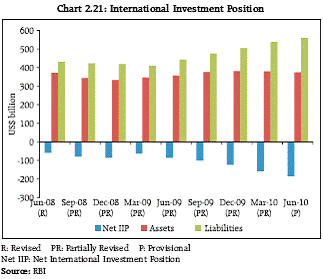
2.35 Along with widening of CAD, there has been
rapid growth in international liabilities after March
2009 resulting in increase in net claim of non-residents
on India (international assets-international liabilities)
or the net international investment position and in
June 2010, which stood at US$ 185.1 billion, more than
three times its level in June 2008 (US$ 58.6 billion) and
more than two times its level in June 2009 (US$ 86.3
billion). Increase in FDI, portfolio investment and loans
have contributed to the growth in international
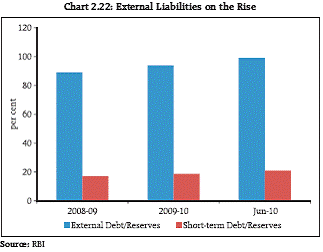
liabilities (Chart 2.21). The enhanced exposure to
external liabilities is reflected in the sharp increase in
the ratio of external debt to foreign exchange reserves
from 89.1 per cent of GDP in 2008-09 to 99.1 per cent
as at end June 2010. Moreover, the ratio of short-term
debt to reserves has increased from 17.2 per cent to
21.0 per cent during the same period (Chart 2.22). The
above trends point to emerging concerns with respect
to India’s external liability position warranting close
monitoring.
 |
 |
Real Estate: Some Concerns Emerge
2.36 Housing price has emerged as one of the most
reliable indicators of banking crises10 . Commenting on
the outlook of the real estate, the recent WEO (October
2010) observes that in economies where real estate
markets are still in decline, the drag on real activity
will continue. And in economies where house prices
and residential investment are rebounding, concern
about bubbles is eliciting policy actions that will temper
any short term boost to economic activity emanating
from this sector.
2.37 In India, data on housing prices reveal that prices
in many centres have surpassed their pre-crisis levels.
The growth in credit to housing sector remained healthy
as the banks continued to offer alluring schemes to
prospective housing loan borrowers (Chart 2.23).
Continued rise in NPAs in the real estate
2.38 Though the share of credit flowing to real estate
has remained stable, the NPAs in real estate sector
recorded a rise, thereby underlining the need for more
intensive monitoring (Chart 2.24). Against this
backdrop, the Reserve Bank announced a series of
measures to tighten prudential norms in the sector, as
discussed in Chapter IV of this Report.
Corporate Sector
Corporate Interest Liability remains Moderate
2.39 The low interest rate environment and
moderation of growth rate resulting in deceleration
in borrowings was reflected in a sharp dip in the
burden of interest payments in the corporate sector
(Chart 2.25). During the first half of current year the
growth in interest payments has been modest. The
interest coverage ratio continued to hover around 5.
2.40 Except for a small dip in the aftermath of
Lehman crisis, the corporate sector has maintained its
profitability which implies that servicing of borrowed
funds may not get adversely impacted.
RBI Survey shows improved outlook
2.41 RBI Industrial Outlook Survey points towards
sharp improvement in assessment of the July-
September 2010 quarter and expectation of October-
December 2010 (Chart 2.26). Both demand and
employment conditions have recorded an uptrend.
Household Sector
Borrowing remains at low level
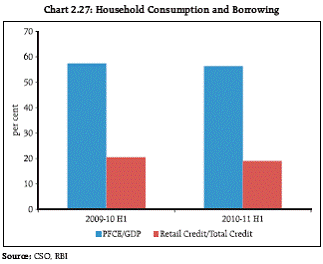
2.42 As mentioned in the first FSR, the dependence
of households on bank credit has been ruling at low
levels. This trend continues during the first half of
2010-11 (Chart 2.27).
 |
2.43 As mentioned earlier, developments in the
housing sector are emerging as a concern due to sharp
rise in prices in some centres and in some segments of
the housing sector. There was significant increase in
the delinquencies in housing loans though gross NPA
ratio remained moderate at around 2.5 per cent. As
discussed in Chapter IV of this Report this was largely a
result of adverse credit selection during the periods of
aggressive lending prior to the crisis. (Chart 2.28).
Overall, however, there has been some improvement
in the quality of the retail loan portfolio of banks which
is reflected in lower retail NPAs (Chart 2.29). This points
to a possible improvement in the health of households
though the level of retail NPAs remains high. The
position could be expected to improve with stronger
economic growth.
Concluding Remarks
2.44 Though the economy is set to move on a higher
growth trajectory, certain downside risks at the global
and domestic levels remain. First, uncertain and
uneven global recovery, particularly in advanced
economies, could have an adverse impact on exports
from India. Second, the global imbalances continue to
persist. There have been some efforts towards
rebalancing but the pace of progress is very slow. Third,
slow recovery, efforts at rebalancing and competitive
currency adjustments are expected to prolong the
recovery in world trade. Fourth, the potential surge in
capital flows raises the spectre of asset price booms in some emerging and developing economies. Fifth,
high liquidity is driving international crude oil and
other commodity prices, which has inflationary
implications. Sixth, the rise in current account deficit
and the increase in the share of volatile capital flows
in financing the deficit require corrective measures.
Seventh, the level of public debt needs to be lowered
to enhance the fiscal space available to the
policymakers and improve the sovereign rating and
confidence level. Eighth, rise in housing prices in
certain centres and certain practices warrant closer
monitoring.
1 RBI (2010). Global Financial Crisis and the Indian Economy. Report on Currency and Finance.
2 BIS (2010). 80th Annual Report.
3 Reinhart, Carmen M. and Kenneth S. Rogoff (2010), “This Time is Different - Eight Centuries of Financial Folly”, Princeton University Press, Princeton and Oxford
4 Baldacci, Emanuele, Sanjeev Gupta and Carlos Mulas-Granados (2010). “Restoring Debt Sustainability After Crises: Implications for the Fiscal Mix”. IMF Working Paper WP/10/232, October
5 Based on the identity “Domestic Private Sector Financial Balance + Governmental Fiscal Balance - the Current Account Balance (or Trade Deficit/Surplus) = 0” domestic private sector and the government sector cannot both deleverage at the same time unless a trade surplus can be achieved and sustained.
6 Inability to borrow abroad in terms of domestic currency and to borrow domestically long-term is referred to as “Original Sin” in Eichengreen, Barry and Ricardo Hausmann (1999), “Exchange Rates and Financial Fragility,” in New Challenges for Monetary Policy, Kansas City: Federal Reserve Bank of Kansas City, pp.329-368
7 Choice of maturity of issuance of debt can affect monetary conditions and funding markets for banks and others as securities in a market
economy are normally priced off the sovereign yield curve. Issuance of short term government debt can reduce the government’s short-run debt
servicing burden but interfere with impact of monetary policy decisions on the yield curve. Shortening maturity of debt issuance also increases
the government’s refinancing risk. At the same time, increased long term public debt creates a steep yield curve thus creating incentives for
banks to extend duration of assets and reduce it for liabilities. It also sharpens the risk/cost trade-off for sovereign debt management.
8 RBI (2010). op. cit.
9 Reinhart and Rogoff (2010), op. cit.
10 Reinhart and Rogoff (2010), op. cit
|