India’s central bank is one of its best institutions. It is also complicit in a government-borrowing binge
One of
the
perks of
being governor of the Reserve Bank of India (RBI) is the use of a colonial
bungalow on Carmichael Road, a posh street that weaves along a ridge
in south Mumbai. On one side live some of India’s richest industrialists,
modern-day pharaohs with flashy architectural tastes. On the other, a
stone’s throw down a cliff, is a small slum—a monument to desperation
and government failure. Both sets of neighbours are part of the 1.2
billion population that India’s central bank must look out for. In normal
times this is a task that would furrow the brow; now that the country’s
boom is faltering, it risks causing a blinding headache.
Judging by the numbers, the RBI is among the world’s best central
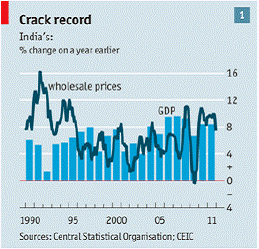
banks. Its record on balancing growth and inflation is decent enough (see chart 1). Since 1995 wholesale
prices have risen by an average of 6% a
year, not too far from the RBI’s comfort
zone of about 5%. Growth has averaged
7% a year. The RBI is also in charge of
the safety of the financial system, to
which end it yanks more levers than
Willy Wonka in a chocolate factory. Its
record here is excellent. Despite a
current-account deficit that leaves India
vulnerable to global jitters, the country
sidestepped the 1997 Asian crisis (“nobody gave us a chance,” recalls a
former governor) and the West’s banking crisis in 2008. The RBI also
coped with big and potentially destabilising capital inflows in the
euphoric years before Wall Street began to totter, and has avoided a
domestic financial crisis despite fast growth in banks’ assets for many
years.
 |
Some fancy the RBI is a model for the kind of full-service central bank
that is back in fashion worldwide—both the Federal Reserve and the
Bank of England, among others, are now in charge of financial stability
as well as interest rates. In truth, it would be hard to run a rich
economy the way the RBI does India, with its financial system only
partly liberalised. But the central bank has new clout abroad and at
home its stock is high.
Under the present governor, Duvvuri Subbarao, a softly spoken figure,
it has made a tough series of rate rises in the past two years to try to
curb a stubborn spell of inflation (a battle that may not be over). And
although the bank finds it hard to tempt star graduates to work in its
tower overlooking Mumbai harbour—“if you look at its people and those
of the Fed, there’s no comparison,” laments one bigwig—relative to
most Indian state bodies the RBI has more brains, muscle and
integrity. It is about the only institution in the country you never hear
accused of graft.
That’s a big turnaround for a body that became a politicians’ plaything
after India nationalised its banks in 1969. For two decades the state
controlled lending and also fixed as many as 200 separate interest
rates. It used the RBI as a piggy bank, forcing it to print money to
finance its short-term needs. After 1991, when a balance-of-payments
crisis led India to deregulate, the central bank rediscovered its spine. Agreements fully enacted in 1997 and 2006 stopped the state using it
as an ATM, and as interest rates were liberalised and the bond market
developed, the RBI began to look more like a normal central bank,
setting short-term policy rates to try to balance inflation and growth.
This journey never reached the destination that was until recently in
vogue in the West—that of a statutorily independent central bank
narrowly focused on setting interest rates and targeting inflation. The
RBI’s independence is not enshrined in law, although none of the four
central-bank governors since 1992, interviewed by The Economist for
this article, raised this as a big concern. The RBI consults the
government but it has enough breathing-space to set rates as it
pleases, they say.
And like a triumphant wearer of flares that have at last come back in
fashion, the RBI’s wide remit—minting coins, managing the exchange
rate, acting as banker for the government, and supervising banks and
the bond market—is now seen as a template. These responsibilities
helped it deal with the 2008 crisis: in short order it defended the
currency, loaned money to cash-strapped banks, gave forbearance on
troubled loans, soothed the bond market and eased banks’ capital
requirements. Today a process of constant tweaking continues. In
December, after a panicky fall in the rupee, the RBI introduced several
obscure measures to bolster it, such as making it more attractive for
Indians resident abroad to deposit money in the homeland.
Such fiddling has a cost. In 2007 an official report on making Mumbai a
global financial centre—a work of great imagination—identified nitpicking
and suspicion of foreign financiers (who are welcome to buy
shares in India but not to play in debt markets) as a big problem. In
2009 an official review of finance chaired by Raghuram Rajan, a former
chief economist of the IMF, worried that conservative regulation was
inhibiting India’s potential. One local bank boss says the RBI “runs a
repressed financial system which is intolerant towards innovation. If the
US was at 90 out of 100 in terms of complexity and sophistication, we
are at 10…I sometimes get the impression it [the RBI] is resting on its
laurels, not realising that more financial innovation could help India’s
development.”
Still, after years of financial convulsions abroad it is hard to say that
the RBI has got the balance between safety and thrills wildly wrong.
Indeed, the thing that endangers India today is not its financial markets
but its government.
Heady talk of 9-10% as India’s new natural rate of growth is long gone.
Many blame the government, which has not passed a significant reform
for years while running a fiscal deficit of almost a tenth of GDP,
including the states and off-balance-sheet items (see chart 2). The
deficit—which began as an electoral giveaway in 2007, morphed into a
stimulus package and is now just a product of indiscipline and populist
politics—is widely seen as bad for India. Government borrowing crowds
out the private sector, which has to live with higher interest rates than
might otherwise be the case. Because the state is less likely than
private business to spend the cash on investment, it does less to boost
the economy’s potential.
At the RBI the boom of 2003-07, when growth was near double-digits
and inflation comfortable, is now seen as a distinct era during which the
deficit was falling, bullish firms were investing freely, a critical mass of
reforms were in the bag and the state was productively solving day-today
problems. Those conditions do not exist today. The central bank’s
rule of thumb for the non-inflationary rate of growth has fallen to 8%,
but that seems to bake in an assumption that the political class will
recover its wits. If, hypothetically, that does not happen, insiders at the
RBI accept that trend growth could be significantly lower. Bears outside
the central bank talk of 6%.
The uncomfortable question for the RBI is whether it is partly
responsible for the slowdown, albeit indirectly. If you have a central
bank that always gets you home safely at the end of the night the
temptation for politicians may be to go crazy. The RBI’s position is
especially delicate on the fiscal deficit. The central bank oversees a
financial system that is a conduit for funnelling savings into government
bonds, 70% of which are owned either by the central bank or by the
banking system, which remains dominated by state-owned lenders.
Although the ratio has come down, the RBI still forces banks to invest
24% of their core deposits in government bonds, far above what is
needed to give banks a safety buffer of liquid assets. This creates
captive demand for public borrowing (although during an economic soft
patch such as today’s, cautious banks may voluntarily hold more than
the minimum). The RBI also buys government bonds in the market. It
argues this makes markets work smoothly, but most outsiders think the
aim is to put a lid on government-bond yields. A spike in yields in
November has been followed by a big, $14 billion RBI bond-purchase
programme.
The RBI is thus in the weird position of publicly rebuking the
government about its deficits while being the guarantor that they are
financed. An extreme remedy would be for it to stop buying nearly so
many bonds and to ease the rules on banks’ bond holdings. Without
captive buyers interest rates would rise, perhaps by a percentage point
or two. Some doubt whether the politicians would pay any attention—
their appetites are insensitive to the government’s borrowing costs, it is
argued. But the RBI would still probably like to try; in December 2010
it cut the liquidity requirement from 25% to 24%. The trouble is,
anything more dramatic might be seen as meddling in politics and could
prompt a bond-market rout that endangers stability.
Prop trading
In this respect, as with its strong supervisory record, the RBI may have
lessons for the world. Other central banks, including the euro zone’s,
are propping up sovereign-bond markets. Mr Rajan talks of “the conceit
that central banks are independent. When they find that the
governments are not going to budge [on cutting their deficits] few feel
able to just walk away.” In a speech on February 1st, Mr Subbarao, the
RBI’s governor, worried that “in the presence of large sovereign
borrowing…central banks typically have little choice.”
One possibility is that slower growth, high borrowing and lack of reform
might eventually prompt a fiscal or balance-of-payments scare that
even the RBI, with its impressive array of tools, struggles to keep a lid
on. That might frighten the political class enough to act. The more
benign scenario is that politicians will anticipate this risk and act
spontaneously to get India’s public finances back on track. But politics
is one thing India’s central bank cannot control. As he settles down at
his villa to watch the sun set over the metropolis of Mumbai, all the
governor of the RBI can do is cross his fingers.
|