|
'Liquidity Management in India' is a subject
that is not widely discussed but is the bread and butter of daily monetary management.
Whereas I was not a monetary specialist prior to coming to the Reserve Bank,
I have been able to gather some insights through on-the-job training. It is
also an issue of current relevance and appeal.
Conduct of monetary policy and management in
the context of large and volatile capital flows has proved to be difficult for
many countries. As India became convertible on the current account, and liberalised
its capital account in a carefully sequenced manner since the balance of payment
crisis of 1991, it too has been faced with similar problems. The evolving policy
mix involved careful calibration that took into account diverse objectives of
central banking, changes in the monetary policy framework and operating procedures,
and widening of the set of instruments for liquidity management.
Before opening of the economy through the 1990s,
both the current and capital accounts were controlled. However, despite trade
restrictions the current account was in constant deficit, which had to be financed
mostly by debt, both official aid flows and private debt. Portfolio flows were
not permitted and foreign direct investment was negligible. The only largely
'uncontrolled' flows were NRI deposits, which waxed and waned according to macro-economic
conditions. The exchange rate was also controlled: it was linked to a basket
of currencies and moved as a crawling peg. Consequently, monetary policy management,
such as it was, did not pose serious problems, particularly since most interest
rates were fixed administratively.
It is only after substantial opening of
the economy, and deregulation of interest rates that price discovery of the
rate of interest has become important. Consequently the Reserve Bank has had
to experiment on a continuous basis. It has had to operate simultaneously on
the external account in the foreign exchange market to contain volatility in
the exchange rate, and in the domestic market to contain volatility in interest
rates. Since both the exchange rate and interest rate are the key prices reflecting
the cost of money, it is particularly important for the efficient functioning
of the economy that they be market determined and be easily observed. Excessive
fluctuation and volatility masks the underlying value and gives rise to confusing
signals. The task of liquidity management then is to provide a framework for
the facilitation of forex and money market transactions that result in price
discovery sans excessive volatility.
Liquidity Management and Management of Capital
Flows
Let me begin with some general remarks on liquidity
management and management of capital flows.
While in the macroeconomic context, liquidity
management refers to overall monetary conditions, reflecting the extent of mismatch
between demand and supply of overall monetary resources, for a central bank,
the concept of liquidity management typically refers to the framework and set
of instruments that the central bank follows in steering the amount of bank
reserves in order to control its price, consistent with the ultimate goals
of monetary policy (Bindseil, 2000). What is the price of bank reserves? The
price of bank reserves is fixed in terms of short term interest rates. This
is set in terms of overnight inter-bank borrowing and lending rates either secured
or unsecured which affect the reserves that the banks keep. As markets do not
clear often on their own the central bank itself steps in by influencing the
short-term interest rates by affecting short-term repurchase obligations with
banks (Borio, 1997).
The need for liquidity management arises from
central banks’ concept of liquidity measured in terms of the monetary base,
of which it is the monopoly supplier. The supply of monetary base by the central
bank depends on (i) the public's demand for currency, as determined by the size
of monetary transactions and the opportunity cost of holding money and, (ii)
the banking system’s need for reserves to settle or discharge payment obligations.
In fulfilling these needs, central banks also attempt to control and modulate
liquidity conditions by varying the supply of bank reserves to meet its macroeconomic
objectives subject to the constraint of financial stability. Bank reserves are,
therefore, influenced through reserve requirements or open market operations.
In so doing, central banks attempt to affect the level of short-term interest
rates in a manner in which market movements of these interest rate movements
are smoothened out as volatility of any monetary or non-monetary asset prices
can be costly in terms of real output and investment decisions. It is from this
standpoint that a central bank decides to modulate its market operations over
a chosen time horizon to reflect its policy stance.
The importance of central bank liquidity management
lies in its ability to exercise considerable influence and control over short-term
interest rates by small money market operations. This ability is determined
by the credibility of the central bank itself. The interventions that the central
bank makes have a pronounced signaling affect. Consequently, developed country
central banks typically aim at a target overnight interest rate, which acts
as a powerful economy wide signal. As a result, the impact of these transactions
is fundamentally different from those undertaken by private market participants.
The liquidity management function of a central bank involves a larger economy-wide
perspective. Central bank liquidity management has short-term effects in financial
markets. However, the long-term implications for the real sector and on price
level are more important.
By operating on the current account balances
that the commercial banks maintain with the central bank or by directly operating
on the short-term money market rate, central banks attempt to influence money
market liquidity in order to exercise control over the short-term interest rate.
The central bank may directly set at least one of the short-term interest rates
that acts as its policy rate. By controlling the short-term interest rate while
letting markets determine the rest of the yield curve, the central bank attempts
to transmit monetary policy impulses across the yield curve. The sovereign yield
curve in turn influences the lending and deposit rates in the economy. Mortgage
rates are found to be particularly sensitive to the policy rate changes through
the interest rate as well as the credit channel. Once bank lending gets affected,
interest rates impact real variables such as consumption and investment, which
in turn impact output and inflation levels. So while active liquidity management
has a localised objective of keeping short-term interest rates range bound,
it also has a long-term meta objective of implementing monetary policy goals
of inflation and output.
The difficulty is that monetary policy is formulated
and implemented under considerable uncertainty. Injections or absorptions made
over extended periods as an intended part of policy have implications on output
and prices through changes in interest rates and aggregate demand. Typically,
the transmission effects tend to differ across countries depending on country
specific factors and institutional and regulatory frameworks. As transmission
occurs with long and variable lags in all countries, the long-run impact is
often unpredictable.
While liquidity management in most advanced
country central banks is conducted in a setting where daily demand for money
typically exceeds its supply, liquidity management in emerging markets is more
varied, with surplus and shortage conditions alternating and with perhaps greater
fluctuations in their external accounts (Saggar, 2006). In recent years, capital
flows have been a major factor affecting liquidity management in a large number
of countries, particularly in Asia, which have faced large and volatile capital
flows. Capital flows have little effect on liquidity in the presence of equivalent
current account deficits that result in the absorption of capital flows in the
economy and they help to accelerate growth in investment, employment and in
technology imports, contributing to productivity growth. In situations where
they exceed the current account deficit, they result in a build up of foreign
exchange reserves, which themselves act as a positive signaling device indicating
financial stability.
But unsterilised capital inflows can result
in inflation, currency appreciation, loss of competitiveness and attenuation
of monetary control. The loss of monetary control could be steep if such flows
are large. Even when these flows are sterilised through open market operations
the costs could be large when sterilisation operations raise domestic interest
rates and result in the trap of even greater capital flows. The fiscal impact
of sterilisation also requires to be factored in, specially when a large stock
of securities is required to be issued for the purpose.
Clearly, macroeconomic policy options for
managing capital flows are difficult. The options also require taking into account
the high volatility often associated with such capital flows. These flows are
marked by sudden surges and reversals, which in some cases, could occur in a
week’s time or less. In other cases, surges could be followed by stoppages in
a short span of time. Stoppages could also give way to reversals at slight triggers.
There are also cases where capital flows are sustained over a long period of
time or a drought in flows occurs over a medium-term. In sum, these flows are
somewhat unpredictable and it is very difficult to assess the liquidity scenario
even over a quarter, far less over a year. At the same time, monetary policy
operates with transmission lags that could run 3-4 quarters or longer and these
lags are often unpredictable.
Typically, countries that are in the quest
for capital flows fall under the impossible trinity problem, referred to earlier.
Notwithstanding the theoretical basis, history is replete with examples of countries
falling under the temptation to achieve all these goals when faced with opportunities
for benefiting from global asset portfolio allocations (Obstfeld, Shambaugh,
and Taylor, 2004). Generally, countries seek to retain their monetary policy
independence as they face asymmetric shocks and common currency area conditions
are not pervasive. They are also tempted to keep their exchange rates stable
for financial stability or for inflation containment objectives. In most cases
countries end up making a costly exit from a hard peg. With greater financial
openness, many countries have to move towards greater exchange rate flexibility
or accept the subordination of monetary policy goals to goals of global capital
market integration. The latter, however, could be costly.
Let me now turn to our own situation and
how we have coped with the evolving circumstances in India.
Capital Flows in India
The far reaching economic reforms in India in
the 1990s, witnessed a sharp increase in capital inflows as a result of capital
account liberalisation in India and a gradual decrease in home bias in asset
allocation in advanced economies. During 1990-91, it was clear that the country
was heading for a balance of payment crisis caused by increased absorption due
to deficit financed fiscal expansion of the 1980s and the trigger of oil price
spike caused by the Gulf War. As foreign exchange reserves dwindled to less
than a month’s import financing requirements in 1991, global capital taps got
switched off and the country faced a real possibility of a first ever sovereign
default. Crisis managers got active and averted the default, leaving the country
still with a default-free history. The survival stimuli it kindled, unleashed
massive economic reforms. The reform story has been told several times in many
different fora and I do not intend to repeat it here.
Foreign investment flows, mainly in the form
of foreign direct investments, averaged US$118 million during 1990-91 and 1991-92.
A significant change in our capital account took place when portfolio investments
by foreign institutional investors were permitted in 1992. With the exception
of 1998-99 when, in the aftermath of contagion from East Asian financial crisis,
portfolio flows turned negative, total foreign investment in the form of direct
and portfolio investment was US$ 4-8 billion a year till 2002-03. Excluding
1998-99, it has averaged nearly US$ 5.8 billion over a 9-year period starting
1993-94. There was another quantum leap in the following two years – 2003-04
and 2004-05 with direct investment averaging US$ 5.1 billion and portfolio investment
averaging US$ 10.1 billion, taking total foreign investment exceeding US$ 15
billion. As it happened, this increase in capital flows coincided with a slowdown
in the economy, particularly the industrial economy after 1997-98, and instead
of current account deficits we had current account surpluses. Consequently,
even ignoring the non-resident deposit flows, equity investment flows in themselves
posed a considerable challenge for monetary management.
While the year to year foreign investment flows
provide some idea of the magnitude of the capital flows that may be required
to be sterilised, the month-to-month or intra-month variations in these flows
provide a better idea of the volatility of these flows with which central bank
liquidity management has to cope and these variations have been sizeable. They
have been dominated by portfolio flows. While these flows appeared to be mean
reverting till October 2002, there appears to have been a strong trend with
wider oscillations subsequently. This means that the monetary authorities now
have to cope with larger and more volatile capital flows than it had been faced
with in about a decade from the onset of reforms.
Faced with these large capital flows, there
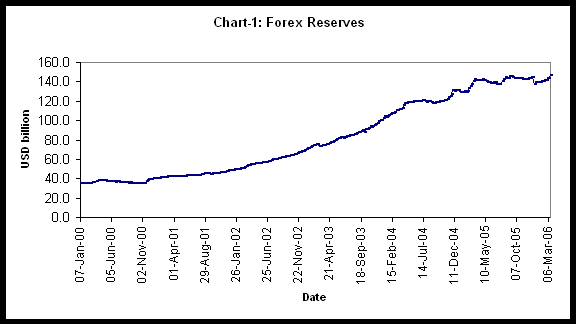
has been a steep accretion to foreign exchange reserves starting October 2000.
Over US$ 100 billion have been added in foreign exchange reserves since then,
taking them from US$ 34.9 billion to US$ 143.6 billion in October 2005. IMD
redemptions saw the reserves temporarily dropping to US$ 135 billion at end-December
2005 but the reserves are back at US$ 146.2 billion by March 17, 2006 (Chart
1). The reserve accretion of this large magnitude has been largely the result
of massive capital flows. The capital flows are adding to absorption directly
as well as indirectly through increased domestic credit growth and have resulted
in a steep rise in trade deficit and, till at least recently, substantial excess
liquidity in the economy. The problem of scarcity of 1991 is now seen as a problem
of plenty by many.
In these circumstances, the problem for monetary
management was two-fold. First, it had to distinguish implicitly between durable
flows and transient flows. If capital flows are deemed to be durable and indefinite,
questions arise regarding foreign exchange management. If the flows are deemed
to be semi-durable, essentially reflecting the business cycle, the task of monetary
and liquidity management is to smoothen out their impact on the domestic economy,
finding means to absorb liquidity in times of surplus and to inject it in times
of deficit. Second, in the short term, daily, weekly or monthly volatility in
flows needs to be smoothened to minimise the effect on domestic overnight interest
rates. In practice, ex-ante, it is difficult to distinguish what is durable,
what is semi-durable and what is transient. Hence policy and practice effectively
operates in an environment of uncertainty and a variety of instruments have
to be used to manage liquidity in this fluid scenario.
Shift from Direct to Indirect Instruments
There has been a worldwide trend for shifting
from direct instruments of monetary control to indirect instruments (Alexander,
Balino and Enoch, 1995). India is one of the emerging market countries, where
such a change has distinctly occurred. A major transformation has occurred in
the monetary policy framework in the 1990s. In response to the changing financial
landscape, the Reserve Bank adopted several policy changes which transformed
the monetary policy framework.
Monetary policy had to respond to the challenge
posed by the problem of plenty, which required liquidity management to be honed
up to meet the new challenge. Major institutional changes since 1991 have supported
the possibility of transition in the monetary policy framework. Credit ceilings
were removed, though directed lending was retained. Interest rates were freed
with the exception of the saving deposit rate, some NRI deposit rates and lending
rates for loans of below Rs 2 lakh. From a completely managed float, the exchange
rate was made market determined and the rupee was made fully convertible on
the current account, while the capital account was substantially liberalised.
Automatic monetisation of budget deficits was stopped with the signing of the
Supplemental Accord in 1997. Yields on gilts were made market determined, while
the pricing of primary stock market issues were freed. With financial innovations,
money demand was seen to be less stable than before and disequilibrium in money
markets had begun to be reflected in short-term interest rates. The exchange
rate had become endogenous to money, income, prices and interest rates. There
is increasing evidence of increased integration among various financial markets.
The money market has integrated substantially with the foreign exchange market
at the short-end. Furthermore, foreign exchange market efficiency was found
to hold at the short-end. The term structure was still somewhat segmented but
some transmission across the yield curve was in evidence.
In response to the changing financial landscape,
the Reserve Bank adopted several policy changes that transformed the monetary
policy framework. Reserve requirements in the form of Cash Reserve Ratio (CRR)
were brought down from the statutory maximum of 15 per cent of net demand and
time liabilities during July 1989 to April 1993 to 4.5 per cent in June 2003,
which was raised subsequently to 5.0 per cent in two stages in October 2004.
The Statutory Liquidity Ratio (SLR), which directs banks to maintain liquid
investments, mainly in the form of government securities, was reduced from an
all time high of 38.5 per cent in January 1993 to the statutory minimum of 25
per cent by October 1997. Legislation has now been introduced in Parliament
to remove both the statutory minimum for SLR and CRR in order to provide for
greater monetary policy flexibility.
From the point of monetary policy framework,
the significant development was the move to a 'multiple indicator approach"
from 1998. Prior to the mid-1980s, monetary policy was based predominantly on
direct instruments of monetary control with credit budgets for the banks being
framed in sync with monetary budgeting. In view of the institutional changes
stated in this section and the subsequent one, the Reserve Bank formally shifted
its policy framework from monetary targeting to the multiple indicator approach
since 1998-99. As part of this approach, it started using the information content
in interest rates and rates of return in different markets along with currency,
credit, fiscal position, trade, capital flows, inflation rate, exchange rate,
refinancing and transactions in foreign exchange, juxtaposing it with output
data for drawing policy perspectives.
Liquidity Management through Indirect Instruments:
Early Trends
Before the advent of repos, market operations
by the RBI almost invariably focused on open market operations through outright
transactions in government securities. The scope of open market operations in
the earlier period was limited as yields were repressed by an administered interest
rate regime, including auctions of T-bills on tap at fixed coupon of 4.6 per
cent. The move towards a market determined system of interest rates began by
development of the secondary market by increasing coupons and decreasing maturity
of government debt. The yields were made substantially market determined by
introduction of auctions since the mid-1980s. The Reserve Bank introduced reverse
repos for absorption from December 1992. With the objective of improving short-term
management of liquidity in the system and to smoothen out interest rates in
the call/notice money market, the Reserve Bank began absorbing excess liquidity
through auctions of reverse repos (then called repos). The development of repos
into a full fledged monetary instrument in the form of LAF has been a fascinating
case study of what it takes to undertake changes in operating framework. The
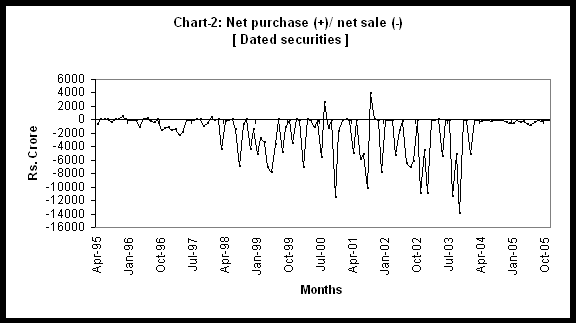
chronology of these developments is provided in Box-I. Till 2003-04, market
operations were primarily conducted in the form of outright sales and purchases
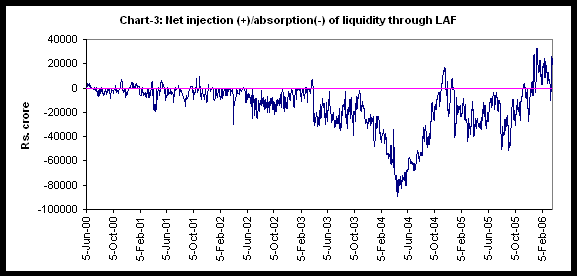
of government securities (Chart-2). Since then, LAF volumes have increased considerable
(Chart-3). The important contribution of LAF has been in keeping overnight interest
rates by and large range bound. With the activation of bank rate as a policy
instrument, reverse repos helped in creating an informal corridor in the money
market, with the reverse repo rate as floor and the Bank Rate as the ceiling.
The use of these two instruments enabled RBI to keep the call rate by and large
within this informal corridor.
Although repo auctions were conducted at variable
rates when LAF was introduced, with a view to providing quick interest rate
signals, RBI did have the additional option to switch over to fixed rate repos
on overnight basis, in order to meet unexpected domestic or external developments.
LAF was introduced on the basis of uniform price auctions, but the auction system
was switched to multiple price auctions from May 5, 2001 (Box - I).
Box-I: Liquidity Adjustment Facility
The choice of operating framework and operating
procedures in any economy is always a difficult one and depends on the stage
of macro-economic and financial sector development and is somewhat of an evolutionary
process. As part of the financial sector reforms launched in mid-1991, India
began to move away from direct instruments of monetary control to indirect ones.
The transition of this kind involves considerable efforts to develop markets,
institutions and practices. In order to facilitate such transition, India developed
a Liquidity Adjustment Facility (LAF) in phases considering country-specific
features of the Indian financial system. LAF is based on repo / reverse repo
operations by the central bank.
In 1998 the Committee on Banking Sector Reforms
(Narasimham Committee II) recommended the introduction of a Liquidity Adjustment
Facility (LAF) under which the Reserve Bank would conduct auctions periodically,
if not necessarily daily. The Reserve Bank could reset its Repo and Reverse
Repo rates which would in a sense provide a reasonable corridor for the call
money market. In pursuance of these recommendations, a major change in the operating
procedure became possible in April 1999 through the introduction of an Interim
Liquidity Adjustment Facility (ILAF) under which repos and reverse repos were
formalised. With the introduction of ILAF, the general refinance facility was
withdrawn and replaced by a collateralised lending facility (CLF) up to 0.25
per cent of the fortnightly average outstanding of aggregate deposits in 1997-98
for two weeks at the Bank Rate. Additional collateralised lending facility (ACLF)
for an equivalent amount of CLF was made available at the Bank Rate plus 2 per
cent. CLF and ACLF availed for periods beyond two weeks were subjected to a
penal rate of 2 per cent for an additional two week period. Export Credit refinance
for scheduled commercial banks was retained and continued to be provided at
the bank rate. Liquidity support to PDs against collateral of government securities
at the bank rate was also provided for. ILAF was expected to promote stability
of money market and ensure that the interest rates move within a reasonable
range.
The transition from ILAF to a full-fledged LAF
began in June 2000 and was undertaken in three stages. In the first stage, beginning
June 5, 2000, LAF was formally introduced and the Additional CLF and level II
support to PDs was replaced by variable rate repo auctions with same day settlement.
In the second stage, beginning May 2001 CLF and level I liquidity support for
banks and PDs was also replaced by variable rate repo auctions. Some minimum
liquidity support to PDs was continued but at interest rate linked to variable
rate in the daily repos auctions as determined by RBI from time to time. In
April 2003, the multiplicity of rates at which liquidity was being absorbed/injected
under back-stop facility was rationalised and the back-stop interest rate was
fixed at the reverse repo cut-off rate at the regular LAF auctions on that day.
In case of no reverse repo in the LAF auctions, back-stop rate was fixed at
2.0 percentage point above the repo cut-off rate. It was also announced that
on days when no repo/reverse repo bids are received/accepted, back-stop rate
would be decided by the Reserve Bank on an ad-hoc basis. A revised LAF
scheme was operationalised effective March 29, 2004 under which the reverse
repo rate was reduced to 6.0 per cent and aligned with bank rate. Normal facility
and backstop facility was merged into a single facility and made available at
a single rate. The third stage of full-fledged LAF had begun with the full computerisation
of Public Debt Office (PDO) and introduction of RTGS marked a big step forward
in this phase. Repo operations today are mainly through electronic transfers.
Fixed rate auctions have been reintroduced since April 2004. The possibility
of operating LAF at different times of the same day is now close to getting
materialised. In that sense we have very nearly completed the transition to
operating a full-fledged LAF.
With the introduction of Second LAF (SLAF) from
November 28, 2005 market participants now have a second window to fine-tune
the management of liquidity. In past, LAF operations were conducted in the forenoon
between 9.30 a.m. and 10.30 a.m. SLAF is conducted by receiving bids between
3.00 p.m. and 3.45 p.m. The salient features of SLAF are the same as those of
LAF and the settlement for both is conducted separately and on gross basis.
The introduction of LAF has been a process and
the Indian experience shows that phased rather than a big bang approach is required
for reforms in the financial sector and in monetary management.
References:
RBI (1999), Repurchase Agreements (Repos):
Report of the Sub-group of the Technical Advisory Committee on Government Securities
Market, April, 1999, Mumbai: Reserve Bank of India.
RBI (2003), Report of the Internal Group
on Liquidity Adjustment Facility, December 2003, Mumbai: Reserve Bank of
India.
The introduction of LAF had several advantages.
- First and foremost, it helped the transition from direct
instruments of monetary control to indirect and, in the process, certain dead
weight loss for the system was saved.
- Second, it has provided monetary authorities with greater
flexibility in determining both the quantum of adjustment as well as the rates
by responding to the needs of the system on a daily basis.
- Third, it enabled the Reserve Bank to modulate the supply
of funds on a daily basis to meet day-to-day liquidity mismatches.
- Fourth, it enabled the central bank to affect demand for
funds through policy rate changes.
- Fifth and most important, it helped stabilise short-term
money market rates.
The call rate has been largely within a corridor
set by the repo and reverse repo rates, imparting greater stability in the financial
markets. As has been mentioned, the emergence of corridor was gradual. The transition
is not a menu choice as is sometimes viewed in text books.
LAF has now emerged as the principal operating
instrument of monetary policy. Although there is no formal targeting of overnight
interest rates, the LAF is designed to nudge overnight interest rates within
a specified corridor, the difference between the fixed repo and reverse repo
rates, currently 100 basic points. The LAF has enabled the Reserve Bank to de-emphasise
targeting of bank reserves and focus increasingly on interest rates. This has
helped in reducing the CRR without loss of monetary control.
Liquidity Management in the More Recent Period
Let me now focus on our experience in liquidity
management in recent years. After the introduction of the second stage of LAF
in May 2001, liquidity has generally been in surplus mode with the increase
in levels of capital flows and in the presence of a current account surplus
until 2003-04. With the continuing accretion to foreign exchange reserves, there
was corresponding injection of liquidity that had to be strerilised. At the
same time, the reverse repo policy interest rate was reduced in successive steps
from 6 per cent in March 2002 to 4.5 per cent by August 2003 before raising
it to 5.50 per cent by January 2006 in four increases of 25 basis points each.
Thus, the aim of monetary policy was to keep overnight call money market rates
in the system within the informal interest rate corridor.
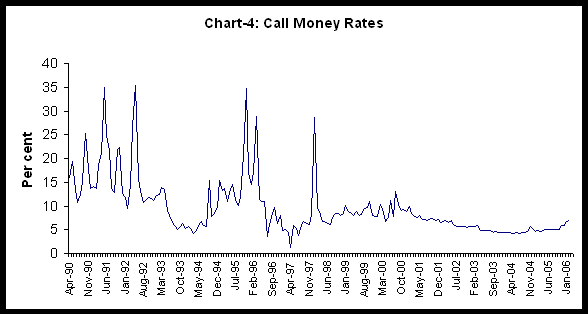
On the whole, LAF has had a pronounced favourable
impact of lowering volatility of short-term money market rates. Monthly average
call rates, which were volatile in a 5-35 per cent band during 1990-98, have
clearly stabilised subsequently and have generally ranged between 5-10 percent
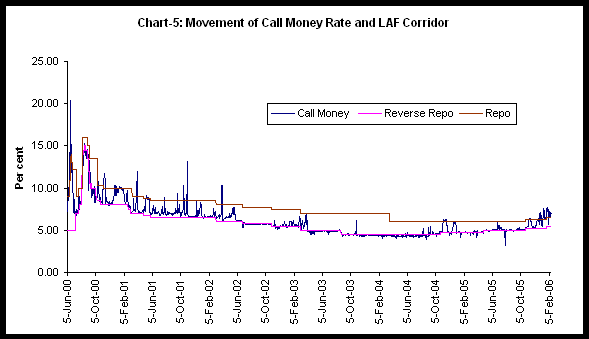
(Chart 4). Call rates have become largely bounded by the informal interest rate
corridor after the introduction of LAF (Chart 5). The corridor between repo
and reverse repo rates which was set at 200 basis points initially and was widened
to 250 basis points in August 2003 was lowered to 150 basis points in March
2004, to 125 basis points in October 2004 and further to 100 basis points in
April 2005. The call rates have remained anchored around the lower corridor
since June 2002, except for a brief period during February-April 2003 and between
October 2004 and January 2005. Again since October 2005, the system appears
to have clearly moved from enduring surplus to marginal deficits.
Monetary management since mid-2002 has clearly
focused on managing surplus liquidity. This was accomplished by the simultaneous
operation of the LAF and open market operations.
Given that RBI had a finite stock of government
securities its ability to mop up large capital inflows indefinitely was therefore
limited, and LAF operations began to bear the burden of stabilisation disproportionately.
Moreover, the LAF is essentially designed to take care of fictional liquidity
on a day-to-day basis, hence its function was itself beginning to get distorted
by such a sterilisation.
Box-II: Market Stabilisation Scheme (MSS)
The money markets operated in liquidity surplus
mode since 2002 due to large capital inflows and current account surplus. The
initial burden of sterilisation was borne by the outright transaction of dated
securities and T-bills. However, due to the depletion in stock of government
securities, the burden of liquidity adjustment shifted on LAF, which is essentially
a tool of adjusting for marginal liquidity. Keeping in view the objective of
absorbing the liquidity of enduring nature using instruments other than LAF,
the Reserve Bank appointed a Working Group on Instruments of Sterilisation (Chairperson:
Smt Usha Thorat). The Group recommended issue of T-bills and dated securities
under Market Stabilisation Scheme (MSS) where the proceeds of MSS were to be
held by the Government in a separate identifiable cash account maintained and
operated by RBI. The amounts credited into the MSS Account would be appropriated
only for the purpose of redemption and / or buy back of the Treasury Bills and
/ or dated securities issued under the MSS. In pursuance of the recommendation
the Government of India and RBI signed a Memorandum of Understanding (MoU) on
March 25, 2004. As part of the MoU, the scheme was made operational since April
2004. It was agreed that the Government would issue Treasury Bills and/or dated
securities under the MSS in addition to the normal borrowing requirements, for
absorbing liquidity from the system. These securities would be issued by way
of auctions by the Reserve Bank and the instruments would have all the attributes
of existing T-bills and dated securities. They were to be serviced like any
other marketable government securities. MSS securities are being treated as
eligible securities for Statutory Liquidity Ratio (SLR), repo and Liquidity
Adjustment Facility (LAF).
The payments for interest and discount on MSS
securities are not made from the MSS Account. The receipts due to premium and/or
accrued interest are also not credited to the MSS Account. Such receipts and
payments towards interest, premium and discount are shown in the budget and
other related documents as distinct components under separate sub-heads. The
T-bills and dated securities issued for the purpose of the MSS are matched by
an equivalent cash balance held by the Government with the Reserve Bank. Thus,
they only have a marginal impact on revenue and fiscal balances of the Government
to the extent of interest payment on the outstanding under the MSS.
For mopping up enduring surplus liquidity,
policy choice exist between central bank issuing its own securities or government
issuing additional securities. A large number of countries, such as, Chile,
China, Colombia, Indonesia, Korea, Malaysia, Peru, Philippines, Russia, Sri
Lanka, Tawian and Thailand have issued central bank securities. However, central
banks of many of these countries faced deterioration in their balance sheets.
As such, there are merits in issuing sterilisation bonds on government account.
This is more so, in case of an already well established government debt market,
where issuing of new central bank bills of overlapping maturity could cause
considerable confusion and possible market segmentation which could obfuscate
the yield curve, reduce liquidity of the instruments and make operations that
much more difficult.
MSS has considerably strengthened the Reserve
Bank's ability to conduct exchange rate and monetary management operations.
It has allowed absorption of surplus liquidity by instruments of short term
(91-day, 182-day and 364-day T-bills) and the medium-term (dated Government
securities) maturity. Generally, the preference has been for the short-term
instruments. This has given the monetary authorities a greater degree of freedom
in liquidity management during transitions in liquidity situation.
Reference:
RBI (2003), Report of the Working Group on
Instruments of Sterlisation, Mumbai: Reserve Bank of India, December 2003.
In order to address these issues the Reserve
Bank appointed a Working Group on Instruments of Sterilisation (Chairperson:
Smt. Usha Thorat). After considerable discussion, the consequence was that the
Reserve Bank signed a Memorandum of Understanding (MoU) with the Government
of India for the issuance of Treasury Bills and dated Government Securities
under the Market Stabilisation Scheme (MSS) on March 25, 2004. The new instrument
empowered the Reserve Bank to undertake liquidity absorption on a more enduring
but still temporary basis. The objective is to keep LAF for fine tuning on a
day-to-day basis, while using MSS to manage sterlisation operations, along with
the use of more conventional open market operations (OMO) for the absorption
or injection of liquidity on an even more enduring basis. The major features
of the MSS are enumerated in Box-II.
As has been explained (Box-II), proceeds of
the MSS are held by the Government in a separate identifiable cash account maintained
and operated by the Reserve Bank. The amount held in this account is appropriated
only for the purpose of redemption and/or buyback of the Treasury Bills and/or
dated securities issued under the MSS. The ceiling on the outstanding amount
under MSS was fixed initially at Rs. 60,000 crore but in accordance with the
MOU provisions was enhanced to Rs. 80,000 crore (discounted value) on October
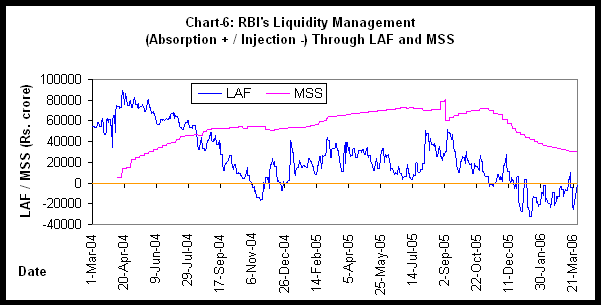
14, 2004 and has now been reduced again to Rs.70,000 crore. The total outstanding
amount absorbed under the Market Stabilisation Scheme (MSS) had increased to
over Rs.78,906 crore as on September 2, 2005 but has been unwinding since then
and the outstandings have currently dropped to Rs 30,000 crore. Nearly Rs. 50,000
crore of liquidity has been released through MSS unwinding, even while overall
marginal liquidity has transited from surplus to deficit.
The introduction of MSS had succeeded in restoring
LAF to its intended function of daily liquidity management. With MSS levels
averaging about Rs.54,000 crore in November 2004, total surplus liquidity averaged
around the levels seen before the introduction of MSS as excess capital flows
continued. LAF operations returned to surplus mode thereafter and by March 2005
averaged around Rs.30,000 crore with total surplus liquidity as reflected in
LAF, MSS and government cash balances in the vicinity of Rs.1,15,000 crore.
By September 2005, total surplus liquidity had surpassed Rs.1,20,000 crore.
However, the liquidity situation has changed significantly since then. With
the change in stance of monetary policy, hiking of the policy rate four times
by 25 bps each since the start of October 2004, high credit growth and bulk
redemptions of IMD liability of US$ 7.1 billion. LAF levels again turned to
neutral levels in December 2005 and there have been liquidity injections through
LAF thereafter (Chart-6).
Credit growth has witnessed a sea change
since mid-2004. Thus, the growth in non food credit in 2004-05 was over 30 per
cent, the highest in 35 years. In recent years the banks had been subscribing
to government securities much higher than the minimum SLR requirements. Making
a forward looking assessment, the Reserve Bank began to unwind MSS from September
2005 and the MSS part in the weekly auctions was discontinued since November
9, 2005. This helped in the orderly withdrawal of liquidity equivalent to US$7.1
billion involved in the redemption of IMD. Managing bunched withdrawal of liquidity
of such a large size is expected to pose a big challenge for monetary operations.
Box-III explains the measures taken proactively by the Reserve Bank, which helped
in limiting the liquidity mismatch to a large extent. Coupled with the high
demand for credit (31.1 per cent growth year-on-year as on March 17, 2006) that
has emerged the liquidity situation has nevertheless changed radically relative
to the situation prevailing in most of 2005. The availability of LAF and MSS
has enabled the RBI to manage these changes in an orderly manner.
Box-III: Liquidity Management During IMD Redemption
The India Millennium Deposits (IMDs) were foreign
currency denominated deposits issued by State Bank of India in 2000, on advice
of the Government of India. It mobilised a sum of USD 5.5 billion for a tenor
of five years. IMD carried coupons of 8.50 per cent, 7.85 per cent and 6.85
per cent on US dollar, Pound Sterling and Euro denominated deposits respectively.
IMD subscription was limited to non-resident Indians, persons of Indian origin
and overseas corporate bodies. The interest income earned on IMD was exempted
from tax and there was provision of premature encashment after six months only
in non-repatriable Indian rupees. These IMDs matured on December 28-29, 2005
and the large sums involved threw a challange for liquidity management.
Liquidity management in face of IMD redemptions
was carried out to contain disequilibrium while retaining monetary policy stance
with a medium-term objective. Outflows on account of the redemptions were met
by smooth arrangements worked out in this regard. During December 27-29, 2005,
RBI sold foreign exchange out of its foreign exchange reserves to State Bank
of India (SBI) totaling nearly US$ 7.1 billion, which in rupee equivalent terms
was about Rs.32,000 crore. SBI on its part had built up the necessary rupee
resources to meet the obligations. Temporary tightness in liquidity, was met
by release of liquidity through repo window (including the second LAF) averaging
about Rs.23,000 crore per day in the last week of December coinciding with the
IMD redemptions, outflows due to advance tax payments and the continued surge
in credit offtake. The second LAF window made available since November 28, 2005
provided an additional opportunity to market participants to fine tune their
liquidity management. The smooth redemption of the IMD liability of this size,
bunched at a point of time, reflects the growing maturity of the financial markets
and the strength of the liquidity management system that has been put in place.
Short-term money market rates eased remarkably in the first week of January
2006 reflecting smooth redemptions of IMDs but again firmed up in the second
week reflecting pressures emanating from scheduled auctions of Government securities.
The evidence of this efficient liquidity management
may be seen in the relatively orderly movement in both exchange rates and interest
rates. During times of excess visible liquidity, the call rates have essentially
hugged the reverse repo rate, as might be expected, whereas they are near or
slightly higher than the repo rate in times of tighter visible liquidity (Chart
5).
Preparing the Markets
An important element in coping with liquidity
management has been smoothening behaviour of the central bank and the communication
strategy. In August 2004, the headline inflation rate shot up to 8.7 per cent,
partly on account of rising global oil prices and partly due to resurgence in
manufacturing inflation. The turning of the interest rate cycle looked imminent.
The issue was addressed through burden sharing by appropriate monetary and fiscal
coordination and by preparing markets for a possible interest rate reversal.
In measured and calibrated steps the monetary policy stance was changed and
measures such as those on CRR and reverse repo were taken in a phased manner.
Also, banks were allowed to transfer HFT (Held for Trading) and AFS (Available
for Sale) securities to HTM (Held to Maturity) category, thereby affording them
some cushion against the possible interest rate shock. Markets were prepared
with a careful communication on the stance of the monetary policy by explaining
that the central bank would strive for provision of appropriate liquidity and
would place equal emphasis on price stability. It would consider measures in
a calibrated manner. Monetary management succeeded in building credibility and
keeping inflation expectations low. Headline inflation receded with the year
ending with 5.1 per cent inflation. Inflation again surged temporarily early
this year, but has been kept under leash even while the central bank moved to
mop up excess liquidity. Markets were again told in October 2005 that the central
bank is prepared to take measures in calibrated and prompt manner and while
genuine credit needs would be ensured, emphasis would be on price stability.
Policy communications have been backed by credible actions in accordance with
stance to keep inflation in tight leash.
In the more recent period, the IMD redemptions
were carried out successfully with temporary volatility in money markets accompanied
by liquidity shortages during December 2005. However, monetary policy operations
were carried out to contain disequilibrium in line with the monetary policy
stance with a medium-term objective. At the same time necessary liquidity has
been provided in recent months to address the tighter liquidity due to frictional
factors. It may be added that the Reserve Bank has enough instruments to manage
liquidity.
Lessons from the Indian Experience & Coping
Ahead
What has been the lesson from the
Indian experience of coping with liquidity management under large and volatile
capital flows?
First, by putting reforms on a more stable footing
by adopting gradualism but avoiding reversals, it has been able to sustain capital
inflows on a more stable basis with lower volatility than has been seen in some
other emerging markets. This has helped central banks in smoothening out interest
rates under cyclical transition.
Second, in cases where money and debt markets
have depth, development of open market operations through repo operations is
particularly important for building up microeconomic capacities for macroeconomic
objective of liquidity management. In India, the emergence of LAF was a single
biggest factor which helped to manage liquidity amidst large and volatile capital
flows and to keep short-term interest rates stable in this environment. It widened
the range of instruments for monetary policy and enabled the Reserve Bank to
operate on shorter range of interest rates. Restricting the maturities of interest
rates at which central bank operates to a smaller range at the short-end has
reinforced market functioning.
Third, in the face of constraints on sterilisation
arising from paucity of instruments, the monetary authorities in India adopted
a careful strategy which preserved the strength of the central bank balance
sheet and the credibility of the central bank, while causing minimal frictions
in the debt markets. MSS was not contemplated of initially even while capital
flows had distinctly increased since 1993-94. However, in face of large surplus
liquidity since 2000, MSS was evolved as a very useful instrument of monetary
policy to sustain open market operations. MSS has marginal costs, but it has
helped the monetary authorities manage business and liquidity cycles through
the surpluses and the deficits. With MSS, the monetary authorities now have
the option of assigning LAF for day-to-day liquidity management, using MSS for
addressing semi-durable liquidity mismatches, while using outright sales/purchases
of dated securities for truly long-term liquidity surpluses or deficits. The
MSS experience tells us that operating framework and procedures undergo changes
and one need to keep innovating to calibrate market operations to the evolving
liquidity conditions.
Fourth, by focusing on the microstructure
of the markets and by facilitating development of a wider range of instruments
such as Collateralised Borrowing and Lending Obligation (CBLO), market repo,
interest rate swaps, Certificates of Deposit (CDs) and Commercial Papers (CPs),
in a manner that avoided market segmentation while meeting demand for various
products, liquidity management could be placed on a much firmer footing. Market
and central bank practices evolved to institutional developments. However, the
payment and settlement system proved to be the most difficult area, but one
which delivered the enabling environment for micro and macro developments supportive
of the liquidity management procedures now in place. The focus on micro-aspects
reinforced the central bank's ability to signal and transmit policy changes.
Fifth, with efforts to build up indirect instruments
for liquidity management, the transmission of monetary policy has improved.
The link between overnight interest rates and yields on T-bills and liquid dated
securities has become far stronger. While the lending rates and even more so
deposit rates have been taking considerable time to adjust, the strength of
the transmission has been in evidence in recent periods. It is important to
note that in a situation of large surplus liquidity, the transmission is understandably
weaker. However, in the more recent period as considerable amount of excess
liquidity was mopped up by the central bank, the rate signal efficacy has gone
up substantially.
Sixth, monetary policy setting through signalling
improves, as the central bank's liquidity management is able to establish its
control over short-term interest rate by reducing volatility in these rates.
By removing working balance constraints for the banks, it can influence the
term structure of interest rates as reflected in money market rates of various
maturities and the sovereign yield curve.
Lastly, while temporary mismatches in liquidity
conditions do pose a problem for maintaining immediate goals of monetary operations,
the overall objective of liquidity management needs to accorded primacy. In
India, in spite of difficulties posed by sudden transitions in liquidity conditions,
macroeconomic success of overall policies are reflected in delivering low inflation,
which at 4.7 per cent, has averaged below 5.0 per cent over last five years
in terms of the headline rate. Consumer price inflation has averaged still lower
at around 4.0 per cent on a point-to-point basis and 3.9 per cent on an average
basis.
In spite of the relative success in liquidity
management in India, several challenges remain ahead.
First, notwithstanding the large size of the
debt markets, absence of a vibrant term market, the illiquidity of a large set
of securities and limitations of corporate debt market continue to come in way
of further contemplated changes.
Second, while the Reserve Bank now enables market
participants to meet their marginal liquidity demand twice a day on each working
day, there is a moral hazard that passive operations by central bank in the
market may be resulting in some market players not doing enough for their own
liquidity management.
Third, as the system moves to maintenance of
SLR securities at statutory minimum levels, liquidity provision would become
more difficult unless the instrument set is widened to facilitate market players
to even out their liquidity mismatches.
Fourth, as RBI withdraws from the primary market
in accordance with the FRBM Act, 2003, there is an urgent need to bridge the
institutional gap with minimal necessary changes so that market operations retain
their efficiency, both from the view point of central bank and the market participants.
Finally, further improvements in liquidity management
would substantially depend on our abilities to improve forecasting of liquidity
in the system. The short span within which liquidity conditions have been changing
by a large amount has been the biggest constraint in targeting short-term interest
rates. More effort for understanding the fiscal position and the government
cash balances, as also the timing of foreign capital flows are of paramount
importance in this context.
References
Alexander, W.E., T.J.T. Balino and C. Enoch
(1995), "The Adoption of Indirect Instruments of Monetary Policy",
IMF Occasional Paper, No. 126, Washington, D.C.
Bindseil, U. (2000), 'Central Bank Liquidity
Management: Theory and Practice', April, European Central Bank.
Borio, C. (1997), "The Implementation
of Monetary Policy in Industrial Countries", BIS Economic Papers
No. 47, Bank of International Settlements.
Obstfeld.M, Shambaugh, J.C. and A.M. Taylor(2004),
'The Trilemma in History: Tradeoffs Among Exchange Rates, Monetary Policies
and Capital Mobility', NBER Working Paper No.10396.
Saggar, M (2006): 'Monetary Policy and Operations
in Countries with Surplus Liquidity', Economic and Political Weekly,
March 18, pp. 1041-52.
* Speech by Dr. Rakesh Mohan, Deputy Governor,
Reserve Bank of India at IGIDR on March 27, 2006 |