|
The Indian debt market, and the
government securities market in particular, is at a turning point in
India with significant changes taking place in the domestic economic
environment along with various proposed legislative changes. Let me briefly
touch upon the reasons why I believe we are living in interesting times and
why this is an opportune time to reflect on further debt market development.
The first such significant change
is the prohibition of RBI’s subscription to Government securities in the primary
market effective April 1, 2006, as mandated by the Fiscal Responsibility and
Budget Management (FRBM) Act. This will complete the transition to a fully market
based issuance of Government securities, a process that was initiated in the
early 1990s with the introduction of auctions.
Second, as a consequence of the
recommendations of the Twelfth Finance Commission, the role of the Central Government
as a financial intermediary for State Governments is effectively ending, although
there will be some transitional arrangements. Thus State Governments' borrowing
will be more and more market determined. This is perhaps the beginning of the
emergence of a vibrant sub-national debt market – although it still has a long
way to go.
Third, the economy is estimated
to be growing at 8.1 per cent this year with modest inflation and if similar
conditions prevail, we can expect growth and inflation next year to also be
on a similar path. If this growth is to be maintained and accelerated in the
medium and long run, financial intermediation will have to improve and the debt
market, in this context will become even more important.
Fourth, the sustenance of such
growth will be possible only if investments in both infrastructure and industry
accelerate. Again, this will require debt financing with medium to long term
maturity to supplement traditional bank financing.
Fifth, as Government finances have
been improving for both, the Central and State Governments in consonance with
the Central and State FRBM Acts, the negative savings rate of public sector
that had arisen over the last 5 years has turned positive. We can, therefore,
look forward to Gross Domestic Savings touching 30 per cent or more of GDP on
a sustained basis. Moreover, as the combined fiscal deficit falls, a greater
proportion of private financial savings will be available for channelising into
the private sector. This entails higher risks but also opens up the possibility
of higher returns. There will then be greater demand for debt securities.
Sixth, in recognition of these
developments, an amendment to the Banking Regulation Act has also been introduced
in the Parliament, which would enable the removal of 25 per cent minimum SLR
as and when feasible. Further, as and when the Government Securities Bill (that
will replace the Public Debt Act and which, I understand, has been approved
by the Standing Committee in Parliament) is passed, the introduction of newer
instruments like STRIPS will also be possible.
Seventh, although gross domestic
savings increased to 29 per cent in 2004-05 driven significantly by improvements
in public and corporate savings, the current account deficit widened reflecting
heightened investment activity in the country and hence greater absorption of
capital flows. The robust growth in industrial activity has resulted in strong
credit growth which in turn has created more competition for available resources.
This development has reemphasized the fact that bond financing has to supplement
traditional bank financing to take care of the growing credit needs of the economy
and that resource allocation has to be more efficient.
Recognising the force of these
changes, the Government had set up an Expert Group under Dr. R.H. Patil to recommend
measures for energizing the corporate debt market. This report was released
recently and as announced in the recent Budget Speech of the Finance Minister,
the Government has broadly accepted the recommendations. With Dr. Patil's track
record of setting up the NSE and revolutionising the equity market, we can now
look forward to similar developments taking place in the debt market.
I. Background
I had reviewed the developments
in the Government securities market earlier. So I don't intend to do a full
review this time. Full documentation of the development of the Government securities
market is also available in two articles in the RBI Bulletin of November and
December 2004. I would, however, briefly take you through the history of reforms
in the Government securities market, before highlighting the pending issues
and concerns.
The Government securities market
before the 1990s was characterised by administered interest rates, high SLR
requirements that led to the existence of captive investors, and the absence
of a liquid and transparent secondary market for G-Secs. Low coupon rates were
offered on Government securities to keep Government borrowing costs down, which
made real rates of return negative for several years till the mid-1980s. During
the 1980s, the volume of Government debt expanded considerably, particularly
short-term debt, due to automatic accommodation to Central Government by the
Reserve Bank, through the mechanism of ad hoc Treasury Bills. However,
with a captive investor base and low interest rates, the secondary market for
Government bonds remained dormant. Artificial yields on Government securities
affected the yield structure of financial assets in the system, and led to an
overall high interest rate environment in the rest of the market. Driven by
these compulsions, the Reserve Bank’s monetary management was characterised
by a regime of administered interest rates, and rising Cash Reserve Ratio (CRR)
and SLR prescriptions. High CRR and SLR left little room for monetary manoeuvering.
Furthermore, the period was
marked by greater pre-emption of financial savings. Given such high pre-emptions
and administered interest rates which were artificially kept lower than the
market rates, there was no possibility of price discovery. Other interest rates
too were perhaps higher than what market interest rates otherwise would have
been.
The RBI had to undertake a long
and phased programme of reforms to make a transition from this situation to
one where interest rates would be market determined, Government borrowing would
be market based and would reflect market costs. The reforms were also important
for developing the environment for effective monetary policy making and monetary
transmission mechanisms.
The reforms process has encompassed
important developments in active policy making and institution building, with
detailed attention being given to development of market micro structure, clearing
and settlement systems, trading systems, diversification of participants and
instruments, better regulatory systems, introduction of new technology and appropriate
enabling legislation.
As a result of gradual reform measures
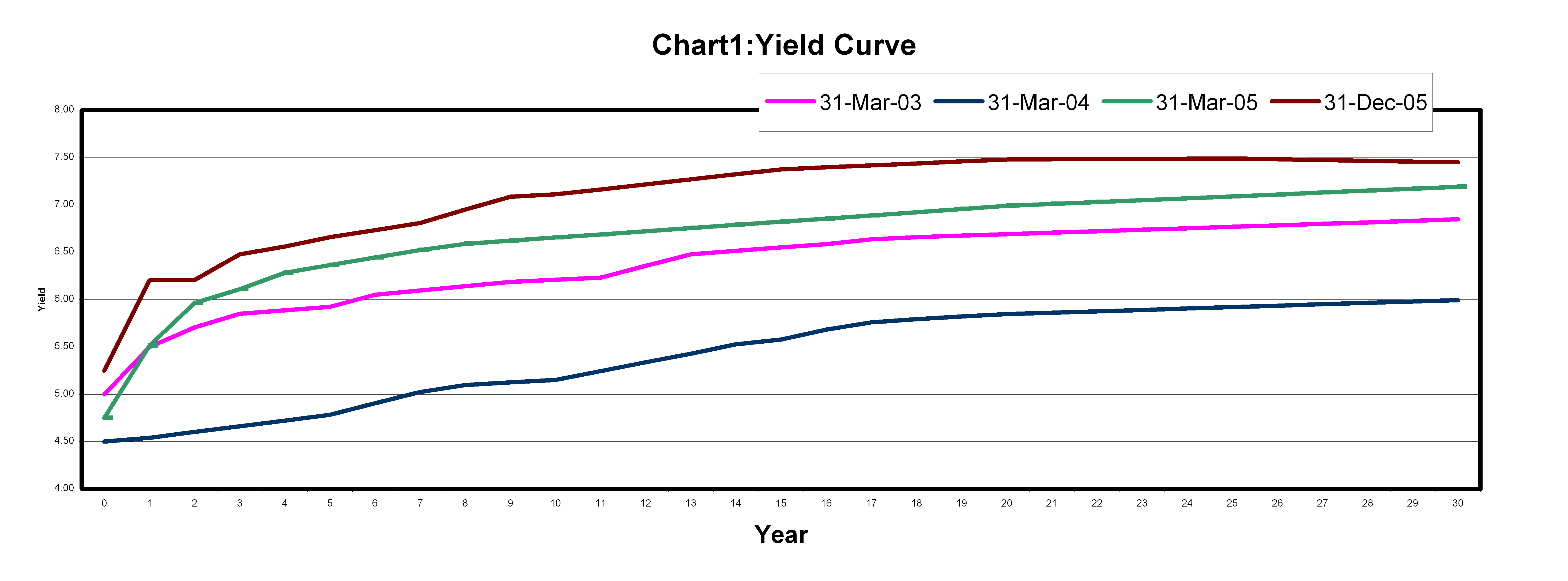
taken over the years, the Indian G-Sec market has seen a transition for the
better, with the market becoming increasingly broad based, characterised by
an efficient auction process, an active secondary market and a liquid yield
curve up to 30 years (Chart 1). The market is now supported by an active Primary
Dealer (PD) system and electronic trading and settlement technology that ensure
safe settlement with STP and central counterparty guarantee. At a more macro
level, the reforms fostered integration of the different segments of the domestic
markets as well as some degree of integration of the domestic financial markets
with international markets. I note some of the specific achievements of the
reforms:
- Although India's (Centre and States combined)
fiscal deficit has been among the highest in the world, we have not had to
resort to external borrowing, except from bilateral and multilateral sources.
This has imparted stability to the system.
- The holding of G-secs among financial institutions
has been more diversified, particularly, with the emergence of insurance and
pension funds as a 'durable' investor class for the long-term securities.
This became possible due to the sustained efforts devoted to elongating the
maturity profile of Government securities by developing a smooth and robust
yield curve.
- The process of passive consolidation has helped
in containing the number of bonds around the level that was prevailing at
the end of 1998-99. This was a significant factor that promoted secondary
market liquidity for Government Securities.
- Market liquidity today compares well not only
with the emerging economies, but also with the developed world, with bid-offer
spreads in at least liquid securities being very fine at 1-3 bps. The illiquidity
premium levels are also in line with those in the international markets.
Though the reform measures have
resulted in creation of a vibrant G-sec market, there is still some way to go
in terms of improvement in regulation, introduction of newer technology and
creating an enabling legislation.
II. Recent developments
Let me now recount the developments
that have taken place in G-sec markets recently. First, security settlement
has migrated to DvP III, enabling net settlement of securities and funds, resulting
in efficient liquidity management. Net settlement has also enabled selling of
securities that are already contracted for purchase, in the same settlement
cycle, which greatly mitigates the price risk faced by participants. Second,
roll over of repos has been enabled thus furthering the participants’ ability
to manage their fund positions more efficiently. Third, a uniform T+1 settlement
cycle has been adopted for the settlement of outright transactions in Government
securities. This will give participants more processing time for transactions
and will thus enable better funds as well as risk management. Fourth, in order
to further widen the repo market in Government Securities, its access has been
extended to listed companies and non-scheduled urban cooperative banks. Fifth,
the facility of selling stock acquired in primary auctions on the same day,
which was hitherto available only for SGL account holders, has been extended
to CSGL account holders also.
NDS-OM
As part of its constant endeavor
to improve the facilities for trading and settlement in the Government securities
market, the Reserve Bank had formally launched, on August 1, 2005, an electronic
Order Matching trading module for Government securities on its Negotiated Dealing
System (NDS-OM in short). The system is an anonymous order matching system
in which the identity of parties is not revealed, the CCIL becomes the central
counterparty to each trade done on the system and the system allows straight-through
processing (STP). The NDS-OM is an additional facility available to the participants
and the participants continue to have the option of using the current reporting
and trading platform of the NDS. The settlements of both types of transactions
are, however, integrated. NDS-OM which was initially open only for the RBI regulated
entities has been extended to all insurance entities in the second phase.
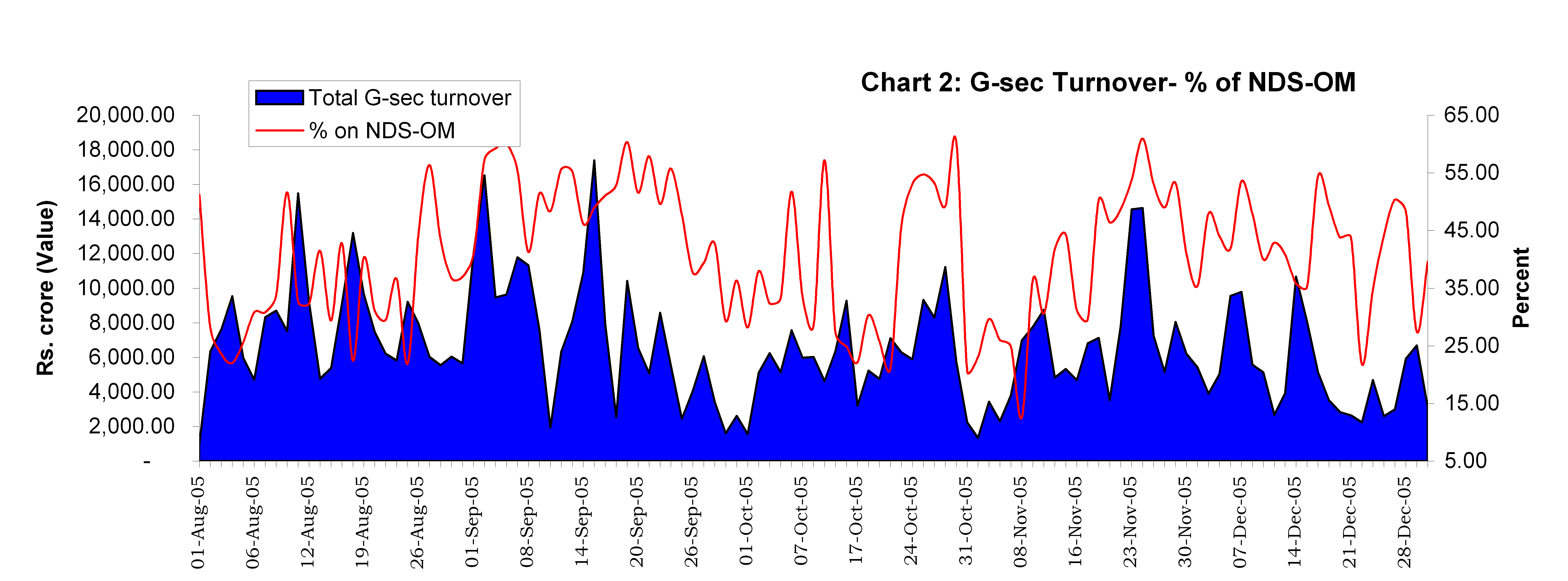
The Order Matching system has been
well received by market participants. Though it started only seven months back,
it now accounts for a significant share of the total traded volume in G-secs
(Chart 2).
Chart 2: NDS-OM as % of G-sec Turnover
III. Current Issues in the G-Securities
Market
Under the FRBM Act, 2003, the RBI
will not be participating in primary issuance of Government securities with
effect from April 1, 2006 and nor can securities devolve on the RBI in a passive
manner. Moreover, the states will also have to be more market dependent. This
situation calls for a paradigm shift in the debt management framework and a
comprehensive restructuring of debt issuance to ensure that the borrowing programme
of the Government is successfully carried out and the cost of borrowing is also
kept at a reasonable level. In order to address these emerging needs and to
equip the RBI and the market participants adequately, an Internal Technical
Group on Central Government Securities Market was constituted in the RBI. Earlier,
another Group (Chairman: Dr.R.H. Patil) had examined the role of PDs in the
Government securities market. A number of important issues have been identified
by these Technical Groups. Let me discuss them one by one.
(i) Greater role for PDs in ensuring
subscription to auctions
The RBI’s non-participation
in primary auctions except under exceptional circumstances, effective April
2006, as indicated in the FRBM Act, will require alternative institutional arrangements
to ensure that
- debt management objectives are met; and
- the Government is able to borrow under all market
conditions without exacerbating market volatility.
This will necessitate some
restructuring of current institutional processes, in as much as the RBI’s role
in the primary market hitherto has to be replaced by a more active and dynamic
participation by PDs. Since the current system of annual bidding commitments
does not guarantee that the notified amount will be sold in each auction, it
was suggested that a system of 100 per cent underwriting for each auction by
PDs be put in place to ensure that the notified amount is sold at each auction.
This suggestion is being considered.
However, with the increased
responsibility, the PDs will require adequate capital backing so as to sustain
adverse movements in the market yields. Consequently in the Annual Policy Statement
2005, it was announced that consultations would be held with banks, PDs and
the Government to consider permitting structures of PD business to include banks
that fulfil certain minimum criteria to act as PDs. The guidelines enabling
banks to do PD business have been issued recently after extensive consultations
with the market participants. A proposal to allow other stand alone PDs to diversify
their activities is also under consideration and will be put in process shortly.
(ii) Thin investor base
Currently a large
portion of G-secs is held in the investment portfolio of banks. With burgeoning
credit growth, the investible surplus of banks has found competition (in terms
of possible deployment in loans vis-à-vis investment in G-secs). Furthermore,
conversion of recap bonds to SLR securities implies reduced demand from banks
for fresh SLR securities. Looking ahead, the Government has already introduced
legislation in the Parliament to remove the statutory minimum SLR of 25 per
cent. On the other hand, the enhancement of FII limits to $2 bn from $1.75 bn,
as announced in the Union Budget, will increase FII demand for Government securities.
As and when it becomes possible to lower the SLR, it will become even more important
to widen the investor base. The market making role of PDs will also become more
important and they will have to make extra efforts to widen the investor base
to add players such as provident funds, pension funds, cooperative banks, trusts,
NGOs and other institutions.
(iii) Price Discovery and Hedging
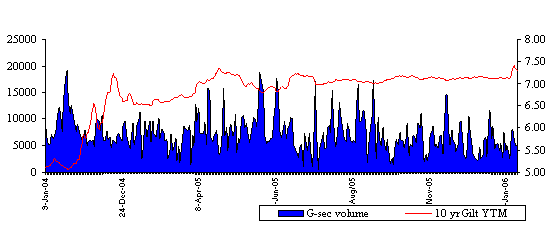
There was a sustained decline
in interest rates for 3 years with the yield on 10 year Central Government Securities
going down to as low as 4.95 per cent in October 2003. Since then, however,
there has been a reversal in the trend and the rates have been hardening to
reach about 7.4 per cent now.
In the absence of instruments
that allow players to take a view on the interest rates, it is observed that
the markets are active and liquid when the rates are falling but turn lackluster
and illiquid when the rates rise (charts 3 A & 3B). Low volumes render markets
shallow and prone to price manipulations. To enable participants to manage their
interest rate risk more efficiently and to also impart liquidity to the markets,
even in a rising interest rate scenario, the Technical Group has recommended
permitting short sales in Government securities in a calibrated manner. This
would enable market participants to express their views on interest rate expectations.
The Mid-term policy review had announced ‘intra-day’ short selling in Government
securities and their guidelines have been issued recently.
Chart 3 A: Relation between market
volumes and yields (during downward trend)
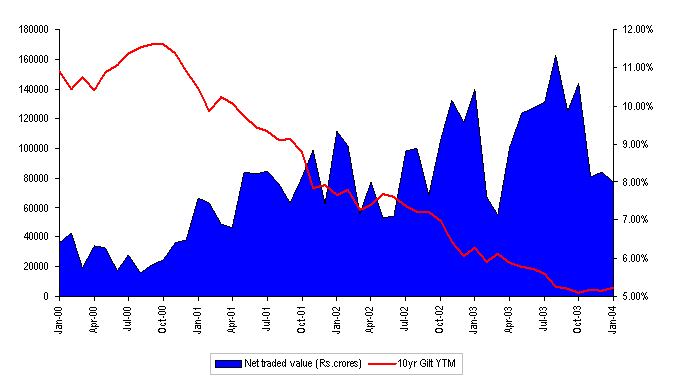
Chart 3 B: Relation between
market volumes and yields (during upward trend)
What are the risks in short selling
Government securities? The inherent risk in short sales is that the participants
may not be able to cover their short positions. Further, due to the rush to
cover intra-day short positions, security prices may actually go up, aggravating
the situation. To mitigate such risks, it has been proposed to limit each participant’s
short position to 0.25% of the total outstanding stock. The details of the outstanding
amounts are made available on the RBI website. Further, the participants are
required to have an internal policy, approved by their respective boards, laying
down the guidelines on risk limits on short positions, aggregate nominal short
sale limit, etc. Over a period of time, as participants get used to short sale,
market may evolve mechanism to meet any unanticipated end-of-day shortages in
the system. The Reserve Bank will be actively monitoring the developments. As
we gain experience in the operation of short sales we will consider the feasibility
and desirability of introduction of other phases of short selling as recommended
in the Technical Group’s report. We also need to give further thought to the
modalities and procedures that would be required for the introduction of interest
rate futures as has been recommended by market participants and expert groups
alike at various times.
(iv) Introduction of ‘When Issued’
Market
The Technical Group has also
recommended introduction of ‘when issued’ market which would facilitate an efficient
distribution process for Government securities by stretching the actual distribution
period for each issue and allowing the market more time to absorb large issues
without disruption, in addition to providing better price discovery. The Government
has concurred with this proposal and guidelines have been discussed with the
market participants and are in the process of being finalized. We expect to
issue them shortly.
(v) Active Consolidation of Central
Government Securities
The Reserve Bank, as a conscious
exercise, has been following passive consolidation through reissuances. The
quantum of reissuances as a percentage of total jumped to 82 per cent in 2004-05
compared to 33 per cent in 1998-99. Yet the number of actively traded securities
is very low as compared with the total number of securities outstanding. As
at end- December 05, there were 111 Central Government
securities of which 44 securities, with minimum
outstanding issues of Rs. 100 billion or more, accounted for 71 per cent of
the total outstanding amount. On a daily basis, hardly 10-12 securities are
traded, of which only four or five securities trade actively. Without active
trades in the markets, the yield curve is kinky making pricing of securities
difficult. This also leads to a situation where securities of similar maturity
profiles trade at very different yields, with the liquidity premium sometimes
going as high as 50 basis points.
The Technical Group on Central
Government Securities markets has recommended active consolidation of Government
securities to promote greater liquidity and a smoother yield curve. The proposal
has since received ‘in principle’ approval from the Government of India and
the finer modalities for implementing the scheme are being worked out in consultation
with the Government.
(vi) Widening the Investor Base
NDS-OM, which initially had permitted
participation of RBI regulated entities only, has also been extended to insurance
entities. It is now being extended to qualified Mutual Funds, Provident Funds
and Pension Funds as announced in the Finance Minister's Budget speech. The
increased participant base should improve liquidity thus enabling the participants
reap the benefits of better price discovery.
As suggested by the Patil Committee
on Screen Based Trading in Government Securities, the largely untapped non-retail
mid-segment comprising Pension Funds, Trusts, Co-op banks, and non-profit organizations
can be targeted with aggressive market making in order to widen the investor
base further.
With the implementation of
the Twelfth Finance Commission recommendations and expected achievement of FRBM
targets in both the Central and State Governments the volume of State Government
borrowing will become similar in magnitude to Central Government securities.
(vii) Liquidity in State Government
Securities
At present secondary market liquidity
in State Government securities has been found to be very low, accounting for
less than 3 per cent of the total turnover. It is, therefore, important that
we take measures to enhance liquidity in this market substantively. As
a first step, measures are being contemplated in terms of granting repo
status to State Government securities as also to enhance the investor base by
permitting non-competitive bidding in primary auctions of State Government securities.
(viii) Legality of OTC Derivatives
Over-the-counter (OTC) derivatives
play a very crucial role in reallocating and mitigating the risks of corporates,
banks and other financial institutions. The ambiguity regarding their legal
validity is said to be inhibiting the growth and stability of the market for
such products. Clearing ambiguity on OTC derivatives is important and has therefore
been attempted through an amendment to the RBI Act which is awaiting Parliament’s
approval.
(ix) Asian Bond Fund
Before I conclude this section,
a few words on the Asian Bond Fund (ABF) initiative would be very relevant.
The ABF is an important initiative to promote bond markets in the Asian region.
With over half of the total trade in Asia being intra-regional trade, and with
this proportion still on an increasing trend, economies in the region are becoming
increasingly interdependent among themselves, arguably more so as each of them
depends less on the developed economies in Europe and America. By comparison,
the degree of financial integration in Asia is disproportionately low. Allow
me to share with you some numbers.
In 2004, according to IMF’s Direction
of Trade Statistics (December 2005), Asia’s exports accounted for 21 per
cent of the world exports. Asia’s trade (exports plus imports) accounted
for about 42.0 per cent of the world trade (exports). Asia accounts of 53 per
cent of developing countries’ total exports. In terms of intra-regional trade,
Asia’s share in its total exports account for 42.8 per cent. Within the Asian
region, China is the largest trading country, followed by Korea, Hong Kong,
Singapore, Malaysia, Thailand, India, Indonesia, Philippines and Vietnam. These
countries, together, account for 87.0 per cent of Asia’s intraregional trade.
In this context, the initiative
of setting up the ABF enables bringing together of Asian economies with different
sizes, different economic structures and with different stages of economic and
social development. This will help to lay the foundation for promotion of development
of regional and domestic bond markets in the Asian region. When different countries
in the region exhibit varying degrees of current account deficits and surpluses,
development of the bond market will enable intra-regional debt flows that can
then usefully be absorbed within the region.
To sum up, what I have just described
illustrates how hard it is to build the markets and to ensure that they work
efficiently. While bringing the G-Sec market where it is today, we have learnt
that such a transition does not happen easily and proactive measures have to
be taken to develop a debt market. Such development also requires cooperation
of and coordination with the key players. In developing the market for Government
securities, for instance, close coordination with the Government has been a
significant element. Many developments that have taken place in the last ten
years illustrate the very close collaboration that exists between the RBI and
the Government.
As we traverse the uncharted path
of FRBM and Post TFC, we enter a new era in the development of the debt market
in which evolving a vibrant market for sub-national debt and corporate debt
will be our major responsibilities. The lessons we have drawn from the earlier
experience of developing the G-Sec market would be helpful in our next endeavour.
Clearly, this will be a long drawn out process and there are no magic solutions.
I have briefly touched upon the measures required in imparting vibrancy to the
sub-national debt market in earlier paragraphs. Let me now briefly touch upon
the corporate debt market.
IV. Corporate Debt
In his recently released report,
Dr. R. H. Patil has, as may be expected, and as always, done an excellent job
in reviewing the status of the corporate debt market and provided recommendations
for energizing it.
A key point that I would like to
emphasize is that learning from the experience of developing the Government
securities market, we need to proceed in a measured manner with well thought
out appropriate sequencing for developing the corporate debt market. Financial
market development involves action on a number of fronts with the key objective,
obviously, being to enable the most efficient allocation of resources to the
most productive uses and efficient intermediation from savers to investors.
In other words, banking development, equity market development, debt market
development all go hand in hand. And within the debt market, an efficient Government
securities market is essential for price discovery and for providing reliable
benchmarks to price corporate bonds off the credit risk free yield curve.
As our financial markets grow,
and as the need for investment grows, which we perceive to be happening at present,
some disintermediation is expected to take place as the most credit worthy borrowers
seek the lowest borrowing costs. The demand for developing the corporate debt
market has to be seen in this context.
What is curious, however, is that
it has been difficult to develop the corporate bond market everywhere. As the
Patil Committee has documented, just under half the world's corporate bond market
is in the US, and another 15 per cent in Japan. Among other countries, the UK
has a long standing bond market, but the European one is still developing, with
financing in many countries still being bank dominated. Among developing countries,
it is perhaps only South Korea that has a reasonably well developed bond market.
The key problem is that for a corporate
bond market to function, we need a large number of issuers, a large number of
investors and issues of a large size.
We have a potentially large pool
of issuers. Let me give a quick run down.
Issuers
(i) Infrastructure Projects:
SPVs formed to build projects like airports, roads, ports and railways
can seriously consider accessing the bond route to raise the required resources,
if an appropriate risk management framework is developed in the country. Once
initial risks have been cleared and income streams are assured, bonds of such
projects should, in principle be very attractive.
(ii) Housing: We
are witnessing a major housing boom, along with very large increases in housing
finance. In fact the growth in housing finance has been large enough for the
Reserve Bank to draw attention of banks and borrowers alike to the credit quality
and we have accordingly increased the risk weights on housing finance. With
increasing urbanisation, changes in economic demographics, increasing tendencies
towards nuclear families, and growing incomes we can expect growth in housing
demand and finance to be sustained for a foreseeable future. Hence, we can expect
mortgage backed securitisation to gather pace. This will need significant institutional
development, but can potentially form a large segment of the corporate debt
market, as in other countries. The High Level Expert Committee on Corporate
Debt and Securitisation has identified, inter alia, resolution of taxation and
stamp duty issues to further the growth of mortgage backed securitisation in
Indian context. The Committee has also recommended establishment of an appropriate
institutional process to evolve a consensus across the States on the affordable
rates and levels of stamp duty on debt assignment, PTCs and securities receipts
(SRs).
(iii) Municipal Bonds:
Growing urbanisation will need large urban infrastructure investment and
hence the associated need for funds could be a potential candidate for bond
issuance. Municipal bonds are a tried and tested method of urban infrastructure
financing in the US accounting for almost 10 per cent of the US bond market.
In India too there is a huge potential for municipal bonds with about 35 cities
that have a population of greater than 1 million and about 400 cities with population
exceeding 1,00,000. Development of this segment, however, requires a lot of
institutional work to be done.
(iv) Corporates: Indian
industry has now begun to exhibit international competitiveness. With expanding
domestic demand and export growth, growth in industrial investments will undoubtedly
accelerate leading to greater demand for bond financing in the absence of term
lending institutions. This segment covers about 20 per cent of the US market.
Investors
The investors in this segment have
typically been institutional investors. It is puzzling that in India corporate
deposits have long been a popular investment avenue for retail investors, yet
the same retail investors do not evince much interest in corporate bonds. It
seems that retail investors are more comfortable with credit risk than with
interest rate risk. This does not seem logical to me. One would have thought
that rated bonds are much safer than unrated corporate deposits. Or is it that
unlike corporates, financial intermediaries have not bothered to market bonds
to retail investors? So I think this is an area where some work can be done.
Who will be the investors in
corporate bonds? Insurance companies, mutual funds, provident funds, pension
funds, banks, non-profit institutions, NGOs and retail segment are all potential
investors provided the instruments offered match their risk return preferences.
In the US about 50 per cent of the mutual fund assets are in debt securities.
Once again, a great deal of work will need to be done to market these to different
kinds of investor segments exhibiting a range of risk appetites.
Given the large heterogeneity
in risk taking capacity, the necessity of risk mitigation techniques, marketing
networks and liquidity can hardly be overemphasized. So the potential exists,
but how is it to be tapped? What are the key issues in this regard?
Trading: It can be seen
everywhere in the world that most bond trading is in the OTC segment, with most
bonds being unlisted. In the US about 92 per cent of the bonds are unlisted
and only 1 per cent of the trading is done on exchanges. It is because of these
structural rigidities, that the corporate bond markets are mainly confined to
institutional investors. We need to understand why developed country markets
have developed in this fashion. However, there is no reason why we can't innovate
and have electronic based, anonymous order matched trading to have a wider reach
and also thereby enhance liquidity in the bond market. In this context, the
Union Budget has proposed establishment of a unified exchange traded system
for corporate bonds. Furthermore, we should note that as new systems are coming
up worldwide, we also need to build efficient price discovery mechanisms.
Size of Issues: Another
issue that concerns development of corporate bond markets is the issue size.
Trading and liquidity needs reasonable issuance size. Cost of issuance is not
related to size so there is great potential for economies of scale. This aspect
will have to be addressed by bringing about more discipline in issuances and
by following consolidation through reissues.
Cost of Issuance: Cost
of issuance in term of rating, listing, disclosure and marketing requirements
makes the public issue of bond expensive making private placement a preferred
alternative for most issuers. If the corporate bond market is to develop, a
great deal of attention will have to be given to minimize the issuance cost
and the time taken to make public issue. Market making institutions, marketing
networks and the like will have to be developed with this. Regulatory attention
will have to be given to provide for economy in disclosure and development of
appropriate systems. Since debt issuance is more frequent than equity, re-issuance
will need to be made much cheaper.
Clearing and Settlement systems:
As already indicated, a robust trading platform would go a long way in enabling
efficient price discovery in corporate bonds as also in creating depth and vibrancy
to the market. An efficient clearing and settlement system would further the
development of corporate bond markets by reducing the counter party risk and
settlement risk.
As the corporate bond market
develops and expands, diversifying and expanding investor interest will need
institutional measures for credit enhancement. We are fortunate in India to
have built up first rate credit rating institutions. So the first step in credit
enhancement has already been taken. Credit risk can also be addressed by developing
bond insurance institutions. Institutional investors who have superior risk
assessment capacity along with investment capacity can also act as credit enhancers.
All this takes time to develop and does not happen on its own.
It may be noted that each of the
problems mentioned in respect of corporate bonds has been addressed in the context
of development of G-securities market. That goes to show that the problems are
not insurmountable but only that it takes some time to resolve. But we have
just begun. Patil Committee has already given us very valuable recommendations
towards resolving these problems. It is true that the Government securities
market took so much time to develop, despite being much simpler. The corporate
debt market being much more complex, would require some extra effort to move
ahead. In short, we have a long way to go.
To conclude, I hope that some of
these issues are deliberated upon and some practical solutions are arrived at
in this conference. I also hope the next 12 months will be eventful with many
changes taking place particularly towards evolving the corporate debt market.
* This is based on Deputy Governor, Dr. Rakesh
Mohan's lectures at the Fourth India Debt Market Conference (organized by Citi
Group and Fitch Rating India on January 31, 2006) and at the Annual Conference
of FIMMDA (jointly organised by Fixed Income Money Market Dealers Association
of India and Primary Dealers Association of India on March 14, 2006) at Mumbai
|