|
Introduction
It is a pleasure to be amidst officials
of the State Governments who are instrumental in implementing government policies
that aim to improve economic and social welfare. In India, bulk of the responsibilities
pertaining to expenditure in social services including education and health
are placed in the domain of the State Governments. Thus, the nature of state
finances has important implications for improving human development in India.
In this context, the theme of today’s discussion ‘Human Development and State
Finances’ is very topical as well as relevant.
The Reserve Bank of India (RBI)
bears a special relationship with the State Governments in its multiple role
as the banker, debt manager and fiscal adviser. The interactions between the
RBI and the State Governments have been stronger through the interface provided
by the bi-annual Finance Secretaries’ Conference organised by the Reserve Bank
since 1997. This Conference has provided a common platform to discuss all aspects
concerned with the fiscal affairs of the States and facilitated the evolution
of a consensual approach on various key issues through active participation
of State Government officials. Some of the outcomes include setting up of Consolidated
Sinking Funds (CSF) for debt servicing, constitution of Guarantee Redemption
Funds (GRF) to meet guarantee obligations, setting of Ways & Means Advance
(WMA) limits for States, fixing limits for guarantees, and most recently, enactment
of the Fiscal Responsibility Legislation (FRL).
In this forum, in two earlier occasions,
my colleague Deputy Governor Shyamala Gopinath had focused on the broad contours
of human development and state finances while Deputy Governor Shri V. Leeladhar
had dwelt on certain critical aspects of human development in the Indian context.
Today I will first discuss the importance of economic growth for human development,
poverty eradication and overall social welfare; second, I will briefly give
an overview of the performance on the human development at both the national
level and across the states; third, I will review the stylized facts relating
to finances of the State Governments as they relate to their impact on expenditure
in the social sector; fourth, I will mention some of the new initiatives taken
by the Government both at the Centre and States’ level for accelerating human
development in India; and finally, I will touch upon some further policy options.
Economic Growth and Human Development
The concept of human development
signifies improvement in the quality of life of the people in terms of various
health and educational indicators. Through betterment of health, education and
skills, human development creates human capabilities that can then lead to productivity
enhancement and acceleration in economic growth. In a broader sense, human development
also implies improvements in terms of human rights and participation and freedom
of choice. The credit for bringing special focus to human development can mainly
be attributed to the noted economist Mahbub Ul Haq. He was instrumental in the
evolution of the Human Development Index (HDI), which has emerged as a composite
measure of development across the countries. The HDI is an index measuring the
basic dimensions of human development, namely, long and healthy life, education
and decent standard of living. Indian economist and Nobel laureate Amartya Sen
has also made valuable contributions towards the formulation of HDI. According
to the Human Development Report, 2005, published by the United Nations Development
Programme (UNDP), all the countries (177 in total) are categorized into three
broad groups, such as, (i) High Human Development, (ii) Medium Human Development,
and (iii) Low Human Development. India is placed in the group of Medium Human
Development countries and ranks at 127 amongst total of 177 countries in 2005.
High economic growth facilitates
reduction of poverty. Growth in production of goods and services leads to growth
in incomes and, hence, to poverty eradication. As might therefore be expected,
acceleration of economic growth in India has led to a marked reduction in poverty
in recent decades. Compared to average economic growth rate of close to 3.5
per cent in the first three decades since Independence, the Indian economy moved
to a higher growth trajectory experiencing an average growth rate of around
6 per cent during 1980s and 1990s, and in the most recent period, the growth
rate has been hovering around 7 per cent. More importantly, per capita income
growth has witnessed a spectacular rise to about 5.5 per cent in the recent
years as against a rise of around 1 – 1.3 per cent in the three decades after
Independence. Reflecting this there has been significant decline in poverty
in India. Between 1977-78 and 1999-2000, the proportion of people living below
the poverty line (BPL) came down from 51.3 per cent to 26.1 per cent. In absolute
numbers, the reduction has been from about 330 million to 260 million during
the comparable period.
It is important to note that with
lower economic growth of the first three decades it was not possible to reduce
the high levels of poverty that had existed in India for generations. However,
the foundations of modern economic growth were laid in that period and we have
observed significant growth acceleration since the 1980s. It is being increasingly
recognized that eradication of poverty requires achievement of higher growth
as it is only higher economic growth that can reduce poverty and provide sustainable
economic security. No distribution can take place when there is nothing to distribute.
Human capital enhancement is essential
to productivity growth. As higher physical capital investment takes place labour
productivity is also enabled to grow. But such productivity can grow even faster
with corresponding or even faster growth in human capital investment. Thus,
per capita income growth is accelerated significantly by improvement in human
development all round. Hence, we have a positive sum game: economic growth enables
human development, and human development itself contributes to the acceleration
of economic growth. Furthermore, for its own sake, in terms of augmenting people’s
own potential, human development is important.
Performance in Human Development:
An Overview
Key indices of human development
relate to measures of health and education. Life expectancy at birth in India
has grown from about 32 years in 1951 to 62 years in 1996. In 2003, it was 63
years. The literacy rate in India also witnessed significant improvement since
independence from 18 per cent in 1951 to 52 per cent in 1991, and further to
65 per cent in 2001. In 2003, life expectancy index for India at 0.64 was close
to the world average of 0.70. The education index at 0.61 and GDP index at 0.56
were however farther away from the world averages of 0.77 and 0.75, respectively.
A perusal of the human development
indicators across the States in India reveals that life expectancy does not
exhibit significant variation across the States. In 2001-06, life expectancy
at birth for males (all India average of around 64 years) varied from 59 years
in Assam and Madhya Pradesh to around 70 years in Kerala and Punjab. For
most of the States, the life expectancy at birth for males was in the range
of 62 to 67 years. For the same period, life expectancy at birth for females
(all India average of around 67 years) varied from 58 years in Madhya Pradesh,
60 years in Orissa to 72 years in Punjab and 75 years in Kerala. For most of
the States the life expectancy at birth for females was in the range of 64 to
70 years. However, the National Human Development Report (NHDR) has revealed
wide disparities in the level of human development across the States. States
like Bihar, Uttar Pradesh, Madhya Pradesh, Rajasthan and Orissa had HDI close
to just half of that of Kerala in 1981 (Table 1). The situation has improved
since then. Besides Kerala, among the major States, Punjab, Tamil Nadu, Maharashtra,
and Haryana have done well on HDI. In general, HDI is better in smaller States
and Union Territories. In terms of the pace of development, Tamil Nadu, Rajasthan,
Madhya Pradesh, West Bengal and Bihar improved their HDI significantly in the
1980s. In the 1990s this momentum was maintained in Rajasthan, Madhya Pradesh
and Uttar Pradesh while it appeared to slow down in other less developed States.
Nevertheless, state-wise analysis in the NHDR indicated a decline in such regional
disparity during the last two decades. Further convergence can take place alongwith
substantial improvement in the national human development index if efforts are
focused on those states that have low levels of measured HDI. Strengthened policy
measures and improvement in health, education and other aspects of rural development
in these states will contribute greatly to the overall improvement in human
development in the country.
It must be noted that inequalities
across the States on HDI are less than the income inequalities in terms of per
capita SDP (Graph 1). At a fundamental level, there is no conflict between economic
growth and human development. Economic growth implies an improvement in the
material well being of the people including better health, education and sanitation.
However, the effect of economic growth on human development may be muted if
the growth is not well distributed across all sectors and geographical areas.
Even in a particular sector, the distribution of benefits of growth amongst
all stakeholders in a just way is also important.
|
Table 1: Human Development
Index for India – Combined
|
|
States
|
1981-Value
|
1981-Rank
|
1991-Value
|
1991-Rank
|
2001-Value
|
2001-Rank
|
|
Andhra Pradesh
|
0.298
|
9
|
0.377
|
9
|
0.416
|
10
|
|
Assam
|
0.272
|
10
|
0.348
|
10
|
0.386
|
14
|
|
Bihar
|
0.237
|
15
|
0.308
|
15
|
0.367
|
15
|
|
Gujarat
|
0.360
|
4
|
0.431
|
6
|
0.479
|
6
|
|
Haryana
|
0.360
|
5
|
0.443
|
5
|
0.509
|
5
|
|
Karnataka
|
0.346
|
6
|
0.412
|
7
|
0.478
|
7
|
|
Kerala
|
0.500
|
1
|
0.591
|
1
|
0.638
|
1
|
|
Madhya Pradesh
|
0.245
|
14
|
0.328
|
13
|
0.394
|
12
|
|
Maharastra
|
0.363
|
3
|
0.452
|
4
|
0.523
|
4
|
|
Orissa
|
0.267
|
11
|
0.345
|
12
|
0.404
|
11
|
|
Punjab
|
0.411
|
2
|
0.475
|
2
|
0.537
|
2
|
|
Rajasthan
|
0.256
|
12
|
0.347
|
11
|
0.424
|
9
|
|
Tamil Nadu
|
0.343
|
7
|
0.466
|
3
|
0.531
|
3
|
|
Uttar Pradesh
|
0.255
|
13
|
0.314
|
14
|
0.388
|
13
|
|
West Bengal
|
0.305
|
8
|
0.404
|
8
|
0.472
|
8
|
|
All India
|
0.302
|
|
0.381
|
|
0.472
|
|
|
Source: National Human Development
Report, 2001, Planning Commission, New Delhi
|
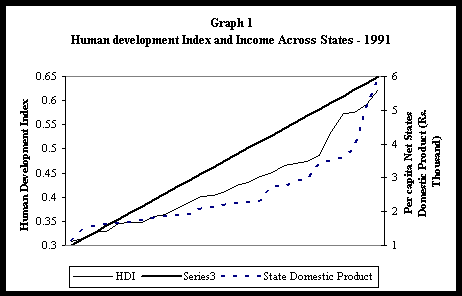
Source: National Human Development
Report 2001, Planning Commission, New Delhi
It turns out that the economically
less developed States are also the ones with low HDI and economically better
off States are the ones with relatively better performance on HDI. However,
the relation between the HDI and the level of development does not show any
correspondence among the middle-income States in the country. In this category
of States, some States like Kerala, have high attainments of HDI, at the same
time, there are States like Andhra Pradesh, or even West Bengal, where HDI values
are not as high.
Finances of State Governments and
Social Sector Expenditure
Progress on human development requires
adequate provision of funds. State Governments are responsible for most public
expenditures for the provision of social services including health and education.
Furthermore, the States are responsible for most infrastructure services except
for telecommunications, civil aviation, railways and major ports. They are also
responsible for law and order. Thus, the ability of the States to spend on social
services has important implications for human development.
As widely documented, States have
experienced significant fiscal stress since 1998-99 due to a variety of factors.
While factors like 5th Pay Commission recommendations, decline in
Central transfers, increase in committed expenditure, such as, interest payments
and pensions, and low economic growth rate account for the acuteness of the
ailment, there are also underlying structural reasons for the persistence of
fiscal deterioration. As evident from Table 2, average revenue deficit of all
States combined as a percentage of GDP more than doubled from 0.71 during 1990-95
to 1.65 during 1995-2000. It increased further to 2.41 per cent during 2000-04.
Similar movement was exhibited by the gross fiscal deficit (GFD) as well. This
has had a significant deleterious impact on the States’ social expenditures
including on education and health. Developmental expenditure as a percentage
of GDP had declined from 9.92 per cent during 1990-95 to 8.97 per cent during
1995-2000. Expenditure on social services in general and education and health
in particular witnessed a fall as a percentage of GDP during the second half
on the 1990s as compared to the first half. The fall in States’ expenditure
on education and health due to fiscal deterioration impeded their role in promoting
human development.
|
Table 2: Deficit Indicators
and Social Expenditure of States
|
|
(As Percentage of GDP)
|
|
Period
|
RD
|
GFD
|
Developmental
Expenditure
|
Social Services
Expenditure
|
Education
Expenditure
|
Health
Expenditure
|
|
1990-95
|
0.71
|
2.82
|
9.92
|
4.88
|
2.62
|
0.81
|
|
1995-2000
|
1.65
|
3.45
|
8.97
|
4.84
|
2.59
|
0.75
|
|
2000-04
|
2.41
|
4.28
|
9.35
|
4.98
|
2.67
|
0.71
|
|
2004-05 RE
|
1.44
|
4.00
|
10.18
|
5.08
|
2.47
|
0.69
|
|
2005-06 BE
|
0.75
|
3.21
|
9.35
|
4.94
|
2.39
|
0.70
|
|
RE: Revised Estimates, BE: Budget Estimates
Notes: RD: Revenue Deficit, GFD: Gross
Fiscal Deficit Education includes Sports, Art and Culture Health includes
Family Welfare
|
With active initiatives of the
States towards fiscal correction and consolidation, some signs of improvements
have been visible in state finances in the recent period. The revenue deficit
as a percentage of GDP came down to 1.44 in 2004-05 (RE) which is budgeted to
further decline to 0.75 per cent in 2005-06. Similarly, GFD as a percentage
of GDP was reduced to 4.00 per cent in 2004-05 from the average of 4.28 per
cent in 2000-2004 and is budgeted to decline further to 3.21 per cent in 2005-06.
With improvement in state finances, there is a reversal of the trend of developmental
expenditure also. The ratio of developmental expenditure to GDP increased to
10.18 per cent in 2004-05 compared to an average of 9.35 per cent during 2000-04.
States’ expenditure on social services witnessed similar movement during the
comparable period. However, expenditures on health and education as a percentage
of GDP, during 2004-05, still remain below the level of the 1990s and early
2000s. In 2005-06, development expenditure and social expenditure of the States
as percentage of GDP are budgeted to be lower than the previous year.
New Initiatives
The Union
Budget 2005-06 has provided a special focus on enhancing human capital investment
in the country in an accelerated manner. Particular emphasis has been given
to significant increases in allocations to the flagship schemes of Sarva Shiksha
Abhiyan (SSA), National Rural Health Mission (NRHM), Employment Guarantee
Scheme (EGS), Rural Electrification, and the like. Sarva Shiksha Abhiyan is
the cornerstone of the Government’s support in basic education for all children.
The allocation for this programme has been enhanced to Rs. 7,156 crore in 2005-06
as against Rs. 3,057 crore in the previous year’s budget. A non-lapsable fund
called ‘Prarambhik Shiksha Kosh’ has been created for funding this programme.
NRHM envisages strengthening primary health care through grass root level public
health interventions based on community ownership. Total allocations for the
Department of Health and the Department of Family Welfare will be enhanced from
Rs. 8,420 crore in the current year to Rs. 10,280 crore in the next year when
NRHM will be launched. Increase in the funding is envisaged to finance NRHM
and its components like training of health volunteers, providing more medicines
and strengthening the primary and community health centre system. The allocation
for the Integrated Child Development Scheme (ICDS) has also been enhanced significantly.
The Union Budget 2005-06 also proposed
launching of a massive rural electrification programme beginning in 2005-06
with the objective of covering 1,25,000 villages in five years with high emphasis
on the deficient States. Similarly, higher allocations have been made for provision
of drinking water and sanitation facilities in rural habitations. Furthermore,
a corpus of Rs 8,000 crore was provided in the current year for the Rural Infrastructure
Development Fund for improving the basic infrastructure in the rural India.
The Pradhan Mantri Gram Sadak Yojana (PMGSY) was launched in December 2000 as
a 100 per cent centrally sponsored scheme to provide rural connectivity. It
is funded by the diesel cess in the central road fund and through borrowings
from domestic financial institution and multilateral funding agencies. Without
appropriate connectivity, it is difficult to bring about the kind of improvements
envisaged for human development.
It is also important to note that
following the recommendations of the Twelfth Finance Commission (TFC), it has
been decided by the Government of India to provide specific grants for education
and health to those States which are unable to spend adequately in these sectors
because of deficiencies in fiscal capacity. TFC has recommended specific grants
amounting to Rs 10,171 crore to eight States for education and Rs 5,887 crore
to seven States for health over its award period of 2005-10. The grants for
both the sectors are an additionality over and above the normal expenditure
to be incurred by the States in these sectors. Furthermore, it recommended specific
grants to local bodies amounting Rs. 25,000 crore meant to improve basic amenities,
viz., water supply, sanitation, solid waste management, etc. which are expected
to improve the quality of life both in rural and urban areas.
As regards States’ initiatives,
many States have embarked upon the path of fiscal correction and consolidation
in the recent period. Increase in the Central transfers in the light of TFC
recommendation has a comforting impact on State finances. With the debt relief
benefits linked to enactment of the Fiscal Responsibility Legislation (FRL)
by the TFC, there has been increasing incentive to observe fiscal discipline.
As of now, while 15 States have already enacted FRL, 2 States have introduced
the Bill and 2 more States have proposed to introduce FRL Bill in their respective
Budget for 2005-06. As all the states put into effect fiscal improvement measures,
their ability to make focused expenditures on health, education, nutrition and
rural infrastructure will increase substantially.
Policy Options
For sustained social sector development,
it is important that the high growth rate of the economy is maintained over
a sustained period. Similarly, macroeconomic stability in terms of lower inflation
is also critically important to protect the poor and vulnerable segment of the
population. It is here that the role of the Reserve Bank and Monetary Policy
becomes important. In addition, prudent fiscal management through expenditure
prioritization and revenue augmentation is also essential. Thus, the recent
initiatives by the State Governments to enact FRL is a welcome move.
As I have been emphasizing in many
of my writings and speeches, widespread and bold imposition of user charges
on all non-merit goods is very important for revenue augmentation of the States.
The pattern and organization of provision of public services in India has been
done in such a way that the public has got used to not paying economic charges
for these services. This includes key services, inter alia, power, water
supply, irrigation and transport. The larger consumers of these services are
typically the better off. Thus, appropriate levy of user charges also promotes
better income distribution. Moreover, by strengthening the finances of the agencies
that supply these services, it also enhances their capacity to improve and expand
services and to serve the less well off. According to one estimate, the hidden
subsidies on these non-merit goods amount to as much as 10.7 per cent of GDP
on an annual basis. The combined fiscal deficit of the Centre and States in
recent period is around 2 to 3 percentage points lower than this as a percentage
of GDP. This highlights the need for augmenting revenue from user charges. However,
it can be noted that with the poor quality of public services provided in India,
the public is loath to pay higher charges. Hence, imposition of higher user
charges has to be accompanied by perceptible improvements in the quality of
services.
Apart from the above, rural connectivity
plays a critical role for higher human development index. Evidence suggests
that the states like Kerala, Tamil Nadu, Goa, Punjab and Himachal Pradesh that
have invested heavily in the provision of better rural connectivity are also
better placed in terms of human development. Thus, better rural infrastructure
and connectivity is necessary to accomplish developmental programmes related
to human development. The direct benefits of rural development and connectivity
in terms of better roads, electrification and communication also enable the
doctors, health workers, and teachers to stay in the villages. Such personnel,
who have with great effort and difficulty, educated themselves can scarcely
be expected to stay in habitations that lack basic infrastructure and connectivity.
They obviously have aspirations for their own children and families. Investment
in social sectors like health and education is unlikely to be successful unless
accompanied by complementary investment in rural infrastructure. The indirect
benefits of better communication would be in terms of better dissemination of
information on all aspects of agricultural products, particularly that on agricultural
prices. Farmers suffer greatly from the large difference between market prices
of agricultural products and farm level prices due to large transportation costs
and lack of information. Thus, better rural connectivity in terms of both transportation
and communication, will promote better price discovery and help in improving
farmers’ income and, hence, their human development. The extension of institutional
credit, be it through banking institutions or microfinance institutions, will
also be enabled by better rural connectivity. The improvement in farmers’ income
from better rural connectivity will itself improve their credit worthiness leading
to lower applicable interest rate and further improvements in incomes and human
development.
Besides, physical connectivity,
economic empowerment of the vast segment of our population who have hitherto
remained financially excluded is an important issue for human development. The
programme of linking Self Help Groups (SHGs) with the banking system has emerged
as the major micro-finance programme in the country. At present, micro-finance
institutions (MFIs) depend on the banks including commercial banks, Regional
Rural Banks (RRBs) and cooperative banks to obtain finance according to the
guidelines issued by the RBI. There is an increasing emphasis to promote MFIs
which provide small-scale credit and other financial services to low income
households and small informal businesses. Empowering MFIs will facilitate their
role as intermediary between the lending banks and the beneficiaries. The Union
Finance Minister, in his Budget Speech 2005-06, has prescribed that the commercial
banks should appoint MFIs as the ‘banking correspondents’ to provide transaction
services on their behalf.
In response, RBI appointed an Internal
Group on Rural Credit and Micro-finance to look at the broad aspects of increasing
"financial inclusion" and promoting MFIs. I am glad, indeed, that
the Principal and the faculty of this College, have been associated with the
preparation of the report which is now being closely examined for implementation.
The report has recognised both
the supply and demand side constraints and circumstances that has made mass
scale financial inclusion elusive. Pragmatically appreciating that the large-scale
expansion of physical infrastructure supported by multifarious policy initiatives
could not accelerate the inclusion of a vast majority of rural population into
the ambit of formal financial institutions, the report suggested that if "financial
inclusion" is to be made a reality, we need to leverage socially active
organizations and persons to work with people, particularly those with small
means, empower them and bring them closer to financial services provided by
the formal financial institutions on the one hand. On the other, these agencies
and persons can be harnessed to bring aggregation of quantities so that the
constraints of reaching large numbers of dispersed, far-flung and socio-economically
disadvantaged clientele is minimized. To translate this into action, the report
has suggested that banks may use the services of the "Business Facilitators"
to bring people and the banks together without having to handle cash and the
"Business Correspondents" who will bring them together and will also
handle cash for providing doorstep services. NBFCs, NGO-MFIs, Section 25 Companies,
Cooperative societies, corporate entities, post-offices, etc. can be identified
as possible correspondents while even informal entities like farmers’ clubs,
NGOs, cooperatives, Rural Kiosks, socially conscious individuals, etc. can work
as the facilitators.
All of us at RBI and our Governor,
in particular, have appreciated the suggestions and we hope that the banks will
use these avenues to accelerate the process of financial inclusion.
Before I conclude let me compliment
CAB, UNDP and the Planning Commission for very thoughtfully designing the programmes
mainly for the State Government officials who are at the cutting edge of human
development initiatives.
The programme on "Human Development
and State Finances" covers substantially the whole gamut of human development
and financing issues. All of you will have the opportunity to hear and interact
with well-known academicians and practitioners like Shri Sridharan, Dr. Seeta
Prabhu, Prof. J B G Tilak, Prof. D K Srivastava, Dr. Amarjeet Sinha besides
UNDP Administrator, Dr. Kemal Dervis, Shri Jayant Patil, Finance Minister, Government
of Maharashtra and other experts in the high power panel discussion scheduled
in Mumbai. I will also urge you to use this programme as a platform to interact
among yourselves and share experiences as seldom you have an occasion when so
many development practitioners come together at one place and get also to hear
from so many renowned people. I am sure this programme will help you realize
the importance of your role in the process of the country’s development and
reinvigorate you intellectually and emotionally to seize the opportunity to
realize the Millennium Development Goals of the UN and human development goals
of the Tenth Five Year Plan.
I wish your deliberations in the
programme a grand success.
* Speech delivered by Deputy Governor, Reserve Bank of India
(RBI) at the inaugural session of the 3rd Programme on "Human Development
and State Finances" jointly organized by the College of Agricultural Banking
(CAB), Reserve Bank of India, Planning Commission and the United Nations Development
Programme (UNDP) on November 7, 2005
|