It is my pleasure to be here at the Columbia Indian Economy Summit, 2026. I would like to thank Prof. Arvind Panagariya for his kind invitation to me to speak on issues related to India’s growth trajectory, both at the national and at the states’ level. My talk is in three parts. I will first present select salient features of the trajectory of economic growth of India over the past four decades, and what it bodes for the years to come. Then, I will present key characteristics of the states’ respective growth trajectories. Finally, I will draw some inferences and implications from these observations for our quest to attain the status of a much more prosperous economy by 2047. 1. Salient features of the trajectory of economic growth of India over the past four decades2 India’s economic growth has consistently accelerated since the early 1980s. Average real gross domestic product (GDP) growth has increased from 5.7 per cent in the 1980s to 5.8 per cent in the 1990s, rising further to 6.3 per cent in the 2000s, to 6.6 per cent in the 2010s, and reaching 7.7 per cent in the most recent four-year period (Table 1). | Table 1: GDP growth and per capita income growth | | | Annual average real GDP growth
(per cent) | Annual average real per capita income growth
(per cent) | | 1980-81 to 1989-90 | 5.7 | 3.5 | | 1990-91 to 1999-2000 | 5.8 | 3.7 | | 2000-01 to 2009-10 | 6.3 | 4.6 | | 2010-11 to 2019-20 | 6.6 | 5.2 | | 2022-23 to 2025-2026* | 7.7 | 6.7 | Note: 1. *: Excluding the COVID years of 2020-21 and 2021-22; 2. Data is for the base year 2011-12.
Source: The Ministry of Statistics and Programme Implementation (MoSPI). Back series with 2011-12 base has been taken from Economic and Political Weekly Research Foundation (EPWRF), https://epwrfits.in/index.aspx (last accessed on April 10, 2026). | The acceleration is even more pronounced in per capita income (Figure 1). From about US$ 274 in 1981 and US$ 306 in 1991, per capita income has risen nearly tenfold to around US$ 2700 in 2024. Importantly, while it took over two decades for per capita income to double initially, it has expanded by almost fivefold in the subsequent two decades, indicating a clear structural shift in growth momentum. As per the forecasts in October 2025 World Economic Outlook (WEO) of the IMF, per capita income is projected to increase to US$ 2818 in 2025, US$ 3051 in 2026 and US$ 4346 in 2030. Decline in population growth, too, has contributed to faster per capita income growth. India’s population growth, once significantly above the global average, has steadily moderated and has converged to global levels since around 2014, amplifying gains in per capita terms. India has attained a virtuous cycle of accelerated growth and macroeconomic stability. Macroeconomic stability is reflected in sustainable and resilient outcomes across inflation, the current account balance, fiscal position, debt quality, and financial sector health, among others. Key macroeconomic outcomes, especially growth (overall and sectoral) and inflation, are broadly less volatile and move within a narrower, more predictable range. Inflation has declined at a faster rate than in most economies, resulting in a narrowing of the inflation differential vis-à-vis advanced economies and other emerging and developing economies. India’s decadal average current account deficit has varied within a moderate range of 0.5-2.2 per cent of GDP since 1990 and has remained modest in recent years. The banking sector has undergone a structural turnaround–following a decade-long phase of balance sheet repair, banks today are significantly stronger and better capitalized, both historically and relative to their peers. On the fiscal front, while deficit and debt levels rose during COVID-19, India has retreated to a path of consolidation, with a clear focus on reducing deficits and stabilizing debt over the medium term.3 There has been a distinct focus on enhancing the quality of fiscal outcomes, with a notable shift towards capital expenditure, thereby strengthening the growth potential of the economy (Government of India, 2026). These improved outcomes are attributed to robust policy frameworks and nimble policy responses. India’s policy frameworks have steadily evolved and today reflect global best practices, while remaining well-anchored in domestic realities. In fiscal policy, the Fiscal Responsibility and Budget Management (FRBM) framework has provided a rule-based path for fiscal management, while retaining flexibility to respond to shocks such as COVID and other external events. In tax policy, reforms such as the Goods and Services Tax (GST) have unified the indirect tax system and improved compliance. In monetary policy, the Flexible Inflation Targeting (FIT) framework introduced in 2016 has lowered inflation, anchored inflation expectations, reduced macroeconomic volatility, and enhanced policy credibility. In the broader financial sector, stronger banking supervision, improved capital norms, and wide-ranging regulatory reforms across financial markets have reinforced system resilience. 2. Salient features of the trajectory of economic growth across states States have become more prosperous than before. India’s growth story consists of broad-based prosperity, with every state recording a significant increase in per capita gross state domestic product (GSDP) over the past two decades, indicating that progress has been nationwide rather than confined to a few states or regions.4 This is seen both in US dollar terms as well as in constant rupees terms, adjusted for inflation. In the last two decades, average per capita incomes across states have surged nearly fivefold in current US dollar terms and more than threefold in constant rupees, underscoring the strength and sustained pace of India’s long-term income gains (Table 2). | Table 2: Ratio of per capita GSDP in 2024-25 to 2003-04 | | States | Constant INR | Current USD | | Sikkim | 6.0 | 11.4 | | Telangana | 4.5 | 7.9 | | Karnataka | 3.9 | 6.7 | | Tamil Nadu | 4.2 | 6.6 | | Uttarakhand | 3.9 | 6.1 | | Andhra Pradesh | 3.5 | 5.9 | | Arunachal Pradesh | 2.7 | 5.8 | | Odisha | 3.4 | 5.7 | | Haryana | 3.3 | 5.6 | | Goa | 3.3 | 5.5 | | Gujarat | 4.0 | 5.4 | | Mizoram | 4.3 | 5.3 | | Rajasthan | 2.7 | 5.2 | | Madhya Pradesh | 2.9 | 5.2 | | Bihar | 3.0 | 5.1 | | Kerala | 3.2 | 5.0 | | Tripura | 3.9 | 4.9 | | Assam | 2.8 | 4.9 | | Maharashtra | 3.3 | 4.8 | | Uttar Pradesh | 2.7 | 4.7 | | Chhattisgarh | 2.7 | 4.7 | | Nagaland | 3.0 | 4.6 | | Himachal Pradesh | 3.2 | 4.4 | | West Bengal | 2.5 | 4.4 | | Punjab | 2.6 | 3.7 | | Jharkhand | 2.5 | 3.6 | | Manipur | 2.1 | 3.5 | | Meghalaya | 2.2 | 3.3 | | Average | 3.3 | 5.4 | Notes: 1. Due to data unavailability, 2023–24 values are used for 2024–25 for Sikkim, Goa, Gujarat, Mizoram, Nagaland, and Manipur; 2. GSDP at constant prices INR is based on 2011-12 base year; 3. Average is the unweighted average; 4. Data for Telangana from the year 2003-04, including backcasted series, was sourced from EPWRF. 5. Per capita income in USD was computed by dividing the current price per capita income by the respective annual average exchange rate.
Sources: MoSPI (sourced from EPWRF); Database on Indian Economy (DBIE) RBI; and staff calculations. | Yet, the pace of income growth has varied across states. Some states have become five to ten times more prosperous over the last two decades, while others have recorded more modest gains of around three times. One strong correlate of the relative performance is their initial prosperity levels. Per capita income levels in more prosperous states have grown faster than in relatively less prosperous ones. The fact that richer states have experienced greater prosperity than the poorer states in the past, and that this trend has not reversed, implies that income levels across states have not been converging. Notwithstanding this, the extent of divergence has weakened considerably over time (Figure 2a, 2b, and 2c). In other words, the growth gap between richer and poorer states has narrowed in recent years. The association between initial income and subsequent growth was positive and statistically significant (at 5 per cent level) during the decade of 1990s (Figure 2a). It became numerically smaller and less significant statistically in the subsequent decade (at 10 per cent level, Figure 2b). During the last decade, the coefficient has declined sharply; and the relationship between the initial income and the subsequent decadal growth has become insignificant (Figure 2c). The attrition of divergence can be attributed to the better performance of relatively lower-income states such as Odisha, Assam, and Uttar Pradesh during the past decade, among other factors. 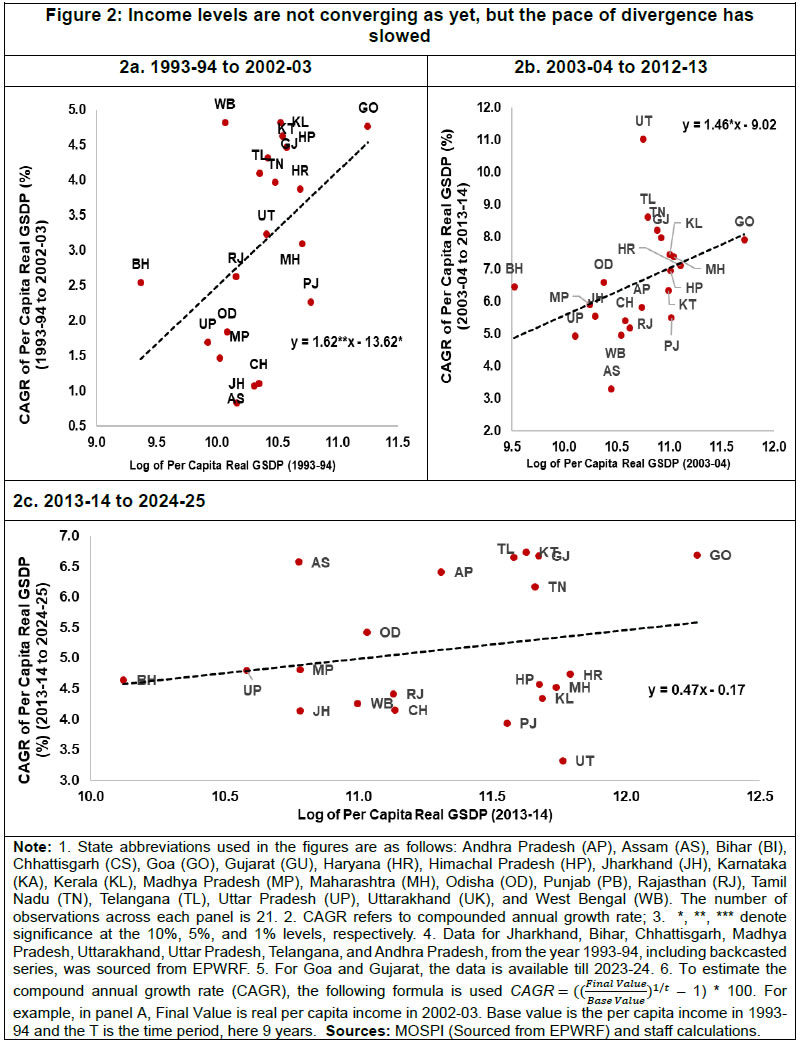 Overall, the outperformance of the richer states in the past has been driven not only by higher income growth but also by slower population growth (Table 3). States above median income levels have both higher GSDP growth as well as slower population growth, resulting in a faster growth in per capita income. Table 3: Average GDP growth and population growth across states
(per cent) | | | Average annual real GSDP growth from 2003-04 to 2024-25 | Average annual population growth from 2003-04 to 2024-25 | | Below median | 6.8 | 1.4 | | Above median | 7.7 | 1.1 | Notes: 1. Due to data unavailability, 2023–24 values are used for 2024–25 for Sikkim, Goa, Gujarat, Mizoram, Nagaland, and Manipur. 2. Based on real per capita GSDP in 2003–04, states were classified as above or below the median. Above-median states include Andhra Pradesh, Arunachal Pradesh, Goa, Gujarat, Haryana, Himachal Pradesh, Karnataka, Kerala, Maharashtra, Punjab, Sikkim, Tamil Nadu, Telangana and Uttarakhand. Below-median states comprise Assam, Bihar, Chhattisgarh, Jharkhand, Madhya Pradesh, Manipur, Meghalaya, Mizoram, Nagaland, Odisha, Rajasthan, Tripura, Uttar Pradesh, and West Bengal. 3. The unweighted average is presented. 4. Data for Telangana from the year 2003-04, including backcasted series, was sourced from EPWRF.
Source: MoSPI (Sourced from EPWRF) and staff calculations. | While income convergence across states remains gradual, several other welfare indicators, most notably per capita consumption expenditure, have been converging more decisively. In earlier periods, for example in case of rural consumption expenditure, consumption growth tended to be positively associated with initial consumption levels, meaning richer states showed higher levels of consumption growth (Figures 3a and 3b). However, in the recent period (2011–12 to 2023–24), this relationship has reversed: states with historically lower consumption levels are now recording faster consumption growth, a pattern confirmed by a statistically significant negative coefficient on initial consumption levels (Figure 3c). This marks a meaningful shift toward distributional convergence in living standards across Indian states. 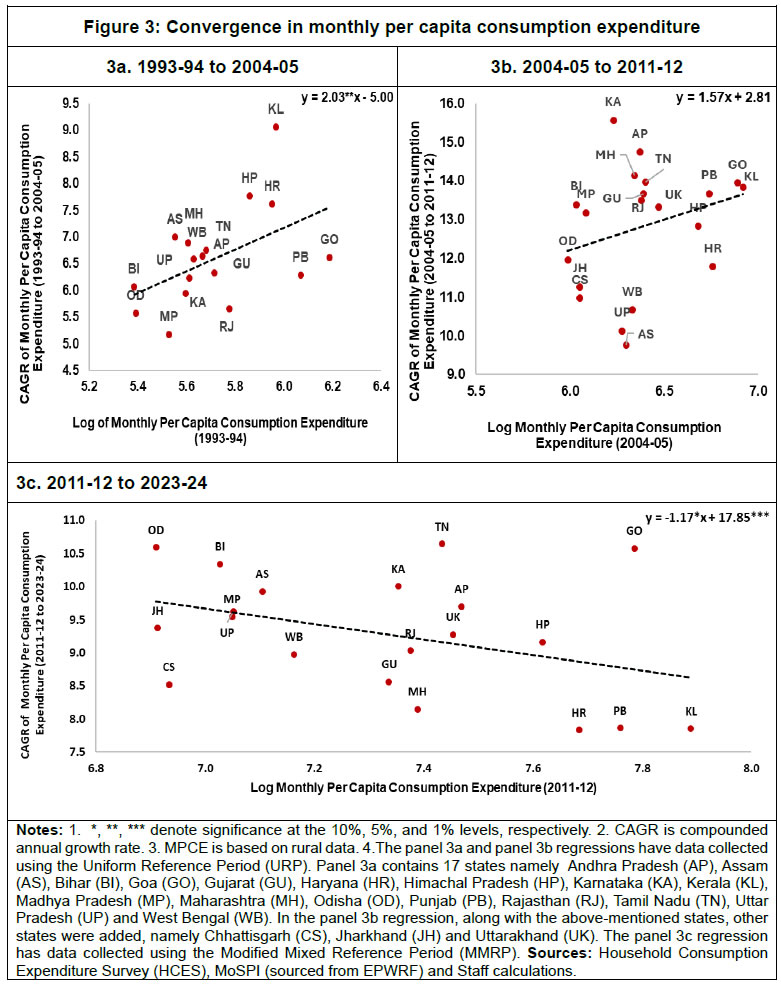 Beyond consumption expenditure, multiple other dimensions of socio-economic wellbeing have been converging. Indicators spanning health, education, demography, physical infrastructure, access to electricity, safe drinking water, sanitation, clean cooking fuel, and financial inclusion have all trended toward greater parity across states, irrespective of their initial income levels. This broad-based convergence is likely driven by sustained policy efforts, saturation levels in the richer states where further gains are numerically not feasible or are inherently harder to achieve, and rising demand in the poorer states that have been experiencing increases in their income levels. Figure 4 (4a to 4h) illustrate these trends across a selection of key outcome indicators. Women’s literacy rate (literacy rate per 100 women) has risen steadily over the decades while fertility rate (number of births per female) has declined sequentially (Figures 4a and 4b). Percentage of children who are not underweight has improved meaningfully, increasing from around 62 per cent in 2005-06 to close to 70 per cent in 2019-21 (Figure 4c). Infant survival rate, too, has also improved sequentially over the decades (Figure 4d). Access to basic services has strengthened considerably across states with an increase in households’ access to electricity, sanitation facilities, improved drinking water facilities (Figures 4e, 4f and 4g). Financial deepening indicators have improved, e.g. per cent of women in India with access to a bank account has jumped to around 80 per cent during 2019-21 from 14 per cent in 2005-06 (Figure 4h). Convergence is also evident in other development indicators like sex ratio (proportion of females to males), vitamin A coverage among children, incidence of anaemia among women and children, stunting (low height for age) and wasting (low weight for height), access to clean fuel, women’s ownership of a phone and house/land; and household health insurance coverage.5 There is significant improvement in each of these indicators, with a narrowing of dispersion across states, reflecting a broad-based improvement in welfare outcomes as well as increasing convergence in living standards across states. What we have depicted here is only a subset of indicators. There are many other indicators where similar phenomenon is prominently visible. 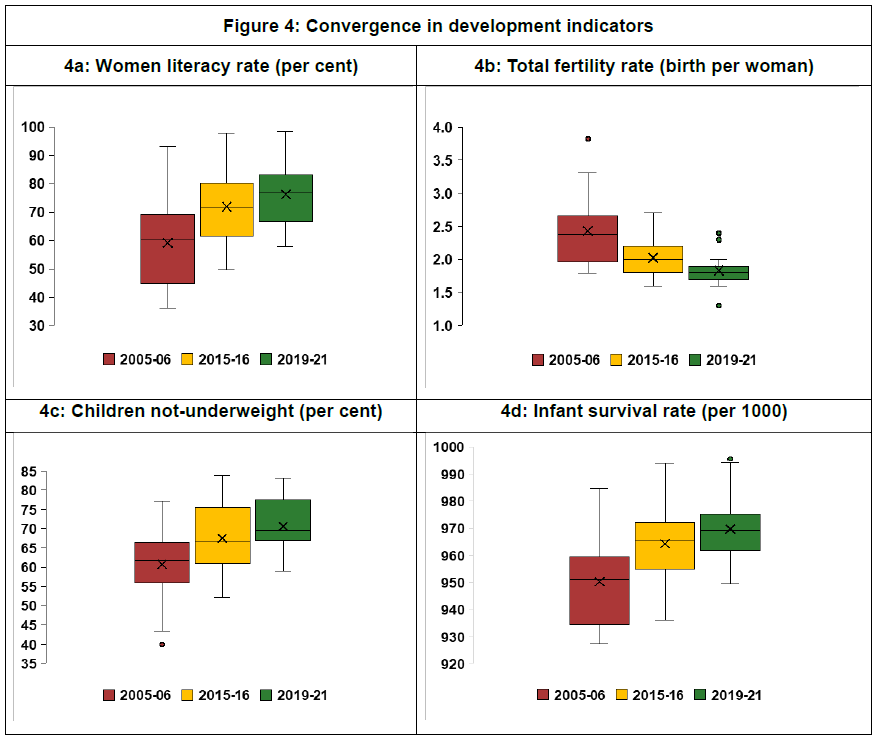 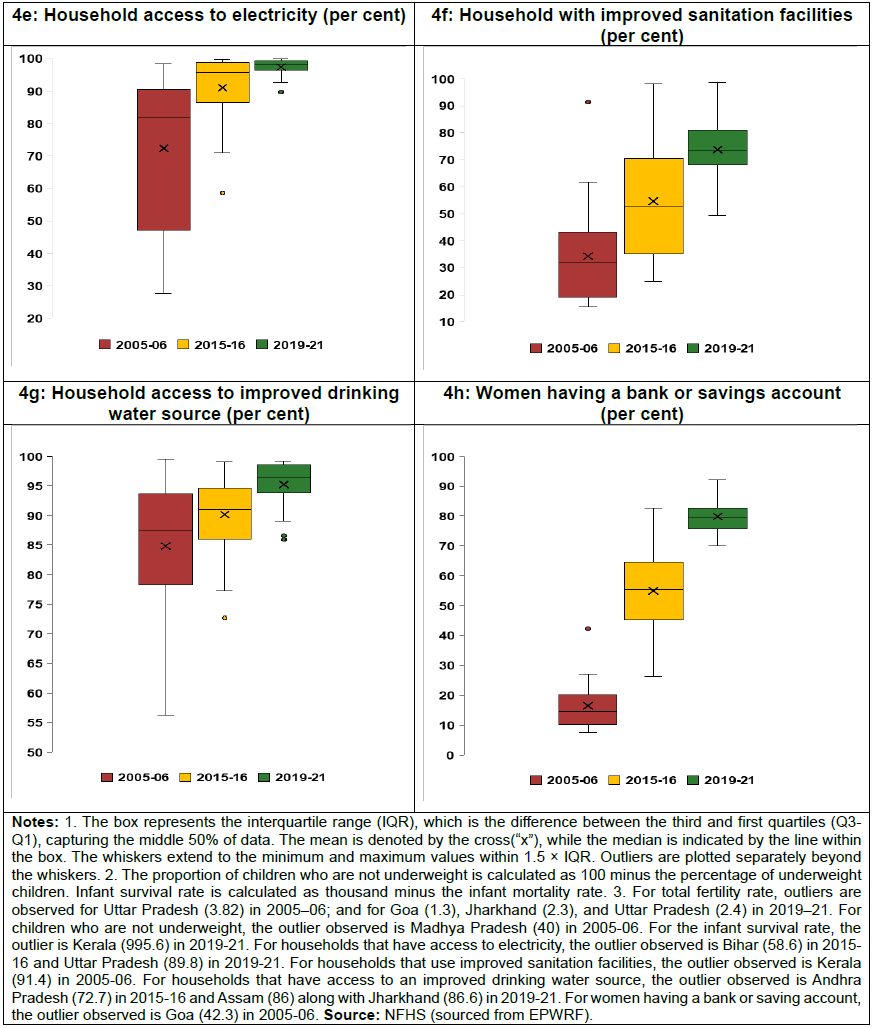 It is equally important to note that convergence has not been universal across all enablers of growth and development. Data limitations make it difficult to establish this with full empirical precision, but interstate convergence appears limited for some of the structural variables, including the share of agriculture in state economies, the pace of movement out of agriculture, productivity growth, capital formation, FDI inflows, and bank credit growth. As per the patterns in these indicators, some of the drivers or correlates of growth are still showing divergence across states. If the past rates of growth are maintained, many states will become or come close to becoming “rich” by 2047 (as per the prevailing international thresholds of prosperity). As a simple thought experiment, we calculate each state's average annual growth rate in per capita GSDP (in USD terms and again in constant INR) over the past decade (2013-14 to 2024-25); and use these to project income levels in 2046-47 assuming that the same rate of growth would prevail over the next two decades.6 On this basis, India's per capita income is projected to grow by 4 times in USD terms by 2046-47. This expansion is expected to be broad-based: both above-median and below-median states are projected to record substantial gains, with below-median states contributing considerable momentum, reinforcing the inclusive nature of India's growth trajectory (Figure 5). 3. Inferences and implications of the above observations for our quest to attain the status of a much more prosperous economy by 2047 Sustaining or exceeding recent growth trajectories to reach an even higher level of prosperity by 2047 will require extending our growth frameworks at the subnational levels. Policy priorities will naturally differ across the spectrum of states. For above-median states, the focus ought to be on innovation and scale, planned urbanization, attracting global and domestic talent, expanding market share both domestically and internationally, and actively taking part in shaping national frameworks on trade, FDI, and finance. For below-median states, priorities could include unlocking productivity in agriculture and reimagining the sector; building skills; integrating more in the national and international labour markets, complementing more advanced states, particularly in labour-intensive activities, emulating proven best practices nationally and internationally while developing niche strengths, and strengthening fiscal capacity to support faster growth. Accelerating growth would require a clearer acknowledgement and more effective use of the distinct policy roles available to the centre and the states respectively. Many macro policies are formulated at the national level. These include monetary policy; financial sector regulation covering banks, non-bank financial institutions; development of equity and debt markets, and private equity; policies related to the external sector including for trade, exchange rate and capital account openness; and industrial and competition policy among others. At the state level, the policy space and levers available are different, though no less consequential. State governments shape the ease of doing business environment; determine land and labour market conditions; quality and reach of education and health services; delivery of public services; and enhancing the quality of public finances including allocation of their budgets into recurrent and capital expenditure and between merit and non-merit activities. Strengthening all of these in a holistic framework would be important to accelerate the rate of growth of prosperity for each one of the states and thereby the national average. Conclusion Prosperity is both India’s ambition and its destiny. The central question is no longer whether India will prosper, but how quickly, how broadly, and how equitably that prosperity would be shared across its states and its people. The pace of income divergence has weakened considerably with the growth gap between richer and poorer states narrowing over successive decades. Meanwhile convergence has been faster and more decisive across a wide set of welfare and development indicators: per capita consumption expenditure, literacy, nutrition, access to basic services, financial inclusion, and a range of health and gender outcomes. Lagging states are catching up, and the distribution of wellbeing across India is becoming more equal. Looking ahead, if growth trajectories of the past two decades are sustained, the average state per capita income could approach high-income thresholds by 2046-47. Crucially, below-median states are projected to contribute substantially to this expansion, reinforcing the broad-based nature of India’s growth story. Realising and accelerating the path to this potential, however, would require moving towards state-specific growth strategies that are anchored in local strengths, structural realities, and their respective stages of development. This calls for holistic assessments, richer dialogues, greater awareness, specific actions across states, alongside learning from each other, to fully leverage their existing strengths and building new comparative advantages. References Eichengreen, Barry, Gupta, Poonam, and Ahmed, Ayesha. (2024). India's debt dilemma, India Policy Forum, vol. 20(1), pages 1-62. Government of India (2026). Fiscal developments - Anchoring stability through credible consolidation, Chapter 2, Economic Survey 2025-26, Ministry of Finance. Gupta, Poonam (2025). Policy frameworks for economic resilience: The case of emerging markets and India (Address at the Business Standard BFSI Insight Summit, Mumbai). Gupta, Poonam (2026). Perspectives on India’s growth: Last four decades to the present (14th Foundation Day Lecture, Centre for Development Studies). International Monetary Fund (2025). World Economic Outlook, October. Panagariya, Arvind (2010). India on the growth turnpike: No state left behind, Columbia Program on Indian Economic Policies Working Paper No. 2010-1. Reserve Bank of India (2025). Financial Stability Report, December.
|