| V.1 During
2006-07, the Reserve Bank continued to focus its regulatory and supervisory initiatives
on promoting a stable and competitive financial sector in an environment characterised
by rising globalisation, ongoing financial deregulation and rapid technological
innovations. Prudential, accounting and disclosure norms were strengthened so
as to promote financial stability. Consistent with the policy approach of conforming
the domestic financial sector to the international best standards with emphasis
on gradual harmonisation, final guidelines for implementation of the New Capital
Adequacy Framework (Basel II) by banks were issued. Initiatives to strengthen
the urban cooperative banks were pursued during the year, following the path set
out in the draft Vision Document. In view of the important role played by the
non-banking financial companies in broadening access to financial services, enhancing
competition and diversification of the financial sector, the Reserve Bank continued
with its efforts to strengthen these entities. The Reserve Bank also focused on
the initiatives for protecting customers’ rights, enhancing the quality
of customer service and strengthening the grievance redressal mechanism in banks
during 2006-07.
V.2 In the above backdrop, this Chapter details the various
regulatory and supervisory measures initiated by the Reserve Bank relating to
banks and other financial institutions during 2006-07. The supervisory review
process (SRP) undertaken with respect to select banks having significant exposure
to the sensitive sectors revealed that real estate exposure increased across banks,
mainly on account of individual housing loans. The prudential norms were strengthened,
especially in view of rapid credit growth in various sectors. The smooth migration
to the Basel II framework continued to engage the attention of the Reserve Bank
as commercial banks in India would start implementing Basel II norms from March
31, 2008. A ‘Code of Banks’ Commitment to Customers’ was released
to provide a framework for a minimum standard for banking services which individual
customers can legitimately expect. As a part of the gradual process of financial
liberalisation, it is considered appropriate to introduce credit derivatives in
a calibrated manner. In the context of the recent amendment to the Reserve Bank
of India Act, 1934 providing legality to OTC derivative instruments, including
credit derivatives, it was proposed in the Annual Policy Statement for the Year
2007-08 to permit banks and PDs to begin transacting in single-entity credit default
swaps. Given the significant role played by urban cooperative
banks in providing banking services to the middle/lower middle income people,
initiatives were also undertaken to strengthen these banks. Following the path
set out in the draft Vision Document, Memoranda of Understanding (MoU) have been
signed with the 12 States and the Task Force for Co-operative Urban Banks (TAFCUBs)
have also been constituted in these States. UCBs in States, which have signed
MoUs, have been enabled to expand their business by allowing them to set up currency
chests, sell mutual fund products, provide foreign exchange services, open new
ATMs and convert extension counters into branches. The MoUs have also been signed
between the Reserve Bank and the Central Government in respect of Multi-State
UCBs. Almost 83 per cent of the UCBs accounting for about 90 per cent of the total
deposits are covered under the MoU arrangements. The regulatory framework with
regard to systemically important non-banking financial companies was strengthened
to reduce regulatory gaps. Systemically important non-deposit taking NBFCs were
also defined and prudential norms were specified for these entities.
REGULATORY FRAMEWORK FOR THE INDIAN
FINANCIAL
SYSTEM
V.3 The Reserve Bank performs regulatory and supervisory
role over commercial and urban co-operative banks (UCBs), financial institutions,
non-banking financial companies (NBFCs) and primary dealers (PDs) through the
Board for Financial Supervision (BFS). As at end-March 2007, there were
82 commercial banks [excluding regional rural banks (RRBs)] (of which nine were
permitted to undertake PD business), 96 RRBs, 1,815 UCBs, 7 development finance
institutions (DFIs), 13,020 NBFCs (of which 403 NBFCs are permitted to accept/hold
public deposits) and 11 PDs. The BFS continued to exercise its supervisory role
over the segments of the financial system that are under the purview of the Reserve
Bank. The BFS is headed by the Governor with a Deputy Governor as Vice Chairperson
and other Deputy Governors and four Directors of the Central Board as members.
In respect of the State and district central co-operative banks, and RRBs, while
the Reserve Bank is the regulator, the supervision is vested with the National
Bank for Agriculture and Rural Development (NABARD). Insurance companies and mutual
funds are regulated by the Insurance Regulatory and Development Authority (IRDA)
and the Securities and Exchange Board of India (SEBI), respectively. A coordinated
approach to supervision is ensured through a High-Level Coordination Committee
on Financial and Capital Markets (HLCCFM) with the Governor of the Reserve Bank,
as Chairman, and the chiefs of the SEBI, the IRDA and the Pension Fund Regulatory
and Development Authority (PFRDA), and the Secretary, Economic Affairs, Ministry
of Finance, Government of India as the members. During 2006-07, two meetings
of the HLCCFM were held on July 28, 2006 and March 8, 2007. During 2007-08, so
far one meeting of the HLCCFM was held on July 19, 2007.
V.4 During 2006-07,
the BFS provided guidance on several regulatory and supervisory policy decisions,
with particular attention to issues arising out of the increasing complexity of
the financial system, the impending implementation of the New Capital Adequacy
Framework (Basel II) in India, banks’ exposure to sensitive sectors, risk
management and corporate governance. The following are some of the major issues
addressed under the guidance of the BFS during the year. First, the second round
of supervisory review process (SRP) with regard to banks’ exposures to sensitive
sectors was initiated for select banks, based on off-site data (Box
V.1).
V.5 Second, recognising the risk facing banks due to their
exposures to the real estate sector, provisioning requirements and risk weights
on real estate exposures were tightened.
V.6 Third, as some of the banks
were found to be using floating provisions to set-off against provisions required
to be made as per extant prudential guidelines which resulted in smoothening of
profits, detailed guidelines were issued to banks. The guidelines stipulated,
inter alia, that floating provisions can be used only for contingencies
under extraordinary circumstances for making specific provisions in impaired accounts
after obtaining Board’s approval and with prior permission of the Reserve
Bank. To enable banks’ Boards to evolve suitable policies in this
regard, it was clarified that the extra-ordinary circumstances refer to losses
which do not arise in the normal course of business and which are exceptional
and non-recurring in nature and could be broadly classified under three categories,
viz., general, market and credit.
V.7 Fourth, in order to capture
the vast and significant changes taking place in the banking sector, the supervisory
rating model based on CAMELS/ CALCS used for the purpose of rating the commercial
banks in India during the Annual Financial Inspection (AFI) was revised comprehensively
to ensure greater objectivity in assessment by introducing benchmarks based on
industry averages/frequency distributions. It was also decided that the rating
model would be assessed for its viability and effectiveness on an ongoing basis
and updated regularly to factor in the evolving dynamics and requirements to reflect
the most objective scenario. Box V.1
Supervisory Review Process The Mid-term Review of the Annual
Policy Statement 2005-06 had stated that supervisory review process (SRP) would
be initiated in respect of select banks having significant exposure to real estate
sector, highly leveraged NBFCs, venture capital funds and capital markets, in
order to ensure that effective risk mitigants and sound internal control are in
place.
In the first round, a framework was developed for monitoring systemically
important individual banks. In the second round of the SRP, undertaken in January-March
2007, the exposure of select banks to sensitive sectors, particularly to the real
estate sector was analysed. Ten banks with real estate exposure and capital market
exposure in excess of 200 per cent and 25 per cent, respectively, of their net
worth were identified. The second round of the SRP was split into two phases.
Under Phase I, detailed information on exposure to sensitive sectors, including
real estate sector as per the revised definition, was sourced from these banks,
followed by discussions with their senior officials. Phase II of the SRP was based
on onsite focused examination to assess the risk exposures of individual banks
with reference to their actual control environment, procedures, and compliance
with internal and regulatory norms. The onsite scrutiny focused on large lending
towards real estate and other sensitive sectors, companies involved, branch-wise
large individual exposures, and other related matters.
The initial analysis
revealed that real estate exposure increased across all the banks, mainly on account
of individual housing loans. Commercial real estate exposure had also risen in
varying degrees across all the banks. Although exposure to the capital market
showed an increasing trend, none of the banks breached the regulatory limits.
Exposure to the highly leveraged NBFCs was found to be minimal in most of the
identified banks and wherever banks had exposures, a majority of them were in
the public sector. The analysis also revealed that, prima facie, all
the banks under review had some risk management policies, systems and controls
in place to tackle the risks posed by exposure to sensitive sectors. However,
in the case of the real estate exposure, certain lapses were observed with regard
to implementation of banks’ own approved policies. V.8 Finally, all
the NBFCs were advised to submit a certificate from their statutory auditors
every year to the effect that they continue to undertake the business of a non-banking
financial institution (NBFI) requiring holding of the certificate of registration
(CoR) under Section 45-IA of the Reserve Bank of India Act, 1934.
REGULATORY
AND SUPERVISORY INITIATIVES
Commercial Banks
V.9 As part of the ongoing efforts to strengthen the banking system through
the adoption of policies aimed at both improving the financial strength of banks
as well as bringing about greater transparency in their operations, several policy
measures were initiated during 2006-07.
Strengthening Prudential
Norms
V.10 Bank credit has recorded sustained high growth since
2003-04, with non-food credit by scheduled commercial banks recording an annual
average growth of about 30 per cent per annum during 2004-05 to 2006-07. Banks’
loans and advances por tfolios are pro-cyclical and concomitantly, there is a
tendency to underestimate the level of inherent risk during times of accelerated
credit growth. In order to ensure that asset quality is maintained in the light
of high credit growth and taking into account the rise in default rates with regard
to personal loans and credit card receivables, the general provisioning requirement
for standard advances by banks in specific sectors, i.e., personal loans,
loans and advances qualifying as capital market exposures, residential housing
loans beyond Rs.20 lakh, commercial real estate loans and loans to non-deposit
taking systemically important NBFCs were raised in May 2006/January 2007 (Table
5.1). As hitherto, these provisions would be eligible for inclusion in Tier
II capital for capital adequacy purposes to the permitted extent. The revised
provisioning requirements are also applicable to the urban cooperative banks (UCBs).
V.11 Implementation of infrastructure projects can get delayed due to a variety
of factors beyond the control of the promoters, requiring restructuring/ reschedulement
by the banks. Accordingly, asset classification norms for infrastructure projects
were modified with effect from March 31, 2007. Consequently, infrastructure projects
would be treated as sub-standard if the date of commencement of commercial production
extended beyond a period of one year after the originally envisaged date
of completion of the project, as against the earlier stipulation of six months.
V.12 Banks (including UCBs) were advised (November 2006) to strictly comply
with the directions of the Monitoring Committee constituted by the High Court
of Delhi regarding unauthorised construction, misuse of properties and encroachment
on public land, while extending housing loans for building construction as well
as for purchase of constructed property/built up property.
Table
5.1: Standard Asset Provisioning Requirements |
(Per cent) |
Sr. No. | Category
of Standard Asset | March
2005 | November
2005 | May
2006 | January
2007 | 1 | 2 | 3 | 4 | 5 | 6 |
1. | Direct
advances to the agricultural and SME sectors | 0.25 | 0.25 | 0.25 | 0.25 |
2. | Residential
housing loans beyond Rs.20 lakh | 0.25 | 0.40 | 1.00 | 1.00 |
3. | Personal
loans (including credit card receivables),
loans and advances | 0.25 | 0.40 | 1.00 | 2.00 |
| qualifying
as capital market exposures and commercial | | | | |
| real
estate loans | | | | |
4. | Loans
and advances to non-deposit taking systemically important NBFCs | 0.25 | 0.40 | 0.40 | 2.00 |
5. | All
other loans and advances not included above | 0.25 | 0.40 | 0.40 | 0.40 |
Risk Management
V.13 Keeping in view the market conditions,
effective September 20, 2006, banks’ exposure to entities for setting up
the Special Economic Zones (SEZs) or for acquisition of units in the SEZs which
included real estate are treated as exposure to the commercial real estate sector.
V.14 Banks are increasingly relying on outsourcing as a means of reducing
costs as well as accessing external expertise. At the same time, outsourcing is
associated with certain risks, viz., strategic risk, reputation risk,
compliance risk, operational risk, exit strategy risk, counterparty risk, country
risk, contractual risk, access risk, concentration risk and systemic risk. The
failure to manage these risks could lead to financial losses/reputational risk
for the bank and systemic risks within the banking system. Accordingly, based
on suggestions received on the draft guidelines issued in December 2005, the final
guidelines were issued in November 2006. These guidelines are concerned
with managing risks in outsourcing of financial services and are not applicable
to technology-related issues and activities not related to banking services like
usage of courier, catering of staff, housekeeping and janitorial services, security
of the premises, movement and archiving of records. Banks, which desire to outsource
financial services, would not require prior approval from the Reserve Bank, whether
the service provider is located in or outside India.
V.15 An Internal
Group was constituted by the Reserve Bank to review the existing guidelines on
derivatives and formulate comprehensive guidelines on derivatives. Based on the
Group’s report, comprehensive guidelines on derivatives were issued on April
20, 2007. These guidelines relate to rupee interest rate derivatives and cover
broad generic principles for undertaking derivative transactions, management of
risk and sound corporate governance requirements and detailed guidance on suitability
and appropriateness policy to be adopted by market makers. Guidelines in respect
of foreign exchange derivatives will be issued separately. As a part of the gradual
process of financial liberalisation, it is considered appropriate to introduce
credit derivatives in a calibrated manner. In the context of the recent amendment
to the Reserve Bank of India Act, 1934 providing legality of OTC derivative instruments,
including credit derivatives, it was proposed in the Annual Policy Statement of
the Reserve Bank in April 2007 to permit banks and PDs to begin transacting in
single-entity credit default swaps. In this context, draft guidelines on credit
default swaps were issued in May 2007. V.16 Venture capital funds (VCFs)
play an important role in encouraging entrepreneurship; however, the absence of
adequate public disclosures with regard to their performance/asset quality can
raise risks inherent in banks’ exposure to VCFs. The prudential framework
governing banks’ exposure to VCFs was revised in August 2006. Under the
revised framework, banks’ exposures to VCFs (both registered and unregistered)
are deemed to be on par with equity and hence reckoned for compliance with the
capital market exposure ceilings (ceiling for direct investment in equity and
equity linked instruments as well as ceiling for overall capital market exposure).
The quoted equity shares/bonds/units of VCFs in the banks’ portfolio shall
be held under the ‘available for sale’ (AFS) category and shall be
marked to market, preferably on a daily basis, but at least on a weekly basis
in line with valuation norms for other equity shares. Banks’ investments
in unquoted shares/ bonds/units of VCFs made after issuance of these guidelines
shall be classified under the ‘held to maturity’ (HTM) category for
an initial period of three years, and shall be valued at cost. For the investments
made before the issuance of these guidelines, the classification shall be done
as per the existing norms. After three years, the unquoted units/shares/bonds
shall be transferred to the AFS category and shall be valued according to the
guidelines. Investments in shares/units/bonds of VCFs shall be assigned 150 per
cent risk weight for measuring the credit risk during the first three years when
these are held under the HTM category. When these are held under or transferred
to the AFS, the capital charge for the specific risk component of the market risk
(as required in terms of the present guidelines on computation of capital charge
for market risk), shall be fixed at 13.5 per cent to reflect the risk weight of
150 per cent. The charge for general market risk component shall be at 9 per cent
for investments in shares/units, as in the case of other equities. For investments
in bonds, the charge for general market risk shall be computed as in the case
of investment in any other kind of bonds. The exposures to VCFs other than investments
shall also be assigned a risk weight of 150 per cent. The entire investment in
VCFs will be outside the purview of guidelines relating to non-SLR securities. V.17
Guidelines on banks’ exposure to capital markets were rationalised in terms
of base and coverage in April 2007. Under the extant norms, banks’
aggregate exposure to the capital market in all forms was restricted to five per
cent of their total outstanding advances (including commercial paper) as on March
31 of the previous year. Within this overall ceiling, banks’ direct investments
in shares, convertible bonds/debentures and units of equity-oriented mutual funds
were restricted to 20 per cent of their net worth. On a consolidated basis, banks’
aggregate exposure to capital market was subject to the overall ceiling of two
the per cent of their total on-balance-sheet assets (excluding intangible assets
and accumulated losses) as on March 31 of the previous year, within which their
investments in shares, convertible bonds/debentures and units of equity oriented
mutual funds were restricted to 10 per cent of their consolidated net worth. In
terms of the revised guidelines, aggregate exposure of a bank on solo as well
as on consolidated basis to the capital markets in all forms (both fund and non-fund
based) should not exceed 40 per cent of its net worth (consolidated net wor th
in the case of consolidated bank) as on March 31 of the previous year. Within
this overall ceiling, direct investment in shares, convertible bonds/debentures,
units of equity-oriented mutual funds and all exposures to VCFs (both registered
and unregistered) should not exceed 20 per cent of the bank’s net worth/consolidated
net worth.
V.18 From the perspective of financial stability, the concentration
risk on the liability side of banks is as important as that on the asset side.
While the counterparty risk concentration on the assets side has attracted adequate
attention and received regulatory policy response, the concentrated risk on the
liability side of the banks has not received similar attention. Uncontrolled liabilities,
in particular inter-bank liabilities, may have systemic implications, even if
the individual counterparty banks are within the allocated exposure. In order
to reduce the extent of concentration on the liability side of banks, the Reserve
Bank put in place a comprehensive framework of liability management in March 2007.
Accordingly, banks were advised to fix, with the approval of their boards of directors,
a limit for their inter-bank liabilities within the prudential limit of 200 per
cent of their net worth, based on their audited balance sheet as on March 31 of
the previous year. Banks with CRAR of more than 11.25 per cent are allowed to
have an additional limit of 100 percentage points, i.e., up to 300 per
cent of the net worth. The limit so fixed will include only fund based inter-bank
liabilities. Since the limits are for inter-bank borrowings within India, inter-bank
borrowings/ liabilities outside would be excluded. Collateralised borrowings
under the CBLO and refinance from NABARD and SIDBI would also be excluded.
The existing limit on the call money borrowings prescribed by the Reserve Bank
would operate as a sub-limit within the above limits. Accounting and
Disclosure Norms
V.19 In order to ensure that the drawdown by banks
of their statutory reserves is done prudently and is not in violation of any of
the regulatory prescriptions, banks were advised (September 2006) (i) to take
prior approval from the Reserve Bank before any appropriation is made from the
statutory reserve or any other reserves; (ii) all expenses including provisions
and write-offs recognised in a period, whether mandatory or prudential, should
be reflected in the profit and loss account for the period as an ‘above
the line’ item (i.e., before arriving at the net profit); (iii)
wherever draw down from reserves takes place with the prior approval of the Reserve
Bank, it should be effected only ‘below the line’ (i.e.,
after arriving at the profit/loss for the year); and (iv) to ensure that suitable
disclosures are made of such draw down of reserves in the ‘notes on accounts’
to the balance sheet.
V.20 In March 2003, banks were advised to adopt
the three business segments, viz., ‘treasury’, ‘other
banking business’ and ‘residual’ as the uniform business segments,
and ‘domestic’ and ‘international’ as the uniform geographic
segments, for the purpose of segment reporting under the Accounting Standard (AS)
17. However, the ‘other banking business’ segment was found to very
broad, containing almost the entire banking book. In order to enhance transparency,
banks were advised in April 2007 to divide this segment into three categories,
viz., corporate/wholesale banking, retail banking and other banking operations.
The disclosure requirement will come into force from the reporting period ending
March 31, 2008. The retail banking has been defined keeping in view the criteria
of orientation, product, granularity, and low value of individual exposures. Individual
housing loans will also be included in the retail banking segment. Wholesale banking
would include all advances to trusts, partnership firms, companies and statutory
bodies, not included under retail banking. V.21 Disclosure of information
in the public interest by the employees of an organisation is increasingly gaining
acceptance by public bodies for ensuring better governance standards and probity/
transparency in the conduct of affairs of public institutions. Accordingly, as
a proactive measure to strengthen financial stability and to enhance public confidence
in the financial sector, the Reserve Bank introduced the ‘protected disclosures
scheme for the private sector and foreign banks’ on April 18, 2007. The
scheme is broadly on the lines of the Government of India Resolution of April
2004 which is applicable to the public sector banks as well as the Reserve Bank
(Box V.2).
Resolution of Non-Performing Loans
V.22 In order to facilitate recovery of their assets, banks have been provided
with a number of avenues. The Securitisation and Reconstruction of Financial Assets
and Enforcement of Security Interest Act, 2002 (SARFAESI Act, 2002), inter
alia, seeks to regulate securitisation and reconstruction of financial assets
and enforcement of security interest for realisation of dues without the intervention
of courts or tribunals. The Act enables banks and financial institutions (FIs)
to realise long term assets, improve recovery by exercising powers to take possession
of securities and sell them and reduce non-performing assets by adopting measures
for recovery or reconstruction. Under the Act, commercial banks issued 193,887
notices up to March 31, 2007, involving an outstanding amount of Rs.44,214 crore.
Of this, an amount of Rs.10,909 crore was recovered from 106,692 cases, while
Rs.6,512 crore was received through 46,461 compromise proposals.
V.23
The Recovery of Debts Due to Banks and Financial Institutions Act, 1993 provides
for the establishment of tribunals for the expeditious adjudication and recovery
of debts owed to banks and FIs. The amendments made in 2000 and 2003 to the Act
and the Rules framed thereunder have strengthened the functioning of the Debt
Recovery Tribunals (DRTs). Out of 75,441 cases involving Rs.1,20,559 crore filed
with the DRTs by the banks, 41,410 cases involving Rs.53,639 crore were adjudicated
by end-March 2007. The amount recovered through the adjudicated cases was Rs.18,521
crore.
V.24 Commercial banks and FIs can also use the forum of Lok
Adalats to reduce the stock of NPAs. While Lok Adalats organised
by the Civil Courts can settle banking disputes involving an amount up to Rs.20
lakh, those convened by the various DRTs/Debt Recovery (Appellate) Tribunals (DRATs)
can resolve cases involving Rs 10 lakh and above. At end-March 2007,
the number of cases filed by commercial banks with Lok Adalats stood
at 976,101 involving an amount of Rs.5,833 crore. Of this, 352,302 cases involving
an amount of Rs.1,772 crore have been decided. An amount of Rs.759 crore has been
recovered from 283,401 cases.
Anti-Money Laundering
V.25 Detailed guidelines based on the recommendations of the Financial Action
Task Force (FATF) on Anti-Money Laundering Standards and on Combating Financing
of Terrorism were issued to banks in November 2004 to formulate and put in place
a proper policy framework on ‘Know Your Customer’ and Anti-Money Laundering
(ALM) measures. With a view to implementing Special Recommendation VII (SR VII)
of the FATF, which aims at preventing terrorists and other criminals from having
unfettered access to wire transfers for moving their funds, the Reserve Bank advised
banks in April 2007 that domestic wire transfers of Rs.50,000 and above and all
cross-border wire transfers should be accompanied by accurate and meaningful originator
information (name, address and account number) which should be retained throughout
the payment chain. Furthermore, the record of originator information accompanying
a wire transfer should be kept for ten years, as required under the Prevention
of Money Laundering Act (PMLA), 2002. The beneficiary banks should also put in
place effective risk-based procedures in order to identify wire transfers that
lack complete originator’s information. In case, any overseas ordering bank/financial
institution fails to furnish information on the remitter, the receiving bank should
restrict or even terminate its business relationship with the ordering bank. Box
V.2
Protected Disclosures Scheme for Private Sector and
Foreign Banks Globally, large scale corporate frauds have necessitated
various legislative measures for safeguarding public interest, through enactments
such as the Whistleblower Protection Act in the US and the Public Interest Disclosure
Act in the UK. In the Indian context, the Government of India had authorised,
on April 21, 2004, the Central Vigilance Commission (CVC) as the ‘designated
agency’ to receive written complaints or disclosure on any allegation of
corruption or of misuse of office and recommend appropriate action. The jurisdiction
of the CVC in this regard is restricted to employees of the Central Government
or of any corporation established by it under any Central Act, Government companies,
societies or local authorities owned or controlled by the Central Government.
Thus, the Government of India scheme covers the public sector banks and the Reserve
Bank (since it is an entity established under the Central statute).
The
Reserve Bank introduced a similar scheme on April 18, 2007, applicable to private
sector and foreign banks operating in India. The complaints under the scheme would
cover areas such as corruption, misuse of office, criminal offences, suspected/actual
fraud, failure to comply with existing rules and regulations, and acts resulting
in financial loss/operational risk, loss of reputation, and detrimental to depositors’
interest/public interest. Under the scheme, employees of the bank concerned (private
sector and foreign banks operating in India), customers, stakeholders, NGOs and
members of public can lodge complaints. Towards More Deregulation
V.26 In order to facilitate the expansion of Indian corporates’ business
abroad, the prudential limit on credit and non-credit facilities extended by banks
to Indian joint ventures (where the holding by the Indian company is more than
51 per cent)/wholly owned subsidiaries abroad was enhanced from 10 per cent to
20 per cent of their unimpaired capital funds (Tier I and II capital) in November
2006.
Opening up of the Financial Sector
V.27 During
2006-07, Indian banks continued to expand their presence overseas (Table
5.2). As at end-June 2007, 16 banks (11 public sector banks and 5 private
sector banks) had a network of 188 offices (123 branches, 38 representative offices,
7 joint ventures and 20 subsidiaries) overseas.
V.28 During the calendar
year 2006, the Reserve Bank issued approvals for opening 13 branches of foreign
banks in India. During 2006-07 (July 2006-June 2007), permission was granted to
three existing foreign banks to open 10 branches in India, to six foreign
banks to open one representative office each in Mumbai and to one foreign bank
to open a representative office in New Delhi. During the same period, six foreign
banks have opened their branches across India and four foreign banks have opened
their representative offices in Mumbai (Table 5.3).
As at end-June 2007, 29 foreign banks were operating in India with 268 branches.
In addition, 34 foreign banks were also operating in India through their representative
offices.
Mergers and Amalgamations
V.29 In view of
the deteriorating financial condition of the Ganesh Bank of Kurundwad Ltd. (GBK),
the Government of India, on the recommendation the Reserve Bank, placed the bank
under an Order of
Table
5.2: Offices of Indian Banks Opened | Abroad:
July 2006 to June 2007 | Name
of the Bank | Type
of | Country | Place |
| Presence | | |
1 | 2 | 3 | 4 |
Allahabad Bank | Branch | Hong
Kong | Hong Kong |
Andhra Bank | RO | UAE | Dubai
| Bank of Baroda | OBU | Singapore
| Singapore | | Branch | Hong
Kong | Hong Kong |
| Branch | Hong
Kong | Hong Kong |
Bank of India | Branch
* | China | Shenzen |
| Branch | Belgium
| Antwerp | Canara
Bank | Branch | Hong
Kong | Hong Kong |
ICICI Bank Ltd | RO | Malaysia
| Kuala Lumpur | | RO | Indonesia
| Jakarta | Punjab
National Bank | Subsidiary
United Kingdom | London |
State Bank of India | Branch | UAE | DIFC |
| Branch | Bahrain
| Manama | | Branch | Israel
| Tel Aviv | | Subsidiary** | Indonesia
| | UCO
Bank | RO | China
| Guangzhou | Union
Bank of India | RO | China
| Shanghai | UTI
Bank Ltd | Branch | Hong
Kong | Hong Kong |
| Branch | UAE | DIFC |
| RO | China
| Shanghai | *
: Upgradation of a representative office to a branch.
** : 76 per cent stake
in PBIM, an Indonesian bank.
Note : RO : Representative office.
UAE United Arab Emirates.
OBU : Offshore Banking Unit.
DIFC : Dubai
International Financial Centre. | Moratorium for a period
of three months with effect from the close of business on January 7, 2006. During
the period of moratorium, based on a
Table
5.3: Offices of Foreign Banks Opened in | India:
July 2006 to June 2007 | Name
of the Bank | Type
of Presence | Place |
1 | 2 | 3 |
Hong Kong and Shanghai | Branch | Raipur,
Jodhpur, | Banking Corporation
(HSBC) | | Lucknow
| ABN Amro Bank N V | Branch | Kohlapur,
Salem, | | | Udaipur, |
| | Ahmedabad |
Barclays Bank | Branch | Kanchipuram, |
| | Bangalore
| Shinhan Bank | Branch | New
Delhi | Deutsche Bank | Centralised | Mumbai |
| Back
Office | | Standard
Chartered Bank | AO | Chennai,Mumbai |
National Australia Bank Ltd | RO | Mumbai |
Banca di Roma | RO | Mumbai |
Depfa Bank PLC | RO | Mumbai |
Banco Bilbao Vizcaya Argentina SA | RO | Mumbai |
Note : AO
: Administrative Office.
RO : Representative Office. | proposal
received from the Federal Bank Ltd., the Reserve Bank prepared a draft Scheme
of Amalgamation of GBK with the Federal Bank Ltd. The objections/suggestions received
on the draft Scheme were considered by the Reserve Bank. With the Reserve Bank
having complied with all the statutory requirements under Section 45 of the Banking
Regulation Act, 1949, the Government of India sanctioned the said scheme and the
Scheme of Amalgamation came into force on January 25, 2006. However, the amalgamation
was challenged by GBK and others before the High Court of Bombay and thereafter
before the Supreme Court. The Supreme Court dismissed the special leave petition
on August 28, 2006. Following this, the Government issued necessary notification
on September 1, 2006 and GBK was amalgamated with the Federal Bank Ltd. with effect
from September 2, 2006. V.30 In view of the deteriorating financial condition
of the United Western Bank Ltd. (UWB), the Government of India, on an application
made by the Reserve Bank, issued an Order of Moratorium under sub Section (2)
of Section 45 of the Banking Regulation Act, 1949, on the bank for a period of
three months effective September 2, 2006. During the period of moratorium, the
Reserve Bank received expression of interest for amalgamation from 17 entities.
On September 12, 2006, the Reserve Bank placed in public domain a draft scheme
of amalgamation of the UWB with the Industrial Development Bank of India (IDBI)
Ltd. and invited suggestions/objections on the draft scheme. After considering
the objections and suggestions, the Scheme was forwarded to the Government of
India for sanction, which was granted on September 30, 2006. The amalgamation
came into force on October 3, 2006.
V.31 ICICI Bank Ltd. and Sangli Bank
Ltd. made applications to the Reserve Bank, after obtaining the approval from
their shareholders, for sanction of the scheme of amalgamation of Sangli Bank
Ltd. with the ICICI Bank Ltd. The scheme of amalgamation was sanctioned
by the Reserve Bank under Section 44 A of the Banking Regulation Act, 1949 and
the amalgamation became effective from April 19, 2007.
V.32 The Government
of India sanctioned the scheme of Transfer of Undertaking of Bharat Overseas Bank
Ltd. to Indian Overseas Bank which was made effective from the close of business
on March 31, 2007. Supervisory Initiatives
V.33 The Basel
Committee on Banking Supervision (BCBS) had released the document ‘International
Convergence of Capital Measurement and Capital Standard: A Revised Framework’
(popularly known as Basel II framework) on June 26, 2004. With a view to ensuring
migration to Basel II in a non-disruptive manner, the Reserve Bank adopted a consultative
approach and constituted a Steering Committee comprising senior officers from
banks, the Indian Banks’ Association (IBA) and the Reserve Bank. On the
basis of the recommendations of the Steering Committee and the sub-groups formed
by it, the Reserve Bank had issued draft guidelines for implementation of the
new capital adequacy framework for comments in February 2005. The draft guidelines
were revised on the basis of the feedback received and reissued for a second round
of consultation in March 2007. On the basis of feedback received on the second
draft, the guidelines for implementation of the New Capital Adequacy Framework
(Revised Framework) were finalised and issued on April 27, 2007 (Box
V.3).
V.34 In view of the emergence of financial conglomerates in
the country, the supervisory framework is being strengthened (Box V.4). Since
the supervision of financial conglomerates is relatively a new concept in the
Indian context, the conglomerate supervision framework in place in a couple of
countries is being studied to identify the processes and structures of conglomerate
supervision which can be replicated in India. Financial Inclusion
V.35 With a view to achieving the objective of greater financial inclusion,
all banks were advised in November 2005 to make available a basic banking ‘no-frills’
account either with ‘nil’ or very low minimum balances as well as
charges that would make such accounts accessible to vast sections of population.
All the public and the private sector banks as well as foreign banks, except those
not having significant retail presence, are reported to have introduced the basic
banking ‘no-frills’ account. Up to end-March 2007, 6.7 million ‘no-frills’
accounts were opened by banks.
V.36 Recognising that Information Technology
(IT)-enabled services have the potential for effectively meeting the challenge
of providing banking facilities in remote and unbanked areas while keeping the
transaction costs low, banks were urged in May 2007 to scale up their financial
inclusion efforts by utilising appropriate technology. Banks were also advised
to ensure that the solutions developed are highly secure, amenable to audit and
widely accepted open standards to allow inter-operability among the banks. Banks
have initiated pilot projects utilising smart cards/mobile technology to increase
their outreach. Box V.3
Basel
II - Implementation of the New Capital Adequacy Framework by Banks in India: Salient
Features • Banks in India shall adopt the Standardised
Approach for credit risk, and the Basic Indicator Approach for operational risk
for computing their capital requirements under the Revised Framework. Banks shall
continue to apply the Standardised Duration Approach for computing capital requirement
for market risk.
• Foreign banks operating in India
and Indian banks having operational presence outside India should adopt the Revised
Framework with effect from March 31, 2008. All other commercial banks (excluding
Local Area Banks and Regional Rural Banks) are encouraged to migrate to the Revised
Framework in alignment with them, but in any case not later than March 31, 2009.
• Banks are required to maintain a minimum capital to risk-weighted
assets ratio (CRAR) of 9 per cent on an ongoing basis. However, taking into account
the relevant risk factor and internal capital adequacy assessments of each bank,
the Reserve Bank may prescribe a higher level of minimum capital ratio to ensure
that the capital held by a bank is commensurate with its overall risk profile.
• Banks are required to maintain, at both solo and consolidated
level, a minimum Tier I ratio of at least 6 per cent. Banks below this level must
achieve this ratio on or before March 31, 2010.
• The
minimum capital maintained by banks on implementation of Basel II norms shall
be subject to a prudential floor computed with reference to the requirement as
per Basel I framework for credit and market risks. The floor has been fixed at
100 per cent, 90 per cent and 80 per cent for the position as at end-March for
the first three years of implementation of the Revised Framework.
•
With a view to ensuring smooth transition to the Revised Framework and providing
opportunity to banks to streamline their systems and strategies, banks were advised
to have a parallel run of the Revised Framework.
• Banks
may use the credit ratings awarded by the following four credit rating agencies
for assigning risk weights for credit risk for capital adequacy purposes: Credit
Analysis and Research Ltd., CRISIL Ltd., Fitch India, and ICRA Ltd. Banks are
also allowed to use the credit ratings of following three international rating
agencies: Fitch, Moody’s and Standard & Poor’s. •
Claims on domestic sovereigns (Central and State Governments) will attract a zero
risk weight while those guaranteed by State Governments will attract 20 per cent
risk weight.
• Risk weights for claims on banks will
be linked to the capital adequacy position of the counter party bank. Scheduled
and other banks will receive a differential treatment.
•
Claims on corporates will be risk weighted as per the ratings awarded by the chosen
rating agencies. Unrated claims on corporates will attract a risk weight of 100
per cent. Claims above Rs.50 crore sanctioned/renewed on or after April
1, 2008 will attract a higher risk weight of 150 per cent; this threshold will
be lowered to Rs.10 crore with effect from April 1, 2009. •
Claims eligible for inclusion as regulatory retail portfolio, specified claims
secured by mortgage of residential property, loans and advances to banks’
own staff meeting the specified conditions, and consumption loans up to Rs.1 lakh
against gold and silver ornaments shall attract a preferential risk weight ranging
between 20 per cent and 75 per cent.
• Claims in respect
of a few specified categories such as venture capital funds, commercial real estate,
consumer credit including personal loans and credit card receivables, capital
market exposures, and claims on non-deposit taking systemically important NBFCs
will attract risk weights of 125 per cent or 150 per cent.
•
Capital requirements for operational risk under the Basic Indicator Approach will
be the average of a fixed percentage of positive annual gross income of the previous
three completed financial years.
• A set of disclosure
requirements has been prescribed to encourage market discipline.
•
Banks are required to obtain prior approval of the Reserve Bank to migrate to
the advanced approaches such as the Internal Rating Based Approach for credit
risk and the Standardised Approach or the Advanced Measurement Approach for operational
risk for computing capital requirements. The pre-requisites and procedure for
approaching the Reserve Bank for seeking such approval will be issued in due course. V.37
In February 2007, banks were permitted to prepare a scheme for offering ‘doorstep
banking’ services to their customers, with the approval of their boards,
thereby dispensing with the need for approval from the Reserve Bank. Under the
scheme, banks can offer doorstep services such as pick up of cash/instruments,
delivery of cash against Box V.4
Evolving Framework for Financial Conglomerate Supervision in India The
Financial Conglomerate (FC) monitoring framework is operated on the following
two tracks: (a) off-site monitoring of intra-group transactions and group-wide
risks through a system of quarterly FC returns and (b) half-yearly discussions
between the group representing all regulators concerned and the CEOs of the entities
in the Group on significant issues relating to group-wide oversight structure,
risk management, intra-group transactions etc. The half-yearly discussions
enhance the understanding amongst the regulators about the affairs of the Groups.
The responsibility of collecting FC data/information and forwarding the same on
a quarterly basis to the principal regulator has been entrusted to the dominant/major
entity in the Group (quite often the parent) which is called a “designated
entity” (DE).
In view of the experience gained in monitoring of
FCs over the past two years, new initiatives have been taken in consultation with
the other regulators for further strengthening of the FC oversight framework.
First, the FC identification criteria have been altered to bring under the oversight
framework only such Groups which have significant presence in at least two of
the five accepted financial market segments in India. It was decided not to treat
the Primary Dealer business as a separate segment. Second, the FC returns have
been amended in order to capture intra-group transactions and exposures of all
the entities (including trusts/ SPVs) and also to appropriately focus on the supervisory
issues. Third, the need for the principal regulator to engage in direct dialogue
with the principal auditors of the Group has been agreed to help the regulators
communicate supervisory concerns to the conglomerates more effectively. The modalities
for the dialogue are being worked out. Finally, the principal regulators have
also agreed in principle to undertake a joint study of the books of accounts and
other operations of major entities in an identified financial conglomerate. The
joint study is expected to not only back-test the efficacy of the reporting format
in capturing the intra-group transactions/exposures and other ‘material’
information but also enhance the regulatory understanding of the affairs of the
conglomerates. Customer Service
V.38 The broad
approach of the Reserve Bank to customer service is to empower the common person
in availing banking services and strengthen customer-service delivery in banks
by adopting a consultative process with banks through the Indian Banks’
Association (IBA). Specifically, the focus is on (a) sensitising banks to
customer service and encouraging the involvement of boards of banks, especially
in matters relating to banks’ own grievance redressal machinery; (b) insisting
on transparency in all dealings with the customers and ensuring reasonableness
in pricing; (c) promoting adherence to self-imposed codes by banks on commitments
to bank customers and monitoring compliance by an independent agency, viz.,
Banking Codes and Standards Board of India (BCSBI); (d) strengthening and empowering
institutional mechanism for dispute resolution; (e) using regulation/prescription
only when essential, while encouraging IBA to take initiatives; and (f) rationalising
the Reserve Bank’s own systems and procedures.
V.39 With the setting
up of the Customer Service Department on July 1, 2006 in the Reserve Bank, various
customer service activities relating to the banks and the Reserve Bank, which
were handled by different departments of the Reserve Bank, have been brought under
a single roof (Box V.5).
V.40 The revised Banking
Ombudsman Scheme, 2006 came into effect from January 1, 2006 and included many
important features such as new grounds for complaints, easier complaint submission
facility and appeal option to the complainants. During 2006-07, the functioning
of the Banking Ombudsman offices was facilitated by fully operationalising the
complaint tracking software, enabling complainants to file their complaints online.
Under the revised Scheme, the Banking Ombudsman dealt with 26,062 complaints during
July-December 2006. Of these, 18,117 complaints were disposed of, while 7,945
complaints were pending as on December 31, 2006. On May 24, 2007, the Scheme was
amended to enable bank customers to appeal to the Reserve Bank against not only
awards passed by the Banking Ombudsmen but also other decisions given by it in
respect of complaints falling on such grounds specified in the Scheme. Box
V.5
Customer Service Department The Reserve
Bank has been vigorously pursuing the efforts to improve the customer service
in the banking sector. Accordingly, it has been taking measures for protection
of customers’ rights, enhancing the quality of customer service and strengthening
the grievance redressal mechanism in banks and within the Reserve Bank itself.
The activities pertaining to customer service in banks and the Reserve Bank were,
however, being undertaken by its different departments. In order to reinforce
its initiatives in the provision of customer services, it was decided to bring
together all activities relating to customer service in banks and the Reserve
Bank in a single department. The Reserve Bank, therefore, constituted a new department
called the Customer Service Department (CSD), effective from July 1, 2006. The
constitution of a new department focusing exclusively on customer services outlines
the importance placed by the Reserve Bank on the delivery of customer services.
The functions of the Customer Service Department include:
•
Dissemination of instructions/information relating to customer service and grievance
redressal by banks and the Reserve Bank. • Overseeing
the grievance redressal mechanism in respect of services rendered by the various
Reserve Bank offices/departments.
• Administration of
the Banking Ombudsman (BO) scheme.
• Acting as a nodal
department for the Banking Codes and Standards Board of India (BCSBI).
• Ensuring redressal of complaints on customer service in banks
received directly by the Reserve Bank.
• Liaison between
banks, the Indian Banks’ Association, the BCSBI, the BO offices and the
regulatory departments in the Reserve Bank on matters relating to customer services
and grievance redressal.
The periodical feedback that the Department
receives from the complaints dealt at the Banking Ombudsman offices has become
one of the most important inputs for policy initiatives in the Reserve Bank. V.41
All scheduled commercial banks/NBFCs involved in credit card operations were advised
in November 2005 to maintain a ‘Do Not Call Registry’ in order to
tackle the complaints relating to unsolicited commercial communications being
received by customers/non-customers as part of the telemarketing efforts of banks
and with a view to protecting the right to privacy of the members of the public.
Despite this measure, complaints continued to be received from credit card subscribers.
To address this issue, the Telecom Regulatory Authority of India (TRAI) has framed
the Telecom Unsolicited Commercial Communications (UCC) Regulations, 2007. The
Regulations envisage setting up a mechanism by all telecom service providers to
receive requests from subscribers who do not want to receive UCC and maintain
and operate a private ‘do not call’ list. The telephone numbers and
area code from this list will be updated online by the operators to a National
Do Not Call Registry (NDNC) to be maintained by National Informatics Centre. Telemarketers
will have to register in the NDNC Registry and would interact with it for updating
their list. The guidelines issued by TRAI on June 6, 2007 mandate telemarketers
to register themselves with Depar tment of Telecommunications (DoT) or any other
agency authorised by DoT. In view of the above, banks have been advised not to
engage telemarketers (DSAs/ DMAs) not having such valid registration certificate.
The IBA shall coordinate with banks to furnish the list of telemarketers (DSAs/DMAs)
engaged by them, along with the registered telephone numbers being used by them,
to TRAI.
V.42 A ‘Code of Banks’ Commitment to Customers’
was released on July 1, 2006. The Code signifies the first formal collaborative
effort by the Reserve Bank, the banks and the Banking Codes and Standards Board
of India (BCSBI) to provide a framework for a minimum standard for banking services
which individual customers can legitimately expect with reliability, transparency
and accountability. The Code outlines how each bank expects to deal with the day-to-day
requirements of the customers and accordingly, what each customer should reasonably
expect from his/her bank. As at end-July 2007, 69 out of 84 SCBs had registered
with the BCSBI.
V.43 In order to facilitate complaint submission by the
customers, banks have been advised that a complaint form, along with the name
of the nodal officer for complaint redressal, may be provided on their websites.
The complaint form should also indicate that the first point for redressal of
complaints is the bank itself and that complainants may approach the Banking Ombudsman
only if the complaint is not resolved at the bank level within a month. Similar
information is to be displayed in the boards put up in all the bank branches to
indicate the name and address of the Banking Ombudsman. In addition, the name,
address and telephone numbers of the controlling authority of the bank to whom
complaints can be addressed are also to be given prominently.
V.44 In
order to enhance the effectiveness of the grievance redressal mechanism, banks
were advised in February 2007 to place a statement of complaints before their
boards/customer service committees along with an analysis of the complaints received.
Banks were also advised to disclose brief details of complaints dealt and the
Banking Ombudsman awards issued against them along with their financial results.
Furthermore, banks were advised to place a detailed statement/analysis of complaints
on their websites for information of the general public at the end of each financial
year.
V.45 In order to protect the rightful interest of borrowers and
guard against undue harassment by lenders, the Reserve Bank had issued the guidelines
on Fair Practices Code for Lenders in May 2003. Accordingly, banks/FIs were required
to ensure that loan application forms in respect of priority sector advances up
to Rs.2 lakh contain comprehensive information about the fees/charges and any
other matter which affects the interest of the borrower. Banks/FIs were also required
to convey in writing the reasons for rejection of loan applications of small borrowers
seeking loans up to Rs.2 lakh. In March 2007, these guidelines were made applicable
in respect of all categories of loans irrespective of the amount of loan sought.
The provisions relating to rejection of applications were also applicable with
respect to credit card applications.
V.46 Keeping in view the advantages
of a handy and compact pass book as a ready reckoner for transactions and the
problems associated with statement of accounts, banks (including UCBs) were advised
(October 2006) to invariably offer pass book facility to all their savings bank
account holders (individuals). In case, a bank offers the facility of sending
statement of account and the customer chooses to get such a statement, the same
must be provided to the customer on a monthly basis. Furthermore, the cost of
providing such pass book or statements should not be charged to the customer.
Banks were also advised (September 2006) to ensure that the full address and telephone
numbers of branches are mentioned in the passbook/statement of accounts issued
to the account holders in order to improve the quality of customer service in
branches. It was also reiterated (December 2006) that banks should ensure the
provision of both the drop box facility and the facility for acknowledgement of
the cheques at the regular collection counters to customers1. In order to improve
transparency, banks (including urban cooperative banks) were advised in July 2006
to place their service charges and fees on their websites at a prominent place
under the title of ‘Service Charges and Fees’. A link to the websites
of the banks has also been provided on the Reserve Bank’s website.
V.47 In 1999, the practice of fixing the benchmark service charges by the Indian
Banks’ Association (IBA) on behalf of the member banks was discontinued
and the decision to prescribe the service charges was left to the discretion of
the boards of individual banks. Banks were then advised that they should ensure
that the charges were reasonable and not out of line with the average cost of
providing the services and that customers with low volume of activities were not
penalised. However, the Reserve Bank continued to receive representations from
the public regarding unreasonable and non-transparent service charges. Accordingly,
in order to ensure fair practices in banking services, the Reserve Bank constituted
a Working Group to formulate a scheme for ensuring reasonableness of bank charges.
The Group submitted its report in August 2006 and banks have been advised to implement
the accepted recommendations of the Working Group (Box V.6).
V.48 In view of several complaints being received by the Reserve Bank and
Banking Ombudsman offices regarding levying of excessive interest and charges
on certain loans and advances, boards of banks were advised in May 2007 to lay
down appropriate internal principles and procedures within three months, so that
usurious interest, including processing and other charges, are not levied by them
on loans and advances, particularly, personal loans and such other loans of similar
nature. Similar advices were issued to cooperative banks and NBFCs. Box
V.6
Reasonable Service Charges by Banks to Customers The
Working Group to formulate a scheme for ensuring reasonableness of bank charges
examined various issues such as basic banking/financial services to be rendered
to individual customers, the methodology adopted by banks for fixing and notifying
the charges and the reasonableness of such charges. The Working Group identified
27 services related to deposit/ loan accounts, remittance facilities and cheque
collections, as an indicative list of basic banking services to be offered by
banks. In order to ensure reasonableness in fixing and communicating the service
charges, the Working Group suggested a set of principles. According to these,
for basic services rendered to individuals, the banks should (a) levy charges
at rates lower than the rates applied when the same services are given to non-individual
entities; (b) levy charges only if they are just and supported by reason; and
(c) levy service charges ad valorem only to cover incremental cost, subject
to a cap. For basic services rendered to special category of individuals, banks
should levy charges on more liberal terms than the terms on which the charges
are levied to other individuals. The recommendations of the Working Group
were accepted by the Reserve Bank with certain modifications and the Reserve Bank
advised banks in February 2007 to identify the basic banking services on the basis
of the broad parameters indicated by the Working Group and implement the accepted
recommendations of the Working Group on making available such services at reasonable
prices/ charges. The list of services identified by the Working Group is only
an indicative one and banks may, at their discretion, include within the category
of basic services such additional services as they may consider appropriate. Banks
are required to provide to customers complete information upfront on all charges
applicable to basic services and any proposed changes in charges, in a timely
manner. Changes in the service charges are to be carried out only with prior notice
to the customers of at least 30 days. Banks should inform the customers in an
appropriate manner regarding recovery of service charges. Banks are also required
to inform customers in all cases where a transaction initiated by the bank itself
results in or is likely to lead to a shortfall in the minimum balance required
to be maintained. The recommendations of the Working Group relating to redressal
of grievances and financial education may also be implemented by banks. Regional
Rural Banks
V.49 The process of amalgamation of regional rural banks
(RRBs) initiated in September 2005 in order to strengthen them continued during
2006-07. With the amalgamation of 145 RRBs into 45 new RRBs, the total number
of RRBs declined from 196 at end-March 2005 to 133 at end-March 2006 and further
to 96 at end-March 2007.
V.50 Considering the critical role of the sponsor
banks in positioning the RRBs as partners in the development of the rural sector
and in order to encourage synergies between the parent bank and the RRBs, the
Reserve Bank advised all sponsor banks to take steps on issues pertaining to human
resources, information technology and operations of the RRBs sponsored by them.
V.51 With a view to improving the performance of the RRBs and giving more
powers and flexibility to the boards of directors in decision making, the Reserve
Bank constituted a Task Force (Chairman: Dr. K.G. Karmakar) (September 2006) to
suggest areas where more autonomy could be given to the boards of the RRBs, par
ticularly in matters of investments, business development and staffing. The Task
Force, which submitted its Report in January 2007, recommended, inter alia,
an increase in number of directors on the boards of the RRBs for large-sized banks,
selection of Chairman on merit from a panel of qualifying officers, fixing a minimum
period for tenure of Chairman, and extension of capital adequacy norms to RRBs.
The recommendations of the Task Force are under implementation/examination.
V.52 The Union Budget for 2007-08 had, inter alia, announced that
RRBs with a negative net worth would be recapitalised in a phased manner. Modalities
for recapitalisation are being worked out by the Government of India in consultation
with the State Governments and sponsor banks.
Deposit Insurance
V.53 A basic function of all deposit insurance systems is to reimburse depositors
promptly for the losses in the event of an insured financial institution’s
closure. As per the Deposit Insurance and Credit Guarantee Corporation (DICGC)
Act, 1961, the depositors’ dues are expected to be settled within a maximum
period of five months from the date of assuming charge by the liquidator
or coming into force of the scheme. However, the time lag between the issue of
liquidation order and actual reimbursement to the depositor was observed to be
very large due to various factors, viz., non-receipt of claim lists,
delay in appointment of liquidators and court cases. Therefore, the DICGC framed
a policy on expeditious settlement of claims of the depositors of insured banks.
During the pendency of the Court case, where no injunction restraining the Corporation
to settle the claim is passed, the claim will be settled against irrevocable undertaking
given by the liquidator of the bank, binding the said bank to repay the whole
amount released by the Corporation in case the liquidation order is set aside.
Furthermore, where the claims are not received even after expiry of more than
three months from the date of liquidator assuming charge of office, the Corporation
will issue a public advertisement in local newspapers stating that, although the
Corporation is ready to settle depositors’ claims, it is not able to do
so due to non-submission of claim list by the liquidators. The depositors will
be asked to contact the concerned banks/liquidators to furnish details of claims
where required. Before such a notice is issued, the concerned Registrar
of Cooperative Societies will be given one month’s time to take up the matter
with the concerned liquidators and arrange for quick submission of the claim list.
V.54 In terms of the proviso to Section 16 (1) of the DICGC Act, 1961, the
total amount payable to any depositor in the same capacity and same right is not
to exceed Rs.1 lakh. Hitherto, the practice had been to interpret the accounts
held in the name of two depositors jointly in the nomenclature of say A and B,
and B and A, as if they were in the same capacity and same right. Therefore, balances
in both the accounts were aggregated for arriving at the amount of claim payable.
This procedure was followed for all types of accounts viz., savings,
recurring, current and fixed deposits held in the names of same set of persons
maintained in all branches of the bank. This policy led to several grievances
from the depositors. In order to redress these grievances, the matter relating
to interpretation of the expression “in the same capacity and same right”
was examined afresh and the policy in this regard was modified. Hereafter, accounts
held exactly in the same nomenclature and having names in the same order with
different branches of the bank will be treated in the same capacity and same right.
Thus, deposits held in the names of say A and B, and B and A, will be treated
as two separate accounts and each joint account will be eligible for claim up
to Rs.1 lakh. Similarly, in the case of three joint account holders, deposits
held in the names of X, Y and Z should be considered in different capacity and
right as compared to deposits held in Y, Z and X and Z, X and Y. With the adoption
of this interpretation, a majority of the grievances of the depositors will be
redressed. Cooperative Banks
V.55 Urban cooperative
banks (UCBs) play a significant role in achieving the objective of financial inclusion
by providing credit and deposit facilities to middle/lower middle income people
in urban/semi-urban areas. The Reserve Bank, therefore, continued with its policy
initiatives during 2006-07 to ensure that these banks emerge as a sound and healthy
network of jointly owned, democratically controlled, and ethically managed banking
institutions, for providing need based quality banking services, essentially to
the middle and lower middle classes and marginalised sections of the society.
V.56 The approach followed for strengthening the UCBs sector focuses on the
following elements: (a) withholding, in each State, new licenses/new branch authorisations
till the Reserve Bank has regulatory comfort; (b) consultative and collaborative
handling of the problems at a decentralised level (State) with representation
from all stakeholders to avoid problem of dual control; (c) professionalisation
of audit and management through consent; (d) emphasis on minimising systemic impact
on account of exit of weak banks; (e) encouraging mergers to facilitate non-disruptive
exit; (f) incentivising the State governments to enter into MoUs by linking liberalisation/flexibility
in operations of UCBs in the State with the signing of MoU; and (g) calibrating
expansion incumbent on financial strength and regulatory comfort.
V.57
Given the present legal framework, the States which have a large number of UCBs
were approached by the Reserve Bank for signing MoU in order to develop a coordinated
approach for regulation and supervision of UCBs and address the problems of dual
control. In the States that have signed the MoU, the Reserve Bank has constituted
State-level Task Force for Cooperative Urban Banks (TAFCUBs) comprising representatives
of the Reserve Bank, State Government and the UCBs. The TAFCUBs identify potentially
viable and non-viable UCBs and suggest time-bound revival path for the former
and non-disruptive exit route for the latter set of banks. The exit of non-viable
banks could be through merger/ amalgamation with stronger banks, conversion into
societies or ultimately, as a last resort, through liquidation. So far, MoUs have
been signed with 12 State Governments, viz., Gujarat, Andhra Pradesh,
Karnataka, Madhya Pradesh, Uttarakhand, Rajasthan, Chattisgarh, Goa, Maharastra,
Haryana, National Capital Territory of Delhi and West Bengal; State-level TAFCUBs
have also been constituted in these 12 States, which together account for 80 per
cent of the total number of UCBs and 66 per cent of the total deposits of the
sector. The MoUs have also been signed between the Reserve Bank and the Central
Government in respect of Multi-State UCBs that account for another 25 per cent
of deposits of the sector. As such, 83 per cent of the UCBs accounting for about
90 per cent of the total deposits are covered under the MoU arrangements. The
problems of all such banks are being addressed through consultation with other
significant stakeholders, viz., State/Central Government and Federation/Association
of UCBs. With the comfort of coordinated supervision, UCBs in States which have
signed the MoUs, have been enabled to expand their business by allowing them to
open currency chests, sell units of mutual fund and insurance products, provide
foreign exchange services, open new ATMs and convert extension counters into branches.
Furthermore, banks in such states could also be considered for grant of license
to open new branches.
V.58 The consolidation of the UCBs through the
process of merger of weak entities with stronger ones has been set in motion by
providing transparent and objective guidelines, taking into consideration the
interests of depositors and financial stability. Pursuant to the issue of guidelines
on mergers of the UCBs in February 2005 which delineate the pre-requisites and
steps to be taken in this regard, the Reserve Bank received 71 proposals for merger
in respect of 62 banks. The Reserve Bank has issued no objection certificates
in 41 cases. Of these, 31 mergers have become effective upon the issue of statutory
orders by the Central Registrar of Cooperative Societies (CRCS)/RCS concerned.
Sixteen proposals for merger were rejected by the Reserve Bank, while three proposals
were withdrawn by the banks. The remaining 11 are under consideration.
V.59 In the absence of other options for exit, 44 banks considered unviable were
taken for liquidation during July 2005 to June 2007 upon cancellation/ refusal
of their banking licence. As the action was an outcome of the consultative
process, the liquidation did not have any systemic implications. The safety
net provided through DICGC ensured that the small depositors’ interests
were protected. V.60 Given the heterogeneity of the UCB sector, a two track
regulatory approach is being followed for UCBs. Accordingly, UCBs are classified
under two categories, viz., (a) Tier I banks comprising unit banks having
a single branch/Head Office with deposits up to Rs.100 crore and UCBs having multiple
branches within a single district with deposits up to Rs.100 crore; and (b) Tier
II banks comprising all the other banks. Relaxed prudential norms are applicable
for Tier I banks.
V.61 As part of rationalisation of supervision, a simplified
off-site surveillance (OSS) reporting system, comprising a set of five returns,
has been introduced for Tier I banks having deposits of over Rs.50 crore. The
larger UCBs are placed under a composite OSS reporting system of eight returns.
A software has also been developed to facilitate electronic preparation and submission
of all supervisory and regulatory (including OSS) returns to the Reserve Bank.
V.62 The share capital of UCBs does not have all the characteristics of equity,
since the share capital can be withdrawn by members after the minimum lock-in
period and can also be adjusted against their loans and advances. In order to
explore various options for raising capital, a Working Group was constituted comprising
representatives of the Reserve Bank, State Governments and the UCB sector to identify
alternative instruments/avenues for augmenting the capital funds of UCBs. The
Group submitted its Report in November 2006 (Box V.7).
V.63 To enhance professionalism and improve the quality of governance in
UCBs, the Reserve Bank provides training for skill upgradation in all important
areas of banking operations. Training programmes are conducted at regional centres,
free of cost for all UCBs and are imparted in local/regional languages to enable
local staff to attend the programme and absorb it without any difficulty. So far,
515 CEOs, 675 directors and 585 officials of UCBs, besides 97 liquidators and
163 auditors/chartered accountants have been trained as part of training programmes
for UCBs in States that have signed MoU.
V.64 Well managed UCBs are being
permitted to set up select offsite/onsite ATMs, based on the recommendations of
the concerned TAFCUB, subject to the following eligibility norms: (i) minimum
deposits of Rs.100 crore; (ii) compliance with the prescribed CRAR; (iii) net
NPA less than 10 per cent; and (iv) consistent record of profitability and compliance
with the CRR/SLR stipulations. Scheduled UCBs classified as Grade I do not require
prior approval of the Reserve Bank for setting up onsite ATMs. Offsite ATMs approved
by the Reserve Bank have to be installed within the area of operation of the UCBs
and shifting or relocation requires prior approval. UCBs permitted to have ATMs
may also issue ATM-cum-Debit Cards. Prior approval of the Reserve Bank for network
connectivity and/or sharing of the ATMs has been dispensed with. Box
V.7
Report of the Working Group on Issues Concerning
Raising of Capital by UCBs The Group recommended that the State
Governments may exempt the UCBs from the existing monetary ceiling on individual
shareholding to enable the UCBs with low capital or negative net worth to shore
up their capital base.
The Group identified the following four new instruments
to enable the UCBs to raise long term capital/quasi-capital funds: • unsecured,
subordinated (to the claims of depositors), non-convertible, redeemable debentures/bonds
• special shares (to be non-voting, perpetual and transferable by endorsement
and delivery) • redeemable cumulative preference shares • long-term
subordinated deposits with maturity in excess of 15 years which would be ineligible
for the DICGC cover.
With regard to these instruments, the Group recommended
that while the funds raised through the special shares - non-voting in nature
which could be issued even at a premium -may be reckoned for Tier I capital, those
raised through the other three instruments may be treated as Tier II capital.
None of these instruments would have a put option but could have a call option
exercisable by the bank with the prior permission of the Reserve Bank. Exercise
of call option/redemption in the case of debentures/bonds and special shares would
be subject to a lock-in clause of the bank meeting the prescribed CRAR at the
relevant time. The Group suggested necessary amendments to the Acts/ Rules to
facilitate issuance of some of the instruments proposed by it. The Group also
recommended that the Reserve Bank may: • exempt commercial banks from the
rating requirement to enable them to invest in special shares and Tier II bonds
issued by the UCBs within the ceiling prescribed for investment in unlisted securities.
• permit the UCBs to invest in Tier II bonds of other UCBs, subject
to appropriate limits linked to the investing/ recipient bank’s net owned
funds.
• treat Tier II capital raised by banks with negative net
worth as part of regulatory capital even if Tier I capital is negative. •
dispense with extant instructions on share to loan ratios, since the UCBs have
been subjected to the capital adequacy norms. V.65 To enable the UCBs to
provide better customer service, they were allowed to undertake the following
limited transactions at the extension counters: (i) deposit/withdrawal; (ii) issue
and encashment of drafts, mail transfers and travellers’ cheques; (iii)
collection of bills; (iv) advances against fixed deposits of their customers (within
the sanctioning power of the concerned official at the extension counter); and
(vi) disbursement of other loans (only for individuals) sanctioned by the Head
Office/base branch up to the limit of Rs.10 lakh.
V.66 UCBs were advise
to ensure that they are fully compliant with the Anti-Money Laundering (AML) standards.
The chief executive officers (CEOs) of UCBs are required to personally monitor
the progress in implementing the KYC guidelines and the AML procedures in letter
and spirit and put in place a system of fixing responsibility for breach of instructions
issued. They are also required to furnish a compliance certificate in this regard.
V.67 Guidelines were issued to all Multi-State Primary UCBs for settlement
of chronic NPAs, especially in the small and medium enterprises (SME) sector,
under one time settlement (OTS) scheme. For this purpose, the small scale industrial
units are defined as undertakings in which investment in plant and machinery does
not exceed Rs.1 crore, except in respect of units manufacturing hosiery, hand
tools, drugs and pharmaceuticals, stationery items and sports goods where the
investment limit is Rs.5 crore. Units with investment in plant and machinery in
excess of the SSI limit and up to Rs.10 crore are treated as medium enterprises
(MEs). These guidelines do not cover loans availed of/guaranteed by directors/their
relatives/firms or companies in which directors are interested and cases of wilful
defaults, frauds and malfeasance.
V.68 On the basis of the recommendations
of the Task Force on Revival of Rural Cooperative Credit Institutions (Chairman:
Prof. A. Vaidyanathan), the Government of India has prepared a package for revival
of the short-term rural co-operative credit structure. A National Implementing
and Monitoring Committee (NIMC) has been set up to oversee implementation and
monitoring of the revival package. So far, twelve States, viz., Maharashtra,
Madhya Pradesh, Orissa, Rajasthan, Andhra Pradesh, Haryana, Gujarat, Uttarakhand,
Uttar Pradesh, Bihar, West Bengal and Arunachal Pradesh have entered into Memorandum
of Understanding with the Government of India and NABARD.
V.69 In January
2005, the same Task Force was also assigned the work of recommending measures
for strengthening the long-term co-operative credit structure (LTCCS) for agriculture
and rural development. The Task Force submitted its final report to the Government
of India in August 2006 which has been forwarded to the State Governments for
their comments.
V.70 As at end-March 2007, 127 out of 367 district central
co-operative banks (DCCBs) and seven out of 31 State co-operative banks (StCBs)
did not comply with the provisions of Section 11 (1) of the Banking Regulation
Act, 1949 (As Applicable to Cooperative Societies). Similarly, 127 DCCBs and 7
StCBs did not comply with the provisions of Section 22(3)(a) of the Act and 333
DCCBs did not comply with Section 22(3)(b) of the Act as at end-March 2007. Two
DCCBs were granted banking licence during 2006-2007. Thus, the total number
of licensed StCBs and DCCBs stood at 14 and 75, respectively, as at end-March
2007. At present, two StCBs and nine DCCBs have been placed under directions issued
under Section 35A of the Banking Regulation Act, 1949, prohibiting them from accepting
fresh deposits, allowing withdrawal of deposits in excess of stipulated amount,
granting loans and advances.
Financial Institutions
V.71 Norms for income recognition, asset classification, provisioning and
other related matters concerning Government guaranteed exposures for financial
institutions were modified during 2006-07. Until then, asset classification and
provisioning requirement in respect of State Government guaranteed exposures were
contingent upon the invocation of State Government guarantee. Pursuant to the
recommendations of the Technical Group on Refinancing Institutions (Chairman:
Shri G.P. Muniappan), the asset classification and provisioning requirement were
de-linked from the invocation of guarantee. Effective March 31, 2007, State Government
guaranteed advances and investments in State Government guaranteed securities
would attract the asset classification and provisioning norms if the interest
and/or principal or any other amount due to the FI remained overdue for more than
90 days. However, the period of default in respect of agricultural activity would
be related to the agricultural cycle instead of 90 days. The credit facilities
backed by guarantee of the Central Government, though overdue, may be treated
as NPA only when the Government repudiates its guarantee when invoked. This provision
is, however, not applicable in the case of income recognition, where the existing
norms continue.
Non-Banking Financial Companies
V.72 Non-banking financial companies (NBFCs) play a crucial role in broadening
the access to financial services, enhancing competition and diversifying the financial
sector. Some NBFCs have been given the status of a conglomerate, in view of the
wide nature of activities undertaken by them, which fall under the jurisdiction
of more than one financial sector regulator. Accordingly, the need to strengthen
these entities while simultaneously monitoring their activities to mitigate the
systemic risks has assumed significance. The Reserve Bank has, therefore, been
strengthening the regulatory and supervisory framework for NBFCs since 1997 with
the aim of making the NBFC sector vibrant and healthy. These efforts were pursued
further during 2006-07.
V.73 NBFCs are increasingly being recognised
as complementary to the banking system; they are capable of absorbing shocks as
also spreading risks at times of financial distress. The application of different
levels of regulations to the activities of banks and NBFCs, and even among different
categories of NBFCs, had given rise to some issues arising out of the uneven coverage
of regulations. Based on the recommendations of an Internal Group to examine the
issues relating to the level playing field, regulatory convergence and regulatory
arbitrage in the financial sector and taking into consideration the feedback received
thereon, it was decided to put in place a revised framework to address the issues
pertaining to the overall regulation of systemically important NBFCs and the relationship
between banks and NBFCs (Box V.8). Furthermore, under the
revised framework, non-deposit taking NBFCs with asset size of Rs 100 crore and
above have been defined as ‘systemically important NBFCs’ (NBFC-ND-SI).
Such NBFCs are required to maintain a minimum CRAR of 10 per cent and should not
(i) lend to any single borrower/any single group of borrowers more than 15 per
cent/25 per cent of their owned funds, respectively; (ii) invest in the shares
of another company/any single group of companies more than 15 per cent/25 per
cent of their owned funds, respectively; and (iii) lend and invest (loan/investment
taken together) more than 25 per cent/40 per cent of their owned funds to a single
party/a single group of parties, respectively. The above credit/investment norms
can be exceeded by 5 percentage points for any single party and by 10 percentage
points for a single group of parties, if the additional exposure is on account
of infrastructure loan and/or investment. Asset finance companies (AFCs) are permitted
to exceed the exposure norms up to a fur ther 5 percentage points of their owned
funds, in exceptional circumstances with the approval of their boards. NBFC-ND-SI
not accessing public funds, both directly and indirectly, may apply to the Reserve
Bank for an appropriate dispensation, consistent with the spirit of the exposure
limits. The ceiling on investment is not applicable to investment by NBFCs in
the equity capital of an insurance company to the extent permitted by the Reser
ve Bank. The revised framework was made effective from April 1, 2007. The residuary
non-banking companies (RNBCs) and primary dealers will continue to be governed
by the extant guidelines, pending a review. Box
V.8
Banks and Financial Regulation of Systemically Important
NBFCs In view of the regulatory gaps in the area of bank and NBFC
operations, the existing framework of prudential regulations for bank and NBFC
operations was reviewed based on the following principles: (i) All systemically
relevant entities offering financial services ought to be brought under a suitable
regulatory framework to contain systemic risks; (ii) focus should be on activity-centric
regulation rather than institution-centric regulation in order to reduce or eliminate
scope for regulatory arbitrage; (iii) the ownership pattern of NBFCs should be
such that more than one entity in the Group does not compete for public deposits;
(iv) the ownership structure of NBFCs should not be the determining factor to
decide on the products that NBFCs may offer; (v) foreign entities which can undertake
certain permitted activities in India under the automatic route for FDI should
not later expand into activities which are not permitted under the automatic route
without going through a further authorisation process; and, (vi) banks should
not use an NBFC as a delivery vehicle for seeking regulatory arbitrage opportunities
or to circumvent bank regulation(s) and that activities of NBFCs do not undermine
banking regulations.
Keeping in view the above principles, the following
broad modifications were made in the regulatory framework for banks: (i)
The exposure (both lending and investment, including off- balance sheet exposures)
of a bank to a single NBFC/ NBFC-Asset Finance Companies (AFC) should not exceed
10 per cent/15 per cent of the bank’s capital funds as per its last audited
balance sheet. The exposure ceilings would be 15 per cent/20 per cent of the capital
funds, in case the exposure in excess of 10 per cent/15 per cent is on account
of funds on-lent by the NBFC-AFC to infrastructure sectors.
(ii) NBFCs
promoted by the parent/group of a foreign bank having presence in India, which
is a subsidiary of the foreign bank’s parent/group or where the parent/group
is having management control, would be brought under the ambit of consolidated
supervision.
(iii) Bank sponsored NBFCs, currently not permitted to offer
discretionary portfolio management services (PMS), will be allowed to offer discretionary
PMS to their clients, on a case by case basis.
(iv) Banks in India, including
foreign banks operating in India, shall not hold more than 10 per cent of the
paid-up equity capital of a deposit taking NBFC, except in the case of housing
finance companies.
Banks were required to comply with the modified regulations
with effect from April 1, 2007. V.74 In order to ensure improved customer
satisfaction as also to impart transparency to their lending operations, NBFCs
were advised in September 2006 to put in place the Fair Practices Code. The Code
mandates a minimum benchmark, leaving the discretion to the NBFCs to enhance the
practices. The guidelines in this respect require the NBFCs to, inter alia,
provide the specified information in loan application forms; introduce a system
of acknowledgement for receipt of all loan applications; indicate a timeframe
for disposal of loan applications; convey in writing to the borrower the amount
of loan sanctioned along with the terms and conditions including annualised rate
of interest and method of application thereof; give notice to the borrower of
any change in terms and conditions; refrain from interference in the affairs of
the borrower; and refrain from undue harassment of the borrower in the matter
of recovery of loans. The boards of directors of NBFCs should also put in place
appropriate grievance redressal mechanism within the organisation to resolve disputes
arising in this regard.
V.75 NBFCs no longer engaged in the business
of non-banking financial institution (NBFI) were observed to be holding the certificate
of registration (CoR) granted by the Reserve Bank, although they are not required/eligible
to hold the same. NBFCs were, therefore, advised in September 2006 to submit a
certificate from their Statutory Auditors every year to the effect that they continue
to undertake the business of NBFI.
V.76 In terms of extant instructions,
in the case of a change of management and control of NBFCs, prior public notice
of 30 days was required before effecting the sale, or transfer of the ownership
by sale of shares, or transfer of control, whether with or without sale of shares
or by way of amalgamation/merger of an NBFC with another NBFC or a non-financial
company by the NBFC and also by the transferor, or the transferee. From
October 2006, such prior public notice has to be given by the NBFC and also by
the transferor or the transferee or jointly by the parties concerned.
V.77 In order to strengthen the NBFC sector by allowing diversification in their
area of business, NBFCs were allowed in December 2006 to (i) market and distribute
mutual fund products as agents of mutual funds; and (ii) issue co-branded credit
cards with commercial banks, without risk sharing. These businesses, with the
prior approval of the Reserve Bank for an initial period of two years (to be reviewed
thereafter), would be subject to fulfilment of the following minimum requirements
by the NBFCs: (a) minimum net owned fund of Rs.100 crore; (b) net profit as per
last two years’ audited balance sheet; (c) net NPAs not exceeding 3 per
cent of net advances, as per the last audited balance sheet; (d) CRAR of 10 per
cent for non-deposit-taking NBFCs (NBFCs-ND) and 12 per cent/15 per cent for deposit-taking
NBFCs (NBFCs-D). With regard to mutual fund business, NBFCs should, inter
alia, also comply with SEBI guidelines/ regulations and they should only
act as an agent and not acquire units of mutual funds. In the case of credit card
business, the role of NBFC would, inter alia, be limited only to marketing
and distribution.
V.78 The classification of NBFCs was modified in December
2006 to provide a separate classification for companies financing physical assets
supporting productive/economic activity. Accordingly, NBFCs, whose principal business,
i.e., not less than 60 per cent of their total assets and total income
is from the financing of real/physical assets supporting economic activity such
as automobiles, general purpose industrial machinery and the like, have been classified
as asset finance companies (AFCs). Consequent upon this reclassification, the
NBFCs earlier classified as equipment leasing (EL) companies and hire-purchase
(HP) companies will emerge as asset finance companies. Since the classification
for the purpose of income recognition, asset classification and provisioning norms
is based on asset specification, the extant prudential norms continue as hitherto.
However, the exposure norms relating to restriction on investments in land and
buildings and unquoted shares would be modified and the provisions applicable
to EL/ HP companies would also be applicable to AFCs.
V.79 Securitisation
companies/reconstruction companies (SCs/RCs) were advised (September 2006) to
invest in security receipts, issued by the trust set up for the purpose of securitisation,
an amount not less than 5 per cent under each scheme. In October 2006, the
SCs/RCs, which had obtained a CoR from the Reserve Bank under Section 3 of the
SARFAESI Act, 2002, were directed to commence business within six months from
the date of grant of the CoR. The Reserve Bank may, on an application made by
the SC/RC, grant extension of time for commencement of business beyond six months,
up to a maximum of 12 months from the date of grant of the CoR. In May 2007, SCs/RCs
registered with the Reserve Bank under the SARFAESI Act, 2002 were advised to
declare net asset value of the security receipts issued by them at periodic intervals.
The Reserve Bank has so far granted the CoR to six SCs/ RCs, of which three have
commenced the business of securitisation/reconstruction of assets.
V.80
All NBFCs accepting/holding public deposits were hitherto required to create floating
charge on the statutory liquid assets invested in favour of their depositors.
In view of the practical difficulties in creating charge in favour of a large
number of depositors, NBFCs accepting/holding public deposits were allowed (January
2007) to create the floating charge through the mechanism of ‘Trust Deed’,
by March 31, 2007.
V.81 As the regulation of Mutual Benefit Financial
Companies (Notified Nidhis) (MBFCs) and Mutual Benefit Companies (Potential Nidhis)
(MBCs) has been taken over by the Ministry of Company Affairs (since renamed as
the Ministry of Corporate Affairs), it was decided not to call for returns from
MBFCs and MBCs. However, if the application of MBCs (Potential Nidhis) for the
grant of the nidhi status is rejected by the Ministry, the provisions
as applicable to NBFCs would apply to such companies.
V.82 In order to
increase investor confidence through adoption of best corporate practices, deposit
taking NBFCs with deposit size of Rs.20 crore and above and NBFCs-ND-SI have been
advised to frame internal guidelines on corporate governance covering, inter
alia, constitution of audit committee, nomination committee and risk
management committee, and disclosure and transparency practices.
MACRO-PRUDENTIAL
INDICATORS REVIEW
V.83 The Reserve Bank has been compiling macro-prudential
indicators (MPIs) since March 2000. These comprise both aggregated micro-prudential
indicators (AMPIs) of the health of individual financial institutions and macroeconomic
indicators (MEIs) associated with the financial system soundness. India is one
of the countries which volunteered to participate in the coordinated compilation
exercise of financial soundness indicators in December 2005 under the aegis of
the International Monetary Fund.
V.84 An overview of MPIs for 2006-07
indicates a further improvement in asset quality of the major constituents of
the financial sector (Table 5.4). Capital adequacy ratios
continued to remain above the minimum requirements. Return on assets of scheduled
commercial banks during 2006-07 remained almost unchanged at the previous year’s
level, while that of primary dealers (PDs) witnessed a sharp decline due to the
merger of nine stand-alone PDs into bank-PDs.
Capital Adequacy
V.85 The capital to risk-weighted asset ratio (CRAR) of scheduled commercial
banks at end-March 2007 remained unchanged from the previous year, suggesting
that the expansion of capital kept pace with the increase in total risk-weighted
assets (Table 5.4). Growth in risk-weighted assets reflected
(i) higher growth in the advances portfolio of banks as compared with investments
in Government securities; (ii) increase in risk weights for personal loans, real
estate and capital market exposure; and (iii) application of capital charge for
market risk for investments held under the AFS category from March 2006. The core
capital (i.e., Tier I) ratio of the banks declined from 9.3 per cent
as at end-March 2006 to 8.3 per cent at end-March 2007. Only one old private sector
bank, viz., Sangli Bank, could not comply with the prescribed minimum
CRAR at end-March 2007 (Table 5.5). This bank was subsequently amalgamated with
ICICI Bank.
V.86 The CRAR of the scheduled UCBs was 11.8 per cent at
end-March 2007, lower than 12.7 per cent at end-March 2006 (Table 5.4). Out of
53 scheduled UCBs, the CRAR of 41 UCBs was over 9 per cent, while that of 10 UCBs
was less than 3 per cent.
V.87 The aggregated CRAR of FIs increased from 22.3
per cent at end-March 2006 to 24.5 per cent at end-March 2007 (Tables
5.4 and 5.6). This was mainly on account of an increase
in the aggregated CRAR of term-lending institutions facilitated by a turnaround
in the net worth of IFCI.
V.88 The aggregated CRAR of the NBFCs increased
from 14.8 per cent at end-March 2006 to 21.6 per cent at end-September 2006, well
above the regulatory minimum [12 per cent for equipment leasing and hire purchase
finance companies (categorised as asset finance companies from December 2006)
and 15 per cent for other NBFCs]. However, seven large companies reported negative
CRAR. As at end-September 2006, 84.9 per cent of the reporting companies had CRAR
equal to or in excess of 12 per cent (Chart V.1). The CRAR
of PDs continued to be at a high level even as it declined to 33.4 per cent at
end-March 2007 from 53.9 per cent at end-March 2006 due to the merger of high
CRAR entities with their parent/group banks.
Table
5.4: Select Financial Indicators | (Per
cent) | Item | Year
ended | Scheduled | Scheduled
Urban | Development | Primary | Non-Banking |
| March | Commercial | Banks | Cooperative
Banks | Finance
Institutions | Dealers | Financial
Companies | 1 | 2 | | 3 | 4 | 5 | 6 | 7 |
| | | | | | | |
CRAR | 2006 | | 12.3 | 12.7 | 22.3 | 53.9 | 14.8 |
| 2007 | | 12.3 | 11.8 | 24.5 | 33.4 | 21.6 |
Gross NPAs to Gross Advances | 2006 | | 3.5 | 21.1 | 8.2 | n.a. | 3.1 |
| 2007 | | 2.7 | 17.2 | 5.6 | n.a. | 3.4 |
Net NPAs to Net Advances | 2006 | | 1.3 | 3.7 | 0.9 | n.a. | 0.3 |
| 2007 | | 1.1 | 2.4 | 0.1 | n.a. | 0.9 |
Return on Total Assets | 2006 | | 0.9 | 0.7 | 1.0 | 5.6 | 2.9 |
| 2007 | | 0.9 | 0.7 | 1.5 | 2.9 | n.a. |
Return on Equity | 2006 | | 12.7 | n.a. | 9.3 | 12.5 | 16.3 |
| 2007 | | 13.4 | n.a. | 11.9 | 9.0 | n.a. |
Cost/Income Ratio | 2006 | | 51.5 | 55.9 | 14.8 | 32.8 | 16.1 |
| 2007 | | 51.2 | 61.5 | 18.7 | 49.9 | n.a. |
n.a.:
Not available.
Note :
1. Data for March 2007 are provisional.
2. Data for 2007 in respect of NBFCs pertain to the period ended September 2006.
3. Data for scheduled commercial banks pertain to the domestic operations only
and may not tally with the balance sheet data.
4. Owing to the merger of certain
PDs with their parent/group banks, data for March 2007 in respect of PDs relate
to the financial performance of 8 stand-alone PDs as against 17 PDs in March 2006.
Source : Off-site returns for scheduled commercial banks, scheduled
urban co-operative banks, NBFCs and PDs and balance sheet data for FIs. |
Table
5.5 : Scheduled Commercial Banks – Frequency Distribution of CRAR
| (End-March
2007) | Bank
Group | Negative | Between | Between | Between | 15
per cent and | Total |
| | 0
and 9 per cent | 9
and 10 per cent | 10
and 15 per cent | above | |
1 | 2 | 3 | 4 | 5 | 6 | 7 |
Number
of Banks | Public
Sector Banks | 0 | 0 | 0 | 28 | 0 | 28 |
| (0) | (0) | (0) | (28) | (0) | (28) |
Nationalised Banks | 0 | 0 | 1 | 20 | 0 | 20 |
| (0) | (0) | (0) | (20) | (0) | (20) |
SBI Group | 0 | 0 | 0 | 8 | 0 | 8 |
| (0) | (0) | (0) | (8) | (0) | (8) |
Private Sector Banks | 1 | 0 | 2 | 19 | 3 | 25 |
| (1) | (2) | (2) | (20) | (3) | (28) |
Old Private Sector Banks | 1 | 0 | 2 | 11 | 3 | 17 |
| (1) | (2) | (1) | (14) | (2) | (20) |
New Private Sector Banks | 0 | 0 | 0 | 8 | 0 | 8 |
| (0) | (0) | (1) | (6) | (1) | (8) |
Foreign Banks | 0 | 0 | 0 | 10 | 19 | 29 |
| (0) | (0) | (2) | (8) | (19) | (29) |
All Banks | 1 | 0 | 2 | 57 | 22 | 82 |
| (1) | (2) | (4) | (56) | (22) | (85) |
Note :
1. Data are provisional and unaudited.
2. Figures in parentheses
are data for March 2006.
Source : Off-site supervisory returns
submitted by the banks pertaining to their domestic operations only. |
Asset Quality
V.89 Asset quality of scheduled
commercial banks improved further during the year, with gross and net NPA ratios
declining to 2.7 per cent and 1.1 per cent, respectively, at end-March 2007 (Table
5.7). Robust economic activity and better recovery climate have facilitated
the reduction in non-performing assets in recent years. Net NPAs of only two banks
were in excess of 5 per cent of net advances (Table 5.8).
Asset quality of financial institutions and scheduled UCBs also improved during
2006-07, with net NPAs at 0.1 per cent and 2.4 per cent, respectively, of their
net
Table
5.6: CRAR and Net NPAs of Select | Financial
Institutions | (End-March
2007) | (Per
cent) | Financial
Institution | CRAR | Net
NPAs | Net NPAs to |
| (Per
cent) | (Rupees crore) | Net
loans | 1 | 2 | 3 | 4 |
Term-Lending | | | |
Institutions (TLIs) | | | |
IFCI | 14.04 | 0.00 | 0.00 |
EXIM Bank | 16.38 | 115.0 | 0.5 |
TFCI | 40.89 | 0.00 | 0.00 |
All TLIs | 15.82 | 115.00 | 0.38 |
Refinancing | | | |
Institutions (RFIs) | | | |
NABARD | 26.97 | 23.00 | 0.03 |
NHB | 24.02 | 0.00 | 0.00 |
SIDBI | 37.48 | 22.37 | 0.14 |
All RFIs | 29.45 | 45.37 | 0.04 |
All FIs | 24.54 | 160.37 | 0.12 |
| | | |
Source : Off-site
returns submitted by Fls. | 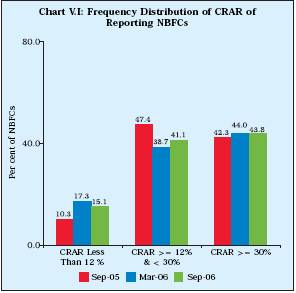
Table
5.7: Scheduled Commercial Banks – | Performance
Indicators | (Per
cent) | Item/
Bank Group | 2006-07 | 2007-08 |
| Q1 | Q2 | Q3 | Q4 | Q1 |
1 | 2 | 3 | 4 | 5 | 6 |
Operating Expenses/
Total Assets* | Scheduled
Commercial Banks | 2.3 | 2.0 | 1.9 | 1.7 | 2.0 |
Public Sector Banks | 2.2 | 1.8 | 1.7 | 1.6 | 1.8 |
Old Private Sector Banks | 2.1 | 2.2 | 1.9 | 1.1 | 1.9 |
New Private Sector Banks | 2.6 | 2.3 | 2.3 | 1.8 | 2.6 |
Foreign Banks | 2.9 | 3.2 | 2.8 | 2.2 | 2.9 |
fNet Interest Income/Total
Assets* | Scheduled
Commercial Banks | 3.0 | 2.6 | 2.9 | 2.5 | 2.8 |
Public Sector Banks | 3.0 | 2.4 | 2.9 | 2.5 | 2.7 |
Old Private Sector Banks | 3.0 | 3.0 | 2.9 | 2.4 | 2.9 |
New Private Sector Banks | 2.6 | 2.5 | 2.5 | 1.9 | 2.3 |
Foreign Banks | 4.3 | 4.1 | 3.3 | 3.2 | 4.2 |
Net Profit/Total Assets*
| Scheduled Commercial Banks | 0.9 | 0.9 | 1.0 | 0.8 | 1.0 |
Public Sector Banks | 0.7 | 0.9 | 0.9 | 0.8 | 0.9 |
Old Private Sector Banks | 0.8 | 1.1 | 1.2 | 0.5 | 1.1 |
New Private Sector Banks | 0.8 | 1.0 | 0.9 | 0.6 | 0.8 |
Foreign Banks | 2.1 | 1.5 | 1.1 | 1.9 | 2.2 |
Gross NPAs to Gross
Advances** | Scheduled
Commercial Banks | 3.4 | 3.2 | 3.0 | 2.7 | 2.8 |
Public Sector Banks | 3.8 | 3.5 | 3.3 | 2.8 | 2.9 |
Old Private Sector Banks | 4.7 | 4.5 | 3.8 | 3.2 | 3.1 |
New Private Sector Banks | 1.9 | 2.0 | 2.2 | 2.1 | 2.5 |
Foreign Banks | 1.9 | 2.1 | 2.0 | 1.9 | 2.0 |
Net NPAs to Net Advances**
| Scheduled Commercial Banks | 1.2 | 1.2 | 1.2 | 1.1 | 1.2 |
Public Sector Banks | 1.3 | 1.3 | 1.2 | 1.2 | 1.2 |
Old Private Sector Banks | 1.7 | 1.6 | 1.3 | 1.0 | 0.9 |
New Private Sector Banks | 0.9 | 1.0 | 1.1 | 1.1 | 1.3 |
Foreign Banks | 0.7 | 0.9 | 0.9 | 0.7 | 0.8 |
CRAR** |
Scheduled Commercial Banks | 12.0 | 12.6 | 12.6 | 12.3 | 12.6 |
Public Sector Banks | 12.0 | 12.6 | 12.4 | 12.4 | 12.9 |
Old Private Sector Banks | 11.8 | 12.1 | 12.9 | 12.4 | 13.0 |
New Private Sector Banks | 12.2 | 13.3 | 12.9 | 12.0 | 11.6 |
Foreign Banks | 11.9 | 11.9 | 12.6 | 12.4 | 12.3 |
* : Annualised to ensure comparability
between quarters.
** : Position as at the end of the quarter.
Source
: Off-site supervisory returns submitted by the banks pertaining to their
domestic operations. | assets as at end-March
2007 (see Table 5.4). Out of 53 scheduled UCBs, net NPA
of 18 UCBs were in excess of 5 per cent of their advances (Table
5.9). Earnings and Profitability Indicators
V.90 Total income of SCBs increased marginally from 8.03 per cent of their assets
in 2005-06 to 8.04 per cent in 2006-07 due to an increase in interest income resulting
mainly from a significant rise in credit offtake (Table 5.10). V.91
Higher interest expenses, however, led to a sharper increase in total expenditure
(as per cent to total assets), despite the fall in operating expenses. As a result,
during 2006-07, profits before provisions and taxes (as per cent to total assets)
were lower than those in the previous year. However, profit after tax (as per
cent to total assets) at 0.90 per cent during 2006-07 was marginally higher than
that during 2005-06 (0.88 per cent) due to lower provisions. As many as 45 banks
(out of 82 banks) recorded an increase in the profits ratio during the year (Table
5.11).
Table
5.9: Net NPAs to Net Advances of | Scheduled
Urban Cooperative Banks* | (Frequency
Distribution) | Net
NPAs to Net Advances (%) | 2004-05 | 2005-06
2006-07 | 1 | 2 | 3 | 4 |
Up to 2 per cent | 21 | 25 | 23 |
Above 2 and up to 5 per cent | 6 | 8 | 12 |
Above 5 per cent and up to 10 per cent | 11 | 10 | 10 |
Above 10 per cent | 16 | 11 | 8 |
Total | 54 | 54 | 53 |
* : Based
on provisional data. | V.92 Total income of UCBs
declined marginally from 6.42 per cent of their assets in 2005-06 to 6.40 per
cent in 2006-07 due to decline in non-interest income. Earnings before provisions
and taxes were, however, higher on account of increase in interest income and
decline in interest expenses (as percentage to total assets). Provisions made
in 2006-07 were higher than those in 2005-06. The return on total assets
of scheduled UCBs declined marginally to 0.69 per cent in 2006-07 from 0.71 per
cent in 2005-06. (Table 5.12).
V.93 The return
on assets of PDs declined to 2.92 per cent during 2006-07 from 5.04 per cent during
2005-06, reflecting the merger impact.
Sensitivity to Market
Risk
Interest Rate Risk
V.94 The investment
portfolio of the scheduled commercial banks has become relatively less sensitive
to interest rate risk on account of shifting of major portion of investments to
HTM category (60 per cent), which are not required to be marked to market unlike
those in the trading book. Furthermore, given the relative unattractiveness of
investments in government securities in an increasing interest rate scenario,
banks restricted/liquidated their investments to fund credit growth which is expected
to reduce the impact of the rising yields on the banks’ balance sheets.
Banks have adopted various portfolio management techniques like reduction of duration,
particularly in the case of trading book in conjunction with reduction in the
size of the trading book itself, to immunise themselves from marked to market
losses.
Table
5.10: Operational Results of Scheduled | Commercial
Banks – Key Ratios | (Per
cent to total assets) | Indicator | 2004-05 | 2005-06 | 2006-07 |
1 | 2 | 3 | 4 |
1. | Total
Income | 8.21 | 8.03 | 8.04 |
| Interest
Income (net of interest tax) | 6.72 | 6.65 | 6.88 |
| Non-Interest
Income | 1.49 | 1.38 | 1.16 |
2. | Total
Expenditure | 5.98 | 5.98 | 6.10 |
| Interest
Expenses | 3.83 | 3.82 | 4.13 |
| Operating
Expenses | 2.15 | 2.16 | 1.97 |
3. | Earnings
Before Provisions and | | | |
| Taxes
(EBPT) | 2.22 | 2.05 | 1.92 |
4. | Provisions
and Contingencies | 1.33 | 1.17 | 1.02 |
5. | Profit
after Tax | 0.89 | 0.88 | 0.90 |
| | Amount
in Rupees crore | | | | | |
1. | Total
Income | 1,87,079 | 2,16,286 | 2,66,266 |
| Interest
Income (net of interest tax) | 1,53,123 | 1,79,087 | 2,27,731 |
| Non-Interest
Income | 33,956 | 37,199 | 38,535 |
2. | Total
Expenditure | 1,36,315 | 1,61,048 | 2,02,137 |
| Interest
Expenses | 87,292 | 1,02,866 | 1,36,899 |
| Operating
Expenses | 49,024 | 58,182 | 65,237 |
3. | Earnings
Before Provisions | | | |
| and
Taxes (EBPT) | 50,515 | 55,212 | 63,459 |
4. | Provisions
and Contingencies | 30,233 | 31,549 | 33,707 |
5. | Profit
after Tax | 20,283 | 23,663 | 29,752 |
Note :
1. Off-site supervisory returns submitted by the banks
pertaining to their
domestic operations only.
2. Data for March 2007
are provisional and unaudited. |
Table
5.11: Operational Results of Scheduled Commercial Banks – 2006-07
| (Number
of banks showing increase in ratios during the period) | Ratio
to total Assets | Public
Sector Banks | Private
Sector Banks | Foreign
Banks | All Banks |
| SBI
Group | Nationalised | Old
Private | New Private | | |
| Banks | Sector
Banks | Sector Banks | | | |
1 | 2 | 3 | 4 | 5 | 6 | 7 |
1. | Total
Income | 3 | 8 | 11 | 5 | 18 | 45 |
| Interest
Income | 6 | 13 | 11 | 5 | 23 | 58 |
| Non-Interest
Income | 0 | 4 | 8 | 2 | 16 | 30 |
2. | Total
Expenditure | 5 | 12 | 8 | 5 | 16 | 46 |
| Interest
Expenses | 7 | 16 | 12 | 7 | 19 | 61 |
| Operating
Expenses | 0 | 0 | 3 | 3 | 17 | 23 |
3. | Earnings
before Provisions | | | | | | |
| and
Taxes (EBPT) | 0 | 7 | 11 | 3 | 20 | 41 |
4. | Provisions
and contingencies | 0 | 6 | 9 | 2 | 15 | 32 |
5. | Profit
after Tax | 5 | 10 | 10 | 4 | 16 | 45 |
Note :
1. Off-site supervisory returns submitted by the banks pertaining to their domestic
operations only.
2. Data are provisional and unaudited. |
Table
5.12 Operational Results of Scheduled | Urban
Cooperative Banks – Key Ratios | (Per
cent to total Assets) | No. | Item | 2005-06 | 2006-07 |
1 | | 2 | 3 |
1. | Total
Income | 6.42 | 6.40 |
| Interest
Income | 5.62 | 5.70 |
| Non-Interest
Income | 0.80 | 0.70 |
2. | Total
Expenses | 5.22 | 5.19 |
| Interest
Expenditure | 3.61 | 3.45 |
| Non-interest
Expenses | 1.61 | 1.74 |
3. | Earnings
Before Provisions and Taxes | 1.20 | 1.21 |
4. | Provisions
and Contingencies | 0.49 | 0.52 |
5. | Profit
after Tax | 0.71 | 0.69 |
Note : All
data are provisional. | | |
Currency Risk
V.95 In the foreign
exchange market, the Indian rupee exhibited two-way movement vis-à-vis
the US dollar during 2006-07. During 2007-08 so far, there have been upward pressures
on the exchange rate, reinforcing the need for all market participants with foreign
currency exposure to hedge their currency risk.
Commodity Risk
V.96 The commodities market witnessed high volatility and two-way movements
during 2006-07. While banks and other financial institutions do not generally
indulge in active commodity trading, movements in commodities market can affect
financial markets adversely through the credit channel. This is especially so
in the case of bank lending to sectors that have not hedged themselves against
the adverse movements of the commodities prices.
Equity Risk
V.97 The Reserve Bank has put in place several regulatory requirements to
ensure that the banks’ participation in the capital market is within limits.
The stringent margin requirements ensure that the banks’ advances are well
collateralised which act as an effective safety net to their advances for investments
in the capital market. Capital market exposure of the banking system as a percentage
of gross advances, at 2.3 per cent at end-March 2007, remained well within the
regulatory limit of 5 per cent even as capital market indices reached historical
levels during 2006-07. The total capital market exposure of the banks at end-March
2007 amounted to Rs.33,330 crore.
Liquidity
V.98 The ratio of liquid assets to total assets in respect of scheduled commercial
banks declined to 32.3 per cent at end-March 2007 from 33.0 per cent at end-September
2006. The decline in the ratio may be attributed to the upturn in industrial growth
witnessed in recent times, which, in turn, bolstered the credit demand. Consequently,
the increase in advances was more than the increase in SLR investment.
Outlook
V.99 The Reserve Bank would continue with various
regulatory and supervisory initiatives to strengthen the domestic financial sector
in order to maintain financial stability. In consonance with the aim of benchmarking
the Indian financial sector to the international best practices, commercial banks
in India will start implementing Basel II from the year ended March 2008 onwards.
In order to strengthen the risk management in banks, credit derivatives are proposed
to be introduced in a calibrated manner, taking into account the risk management
systems in banks and their state of preparedness for Basel II. The principles
for accounting of derivatives are also being finalised. In view of the fast
pace of deregulation, liberalisation and the emergence of financial conglomerates,
the supervisory process is being constantly fine-tuned to ensure that adequate
attention is given to the complexities of organisational structures, business
processes and risk-positions of the banks. The focus is on risk based supervisory
framework and smooth migration to Basel II that will require appropriate capacity
building in the Reserve Bank as well as in the banks. While strengthening the
regulatory and the supervisory framework, the Reserve Bank will continue to persevere
with its efforts towards greater financial inclusion and improvement in customer
service provided by the banking sector. |