The Reserve Bank continued with its efforts to strengthen credit delivery and deepen financial inclusion in the country as envisaged under the National Strategy for Financial Inclusion (NSFI). The Financial Inclusion Index (FI-Index) improved to 67.0 in March 2025 from 64.2 a year ago. IV.1 The Reserve Bank continued with its focus on ensuring availability of banking services to all sections of society across the country, including strengthening the credit delivery system to cater to the needs of the productive sectors of the economy, particularly agriculture, and micro and small enterprises (MSEs). During 2025-26, a number of initiatives were taken in terms of spreading financial literacy, campaigning for saturation of financial inclusion schemes and renewal of know your customer (re-KYC), campaigning to facilitate efficient and faster settlement of unclaimed funds, conducting a comprehensive review of Lead Bank Scheme (LBS), expanding and deepening of digital payments ecosystem (EDDPE)1, and launch of National Strategy for Financial Inclusion (NSFI) for 2025-30. 2. Agenda for 2025-26 IV.2 The Department had set out the following goals for 2025-26: -
Review of FI-Index (Paragraph IV.3); -
Strengthening micro, small and medium enterprises (MSMEs) outreach and inclusion (Paragraph IV.4 - IV.5); and -
Achieving 100 per cent coverage in 80 per cent districts across the country by March 2026, under EDDPE programme (Paragraph IV.6). Implementation Status IV.3 A comprehensive review of FI-Index has been conducted by the Department on completion of five years of its launch. In this regard, consultation with concerned stakeholders is under process to finalise its framework. IV.4 With a view to facilitating improved access to formal credit, supporting entrepreneurial activity and strengthening last mile credit delivery for MSEs with limited collateral, the limit for collateral free loans to MSEs was enhanced from ₹10 lakh to ₹20 lakh, effective April 1, 2026. IV.5 Regional Offices of the Reserve Bank have been conducting MSME town hall meetings as an outreach initiative to facilitate engagement with MSMEs, improve awareness of banking facilities and address issues relating to access to formal finance. In view of significant developments in the financial landscape and evolving needs of MSMEs, the MSME town hall meeting framework has been revised to incorporate an additional decentralised outreach mechanism through district-level MSME SAMVAAD meetings, enabling more granular engagement with stakeholders at district and regional level. IV.6 As on March 31, 2026, 100 per cent coverage has been achieved under the EDDPE programme in more than 80 per cent of the districts (710 districts) across the country. Major Developments Credit Delivery Priority Sector IV.7 Scheduled Commercial Banks’ (SCBs) priority sector lending (PSL) as on March 31, 2026 stood at 45.0 per cent2 of adjusted net bank credit (ANBC)/credit equivalent of off-balance sheet exposure (CEOBSE), whichever is higher. Each of the bank groups, has achieved the prescribed 40 per cent overall PSL target during 2025-26 (Table IV.1). Flow of Credit to Agriculture IV.8 The Kisan Credit Card (KCC) is a single window facility for providing working capital as well as investment credit to farmers for cultivation, animal husbandry and fisheries. The number of operative KCCs declined by 11.7 per cent and the outstanding amount has decreased by 4.9 per cent during 2025-26 over the corresponding period in the previous year (Table IV.2). | Table IV.1: Achievement of Priority Sector Lending Targets | | (Amount in ₹ lakh crore) | | Financial Year | Public Sector Banks | Private Sector Banks | Foreign Banks | Small Finance Banks | SCBs | | 1 | 2 | 3 | 4 | 5 | 6 | | 2024-25 | 35.9 | 27.1 | 2.7 | 1.6 | 67.3 | | | (42.3) | (44.3) | (41.8) | (84.4) | (43.6) | | 2025-26* | 39.3 | 31.5 | 3.0 | 1.9 | 75.7 | | | (42.8) | (47.2) | (42.0) | (78.8) | (45.0) | *: Data are provisional.
Note: Figures in parentheses are percentage to ANBC/CEOBSE, whichever is higher.
Source: Priority sector returns submitted by SCBs. | IV.9 A comprehensive review of the KCC scheme guidelines was undertaken with the objective of expanding coverage, streamlining operational aspects and addressing emerging requirements. The draft guidelines have been issued for public comments. Bank Credit to the MSME Sector IV.10 Increasing the flow of credit to the MSMEs has been a policy priority of the Reserve Bank and the Government of India. On a y-o-y basis, the outstanding credit to the MSMEs by SCBs increased by 23.5 per cent during 2025-26 (as at end-December 2025) as compared with 18.3 per cent in the corresponding period of the previous year (Table IV.3). | Table IV.2: Kisan Credit Card (KCC) Scheme | | (Number in lakh, Amount in ₹ crore) | | Financial Year | Number of Operative KCCs# | Outstanding Crop Loan | Outstanding Term Loan | Outstanding Loan for Animal Husbandry and Fisheries | Total | | 1 | 2 | 3 | 4 | 5 | 6 | | 2024-25 | 290.2 | 5,07,821 | 55,047 | 38,107 | 6,00,975 | | 2025-26* | 256.2^ | 4,95,596^ | 39,352^ | 36,496^ | 5,71,444^ | *: Data are provisional.
#: The number of operative KCC accounts does not include non-performing asset (NPA) accounts.
^: The decline is primarily on account of select private sector banks reclassifying/declassifying certain exposures that were not aligned with extant KCC guidelines.
Sources: Public sector banks, private sector banks and small finance banks. |
| Table IV.3: Bank Credit to MSMEs | | (Number in lakh, Amount in ₹ lakh crore) | | Financial Year | Micro Enterprises | Small Enterprises | Medium Enterprises | MSMEs | | | Number of Amount | Accounts Outstanding | Number of Amount | Accounts Outstanding | Number of Amount | Accounts Outstanding | Number of Accounts | Amount Outstanding | | 1 | 2 | 3 | 4 | 5 | 6 | 7 | 8 | 9 | | 2023-24 | 231.9 | 13.3 | 21.3 | 8.6 | 3.8 | 5.3 | 257.0 | 27.3 | | 2024-25 | 223.9 | 15.0 | 15.2 | 9.8 | 4.0 | 6.3 | 243.1 | 31.1 | | 2024-25 (as at end-December 2024) | 216.5 | 14.4 | 14.8 | 9.4 | 3.8 | 5.9 | 235.1 | 29.8 | | 2025-26 (as at end-December 2025) | 217.4 | 18.3 | 13.9 | 11.5 | 3.4 | 6.9 | 234.7 | 36.8 | | Source: Priority sector returns submitted by SCBs. | Financial Inclusion (FI) Campaign for Saturation of FI Schemes and re-KYC IV.11 The Reserve Bank has been closely associated with a nationwide campaign involving banks, conducted by Department of Financial Services (DFS), Ministry of Finance, Government of India, for saturation of financial inclusion schemes at the Gram Panchayat level. At the Reserve Bank’s instance, the scope of the campaign was expanded to cover re-KYC of all accounts where it had fallen due and was leveraged for grievance redressal and promoting awareness on unclaimed deposits. Top Management and senior officials of the Reserve Bank visited and addressed several camps conducted as part of the campaign. A nationwide multimedia campaign to educate the public about the importance of re-KYC/KYC updation was undertaken and progress in coverage of accounts was monitored closely. Campaign to Facilitate Efficient and Faster Settlement of Unclaimed Funds IV.12 The Reserve Bank was also involved with the nationwide campaign, ‘Aapki Poonji, Aapka Adhikar’ (Your Money, Your Right), conducted during October-December 2025 to facilitate the return of unclaimed deposits and timely settlement of eligible claims from the Depositor Education and Awareness (DEA) Fund. During the campaign, ₹2,876 crore of unclaimed deposits were settled by public sector banks and regional rural banks. Comprehensive Review of Lead Bank Scheme (LBS) IV.13 A comprehensive review of the LBS was undertaken with a view to enhancing its effectiveness in deepening financial inclusion and promoting flow of credit to priority sectors. The draft guidelines were published for public comments. Assignment of Lead Bank Responsibility IV.14 At present, 12 public sector banks and two private sector banks (Jammu & Kashmir Bank and ICICI Bank) have been assigned lead bank responsibility, covering 778 districts across the country. Expanding and Deepening of Digital Payments Ecosystem (EDDPE) IV.15 The EDDPE programme was extended to all districts [except two districts of union territory (UT) of Andaman & Nicobar Islands] in August 2023. As on March 31, 2026, 100 per cent coverage has been achieved in more than 80 per cent districts (710 districts) across the country, which includes all districts in 22 states3 and eight UTs4. Monitoring Progress of Financial Inclusion IV.16 Banks’ progress in financial inclusion is monitored through the Monitoring Progress of Financial Inclusion (MPFI) Return. The progress achieved by banks on these parameters as at end-December 2025 is presented in Table IV.4. Financial Inclusion Index (FI-Index) IV.17 The Reserve Bank has developed a composite Financial Inclusion Index (FI-Index) comprising three sub-indices (viz., access, usage and quality) to assess the extent of financial inclusion in the country. Based on data from banking, investment, insurance, postal and pension sectors, the FI-Index improved to 67.0 in March 2025 from 64.2 in March 2024, with gains across all dimensions, led by usage and quality, reflecting deeper financial inclusion and sustained financial literacy efforts (Charts IV.1 and IV.2). IV.18 The National Strategy for Financial Inclusion (NSFI): 2025-30, approved by the Sub-Committee of the Financial Stability and Development Council (FSDC-SC) in its 32nd meeting, was formally unveiled by Shri Sanjay Malhotra, Governor, Reserve Bank of India on December 1, 2025. The strategy builds upon the achievements of the preceding strategy (NSFI: 2019-24) and seeks to put in place a strategic vision and pathway to mitigate demand and supply impediments, while further deepening and strengthening the financial inclusion ecosystem for the wellbeing of people (Box IV.1). 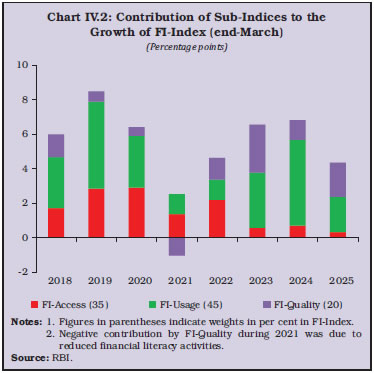
| Table IV.4: Monitoring Progress of Financial Inclusion | | Particulars | December 2024& | | December 2025$ | | 1 | 2 | | | 3 | | | Total | Rural | Urban* | Total | | Number of Banking Outlets Manned by Bank’s Own Staff - Branches | 56,579** | 57,319 | 1,12,870 | 1,70,189 | | | (34) | (66) | | | Number of Banking Outlets Manned by Business Correspondents ^ (Fixed Point BC Outlet) ^^ | - | 7,56,840 | 4,18,410 | 11,75,250 | | | (64) | (36) | | | BSBDA - Total (Number in lakh) | 7,201 | 3,509 | 3,795 | 7,304 | | | (48) | (52) | | | Out of Total Number of BSBDAs, Number of Female Account Holders (Number in lakh) | - | 1,943 | 2,081 | 4,024 | | | (48) | (52) | | | BSBDA - Total (Amount in crore) | 3,04,715 | 1,76,105 | 1,69,372 | 3,45,477 | | | (51) | (49) | | | Out of Total Amount in BSBDAs, Amount in Female Account Holders’ Accounts (Amount in crore) | - | 1,05,842 | 1,00,253 | 2,06,095 | | | (51) | (49) | | | OD Facility Availed in BSBDAs (Number in lakh) | 45 | 13 | 19 | 32 | | | (41) | (59) | | | Out of Total, OD Facility Availed in BSBDAs by Females (Number in lakh) | - | 7 | 10 | 17 | | | (41) | (59) | | | OD Facility Availed in BSBDAs (Amount in crore) | 548 | 174 | 240 | 414 | | | (42) | (58) | | | Out of Total, OD Facility Availed in BSBDAs by Females (Amount in crore) | - | 83 | 110 | 193 | | | (43) | (57) | | | ICT- BC-Total Transactions (Number in lakh) #@ | 29,944 | 23,778 | 15,635 | 39,413 | | | (60) | (40) | | | Out of Total ICT-BC Transactions, Transactions Undertaken by Female BC agents(Number in lakhs) #@ | - | 4,288 | 2,632 | 6,920 | | | (62) | (38) | | | ICT- BC-Total Transactions (Amount in crore) # | 10,73,073 | 6,90,093 | 4,99,674 | 11,89,767 | | | (58) | (42) | | | Out of Total ICT-BC Transactions, Transactions Undertaken by Female BC agents (Amount in crore) # | - | 1,36,844 | 94,441 | 2,31,285 | | | (59) | (41) | | BCs : Business Correspondents. BSBDAs : Basic Savings Bank Deposit Accounts. OD : Overdraft.
ICT : Information and Communication Technology - : Not available
&: Based on Financial Inclusion Plan (FIP) Return submitted by public sector banks (PSBs), private sector banks (PVBs) and regional rural banks (RRBs). FIP Return has been discontinued from March 2025.
$: Based on MPFI Return submitted by public sector banks, private sector banks, regional rural banks, small finance banks, payment banks and urban cooperative banks (Tier III and IV).
*: Urban includes semi-urban, urban, and metropolitan areas.
**: Data are for banking outlet manned by bank’s own staff (i.e., branches) in villages.
^: In the previous Annual Report (2024-25), the total number of BC Outlets (villages and urban locations) was reported as 17,23,303, based on FIP return (submitted by PSBs, PVBs, and RRBs) for December 2024. The corresponding numbers as per MPFI return for December 2025 was 14,77,594. The decrease in number of BC outlets was on account of revised reporting by one public sector bank and realignment of BC network by some private sector banks.
^^: Banking Outlets manned by BCs, i.e., Fixed Point BC Outlets working for a minimum of 4 hours per day, 5 days a week.
#: Transactions from the beginning of the financial year.
@: Both financial and non-financial transactions.
Notes: 1. Figures in parentheses indicate share in total (per cent).
2. Provisional data.
Source: FIP returns submitted by public sector banks, private sector banks and regional rural banks. | Financial Literacy Observing Financial Literacy Week 2026 IV.19 The Financial Literacy Week (FLW) 2026, an annual initiative of the Reserve Bank, was observed during February 9 - 13, 2026 on the theme “KYC - Your first step to safe banking” to promote awareness among the public on the importance of KYC and account discipline. A centralised mass-media campaign across television, radio, digital platforms and outdoor hoardings was undertaken during the week. The Regional Offices of the Reserve Bank also carried out localised campaigns on the theme. Banks were also advised to create awareness amongst their customers and the general public. KYC related awareness messages were covered in the Hon’ble Prime Minister’s Mann Ki Baat address on February 22, 2026. Box IV.1: National Strategy for Financial Inclusion (NSFI): 2025-30 The NSFI:2025-30 envisions upscaling the financial inclusion efforts towards seamless and effective access to a bouquet of formal financial services, coupled with financial literacy, consumer awareness and customer protection. It emphasises adoption of a synergistic ecosystem approach and focusing on improving the quality and consistency of last mile access, and effective usage of financial services through linkages with skilling and livelihood initiatives. The strategy lays down five strategic objectives (Panch-Jyoti) towards elevating the state of financial inclusion in the country and a menu of 47 action points to achieve them. The Panch-Jyoti includes the following: -
Improving the availability and use of an equitable, responsible, suitable, and affordable bouquet of financial services to achieve financial safety and financial security for households and micro enterprises; -
Adopting a gender-sensitive approach for women-led financial inclusion and differentiated strategies for improving financial resilience of households, especially for the underserved and vulnerable segments; -
Synergising livelihood, skill development and support ecosystem and their linkages with financial inclusion; -
Leveraging financial education as a tool for promoting financial discipline; and -
Strengthening the quality and reliability of customer protection and grievance redressal measures. The focus of the recommendations is on enhancing the usage and quality dimensions of financial inclusion, while improving last mile access and ensuring effectiveness and granularity in the monitoring and measurement mechanism. The action-points and timelines under NSFI: 2025-30 are distributed across financial sector regulators [viz., Reserve Bank of India (RBI), Securities and Exchange Board of India (SEBI), Insurance Regulatory and Development Authority of India (IRDAI) and Pension Fund Regulatory and Development Authority (PFRDA)], and financial services providers under their respective jurisdictions, along with the National Bank for Agriculture and Rural Development (NABARD), National Skill Development Corporation (NSDC) and National Centre for Financial Education (NCFE). The strategy has been framed under the aegis of the Technical Group on Financial Inclusion and Financial Literacy (TGFIFL) following country-wide discussions with various stakeholders by the Reserve Bank and consultations involving the Department of Economic Affairs (DEA) and Department of Financial Services (DFS), Ministry of Finance, Government of India; SEBI; IRDAI; PFRDA; NABARD; NSDC and NCFE. Source: RBI. | 3. Agenda for 2026-27 IV.20 The Department has set out the following goals for 2026-27: -
Implementation of action points under NSFI: 2025-30; -
Achieving 100 per cent coverage in all identified districts across the country by March 2027, under EDDPE (Utkarsh 2029); and -
Review of the framework for revival and rehabilitation of MSMEs to make it more effective for timely resolution of stress in MSMEs. 4. Conclusion IV.21 The Reserve Bank continued with its focus on ensuring availability of banking services to all sections of society and strengthening the credit delivery system to cater to the needs of all productive sectors of the economy. Going forward, the strategy adopted under NSFI: 2025-30 is expected to further deepen financial inclusion in the country.
Index |