Aided by sharp moderation in headline inflation to historical lows, the Monetary Policy Committee (MPC) continued with the easing cycle initiated in February 2025 and reduced the policy repo rate by a cumulative 100 basis points (bps) to 5.25 per cent during 2025-26. During the year, the policy stance was changed from neutral to accommodative in April 2025, but reverted to neutral in June 2025. Monetary policy focused on maintaining congenial financial conditions during the year through a mix of policy rate cuts and reduction in the cash reserve ratio (CRR) along with several measures that injected durable liquidity. These measures facilitated robust credit offtake and improved policy transmission to the banking sector. III.1 Headline inflation in terms of the consumer price index (CPI) trended down mainly due to food price deflation during 2025-26 and reached an all-time low in the series (2012=100, base year) in October 2025 (see Section 3 of Chapter II). In view of the inflation-growth dynamics, the MPC continued with its easing cycle by reducing the policy rate cumulatively by 100 bps in 2025-26 – 25 bps cut in April 2025, followed by a larger 50 bps reduction in June 2025, and a further 25 bps cut in December 2025 – lowering the repo rate to 5.25 per cent. The policy stance shifted from neutral to accommodative in April 2025, before reverting to neutral in June 2025. III.2 During the year, system liquidity improved and remained largely in surplus. To ease potential liquidity stress, the CRR was reduced by 100 bps to 3.0 per cent of net demand and time liabilities (NDTL) in a staggered manner during September-November 2025. In line with the lower policy repo rate, short-term money market rates softened. Transmission of policy rate changes to banks’ deposit and lending rates was steady during the year, aided by the external benchmark regime for loan pricing introduced in October 2019. III.3 Against this backdrop, section 2 reviews the implementation status of the agenda set for 2025-26 along with major developments during the year, while section 3 outlines the agenda for 2026-27. Concluding observations are provided in the last section. 2. Agenda for 2025-26 III.4 The Department had set out the following goals for 2025-26: -
Review of monetary policy framework (Paragraph III.5); -
Revisiting optimal level of system liquidity for effective monetary policy transmission (Paragraph III.6); -
Spatial and cross-sectional analysis of National Sample Survey Organisation’s household consumption expenditure data (Paragraph III.6); and -
Expanding coverage of sectoral deployment of credit of non-banking financial companies (NBFCs) - inclusion of housing finance companies (HFCs) [Paragraph III.6]. Implementation Status III.5 A discussion paper on review of the monetary policy framework was placed on the Reserve Bank’s website on August 21, 2025. Based on the feedback received, cross-country experience and other practical considerations, a recommendation was submitted to the Government of India (GoI). On March 25, 2026, GoI, in its Gazette notification, retained the CPI headline inflation target at 4 per cent with the upper tolerance level of 6 per cent and the lower tolerance level of 2 per cent for the period April 1, 2026 to March 31, 2031. III.6 A study on estimating optimal level of system liquidity in India was completed. Spatial and cross-sectional analysis of National Sample Survey Organisation’s household consumption expenditure data was also completed. Collection of credit deployment data from HFCs has been started for a comprehensive overview of sectoral credit dynamics of the non-bank sector. Major Developments Monetary Policy III.7 Notwithstanding a challenging global backdrop through 2025, monetary policy in India continued with the easing cycle initiated in February 2025 in a decisive manner, with a cumulative reduction of 125 bps in the policy repo rate between February and December 2025. III.8 The first MPC meeting of 2025-26 held in April 2025 noted that despite global economic challenges and trade related uncertainties, the domestic economy witnessed steady improvement, supported by a revival in manufacturing sector, strong rural demand and gradual recovery in urban consumption. Real gross domestic product (GDP) growth for 2025-26 was projected at 6.5 per cent. Headline CPI inflation had eased in January-February 2025 due to a sharp decline in food prices. Assuming a normal monsoon, CPI inflation was projected at 4.0 per cent for 2025-26 with Q1 at 3.6 per cent, Q2 at 3.9 per cent, Q3 at 3.8 per cent; and Q4 at 4.4 per cent. With growth still recovering amidst global uncertainty and increasing confidence on inflation durably aligning with the 4 per cent target, the MPC decided to remain growth supportive by unanimously voting to reduce the policy rate by 25 bps and changing the stance to accommodative from neutral. III.9 In the June 2025 meeting, the CPI inflation projections for 2025-26 were revised downwards by 30 bps to 3.7 per cent with Q1 at 2.9 per cent; Q2 at 3.4 per cent; Q3 at 3.9 per cent; and Q4 at 4.4 per cent; in the wake of continuous decline in headline inflation due to softening food inflation. Real GDP growth projection for 2025-26 was retained at 6.5 per cent despite trade policy uncertainty, although free trade agreement with the United Kingdom (UK) and progress in trade deals with other countries were expected to be growth supportive, going forward. The continued moderation in CPI inflation created space for further policy easing to support growth, prompting the MPC, with a 5-1 majority to frontload and reduce the policy repo rate by 50 bps to 5.50 per cent. After cumulative rate cuts of 100 bps since February 2025, the MPC acknowledged limited policy space for further rate cuts. Accordingly, the MPC changed the stance from accommodative to neutral. III.10 During the August 2025 meeting, it was observed that global growth was weak and disinflation momentum was fading, with some advanced economies (AEs) registering an uptick in inflation. In the Indian context, real GDP growth projection for 2025-26 was retained at 6.5 per cent. Headline CPI inflation declined for the eighth consecutive month due to softer food prices, though core inflation edged up to 4.4 per cent in June 2025, partly reflecting higher gold prices. Considering favourable south-west monsoon, strong kharif sowing and adequate stock of food grains, the CPI inflation projection for 2025-26 was again revised downwards by 60 bps to 3.1 per cent with Q2 at 2.1 per cent; Q3 at 3.1 per cent and Q4 at 4.4 per cent; with risks evenly balanced. The MPC observed that the significant decline in headline inflation was mainly driven by volatile food prices while core inflation remained stable around 4 per cent. Considering the persisting tariff uncertainties and ongoing policy transmission, the MPC, while closely monitoring incoming data and the evolving growth-inflation dynamics, decided unanimously to keep the repo rate unchanged at 5.50 per cent and continued with the neutral stance. III.11 With the impending review of the monetary policy framework due in March 2026, the Reserve Bank issued a discussion paper on August 21, 2025, inviting public comments on key aspects of the extant framework (Box III.1). Box III.1 Second Review of the Flexible Inflation Targeting Framework India’s flexible inflation targeting (FIT) framework was formally adopted in May 2016.1 Section 45ZA of the Reserve Bank of India (RBI) Act, 1934 mandates that the central government, in consultation with the Reserve Bank, determine the inflation target in terms of the consumer price index (CPI) every five years. Accordingly, on August 5, 2016, the inflation target of 4 per cent based on headline CPI with a tolerance band of 2-6 per cent was notified for the period up to March 31, 2021. The target was subsequently reviewed in March 2021 and retained for a further five-year period up to March 31, 2026, which was again extended till March 31, 2031. At the time of the first review, the Reserve Bank had published the Report on Currency and Finance 2020-21 with the theme, ‘Reviewing the Monetary Policy Framework’, which discussed various aspects of the FIT regime in India during the first five years of its operationalisation, i.e., 2016-2021. In alignment with emerging international best practices on monetary policy framework reviews, the Reserve Bank initiated a public consultation process in August 2025 for the second review with the release of a Discussion Paper. The consultation sought stakeholder feedback on four core aspects of the FIT framework: (a) choice of headline versus core inflation as the nominal anchor; (b) appropriateness of the 4 per cent target; (c) adequacy of the ± 2 per cent tolerance band; and (d) relative merits of point versus range targeting. The responses indicated broad-based support for the existing FIT framework highlighting its overall effectiveness. There was a strong consensus in favour of retaining headline CPI inflation as the formal target, and the role of core inflation as a complementary guide also found favour with a few respondents. The respondents strongly supported maintaining the target at 4 per cent although about one-third respondents favoured a narrower band to leverage existing policy credibility and build on it. Overall, the feedback favoured continuation of the extant framework, complemented by calibrated refinements to enhance policy analysis and communication (Chart 1). Based on a comprehensive assessment - including empirical analysis, cross-country experience, stakeholder feedback on the Discussion Paper, and other practical considerations - the Reserve Bank submitted its recommendations to the Government of India for determining the inflation target for the next five years. On March 25, 2026, the central government, in its Gazette notification, retained the CPI headline inflation target at 4 per cent with the upper tolerance level of 6 per cent and the lower tolerance level of 2 per cent for the period April 1, 2026 to March 31, 2031.2 Source: RBI. |
III.12 During the October 2025 meeting, it was noted that despite weak global growth, economic activity in India was robust with real GDP registering a growth of 7.8 per cent in Q1:2025-26. Although geopolitical tensions and global financial market volatility posed downside risks, ongoing structural reforms, including goods and services tax (GST) rationalisation, were expected to mitigate their impact. In view of these developments, projection of real GDP growth for 2025-26 was revised upwards by 30 bps to 6.8 per cent. Headline inflation remained subdued and undershot earlier projections, supported by GST rationalisation and benign food prices. Accordingly, CPI headline inflation for 2025-26 was further revised downwards to 2.6 per cent with Q2 at 1.8 per cent; Q3 at 1.8 per cent; and Q4 at 4.0 per cent. CPI inflation for Q1:2026-27 was projected at 4.5 per cent. With the effects of earlier monetary and fiscal measures still unfolding, the MPC unanimously decided to keep the repo rate unchanged at 5.50 per cent. The MPC decided to retain the neutral stance though two members were in favour of changing it to accommodative. III.13 When the MPC met in December 2025, the economy was in a rare goldilocks period, with real GDP growth in Q2:2025-26 at a six-quarter high of 8.2 per cent and average headline inflation moderating to 1.7 per cent, even below the 2 per cent lower tolerance threshold. The global economy also performed better than expected, aided by the end of the US government shut down and progress on trade agreements. The real GDP growth for 2025-26 was revised upwards to 7.3 per cent, with Q1 and Q2 of 2026-27 projected at 6.7 and 6.8 per cent, respectively. Concomitantly, CPI inflation for 2025-26 was revised downwards to 2.0 per cent with Q3 at 0.6 per cent; and Q4 at 2.9 per cent. Projections for Q1 and Q2 of 2026-27 were placed at 3.9 per cent and 4.0 per cent, respectively. Expecting both core and headline inflation to remain around 4 per cent in 2026-27, the MPC noted that the growth-inflation balance continued to provide the policy space to support the growth momentum. Accordingly, the MPC unanimously voted to reduce the policy repo rate by 25 bps to 5.25 per cent and decided to continue with the neutral stance, though one member was in favour of changing it to accommodative. III.14 In its February 2026 meeting, the MPC noted that the near-term domestic inflation and growth outlook remained positive, though external headwinds had intensified since the December 2025 meeting. Nonetheless, the successful completion of several landmark trade deals would boost the economic outlook. Headline inflation during November-December 2025 remained below the tolerance band of the inflation target and the outlook for CPI inflation in Q1:2026-27 and Q2 continued to be benign. On the growth front, economic activity was assessed to remain resilient with the first advance estimates suggesting continued growth momentum and favourable growth outlook. Based on the domestic macroeconomic conditions and the outlook, the MPC viewed that the current policy rate was appropriate and hence voted unanimously to continue with the existing policy rate. The MPC also agreed to retain the neutral stance although one member was in favour of changing it to accommodative III.15 The MPC’s rate decisions during 2025-26 were marked by unanimity barring the June 2025 policy when one member preferred a lower 25 bps rate cut as against the majority decision of a 50 bps cut (Chart III.1) The MPC continued to remain data driven in its decisions. III.16 Globally, central banks continued with monetary policy easing during 2025, although the pace and extent became increasingly divergent, reflecting country-specific growth-inflation dynamics (Chart III.2). While policy stances became progressively less restrictive, central banks remained vigilant and data dependent, adopting a cautious approach in calibrating future policy paths. Unlike India, most central banks navigated an unfavourable growth-inflation trade-off, characterised by growth outcomes below historical averages and inflation levels persisting above targets (Chart III.3). Nevertheless, the easing cycle continued across most jurisdictions.
The Operating Framework: Liquidity Management III.17 In view of the liquidity pressures arising mainly from volatile capital flows and an increase in currency in circulation (CiC) during the year, the Reserve Bank undertook several liquidity augmenting measures including term repo, open market operations (OMOs), long-term forex swaps and CRR reduction. The Reserve Bank reviewed the liquidity management framework against the backdrop of structural changes in the financial system, including 24×365 payment systems and ‘Just-in-Time’ fund releases for centrally sponsored schemes. The review retained the weighted average call rate (WACR) as the operating target of monetary policy and the symmetric policy corridor of 50 bps around the policy repo rate. The 14-day variable rate repo and reverse repo auctions were discontinued as the main liquidity management operations. Transient liquidity was sought to be managed primarily through variable rate repo and reverse repo auctions of 7-day and other tenors (from overnight to 14-days). 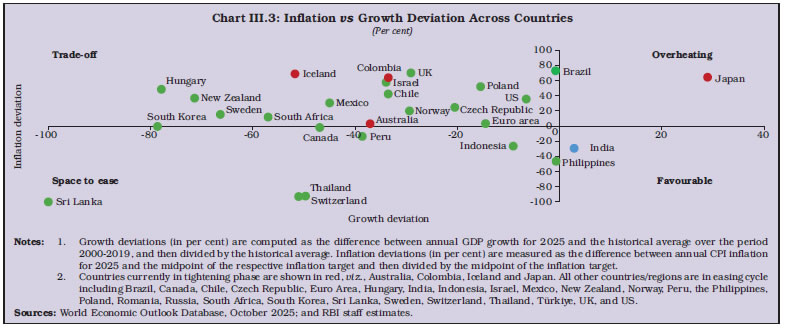 Drivers and Management of Liquidity III.18 Changes in GoI cash balances, expansion in CiC, and volatile capital flows emerged as the major drivers of liquidity during 2025-26 (Table III.I). The withdrawal of liquidity from the banking system due to increase in currency demand and the Reserve Bank’s forex market operations was more than offset by the injection of primary liquidity through the Reserve Bank’s durable liquidity augmenting measures. III.19 System liquidity improved in 2025-26 with average daily surplus of ₹1.86 lakh crore (Chart III.4). Amidst surplus liquidity conditions, banks’ recourse to the marginal standing facility (MSF) declined during the year. During the year, absorption through the standing deposit facility (SDF) constituted 84.9 per cent (₹2.02 lakh crore) of average total absorption under the liquidity adjustment facility (LAF) of ₹2.38 lakh crore. Banks’ holdings of elevated SDF balances, inter alia, reflected their higher demand for precautionary liquidity. III.20 In Q1:2025-26, liquidity conditions remained comfortable on account of durable liquidity measures. As a result, average daily net absorption under the LAF stood at ₹2.03 lakh crore in the quarter. With a significant improvement in liquidity conditions, the Reserve Bank discontinued the daily variable rate repo (VRR) auctions, effective June 11, 2025. As overnight rates hovered near the SDF rate amidst ample surplus liquidity, the Reserve Bank resumed variable rate reverse repo (VRRR) auctions on June 27, 2025, to mop up surplus liquidity, after a gap of nearly eight months.3 | Table III.1 Liquidity - Key Drivers and Management | | (₹ crore) | | Item | 2024-25 | 2025-26* | Q1:2025-26 | Q2:2025-26 | Q3:2025-26 | Q4:2025-26* | | 1 | 2 | 3 | 4 | 5 | 6 | 7 | | Drivers | | (i) CiC [withdrawal (-) / return (+)] | -2,12,987 | -4,43,215 | -96,779 | 22,727 | -1,25,022 | -2,44,141 | | (ii) Net Forex Purchases (+) / Sales (-) | -2,91,233 | -4,69,454 | 3,892 | -1,45,483 | -3,28,665 | 802 | | (iii) GoI Cash Balances [build-up (-) / drawdown (+)] | 93,729 | -1,66,865 | -2,09,383 | -1,34,720 | 74,298 | 1,02,940 | | (iv) Excess Reserves [build-up (-) / drawdown (+)] | 816 | 19,015 | 19,080 | -4,704 | 17,884 | -13,245 | | Management | | (i) Net OMO Purchases (+) / Sales (-) | 2,59,346 | 8,77,567 | 2,39,213 | 10 | 1,81,435 | 4,56,909 | | (ii) Required Reserves [including both change in NDTL and CRR / I-CRR] | 20,837 | 1,53,720 | -25,190 | 40,865 | 1,67,530 | -29,484 | | (iii) Term Repo Auctions | 1,82,964 | 1,62,235 | 25,731 | - | - | 1,36,504 | | Memo Items: | | (i) Long Term Forex Swaps Buy/Sell (+)/ Sell/Buy (-) | 2,19,245^ | 2,26,885^ | - | - | 46,147^ | 1,80,738^ | | (ii) Daily Net Absorption (-) / Injection (+) as at end-period | -1,30,261 | -2,58,380 | -3,07,793 | -56,274 | -28,123 | -2,58,380 | *: Data are up to March 30, 2026. ^: Approximate values. - : Nil.
CiC: Currency in Circulation. GoI: Government of Ind ia. I-CRR: Incremental Cash Reserve Ratio.
Notes: 1. Inflow (+)/Outflow (-) to and from the banking system.
2. Data pertain to the last available observation in the respective period.
Source: RBI. |
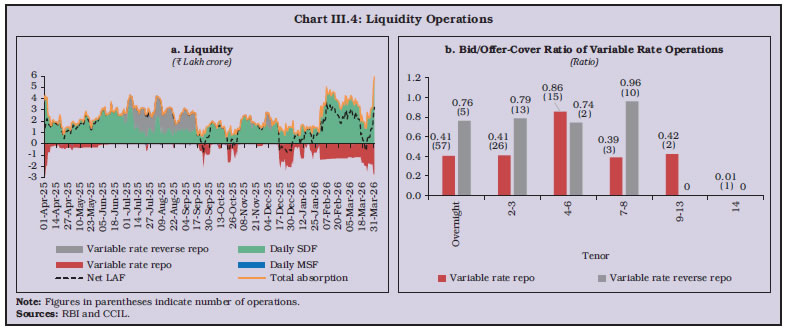 III.21 Surplus liquidity conditions continued in Q2:2025-26 with a brief period of liquidity deficit during September 22-24, 2025 owing to the build-up of GoI cash balances and Reserve Bank’s forex operations. The Reserve Bank conducted 22 VRRR auctions to absorb surplus liquidity, while 14 VRR auctions were held to address intermittent liquidity tightness. III.22 The liquidity surplus moderated in Q3:2025-26, with average net absorption under the LAF declining to ₹1.21 lakh crore. Except for a brief period, system liquidity remained in surplus during October-November 2025 due to higher government spending, notwithstanding a significant increase in CiC in October 2025 and capital outflows in November 2025. The Reserve Bank conducted 26 VRR operations to alleviate transient liquidity tightness.4 System liquidity turned into deficit in the second half of December 2025 due to advance tax payments and capital outflows. III.23 Liquidity conditions turned into surplus and expanded during Q4:2025-26 with a pick-up in government spending and durable liquidity operations of the Reserve Bank. Eighteen VRR operations were conducted to ease intermittent phases of liquidity tightness.5 Moreover, the Reserve Bank has conducted OMO purchases of GoI securities for an aggregate amount of ₹1 lakh crore in two tranches of ₹50,000 crore each, on March 9, 2026 and March 13, 2026. During 2025-26, two-way fine-tuning operations were the key instrument to manage frictional liquidity. During this period, the market was more responsive to short-term operations vis-à-vis the longer-term operations as reflected in much higher bid-cover ratios for short-term operations (Chart III.4). III.24 In view of the intermittent tightening liquidity conditions and the outlook, the Reserve Bank undertook a slew of durable liquidity augmenting measures during the year (Table III.2). III.25 Reflecting the liquidity dynamics, the WACR - the operating target of monetary policy - remained broadly within the LAF corridor during 2025-26.6 It moderated in line with the cumulative 125 bps reduction in the policy repo rate since February 2025. Overall, the WACR, on average, remained 7 bps below the policy repo rate in 2025-26, while it remained 6 bps above the repo rate during the corresponding period of the previous year (Chart III.5). III.26 Overnight rates in the collateralised segment moved generally in tandem with the WACR (Table III.3). Yields on 3-month T-Bills moderated during 2025-26, supported by comfortable liquidity conditions and policy rate cuts. Rates on certificates of deposit (CDs) and commercial papers (CPs) issued by NBFCs also moderated until Q3; however, they hardened significantly during Q4:2025-26 due to a range of market-specific factors. In the bond market, yields at shorter tenors declined relatively more than longer-end yields. G-sec yields hardened since Q2 amidst uncertainty over the India-US trade deal, receding expectations of further monetary easing, demand-supply mismatches and geopolitical tensions. Spreads in the money and bond markets generally increased during the year, except in Q1. | Table III.2: Reserve Bank’s Durable Liquidity Injection Measures (2025-26) | | Period | Measure | Amount
(₹ crore) | | 1 | 2 | 3 | | April 2025 | OMO Purchases (5) | 1,20,000 | | Term VRR Auction (1) | 25,731 | | May 2025 | OMO Purchases (4) | 1,19,203 | | September-November 2025 | CRR Cuts (4) | 2,50,000* | | December 2025 | OMO Purchases (3) | 1,50,000 | | Forex Swap (1) | 46,147* | | January 2026 | OMO Purchases (4) | 2,00,000 | | Forex Swap (1) | 90,304* | | Term VRR Auctions (2) | 1,36,504 | | February 2026 | OMO Purchase (1) | 50,000 | | Forex Swap (1) | 90,434* | | March 2026 | OMO Purchases (2) | 1,00,000 | | | Total | 13,78,323 | *: Approximate values.
Note: Figures in parentheses indicate number of operations.
Source: RBI. |
Transmission to Deposit and Lending Rates III.27 Transmission of monetary policy to the credit market has been steady in 2025-26. In response to the cumulative 100 bps reduction in the policy repo rate, banks have reduced their marginal cost of funds-based lending rate (MCLR) and external benchmark-based lending rates (EBLRs) during the year. Consequently, the weighted average lending rates (WALRs) on fresh and outstanding rupee loans of scheduled commercial banks (SCBs) declined by 95 bps and 78 bps, respectively, during 2025-26 (Table III.4). | Table III.3: Interest Rates | | (Per cent) | | Indicator | Average for | | Mar-2025 | Jun-2025 | Sep-2025 | Dec-2025 | Mar-2026 | | 1 | 2 | 3 | 4 | 5 | 6 | | Rates | WACR | 6.32 | 5.40 | 5.45 | 5.36 | 5.29 | | Tri-party Repo | 6.17 | 5.31 | 5.38 | 5.19 | 5.09 | | Market Repo | 6.32 | 5.24 | 5.43 | 5.27 | 5.13 | | 3-Month T-Bill | 6.46 | 5.40 | 5.47 | 5.29 | 5.33 | | 3-Month CP | 7.80 | 6.19 | 6.52 | 6.48 | 7.60 | | 3-Month CD | 7.54 | 5.92 | 5.86 | 6.05 | 7.35 | | AAA Corporate Bond - 5-year | 7.43 | 6.81 | 6.92 | 7.06 | 7.53 | | G-Sec Yield - 5-year | 6.56 | 6.02 | 6.22 | 6.30 | 6.46 | | G-Sec Yield - 10-year | 6.66 | 6.27 | 6.51 | 6.57 | 6.76 | | Spreads (bps) | CP - T-Bill | 134 | 84 | 105 | 119 | 227 | | AAA 5-year - G-Sec 5-year | 87 | 79 | 70 | 76 | 107 | | Memo Items: | | Liquidity | Net LAF (₹ crore) | -1,14,640 | 2,81,592 | 1,56,400 | 82,046 | 1,66,407 | | Global Indicators | US 10-year G-sec Yield (Per cent) | 4.27 | 4.38 | 4.12 | 4.14 | 4.24 | | Crude Oil Price (Indian Basket) [US $ per barrel] | 73 | 70 | 70 | 62 | 124 | | Sources: CCIL, RBI and Bloomberg. |
| Table III.4: Transmission from the Policy Repo Rate to Deposit and Lending Rates of SCBs | | (Basis points) | | Period (April-March) | Repo Rate | Term Deposit Rates | Lending Rates | | WADTDR - Fresh Deposits | WADTDR - Outstanding Deposits | 1-year MCLR (Median) | EBLR | WALR - Fresh Rupee Loans | WALR - Outstanding Rupee Loans | | 1 | 2 | 3 | 4 | 5 | 6 | 7 | 8 | | 2024-25 | -25 | 8 | 15 | 20 | -25 | -2 | -6 | | 2025-26 | -100 | -65 | -49 | -60 | -100 | -95 | -78 | | Memo Items: | | February 2019 to March 2022 (Easing Cycle) | -250 | -259 | -188 | -155 | -250 | -232 | -150 | | May 2022 to January 2025 (Tightening Cycle) | 250 | 259 | 206 | 175 | 250 | 182 | 115 | | February 2025 to March 2026 (Easing Cycle) | -125 | -55 | -47 | -60 | -125 | -93 | -88 | WADTDR: Weighted Average Domestic Term Deposit Rate. WALR: Weighted Average Lending Rate.
MCLR: Marginal Cost of Funds-based Lending Rate. EBLR: External Benchmark-based Lending Rate.
Note: Data on EBLR pertain to 32 domestic banks.
Source: RBI. | III.28 The weighted average domestic term deposit rates (WADTDRs) on fresh and outstanding deposits (including retail and bulk deposits) declined by 65 bps and 49 bps, respectively, during 2025-26. III.29 Across bank groups, the decline in the WALR on both fresh and outstanding loans was highest in the case of foreign banks (FBs), reflecting a higher share of external benchmark-linked loans. This decline was higher for private banks (PVBs) compared to public sector banks (PSBs) during the easing cycle (Chart III.6). External Benchmark-based Loan Rates III.30 The introduction of EBLR system, for loan pricing in select sectors7 has strengthened the pace of transmission. Banks are extending EBLR-linked loans in non-mandated sectors too. The share of EBLR-linked loans in outstanding floating rate rupee loans of SCBs has increased over time (Table III.5). | Table III.5: Outstanding Floating Rate Rupee Loans of SCBs Across Interest Rate Benchmarks | | (Per cent to total) | | Month | MCLR | EBLR | Others* | Total | | 1 | 2 | 3 | 4 | 5 | | March 2024 | 39.2 | 56.6 | 4.2 | 100.0 | | March 2025 | 34.9 | 61.7 | 3.4 | 100.0 | | December 2025 | 32.0 | 65.4 | 2.6 | 100.0 | *: Include benchmark prime lending rate, base rate and other internal benchmarks.
Note: Data pertain to 74 SCBs.
Source: RBI. | III.31 The share of EBLR-linked loans in total outstanding floating rate loans of PSBs stood at 50.6 per cent, whereas the corresponding share for PVBs was 89.2 per cent as of December 2025 (Chart III.7). The predominance of such loans in PVBs’ loan portfolios has contributed to faster transmission to the WALR on outstanding rupee loans for PVBs vis-à-vis PSBs. Sectoral Lending Rates III.32 The WALR on fresh rupee loans moderated across all sectors during 2025-26 (Table III.6). The highest decline was observed in rupee export credit, followed by education, professional services, MSMEs, trade, large industry, and housing loans.
III.33 For outstanding loans, the decline in WALR was broad based and was highest in trade segment, followed by housing, and education loans (Table III.7). III.34 Lending rates of NBFCs are typically higher than those of banks due to differences in funding structures and borrower risk profiles. Consequently, the extent of monetary policy transmission differs between NBFCs and SCBs (Chart III.8). 3. Agenda for 2026-27 III.35 During 2026-27, the Department will focus on strengthening macroeconomic forecasting and policy analysis. Accordingly, the Department has set the following goals: -
Reviewing and improving GDP growth forecasting; -
Reviewing and improving inflation forecasting; -
Sectoral deployment of credit to include non-bank sources; -
Estimating the natural real rate of interest; -
Estimating potential GDP and its growth rate; and -
Reviewing the quarterly projection model. | Table III.6: Sector-wise WALR of SCBs (Excluding RRBs) - Fresh Rupee Loans | | (Per cent) | | End-Month | Agriculture | Industry
(Large) | MSMEs | Infrastructure | Trade | Professional Services | Personal Loans | Rupee Export Credit | | Housing | Vehicle | Education | Other Personal Loans | | 1 | 2 | 3 | 4 | 5 | 6 | 7 | 8 | 9 | 10 | 11 | 12 | | Mar-25 | 10.02 | 8.33 | 9.69 | 8.56 | 8.45 | 9.19 | 8.55 | 10.37 | 10.41 | 10.87 | 8.07 | | Jun-25 | 9.61 | 7.36 | 9.18 | 8.59 | 7.98 | 8.48 | 7.87 | 10.27 | 9.55 | 10.62 | 7.31 | | Sep-25 | 9.59 | 7.08 | 9.03 | 7.65 | 7.86 | 8.19 | 7.89 | 9.74 | 9.61 | 10.55 | 8.04 | | Dec-25 | 9.54 | 7.03 | 8.84 | 7.47 | 7.50 | 8.57 | 7.63 | 9.41 | 9.60 | 10.28 | 7.17 | | Mar-26 | 9.81 | 7.41 | 8.72 | 7.76 | 7.51 | 8.15 | 7.63 | 9.57 | 9.14 | 10.07 | 6.78 | | Variation (Percentage Points) | | 2024-25 | -0.16 | -0.06 | -0.30 | -0.18 | -0.08 | -0.39 | -0.10 | 1.16 | -0.04 | 0.27 | 0.86 | | 2025-26 | -0.21 | -0.92 | -0.97 | -0.80 | -0.94 | -1.04 | -0.92 | -0.80 | -1.27 | -0.80 | -1.29 | Note: Variation is difference between WALRs on annual basis.
Source: RBI. |
| Table III.7: Sector-wise WALR of SCBs (Excluding RRBs) - Outstanding Rupee Loans | | (Per cent) | | End-Month | Agriculture | Industry
(Large) | MSMEs | Infrastructure | Trade | Professional Services | Personal Loans | Rupee Export Credit | | Housing | Vehicle | Education | Other Personal Loans | | 1 | 2 | 3 | 4 | 5 | 6 | 7 | 8 | 9 | 10 | 11 | 12 | | Mar-25 | 10.21 | 8.45 | 10.02 | 9.01 | 9.13 | 9.41 | 8.73 | 9.96 | 10.31 | 11.31 | 8.52 | | Jun-25 | 10.06 | 8.09 | 9.55 | 8.83 | 8.72 | 9.21 | 8.16 | 9.83 | 9.75 | 11.08 | 8.01 | | Sep-25 | 9.94 | 7.80 | 9.40 | 8.52 | 8.58 | 8.72 | 7.98 | 9.78 | 9.64 | 10.88 | 7.86 | | Dec-25 | 9.81 | 7.63 | 9.27 | 8.20 | 8.26 | 8.55 | 7.79 | 9.63 | 9.43 | 10.74 | 7.73 | | Mar-26 | 9.72 | 7.57 | 9.17 | 8.10 | 8.13 | 8.48 | 7.74 | 9.64 | 9.35 | 10.63 | 7.60 | | Variation (Percentage Points) | | 2024-25 | 0.05 | -0.24 | -0.28 | -0.09 | -0.32 | -0.14 | -0.21 | 0.48 | -0.15 | 0.44 | 0.56 | | 2025-26 | -0.49 | -0.88 | -0.85 | -0.91 | -1.00 | -0.93 | -0.99 | -0.32 | -0.96 | -0.68 | -0.92 | Note: Variation is difference between WALRs on annual basis.
Source: RBI. |
4. Conclusion III.36 During 2025-26, monetary policy operations were conducted in a challenging yet evolving macroeconomic environment marked by a sharp moderation in inflation, improving growth momentum amidst heightened global uncertainty. While remaining data dependent, the MPC responded in a timely and calibrated manner, easing monetary policy through rate cuts and liquidity injections that facilitated liquidity conditions conducive for effective transmission. Overall, monetary policy actions during the year remained growth supportive even as the Reserve Bank reinforced the growth-inflation balance, strengthened transmission, and enhanced the effectiveness of monetary policy, while remaining agile and flexible in responding to evolving domestic and global developments.
Index |