The Indian economy remained robust in 2025-26 on the back of steady domestic demand and buoyant services sector, amidst persisting global uncertainties. Headline inflation moderated, led by deflation in food and strong favourable base effect. Deposit and credit exhibited double digit growth. The central government continued its fiscal consolidation, with an emphasis on capital spending. The external sector remained resilient despite elevated global trade uncertainties. The current account deficit remained well within its sustainable level and forex reserves stood at an adequate level, thus supporting macroeconomic and financial stability. II.1.1 The global economic growth sustained at 3.41 per cent in 2025, despite trade and geopolitical uncertainties, aided by investment in technology, fiscal and monetary support, and accommodative financial conditions. Global inflation cooled down to 4.12 per cent from 5.8 per cent a year ago, although high services costs persist. While trade volumes recovered to 5.13 per cent from 3.6 per cent on account of front loading and technology exports, fiscal outlook weakened. Market volatility persisted due to geopolitical risks and valuation concerns but surged towards the end of March 2026 following the outbreak of West Asia conflict. The US dollar after persistent weakness in 2025, began to exhibit strength with escalation in geopolitical risk in 2026. Further, sovereign bond yields that softened broadly in 2025, witnessed upward pressure in the current year over energy prices-driven inflation concerns induced by the conflict in West Asia. II.1.2 Despite heightened global uncertainties, the Indian economy remained strong on the back of steady private consumption and robust investment on the demand side, and buoyant services alongside improving industrial activity on the supply side. Headline inflation moderated further during 2025-26 on account of sharp contraction in food prices supported by robust agricultural production and softened global commodity prices. However, core inflation faced upward pressures driven by precious metals. Indian financial markets demonstrated resilience, with money market rates evolving in line with the policy repo rate and prevailing liquidity conditions. Equity markets witnessed bi-directional movements in 2025-26, as supportive monetary and fiscal policy measures improved sentiment while negative global cues from geopolitical and tariff uncertainties, and artificial intelligence-related concerns weighed on risk appetite. During 2025-26, the central government continued its fiscal consolidation and emphasis on capital expenditure, even as its total expenditure was contained within the budgeted target. States also prioritised capital expenditure while containing revenue expenditure, thereby improving the quality of expenditure. A modest current account deficit and adequate forex reserves imparted resilience to the external sector amid subdued capital flows during the year. II.1.3 Against this backdrop, the rest of the chapter is structured into six sections. An analysis of the real economy is presented in section 2 followed by that of inflation and its drivers in section 3. The developments in monetary aggregates and financial markets are presented in sections 4 and 5, respectively. The evolution of government finances (centre and states) is discussed in section 6, and external sector dynamics are covered in section 7. II.2 THE REAL ECONOMY II.2.1 The Indian economy remained on a strong and steady growth path, notwithstanding the heightened external shocks in 2025-26, particularly following the imposition of higher US tariffs in April 2025. India continued to be the fastest growing large economy, supported by robust macroeconomic fundamentals and proactive policy measures. Economic activity was bolstered by steady growth in consumption and investment on the demand side, and a buoyant services sector and improvement in industrial activity on the supply side. Aggregate Demand II.2.2 Aggregate demand – measured by gross domestic product (GDP) at constant prices – grew by 7.6 per cent in 2025-26 from 7.1 per cent a year ago (Table II.2.1 and Appendix Table 1).4 Growth in GDP was anchored by domestic drivers – private final consumption expenditure and fixed investment (Chart II.2.1 and Appendix Table 2). II.2.3 The imposition of steep tariffs by the US on its trading partners initially raised concerns about a possible drag on the external sector and overall GDP growth. However, the adverse spillovers remained contained, with net exports exerting only a marginal drag of 0.1 percentage points in 2025-26. | Table II.2.1. Real GDP Growth | | (Per cent) | | Component | 2023-24 | 2024-25 | 2025-26 | | 1 | 2 | 3 | 4 | | I. Total Consumption Expenditure | 4.9 | 5.9 | 7.5 | | Private | 5.8 | 5.8 | 7.7 | | Government | 0.6 | 6.5 | 6.6 | | II. Gross Capital Formation | 8.7 | 6.1 | 6.5 | | Gross Fixed Capital Formation | 7.3 | 6.4 | 7.1 | | Change in Stocks | 116.9 | 1.7 | 10.4 | | Valuables | -9.3 | 1.9 | -15.8 | | III. Net Exports | | | | | Exports | 0.7 | 6.6 | 6.5 | | Imports | -1.0 | 5.3 | 6.4 | | IV. GDP | 7.2 | 7.1 | 7.6 | Note: Figures are based on the 2022-23 base series.
Source: NSO. | Consumption II.2.4 During 2025-26, private final consumption expenditure – the mainstay of aggregate demand – grew by 7.7 per cent, strengthening from 5.8 per cent a year ago. The growth momentum was buoyed by steady rural consumption and improvement in urban demand, which may be partly attributable to the income tax cuts and goods and services tax (GST) rationalisation.5 Government final consumption expenditure remained steady at 6.6 per cent. Investment and Saving II.2.5 The gross domestic investment rate, measured by the ratio of gross capital formation (GCF) to GDP at current prices, remained broadly stable at 34.3 per cent in 2024-25.6 Gross fixed capital formation – a primary component of GCF – expanded at a robust pace of 7.1 per cent in 2025-26 (6.4 per cent a year ago), as reflected in the sustained performance of its key coincident indicators (Chart II.2.2). Government-led capital expenditure continued to play a counter-cyclical role, helping to crowd in private investment. India’s sovereign credit rating upgrade in August 2025 further reinforced investor confidence. Corporate earnings also improved during the year.7 While corporate sales growth was subdued at the start of 2025-26, it picked up by Q3 amid strengthening demand. 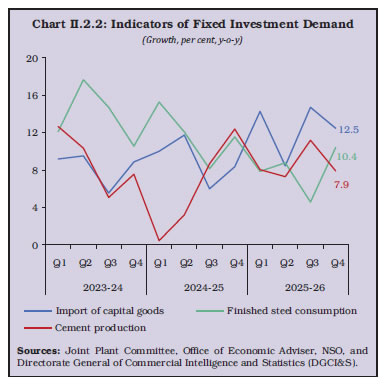 II.2.6 Gross domestic savings rose to 34.2 per cent of gross national disposable income (GNDI) in 2024-25 from 32.3 per cent in 2023-24. The net household financial saving increased to 7.0 per cent of GNDI in 2024-25 from 5.8 per cent a year earlier, as the decline in household financial liabilities more than offset the moderation in gross financial saving (Appendix Table 3). Gross household financial saving moderated to 11.8 per cent of GNDI in 2024-25 from 12.1 per cent in 2023-24, while household financial liabilities fell sharply to 4.8 per cent of GNDI in 2024-25 from 6.4 per cent in the previous year. Instrument-wise, household financial saving is dominated by deposits, followed by provident and pension funds, insurance, with a gradual increase in investment in shares and debentures (Table II.2.2). II.2.7 The saving-investment gap narrowed during 2024-25, with the household sector remaining the primary net supplier of funds with its surplus funds rising to 7.8 per cent of GDP in 2024-25 from 6.4 per cent in 2023-24 (Chart II.2.3). The resource gap of private corporations narrowed amid higher savings and lower investment, while fiscal consolidation reduced general government dissaving to 4.6 per cent of GDP from 5.3 per cent of GDP in the preceding year. The narrowing of the savings-investment gap at the economy-wide level indicates a reduced dependence on external capital and vulnerability to external shocks. | Table II.2.2: Financial Saving of Household Sector | | (Per cent of GNDI) | | Item | 2015-16 | 2016-17 | 2017-18 | 2018-19 | 2019-20 | 2020-21 | 2021-22 | 2022-23 | 2023-24 | 2024-25 | | 1 | 2 | 3 | 4 | 5 | 6 | 7 | 8 | 9 | 10 | 11 | | A. Gross Financial Saving | 10.7 | 10.4 | 11.9 | 11.8 | 11.4 | 15.2 | 10.9 | 11.2 | 12.1 | 11.8 | | of which: | | | | | | | | | | | | 1. Currency | 1.4 | -2.1 | 2.8 | 1.4 | 1.4 | 1.9 | 1.1 | - | - | - | | 2. Deposits | 4.6 | 6.3 | 3.0 | 4.2 | 4.3 | 6.2 | 3.5 | - | - | - | | 3. Shares and Debentures | 0.2 | 1.1 | 1.0 | 0.9 | 0.5 | 0.5 | 0.9 | - | - | - | | 4. Claims on Government | 0.5 | 0.7 | 0.9 | 1.1 | 1.3 | 1.3 | 1.1 | - | - | - | | 5. Insurance Funds | 1.9 | 2.3 | 2.0 | 2.0 | 1.7 | 2.8 | 2.0 | - | - | - | | 6. Provident and Pension Funds | 2.1 | 2.1 | 2.1 | 2.1 | 2.2 | 2.5 | 2.3 | - | - | - | | B. Financial Liabilities | 2.7 | 3.0 | 4.3 | 4.0 | 3.8 | 3.7 | 3.8 | 6.0 | 6.4 | 4.8 | | C. Net Financial Saving (A-B) | 7.9 | 7.3 | 7.5 | 7.8 | 7.6 | 11.6 | 7.2 | 5.2 | 5.8 | 7.0 | GNDI: Gross National Disposable Income. -: Not available.
Notes: 1. Figures may not add up to total due to rounding off of the numbers.
2. Data from 2022-23 onwards are as per the revised base year 2022-23.
Sources: NSO and RBI staff estimates. |
Aggregate Supply II.2.8 Aggregate supply – measured by real gross value added (GVA) at basic prices – expanded by 7.7 per cent in 2025-26 (7.3 per cent a year ago). GVA growth was driven by a buoyant services sector and a marked improvement in industrial activity, despite some moderation in the agricultural sector (Table II.2.3). Agriculture and Allied Activities II.2.9 Agriculture and allied sector growth moderated in 2025-26, reflecting weather-related disruptions in kharif crops, although favourable rabi conditions provided some support. The above normal8 south-west monsoon (Chart II.2.4.a) helped replenish reservoir levels to all-time high (Chart II.2.4.b).9,10 Due to higher reservoir levels11 and above normal post-monsoon rainfall12, rabi sowing ended with higher area than last year.13 Also, the sowing for summer (zaid) season has been progressing well. | Table II.2.3: Real GVA Growth | | (Per cent) | | Sector | 2023-24 | 2024-25 | 2025-26 | | 1 | 2 | 3 | 4 | | I. Agriculture, Livestock, Forestry and Fishing | 2.6 | 4.2 | 2.4 | | II. Industry | 11.3 | 8.7 | 9.5 | | II.1 Mining and Quarrying | 2.4 | 11.7 | 4.1 | | II.2 Manufacturing | 12.7 | 9.3 | 11.5 | | II.3 Electricity, Gas, Water Supply and Other Utility Services | 10.7 | 2.9 | 1.5 | | III. Services | 7.4 | 7.8 | 8.7 | | III.1 Construction | 9.9 | 7.3 | 7.1 | | III.2 Trade, Hotels, Transport, Communication and Services Related to Broadcasting, Storage | 10.1 | 6.6 | 10.1 | | III.3 Financial, Real Estate, IT, Professional Services and Ownership of Dwellings | 5.5 | 10.0 | 9.9 | | III.4 Public Administration, Defence and Other Services | 6.8 | 5.0 | 5.8 | | IV. GVA at Basic Prices | 7.2 | 7.3 | 7.7 | Note: Figures are based on the 2022-23 base series.
Sources: NSO and RBI staff estimates. | II.2.10 As per the second advance estimates (SAE), total foodgrains (kharif and rabi) production is estimated at a record level in 2025-26. This year is marked with the record production of kharif rice, wheat, maize, kharif groundnut, rapeseed and mustard and sugarcane (Table II.2.4). II.2.11 As per the first advance estimates, the production of horticultural crops during 2025-26 increased to a record level, mainly driven by banana, tomato and plantation crops14. II.2.12 The government announced an increase in minimum support prices15 for major kharif and rabi crops, ensuring a minimum return of 50 per cent over the cost of production.16 The wheat procurement in rabi marketing season 2025-26 has been at a four-year high and rice procurement in kharif marketing season 2025-26 has also been robust. 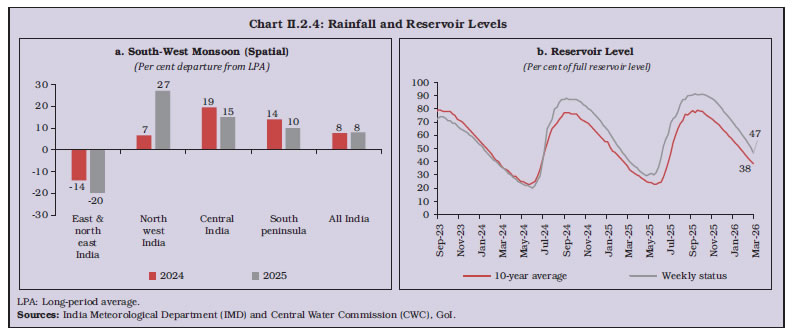
| Table II.2.4: Agricultural Crop Production 2025-26* | | (Lakh tonne) | | Crops | 2024-25 Final Estimate | 2025-26 SAE | 2025-26 SAE Variation over 2024-25 Final Estimate (per cent) | | 1 | 2 | 3 | 4 | | 1. Foodgrains | 3,386.3 | 3,486.6 | 3.0 | | Rice | 1,389.0 | 1,406.5 | 1.3 | | Wheat | 1,179.5 | 1,202.1 | 1.9 | | Coarse Cereals | 588.2 | 639.3 | 8.7 | | Pulses | 229.7 | 238.7 | 3.9 | | Tur | 36.2 | 34.6 | -4.7 | | Gram | 111.1 | 117.9 | 6.1 | | Lentil | 16.5 | 17.3 | 4.8 | | Urad | 18.9 | 17.1 | -9.5 | | Moong | 18.7 | 20.7 | 10.4 | | 2. Oilseeds | 416.6 | 410.0 | -1.6 | | 3. Sugarcane (Cane) | 4,546.1 | 5,002.0 | 10.0 | | 4. Cotton # | 297.2 | 290.9 | -2.1 | | 5. Jute & Mesta ## | 88.0 | 83.4 | -5.2 | *: Kharif and Rabi crops (excluding summer crops).
#: Lakh bales of 170 kg each.
##: Lakh bales of 180 kg each.
Source: Ministry of Agriculture and Farmers Welfare, GoI. | II.2.13 As at end-March 2026, the overall public stock of foodgrains held by Food Corporation of India is more than four times the buffer requirement, mainly due to high stock of rice (Chart II.2.5).17 The government has allotted 52 lakh tonne of rice from the excess stock for ethanol blending. Similarly, the export restrictions for wheat and wheat products have been partially relaxed.18 Going forward, the likelihood of El Niño19 during the upcoming kharif season needs to be closely monitored. Industrial Sector II.2.14 Industrial sector GVA growth surged to 9.5 per cent in 2025-26. Manufacturing activity, which accounts for 80 per cent of the industrial sector, picked up in 2025-26 as reflected in higher sales growth and profitability in H1:2025-26 (Chart II.2.6).
II.2.15 Industrial output, as measured by the index of industrial production (IIP), moderated during H1:2025-26 due to mining and electricity (Chart II.2.7a). In H2:2025-26, IIP recovered with a rebound in mining activity and further strengthening of the manufacturing sector. Overall, the manufacturing sector posted strong growth with 16 of 23 industry groups recording expansion in 2025-26. As per use-based classification, all categories of industries recorded growth (Chart II.2.7b). II.2.16 Renewable energy (including large hydro), which accounts for nearly one fourth of power generation, grew by 18.4 per cent y-o-y in 2025-26 (Chart II.2.8). By end-March 2026, India’s non-fossil energy capacity reached 283 gigawatt (53.2 per cent of the total installed power capacity), enabling India to meet its COP26 target of 50 per cent non-fossil capacity well ahead of 2030.20 Investments have shifted towards renewables, with most new project spending concentrated in this sector away from conventional capacity. II.2.17 After remaining subdued during H1:2025-26, both capacity utilisation and private capex showed early signs of revival, indicating improving business confidence and upbeat demand conditions in the second half of the year.
Manufacturing capacity utilisation increased to 75.6 per cent in Q3:2025-26, expanding for the second successive quarter, supported by sequential growth in new orders and stable inventory levels (Chart II.2.9). II.2.18 Private sector net fixed asset growth recovered in 2025-26, with growth rising to 11.5 per cent in H1:2025-26, driven by telecommunications, metals, construction, and automobiles. The production linked incentive (PLI) scheme gave a fillip to private sector investment with the scheme attracting an actual investment of over ₹2.2 lakh crore, leading to incremental production/sales of over ₹20.4 lakh crore and employment generation of over 14.4 lakh as at end-December 2025.21 Services Sector II.2.19 Services sector growth strengthened to 8.7 per cent in 2025-26, on the back of broad-based expansion across trade, transport and hotels and restaurants; and financial, real estate and professional services. High frequency indicators of services sector reflected a mixed picture in 2025-26. In H2:2025-26, following GST 2.0 reforms, commercial vehicle sales and vehicle registrations surged. Other indicators such as retail automobile sales (passenger vehicle, tractor, two-wheeler and three-wheeler), domestic air cargo, port cargo, railway freight traffic, foreign tourist arrivals, and GST E-way bills intra-state also improved as compared to H2:2024-25. While air passenger traffic and toll collection (value) moderated, hotel occupancy indicator showed contraction during the same period (Table II.2.5). 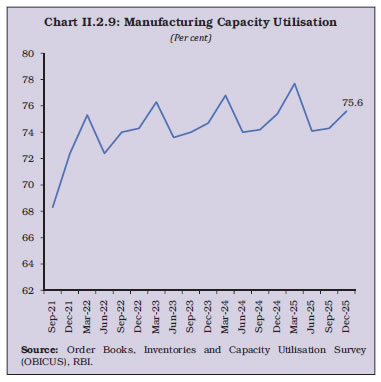 II.2.20 India’s construction sector showed mixed trends in 2025-26 with moderating steel consumption and improving cement production as compared to 2024-25 (Table II.2.5). During Q3:2025-26, housing launches accelerated, supported by GST-led cost reductions while sales declined after registering modest growth in the previous quarter. Sales adjusted inventory overhang22, after stabilising in recent quarters, inched up in Q3:2025-26, but remained below the two-year pre-COVID-19 average of 32 months (Chart II.2.10). 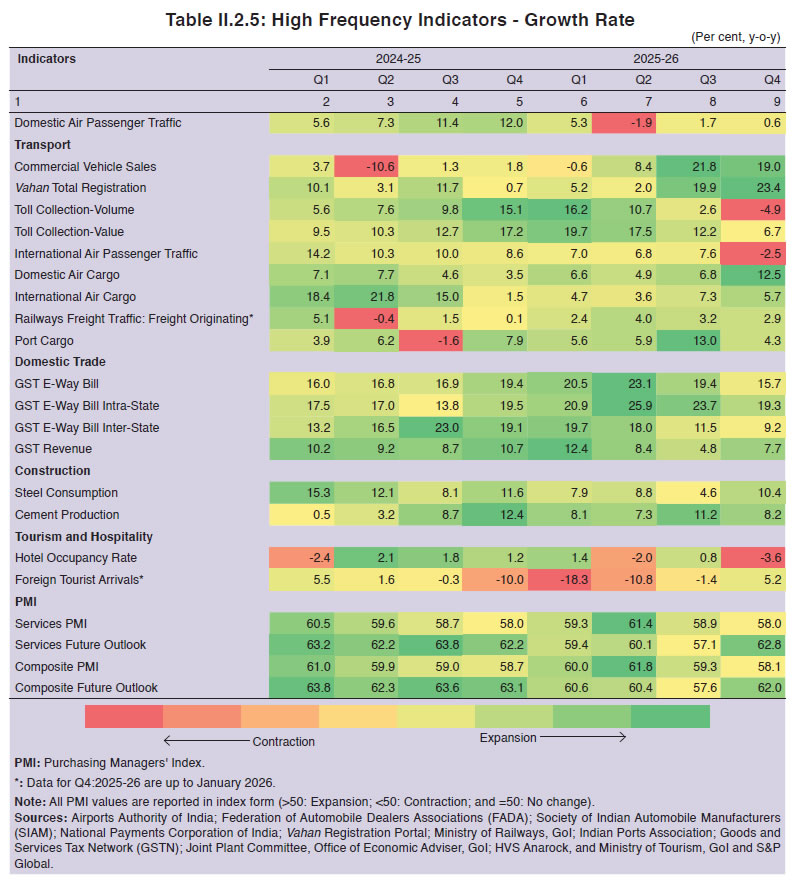 II.2.21 The services sector composite index (SSCI)23, which monitors activity in construction, trade, transport, and financial services, and serves as a coincident indicator of GVA growth in the services sector [excluding public administration, defence, and other services (PADO)], moderated in March 2026, after showing a sequential improvement in the preceeding three quarters. The moderation in SSCI is driven by weak growth in trade and transport indicators in Q4:2025-26 (Chart II.2.11). Employment II.2.22 Employment conditions remained steady in 2025. According to the annual periodic labour force survey (PLFS) report for January-December 2025, the labour force participation rate (LFPR), worker population ratio (WPR), and the unemployment rate (UR) showed marginal decline (Chart II.2.12a).24 LFPR and WPR moderated in rural areas, whereas urban LFPR remain unchanged and WPR increased (Chart II.2.12b). The share of regular wage/ salaried and casual labour increased, while the share of self-employed declined in total employed (Chart II.2.12c). II.2.23 Recently enacted labour reforms are expected to improve labour market flexibility and reduce compliance burden while ensuring universal social security coverage, statutory minimum wages, and enhanced health and safety provisions, thereby encouraging formal job creation, worker well-being and enterprise expansion.
Conclusion II.2.24 India’s economic activity exhibited marked resilience in 2025-26, driven by a steady momentum in private consumption, uptick in fixed investment, strong performance of manufacturing activity and upbeat performance in services. Moreover, the recently concluded India-EU free trade agreement (FTA), along with discussions on the India-US trade deal and several other trade agreements are expected to support exports over the medium-term. However, moderation in agricultural and allied sector activity due to weather-related events, coupled with global headwinds such as persistent geopolitical tensions, uncertain trade environment and volatility in financial markets continue to pose downside risks to growth outlook. II.3 PRICE SITUATION II.3.1 Inflation dynamics during 2025-26 was characterised by a sustained period of moderation, marking a distinct break from the previous years. Headline inflation moderated to 2.1 per cent during 2025-26, aided by deflation in food and strong favourable base effect (Chart II.3.1)25. Rationalisation and simplification of GST rates in September 2025 also helped limit price pressures across several goods and services. Core inflation, i.e., Consumer Price Index (CPI) excluding food and fuel, on the other hand, faced upward pressures emanating from precious metals. Towards the end of the year, however, as the conflict in West Asia broke out, the increase in domestic liquefied petroleum gas (LPG) prices pushed up inflation in the fuel and light component. 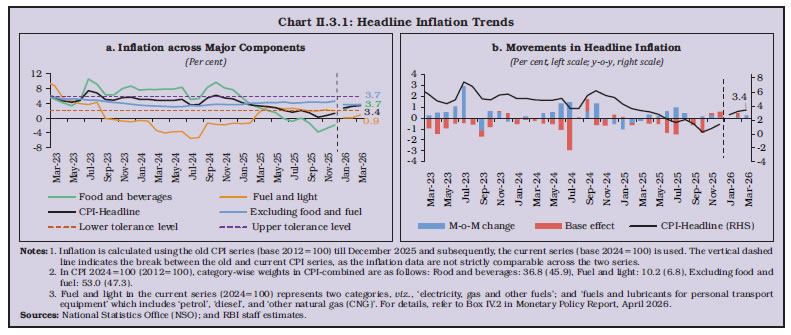 II.3.2 On February 12, 2026, the Ministry of Statistics and Programme Implementation (MoSPI), Government of India (GoI), released a new CPI series with base year 2024=100. The revised structure follows the United Nation’s Classification of Individual Consumption According to Purpose (COICOP) 2018, with the weights being derived from the Household Consumption Expenditure Survey (HCES) 2023-24. Under the new structure, the erstwhile six groups as per the CPI base year 2012=100 have now been reconstituted into 12 divisions. Notably, the weight of ‘food and beverages’ declined from 45.9 per cent to 36.8 per cent in the new series, reflecting evolving consumption patterns of consumers towards more non-food items, as well as a reclassification of prepared meals to a new division ‘restaurants and accommodation services’. Additionally, ‘housing’ and ‘fuel and light’ groups have been clubbed together into ‘housing, water, electricity, gas and other fuels division’, whereas ‘transport and communication’ group has been segregated into ‘transport’ and ‘information and communication’ divisions (Table II.3.1). II.3.3 While average inflation moderated sharply, volatility, as measured by standard deviation, increased marginally in 2025-26 as inflation ranged from 0.3 to 3.4 per cent (Table II.3.2). The intra-year distribution of inflation exhibited a slight negative skewness indicating a slightly longer tail towards lower inflation outcomes. Constituents of CPI Infation Food II.3.4 Prices of food and beverages contracted by 0.8 per cent in 2025-26 (April-December 2025), year-on-year (y-o-y), as compared to an increase of 7.6 per cent in the corresponding period of the preceding year. In Q4:2025-26, inflation in food and beverages averaged higher at 3.1 per cent (CPI 2024=100). In October 2025, CPI food and beverages recorded the steepest deflation in the CPI series at 3.7 per cent (y-o-y) before inching up to 1.8 per cent deflation in December. The secular decline in inflation from a peak of 9.7 per cent in October 2024 was primarily driven by muted price pressures in vegetables, pulses and cereals, and a strong favourable base effect (Chart II.3.2). Favourable supply-side factors, i.e., comfortable foodgrain stocks stemming from higher domestic and steady wholesale market arrivals, supportive trade policies, proactive supply management by the government, and largely conducive weather conditions contributed to moderation in food inflation. | Table II.3.1: Change in CPI Weighting Structure | | S. No. | Divisions | CPI 2024 = 100 | S. No. Groups | | CPI 2012 = 100 | | 1 | 2 | 3 | 4 | 5 | 6 | | 1 | Food and beverages | 36.8 | 1 | Food and beverages | 45.9 | | 2 | Pan, tobacco and intoxicants | 3.0 | 2 | Pan, tobacco and intoxicants | 2.4 | | 3 | Clothing and footwear | 6.4 | 3 | Clothing and footwear | 6.5 | | 4 | Housing, water, electricity, gas and other fuels | 17.7 | 4 | Housing | 10.1 | | 5 | Furnishings, household equipment and routine household maintenance | 4.5 | 5 | Fuel and light | 6.8 | | 6 | Education services | 3.3 | 6 | Miscellaneous | 28.3 | | 7 | Health | 6.1 | | of which: | | | 8 | Information and communication | 3.6 | 6.1 | Household goods and services | 3.8 | | 9 | Transport | 8.8 | 6.2 | Health | 5.9 | | 10 | Recreation, sport and culture | 1.5 | 6.3 | Transport and communication | 8.6 | | 11 | Personal care, social protection and miscellaneous goods and services | 5.0 | 6.4 | Recreation and amusement | 1.7 | | 12 | Restaurants and accommodation services | 3.3 | 6.5 | Education | 4.5 | | | | | 6.6 | Personal care and effects | 3.9 | | | Total | 100 | | Total | 100 | Note: Each CPI series follows the classification that it was published with, and the weighting structure across similar categories are not strictly comparable.
Sources: NSO; and RBI staff estimates. |
| Table II.3.2: CPI Headline Inflation – Key Summary Statistics | | (Per cent) | | | 2016-17 | 2017-18 | 2018-19 | 2019-20 | 2020-21 | 2021-22 | 2022-23 | 2023-24 | 2024-25 | 2025-26 | | 1 | 2 | 3 | 4 | 5 | 6 | 7 | 8 | 9 | 10 | 11 | | Mean | 4.5 | 3.6 | 3.4 | 4.8 | 6.2 | 5.5 | 6.7 | 5.4 | 4.6 | 2.1 | | Standard deviation | 1.0 | 1.2 | 1.1 | 1.8 | 1.1 | 0.9 | 0.7 | 0.9 | 0.9 | 1.0 | | Skewness | 0.2 | -0.2 | 0.1 | 0.5 | -0.7 | -0.1 | -0.1 | 1.5 | 0.0 | -0.3 | | Kurtosis | -1.6 | -1.0 | -1.5 | -1.4 | -0.7 | -1.0 | -0.6 | 1.6 | -1.2 | -1.0 | | Median | 4.3 | 3.4 | 3.5 | 4.3 | 6.5 | 5.6 | 6.7 | 5.1 | 4.8 | 2.1 | | Maximum | 6.1 | 5.2 | 4.9 | 7.6 | 7.6 | 7.0 | 7.8 | 7.4 | 6.2 | 3.4 | | Minimum | 3.2 | 1.5 | 2.0 | 3.0 | 4.1 | 4.2 | 5.7 | 4.3 | 3.3 | 0.3 | Notes: 1. Skewness and kurtosis are unit-free. Annual inflation is the average of the monthly inflation rates during the year and therefore, may vary from the annual inflation calculated from the average index for the year.
2. Monthly inflation rates pertain to the old CPI series (base 2012=100) till December 2025, subsequently, to the current series (base 2024=100).
Sources: NSO; and RBI staff estimates. |
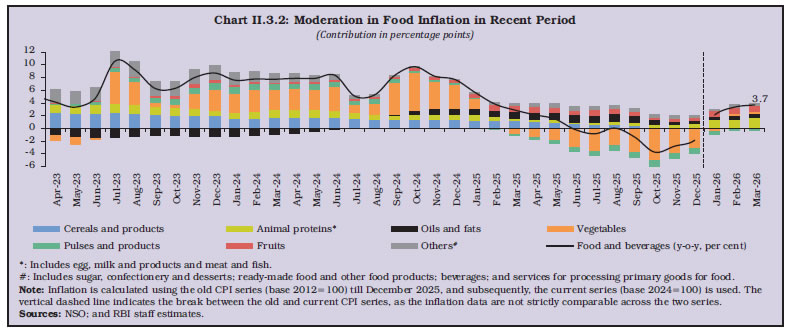 II.3.5 Vegetables experienced an unusually low and delayed summer price build-up following an extended period of winter price easing, in contrast to seasonal and historical patterns. Vegetable prices recorded a 19.4 per cent (y-o-y) decline during April-December 2025, followed by a pick-up of 0.8 per cent Q4:2025-26 (Chart II.3.3a). II.3.6 Tomato, onion and potato (TOP) prices remained benign throughout the year. A low summer build-up in prices was followed by a sharp decline in September-October 2025 as production and market availability remained robust. A deflation of 31.3 per cent during the first three quarters and 12 per cent during Q4:2025-26 was recorded in this category, particularly driven by onion, on account of steady arrivals from higher production in 2024-25 (26.7 per cent over 2023-24), lower exports and supply-side measures including targeted retail sales from government’s buffer stocks (Chart 11.3.3b). Prices of vegetables excluding TOP also recorded a contraction of 11.4 per cent in April-December 2025 (y-o-y) followed by an increase of 8 per cent (y-o-y) in Q4:2025- 26, largely due to unfavourable base effects. 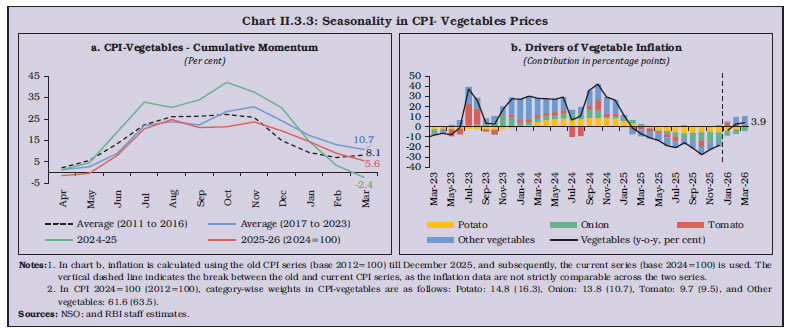 II.3.7 Pulses, the primary source of plant-based protein, recorded deflation of 13 per cent during the first three quarters against a 11.4 per cent price increase in the previous year, followed by deflation of 7.9 per cent in Q4:2025-26. Inflation in pulses moderated sequentially for 17 months till October 2025 amidst higher availability from robust production in 2024-25 (5.9 per cent higher over 2023-24), large imports of key pulses (yellow peas, arhar and urad), stock disclosure requirements and retail sales of Bharat Dal by the central government26 (Chart II.3.4). II.3.8 Cereals recorded a modest price increase of 2.4 per cent during April-December 2025 as compared to 7.6 per cent in the previous year, driven by a broad-based decline in prices of rice, wheat and other cereals and products. In Q4:2025-26, cereals prices contracted by 0.2 per cent driven by wheat (Chart II.3.5). Wheat recorded deflation after 50 months in December 2025 led by record production (higher by 4.1 per cent in 2024-25), comfortable buffer stocks (1.7 times the norm as on March 16, 2026), and continued export restrictions till February 2026. Record rice production (higher by 9 per cent in 2024-25) and high buffer stocks (9.7 times the norm as on March 16, 2026) kept rice inflation subdued. 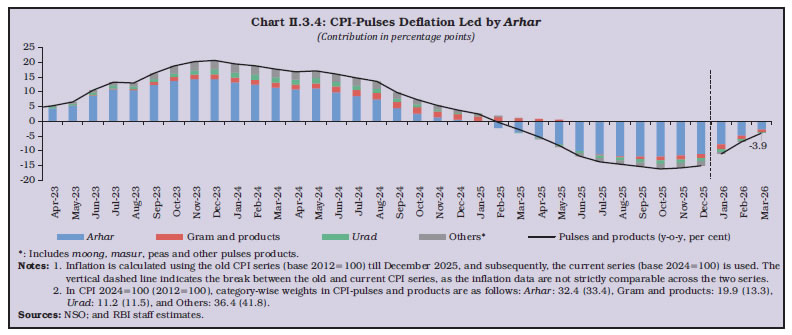 II.3.9 Unlike overall benign food inflation through the year driven by the staples, ‘fruits’ and ‘oils and fats’ witnessed upside price pressures. Decline in coconut production by 5 per cent due to higher temperature and unseasonal rains in 2024-25 led to higher coconut prices, leading to an average fruit inflation of 10.6 per cent during April-December 2025 and 7.9 per cent during Q4. Oils and fats inflation remained in double-digits for 12 consecutive months till October 2025 and recorded a 15 per cent increase in prices (y-o-y) in 2025-26 (April-December) from 1.9 per cent during the corresponding period a year ago, followed by a 7.3 per cent increase in prices (y-o-y) in Q4:2025-26. This was due to higher international palm oil prices on account of higher bio-diesel mandates in key producer countries. Furthermore, a domestic production shortfall in 2024-25 led to price pressures in mustard oil, which recorded a 41-month high inflation of 24.2 per cent in August 2025. Production shortfall in soybean during the 2025-26 kharif season may pose some upside risks despite higher rabi output of mustard and rapeseed (as per second advance estimates of 2025-26). Prices of fats like ghee and butter remained largely stable through the year and recorded a decline in October 2025 due to reduced GST rates on retail prices. 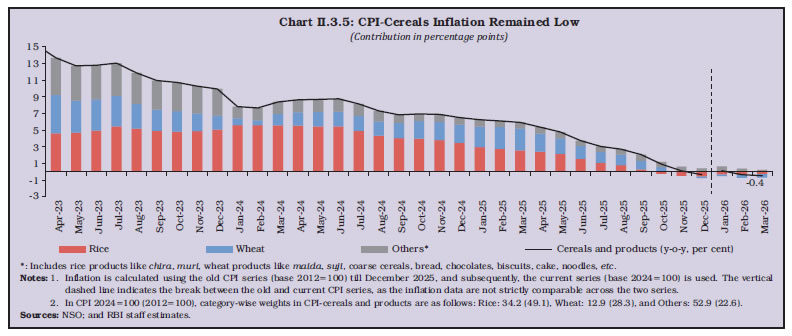 II.3.10 Among other food items, prices of spices remained in deflation for 18 consecutive months till December 2025, driven primarily by jeera (cumin) and dry chillies. Inflation in animal proteins was subdued in 2025-26 as weather conditions remained favourable for cattle and poultry, although prices picked up in meat and fish during January-March 2026. Fuel II.3.11 Fuel inflation increased to 2.4 per cent during April-December 2025 from a deflation of 3.2 per cent during the corresponding period a year ago, due to a price hike of ₹50 per LPG cylinder in April 2025. Consequently, the fuel group’s contribution to headline inflation increased to 8.8 per cent in April-December 2025 from (-) 4.3 per cent a year ago (Chart II.3.6). In March 2026, inflation in fuel rose to 0.9 per cent from 0.1 per cent in January and February each, on account of ₹60 hike per LPG cylinder in March 2026. Core Inflation (Inflation Excluding Food and Fuel)27 II.3.12 Core inflation remained range bound, averaging 4.3 per cent during April-December 2025, compared with 3.4 per cent in the corresponding period a year ago (Appendix Table 4). Under the revised series (2024=100), core inflation remained broadly stable at 3.7 per cent during January to March 2026. The persistence in core inflation was largely driven by elevated inflation in ‘personal care and effects’ including gold and silver precious metals, which accounted for nearly half of the core inflation in the second half of 2025-26 (Chart II.3.7). 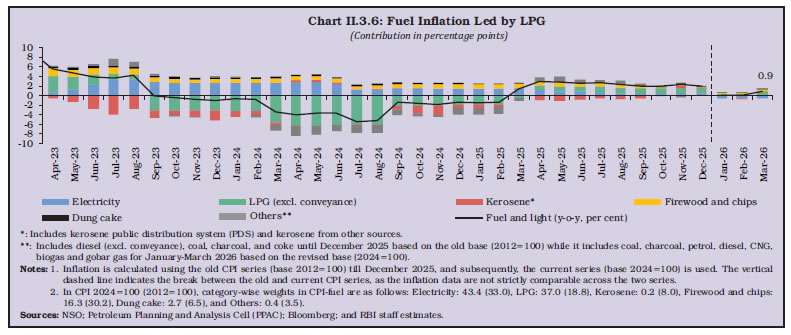 II.3.13 The rise in inflation in personal care and effects was primarily driven by a surge in prices of precious metals – gold and silver, reflecting heightened global safe-haven demand amid geopolitical uncertainty and the evolving global monetary policy trajectory and expectations. Excluding gold and silver, core inflation moderated in the second half of 2025-26 supported by GST rationalisation measures-led price corrections, particularly in motor vehicles and related components (Chart II.3.8). Inflation in clothing and footwear fell to 2.2 per cent during April to December 2025, from 2.7 per cent in the corresponding period a year ago, reflecting lower domestic and international cotton prices and subdued export demand for textiles and wearing apparel. Inflation in household goods and services, health, and education remained broadly stable during 2025-26.
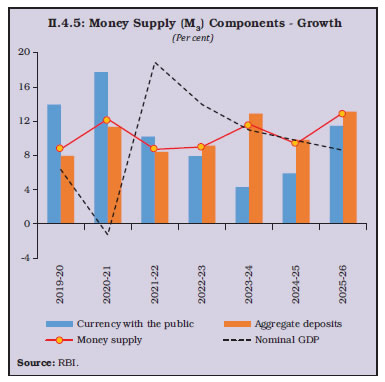
Other Indicators of Inflation II.3.14 From a sectoral perspective, inflation measured by the CPI for industrial workers (CPI-IW) moderated to 3.1 per cent during 2025-26 from 3.4 per cent a year ago, driven by lower food inflation. The base of CPI-agricultural labourers/ rural labourers (AL/RL) series was revised in July 2025, from 1986-87 to 2019=100. The revised CPI basket based on Household Consumption Expenditure Survey (2011-12) shows significant reduction in the weight of food and non-alcoholic beverages group and a sharp increase in the miscellaneous group, indicating changes in the consumption pattern of rural households28. II.3.15 Wholesale price index (WPI) inflation moderated to 0.7 per cent during 2025-26 from 2.3 per cent a year ago, majorly due to deflation in primary articles and fuel and power. WPI primary articles (weight of 22.6 per cent) experienced a deflation of 1.1 per cent during 2025-26 from an inflation of 5.2 per cent a year ago, driven by favourable supply and weather conditions. Furthermore, fuel and power deflation deepened to 2.9 per cent during 2025-26 from 1.3 per cent a year ago, mirroring the easing of global energy prices. Inflation in manufactured products (weight of 64.2 per cent) increased to 2.3 per cent during 2025-26 from 1.7 per cent a year ago, led by manufacture of chemical, fabricated metal, paper and food products. Reflecting the overall decline in inflation, the gross domestic product (GDP) deflator-based inflation decreased to 0.9 per cent during April-December 2025 from 2.5 per cent in the corresponding period of the previous year29. Although there have been periods of divergence between WPI and CPI in the past, the two have moved in tandem in the recent period (Chart II.3.9). 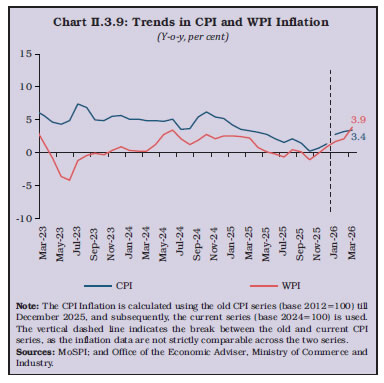 II.3.16 Minimum support prices (MSPs) in 2025-26 were increased in the range of 1.0-13.9 per cent for the kharif crops and 4.0-10.1 per cent for the rabi crops. Ragi witnessed the maximum MSP increase among the kharif crops while safflower recorded the highest increase among the rabi crops. Conclusion II.3.17 Headline inflation remained benign during 2025-26 on account of robust foodgrains production, softened global commodity prices — particularly food and energy — and supply management measures undertaken by the government. Towards the end of the financial year, some price pressures started emerging due to outbreak of West Asia conflict. Looking ahead, the challenges on account of uncertainties emanating from prolonged geopolitical conflicts, rising energy prices, input costs, currency fluctuations, evolving trade policies and weather conditions — especially possibility of El Niño and below normal monsoon — warrant continuous vigil and careful monitoring of the evolving dynamics. II.4 MONEY AND CREDIT30 II.4.1 The Reserve Bank’s balance sheet expanded during the year, primarily driven by revaluation gains arising from elevated gold prices and rupee depreciation. Currency in circulation (CiC) grew in double digits, contributing to higher growth in reserve money (RM) adjusted for the first-round impact of changes in the cash reserve ratio (CRR)31. Bank credit growth remained subdued in the first half amidst increased reliance on non-bank channels for financing commercial sector. As the year progressed, credit growth gained significant momentum across sectors, outpacing deposit growth during H2:2025-26. Reserve Money II.4.2 Reserve money represents the stock of monetary liabilities in the central bank’s balance sheet (Chart II.4.1). Risk buffers and revaluation accounts [forming the bulk of net non-monetary liabilities (NNML)], along with surplus liquidity placed by banks with the Reserve Bank under the reverse repos/standing deposit facility (SDF) are the other major components of the balance sheet. As at end-March 2026, the Reserve Bank’s balance sheet size stood at 26.4 per cent of GDP32 (23.7 per cent a year ago). ![Chart II.4.1: Reserve Bank's Balance Sheet -Components (Liabilities) [end-March]](https://www.rbi.org.in/scripts/images/02ECO290526_C41.jpg "Chart II.4.1: Reserve Bank's Balance Sheet -") II.4.3 Adjusted for the first-round impact of change in CRR, the RM33 growth accelerated to 10.8 per cent in 2025-26 from 5.8 per cent a year ago (Chart II.4.2 and Appendix Table 4). CiC - the major constituent of RM with a share of 81.4 per cent - expanded at 11.4 per cent during 2025-26 from 5.8 per cent a year ago, driven by higher cash withdrawal resulting from welfare measures taken by several state governments (viz., compensation for crop damage and direct benefit transfers), higher consumption-driven cash withdrawals after recent GST and income tax rate cuts alongside increased cash demand amidst easing interest rates and rising prices of precious metals. Growth in bankers’ deposits with the Reserve Bank (15.8 per cent share in RM), i.e., balances maintained by banks to meet their CRR requirements and settlement obligations, declined by 18.2 per cent during the year, reflecting the reduction in CRR by 100 bps. 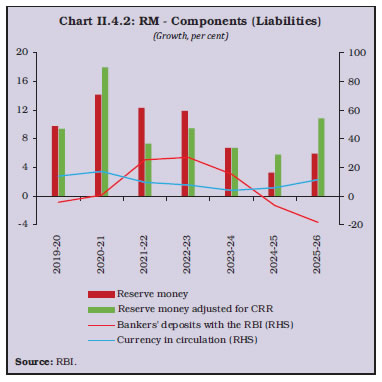 II.4.4 The currency-GDP ratio increased marginally alongside rising usage of digital payments. Retail digital payments grew by 15.1 per cent in value terms and 26.9 per cent in volume terms during 2025-26 (Chart II.4.3). II.4.5 On the sources side (assets), RM comprises net domestic assets (NDA)34 and net foreign assets (NFA)35 of the Reserve Bank. During 2025-26, NFA expanded by ₹8.2 lakh crore, driven by expansion in both FCA and gold. Although net sales to authorised dealers were higher than a year ago, FCA expanded on account of revaluation gains. The share of gold in NFA increased to 17.2 per cent as at end-March 2026 from 12.0 per cent a year ago, mainly due to revaluation gains from increase in gold prices. The Reserve Bank’s net credit to the government expanded during the year owing to the liquidity injection through purchase of G-secs via open market operations (Chart II.4.4). Money Supply II.4.6 Money supply - in terms of broad money (M3) - mainly consists of currency with the public (CwP) and aggregate deposits (AD) of banks on the components side (liabilities). M3 recorded a growth of 13.0 per cent as on March 31, 2026 as compared with 9.4 per cent a year ago (Chart II.4.5). On the components side, expansion in M3 was driven by AD, its largest constituent (86.6 per cent share) with sustained growth in time deposits (10.6 per cent vis-à-vis 9.8 per cent a year ago), notwithstanding considerable moderation in interest rates. Demand deposits remained volatile, largely mirroring the variations in currency with the public, which grew by 11.4 per cent in 2025-26 vis-à-vis 5.9 per cent in the previous year. 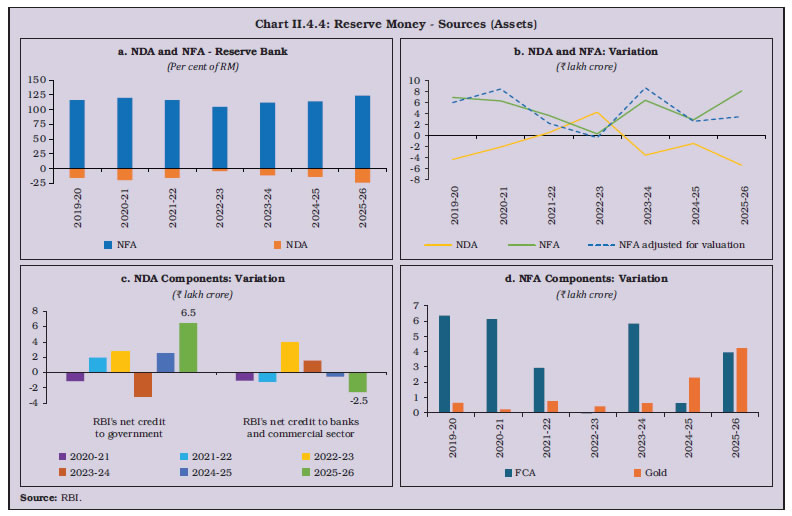
 II.4.7 On the sources side (assets), expansion in M3 was mainly driven by bank credit to the commercial sector (the largest constituent of M3), which grew by 15.7 per cent in 2025-26 as compared with 10.8 per cent during the previous year (Chart II.4.6). Net bank credit to government increased by 9.1 per cent in 2025-26 (10.5 per cent a year ago), owing to purchases of G-secs by the Reserve Bank. Accordingly, excess holdings of statutory liquidity ratio (SLR) securities36 of scheduled commercial banks (SCBs) declined to 8.2 per cent of NDTL as on March 31, 2026 (10.3 per cent a year ago). The net foreign assets of the banking sector increased, mirroring the expansion in NFA of the Reserve Bank’s balance sheet during the year. Key Monetary Ratios II.4.8 Transaction velocity of money, i.e., the ratio of nominal GDP to M3, declined during 2025-26 with greater financial deepening and monetisation of the economy. Currency-deposit ratio moderated further from 15.4 per cent as on March 21, 2025 to 14.9 per cent as on March 31, 2026, reflecting, inter alia, an increasing shift in public preference towards digital modes of payments. The reserve-deposit ratio declined during the year due to reduction in CRR (Chart II.4.7a). The combined impact of moderation in both currency-deposit ratio and reserve-deposit ratio resulted in an improvement in the money multiplier to 6.1 as on March 31, 2026 from 5.7 a year ago (Chart II.4.7b).
Credit II.4.9 Double digit growth in bank credit was sustained during 2025-26, led by services and retail sectors (Chart II.4.8a). Public sector banks (PSBs) registered higher credit growth than that of private sector banks (PVBs) for the second consecutive year resulting in rise in PSBs’ share in total credit (Chart II.4.8b). II.4.10 Key sectors witnessed an uptick in credit growth with overall non-food credit37 growth at 15.9 per cent as at end-March 2026 (Chart II.4.9). Industrial credit continued to expand at a robust pace since May 2025, on the back of sturdier credit growth in micro, small and medium enterprises (MSMEs). Industrial sub-segments such as ‘infrastructure’, ‘all engineering’, ‘basic metal and metal product’, ‘chemical and chemical products’, and ‘petroleum, coal products and nuclear fuels’ marked resilient y-o-y growth. Services sector credit sustained robust double-digit growth, largely supported by healthy credit growth in ‘trade’, ‘commercial real estate’, and sharp resumption of credit to NBFCs38 since October 2025. Personal loans continued to remain the major driver of overall non-food credit growth. Housing loans, which account for nearly half of the personal loans, recorded healthy growth and segments such as vehicle loans and loans against gold jewellery showed buoyant growth (Table II.4.1). 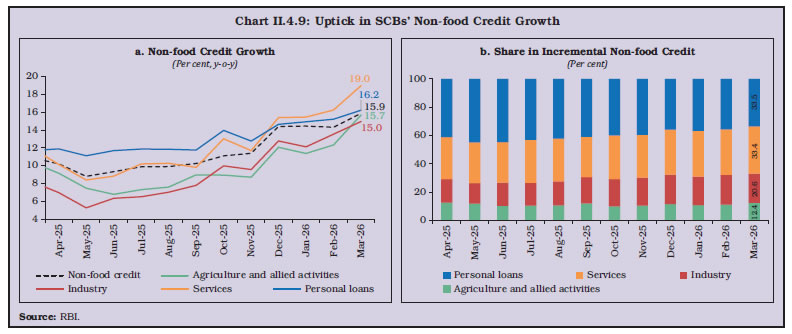
| Table II.4.1: Sectoral Credit Growth - SCBs | | (Per cent, y-o-y) | | Sector | 2024-25# | 2025-26 | | Apr | May | Jun | Jul | Aug | Sep | Oct | Nov | Dec | Jan | Feb | Mar | | 1 | 2 | 3 | 4 | 5 | 6 | 7 | 8 | 9 | 10 | 11 | 12 | 13 | 14 | | Non-food Credit | 10.9 | 10.2 | 8.8 | 9.3 | 9.9 | 9.9 | 10.2 | 11.1 | 11.4 | 14.4 | 14.4 | 14.3 | 15.9 | | I. Agriculture & Allied Activities | 10.4 | 9.2 | 7.5 | 6.8 | 7.3 | 7.6 | 9.0 | 8.9 | 8.7 | 12.1 | 11.4 | 12.3 | 15.7 | | II. Industry (Micro & Small, Medium and Large) | 8.2 | 7.0 | 5.3 | 6.3 | 6.5 | 7.0 | 7.8 | 10.0 | 9.6 | 12.8 | 12.1 | 13.5 | 15.0 | | II.1. Micro & Small | 8.9 | 9.2 | 13.7 | 19.2 | 20.9 | 20.8 | 22.0 | 25.9 | 24.6 | 30.4 | 31.2 | 30.4 | 33.1 | | II.2. Medium | 18.5 | 18.1 | 16.9 | 13.2 | 15.0 | 13.3 | 14.5 | 17.6 | 15.7 | 20.4 | 22.3 | 21.0 | 21.7 | | II.3. Large | 6.9 | 5.0 | 1.5 | 2.0 | 1.6 | 2.4 | 3.0 | 4.6 | 4.6 | 6.9 | 5.5 | 7.8 | 8.9 | | II.3.1 Infrastructure | 2.8 | 0.3 | -1.3 | 0.8 | 3.4 | 3.5 | 5.0 | 4.6 | 4.3 | 7.2 | 6.4 | 7.9 | 9.5 | | II.3.2 Basic Metal & Metal Product | 12.8 | 14.3 | 10.6 | 11.0 | 9.5 | 8.9 | 9.1 | 13.1 | 11.8 | 14.2 | 13.8 | 15.2 | 19.4 | | II.3.3 Chemicals & Chemical Products | 7.4 | 6.0 | 4.7 | 6.3 | 5.5 | 6.7 | 8.3 | 12.2 | 11.1 | 14.8 | 15.1 | 19.1 | 14.9 | | II.3.4 Textiles | 8.3 | 8.5 | 6.8 | 8.6 | 6.0 | 6.4 | 7.1 | 9.1 | 8.1 | 11.8 | 10.0 | 8.2 | 8.9 | | II.3.5 All Engineering | 22.0 | 21.7 | 20.4 | 22.1 | 23.0 | 19.8 | 22.4 | 25.1 | 22.6 | 30.4 | 35.9 | 36.0 | 32.2 | | II.3.6 Food Processing | 5.1 | 6.5 | 7.8 | 8.1 | 5.2 | 6.1 | 7.7 | 10.2 | 6.5 | 11.7 | 9.6 | 10.2 | 14.0 | | III. Services | 12.0 | 10.1 | 8.4 | 8.8 | 10.2 | 10.3 | 9.8 | 13.0 | 11.7 | 15.4 | 15.5 | 16.3 | 19.0 | | III.1. Trade | 15.6 | 13.9 | 10.4 | 10.7 | 12.8 | 12.3 | 11.7 | 13.8 | 14.2 | 17.5 | 16.1 | 14.4 | 16.2 | | III.2. Commercial Real Estate | 13.7 | 17.3 | 14.8 | 14.9 | 15.7 | 13.2 | 15.5 | 14.1 | 12.6 | 15.4 | 16.2 | 17.4 | 19.9 | | III.3. NBFCs | 7.4 | 4.5 | 1.0 | 3.1 | 3.0 | 3.7 | 3.9 | 10.9 | 9.5 | 15.1 | 17.8 | 20.9 | 26.3 | | IV. Personal Loans | 11.7 | 11.9 | 11.1 | 11.7 | 11.9 | 11.9 | 11.8 | 14.0 | 12.8 | 14.6 | 14.9 | 15.2 | 16.2 | | IV.1. Consumer Durables | -1.0 | -1.0 | -3.7 | -2.8 | -5.8 | -5.8 | -6.1 | 1.0 | -5.9 | -5.1 | -4.0 | -9.8 | -5.3 | | IV.2. Housing | 10.7 | 9.8 | 9.0 | 9.6 | 9.6 | 9.7 | 10.1 | 11.0 | 9.9 | 11.1 | 11.1 | 11.0 | 11.5 | | IV.3. Credit Card Outstanding | 10.6 | 10.6 | 8.5 | 7.2 | 5.6 | 4.4 | 3.7 | 7.7 | 2.4 | 1.0 | 1.5 | 1.7 | 3.5 | | IV.4. Vehicle Loans | 8.6 | 8.8 | 8.7 | 9.2 | 8.9 | 8.7 | 7.3 | 12.5 | 12.4 | 16.7 | 17.1 | 17.1 | 18.6 | | IV.5. Loans against Gold Jewellery | 121.1 | 138.0 | 132.7 | 140.9 | 136.4 | 130.2 | 125.6 | 128.5 | 125.3 | 126.1 | 128.8 | 127.9 | 123.1 | | IV.6. Other Personal Loans | 7.5 | 8.5 | 7.2 | 7.1 | 7.6 | 7.6 | 7.4 | 9.9 | 8.9 | 11.5 | 11.6 | 12.1 | 13.0 | #: March 2025 over March 2024.
Note: Data are provisional.
Source: RBI. |
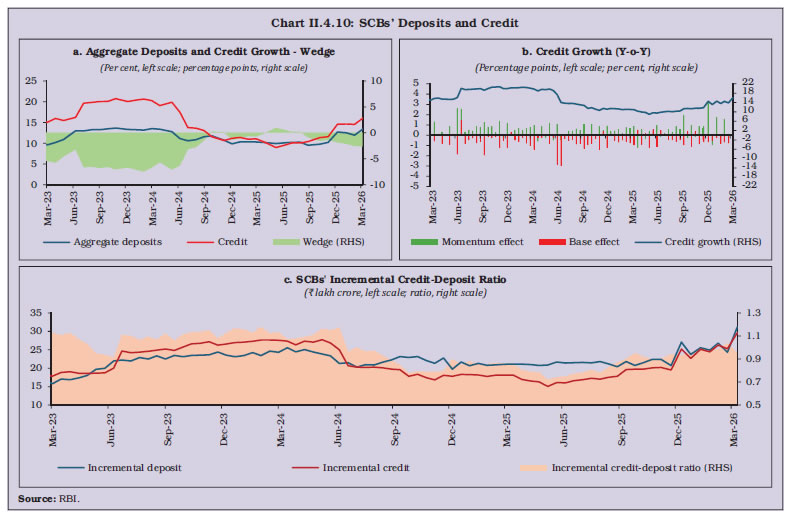 II.4.11 SCBs’ deposit growth broadly remained below that of credit growth during 2025-26. Although deposit growth showed some improvement in recent months, the wedge between deposit and credit growth persisted (Chart II.4.10). Consequently, the incremental credit-deposit ratio remained elevated. To bridge the funding gap, banks took recourse to sizeable issuances of certificates of deposit39. In this context of sustained funding pressures, the evolving dynamics between bank deposits and alternate savings instruments such as mutual funds have been examined (Box II.4.1). Box II.4.1
Bank Time Deposits and Mutual Fund Flows Dynamics — A Comparative Analysis Time deposits with banks and mutual funds serve as important channels for mobilising domestic savings for investment to support economic activity. While time deposits with banks are regarded as safe and capital-protected instruments, the debt mutual funds provide market-linked returns from fixed-income securities and the equity mutual funds may offer long-term capital gains with higher market risk. Recent evidence suggests that mutual funds have emerged as a major alternative investment avenue in India (Gupta et al., 2025). For instance, during 2020-21 to 2024-25, on an average, outstanding bank time deposits grew by 10.7 per cent, while the assets under management (AUM) of debt mutual funds increased by 5.3 per cent and the AUM of equity mutual funds expanded by 32.4 per cent (Chart 1). 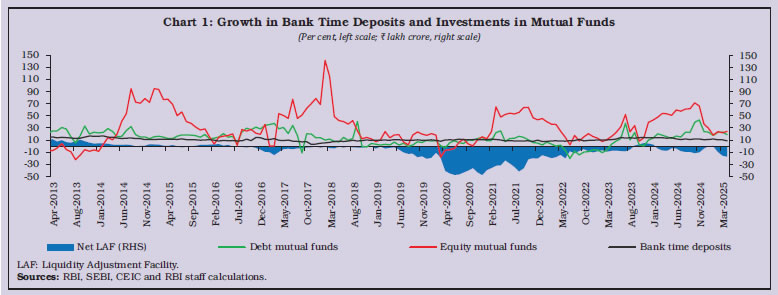 Against this backdrop, the question arises whether bank time deposits and mutual funds (debt and equity) instruments act as complements (substitutes) and what role the state of liquidity conditions plays in determining investor preferences. This question is examined for the sample period 2013-14 to 2024-25 using monthly data, applying empirical methodology akin to Im et al. (2025). Growth in debt and equity mutual funds AUM is explained by growth in outstanding bank time deposits, controlling for relative returns, and lags for growth in gold prices, BSE Sensex returns, 3-month treasury yields, India VIX (i.e., volatility index), growth in outstanding small savings, and growth in index of industrial production. The analysis indicates that bank time deposits and debt mutual funds act as complementary avenues in both surplus and deficit liquidity regimes. One plausible explanation for this complementarity is that within India’s bank-centric and evolving debt market, bank time deposits and debt mutual funds predominantly serve distinct investor segments. This structural segmentation minimises direct competition between the two instruments, fostering concurrent allocation rather than substitution. The analysis finds no statistically significant relationship between bank time deposits and equity mutual fund flows. References: 1. Gupta, M., Kumar, S., Borad, A., Seet, S. K. & Kedia, P. (2025), ‘Equity Mutual Funds: Transforming India’s Savings Landscape’, RBI Monthly Bulletin, August, 79(8), 81-94. 2. Im, J., Li, Y., & Wang, A. (2025), ‘What Drives the Substitution between Bank Deposits and Money Market Funds?’, FEDS Notes (November), Board of Governors of the Federal Reserve System. | II.4.12 Against the backdrop of deposit growth lagging credit expansion, the total flow of financial resources to the commercial sector increased to ₹47.0 lakh crore during 2025-26 from ₹36.2 lakh crore a year ago, supported by credit from both banks and non-bank sources (Appendix Table 5). The increase in flow from non-bank sources was mainly driven by corporate bond issuances and foreign direct investment to India. As on March 31, 2026, total outstanding credit to the commercial sector grew by 15.0 per cent (y-o-y), with non-bank sources registering a growth of 13.3 per cent (y-o-y). Conclusion II.4.13 During the year, the currency-GDP ratio increased with currency demand remaining at elevated levels. Amidst persistent wedge between deposit and credit growth, bank credit expanded in double digits and was largely broad-based, led by services and retail sectors. II.5 FINANCIAL MARKETS II.5.1 Global financial markets remained volatile in 2025-26 amidst concerns emanating from surging fiscal deficit, debt repayment, varied growth-inflation outcomes and trade tariff impositions. Notwithstanding global headwinds, Indian financial markets demonstrated resilience, with money market rates evolving in line with the policy repo rate and prevailing liquidity conditions. After declining in the first quarter, sovereign bond yields hardened amidst oversupply of state government securities, delay in signing of India- US trade deal, and surge in crude oil prices due to tensions in the Middle East. Corporate bond yields exhibited a hardening bias, accompanied by a broadening of spreads, amidst divergent corporate earnings performance. Indian equity markets remained volatile during the year, navigating global uncertainties while buoyed by stronger-than-expected gross domestic product (GDP) growth and supportive fiscal and monetary policies. The Indian Rupee (INR) traded with a depreciating bias amidst escalating geopolitical tensions and portfolio investment outflows. Money Market II.5.2 During 2025-26, money market rates moved in tandem with the policy repo rate and the evolving liquidity conditions. The weighted average call rate (WACR) moved in line with the repo rate, and its average spread over the repo rate was (-) 7 bps during 2025-26 as against 6 bps during 2024-25. Volatility in the WACR measured by coefficient of variation40 increased to 4.8 per cent in 2025-26 from 2.2 per cent in the previous year. II.5.3 During April to early July 2025, due to large surplus liquidity, the WACR hovered around the standing deposit facility (SDF) rate, floor of the policy corridor. Since mid-July 2025, following Reserve Bank’s absorption of liquidity through variable rate reverse repo (VRRR) auctions, the WACR increased and traded closer to the policy repo rate. However, the WACR moved near marginal standing facility (MSF) rate, ceiling of the policy corridor during mid-December 2025 to January 2026 amidst moderation in liquidity surplus. The WACR eased in February, while remaining elevated at end-March following the seasonal effect. The collateralised market segments – triparty repo and market repo – followed the WACR movements (Chart II.5.1a). II.5.4 For the longer tenor money market instruments, following the overnight trends, yields softened for 3-month treasury bills (T-bills), certificates of deposit (CDs) and commercial papers (CPs) during H1:2025-26. However, in H2, CD rates remained elevated owing to higher issuances by banks to meet funding requirements in the face of higher offtake in credit. CP rates also followed an upward trend in H2 (Chart II.5.1b). II.5.5 The average daily volume in the money market41 increased by 16 per cent to ₹6.4 lakh crore during 2025-26 from ₹5.5 lakh crore in the previous year. The quarterly volumes in the call money market mostly depicted an increasing trend since Q2, which could partly be attributed to the extension of market timings.42 II.5.6 Money market continued to be dominated by the collateralised segments in 2025-26, with the average share of triparty repo and market repo at around 67 per cent and 30 per cent, respectively. The share of call money market increased marginally to 3 per cent during the year (Chart II.5.2). II.5.7 In the longer-term segments, the average daily spread of CD rates and CP rates over T-bill rates trended downwards until September 2025, while they increased afterwards (Chart II.5.3). In the primary market, the CD issuances increased to ₹5.3 lakh crore in Q4:2025-26 from ₹2.3 lakh crore in Q1. Total CD issuances aggregated ₹13.5 lakh crore in 2025-26 as against total issuances of ₹11.9 lakh crore in the previous year. II.5.8 As the liquidity remained largely in surplus and interest rates favourable, new issuances of CPs depicted a steady trend during H1:2025-26. However, CP issuances declined in H2:2025-26, as higher rates led to a shift towards bank borrowings. Total issuances of CPs increased to ₹16.9 lakh crore during 2025-26 from ₹15.7 lakh crore in the previous year. Government Securities Market II.5.9 During Q1:2025-26, domestic G-sec yield curve steepened as short and medium-term yields traded with a softening bias while long-term yields traded range bound amid monetary policy easing and liquidity infusion measures undertaken by the Reserve Bank. Open market operation (OMO) purchase auctions for an aggregate amount of ₹2.39 lakh crore were conducted during the quarter. However, yields hardened after the monetary policy stance was changed to ‘neutral’ in June 2025, as further rate cut expectations faded (Chart II.5.4). II.5.10 G-sec yields hardened during Q2:2025-26 after a better-than-expected Q1:2025-26 GDP data amid fiscal concerns emanating from the implementation of higher US tariffs and GST rationalisation. However, the upside in yields was capped as oversupply related concerns ebbed after clarity emerged that revenue loss on account of goods and services tax (GST) rationalisation would be limited and government’s market borrowings for H2:2025-26 remained largely on expected lines. II.5.11 During Q3:2025-26, yields exhibited two-way movements as better-than-expected Q2:2025-26 GDP data and reduced expectations of further easing post 25-bps rate cut in the December 2025 monetary policy committee meeting43 provided an upward bias. However, the Reserve Bank’s liquidity injection measures helped ameliorate this upward pressure on yields. OMO purchases for an aggregate amount of ₹1.81 lakh crore were conducted during the quarter, of which ₹1.50 lakh crore were through auctions. II.5.12 During Q4:2025-26, yields traded with a hardening bias amidst higher-than-expected gross market borrowings announced in the Union Budget 2026-27 and a sharp increase in crude oil prices following the escalation of the Middle East conflict. On the final trading session of 2025-26, the 10-year generic G-sec yield crossed the 7 per cent mark for the first time since July 2024. OMO purchases for an aggregate amount of ₹4.57 lakh crore were conducted during the quarter, of which ₹3.5 lakh crore were through auctions. II.5.13 With the introduction of the fully accessible route (FAR)44 with effect from April 1, 2020, foreign portfolio investors (FPIs) have three channels of investment - the general route45; the voluntary retention route (VRR); and fully accessible route (FAR) [Table II.5.1]. In aggregate, FPIs invested ₹16.1 thousand crore in debt instruments in 2025-26. | Table II.5.1: FPI Investment in Debt Instruments (End-March) | | (Amount in ₹ thousand crore) | | Route/ Channel of Investment | 2024 | 2025 | 2026 | | Limit | FPI Holding* | Utilisation (per cent of Limit) | Limit | FPI Holding* | Utilisation (per cent of Limit) | Limit | FPI Holding* | Utilisation (per cent of Limit) | | 1 | 2 | 3 | 4 | 5 | 6 | 7 | 8 | 9 | 10 | | General Route^ | 1,172.6 | 187.1 | 16.0 | 1,295.3 | 187.2 | 14.5 | 1,470.7 | 186.6 | 12.7 | | VRR^ | 250.0 | 175.4 | 70.1 | 250.0 | 205.2 | 82.1 | 250.0 | 188.8 | 75.5 | | FAR# | 3,866.2 | 173.8 | 4.5 | 4,337.0 | 306.2 | 7.1 | 4,751.2 | 313.3 | 6.6 | ^: Includes central government securities (G-secs), state government securities (SGSs) and corporate bonds.
#: Available only for the specified securities included under the route.
*: For VRR, it indicates investment limit allotted to FPIs.
Sources: CCIL and NSDL. | Corporate Bond Market II.5.14 Although corporate bond yields declined during 2025-26, they exhibited a hardening bias (Table II.5.2). II.5.15 The spread on AAA-rated 3-year corporate bond yields over G-sec yields of corresponding maturity inched up during 2025-26 amidst mixed corporate earnings results. The average daily secondary market turnover in the corporate bond market increased to ₹7.1 thousand crore during 2025-26 from ₹6.2 thousand crore during the previous year (Chart II.5.5). | Table II.5.2: Corporate Bond Yields* | | (Per cent) | | Entity | March 2025 | March 2026 | Change (bps) | | 1 | 2 | 3 | 4 (=3-2) | | (i) PSUs, FIs and Banks | 7.48 | 7.33 | -15 | | (ii) NBFCs | 7.70 | 7.53 | -17 | | (iii) Corporates | 7.62 | 7.36 | -26 | *: AAA-rated 3-year bonds.
Note: Yields are computed as monthly averages.
Source: FIMMDA. | II.5.16 Primary issuances of listed corporate bonds on domestic stock exchanges declined to ₹9.1 lakh crore during 2025-26 from ₹9.9 lakh crore during the previous year, along with a moderation in mobilisation through overseas issuances. Private placements remained the preferred channel, accounting for 99 per cent of total resources mobilised through the domestic bond market. Investments by FPIs in corporate bonds increased during the year. However, the utilisation of the approved limits by FPIs decreased to 15.0 per cent as at end-March 2026 from 15.8 per cent a year ago on account of an increase in absolute limits. Equity Market II.5.17 In 2025-26, Indian equity market witnessed bi-directional movements. It increased in the first half of the year amidst supportive monetary and fiscal policy measures, while it declined in the second half as escalation in geopolitical tensions in the Middle East and artificial intelligence (AI) related concerns weighed on investor sentiment. Overall, the BSE Sensex declined by 7.1 per cent to close at 71,948 at end-March 2026 (Chart II.5.6). Resource mobilisation in the primary markets through public and rights issues, preferential allotments and qualified institutional placements (QIPs) remained strong. 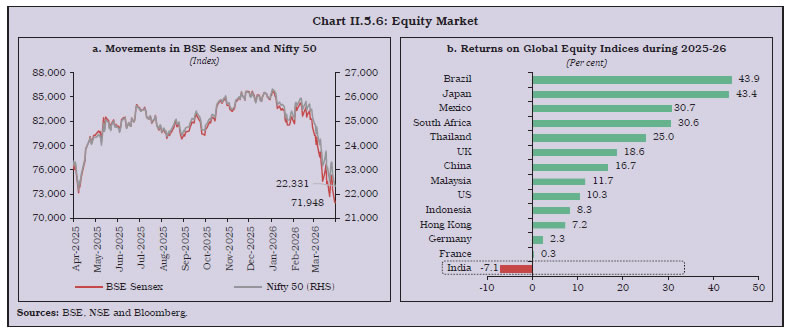 II.5.18 In Q1:2025-26, Indian equity markets witnessed two-way movements driven by unfavourable factors such as tariff announcements by the US, escalation of India-Pakistan conflict and geopolitical tensions in the Middle East, while investor sentiment was bolstered by a record surplus transfer by the Reserve Bank to the Government of India and the front loading of monetary policy easing by the Reserve Bank in June, among others. In Q2, markets declined as negative cues from elevated tariff uncertainty and hike in H1B visa fees by the US outweighed improved investor sentiment surrounding India’s sovereign rating upgrade by a major global credit rating agency, the announcement of GST reforms and the release of strong macroeconomic data. In Q3, markets gained amidst optimism surrounding corporate earnings results for Q2 and positive global cues from policy rate cut by the US Federal Reserve and increasing investments in technology including AI. Markets declined in Q4 as renewed tariff uncertainties, escalation in geopolitical tensions in the Middle East and persistent AI related concerns outweighed improved sentiment surrounding announcement of India-EU trade deal, and higher GDP growth projections for 2025-26 and Q1 and Q2 of 2026-27 in the monetary policy statements. II.5.19 Overall, BSE 150 Midcap decreased marginally by 1.0 per cent while BSE 250 SmallCap decreased by 6.5 per cent in 2025-26. Performance of sectoral indices was mixed during this period (Chart II.5.7a). FPIs made net sales of ₹2.7 lakh crore in the domestic equity market during 2025-26 as against net sales of ₹2.6 lakh crore during the previous year. Domestic institutional investors (DIIs) made net purchases of ₹8.5 lakh crore in 2025-26 as against ₹6.1 lakh crore during the previous year (Chart II.5.7b). Primary Market Resource Mobilisation II.5.20 In the primary segment of the equity market, resource mobilisation through QIPs and preferential allotments stood at ₹2.2 lakh crore during 2025-26, same as the previous year. Resource mobilisation through initial public offers (IPOs), follow-on public offers (FPOs) and rights issues increased to ₹2.3 lakh crore during 2025-26 from ₹2.1 lakh crore during the previous year (Chart II.5.8a). FPIs were net purchasers in the primary market during the year. Average monthly contribution to mutual funds through the systematic investment plan (SIP) route increased to ₹29.1 thousand crore in 2025-26 from ₹24.1 thousand crore during the previous year (Chart II.5.8b).
Foreign Exchange Market II.5.21 The INR traded with a depreciating bias during 2025-26 and closed lower by 9.9 per cent. During H1:2025-26, INR gained initially amidst softening in the US dollar index and suspension of reciprocal tariffs by the US, touching the year’s high of ₹83.75 per USD on May 2, 2025. It, however, came under pressure later amidst flaring up of border tensions, tariff related concerns and FPI outflows in the equity segment. The INR closed H1 at ₹88.79 per USD, lower by 3.8 per cent (Chart II.5.9). II.5.22 During H2:2025-26, after trading range bound initially, the INR came under pressure later amidst multiple headwinds including continued trade related uncertainties and widening merchandise trade deficit among others. INR pared some of its losses amid positive developments on the trade front during February. However, it witnessed a renewed bout of pressure in March amid worsening risk sentiments due to the outbreak of conflict in the Middle East and consequent surge in crude oil prices. FPI outflows and strengthening in the dollar index also weighed on the INR. For H2:2025-26, the INR closed lower by 6.4 per cent at ₹94.83 per USD. 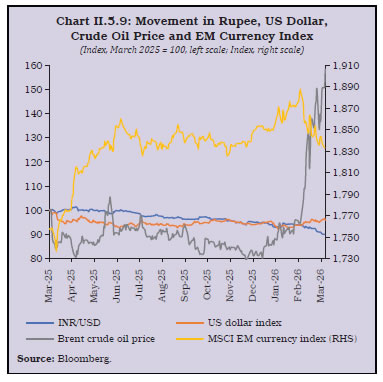 II.5.23 During 2025-26, the forward premia traded range bound till November 2025 largely tracking interest rate differential. However, they rose during December 2025 and remained elevated thereafter amid escalation in geopolitical tensions. The 40-currency nominal effective exchange rate (NEER) and real effective exchange rate (REER) depreciated (y-o-y) by 6.9 per cent and 7.5 per cent, respectively, during 2025-26. Conclusion II.5.24 During 2025-26, Indian financial markets demonstrated resilience and orderly movements despite volatility in global financial markets. Overnight money market rates largely remained aligned with the policy repo rate and the evolving liquidity conditions. G-sec yields softened during Q1 but later hardened amid fiscal concerns, rising crude oil prices and lower expectations of further easing post-December 2025 rate cut. The INR witnessed depreciating bias in the latter half of the year due to trade related uncertainty and portfolio equity outflows. Indian equity markets are expected to be driven by evolving geopolitical developments, global financial market volatitlity and foreign portfolio investment flows. II.6 GOVERNMENT FINANCES II.6.1 The Union Government reaffirmed its commitment to fiscal discipline by reducing the gross fiscal deficit (GFD)46 to below 4.5 per cent of GDP in 2025-26 (RE), as announced in the Union Budget for 2021-22, and setting it at 4.3 per cent in 2026-27(BE). The Centre’s debt-to-GDP ratio is budgeted to decline to 55.6 per cent in 2026-27 from 56.1 per cent in 2025-26 (RE). | Table II.6.1: Central Government’s Fiscal Performance | | (Amount in ₹ lakh crore) | | Item | 2021-22 | 2022-23 | 2023-24 | 2024-25 | 2025-26 (RE) | 2026-27 (BE) | | 1 | 2 | 3 | 4 | 5 | 6 | 7 | | I. Non-Debt Total Receipts | 22.1 | 24.6 | 27.9 | 30.8 | 34.1 | 36.5 | | | (9.4) | (9.1) | (9.3) | (9.3) | (9.5) | (9.3) | | II. Gross Tax Revenue | 27.1 | 30.5 | 34.7 | 38.0 | 40.8 | 44.0 | | | (11.5) | (11.4) | (11.5) | (11.5) | (11.4) | (11.2) | | (a) Direct Tax | 14.1 | 16.6 | 19.6 | 22.2 | 24.2 | 27.0 | | | (6.0) | (6.2) | (6.5) | (6.7) | (6.8) | (6.9) | | (b) Indirect Tax | 13.0 | 13.9 | 15.1 | 15.7 | 16.6 | 17.1 | | | (5.5) | (5.2) | (5.0) | (4.8) | (4.6) | (4.3) | | III. Net Tax Revenue | 18.0 | 21.0 | 23.3 | 25.0 | 26.7 | 28.7 | | | (7.6) | (7.8) | (7.7) | (7.6) | (7.5) | (7.3) | | IV. Non-Tax Revenue | 3.7 | 2.9 | 4.0 | 5.4 | 6.7 | 6.7 | | | (1.5) | (1.1) | (1.3) | (1.6) | (1.9) | (1.7) | | V. Non-Debt Capital Receipts | 0.4 | 0.7 | 0.6 | 0.4 | 0.6 | 1.2 | | | (0.2) | (0.3) | (0.2) | (0.1) | (0.2) | (0.3) | | VI. Total Expenditure | 37.9 | 41.9 | 44.4 | 46.5 | 49.6 | 53.5 | | | (16.1) | (15.6) | (14.8) | (14.1) | (13.9) | (13.6) | | VII. Revenue Expenditure | 32.0 | 34.5 | 34.9 | 36.0 | 38.7 | 41.3 | | | (13.6) | (12.8) | (11.6) | (10.9) | (10.8) | (10.5) | | VIII. Capital Expenditure | 5.9 | 7.4 | 9.5 | 10.5 | 11.0 | 12.2 | | | (2.5) | (2.8) | (3.2) | (3.2) | (3.1) | (3.1) | | IX. Revenue Deficit | 10.3 | 10.7 | 7.7 | 5.6 | 5.3 | 5.9 | | | (4.4) | (4.0) | (2.5) | (1.7) | (1.5) | (1.5) | | X. Gross Fiscal Deficit | 15.8 | 17.4 | 16.5 | 15.7 | 15.6 | 17.0 | | | (6.7) | (6.5) | (5.5) | (4.8) | (4.4) | (4.3) | BE: Budget Estimates. RE: Revised Estimates.
Note: Figures in parentheses are as per cent of GDP.
Source: Union Budget documents. | Central Government Finances in 2025-26 II.6.2 The Central Government contained its GFD at 4.4 per cent of GDP in 2025-26 (RE), lower than 4.8 per cent in 2024-25. During 2025-26, the fiscal consolidation was attributable to higher-than-budgeted non-tax revenue and rationalisation of expenditure (Table II.6.1 and Chart II.6.1). II.6.3 Revenue expenditure rose by 7.4 per cent in 2025-26 (RE) over 2024-25, primarily driven by elevated interest payments and major subsidies. The expenditure on major subsidies exceeded its budgeted amount by ₹46,327 crore, mainly attributable to higher food and fertiliser subsidies. II.6.4 Capital expenditure in 2025-26 (RE) remained at 3.1 per cent of GDP, in line with the budget estimates, despite undershooting by ₹25,335 crore. Effective capital expenditure remained broadly unchanged in 2025-26 (RE) [3.9 per cent of GDP] as in 2024-25 (4.0 per cent of GDP). II.6.5 In 2025-26 (RE), gross tax revenue expanded by 7.4 per cent, largely driven by accelerated growth in revenue from corporation tax, and double-digit growth in excise duty and customs. It stood at 11.4 per cent of GDP, broadly in line with 2024-25 (Chart II.6.2). II.6.6 Net tax revenue increased by 7.0 per cent in 2025-26 (RE). Non-tax revenue recorded robust growth of 24.4 per cent in 2025-26 (RE), exceeding its budget estimates by ₹84,662 crore. Non-debt capital receipts recovered strongly in 2025-26 (RE) [growth of 53.1 per cent], after contracting in 2024-25. Overall, total non-debt receipts grew by 10.7 per cent in 2025-26 (RE). Central Government Finances in 2026-27 II.6.7 The Central Government has been consistently reducing the GFD as per cent of GDP since it reached its peak in 2020-21 (9.2 per cent of GDP) [Table II.6.1 and Appendix Table 6]. With GFD for 2026-27 budgeted at 4.3 per cent of GDP, the fiscal consolidation witnessed in the post-pandemic period is expected to continue. II.6.8 Capital expenditure is budgeted to grow by 11.5 per cent in 2026-27. Revenue expenditure to capital outlay (RECO) ratio and revenue deficit, as per cent of GFD, broadly exhibited a declining trend in recent years, indicating an improvement in quality of public expenditure (Chart II.6.3). II.6.9 Gross tax revenue is budgeted to decline marginally to 11.2 per cent of GDP in 2026-27. Indirect taxes are budgeted lower at 4.3 per cent of GDP in 2026-27, partly due to discontinuation of GST compensation cess (Chart II.6.4). II.6.10 Gross market borrowings for 2026-27 are budgeted at ₹17.2 lakh crore, higher than ₹14.6 lakh crore in 2025-26 (RE). Net market borrowings stand at ₹11.7 lakh crore (3.0 per cent of GDP) for 2026-27 (BE) [Chart II.6.5a]. Market borrowings, and small savings continue to be the major sources of financing GFD (Chart II.6.5b). State Finances in 2025-26 II.6.11 For 2025-26, states had budgeted a GFD of 3.3 per cent of GDP (Table II.6.2). As per provisional accounts data of 22 states, during April-February 2025-26, states’ GFD as a share of the budget estimates rose to 77.1 per cent from 64.3 per cent a year ago. This uptick reflects subdued revenue performance, driven primarily by a slowdown in states’ GST (SGST) collection and contraction in grants from the Centre. Revenue expenditure grew at a slower pace than a year ago, while capital expenditure recorded strong growth during the same period. 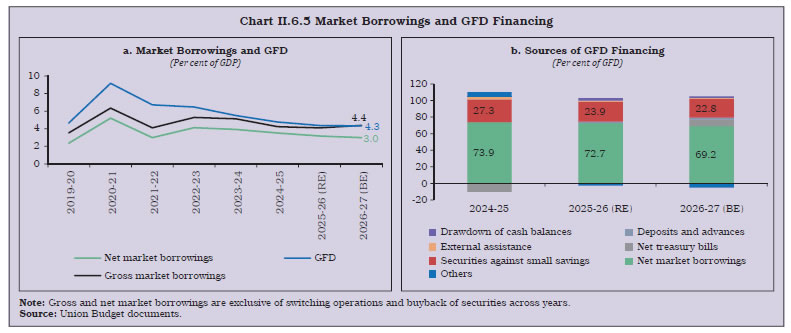
| Table II.6.2: Fiscal Position of States/UTs | | (Amount in ₹ lakh crore) | | Item | 2021-22 | 2022-23 | 2023-24 | 2024-25 (RE) | 2025-26 (BE) | | 1 | 2 | 3 | 4 | 5 | 6 | | I. Non-debt Receipts | 32.5 | 36.6 | 39.5 | 46.0 | 51.8 | | | (13.8) | (13.6) | (13.1) | (14.0) | (14.5) | | II. Revenue Receipts | 32.3 | 36.5 | 39.3 | 45.8 | 51.3 | | | (13.7) | (13.6) | (13.0) | (13.9) | (14.4) | | III. Non-debt Capital Receipts | 0.2 | 0.1 | 0.2 | 0.2 | 0.5 | | | (0.1) | (0.04) | (0.1) | (0.1) | (0.1) | | IV. Revenue Expenditure | 33.3 | 37.1 | 40.2 | 47.7 | 52.1 | | | (14.1) | (13.8) | (13.4) | (14.4) | (14.6) | | V. Capital Expenditure | 5.8 | 6.7 | 8.1 | 9.9 | 11.4 | | | (2.4) | (2.5) | (2.7) | (3.0) | (3.2) | | a. Capital Outlay | 5.3 | 6.0 | 7.5 | 9.1 | 10.6 | | | (2.3) | (2.2) | (2.5) | (2.7) | (3.0) | | b. Loans and Advances by States | 0.4 | 0.7 | 0.6 | 0.8 | 0.8 | | | (0.2) | (0.3) | (0.2) | (0.3) | (0.2) | | VI. Total Expenditure | 39.1 | 43.8 | 48.3 | 57.7 | 63.6 | | | (16.5) | (16.3) | (16.0) | (17.4) | (17.8) | | VII. Fiscal Deficit | 6.5 | 7.2 | 8.8 | 11.6 | 11.8 | | | (2.8) | (2.7) | (2.9) | (3.5) | (3.3) | | VIII. Revenue Deficit | 1.0 | 0.6 | 0.9 | 1.9 | 0.8 | | | (0.4) | (0.2) | (0.3) | (0.6) | (0.2) | | IX. Primary Deficit | 2.3 | 2.6 | 3.7 | 6.0 | 5.5 | | | (1.0) | (1.0) | (1.2) | (1.8) | (1.5) | BE: Budget Estimates. RE: Revised Estimates.
Note: Figures in parentheses are per cent of GDP.
Source: Budget documents of State governments. | State Finances in 2026-27 II.6.12 As per information available for 24 states/ UTs for 2026-27, their consolidated GFD-GSDP ratio is budgeted at 3.0 per cent (Table II.6.3). The gross transfers to states have been budgeted to increase by 12.2 per cent in 2026-27 (BE), largely on account of transfers under centrally sponsored schemes and special assistance to states for capital investment. The scheme of 50- year interest free loans for capital expenditure to states would be continued in 2026-27, with total outlay of ₹2 lakh crore - an increase of 33.3 per cent over 2025-26 (RE) levels. | Table II.6.3: State Government Finances 2026-27*: Key Deficit Indicators | | (Per cent of GSDP) | | Item | 2024-25 | 2025-26 (RE) | 2026-27 (BE) | | 1 | 2 | 3 | 4 | | Revenue Deficit | 0.3 | 0.4 | -0.1 | | Gross Fiscal Deficit | 3.0 | 3.5 | 3.0 | | Primary Deficit | 1.5 | 1.9 | 1.4 | *: Data pertain to 24 states that have presented their final budgets for 2026-27.
Note: Negative in deficit indicators denote surplus.
Source: Budget documents of state governments. | II.6.13 The Sixteenth Finance Commission (FC-XVI) report for 2026-27 to 2030-31 has ensured continuity in Centre-State fiscal relations while reinforcing incentives for performance and fiscal discipline. It retains states’ share at 41 per cent in the divisible tax pool. II.6.14 The FC-XVI has moderately rebalanced the horizontal devolution formula while preserving its equity-focused core (Table II.6.4). Greater emphasis has been placed on population, while the weights assigned to area, income distance and demographic performance have been trimmed. While the weight assigned to forest cover has been retained, the tax effort criterion has been removed. The Commission has introduced a new criterion, states’ contribution to GDP with a weight of 10 per cent, reflecting India’s growth ambitions and the need to recognise states’ role in driving national economic performance. | Table II.6.4: Horizontal Devolution Criteria | | (Per cent to total) | | Dimension | Criteria | FC -XIII | FC -XIV | FC -XV | FC-XVI | | (2010-11 to 2014-15) | (2015-16 to 2019-20) | (2020-21 to 2025-26) | (2026-27 to 2030-31) | | 1 | 2 | 3 | 4 | 5 | 6 | | | Population | 25 | 27.5 | 15 | 17.5 | | Need and Cost Disability | Area | 10 | 15 | 15 | 10 | | | Forest Cover | - | 7.5 | 10 | 10 | | | Income Distance/Per Capita GSDP Distance | - | 50 | 45 | 42.5 | | Equity | | Fiscal Capacity | 47.5 | - | - | - | | | Tax effort | - | - | 2.5 | - | | | Fiscal Discipline | 17.5 | - | - | - | | Performance | | Demographic Performance | - | - | 12.5 | 10 | | | Contribution to GDP | - | - | - | 10 | -: Not applicable.
Note: For FC-XIII, the population criterion was based on 1971 census data. For FC-XIV, 17.5 per cent weight was assigned to 1971 census data and 10 per cent weight to 2011 census data. From FC-XV onwards, the population criterion is based on 2011 census data.
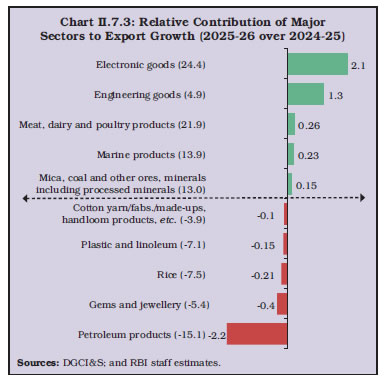
Source: Finance Commission Reports. | II.6.15 Post-devolution, revenue deficit grants have been discontinued to promote fiscal discipline and sustainable state budgets The Commission concluded that existing revenue deficits largely reflect gaps in revenue mobilisation and expenditure management. It, therefore, emphasised that continued gap-filling transfers weaken fiscal adjustment incentives, as expectations of central support can dilute efforts to enhance own revenues and rationalise spending. General Government Finances II.6.16 The general government’s GFD moderated from 7.8 per cent of GDP in 2024-25 (RE) to 7.2 per cent in 2025-26 (BE). The debt-to-GDP ratio is budgeted for a marginal uptick to 81.9 per cent in 2025-26 (BE), partly attributable to higher states liabilities. External liabilities remain low at 2.5 per cent of GDP in 2025-26 (BE), implying limited exchange rate risk (Chart II.6.6a). II.6.17 The general government’s reduction in GFD was supported by increase in tax revenues at 19.1 per cent of GDP in 2025-26 (BE) from 18.4 per cent in the previous year. However, ratio of total expenditure to GDP remained the same at 29.6 per cent in both years. Capital expenditure is budgeted higher at 5.8 per cent of GDP in 2025-26 (BE) [5.6 per cent in 2024-25] (Chart II.6.6b). Conclusion II.6.18 The Union Budget 2026-27 continued with the post-pandemic fiscal consolidation path, which augurs well for medium-term growth. The GFD is budgeted at 4.3 per cent of GDP in 2026-27, down from 4.4 per cent of GDP in 2025-26 (RE). Notably, the thrust on capital expenditure is maintained, which is budgeted to grow at 11.5 per cent in 2026-27. The Sixteenth Finance Commission has ensured continuity in Centre-State fiscal relations with a renewed emphasis on performance-linked incentives and long-term fiscal responsibility. II.7 EXTERNAL SECTOR II.7.1 Amidst heightened global policy uncertainty and geopolitical tensions, India’s external sector remained broadly resilient due to efforts towards diversification of exports, a sustained surplus in services trade and steady inward remittances. With net capital flows falling short of current account deficit (CAD), foreign exchange reserves declined on a balance of payments (BoP) basis during April-December 2025. Global Economic Conditions II.7.2 Global GDP growth increased marginally to 3.4 per cent in 2025 (Chart II.7.1a). Global inflation eased, thus prompting major central banks to cut policy rates. With contained inflationary pressures and stable demand, global trade volume (goods and services) rose by 5.1 per cent in 2025 (3.6 per cent in 2024) [Chart II.7.1b]. In 2026, however, with the ongoing West Asia conflict, global GDP growth is expected to weaken to 3.1 per cent48. The conflict-led disruptions in critical trade routes and the continuing global trade policy uncertainties have clouded the outlook for global merchandise trade going forward. A slower growth in transportation and travel segments under services trade is also expected. Consequently, global trade volume growth could decline in 2026. 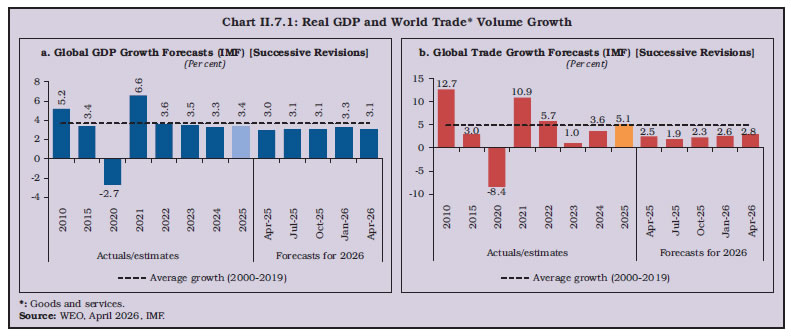 II.7.3 Emerging market economies (EMEs) recorded robust net portfolio inflows during 2025-26, supported by the debt segment. Net outflows were recorded in the equity segment owing to persistent global uncertainty exacerbated by conflict in West Asia (Chart II.7.2a). Global foreign direct investment (FDI) rose in 2025, with net inflows to developed economies increasing by 43 per cent, driven by Europe and financial hubs49 (Chart II.7.2b). In contrast, net FDI inflows to developing economies declined by 2 per cent in 2025. Merchandise Trade II.7.4 Despite tariff related uncertainty, India’s merchandise exports and imports (in value terms) expanded at higher pace in 2025-26 than in 2024-25 (Table II.7.1). II.7.5 The expansion in merchandise exports in 2025-26 was led by growth in electronic goods; engineering goods; meat, dairy and poultry products; marine products; and mica, coal and other ores, minerals including processed minerals while petroleum products; gems and jewellery; rice; plastic and linoleum; and cotton and handloom products witnessed a contraction (Chart II.7.3). | Table II.7.1: India’s Merchandise Trade | | | Value in US$ Billion | Growth Rate (Y-o-Y, per cent) | | 2022-23 | 2023-24 | 2024-25 | 2025- 26 | 2022- 23 | 2023- 24 | 2024- 25 | 2025- 26 | | 1 | 2 | 3 | 4 | 5 | 6 | 7 | 8 | 9 | | Exports | | Q1 | 121.0 | 103.9 | 114.0 | 111.6 | 26.6 | -14.1 | 9.8 | -2.2 | | Q2 | 110.7 | 107.2 | 99.6 | 107.9 | 7.8 | -3.2 | -7.0 | 8.3 | | Q3 | 104.6 | 105.6 | 108.7 | 110.2 | -2.1 | 1.0 | 3.0 | 1.4 | | Q4 | 114.8 | 120.4 | 115.3 | 112.0 | -1.9 | 4.9 | -4.3 | -2.8 | | Annual | 451.1 | 437.1 | 437.7 | 441.7 | 6.9 | -3.1 | 0.1 | 0.9 | | Imports | | Q1 | 183.5 | 159.7 | 172.2 | 180.3 | 44.5 | -13.0 | 7.8 | 4.7 | | Q2 | 189.0 | 169.4 | 186.7 | 196.0 | 28.1 | -10.4 | 10.2 | 5.0 | | Q3 | 176.1 | 174.7 | 187.5 | 204.2 | 5.4 | -0.8 | 7.3 | 8.9 | | Q4 | 167.3 | 170.2 | 173.9 | 194.5 | -2.5 | 1.7 | 2.2 | 11.9 | | Annual | 716.0 | 674.0 | 720.2 | 775.0 | 16.8 | -5.9 | 6.9 | 7.6 | | Trade Balance | | Q1 | -62.6 | -55.8 | -58.1 | -68.7 | | | | | | Q2 | -78.3 | -62.2 | -87.1 | -88.0 | | | | | | Q3 | -71.5 | -69.1 | -78.7 | -94.0 | | | | | | Q4 | -52.6 | -49.7 | -58.6 | -82.5 | | | | | | Annual | -264.9 | -236.9 | -282.5 | -333.2 | | | | | Note: Quarterly figures may not add up to annual figures due to rounding off of numbers.
Source: DGCI&S. |
 II.7.6 Among India’s top export commodities, exports of electronic goods recorded fastest growth, though lower than last year. This growth was largely driven by exports of mobile phones, which constitute around 61 per cent of electronic goods exports and were exempted from the tariffs imposed by the US (Chart II.7.4). II.7.7 Growth in India’s merchandise exports to the US moderated during 2025-26 due to the heightened tariffs. The positive growth in exports to the US during April-August 2025 was driven by front-loading in anticipation of higher tariffs, along with rise in exports in the sectors exempted from the tariffs imposed by the US. Thereafter, barring November 2025, exports to the US witnessed contraction since September 2025. In a major trade reconfiguration, China became the largest trading partner of India overtaking the US in 2025-26. II.7.8 The expansion in merchandise imports in 2025-26 was led by electronic goods, gold, and machinery, electrical and non-electrical. Petroleum, crude and products; coal, coke and briquettes; pulses; iron and steel; and organic and inorganic chemicals contributed negatively to import growth (Chart II.7.5). II.7.9 Despite an increase in the volume, the value of petroleum, oil and lubricants imports (22.4 per cent of total merchandise imports during 2025-26) declined in 2025-26 due to contraction in oil prices (Chart II.7.6a). The share of Russia and Iraq in India’s crude oil imports declined during the year, while that of Saudi Arabia, the UAE and the US increased (Chart II.7.6b). II.7.10 Value of gold imports increased in 2025- 26, with the effect of contraction in gold import volume offset by higher international prices (Chart II.7.7). II.7.11 Merchandise trade deficit widened in 2025- 26, with oil deficit remaining the largest contributor (Chart II.7.8a). Among the major trading partners, trade deficit with China and Switzerland widened, while trade surplus improved with respect to Spain in 2025-26 (Chart II.7.8b).
II.7.12 As of April 2026, India has signed 24 trade agreements. Accelerating the trade diversification efforts with new trade alliances, India signed a Comprehensive Economic and Trade Agreement (CETA) with the United Kingdom on July 24, 2025, Comprehensive Economic and Partnership Agreement (CEPA) with Oman on December 18, 2025 and India- New Zealand Free Trade Agreement (FTA) on April 27, 2026. These agreements are yet to be enforced. The FTA negotiations with the European Union were also concluded on January 27, 2026. Invisibles II.7.13 Receipts from India’s trade in invisibles - consisting of cross-border transactions in services, income, and transfers - remained buoyant during 2025-26 (up to December 2025). Net services exports grew strongly by 15.3 per cent (y-o-y) during April-December 2025, driven by software and business services (accounting for 77.8 per cent of services exports) [Chart II.7.9]. Amongst other key services, transportation receipts contracted by 7.3 per cent (y-o-y), largely due to a decline in sea freight50. Travel services exports also contracted, reflecting a fall in foreign tourist arrivals during the period. Going forward, robust global IT spending, as projected by Gartner51, bodes well for India’s software services exports. 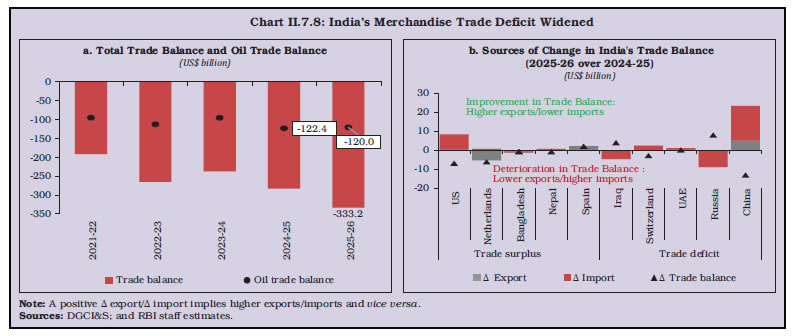
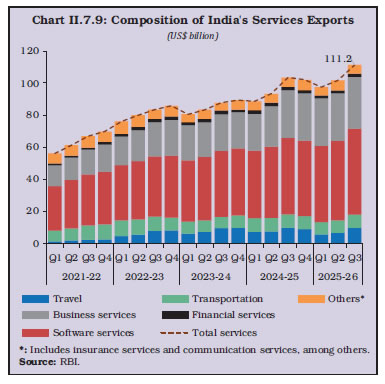 II.7.14 Private transfer receipts, mainly representing remittances by Indians working overseas, posted a robust growth of 10.1 per cent (y-o-y) during April-December 2025 (16.2 per cent during April-December 2024). The average cost of sending US$ 200 as remittance to India stood at 5.3 per cent in Q3:2025, same as a year ago, below the global average cost of 6.4 per cent, but still above the sustainable development goal (SDG) target of 3 per cent by 2030. II.7.15 Net outgo in the primary income account52 stood at US$ 37.2 billion during April-December 2025, higher than US$ 36.5 billion during April- December 2024. This reflects the rise in payment of dividends and reinvested earnings owing to inward FDI during the same period. II.7.16 The buoyancy in net services receipts and workers’ remittances largely offset the expansion in merchandise trade deficit, thus containing CAD at US$ 30.2 billion (1.1 per cent of GDP) during April-December 2025 as compared with US$ 36.7 billion (1.3 per cent of GDP) during the corresponding period a year ago (Chart II.7.10). External Financing II.7.17 The global environment for international investment remained challenging. Against this backdrop, net capital flows during April-December 2025 moderated (y-o-y) and fell short of CAD, leading to a depletion of foreign exchange reserves by US$ 30.8 billion on a BoP basis (excluding valuation effects) during the period (Chart II.7.11 and Appendix Table 7).
II.7.18 Within capital flows, FDI stood higher, both on gross and net basis, during 2025-26 (Table II.7.2). Globally, India ranked second in terms of greenfield FDI announcements during 2025-26, after the US, according to fDi Markets53. II.7.19 Services sector accounted for the major share of FDI equity flows into India during 2025- 26, followed by manufacturing.54 Major source countries, viz., Singapore, the US, Mauritius, Japan, the Netherlands and the UAE contributed about four-fifths of the flows. Outward FDI by India also increased during this period, with Singapore, the US, the UAE and Mauritius being the major destinations. Financial, insurance and business services; manufacturing; and wholesale/retail trade, restaurants and hotels were the main sectors for India’s outward FDI. II.7.20 During 2025-26, foreign portfolio investment (FPI) registered net outflows of US$ 16.5 billion driven by the equity segment (Table II.7.2). In March 2026 alone, net FPI outflows were to the tune of US$ 13.1 billion, triggered by the outbreak of the West Asia conflict on February 28, 2026. The debt segment witnessed modest inflows in 2025-26 of US$ 2.1 billion, reflecting preference for safer assets amidst uncertain global environment. Equity sell-offs were largely contributed by information technology, financial services and fast-moving consumer goods sectors. Inflows were primarily recorded in capital goods, metals and mining, and telecommunication sectors. | Table II.7.2: Capital Flows | | (US$ billion) | | Item | 2022-23 | 2023-24 | 2024-25 | 2025-26 | | 1 | 2 | 3 | 4 | 5 | | 1. Net FDI (1.1 - 1.2) | 28.0 | 10.2 | 1.0 | 7.7 | | 1.1 Net Inward FDI (1.1.1 - 1.1.2) | 42.0 | 26.8 | 29.1 | 40.9 | | 1.1.1 Gross Inflows | 71.4 | 71.3 | 80.6 | 94.5 | | 1.1.2 Repatriation/Disinvestment | 29.3 | 44.5 | 51.5 | 53.6 | | 1.2 Net Outward FDI | 14.0 | 16.7 | 28.2 | 33.3 | | 2. Net FPI to India | -4.8 | 44.6 | 3.3 | -16.5 | | 3. Net ECB to India | -4.1 | 3.5 | 18.5 | 12.0 | | 4. Non-Resident Deposits | 9.0 | 14.7 | 16.2 | 14.4 | | 4.1 Non-Resident External (Rupee) Account | 2.5 | 4.2 | 4.7 | 7.9 | | 4.2 Non-Resident Ordinary Account | 4.0 | 4.2 | 4.4 | 5.5 | | 4.3 Foreign Currency Non-Resident (B) Account | 2.4 | 6.4 | 7.1 | 0.9 | Note: Data for net FPI to India in column 5 is sourced from NSDL. FPI data for previous financial years are based on BoP.
Sources: RBI; and NSDL. |
| Table II.7.3: External Vulnerability Indicators (End-March) | | (Per cent, unless indicated otherwise) | | Indicator | 2013 | 2023 | 2024 | 2025 | End-Dec 2025 | | 1 | 2 | 3 | 4 | 5 | 6 | | 1. External Debt to GDP Ratio# | 22.4 | 19.6 | 19.2 | 19.8 | 20.4 | | 2. Ratio of Short-term Debt (Original Maturity) to Total Debt | 23.6 | 20.6 | 19.1 | 18.3 | 19.7 | | 3. Ratio of Short-term Debt (Residual Maturity) to Total Debt | 42.1 | 44.0 | 43.4 | 41.2 | 43.2 | | 4. Ratio of Concessional Debt to Total Debt | 11.1 | 8.2 | 7.4 | 6.9 | 7.0 | | 5. Ratio of Reserves to Total Debt | 71.3 | 92.7 | 96.6 | 90.8 | 89.8 | | 6. Ratio of Short-term Debt (Original Maturity) to Reserves | 33.1 | 22.2 | 19.7 | 20.1 | 21.9 | | 7. Ratio of Short-term Debt (Residual Maturity) to Reserves | 59.0 | 47.4 | 44.9 | 45.4 | 48.1 | | 8. Reserve Cover of Imports (in Months)* | 7.0 | 9.6 | 11.3 | 11.0 | 10.8 | | 9. Debt Service Ratio (Debt Service to Current Receipts)@ | 5.9 | 5.3 | 6.7 | 6.6 | 5.8 | | 10. External Debt (US$ billion) | 409.4 | 623.9 | 668.9 | 736.4 | 765.5 | | 11. Net International Investment Position (NIIP) [US$ billion] | -326.7 | -367.0 | -361.3 | -329.1 | -260.5 | | 12. NIIP/GDP Ratio | -17.8 | -11.6 | -10.5 | -9.0 | -7.1 | | 13. CAB/GDP Ratio@ | -4.8 | -2.1 | -0.7 | -0.6 | -1.1 | #: Ratios from 2023 onwards are based on new series of GDP estimates with base year 2022-23.
*: Based on merchandise imports of latest four quarters, published in BoP statistics.
@: Figures corresponding to column 6 pertains to April-December 2025.
Sources: RBI and Government of India. | II.7.21 During 2025-26, net ECB inflows to India moderated from a year ago. Besides on-lending/ sub-lending, ECBs were used for refinancing of earlier ECBs, import of capital goods and new projects. Net inflows under non-resident deposits also moderated during 2025-26 from a year ago, due to a decline in net inflows under FCNR(B) deposits. Key Vulnerability Indicators II.7.22 India’s key external sector vulnerability indicators, such as the external debt to GDP ratio, debt service ratio and net IIP to GDP ratio, remained contained at end-December 2025 (Table II.7.3). Robust foreign exchange reserves provided a strong buffer for mitigating external risks and spillovers. Reserves provided a cover of around 11 months of merchandise imports55 (on BoP basis), while reserves to total external debt stood at around 90 per cent at end-December 2025. Conclusion II.7.23 Despite a widening merchandise trade deficit, India’s external sector vulnerability remained low during 2025-26, supported by sustained growth in services exports and private transfer receipts. Although net capital flows fell short of external financing requirements with portfolio flows exhibiting net outflows, strong buffers in the form of ample foreign exchange reserves and modest external debt liabilities continued to impart strength to the external sector, contributing to overall macroeconomic and financial stability.
Index |