Contents Foreword The half-yearly Payment Systems Report for December 2025 presents a comprehensive and forward-looking overview of the evolving landscape of payment systems in India. Over the years, India’s digital payments ecosystem has witnessed remarkable growth — fueled by widespread accessibility, surging user adoption, and continuous strengthening of acceptance infrastructure across urban and rural geographies. Innovations in fintech, regulatory support, and public-private collaboration have accelerated the transition toward a less cash economy, positioning India as a global leader in digital financial inclusion. The Payment Systems Reports are designed to serve as a reference for policymakers, industry stakeholders, and researchers, providing a comprehensive analysis of payment system statistics, regulatory developments, and emerging technological advancements shaping India’s payment ecosystem. Aligned with the strategic framework of Payments Vision 2028, the Reserve Bank of India remains steadfast in its commitment to advancing an efficient, resilient, and inclusive payment infrastructure that propels economic growth and accelerates the nation’s digital transformation journey. Sd/- Vivek Deep
Executive Director May 18, 2026
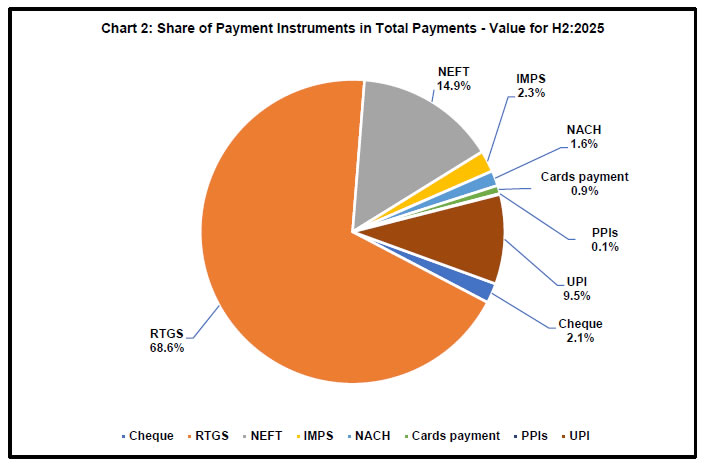
1. Introduction 1.1 A robust, adaptive, and inclusive payment infrastructure delivering secure, affordable, and user-centric payment instruments across segments not only serves as an engine for economic advancement but also supports financial inclusion. In India, the Payment and Settlement Systems Act, 2007 (PSS Act, 2007) constitutes the foundational legal architecture governing the regulation and oversight of payment and settlement mechanisms. Under this Act, the Reserve Bank of India (RBI) is vested with the powers to authorize, regulate, and supervise payment systems and their operators. 1.2 The Payments Regulatory Board (PRB) is the body for regulation and supervision of payment systems. PRB was constituted on May 09, 2025, replacing the erstwhile Board for Regulation and Supervision of Payment and Settlement Systems (BPSS). The first meeting of the PRB was held on January 05, 2026. 1.3 India’s digital payments ecosystem has witnessed impressive expansion, with transaction volumes surging 33 times and values rising by almost 3 times over the 10-year period 2016 to 2025. Over the most recent five-year period, volumes have grown more than 4 times and values have nearly doubled, translating into a compound annual growth rate (CAGR) of 43% in volume and 17% in value. This reflects the nation’s rapidly expanding digital landscape, driven by ubiquitous smartphone penetration, transformative public infrastructure such as the Unified Payments Interface (UPI), and growing public trust in secure, seamless cashless transactions. 1.4 The Report presents a comprehensive analysis of various payment systems operated by the RBI, the National Payments Corporation of India (NPCI), banks and other Payment System Operators (PSOs). It examines the growth of both large-value and retail payment systems from the first half (H1) of 2021 to the second half (H2) of 2025. 1.5 The Report is organised as follows. Chapter 2 outlines the structure of India’s payment systems and presents key payment system statistics. Chapter 3 covers significant regulatory developments and major innovations and policy changes in the payments ecosystem during the HY ended December 2025. Chapter 4 examines the role of Central Counterparties (CCPs), regulated under the Principles for Financial Market Infrastructures (PFMIs), in strengthening India’s financial stability. These CCPs mitigate counterparty credit risk through novation, multilateral netting, and robust default management frameworks. Chapter 5 outlines the frictions observed in cross-border payments, the efforts made by the Reserve Bank of India, as part of the G20 Roadmap, for improving efficiency therein and technical innovations in general, which are re-shaping global payments ecosystem. 2. Payment Systems in India – An Overview 2.1 An efficient payment system promotes market efficiency, reduces transaction costs, and sustains the confidence of the participants in the financial system. 2.2 The payments landscape encompasses traditional instruments like cheques as well as a robust suite of digital payment systems — including NEFT for near real-time transfers, IMPS for 24/7 instant mobile payments, RTGS for high-value real-time settlements, NACH for bulk and recurring transactions, and widely adopted tools such as debit/credit cards, PPIs, and the globally benchmarked Unified Payments Interface (UPI) — all designed to meet the diverse financial needs of individuals, businesses, and institutions across urban and rural geographies, thereby driving financial inclusion, digital transformation, and the growth of a secure, efficient, and accessible digital economy. 2.3 India’s payment ecosystem has undergone transformative growth, marked by substantial improvements in acceptance infrastructure, expanded accessibility, and a pronounced shift towards digital payment adoption by users across the country. Details of various authorised payment systems, their instruments, and operational activities are furnished in Annexes I to III. 2.4 As shown in Chart 1 and Chart 2, in the second half (H2) of CY 2025, the Unified Payments Interface (UPI) commanded the largest share of transaction volume at 85.5 per cent, followed by NEFT at 3.6 per cent and Prepaid Payment Instruments (PPIs) at 3.6 per cent, while RTGS accounted for a mere 0.1 per cent, reflecting its role as a high-value, low-volume system; conversely, in terms of transaction value, RTGS dominated with 68.6 per cent of the total transaction value, followed by NEFT at 14.9 per cent and UPI at 9.5 per cent, with PPIs contributing only 0.1 per cent — a clear illustration of how RTGS handles large-value settlements while UPI drives mass retail transactions; NEFT, positioned as a hybrid system capable of processing both small and large transactions with settlement within an hour, holds the second-highest share in both volume and value, underscoring its versatility and continued relevance in India’s evolving payments ecosystem. 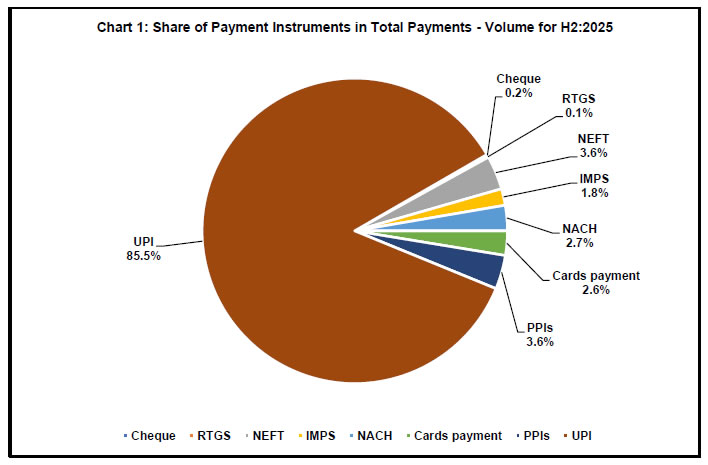
 Payment System Statistics: Recent Trends 2.5 Tables 2.1 and 2.2 present transaction volumes and values across different categories of payments during the last three half-years. An increasing trend is observed across all categories, except for paper-based instruments which include cheques. The last column in each table reports the daily average volume / value of transactions during H2 2025. | Table 2.1: Trend in Payment Transaction Volumes over the Last Three Half-Years | | Transaction Volume (in Crore) * | | | H2-2024 | H1-2025 | H2-2025 | Daily Average (during H2-2025) | | Total Payments | 11161 | 12549 | 14270 | 77.6 | | Paper-based Instruments | 31 | 29 | 28 | 0.2 | | Digital Payments | 11131 | 12520 | 14242 | 77.4 | | RTGS | 15 | 16 | 17 | 0.1 | | Retail Payments | 11146 | 12533 | 14253 | 77.5 | | Retail Digital Payments | 11116 | 12503 | 14225 | 77.3 |
| Table 2.2: Trend in Payment Transaction Value over the last three Half-Years | | Transaction Value (in ₹ lakh Crore) * | | | H2-2024 | H1-2025 | H2-2025 | Daily Average (during H2-2025) | | Total Payments | 1466 | 1572 | 1643 | 8.9 | | Paper-based Instruments | 35 | 36 | 35 | 0.2 | | Digital Payments | 1431 | 1536 | 1608 | 8.7 | | RTGS | 1007 | 1079 | 1127 | 6.1 | | Retail Payments | 459 | 492 | 516 | 2.8 | | Retail Digital Payments | 424 | 456 | 481 | 2.6 | *Note–
(a) Total payments include Digital payments and Paper-based Instruments
(b) Digital Payments include retail digital payments and RTGS
(c) Retail Digital Payments include NEFT, IMPS, NACH (credit, debit and APBS), card payment transactions (excl. cash withdrawal), PPI payment transactions (excl. cash withdrawal), UPI (including BHIM & USSD), BHIM Aadhaar Pay, AePS fund transfer and NETC (linked to bank accounts).
(d) Retail payments include Retail Digital Payments and Paper-based Instruments | 2.6 Table 2.3 presents data on the payment system infrastructure, i.e. the network of systems through which various payment transactions are carried out. The data indicates the outstanding position as of end-June 2025 and end-December 2025. The trend during this period, however, is not uniform across various systems. While credit cards, debit cards, PPI wallets, and UPI QR codes exhibit an upwards trend, PPI cards, PoS terminals, Bank-owned ATMs, CRMs and Micro ATMs registered a decline during the six-month period. | Table 2.3: Payment System Infrastructure Outstanding as on HY-end (in lakh) | | | H1-2025 | H2-2025 | | Credit Cards | 1109.69 | 1157.84 | | Debit Cards | 10051.80 | 10343.46 | | PPI Wallets | 8681.92
(1629.38)* | 16170.73
(8770.43)* | | PPI Cards | 4838.73
(3386.64)* | 4702.43
(2220.64)* | | Bank owned ATMs and CRMs | 2.15 | 2.13 | | White Label ATMs | 0.36 | 0.37 | | Micro ATMs | 14.59 | 14.15 | | PoS Terminals | 117.83 | 114.75 | | Bharat QR | 66.99 | 58.90 | | UPI QR | 6781.61 | 7313.65 | * Note: Figures in () are of “Active” PPIs
(Active PPI Card / Wallet is defined as that which has at least one financial transaction during the last one year) | 2.7 In the rest of this chapter, we present an analysis of the trend in the payment system data since 2021, segmented into ten half-yearly intervals. Analysis of Payment Systems Data – Since 2021 2.8 The payments ecosystem in India has witnessed remarkable growth in recent years. In terms of volume, the payment transactions grew from 6,437 crore in CY 2021 to 26,819 crore in CY 2025 and, in terms of value, from ₹1,741 lakh crore to ₹3,215 lakh crore during this period recording a compound annual growth rate (CAGR) of 42.9 percent and 16.6 percent respectively as shown in Chart 3. The details regarding the activities in various payments systems in India since CY 2021 are presented in Annex III. 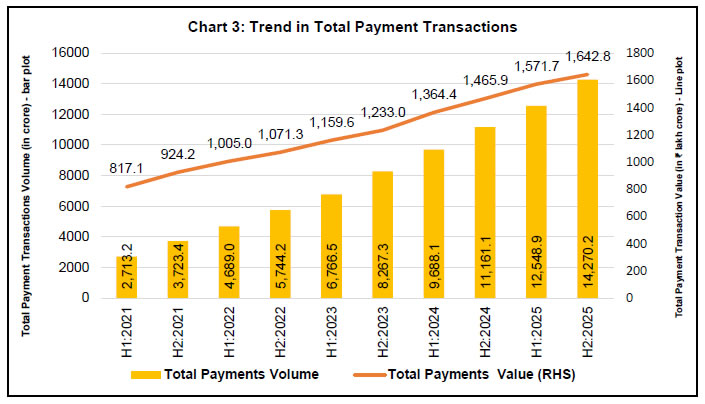 2.9 Almost all of the growth in payments is attributable to digital payment transactions.1 In CY 2021, digital payments constituted approximately 98.9 per cent of the total payment transactions by volume and 96.2 per cent by value. By CY 2025, these figures had risen to 99.8 per cent in terms of volume and 97.8 per cent in value. Over this period, digital payments recorded a CAGR of 43.2 per cent in volume and 17.0 per cent in value. Chart 4 depicts the half-yearly trend for digital payments. Large Value Payment Systems (LVPS) 2.10. The Large Value Payment Systems (LVPS), also called wholesale payment systems, facilitate large value and high-priority payments such as money market, securities market and interbank settlements, involving banks and other financial institutions. In India, LVPS include RBI-operated system viz. Real Time Gross Settlement (RTGS) and systems operated by Clearing Corporation of India Limited (CCIL). CCIL-operated LVPS 2.11 The CCIL-operated LVPS include Government Securities Market, Forex Clearing, and Rupee Derivative Markets. In the recent years, CCIL transactions have witnessed an increasing trend. In terms of volume, they increased from 32 lakh in CY 2021 to 57 lakh in CY 2025, recording a CAGR of 15.4 per cent. The value of transactions rose from ₹1,994 lakh crore to ₹3,581 lakh crore over the same period, translating into a CAGR of 15.8 per cent. Chart 5 depicts this trend in CCIL-operated systems on a half-yearly basis, while Table 2.4 shows year-wise growth in the three segments, during this period. 2.12 Government Securities (G-Sec) market has experienced notable expansion from a value of ₹1,355 lakh crore in CY 2021 to ₹2,093 lakh crore by CY 2025. Transactions volume also increased from 11.9 lakh in CY 2019 to 19.6 lakh in CY 2025. Over this five-year period, the market recorded a CAGR of 13.2 per cent in volume and 11.5 per cent in value (Table 2.4). 2.13 Forex Clearing transactions volume grew from 19.3 lakh in CY 2021 to 35.8 lakh in CY 2025. In value terms, the transactions grew from ₹596 lakh crore in CY 2021 to ₹1,379 lakh crore in CY 2025. This reflects a CAGR of 16.7% in volume and 23.3% CAGR in value during this five-year period (Table 2.4). 2.14 The Rupee Derivatives market has displayed a steady upward trend during this period. With 0.7 lakh transactions valued at ₹43 lakh crore in CY 2021, the segment grew to 1.3 lakh transactions with a value of ₹109 lakh crore in CY 2025. This growth corresponds to a 14.8 % CAGR in volume and 26.0% in value (Table 2.4). | Table 2.4: Trend in growth of CCIL transactions over the years | | Year | 1. Govt. Securities Clearing | 2. Forex Clearing | 3. Rupee Derivatives | CCIL Operated Systems (1+2+3) | Volume
(in lakh) | Value
(in ₹ lakh crore) | Volume
(in lakh) | Value
(in ₹ lakh crore) | Volume
(in lakh) | Value
(in ₹ lakh crore) | Volume
(in lakh) | Value
(in ₹ lakh crore) | | 2021 | 11.94 | 1355.44 | 19.3 | 595.67 | 0.75 | 43.18 | 31.98 | 1994.29 | | 2022 | 14.39 | 1681.99 | 23.74 | 736.89 | 1.20 | 70.21 | 39.33 | 2489.09 | | 2023 | 16.47 | 1712.50 | 25.19 | 806.98 | 1.41 | 83.28 | 43.06 | 2602.77 | | 2024 | 17.63 | 1811.88 | 26.26 | 885.31 | 1.35 | 83.35 | 45.24 | 2780.55 | | 2025 | 19.60 | 2093.03 | 35.75 | 1378.95 | 1.30 | 108.83 | 56.65 | 3580.82 | RBI-operated LVPS – Real Time Gross Settlement (RTGS) 2.15 RTGS is India’s primary large-value payment system, owned and operated by the Reserve Bank of India (RBI). RTGS transactions volume grew from 20 crore in CY 2021 to 33 crore in CY 2025, while transactions value increased from ₹1,246 lakh crore to ₹2,206 lakh crore during this period (Chart 6). This reflects a CAGR of 13.5% in transaction volume and 15.3% in transaction value. Retail Payment Systems 2.16 Retail payment systems are designed to process routine low- to medium-value transactions, including bill payments, purchases of goods and services, and fund transfers. These systems are characterised by their ability to handle large volumes of transactions efficiently. In India, various retail payment systems exist to cater to different consumer needs. For example, NEFT and IMPS facilitate fund transfers, BBPS provides a platform for bill payments, NACH enables auto-debits from / auto-credits to a customer’s bank account based on an authenticated and approved mandate, addressing a range of consumer payment requirements and disbursal of government subsidies and Direct Benefit Transfers (DBTs). 2.17 Retail transactions increased, in volume terms, from 6,417 crores in CY 2021 to 26,786 crores in CY 2025. In value terms, the transactions grew from ₹495 lakh crore to ₹1009 lakh crore during the same period (Chart 7). This translates into a CAGR of 43 per cent in volume and 19.5 per cent in value terms during the period. RBI-operated Retail Payment System – National Electronic Funds Transfer (NEFT) 2.18 The National Electronic Funds Transfer (NEFT) system is a nationwide, centralised electronic payment platform operated by the Reserve Bank of India (RBI). It enables fund transfers between bank accounts across the country. Although there is no upper limit imposed by the RBI for funds transfer through NEFT system, a member bank may, with the approval of its Board, place such limit based on its own risk perception. This is because NEFT is primarily used for low and medium-value transactions, unlike RTGS, which is designed for high-value payments. 2.19 During the period CY 2021 to CY 2025, NEFT transactions nearly tripled in terms of volume, from 380 crore to 1,000 crore. However, over the same period, in terms of value, they grew from ₹277 lakh crore to ₹482 lakh crore (Chart 8). This translates into a CAGR of 27.4 per cent and 14.9 per cent in volume and value respectively during this period. NPCI Operated Fast Payment Systems Unified Payment Interface (UPI) 2.20 UPI has become the most widely used fast payment system (FPS) in India because of its efficiency, round the clock availability, and ease of use. The volume of UPI transactions has increased significantly from 3,873 crore transactions in CY 2021 to 22,828 crore transactions in CY 2025. The total value of transactions grew from ₹72 lakh crore in CY 2021 to ₹300 lakh crore in CY 2025 (Chart 9). The CAGR of the UPI transaction during this period is 55.8 per cent in terms of volume and 43 per cent in terms of value. As UPI is mainly used for small value transactions, the average ticket size of such transactions remains low. From ₹1,848 in CY 2021, the average ticket size of UPI transactions declined further to ₹1313 in CY 2025. Immediate Payment Services (IMPS) 2.21 Immediate Payment Service (IMPS) is another FPS in India, enabling real-time settlement of transactions. The individual transaction limit under IMPS is ₹5 lakh across all channels, except for SMS and IVR. IMPS transactions volume rose from 434 crore in CY 2021 to 518 crore in CY 2025. More notably, transaction value doubled during the same period from ₹38 lakh crore to ₹75 lakh crore (Chart 10). This translates into a CAGR of 4.5 per cent in in volume and 18.1 per cent in value. 2.22 The average transaction size under IMPS is higher than that of UPI, which indicates that users typically prefer IMPS for medium- to large-value transfers, while UPI is more commonly used for small- to medium-value transactions. AePS – Fund Transfer and BHIM Aadhaar Pay 2.23 Aadhaar-enabled Payment System (AePS) is a bank-led model that facilitates online interoperable financial inclusion transactions at Point of Sale (Micro ATM) terminals through Business Correspondents of banks, using Aadhaar authentication. The banking services offered under AePS include cash deposit, cash withdrawal, balance enquiry, mini statement, Aadhaar-to-Aadhaar fund transfer, and BHIM Aadhaar Pay. Additional services include e-KYC, Best Finger Detection (BFD), and biometric authentication etc. 2.24 The volume of transactions conducted through AePS (fund transfers) and BHIM Aadhaar Pay increased from 212 lakh in CY 2021 to 231 lakh in CY 2025. The corresponding value of these transactions rose from ₹5,697 crore to ₹7,422 crore over the same period (Charts 11 and 12). This translates into a CAGR of 2.1 per cent in volume and 6.8 per cent in value.
National Automated Clearing House (NACH) – Credit and Debit 2.25 The National Automated Clearing House (NACH) is a system run by the National Payments Corporation of India (NPCI) that helps banks automatically handle large number of payments and collections. It facilitates two types of transactions. The first is called NACH Credit, i.e. one debit and multiple credits and includes payment of salaries, pensions, interest, subsidies, and dividends. The second is called NACH Debit, i.e. multiple debits and once credit and includes payment of electricity bills, loan EMIs, and insurance premiums. NACH Credit also covers payment transactions including government's Direct Benefit Transfer (DBT) payouts, while DBT-related transactions are processed through the Aadhar Payment Bridge (APB) system. On the other hand, collection-based transactions fall under NACH Debit. 2.26 The usage of NACH has grown significantly in recent years. The volume of NACH transactions (both Credit and Debit) rose from 400 crore in CY 2021 to 742 crore in CY 2025. During the same period, the value of NACH transactions also rose from ₹23 lakh crore to ₹51 lakh crore. This translates into a CAGR of 16.7% in volume and 21.5% in value (Chart 13), reflecting sustained and accelerating adoption. While NACH Credit transactions grew at a CAGR of 15.8% in volume and 17.02% in value, reflecting the platform’s important role in bulk disbursements, NACH Debit transactions have shown even more vigorous expansion, with a CAGR of 19.3% in volume and 27% in value, indicating rising consumer reliance on automated, recurring payments for utilities, EMIs, subscriptions, and other regular obligations. National Electronic Toll Collection (NETC) 2.27 National Electronic Toll Collection (NETC) system uses Radio Frequency Identification (RFID) technology that enables customers to make electronic payments at NETC-enabled highway toll plazas on the highway, without stopping their vehicles, from their prepaid accounts linked to the FASTag. 2.28 NETC (linked to bank account) transaction volume rose from 11 crore in CY 2021 to 17 crore in CY 2025. In value terms, these transactions grew from ₹1,534 crore to ₹2,189 crore during the same period (Chart 14). This translates into a CAGR of 11.2 per cent in volume and 9.3 per cent in value. NETC Infrastructure 2.29 NETC infrastructure has expanded rapidly. The number of toll plazas onboarded increased from 964 in December 2021 to 1,896 in December 2025. FASTag issuance grew from 4.42 crore to 11.87 crore during this period (Chart 15). Bharat Bill Payment System (BBPS) 2.30 The Bharat Bill Payment System (BBPS) is an RBI-mandated system that offers a reliable, secure, and integrated platform for bill payments across the country. It facilitates convenient, real-time payment of various utility bills such as electricity, water, gas, telecom, DTH, and more through multiple channels, including bank branches, mobile apps, ATMs, and agent outlets. The system ensures transparency and immediate confirmation of transactions. BBPS is operated by NPCI Bharat BillPay Ltd. (NBBL), a wholly owned subsidiary of NPCI. Chart 16 shows number of billers onboarded in BBPS system. The number of billers grew from 20.4 thousand in December 2021 to 22.6 thousand in December 2025. 2.31 The growth of BBPS has been remarkable, with transaction volume rising almost six-fold from 56 crore in CY 2021 to 305 crore in CY 2025. Transaction value rose 16 times from ₹0.96 lakh crore to ₹14.8 lakh crore over the same period (Chart 17).
Cards and Prepaid Payment Instruments 2.32 As of December 2025, there were 115.01 crore outstanding cards in India, including 11.58 crore credit cards and 103.43 crore debit cards. Credit Cards 2.33 Credit card transactions have seen an upsurge over the years. Transaction volume increased from 216 crore in CY 2021 to 570 crore in CY 2025 while transaction value rose from ₹8.9 lakh crore to ₹23.2 lakh crore during the same period (Chart 18). This translates into a CAGR of approximately 27% for both volume and value. 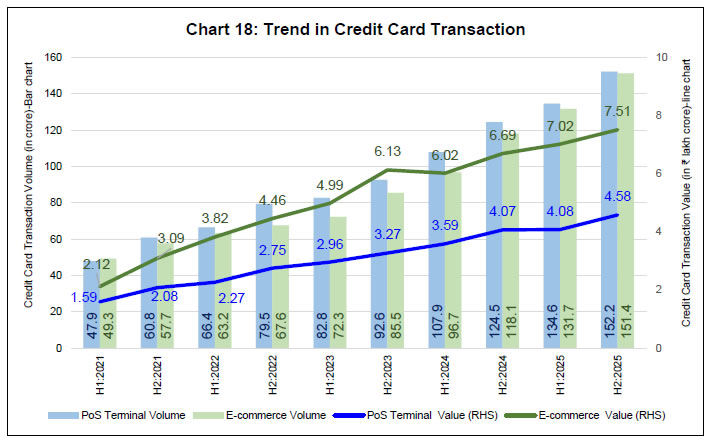 2.34 Private sector banks continue to dominate in the credit card space, focusing on digital and co-branded offerings for customers, as their market share increased from 67.7 per cent (4.8 crore outstanding cards) in December 2021 to 71.1 per cent (8.2 crore outstanding cards) in December 2025. The share of Public Sector Banks (PSBs) witnessed a modest increase, from 23.5 per cent (1.6 crore outstanding cards) to 23.9 per cent (2.8 crore outstanding cards) over the same period. In contrast, the share of foreign banks saw a steep decline, from 9.3 per cent (50 lakh outstanding cards) to 3.8 per cent (44 lakh outstanding cards). Small Finance Banks had issued 14 lakh cards by December 2025 (Chart 19). Debit Cards 2.35 Transactions in debit cards have witnessed a decline since 2021, both in volume and value. In volume terms, debit card transactions declined from 408.7 crore in CY 2021 to 133.6 crore in CY 2025, while in value terms, they declined from ₹7.4 lakh crore to ₹4.5 lakh crore during this period. This translates into a CAGR of (‒)24.4% in volume and (‒)11.7% in value (Chart 20). 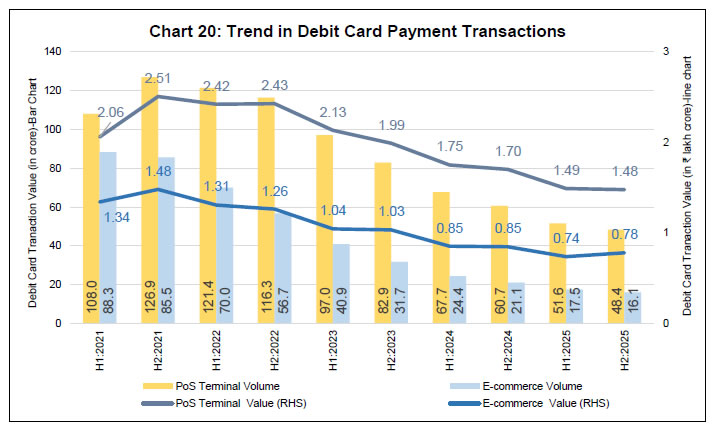 2.36 While the decline in debit card transactions, both in volume and value, is potentially driven by the rise of digital wallets, UPI, and credit card adoption, debit cards remain more widely held than credit cards. However, their market share, across bank groups, has seen shifting trends. Unlike in the case of credit cards, PSBs dominate the debit card space, although their market share has declined from 67.9 per cent (63.7 crore cards outstanding) in December 2021 to 63.1 per cent (65.2 crore cards outstanding) in December 2025, partly due to competition in payments posed by UPI. During this period, however, private sector banks improved their share from 23.5 per cent (19.3 crore cards outstanding) to 25.1 per cent (26.0 crore cards outstanding). Small Finance Banks (SFBs) and Payment Banks also enhanced their market shares, with number of debit cards issued by SFBs increasing from 2.3 crore (2.4% market share) to 3.3 crore (3.2% market share) between December 2020 and December 2025 (Chart 21). 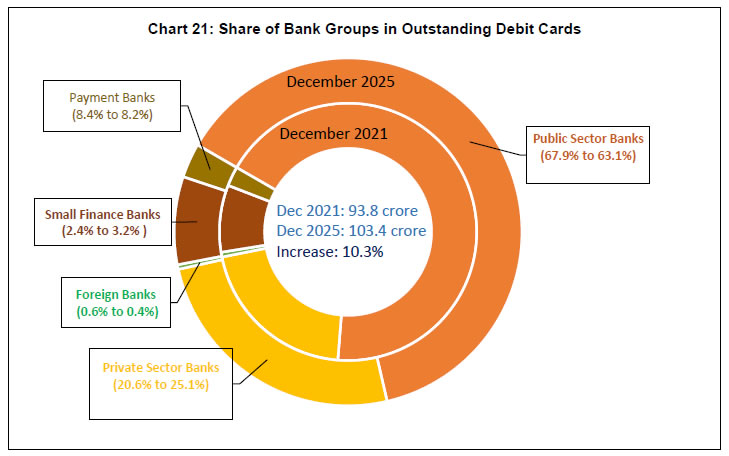 2.37 To summarise, credit and debit cards show different usage patterns (Chart 22). While credit cards are being increasingly used for online purchases and credit access, debit cards are mostly being used for cash withdrawals and basic transactions. Both instruments, however, face growing competition from digital alternatives. Prepaid Payment Instruments (PPIs) 2.38 Prepaid Payment Instruments (PPIs), including mobile wallets and prepaid cards, continue to play a versatile role in digital transactions. While PPI transaction volume rose from 620 crore in CY 2021 to 918 crore in CY 2025, transaction value remained almost at the same level of ₹2.65 lakh crore during this period (Chart 23). The issuance of PPIs also grew from 151 crore instruments (125 crore wallets and 26 crore cards) in December 2021 to 209 crore (162 crore wallets and 47 crore cards) in December 2025 (Annex – III). Paper-based Instruments 2.39 The Cheque Truncation System (CTS), implemented by the Reserve Bank of India and operated by NPCI, is a mechanism of cheque clearing, which eliminates the physical movement of cheques, replacing it with the secure electronic transmission of high-resolution cheque images and structured data. More than 60 crore cheques with a value of approximately ₹70 lakh crore are cleared through CTS every year. With the objective of making cheque clearing faster and reducing settlement risks, Continuous Clearing and Settlement on Realization was implemented in CTS on October 04, 2025. Under this, cheques are scanned, presented, and passed on a continuous basis during the presentation and confirmation sessions. Cheques that are positively confirmed are included for settlement while negatively confirmed (dishonoured) cheques are not. Banks are required to credit customer accounts within one hour of settlement. 2.40 The CTS transaction volume declined from 72 crore in CY 2021 to 57.2 crore in CY 2025. However, the transaction value increased from ₹66.03 lakh crore to ₹70.82 lakh crore during the same period (Chart 24). The average transaction size increased from about ₹92 thousand to ₹1.24 lakh. 3. Major Regulatory Developments in Payment Systems in India 3.1 The payment systems in India serves as the backbone for economic transactions across sectors. India’s payment systems are vital to its financial infrastructure, enabling seamless economic transactions. Governed by the Payment and Settlement Systems Act, 2007, the RBI oversees and regulates these systems as the designated authority. To effectively carry out its mandate, the RBI exercises its powers, performs its functions, and discharges its duties through the Payments Regulatory Board (PRB). 3.2 India’s payment infrastructure has evolved into a dynamic, multi-layered ecosystem that caters to diverse user needs — from rural communities to urban tech-savvy consumers. It encompasses traditional instruments such as cheques and demand drafts, alongside modern, real-time digital platforms including the globally acclaimed Unified Payments Interface (UPI), the instant interbank transfer service Immediate Payment Service (IMPS), and a wide array of Prepaid Payment Instruments (PPIs) such as digital wallets and mobile payment apps. These systems collectively offer users seamless, secure, and convenient payment options — fostering financial inclusion, accelerating digital adoption, and supporting India’s transition toward a cash-lite economy. 3.3 RBI has proactively implemented a comprehensive suite of measures to ensure that India’s payment systems remain not only efficient, secure, accessible, and inclusive, but also resilient and future-ready — while simultaneously strengthening customer protection and enabling the orderly, innovation-driven expansion of the digital payments ecosystem. Key regulatory initiatives undertaken by the RBI over the past six months include the following: (a) Master Direction on Regulation of Payment Aggregator (PA) The Reserve Bank of India issued the Master Direction on Regulation of Payment Aggregators (PA) on September 15, 2025. With the issuance of this Master Direction, all the PAs – online (guidelines issued in March 2020), cross-border (guidelines issued in October 2023) and Physical (vide this Master Direction) have been brought under the regulatory framework. It streamlines the definition of PAs, prescribes an authorisation framework for non-bank PAs, mandates robust risk-based KYC for onboarding of merchants, requires maintenance of escrow accounts, and strengthens security and governance standards. (b) Reserve Bank of India (Authentication mechanisms for digital payment transactions) Directions, 2025 The Reserve Bank of India issued the Reserve Bank of India (Authentication Mechanisms for Digital Payment Transactions) Directions, 2025 on September 25, 2025. The Directions encourage the adoption of new, technology-driven authentication factors, including biometrics and device-based credentials, while continuing to recognise SMS-based one-time passwords as a valid authentication factor. They allow issuers to implement additional risk-based checks over and above the minimum two-factor authentication requirement, based on the assessed fraud risk of the transaction, promote interoperability and open access to authentication technologies across ecosystem participants, and clearly assign responsibility to issuers for ensuring robust authentication controls. The Directions also mandate AFA for cross-border card-not-present transactions, when such a validation is required by the overseas acquirer. (c) Framework for Recognition of a Self-Regulatory Organisation for Payment System Operators The Reserve Bank of India had issued the Framework for Recognition of Self-Regulatory Organisation (SRO) for Payment System Operators (PSOs) on October 22, 2020, followed by an Omnibus Framework for Recognition of SROs for Regulated Entities of the Reserve Bank on March 21, 2024, which together laid down the eligibility criteria and process for recognition of SROs and invited eligible associations to apply. Pursuant to these frameworks, an application was received from the Self-Regulated PSO Association (SRPA) seeking recognition as the SRO for Payment System Operators. The application was examined by the Reserve Bank in accordance with the prescribed criteria and based on this assessment, SRPA was recognised as the Self-Regulatory Organisation for Payment System Operators on November 11, 2025. 4. In Focus: Central Counterparties (CCPs) – Anchoring Market Stability 4.1 A Central Counterparty (CCP) is a critical Financial Market Infrastructure (FMI) that acts as an intermediary between buyers and sellers in financial transactions, fundamentally altering the nature of counterparty obligations. Through a legal process known as novation, the CCP extinguishes the original bilateral contract between a buyer and a seller, substituting it with two distinct contracts where the CCP acts as the seller to every buyer and the buyer to every seller. Its primary objective is to centralize and mitigate counterparty credit risk, ensuring that the failure of a single participant does not lead to a systemic collapse. By guaranteeing the performance of obligations, CCPs foster confidence, liquidity, and stability within global financial markets The Pre-CCP Landscape: Structural Fragility and Bilateral Risks 4.2 Prior to the systematic shift towards central clearing, markets operated primarily through bilateral settlement, where participants traded directly with one another. This decentralized structure created a complex web of exposures where every transaction created a direct, siloed exposure between two firms. This structure had the following deficiencies: • Counterparty Credit Risk: Each institution was directly exposed to the creditworthiness of its peers. If a major bank defaulted, its counterparties faced immediate, unhedged losses, often triggering a ';domino effect'; across the financial system. • Operational Complexity: Without a central hub, firms had to manage thousands of individual contracts, margin calls, and settlement instructions. This lack of standardization led to high error rates and significant administrative burden, which was at times prohibitive for smaller players. • Liquidity Inefficiency: In a bilateral setting, obligations could not be offset across different counterparties. For example, bank A might owe ₹100 crore to bank B and be owed ₹90 crore by bank C; however, it was required to provide the full ₹100 Crore in liquidity, as the payable could not be ';netted'; against the receivable. • Lack of Transparency: Risk was ';invisible'; to the broader market as regulators had no single vantage point to monitor the build-up of concentrated risks. This ';blind spot'; resulted in aggravating the severity of the 2008 Global Financial Crisis. Strengthening the Financial Core: Roles and Benefits of the CCP 4.3 CCPs provide a robust defence mechanism to the financial system by transforming how risk is managed: • Multilateral Netting: The CCP aggregates all trades from a member and reduces them to a single net payment or delivery obligation. This drastically reduces the net liability for members, need for market liquidity and settlement costs for members. • Risk Mutualization: By creating a collective defence layer through a shared Default Fund, CCPs spread the impact of a member’s failure across the entire clearing membership. This collective protection ensures that even a significant default can be absorbed without destabilizing the broader market. • Transparency and Standardization: CCPs provide regulators with a centralized data source, allowing for real-time monitoring of systemic health. Important trade information is also disseminated to participants allowing them to fairly price their deals, learn about directional bets in the market, etc. CCPs promote standardization by enforcing uniform rules for margining, collateral, and dispute resolution. Standardized margin simulation tools enable members to clearly understand collateral requirements for their trades. These twin attributes promote equity and inclusion in the financial markets. • Default Management: In the event of a member’s failure, the CCP manages the ';close-out'; process in an orderly fashion, preventing fire sales and maintaining market continuity. Regulatory Oversight and Risk Management: The PFMI Framework 4.4 CCPs are fundamentally in the business of risk absorption – they reduce the overall risk in the system by taking-over key risks faced by individual members. With such levels of risks concentrated in CCPs, failure is not an option – a robust risk management framework to support sustainable operations and promote safe risk-taking is essential, a blueprint that transforms “too-big-to fail” into “too-safe-to-fail”. 4.5 CCPs are primarily guided by the Principles for Financial Market Infrastructures (PFMIs), which are a set of 24 risk management principles published by Committee on Payments and Market Infrastructures (CPMI) and the International Organization of Securities Commissions (IOSCO), covering areas such as legal risk, credit and liquidity risk, settlement, participant default rules, operational risk, transparency etc. Some best practices that have emerged from PFMIs are described below: • The Margin Regime: CCPs protect themselves using a two-tiered margin system. Initial Margin acts as a performance bond against potential future price swings, while Variation Margin is collected daily (or intraday) to mark positions to current market prices, preventing the accumulation of losses. • Liquidity Standards: As per PFMI standards, CCPs must maintain sufficient liquid resources to settle obligations under extreme but plausible market conditions —typically enough to cover the simultaneous default of their two largest clearing members (the ';Cover 2'; requirement). • The Default Waterfall: This is a pre-defined sequence of financial resources used to cover losses. It begins with the defaulter’s own margin and contributions, followed by the CCP’s ';skin in the game'; (its own capital), and finally, the mutualized default fund. This hierarchy ensures that the CCP’s incentives are naturally aligned with market safety. • Money Settlements: To avoid settlement bank risk, CCP settlements are expected to be affected in, as much as possible, central bank money. CCPs regulated by RBI 4.6 The history of CCPs in India goes back to 1990s – the decade which saw many far-reaching financial reforms in India. Reforms in capital market, securities market, forex markets, etc. led to a growing need for a robust and reliable settlement infrastructure to support the expanding market participation. The democratization of the market inevitably catalyzed the journey towards central clearing. Two CCPs are authorized by RBI under the Payment and Settlement Systems Act, 2007 – Clearing Corporation of India Ltd. (CCIL) and AMC Repo Clearing Ltd. (ARCL). A brief introduction to both these entities is given below: Clearing Corporation of India Limited (CCIL) 4.7 The Clearing Corporation of India Ltd. (CCIL) was created as part of a strategic vision by the Reserve Bank of India (RBI) to safeguard the government securities, money, and forex markets. A core group of experts was constituted in June 2000, comprising officials from RBI, FIMMDA, FEDAI, PDAI and Association of Mutual Funds in India (AMFI) to draft the blueprint of a clearing corporation for providing central clearing in these markets. The setting up of an organization named the Clearing Corporation of India Ltd. (CCIL) was announced in the budget speech of 2001-02. 4.8 Since its inception in 2001, CCIL has become a cornerstone of Indian finance, achieving netting efficiencies of over 90% in funds and 60% in securities — a feat that has significantly mitigated systemic risk and unlocked vital market liquidity. It currently offers guaranteed settlement services for the government securities market comprising of outright trades and for market repo and triparty repo in the money market segment. In the forex market, it offers guaranteed settlement for all interbank USD/INR transactions (Cash / Tom / Spot / Forward). It also offers settlement services for trades in rupee derivatives segment (Interest Rate Swaps and FRAs) and cross currency transactions (through CLS Bank). Apart from managing key trading platforms in these segments, CCIL also acts as the trade repository for the interest rate, forex and credit derivatives markets and Commercial Paper (CP)/Commercial Deposit (CD) transactions in India. A brief history of key events associated with CCIL is depicted in Chart 25. 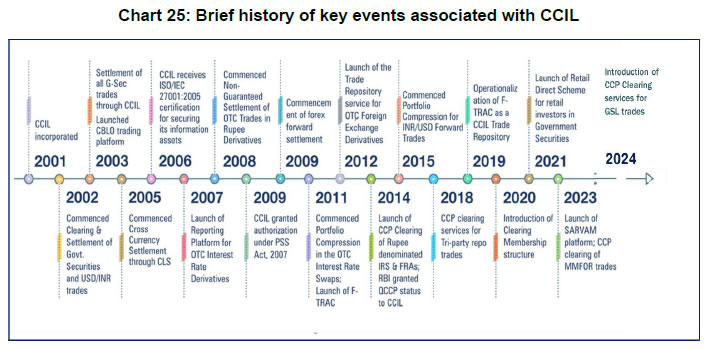 4.9 The Charts 26-28 depict the growth in the daily settled value in the product mix of CCIL over the years: Securities segment Rupee Derivatives Segment Forex Market 4.10 CCIL has recently completed 25 years of its establishment and intends to leverage its experience to launch products in new segments such as bond forwards, non-deliverable forwards etc. It is also looking to support market participants by providing value added services like margining for non-centrally cleared derivatives, consultancy support etc. AMC Repo Clearing Limited 4.11 Building on the foundational role of CCPs, the development of AMC Repo Clearing Ltd. (ARCL) represents a targeted effort to strengthen India's corporate bond market — a critical engine for national economic growth. Historically, multiple expert committees advocated for the introduction of tri-party repos in corporate debt to enhance market liquidity. Responding to this need, the Securities and Exchange Board of India (SEBI) formed a working group of industry experts from mutual funds, CCIL, and AMFI. Their primary recommendation was the establishment of a Limited Purpose Clearing Corporation (LPCC), funded and spearheaded by Asset Management Companies (AMCs), dedicated specifically to the clearing, settlement, and guarantee of these transactions. 4.12 The above was the genesis of AMC Repo Clearing Ltd. (ARCL), set up on April 17, 2021 as an LPCC under the SEBI Stock Exchanges and Clearing Corporations (SECC) Regulations, 2018 for providing clearing and settlement services as well as settlement guarantee for tri-party repo in corporate debt securities. While established under SEBI regulations, ARCL’s core product — tri-party repos in corporate debt — is classified as a money market instrument under the regulatory purview of the Reserve Bank of India (RBI). Consequently, the RBI authorized ARCL to function as a Central Counterparty (CCP), bridging the gap between corporate debt holders and institutional lenders. 4.13 Since becoming operational on July 28, 2023, ARCL has rapidly gained traction within the financial ecosystem. Its tri-party repo product has seen significant market adoption, with daily average trading volumes surging fifteen-fold since its launch. The trade statistics are depicted below: 4.14 Going forward, ARCL intends to expand its product base to cover clearing and settlement of non-SLR debt securities covering products such as tri-party repos and secondary market OTC trades in non-SLR debt securities. It also plans to introduce repo in municipal bonds subject to regulatory approval. Conclusion 4.15 Adoption of central clearing in major markets has marked a fundamental shift in the way financial transactions are undertaken today. It has reduced risks, lowered costs and ushered transparency. 4.16 While CCPs have proved to be instrumental in ensuring financial stability, the centralised nature of their activities makes them inherently susceptible to severe risks. Increasing sophistication in financial markets, complex global inter-linkages and rapid technological disruptions put CCPs requires them to be agile and constantly evolve their risk management practices. The role of regulators, tasked with the delicate balancing act of maintaining a conservative safety net while leaving sufficient room for innovation, becomes important in this regard. The resultant vector force of these divergent demands will determine the future trajectory of India’s financial landscape. 5. Cross-Border Payments – Regulatory and Technological Developments 5.1 Cross-border payments continue to rely predominantly on correspondent banking, a model that has long served as the backbone of international fund transfers. Although this structure successfully links banks across jurisdictions, it introduces significant operational and regulatory complexity. The necessity for payments to traverse a chain of intermediaries before reaching the beneficiary can result in delays, increased costs, and reconciliation difficulties. 5.2 Three factors make cross-border payments especially complex. First, the use of multiple intermediaries increases the number of processing points, each of which may apply their own fees, operational checks, and lead to delays. Second, cross-border compliance checks are imperative to fulfil anti-money laundering, sanctions, and customer due diligence mandates across multiple jurisdictions. Third, foreign exchange conversion related aspects and time-zone differences lead to added costs, exchange-rate uncertainty, with the associated processes contributing to slowing down the speed of payments. These elements together explain, to a large extent, why cross-border payments often are more expensive and slower than domestic payments. As the payment travels through multiple correspondent banks and compliance layers, the sender and recipient may face difficulties in tracking the transaction. This lack of end-to-end transparency can make it difficult to predict settlement times, identify bottlenecks, or trace the source of delays. 5.3 The efforts to address the said frictions associated with cross-border payments viz., slow speed, high costs, limited access, and low transparency continued globally under the G20 Roadmap while the Reserve Bank remained focused on improving the efficiency of cross-border payments through regulatory interventions and developmental measures. Further, technological developments have the potential to considerably alter the contours of the payments ecosystem in the coming years, which necessitate responsive and agile regulatory responses globally. These developments are discussed in the following sections. A. Progress on the G20 Roadmap for enhancing cross-border payments 5.4 The G20 Roadmap, launched in 2020, established a strategic framework to make cross-border payments cheaper, faster, more inclusive, and transparent. Yet the Financial Stability Board (FSB) Progress Report, 2025 indicates that progress towards these goals has been mixed. Most of the foundational priority action items have been completed under the G20 Roadmap, such as international recommendations by the standard setting bodies (SSBs) on operating hours, ISO 20022 harmonization, data-related frictions, levelling the playing field between banks and non-bank payment service providers (PSPs), and revised AML/CFT standards. Progress towards implementation of the said recommendations by the jurisdictions would enhance cross-border payments globally. 5.5 The slower-than-expected progress in enhancing cross-border payments has been attributed to complex platform structures, inconsistent private sector support, a challenging geopolitical landscape, inefficient implementation of capital controls, limited transparency for end-users, interoperability challenges, and insufficient competition in certain market segments. Over the coming year, the SSBs like FSB and the Committee on Payments and Market Infrastructure (CPMI) will focus on supporting implementation of the international policies that have been agreed under the G20 Roadmap, in active coordination with the jurisdictions. B. Initiatives by the Reserve Bank to enhance cross-border payments 5.6 The Reserve Bank continues to work towards reducing frictions in cross-border payments. To address the delays in passing of funds to the end-beneficiaries in case of inward cross-border payments, the Bank had issued draft circular on ‘Guidelines to facilitate faster cross-border inward payments’ on October 29, 2025. The feedback received from the banks was reviewed after which the final guidelines were issued by the Reserve Bank on April 9, 2026. Further, lack of transparency in cross-border payments is one of the identified challenges as per the G20 Roadmap. On December 9, 2025, the Reserve Bank issued draft circular on ‘Disclosure of transaction cost for foreign exchange transactions’ on which comments have been sought from banks, market participants and other interested parties. The said guidelines shall enhance transparency by mandating the Authorized Dealers to provide details of the total transaction costs to the users before entering into the contract. 5.7 The Reserve Bank continues to pursue measures to enhance cross-border payments by encouraging various modes of collaboration with other countries which include interlinking of UPI on bilateral and multilateral basis with Fast Payment Systems (FPSs) of other countries for personal remittances and acceptance of FPS via QR Codes at merchant locations abroad. Since February 2023, India’s Unified Payments Interface (UPI) and Singapore’s PayNow have been bilaterally linked, enabling real-time cross-border remittances. Similar integrations with other national fast payment systems are currently underway, alongside the ongoing multilateral Project Nexus for international remittances. Currently, UPI QR-code payments are operational across Bhutan, France, Mauritius, Nepal, Qatar, Singapore, Sri Lanka, and the UAE. Accessibility varies by region, with some countries offering nationwide coverage while others remain limited to specific local hubs. The Reserve Bank remains committed to further broadening and deepening of international UPI linkages. 5.8 Payment Aggregators Cross-Border (PAs-CB) are non-bank entities that facilitate aggregation of cross-border payments for current account transactions eligible under FEMA (Foreign Exchange Management Act), for their onboarded merchants through e-commerce mode. The RBI’s directions dated September 15, 2025 consolidated guidelines related to PAs operating in domestic market and PAs-CB that facilitate cross-border operations. The directions on PAs-CB require entities to have a minimum net worth of ₹15 crore at the time of tendering application for authorisation and ₹25 crore by the third financial year of grant of authorisation, ongoing maintenance of that capital with no co-mingling of inward and outward funds, and a maximum value of ₹25 lakh per transaction for either inward or outward transaction. PAs-CB add value by simplifying merchant onboarding, improving payment acceptance for global trade, supporting settlement and reconciliation, and giving businesses a compliant way to reach overseas customers or suppliers. C. Technological innovations with implications for global payment systems 5.9 The technological innovations like the tokenisation of funds / assets and distributed ledger technology (DLT) are actively reshaping the payments ecosystem, world over, including the cross-border payments. The seamless coexistence of the innovative technology-based payments and traditional payment systems warrant concerted efforts by the stakeholders. To ensure stability and resilience of the payment systems, public authorities need to promote technological innovations within a robust legal and regulatory framework that carefully manages the interaction between new and existing infrastructures2. 5.10 The global community is actively debating the rise of stablecoins and their impact on international payments including cross-border remittances. However, the basic characteristics of stablecoins render their use as an effective payment medium questionable when juxtaposed against the tests of singleness of money, elasticity, and integrity of payments. The traditional monetary system, globally, rests on a two-tier banking system, wherein the central bank money-based settlement forms the edifice while commercial banks can issue money which is beyond their reserves held, as the central bank can always provide liquidity for settlement preventing a gridlock scenario. This system ensures singleness of money with the various money forms convertible at par with no questions asked, extends elasticity by way of central banks providing liquidity in excess of deposits ensuring seamless settlement, and maintains integrity of the payments. The stablecoins do not pass the said tests of singleness, elasticity and integrity3. 5.11 Stablecoins pose jurisdictional risks as volatile backing assets can cause de-pegging, undermining the singleness of money. Their vulnerability to runs due to limited redemption rights may trigger fire sales of underlying asset bills, disrupting financial markets, monetary policy transmission and posing financial stability concerns. Mass adoption threatens bank disintermediation, raising funding costs and limiting lending capacity. Deep interconnections with banks create systemic risks, where sudden withdrawals by issuers could rapidly spread financial instability globally. Additionally, currency substitution in high-inflation economies challenges monetary sovereignty by reducing local currency demand and seigniorage income. Furthermore, cross-border stablecoin flows can circumvent capital controls, complicating effective regulation. Stablecoins could pose a risk to emerging market economies without commensurate efficiencies and do not serve a purpose that cannot be better fulfilled by a Central Bank Digital Currency (CBDC). CBDCs offer similar level of efficiency without the risks that stablecoins are associated with. CBDCs are fiat, ensure singleness of money, preserve seigniorage income of the central banks, backed by sovereign guarantee with no risk of fragmentation that the private issuance of stablecoins represents. 5.12 The tokenization of assets and its integration with payment systems also remain a subject of ongoing public discussion. BIS has discussed a blueprint of the next-generation monetary and financial system centred on tokenised platforms with central bank reserves, commercial bank money and government bonds laying the groundwork. For cross-border payments, it may streamline the process by replacing the traditional, complex network of intermediaries and sequential account updates in the existing correspondent banking environment with a single, integrated platform. Utilizing integrated compliance tools, this new system can reduce operational risks, processing delays, and associated costs. 5.13 However, the market for tokenised assets remains in its infancy at the current stage. Some of the possible reasons for the same are the lack of liquid markets for tokenised assets along with lack of full ecosystem to participle in DLT-based finance impeding large-scale investor participation; the need for payment rails to be integrated in DLTs which have been held back due to absence of tokenized forms of money like CBDC or tokenized deposits for payment leg of the transaction; the limited availability of digital asset-related services by custodians as the customers need to be on-boarded to DLT platforms; etc4. Nevertheless, tokenization is stated to have the potential to modernize financial architecture by eliminating current frictions and is presented as the next logical step in the evolution of money and payments. 5.14 The modern payment ecosystems rely on cryptographic protocols to secure transactions and protect sensitive user credentials. The primary threat of quantum computing lies in its potential to compromise many of today’s widely used cryptographic algorithms, that form the backbone of modern secure communications and transactions. This holds significance for cross-border transactions too, particularly those using international financial messaging which rely on established guidelines featuring layered encryption and mutual authentication. BIS Innovation Hub has recently released a report on ‘Quantum Proofing Payment Systems’ under the Project Leap5. The Project Leap has reported successful demonstration of the feasibility of migrating payment systems to post-quantum cryptography laying groundwork for safeguarding the integrity and resilience of existing and future financial infrastructures. 5.15 Payment pre-validation (PPV) enhances safety and efficiency by validating payment details before transactions are initiated thus playing an important role in mitigating fraud and non-compliance risks. CPMI, in its recently published brief6 discusses the various facets of PPV adoption. The report suggests that the Cross-border PPV is in early stages primarily due to the complexity of aligning technical and governance frameworks across different jurisdictions. While efforts like ISO 20022 and API recommendations promote interoperability, legal and governance alignment pose significant challenges. Success requires navigating diverse regulatory environments, where elements like account name matching must adapt to specific jurisdictional practices. Expanding these services necessitates balancing effective validation with strict data privacy compliance across varying international laws. India’s UPI, RTGS and NEFT all support confirmation of payee which is a specific pre-validation service that authenticates the payee’s information, typically based on at least a name and an account identifier. Further, UPI’s cross-border interlinkage with Singapore’s PayNow already supports confirmation of payee functionality.
Annex – I Authorised Payment Systems in India
Annex – II Payment Systems Instruments India has developed a diverse and robust payment system infrastructure that caters not only to the domestic population but also supports cross-border needs. The ecosystem encompasses a wide range of payment mechanisms, from large-value transactions to retail and real-time systems. Key components of India’s payment systems include the following: Real Time Gross Settlement (RTGS): Launched in 2004, RTGS is a large-value payment system operated by the Reserve Bank of India (RBI). It facilitates the real-time settlement of funds on a gross basis, available 24x7. RTGS is primarily used for high-value transactions, ensuring speed, finality, and security. National Electronic Funds Transfer (NEFT): NEFT is a nation-wide centralised payment system that caters to both retail and large-value fund transfers. Also operated by the RBI, NEFT processes transactions in half-hourly batches, starting at 00:30 hours, with the last batch processed at 23:30 each day. It is widely used for one-to-one fund transfers across banks in India. National Automated Clearing House (NACH): Developed and operated by the National Payments Corporation of India (NPCI), NACH is designed for bulk and repetitive payments, such as salary disbursements, pension payments, subsidies, utility bill payments, and loan EMIs. It supports both credit and debit transactions and is extensively used by government and corporate entities. Immediate Payment Service (IMPS): IMPS is a fast payment system introduced by NPCI, offering 24x7 instant fund transfer through multiple channels including mobile banking, internet banking, and ATMs. It enables real-time credit to beneficiaries’ accounts and supports both person-to-person and person-to-merchant transactions. Unified Payments Interface (UPI): Launched in 2016, UPI has transformed digital payments in India and emerged as one of the fastest-growing payment platforms globally. Developed and managed by NPCI, UPI enables real-time interbank transfers through mobile devices. Innovations such as UPI 123Pay (for feature phones), Hello UPI (voice-enabled payments), UPI-ATM (cardless cash withdrawals), Credit Card on UPI, and UPI Circle have significantly expanded its functionality and accessibility. Card Payments: Card-based payments form a significant segment of India’s retail payment systems. Transactions are facilitated through debit cards, credit cards, and Prepaid Payment Instruments (PPIs). Debit cards are primarily issued by banks, while credit cards are issued by both banks and a few Non-Banking Financial Companies (NBFCs). PPI cards can be issued by banks as well as authorised non-bank PPI entities. RuPay is India’s indigenous domestic card network, offering an affordable and secure card payment infrastructure. Prepaid Payment Instruments (PPIs): PPIs are instruments that facilitate the purchase of goods and services, enable financial services, and support fund transfers against the value stored within them. PPIs may take the form of wallets or cards and are classified based on Know Your Customer (KYC) norms into: Small PPIs: With limited KYC requirements, further subdivided based on the facility of cash loading. Full-KYC PPIs: Allows greater functionality and higher transaction limits. Gift PPIs: Non-reloadable instruments with a maximum value of ₹10,000. PPI-MTS (Mass Transit Systems): Issued by transport operators, reloadable, and capped at a maximum value of ₹3,000. Bharat Bill Payment System (BBPS): Launched in August 2016, the Bharat Bill Payment System is an integrated and interoperable platform that offers customers a convenient, anytime-anywhere bill payment service. BBPS supports multiple payment modes and operates through a wide network of physical agent locations. It facilitates the payment of various recurring bills, including electricity, water, gas, telephone, DTH, insurance, and more. A recent enhancement to BBPS includes a cross-border bill payment facility that allows Non-Resident Indians (NRIs) to pay utility, education, and other bills in India on behalf of their families, thereby broadening the system’s reach and utility. Trade Receivables Discounting System (TReDS): TReDS is an institutional mechanism designed to facilitate the financing of trade receivables for Micro, Small, and Medium Enterprises (MSMEs) from corporate buyers, government departments, and Public Sector Undertakings (PSUs). The platform enables the digital uploading, acceptance, discounting, trading, and settlement of invoices or bills, supporting both receivables factoring and reverse factoring. TReDS enhances liquidity for MSMEs by ensuring timely access to working capital at competitive rates. National Electronic Toll Collection (NETC): The NETC system provides a unified and interoperable toll payment solution across India. Operated with clearinghouse services for settlement and dispute management, NETC streamlines toll collection through FASTag, a device based on Radio Frequency Identification (RFID) technology. Affixed to a vehicle's windscreen, FASTag enables automatic toll payments directly from the linked payment account while the vehicle remains in motion, thus reducing congestion and enhancing efficiency at toll plazas. Aadhaar Enabled Payment System (AePS): Introduced in 2011 to promote financial inclusion, AePS is a bank-led model that allows customers to access their Aadhaar-linked bank accounts using biometric authentication. Through Business Correspondents (BCs), customers can perform basic banking services such as balance inquiry, cash withdrawal, cash deposit, and fund transfers. The Unique Identification Authority of India (UIDAI) provides biometric verification services, while the National Payments Corporation of India (NPCI) handles the switching, clearing, and settlement of transactions under the AePS framework.
Annex – III Activity in India’s Payment Systems | CCIL Operated Systems* | | Period | Volume | Value | | (in crore) | (in ₹ Lakh crore) | | H1:2021 | 0.15 | 959.15 | | H2:2021 | 0.17 | 1035.14 | | H1:2022 | 0.19 | 1177.30 | | H2:2022 | 0.21 | 1311.79 | | H1:2023 | 0.22 | 1316.02 | | H2:2023 | 0.21 | 1286.75 | | H1:2024 | 0.23 | 1319.55 | | H2:2024 | 0.22 | 1460.99 | | H1:2025 | 0.29 | 1734.20 | | H2:2025 | 0.28 | 1846.61 | | *:Includes settlement data of government securities, forex clearing and Rupee derivatives. |
| RTGS | | Period | Volume | Value | | (in crore) | (in ₹ Lakh crore) | | H1:2021 | 9.46 | 585.69 | | H2:2021 | 10.58 | 660.58 | | H1:2022 | 11.77 | 698.70 | | H2:2022 | 11.87 | 745.86 | | H1:2023 | 12.87 | 798.19 | | H2:2023 | 13.18 | 843.56 | | H1:2024 | 14.65 | 930.92 | | H2:2024 | 14.88 | 1007.29 | | H1:2025 | 16.11 | 1079.23 | | H2:2025 | 17.17 | 1126.56 |
| AePS (Fund Transfers) | | Period | Volume | Value | | (in Lakh) | (in ₹ '00 crore) | | H1:2021 | 6.12 | 3.74 | | H2:2021 | 5.19 | 3.00 | | H1:2022 | 3.37 | 1.98 | | H2:2022 | 3.16 | 1.82 | | H1:2023 | 1.99 | 1.37 | | H2:2023 | 1.90 | 1.26 | | H1:2024 | 1.92 | 1.19 | | H2:2024 | 1.84 | 0.88 | | H1:2025 | 1.81 | 0.99 | | H2:2025 | 1.62 | 0.78 |
| IMPS | | Period | Volume | Value | | (in crore) | (in ₹ lakh crore) | | H1:2021 | 193.53 | 17.41 | | H2:2021 | 240.27 | 20.87 | | H1:2022 | 276.52 | 25.74 | | H2:2022 | 282.17 | 27.52 | | H1:2023 | 288.48 | 30.41 | | H2:2023 | 291.58 | 31.77 | | H1:2024 | 324.89 | 35.45 | | H2:2024 | 268.95 | 35.26 | | H1:2025 | 267.17 | 37.06 | | H2:2025 | 250.63 | 37.45 |
| NACH Cr | | Period | Volume | Value | | (in crore) | (in ₹ lakh crore) | | H1:2021 | 146.42 | 6.87 | | H2:2021 | 148.94 | 6.65 | | H1:2022 | 178.03 | 7.96 | | H2:2022 | 174.68 | 8.80 | | H1:2023 | 187.12 | 9.50 | | H2:2023 | 214.42 | 9.28 | | H1:2024 | 234.71 | 10.47 | | H2:2024 | 252.21 | 10.99 | | H1:2025 | 255.81 | 12.32 | | H2:2025 | 275.45 | 13.02 |
| NEFT | | Period | Volume | Value | | (in crore) | (in ₹ lakh crore) | | H1:2021 | 175.29 | 133.29 | | H2:2021 | 204.80 | 143.50 | | H1:2022 | 231.49 | 161.74 | | H2:2022 | 263.31 | 166.21 | | H1:2023 | 297.62 | 181.64 | | H2:2023 | 361.09 | 191.49 | | H1:2024 | 435.26 | 211.80 | | H2:2024 | 491.58 | 221.99 | | H1:2025 | 490.48 | 236.98 | | H2:2025 | 509.36 | 245.29 |
| UPI | | Period | Volume | Value | | (in crore) | (in ₹ lakh crore) | | H1:2021 | 1530.51 | 28.91 | | H2:2021 | 2342.81 | 42.66 | | H1:2022 | 3194.39 | 56.58 | | H2:2022 | 4209.58 | 69.37 | | H1:2023 | 5183.85 | 83.20 | | H2:2023 | 6577.03 | 99.68 | | H1:2024 | 7897.07 | 116.64 | | H2:2024 | 9323.73 | 130.19 | | H1:2025 | 10636.96 | 143.35 | | H2:2025 | 12191.23 | 156.40 |
| BHIM Aadhar Pay | | Period | Volume | Value | | (in crore) | (in ₹ ‘00 crore) | | H1:2021 | 0.81 | 20.00 | | H2:2021 | 1.20 | 30.23 | | H1:2022 | 1.34 | 40.74 | | H2:2022 | 1.02 | 31.77 | | H1:2023 | 0.84 | 30.41 | | H2:2023 | 0.90 | 29.06 | | H1:2024 | 1.18 | 32.28 | | H2:2024 | 1.18 | 36.67 | | H1:2025 | 1.06 | 34.47 | | H2:2025 | 1.21 | 37.98 |
| NACH Dr | | Period | Volume | Value | | (in crore) | (in ₹ lakh crore) | | H1:2021 | 50.91 | 4.64 | | H2:2021 | 53.43 | 5.17 | | H1:2022 | 59.24 | 5.65 | | H2:2022 | 67.81 | 6.39 | | H1:2023 | 74.87 | 7.28 | | H2:2023 | 82.01 | 8.35 | | H1:2024 | 89.75 | 9.66 | | H2:2024 | 100.42 | 11.03 | | H1:2025 | 103.03 | 12.15 | | H2:2025 | 108.10 | 13.44 |
| Credit Cards | | Period | Volume | Value | | (in crore) | (in ₹ lakh crore) | | H1:2021 | 97.12 | 3.71 | | H2:2021 | 118.52 | 5.17 | | H1:2022 | 129.67 | 6.09 | | H2:2022 | 147.07 | 7.21 | | H1:2023 | 155.07 | 7.94 | | H2:2023 | 178.12 | 9.40 | | H1:2024 | 204.64 | 9.60 | | H2:2024 | 242.57 | 10.76 | | H1:2025 | 266.29 | 11.10 | | H2:2025 | 303.61 | 12.09 |
| Debit Cards | | Period | Volume | Value | | (in crore) | (in ₹ lakh crore) | | H1:2021 | 196.25 | 3.40 | | H2:2021 | 212.43 | 3.99 | | H1:2022 | 191.42 | 3.73 | | H2:2022 | 173.04 | 3.69 | | H1:2023 | 137.95 | 3.18 | | H2:2023 | 114.60 | 3.02 | | H1:2024 | 92.08 | 2.60 | | H2:2024 | 81.72 | 2.55 | | H1:2025 | 69.09 | 2.23 | | H2:2025 | 64.46 | 2.26 |
| Prepaid Payment Instrument (PPI) | | Period | Volume | Value | | (in crore) | (in ₹ lakh crore) | | H1:2021 | 272.58 | 1.21 | | H2:2021 | 347.57 | 1.44 | | H1:2022 | 370.71 | 1.49 | | H2:2022 | 370.19 | 1.44 | | H1:2023 | 384.83 | 1.38 | | H2:2023 | 393.36 | 1.46 | | H1:2024 | 353.84 | 1.14 | | H2:2024 | 345.04 | 1.09 | | H1:2025 | 404.72 | 1.23 | | H2:2025 | 513.09 | 1.42 |
| NETC (linked to bank account) | | Period | Volume | Value | | (in crore) | (in ₹ ‘00 crore) | | H1:2021 | 4.96 | 7.20 | | H2:2021 | 6.02 | 8.14 | | H1:2022 | 7.52 | 10.81 | | H2:2022 | 8.11 | 13.18 | | H1:2023 | 8.63 | 14.55 | | H2:2023 | 8.04 | 13.89 | | H1:2024 | 7.91 | 12.23 | | H2:2024 | 8.26 | 12.02 | | H1:2025 | 8.80 | 11.29 | | H2:2025 | 8.01 | 10.60 |
| Outstanding PPI Issuances (as of) | | Period | Wallets | Cards | | (In crore) | (In crore) | | H1:2021 | 108.49 | 20.86 | | H2:2021 | 125.11 | 26.01 | | H1:2022 | 129.32 | 26.76 | | H2:2022 | 133.47 | 28.88 | | H1:2023 | 134.09 | 33.00 | | H2:2023 | 142.93 | 32.51 | | H1:2024 | 113.76 | 36.76 | | H2:2024 | 89.07 | 43.65 | | H1:2025 | 86.82 | 48.39 | | H2:2025 | 161.71 | 47.02 |
|