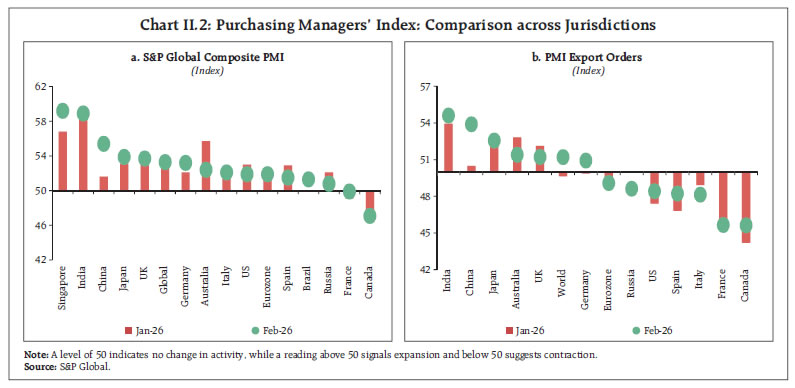
The conflict in Middle East and fresh trade investigations by the US have resulted in increased volatility in the global markets. The second advance estimates of GDP for 2025–26 indicate sustained resilience of the Indian economy. High frequency indicators signal towards economic activity gaining momentum in February. CPI headline inflation picked up in February on account of food and beverages. System liquidity has remained comfortable and the total flow of financial resources to the commercial sector rose, with a rise in financing from both the bank and non-bank sources. India's foreign exchange reserves remain adequate to provide cushion against external shocks. Introduction Global uncertainty, after retreating for four consecutive months, rose again in February with an uptick in trade policy uncertainty, following the verdict of the US Supreme Court on import tariffs. Since end-February, the geopolitical tensions in the Middle East intensified into a major conflict causing significant disruption to key oil infrastructure and critical energy corridors due to the closure of Strait of Hormuz. Alongside, US administration has also launched fresh probes into trade practices by major trading partners. All these factors have resulted in increased volatility across the various commodity and financial markets. Global commodity markets came under intense pressure from supply disruptions across trade in crude oil, natural gas, and fertilisers. The International Energy Agency categorised it as "the largest supply disruption in the history of the global oil market".1 Brent crude oil prices exhibited volatility with prices moving from US$ 78 per barrel to US$ 112.2 per barrel in March.2 Besides the markets for fuel products and LNG, critical industrial inputs like aluminium and urea were also adversely affected. Reverberations of the energy shock transmitted rapidly to the financial markets. Equity markets came under selling pressures in March with the decline more pronounced in energy-importing economies, particularly in Europe and Asia. Bond markets repriced, with US sovereign yields hardening. Emerging market currencies came under pressure amidst heightened risk aversion while the US dollar strengthened on safe-haven demand. In this environment of heightened uncertainties, major systemic central banks kept policy rates unchanged during February–March. The second advance estimates of GDP for 2025-26, with the new base year 2022-23, indicate sustained resilience in the Indian economy. The growth was driven by strong domestic demand, with private final consumption expenditure and investment activity remaining robust. The quarterly growth also remained high at 7.8 per cent in Q3:2025-26. High frequency indicators signal towards economic activity gaining momentum in February. Both urban and rural markets supported strong demand, aided by lower income tax and GST rates, cash flows from the kharif harvest, and the wedding season. Retail sales of two-wheelers, passenger vehicles, and tractors reached their highest-ever levels for February. Agriculture remained on a strong footing, with the second advance estimates placing foodgrain production at a record level in 2025-26. Industrial activity continued to register robust growth and the services sector demonstrated resilience. Corporate sector performance also improved with listed private non-financial companies reporting stronger operating profit growth in Q3:2025-26, driven particularly by manufacturing and information technology firms. Headline consumer price index (CPI) inflation edged up in February. Food and beverages inflation increased as vegetable prices came out of deflation. On the other hand, core inflation, across various measures, remained stable. System liquidity has remained comfortable since February on account of increased government spending and RBI's liquidity augmenting measures, though advance tax and GST related outflows have resulted in some moderation since March 16. The weighted average call rate (WACR) – the operating target of monetary policy – hovered in the lower half of the policy corridor till first half of March and then inched up closer to the repo rate on account of moderation in surplus liquidity. The yields on treasury bills remained rangebound. Yields on commercial papers and interest rate on certificates of deposit, however, remained elevated with the edging up in the latter partly reflecting the increased issuances by banks to bridge the year-end funding gaps amidst the rollover of maturing papers. The Middle East conflict led to the firming up of yields on dated government securities. Bank deposit and credit continued to sustain double digit growth. During 2025-26 so far (February 28), the total flow of financial resources to the commercial sector rose, with a rise in financing from both the bank and non-bank sources. Indian equity markets corrected in the second half of February amidst persistent selling of IT stocks after some advance in the first half. The conflict in the Middle East since end-February has triggered a broad-based sell-off across sectors. The Rupee has come under renewed pressures in March amidst FPI outflows. India's current account deficit (CAD) went up marginally in Q3:2025-26 from last year, primarily driven by a higher merchandise trade deficit. Despite the capital outflows, India's foreign exchange reserves remain adequate to provide cushion against external shocks. Set against this backdrop, the rest of the article is structured into four sections. Section II covers the rapidly evolving developments in the global economy. Section III provides an assessment of domestic macroeconomic conditions. Section IV encapsulates financial conditions in India, while Section V presents the concluding observations. The analysis in this article primarily pertains to the month of February and as such does not cover the full impact of the Middle East conflict. The impact of the conflict would be covered more in the next issue once the data/information for the month of March are available. II. Global Setting Measures of uncertainty, including trade and policy uncertainties, edged up in February after the US Supreme Court struck down earlier import tariffs and the US administration imposed fresh global duties on all countries. The global environment saw a drastic deterioration towards the end of the month, as geopolitical tensions in the Middle East intensified leading to a major conflict between the US-Israel and Iran. The conflict disrupted critical energy supply routes, including the Strait of Hormuz, and damaged key energy complexes in the Middle East. Reflecting these developments, global financial markets registered a sharp increase in volatility in March (Chart II.1).3 The global composite PMI rose to a 21-month high in February, with economic activity broadly returning to its long-run trend. Robust expansion in business activity was supported by services sector growth and marked improvement in manufacturing. Broad-based growth was witnessed across major AEs and EMDEs (Table II.1 and Chart II.2a). New export orders crossed the neutral zone and turned expansionary for the first time since April 2025, reversing the sentiments of the previous ten months driven by heightened trade policy uncertainty. New export orders, however, displayed divergent trends across regions. They remained in contraction across most AEs, except the UK, Japan, Germany and Australia. Among major EMDEs, export orders in India and China expanded at a robust pace, while it contracted in Russia (Table II.1 and Chart II.2b). In February, global commodity prices exhibited divergent trends across segments. The World Bank Commodity Price Index declined, while the Food and Agriculture Organization's Food Price Index increased, snapping a five-month declining streak (Chart II.3a). Gold prices strengthened during February amidst elevated geopolitical uncertainty but moderated in March as safe-haven demand shifted towards the US dollar and fixed income assets. 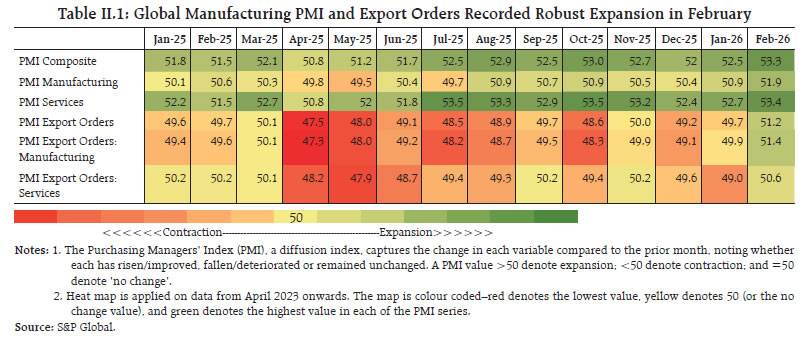
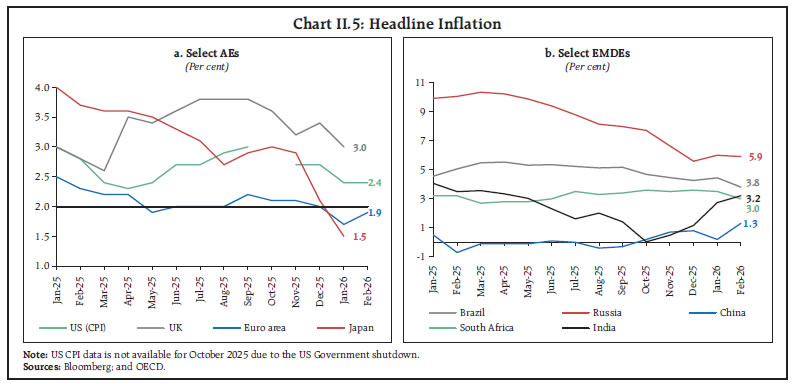
 Commodity price movements, as indicated by high-frequency indicators, underwent a sharp change in March following the start of the military conflict in the Middle East. The upturn in commodity prices has been broad-based, accompanied by an intensification of price volatility. The Bloomberg Commodity Index spiked in March so far, driven by sharp increases in prices of energy and a modest rise in agricultural commodities (Chart II.3b). Aluminium prices, which were already elevated, surged further amidst supply concerns, due to smelter closures and force majeure declarations by producers in the Middle East, at a time when global inventories were near historic lows. Brent crude oil prices surged to an intraday peak of USD 119.5 per barrel on March 9. Marked by high volatility, prices continued to climb despite the agreement by International Energy Agency member countries to release emergency oil reserves to mitigate shortages. Aviation fuel prices spiked along with sharp increases in gasoline and LPG prices on refinery outages. Given the Middle East's significant role in global fertiliser production and exports, supply disruptions due to the conflict led to a surge in urea prices (Chart II.4). 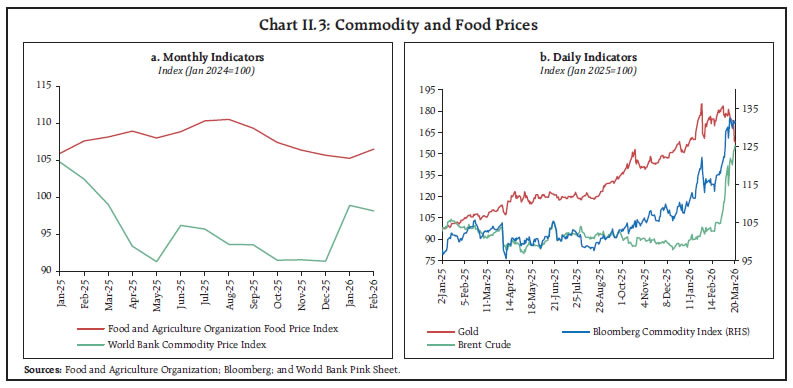 Inflation, in February, exhibited mixed movements across major AEs and EMDEs. In the UK, inflation eased to its lowest level since March 2025, led by softer increases in transport and food prices, while inflation in the US remained steady. Japan's inflation continued to ease, driven by softer food prices. Euro area inflation rose from a 16-month low in the previous month, driven by a notable acceleration in services inflation (Chart II.5a). Among major EMDEs, China's CPI inflation rose to its highest level since January 2023, driven primarily by stronger consumer spending during this year's Lunar New Year festivities. CPI inflation in Brazil declined on account of easing food prices. In Russia, though inflation moderated, it remained elevated. South Africa's inflation fell to its lowest level since June 2025 (Chart II.5b). In March, the widening conflict in the Middle East is expected to increase upside risks to global inflation across major economies, as surging energy prices and potential transport disruptions to key shipping routes could renew supply-side pressures. 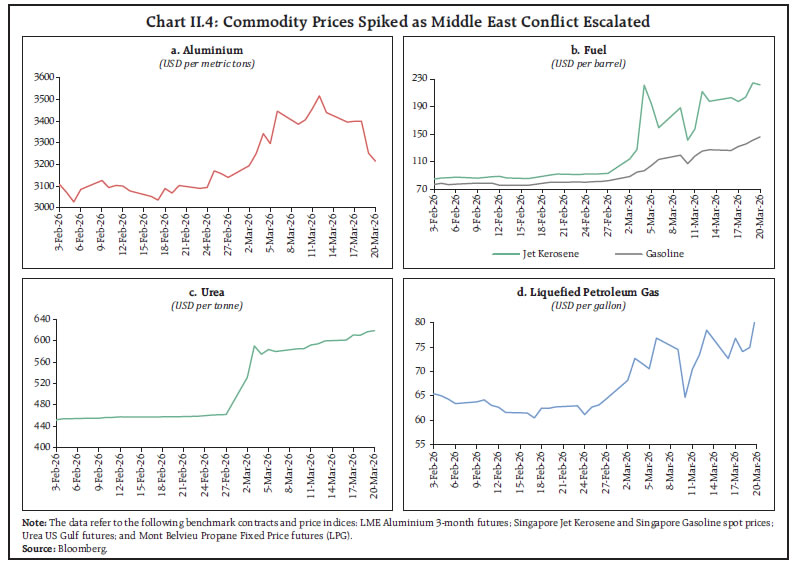
 Global equity markets in February registered range-bound movement (Chart II.6a). Euro area equities advanced on signs of an economic pick-up and portfolio reallocation away from the US stocks. Japanese equities posted gains on expectations of political stability and pro-growth policies. Chinese stocks rose on policy support and easing trade tensions. In contrast, the US S&P 500 declined moderately amidst concerns over high valuation of artificial intelligence (AI) companies and weaker-than-expected Q4:2025 growth. In March, however, all major global equity indices came under selling pressure following the Middle East crisis. 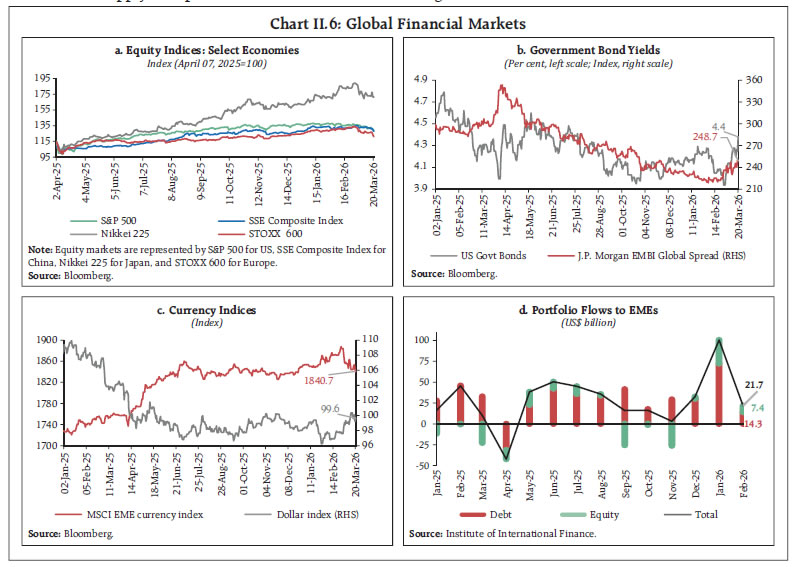 The US 10-year Treasury yield declined in February following a softer-than-expected inflation print, with the fall reinforced by safe-haven demand amidst volatility in stocks of AI companies and renewed trade policy uncertainty. Yields rose sharply in March as inflationary risks from the Middle East conflict took the centre stage, though safe-haven demand for the US securities cushioned it to some extent. The emerging market bond yields spread remained broadly steady for most of February due to softer US yields and emerging geopolitical risks. In March, the spreads widened on reassessment of risks as tensions intensified (Chart II.6b). The US dollar index generally remained range-bound in February, but it strengthened sharply in March amidst safe-haven demand for US assets (Chart II.6c). Portfolio flows to emerging markets declined sharply in February amidst a deterioration in global risk sentiment, prompting a retreat from emerging markets (Chart II.6d). In February–March, most systemic central banks maintained a status quo on interest rates, reflecting persistent upside risks to inflation and lingering geopolitical uncertainties (Chart II.7). In February, among AEs, the UK, the Euro area, New Zealand and South Korea kept their policy rates unchanged, while Australia raised its benchmark rate as inflation increased to its highest level since August 2024. Among major EMDEs, Brazil, China, Indonesia and Mexico kept their policy rates unchanged. In March so far, major AEs including the US, the UK, the Euro area, Japan, Switzerland, Sweden, and Canada kept their policy rates unchanged, while Australia raised its rate by 25 bps for the second consecutive month. Among major EMDEs, China, Malaysia, and Indonesia kept rates unchanged, while Brazil and Russia cut their policy rates. III. Domestic Developments The second advance estimates of gross domestic product (GDP) for 2025-26, with the new base year 2022-23, indicate continued resilience in growth in line with the previous estimates. High frequency indicators signal economic activity gaining momentum in February. Industrial activity recorded robust growth, while the services sector remained resilient. Aggregate Demand The new GDP series with the revised base year of 2022-23 was released on February 27, 2026. The new series has improved the economic estimates by integrating several new data sources such as the goods and services tax (GST), public financial management system (PFMS), annual survey of unincorporated sector enterprises (ASUSE), periodic labour force survey (PLFS) and e-Vahan. Key reforms include revising the base year of GDP from 2011–12 to 2022–23, strengthening the measurement of the informal and services sectors, use of double deflation for manufacturing sector and introduction of supply and use tables to reduce statistical discrepancies (For further details see Annex Box A). According to the new series, the Indian economy remained robust, with real GDP growth accelerating to 7.6 per cent in 2025-26 from 7.1 per cent a year ago amidst heightened global uncertainty. The growth was driven by strong domestic demand, with private final consumption expenditure maintaining momentum and investment activity remaining robust. The quarterly growth also remained high at 7.8 per cent in Q3:2025-26, despite moderation in net exports due to dampening of merchandise exports following weak global trading environment including the higher US tariffs (Chart III.1 and Annex Table A2).4 Economic activity picked up pace in February, as evidenced by high-frequency indicators of fuel consumption, trade and logistics. E-way bills continued to exhibit double-digit growth supported by GST rate rationalisation. GST revenue strengthened, reflecting sustained demand and economic activity.5 Petroleum consumption recorded stronger growth, supported by a favourable base effect. Digital payments sustained steady growth in terms of both transaction value and volume. However, electricity demand moderated, primarily due to lower usage of heating appliances amidst above normal winter temperatures during February. Toll collections continued with the declining trend after the introduction of the FASTag Annual Pass scheme in August 20256 (Table III.1). Both urban and rural markets supported strong demand, aided by lower income tax and GST rates, cash flows from the kharif harvest, and the wedding season. The automobile sector continued to build on the positive momentum following the GST reforms. Retail sales of two-wheelers, passenger vehicles, and tractors reached their highest-ever levels for February (Table III.2).
The all-India unemployment rate declined marginally in February, driven by improvement in urban areas.7 The labour force participation rate remained steady, while worker population ratio marginally increased, due to a rise in both rural and urban areas. The PMI employment indices for manufacturing and services edged up in February. The Naukri JobSpeak Index also showed double digit growth in white-collar hiring, led by insurance, BPO/ ITES and real estate. The demand for work under the Mahatma Gandhi National Rural Employment Guarantee Scheme (MGNREGS) continued to decline for the eighth consecutive month, underscoring the resilience of rural employment conditions and alternate job opportunities (Table III.3). 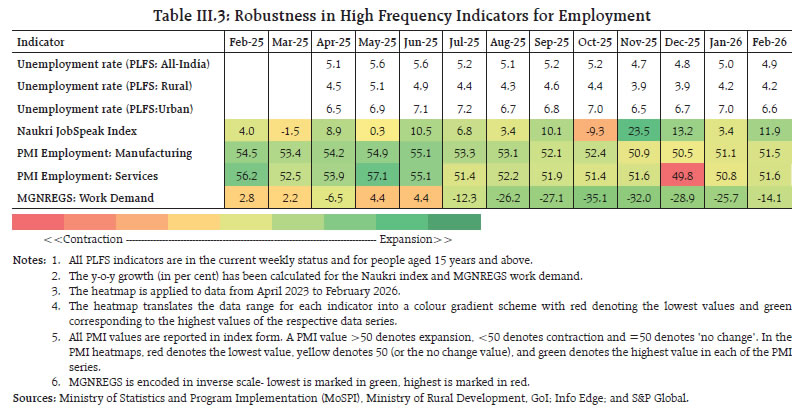 During April-January 2025-26, all the key deficit indicators of the Centre as per cent of revised estimates (RE) were lower than the corresponding period of the previous financial year (Chart III.2a).8 The lower fiscal deficit during April-January 2025-26 was primarily driven by double digit growth in net tax revenue, and a modest growth in revenue expenditure.9 Growth in net tax revenue was higher due to the accelerated growth in corporation tax, customs and union excise duties.10 Capital expenditure grew at more than twice the pace recorded in the corresponding period of the previous year, reflecting government's focus on expenditure quality. The deficit indicators of states during April-January 2025-26, as a proportion of budget estimates for the financial year, are higher than the last year (Chart III.2b). The higher gross fiscal deficit was primarily on account of moderation in revenue receipts relative to their budget estimates. Within revenue receipts, SGST growth decelerated, while state excise remained strong. States' revenue expenditure grew at a slower pace than a year ago, while capital expenditure recorded a turnaround from last year's contraction. Trade India's merchandise exports and imports have expanded during 2025-26 so far.11 During 2025-26 (April-February), the merchandise trade deficit stood higher than the last year, primarily driven by petroleum products, electronic goods, and gold.12 In February 2026, trade deficit moderated on a sequential basis. However, when compared to February 2025, the merchandise trade deficit registered an increase reflecting a sharp rise in imports alongside marginal contraction in exports (Chart III.3).13 The high expansion of imports was primarily driven by triple-digit growth in gold imports. Imports from Switzerland surged mainly due to gold imports, while those from Russia contracted due to crude oil diversification. Contraction in total exports was mainly led by petroleum products. Exports to the US and the Netherlands contracted, while exports to China continued to grow in double digits.14 Net services exports grew at a healthy pace in January, with exports rising and imports declining (Chart III.4).15 Growth in business, software, and travel fuelled services exports while decline in transportation led to a contraction in services imports. Aggregate Supply On the supply side, real gross value added (GVA) growth firmed up to 7.7 per cent in 2025-26 from 7.3 per cent a year ago, propelled by a buoyant services sector and an improvement in the industrial activity. The real GVA growth remained strong at 7.8 per cent in Q3:2025-26. Services growth strengthened with a broad-based expansion across trade, transport and hotels and restaurants; and financial, real estate and professional services. Industrial GVA growth surged led by strong manufacturing sector performance. Improved profitability of listed manufacturing firms supported the growth in manufacturing. Growth in agriculture and allied activities moderated in Q3 (Chart III.5 and Annex Table A3).
Agriculture The second advance estimates of the agriculture crop production (kharif and rabi) placed total foodgrains production at a record level in 2025-26 (Chart III.6).16 This year is marked by the record production of kharif rice, wheat, maize, kharif groundnut, rapeseed and mustard, and sugarcane. Additionally, based on the first advance estimates, the horticulture crops also recorded highest ever production in 2025-26.17 Monthly Indicators of Industrial Activity Industrial activity, as measured by the year-on-year change in the Index of Industrial Production (IIP), moderated in January from the 26-month high recorded in the previous month. The manufacturing sector decelerated, as gains in metals and motor vehicles were partly offset by weaker performance in pharmaceuticals, apparels, and textiles. Infrastructure/construction goods registered their fastest growth since mid-2023, reflecting sustained momentum in government capital expenditure and public infrastructure projects. In February, the index of eight core industries moderated but continued to show resilience. High-frequency indicators of industrial activity for February remained robust. Manufacturing PMI increased to a four-month high, on account of higher output and new orders as stronger domestic demand supported fresh business inflows. Automobile production continued to record strong growth across major segments [Table III.4]. At the aggregate, the operating profit growth of listed private non-financial companies improved during Q3:2025-26, primarily driven by stronger performance of manufacturing and IT sector companies (Chart III.7a). Among major industries, non-ferrous metals, electrical machinery, automobiles, food products and cement industries recorded double digit growth in their operating profits (Chart III.7b). Above normal temperatures in most parts of the country may raise energy consumption during the summer months.18 India's rapid expansion of electricity generation from renewable sources, particularly solar power, could play a crucial role in meeting the country's rising power demand19 (Chart III.8). Monthly Indicators of Services Activity India's services sector remained resilient in February. Services PMI continued to record strong expansion. Commercial vehicle sales grew at their fastest pace in over three years supported by improved freight availability, steady e-commerce activity, and infrastructure-driven demand. Port cargo traffic moderated due to contractions in thermal coal, iron ore and fertiliser cargo (Table III.5).
Inflation CPI headline inflation20 increased to 3.2 per cent (y-o-y) in February from 2.7 per cent in January 2026, primarily on account of food and beverages. Core (CPI excluding food and fuel) inflation was steady at 3.4 per cent. Excluding precious metals, core inflation was stable at a lower 1.9 per cent, indicating muted underlying price pressures (Chart III.9). Within food and beverages division, increase in inflation was driven by 'meat, fresh, chilled or frozen', 'fish and other seafood', 'oils and fats', 'fruits and nuts', 'ready-made food and other food products' and 'vegetables, tubers, plantains, cooking bananas and pulses'. Vegetable prices came out of deflation in February while cereal prices recorded a deflation of (-) 0.3 per cent. 'Paan, tobacco and intoxicants' registered an uptick in inflation due to a hike in GST rates effective February 1, 2026. Precious metals under 'personal care, social protection and miscellaneous goods and services' continued to remain the major drivers of core inflation (Chart III.10). In terms of spatial distribution, inflation in both urban and rural areas edged up in February. Overall, a broad-based rise in inflation was observed across states/UTs. However, majority of states continued to record inflation below 4 per cent (Chart III.11). High-frequency food prices data up to 19th March 2026 point towards stable rice prices (month-over-month) even as wheat prices declined. Among pulses, an increase is observed across tur/arhar and moong dal. There is a broad-based increase in edible oils prices led by sunflower oil and groundnut oil. On the other hand, among major vegetables, potato, tomato and onion prices softened significantly (Chart III.12).
Retail selling prices of petrol and diesel remained unchanged in March 2026 (up to 19th) while they increased for kerosene and LPG (Table III.6). The services PMI indicated a sharp increase in the rate of expansion of input prices in February. Input cost in manufacturing remained in expansion zone but below the long-term average. The rate of expansion in output prices picked up for manufacturing firms, while it moderated for services firms (Chart III.13). | Table III.6: Petroleum Products Prices | | Item | Unit | Domestic Prices | Month-over-month (per cent) | | Mar-25 | Feb-26 | Mar-26^ | Feb-26 | Mar-26^ | | Petrol | ₹/litre | 101.0 | 101.2 | 101.2 | 0.0 | 0.0 | | Diesel | ₹/litre | 90.5 | 90.5 | 90.5 | 0.0 | 0.0 | | Kerosene (subsidised) | ₹/litre | 46.2 | 44.1 | 46.8 | -2.2 | 6.2 | | LPG (non-subsidised) | ₹/cylinder | 813.3 | 863.3 | 904.3 | 0.0 | 4.8 | ^: For the period March 1-19, 2026.
Note: Other than kerosene, prices represent the average Indian Oil Corporation Limited (IOCL) prices in four major metros (Delhi, Kolkata, Mumbai and Chennai). For kerosene, prices denote the average of the subsidised prices in Kolkata, Mumbai and Chennai.
Sources: IOCL; Petroleum Planning and Analysis Cell (PPAC); and RBI staff calculations. |
IV. Financial Conditions Overall financial conditions tightened from the second half of February till March so far (up to 17th), driven by changes in the forex and equity markets segments (Chart IV.1). System liquidity eased considerably in February due to increased government spending and the RBI's liquidity augmenting measures.21 Liquidity conditions continued to remain comfortable in March.22 Reflecting the prevailing easy conditions, the net absorption under the liquidity adjustment facility remained high in February and the first half of March. System liquidity, however, moderated from March 16 on account of advance tax and GST related outflows (Chart IV.2).23 Marginal standing facility usage was low and stable, suggesting that day-to-day liquidity mismatches were minimal and well managed.
Money Market The weighted average call rate (WACR) hovered in the lower half of the policy corridor during February and first half of March (Chart IV.3a).24 Overnight rates in the collateralised segments – measured by the benchmark secured overnight rupee rate (SORR) – tended to trade below the policy corridor. WACR inched up closer to the repo rate in the second half of March (up to March 18) amidst moderation in surplus liquidity. Money market rates beyond the overnight segment, comprising certificates of deposits and commercial papers, however, remained elevated. The rates on certificates of deposit edged up as banks increased issuances to bridge the year-end funding gaps amidst the rollover of maturing papers. Yields of treasury bills, on the other hand, remained rangebound (Chart IV.3b).25 The average risk premium in the money market (the spread between the yields on 3-month commercial paper and 91-day treasury bills) remained broadly unchanged. Government Securities (G-Sec) Market In the other fixed-income segments, dated government security (G-Sec) yields remained largely rangebound with a softening bias in February, but firmed up thereafter on account of the Middle East conflict and the rise in crude oil prices (Chart IV.4a).26 The yields rose more at the shorter end (Chart IV.4b). Corporate Bond Market Corporate bond yields and spreads remained elevated till the middle of February, though some moderation was observed subsequently across tenors and the rating spectrum (Table IV.1). Corporate bond issuances declined in January 2026 as compared with December 2025. On a cumulative basis, the total issuances have remained lower in the current financial year till January than in the same period last year.27 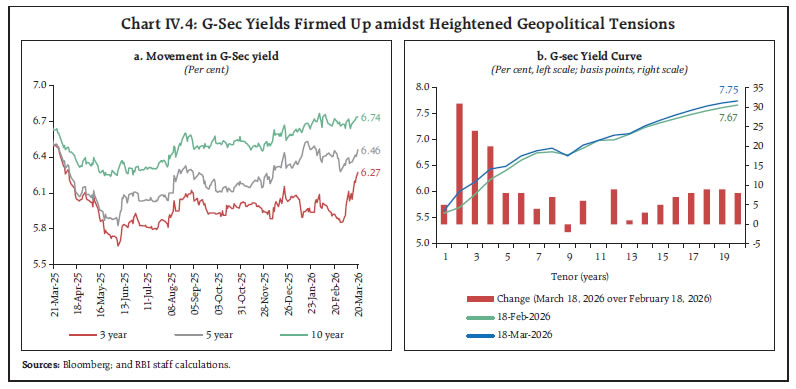
| Table IV.1: Corporate Bonds Yields and Spreads Softened | | | Interest Rates
(Per cent) | Spread (bps) | | (Over Corresponding Risk-free Rate) | | Instrument | January 16, 2026 – February 13, 2026 | February 16, 2026 – March 18, 2026 | Variation | January 16, 2026 – February 13, 2026 | February 16, 2026 – March 18, 2026 | Variation | | 1 | 2 | 3 | (4 = 3-2) | 5 | 6 | (7 = 6-5) | | (i) AAA (1-year) | 7.54 | 7.31 | -23 | 182 | 164 | -18 | | (ii) AAA (3-year) | 7.31 | 7.20 | -11 | 123 | 110 | -13 | | (iii) AAA (5-year) | 7.51 | 7.42 | -9 | 92 | 94 | 2 | | (iv) AA (3-year) | 8.29 | 8.12 | -17 | 220 | 202 | -18 | | (v) BBB (3-year) | 11.91 | 11.79 | -12 | 582 | 569 | -13 | Note: Yields and spreads are computed as averages for the respective periods.
Source: FIMMDA. | Money and Credit During February 2026, reserve money (adjusted for CRR) largely maintained its growth trajectory, with the currency in circulation expanding at a robust pace since October 2025.28 The growth in money supply also remained high and above the last year's level of expansion (Chart IV.5).29 Scheduled commercial banks' (SCBs') credit and deposit continued to grow in double digits during the month, sustaining the expansion of credit demand since the second half of 2025-26 (Chart IV.6).30 Along with bank credit, the finance from non-bank sources also expanded in 2025-26 (up to February 28). The total flow of financial resources to the commercial sector increased to ₹39.2 lakh crore from ₹29.5 lakh crore a year ago (Table IV.2a). Non-bank sources − corporate bond issuances, and foreign direct investment to India31− showed a marked increase during the year so far. As of February 28, the total outstanding credit to the commercial sector rose by 14.7 per cent, with non-bank sources registering a growth of 15.6 per cent (Table IV.2b). 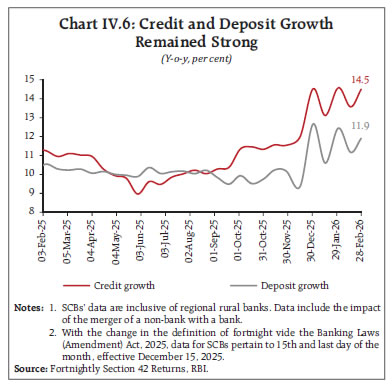
| Table IV.2a: Increased Flow of Financial Resources to the Commercial Sector | | (₹ lakh crore) | | Source | April-March | Up to February 28 | | 2023-24 | 2024-25 | 2024-25 | 2025-26 P | | A. Non-Food Bank Credit | 21.40 | 17.98 | 16.74 | 24.64 | | B. Non-Bank Sources (B1+B2) | 12.64 | 17.10 | 12.72 | 14.58 | | B1. Domestic Sources | 10.20 | 13.86 | 9.70 | 10.31 | | B2. Foreign Sources | 2.43 | 3.25 | 3.01 | 4.28 | | C. Total Flow of Resources (A+B) | 34.04 | 35.09 | 29.46 | 39.22 | P: Provisional.
Notes: 1. Figures in the columns might not add up to the total due to rounding off of numbers.
2. For detailed notes and data, please refer to Current Statistics Table No: 18(a).
Sources: RBI; SEBI; AIFIs; and RBI staff calculations. | In January 2026, non-food bank credit32 growth was well spread out across sectors, though some easing has been observed in agriculture and industry (Chart IV.7). Within industries, lending to micro, small and medium enterprises (MSMEs) continued to improve. Services sector credit growth sustained its momentum, driven by robust bank lending to NBFCs and commercial real estate, despite a moderation in credit growth to trade and professional services segments. The growth in personal loans was led by housing, gold and vehicle segments. | Table IV.2b: Higher Outstanding Credit to the Commercial Sector | | (₹ lakh crore; Figures in parentheses are y-o-y percentage changes) | | Source | At End-March | As on February 28 | | 2024 | 2025 | 2025 | 2026 P | | A. Non-Food Bank Credit | 164.09 | 182.07 | 180.83 | 206.71 | | | (20.2) | (11.0) | (11.1) | (14.3) | | B. Non-Bank Sources | 77.57 | 88.86 | 85.37 | 98.70 | | (B1+B2) | (4.2) | (14.6) | (13.7) | (15.6) | | B1. Domestic Sources | 56.59 | 66.37 | 62.55 | 73.11 | | | (4.9) | (17.3) | (15.5) | (16.9) | | B2. Foreign Sources | 20.98 | 22.49 | 22.82 | 25.59 | | | (2.4) | (7.2) | (9.2) | (12.2) | | C. Total Credit (A+B) | 241.66 | 270.94 | 266.20 | 305.41 | | | (14.5) | (12.1) | (11.9) | (14.7) | P: Provisional.
Notes: 1. Figures in the columns might not add up to the total due to rounding off of numbers.
2. Data on non-bank sources excludes issuances of equities and hybrid instruments under domestic sources and foreign direct investment in equities under foreign sources.
3. Flows based on outstanding data may not tally with the flows provided in Table IV.2a due to:
(a) Merger of HDFC Limited with HDFC Bank on July 1, 2023;
(b) Conversion of some Housing Finance Companies into Non-Banking Financial Companies; and
(c) Valuation effect in case of foreign sources.
4. For detailed notes and data, please refer to Current Statistics Table No: 18(b).
Sources: RBI; SEBI; AIFIs; and RBI staff calculations. | Deposit and Lending Rates During the current easing cycle from February 2025 to January 2026, the weighted average lending rates of scheduled commercial banks (SCBs) on both fresh and outstanding rupee loans decreased by 66 basis points (bps) and 83 bps, respectively. On the deposit side, interest rates on fresh term deposits have also fallen; however, pass-through to the interest rates on outstanding deposits has been moderate (Table IV.3). During February 2025 - January 2026, the decline in the weighted average lending rate on fresh and outstanding rupee loans was higher for private banks than public sector banks (Chart IV.8). On the deposit side, the extent of transmission wasbroadly similar across both groups. The reductions in deposit and lending rates have been higher for foreign banks. 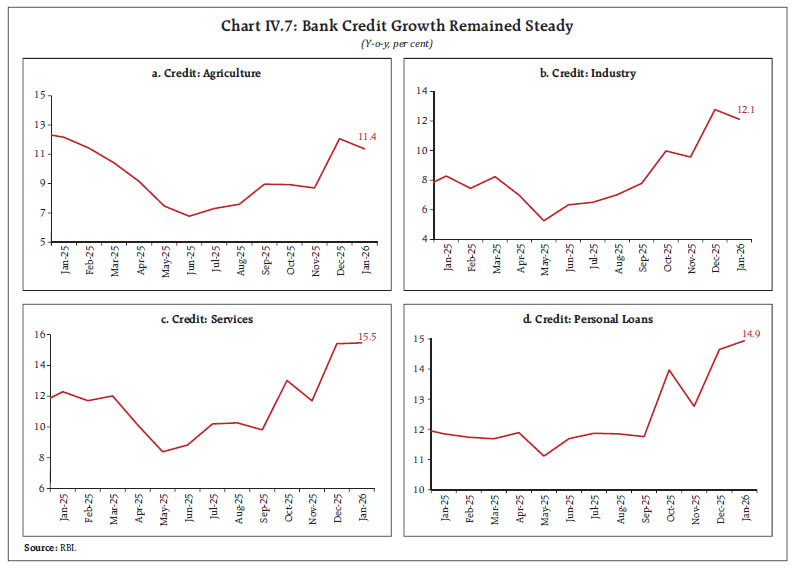
| Table IV.3: Banks' Deposit and Lending Rates during the Ongoing Easing Cycle | | (Basis points) | | | | Term Deposit Rates | Lending Rates | | Period | Repo Rate | WADTDR - Fresh Deposits | WADTDR - Outstanding Deposits | EBLR | 1-Year MCLR (Median) | WALR - Fresh Rupee Loans | WALR - Outstanding Rupee Loans | | Overall | Interest Rate Effect# | | (1) | (2) | (3) | (4) | (5) | (6) | (7) | (8) | (9) | Tightening Period
May 2022 to Jan 2025 | 250 | 259 | 206 | 250 | 175 | 182 | 191 | 115 | Easing Phase
Feb 2025 to Jan 2026 | -125 | -96 | -45 | -125 | -60 | -66 | -81 | -83 | #: Calculated at January 2025 weights.
WALR: Weighted average lending rate; WADTDR; Weighted average domestic term deposit rate;
MCLR: Marginal cost of funds-based lending rate; EBLR: External benchmark-based lending rate.
Note: Data on EBLR pertain to 32 domestic banks.
Source: RBI. |
Equity Markets Indian equity markets, buoyed by the India-US trade deal and strong corporate earnings results for Q3:2025-26 in the first half of February, started retreating in the second half on persistent selling of IT stocks. Following the escalation of geopolitical tensions in the Middle East in end-February, domestic equity markets saw sharp declines. A broad-based sell-off across all sectors has led to a massive jump in the India Volatility Index in March (Chart IV.9).33 External Sources of Finance During April 2025 – January 2026, gross foreign direct investment (FDI) inflows remained strong, higher than the corresponding period a year ago.34 Sector-wise, manufacturing received the highest share of equity inflows, followed by computer services, electricity and other energy, and financial services - these sectors together accounted for over 60 per cent of total inflows. However, net FDI during April 2025 – January 2026 remained negative for the fifth consecutive month, owing to higher repatriation and outward FDI from India.35 Around 75 per cent of the outward FDI flows were directed to the US, Singapore, the UK, and the UAE during the period (Chart IV.10). After staging a comeback in February 2026, foreign portfolio investments (FPIs) turned net sellers again in March 2026, driven by deteriorating global investor sentiment following the conflict in the Middle East (Chart IV.11).36 Offshore fund raising through external commercial borrowings during April-January 2026 indicated a slowdown in terms of registrations and net inflows, over the corresponding period of last year (Chart IV.12).37 Around 43 per cent of the borrowings mobilised during this period were earmarked for capital expenditure by corporates. India's current account deficit (CAD) stood higher in Q3:2025-26 than the same period last year, primarily driven by a higher merchandise trade deficit (Chart IV.13).38 In terms of external financing needs, net capital flows fell short of financing the CAD, leading to a depletion of US$ 24.4 billion in the foreign exchange reserves (on a BoP basis) in Q3:2025-26.
Nevertheless, India's foreign exchange reserves remain adequate, providing cover for goods imports for 11.2 months and around 95 per cent of the external debt outstanding (Chart IV.14).39
Foreign Exchange Market The Indian rupee (INR) appreciated against the US dollar in the first week of February amidst foreign portfolio inflows and the announcement of the interim India-US trade deal and remained broadly stable thereafter. In March so far (up to March 20th), the INR came under renewed depreciation pressures amidst elevated global market volatility due to the Middle East conflict (Chart IV.15). In real effective terms, the Indian rupee depreciated in February due to depreciation of INR in nominal effective terms and relatively lower inflation in India vis-à-vis its major trading partners (Chart IV.16).
V. Conclusion The renewed conflict in the Middle East and the US investigations into trade practices of key trading partners have brought uncertainties regarding global energy security, US import tariffs and global supply chains back to the centre stage. Prolonged period of war and high uncertainty would be detrimental to the broader global outlook, which was already in a state of flux prior to the recent events. For the domestic economy, given India's external dependence on crude oil, the evolving situation requires close monitoring and proactive measures to limit adverse spillovers even though it is mention-worthy that the capacity and resilience of the Indian economy to absorb external shocks have strengthened over time, buttressed by its strong growth, sound macroeconomic fundamentals and robust external sector buffers. In terms of energy security, India has progressively diversified its crude oil import sources and augmented its domestic refining capacity. Since the start of the conflict, several policy measures have been implemented to blunt the immediate impact of the disruptions in global fuel supply chains and to achieve more effective use of domestic capacity to meet shortfalls.40 The creation of an Economic Stabilisation Fund would further provide fiscal headroom and buffer to proactively respond to global headwinds.
Annex Box A: Base Year Revision for National Income Accounts: Salient Features The National Statistics Office (NSO) has released new GDP series with 2022-23 as the revised base year, incorporating several improvements, including the use of new data sources, broader sectoral coverage, and refined estimation and deflation methods. To illustrate, it (a) enriched measurement of corporate sector with the help of updated Ministry of Corporate Affairs (MCA) filings and survey-based annual estimates for the unincorporated sector; (b) updated consumption classification with the help of classification of individual consumption according to purpose (COICOP) 2018, (c) improved coverage of financial intermediation and public administration; (d) shift to either volume-based or double deflation methods from the single deflation method commonly used under the earlier base for obtaining constant price estimates; and (e) enhanced use of supply and use tables to narrow down the statistical discrepancy between the GDP estimated from the production and the expenditure sides (see details in Table A1). | Table A1: Key Changes in Revised Base Year Series and Their Implications | | Reform Theme | Focus Area | Change in 2022-23 Series | Implications | | I. Real Growth Measurement | Deflation methodology | Greater reliance on volume extrapolation/single extrapolation; adoption of double deflation in manufacturing | Real GDP reflects volume movements and cost structures better | | | Improved derivation of FISIM and net indirect taxes | Refined FISIM computation using volume and spread-based indicators; updated banking/NBFC data; volume extrapolation of subsidies and indirect taxes | Output better aligned with economic activity | | | Reducing statistical discrepancies | Enhanced use of supply and use tables | Improved estimation of GDP and components from the expenditure side | | II. Quarterly Compilation and Alignment | Use of new data sources | Greater use of GST outward supply and high-frequency indicators like e-way bills, natural gas consumption, e-vahanregistration, sector-specific administrative datasets | Quarterly series more data-driven, strengthening real-time macroeconomic assessment | | | Consistency with annual estimates | Improved benchmarking techniques to align quarterly and annual estimates | Smoother quarterly series | | III. Institutional Coverage | Corporate sector | Enhanced MCA-based allocation of multi-activity enterprises; expanded LLPs coverage | More accurate sectoral allocation; improved industry-wise value addition | | | Unincorporated/ Household sector | Direct annual estimates using ASUSE-PLFS | Improved measurement of informal manufacturing and services | | | Government sector | Revised pension treatment, imputation of employer-provided housing in government accounts; improved classification of government and autonomous units | Improved comparability over time and clearer sectoral allocation | | IV. Sectoral Coverage | Agriculture and construction | Updated input-output ratios; expanded crop-wise coverage | Better capture of value addition, especially in the unorganised segment | | | Private consumption estimates | Expanded PFCE classification based on COICOP 2018; improved survey-based inputs | More precise mapping of demand components | | | Household saving estimates | Incorporation of additional financial market data (including SEBI-based investments) | Improvement in estimation of net household financial saving | The new series shows a lower share of total consumption and higher share of investment as per cent of nominal GDP. On the supply side, the shares of agriculture and industry have increased, while that of services has moderated. There is also a shift within services output composition towards financial, real estate and professional services. Nominal GDP levels are lower by about 2 to 3 per cent than under the old base, raising several GDP-based macroeconomic ratios used for policy purposes. Furthermore, real GVA growth is higher than the real GDP growth, partly reflecting refinements in the treatment of net indirect taxes. |
Table A2: Real GDP Growth (at 2022-23 prices)
(Y-o-y growth, per cent) | | Components | Share in 2025-26
(percent) | Weighted Contribution
(percentage points) | 2024-25 | 2025-26 | 2023-24 (FE) | 2024-25 (FRE) | 2025-26 (SAE) | | 2023-24 | 2024-25 | 2025-26 | Q1 | Q2 | Q3 | Q4 | Q1 | Q2 | Q3 | Q4# | | I. Total | 66.0 | 3.4 | 3.9 | 5.0 | 6.3 | 5.8 | 6.2 | 5.3 | 8.6 | 7.8 | 8.1 | 5.7 | 4.9 | 5.9 | 7.5 | | Consumption Expenditure | | | | | | | | | | | | | | | | | Private | 55.7 | 3.3 | 3.3 | 4.3 | 6.1 | 5.6 | 6.0 | 5.6 | 9.2 | 8.0 | 8.7 | 5.1 | 5.8 | 5.8 | 7.7 | | Government | 10.2 | 0.1 | 0.7 | 0.7 | 7.5 | 7.0 | 7.6 | 3.6 | 5.8 | 6.6 | 4.7 | 9.4 | 0.6 | 6.5 | 6.6 | | II. Gross Capital Formation | 34.2 | 3.0 | 2.1 | 2.2 | 5.9 | 7.7 | 6.3 | 4.5 | 4.2 | 6.8 | 7.7 | 7.0 | 8.7 | 6.1 | 6.5 | | Fixed Investment | 32.0 | 2.3 | 2.1 | 2.3 | 6.5 | 6.6 | 6.3 | 6.2 | 4.9 | 8.4 | 7.8 | 7.2 | 7.3 | 6.4 | 7.1 | | III. Net Exports | -1.7 | 0.4 | 0.2 | -0.1 | -15.5 | -13.8 | 63.9 | 1.8 | -13.2 | 18.2 | -89.7 | 14.2 | 17.0 | 8.6 | -5.6 | | Exports | 22.2 | 0.2 | 1.5 | 1.5 | 7.3 | 3.1 | 10.5 | 5.4 | 6.6 | 10.2 | 5.6 | 4.0 | 0.7 | 6.6 | 6.5 | | Imports | 23.9 | -0.3 | 1.3 | 1.5 | 8.3 | 4.6 | 2.9 | 5.5 | 7.4 | 5.9 | 8.6 | 3.6 | -1.0 | 5.3 | 6.4 | | GDP | 100.0 | 7.2 | 7.1 | 7.6 | 7.5 | 6.6 | 7.4 | 7.0 | 6.7 | 8.4 | 7.8 | 7.3 | 7.2 | 7.1 | 7.6 | FE: Final Estimates; FRE: First Revised Estimates; SAE: Second Advance Estimates
*: Component-wise contributions to growth may not add up to GDP growth, as change in stock, valuables and discrepancies are not included.
#: Implicit growth rate for Q4:2025-26.
Source: NSO. |
Table A3: Real GVA Growth (at 2022-23 prices)
(Y-o-y growth, per cent) | | Sectors | Share in 2025-26
(percent) | Weighted Contribution
(percentage points) | 2024-25 | 2025-26 | 2023-24 (FE) | 2024-25 (FRE) | 2025-26 (SAE) | | 2023-24 | 2024-25 | 2025-26 | Q1 | Q2 | Q3 | Q4 | Q1 | Q2 | Q3 | Q4# | | I. Agriculture and allied activities | 17.7 | 0.5 | 0.8 | 0.5 | 2.6 | 4.1 | 5.8 | 3.8 | 4.2 | 2.3 | 1.4 | 2.1 | 2.6 | 4.2 | 2.4 | | II. Industry | 20.6 | 2.2 | 1.7 | 1.9 | 9.6 | 4.6 | 9.7 | 10.8 | 8.0 | 11.4 | 11.1 | 7.8 | 11.3 | 8.7 | 9.5 | | Mining and quarrying | 2.0 | 0.1 | 0.2 | 0.1 | 11.9 | 8.3 | 13.1 | 12.9 | 4.5 | 6.1 | 4.7 | 1.7 | 2.4 | 11.7 | 4.1 | | Manufacturing | 16.2 | 1.9 | 1.4 | 1.8 | 9.4 | 4.9 | 10.8 | 11.8 | 10.6 | 13.2 | 13.3 | 9.3 | 12.7 | 9.3 | 11.5 | | Electricity, gas, water supply and other utility services | 2.3 | 0.3 | 0.1 | 0.0 | 9.2 | -0.2 | 0.6 | 2.1 | -1.9 | 3.9 | 1.5 | 2.7 | 10.7 | 2.9 | 1.5 | | III. Services | 61.7 | 4.5 | 4.7 | 5.3 | 8.5 | 7.8 | 7.9 | 7.0 | 7.5 | 9.2 | 9.1 | 8.9 | 7.4 | 7.8 | 8.7 | | Construction | 9.0 | 0.9 | 0.7 | 0.6 | 8.7 | 6.1 | 6.4 | 8.0 | 5.4 | 8.7 | 6.6 | 7.6 | 9.9 | 7.3 | 7.1 | | Trade, hotels, transport, communication, and services related to broadcasting | 14.3 | 1.4 | 0.9 | 1.4 | 6.9 | 6.6 | 6.7 | 6.3 | 9.4 | 10.4 | 11.0 | 9.7 | 10.1 | 6.6 | 10.1 | | Financial, real estate and professional services | 26.1 | 1.4 | 2.5 | 2.5 | 10.3 | 10.0 | 11.1 | 8.8 | 8.8 | 9.9 | 11.2 | 9.6 | 5.5 | 10.0 | 9.9 | | Public administration, defence and other services | 12.2 | 0.9 | 0.6 | 0.7 | 6.9 | 6.0 | 4.4 | 3.2 | 4.3 | 6.9 | 4.5 | 7.5 | 6.8 | 5.0 | 5.8 | | IV. GVA at basic prices | 100.0 | 7.2 | 7.3 | 7.7 | 7.6 | 6.5 | 7.8 | 7.1 | 7.0 | 8.6 | 7.8 | 7.4 | 7.2 | 7.3 | 7.7 | FE: Final Estimates; FRE: First Revised Estimates; SAE: Second Advance Estimates
#: Implicit growth rate for Q4:2025-26.
Sources: NSO; and RBI staff calculations. |
|