|
The India-OECD-World Bank Regional Conference on Financial Education will take place
between March 4-6, 2013 in New Delhi, India. The Conference is co-organised by the
Reserve Bank of India (RBI), the Organisation for Economic Co-operation and Development
(OECD) and the World Bank.
Conference Venue
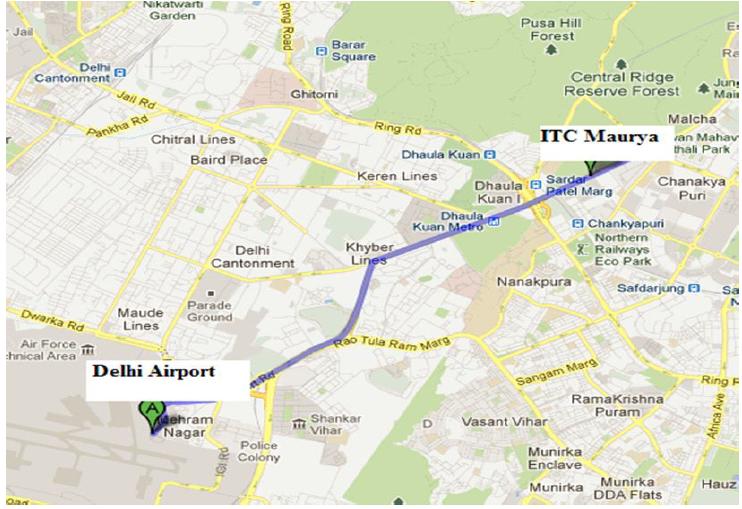
Kamal Mahal, Hotel ITC Maurya, New Delhi, India
Address: Diplomatic Enclave, Sardar Patel Marg, New Delhi 110 021, India
Tel: +91-11-26112233
Fax: +91-11-26115555
Email: conferences.itcmaurya@itchotels.in
Website: http://www.itchotels.in/hotels/itcmaurya.aspx
Participation
Please note that participation in the conference is by invitation only. If you have
already received the invitation to participate, you may kindly register through
the following link: http://www.rbi.org.in/rbioecdflc2013/Scripts/Registration.aspx
For further registration enquiries, you may contact:
For participants invited by RBI:
Ms. Alpana Killawala, RBI, email: alpanakillawala@rbi.org.in
Ms Sabeeta Badkar, RBI email: sabeetabadkar@rbi.org.in
Tel: +91-22-22660502
Fax: +91-22-22660358; and + 91-22-22703279
For participants invited by OECD:
Ms. Jennah Huxley, OECD, email: jennah.huxley@oecd.org
Mr. Andrea Grifoni, OECD, email: andrea.grifoni@oecd.org
Fax: +33-1-45241833 and +33-1-44306308
Fees
There are no fees for participation in the Conference
Meals and Social Events
Lunch and dinners will be offered to all the participants during the 3-day conference.
Dress Code
Dress code during the Conference will be business-casual.
Accommodation and Hotel Booking
Registered participants will be able to avail accommodation at negotiated rates
with Hotel ITC Maurya, New Delhi, where a block
booking has been made for this Conference. Rooms are also available at negotiated
rates for the Conference participants at Hotel Taj Palace
and Hotel Le Meridien.
Kindly note that the deadline for booking in all the three hotels is different and
is mentioned in the registration form. Please ensure to book your accommodation
well in advance. Accommodation reservations are to be made directly by filling out
a separate hotel reservation form and mailing to the hotel directly.
Neither RBI nor OECD would be responsible for any costs associated with the participants’
hotel rooms. Delegates will be responsible for hotel costs incurred, including room
charges, cancellation charges, as well as internet, telephone, fax and telex services
provided by the hotel. All bills should be settled directly with the hotel. A valid
credit card number is required for reservations to be confirmed. Hotels accept all
generally accepted credit cards and cash for payment.
Hotel Booking Form
ITC Maurya
Taj Palace
Hotel
Hotel Meridien
Working Language
The official language of the Conference is English. The Conference documentation
will be in English.
Passports and Visas for India
Valid passports are required for all delegates entering India. Please also note
that a visa is required for most nationalities to enter India and it is strongly
recommended that participants verify requirements with the embassy/consulate in
his/her country.
Apply for a visa online:
https://indianvisaonline.gov.in/visa/indianVisaReg.jsp
Registered participants who require an official invitation letter for visa purposes
should contact RBI by sending an email to flc2013@rbi.org.in
Transport
It is proposed to provide transport facilities for foreign participants from the
airport to the hotel on arrival and from the hotel to the airport for departure.
The hotel can also arrange for pick-up from and drop to the airport. Pre-paid air-conditioned
taxi services can also be availed at the airports (both international and domestic).
Further Enquiries
For further logistical information or enquiries about this Conference, please contact:
- Ms. Alpana Killawala, email: alpanakillawala@rbi.org.in
- Ms. Sabeeta Badkar, email: sabeetabadkar@rbi.org.in
Map of the Conference Venue Area
Insurance and Medical Cover
The Conference organisers do not take the responsibility for medical, travel or
life insurance, and participants are advised to hold valid international personal
insurance policies.
All delegates will be responsible for payment of any medical, surgical, dental,
hospital, or ambulance services that they require in New Delhi, India, and are advised
to make appropriate arrangements for insurance. However, first-aid medical service
will be available at the Conference venue.
India has one of the best hospital facilities. Private hospitals have ultra modern
medical equipments and acclaimed practitioners.
Water: Bottled water
is recommended.
Malaria/Yellow Fever/Dengue
For the list of countries requiring yellow fever vaccination to get into India,
kindly check http://www.immigrationindia.nic.in
(Select "Health Regulations")
Tipping: No specific
rules.
Electrical Supply
The voltage in India is between 220 to 240 Volts. Voltage converter will be required
if you are carrying a device that does not accept 240 volts at 50 hertz. Outlets
in India generally accept two round pins or three round pins arranged in a triangle.
If your appliance plug has any other shape, you will need a plug adapter.
Climate
In March you can expect plenty of sunny weather, fairly low levels of rainfall and
pleasant temperatures. Average maximum and minimum temperatures for March in New
Delhi are 30ºC and 15 ºC respectively.
Currency
The official currency is the Rupee. Major credit cards are accepted in majority
of the hotels, restaurants and shops. Banking hours in New Delhi are generally from
10.30 a.m. to 3.30 p.m. Currency exchange service is available at the hotels.
Communication
To make an international call, dial: 00 + country code + area code + telephone number.
To dial into India:
00-91-11-local number (New Delhi)
00-91-22-local number (Mumbai)
Time Difference
New Delhi is GMT + 5:30 throughout the year.
Smoking
Due to legislation, the policy is no smoking in any area of the Conference. Smoking
is, however, allowed on the smoking floors of the hotel.
Tourism Information about India
India, officially the Republic of India is the seventh-largest country in terms
of geographical area, the second-most populous country, and the largest democracy
in the world. Bounded by the Indian Ocean in the south, the Arabian Sea in the west,
the Bay of Bengal in the east and the Himalayas in the north, India is a sub-continent
with a 5000-year old history, a civilization representing unity in diversity. India
is a republic consisting of 28 states and 7 union territories and one of the fastest
growing economies. A pluralistic, multilingual, and multiethnic society, India is
also home to a diversity of wildlife in a variety of protected habitats.
Information about New Delhi
Through most of its history, Delhi has served as a capital of various kingdoms and
empires. In 1639 AD, the Mughal emperor Shahjahan built a new walled city in Delhi
which served as the capital of the Mughal Empire from 1649 until the Rebellion of
1857. The British captured Delhi in 1857 and the city replaced Kolkata as the seat
of British government in India in 1911. A new capital city, New Delhi, was built
to the south of the old city during the 1920s. When the British left India in 1947,
New Delhi became the national capital and seat of the government.
New Delhi is the second most populous metropolis in India after Mumbai. It is a
cosmopolitan city due to the multi-ethnic and multi-cultural presence of the vast
Indian bureaucracy and political system.
Another aspect of the culture of Delhi is the numerous fairs and festivals celebrated
in the city. It is this diversity that makes Delhi so lively and colourful.
Tourist Places
|
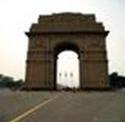
India Gate was built in 1931 in the memory of 90,000 soldiers who laid their
lives during World War I. Located at Rajpath, India Gate is 42 m high. It was designed
and constructed by Sir Edwin Lutyens. Following India's independence, India Gate
became the site of the Indian Army's Tomb of the Unknown Soldier, known as the Amar
Jawan Jyoti.
Raj Ghat, not far from the banks of the Yamuna river, has a simple black
marble memorial to Mahatma Gandhi, marking the spot where he was cremated following
his assassination in 1948. A commemorative ceremony takes place every Friday.
|
|
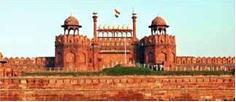
Red Fort is a massive monument built by the Mughal emperor Shah Jahan. Situated
on the embankment of river Yamuna, it took approximately 10 years to complete. The
Red Fort was supposed to be the fortress of Shah Jahan's new capital at Delhi, Shahjahanabad.
Today, the Red Fort serves as the venue for the Prime Minister's Speech that is
given on January 26, the Republic Day.
Jantar Mantar : At first sight, the "Jantar Mantar" appears like a gallery
of modern art. It is, however, an observatory. Sawai Jai Singh II of Jaipur (1699-1743),
a keen astronomer and a noble in the Mughal court, was dissatisfied by the errors
of brass and metal astronomical instruments. Under the emperor’s patronage, he set
on himself the task of correcting the existing astronomical tables and updating
the almanac with more reliable instruments. It consists of 13 architectural astronomy
instruments. The primary purpose of the observatory was to compile astronomical
tables, and to predict the times and movements of the sun, moon and planets.
Qutub Minar constructed with red sandstone and marble, it is the tallest
minaret in India with a height of 72.5 metres (237.8 ft), it contains 379 stairs
to reach the top and the diameter of the base is 14.3 metres.
Rajpath which was built similar to the Champs-Élysées in Paris, is the ceremonial
boulevard for the Republic of India located in New Delhi. The annual Republic Day
parade takes place here on January 26 each year.
|
|
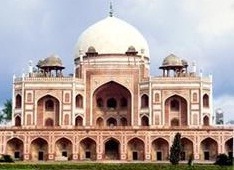
Humayun's Tomb is an excellent example of early Mughal architecture with
a bulbous dome, geometric patterns, high arches, spire, lattice stone windows, geometric
proportions, etc. This quiet but splendid edifice was the last resting place of
the second Mughal emperor. This building is set in the centre of a charbagh or four-garden
plan, which is further divided into smaller geometric sections by a network of water
channels and fountains - a reflection of Persian influence.
The National Museum is the largest museum in Delhi with around 2,00,000 exhibits
of exquisite art both foreign and Indian, giving a detailed insight into Indian
history and its cultural heritage.
Crafts Museum is situated in the Pragati Maidan area. It showcases over 20,000
pieces of traditional Indian crafts, tribal arts and textiles from all over the
country. 18th to 20th century objects, including terracotta sculptures from Tamil
Nadu, bronzes, enamel work, wood paintings and carvings are housed here.
|
|