The decline of the Mughal Empire commenced soon after the death of Aurangzeb. For a while, the military successes of the Marathas gave rise to
the feeling that they would fill the vacuum left by the Mughals and don the
imperial mantle. This was not to be. In the anarchy that followed, regional
forces tended to reassert themselves and states with ancient antecedents, many
of which had been independent during Medieval times, like the states of
Rajputana, re-emerged. The dilution of central authority prompted Provincial
Governors of the Mughals, to assume independence (e.g., the states of Avadh
and Hyderabad). The turbulence of the times also gave rise to Military
Adventurers who through force carved out kingdoms for themselves, like Scindia
(Gwalior), and Hyder Ali (Mysore). Finally, there were 'states of
convenience', - titular states whose ruling dynasty was supported either by
the British (e.g., the Wodeyars) or the regional hegemon in the interest of
high politics. When the British Crown took over the administration from the
East India Company in 1858 there were over a hundered Princely States which
were issuing coins nominally in the name of the Mughal Emperor. With the
deportation of the last Mughal Emperor Bahadur Shah to Rangoon, the native
rulers gradually replaced the Mughal superinscriptions on their coins with the
name or portrait of the Queen of England as an expression of acceptance of
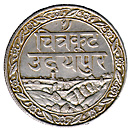
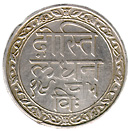
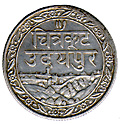
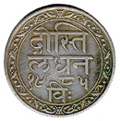
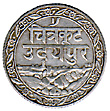
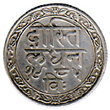
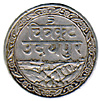
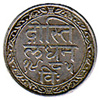
British supremacy. Some coins like those of Mewar inscribed the word 'Dosti
London' i.e. 'Friends of London' on their coins. The British over time
curtailed the rights of the the Native States to strike their own coins.
Representative Coinage of some of the States are depicted below.
While the Marathas have had a long history, they came into the limelight in
the seventeenth century led by the charismatic leader Shivaji. The Maratha
Confederacy consolidated itself after Aurangzeb's death in 1707 AD. Their
military successes saw them overrun most of India by 1738 AD. The Marathas
were set to be the only power in India to take on the Imperial mantle and
build an Indian empire. Their fortunes suffered a setback with the battle of
Panipat in 1761 AD. They, however, retained their hegemony over the Deccan
till the end of the century. With the decline of central power, Maratha
families established the states of Baroda, Gwalior, Indore, etc. As regards
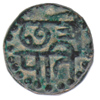
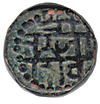
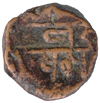
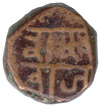
coinage, Shivaji first issued coins in 1664 AD when he assumed the title of
Raja. Coins were again issued to commemorate his coronation at Raigadh in 1674
AD. These coins are rare. Maratha Mints and coinage were consolidated around
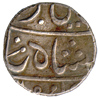
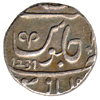
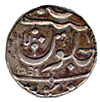
the middle of the eighteenth century. Three types of Rupees were in
circulation during this period, viz., the Hali Sicca, the Ankushi rupee which
was the standard rupee of Pune, and the Chandori rupee which was on par with
the Ankushi.
Coins of the Marathas
| Copper |
 |
 |
| Copper |
 |
 |
| Silver, Pune Mint |
 |
 |
| Silver, Pune Mint |
 |
 |
The Province of Awadh, situated in Northern India, was governed by
Nawab-Wazirs on behalf of the Mughal Emperor from around 1720 AD. With the
decline of the Mughal Empire, the British Governor General, the Marquis of
Hastings, persuaded Ghaziuddin Haidar, the Nawab-Wazir of Awadh, to cast off
Mughal suzerainty and declare himself independent. Ghaziuddin was crowned in
1819, but the State of Awadh whose capital Lucknow, laid claimed the title of
the cultural capital of India, did not survive even four decades. Despite
Ghaziuddin's proclamation of independence, the first issues continued in the
name of the Mughal Emperor, with the Awadh coat of arms on the reverse, before
independent coins were issued. The coat of arms was imitative of the English
and marked a departure from the traditional Mughal designs. Nasiruddin Hyder,
Muhammed Ali, and Wajid Ali succeeded Ghaziuddin. The monetary system
consisted of the gold ashrafi, (half, quarter, eighth and sixteenth of an
ashrafi), the silver rupee with similar five denominations and the copper
fulus. The defeat of the Nawab of Awadh at the Battle of Buxar (1764),
precipitated the decline of the Kingdom. Wajid Ali Shah, the last Nawab was
forced to abdicate in 1856 by Lord Dalhousie. During the 1857 uprising, the
battle of Lucknow was one of the most bitterly fought battles. The
revolutionaries are said to have minted coins in the name of the
Nawab-Wazarat.
Coins of Avadh
The Kingdom of Mysore was situated in Southwest India and was ruled by
various Hindu dynasties. In 1761, Haider Ali a military adventurer deposed the
Wodeyar ruler and proclaimed himself King. In the region, coins of both the
Mughal and Vijayanagar standards were current. His coin issues coins of the
pagoda types continued to carry the motifs and iconographic forms of the
Vijayanagar period (e.g., Hara-Gauri) with his initial, the letter 'He' on the
reverse. Tipu, his son, succeed him and assumed the title of Sultan. He
introduced various innovations and new varieties in his coinage, continuing
with the pagodas, the mohurs, and introduced his own standards. An interesting
feature of his coins is that they do not bear his name. Tipu Sultan, a
progressive ruler, was one of the few Indian princes to perceive the imperial
designs of the British and oppose them; he, however, was slain in the battle
of Srirangpatanam in 1799 after which the British reinstated Krishna Raja
Wodeyar as King of Mysore. Krishna Raja Wodeyar continued to issue coins of
the Vijayanagar and Mughal standards. The gold coins carried the Hara-Gauri
motif and the King's name on the reverse. The silver coins were in the Mughal
tradition, bearing the name of the Mughal Emperor, Shah Alam II on the obverse
and the name of the mint on the reverse. Some of the smaller fraction coins
carried the image of the deity Chamunda, the family deity of the Wodeyar
family; other coins carried motifs drawn from nature and inscriptions in
Nagri, Persian, Kannada, and English at various points of time.
Coin of Hyder Ali
Rupee of Tipu
Sultan
Guru Nanak laid the foundations of a religious community, which gradually
metamorphised into the Sikh Empire, a formidable military power in North
Western India. This transformation was brought about on account of continued
Mughal oppression. Constant harassment by the Mughal forces because of the
failure of the Sikhs to embrace Islam, led to the emergence of Sikh
militarism. However it was with the defeat of Ahmad Shah Durrani at Sirhind in
1710, that the Sikh league also known as Khalsa, came into its own. The whole
tract of land between Jhelum and Sutlej was divided among the Sikh chieftains.
Around 1777 AD, coins were issued from Amritsar without the name of the Mughal
Emperor and were called 'Nanak Shahi'. These coins bore the name of Guru
Gobind Singh, the tenth and the last Guru of the Sikhs. The most distinguished
statesman amongst the chieftains was Ranjit Singh who successfully recaptured
Amritsar, Ludhiana, Multan, Kashmir and Peshawar. The treaty of 1809, with the
British, confirmed his right to rule the tracts he had occupied south of
Sutlej. However, after his death, the Sikh Empire began to deteriorate and was
finally annexed to the British Empire in 1849. Most coins struck during the
reign of Ranjit Singh bear a large leaf on one side and bear Persian legends.
He also introduced coins with Gurumukhi legends, mostly of the copper variety.
Coins of the Sikhs
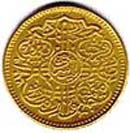
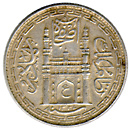
The Princely State of Hyderabad was founded around 1724 when Mir
Qamar-ud-Din, the Mughal Viceroy of the Deccan, assumed independence under the
title of Asaf Jah and founded the dynasty of the Nizams of Hyderabad. In the
post 1857 era, the State of Hyderabad was one of the largest Princely States
in India and later came to be known as the 'Dominion of His Exalted Highness,
the Nizam'. The State which covered territories presently included in Andhra
Pradesh, Maharashtra, and Karnataka was assimilated into the Indian Union in
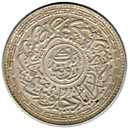
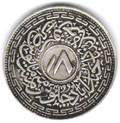
September 1948. In matters of currency and coinage, the coins of the Nizams
were issued in the name of the Mughal Emperor till 1858 when a coin legend was
introduced with the name of the founder of the state, Asaf Jha. Thereafter,
they were struck independently and the new coins were termed the 'Hali Sicca',
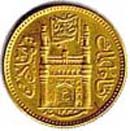
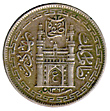
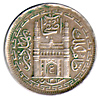
i.e., the current coins. In 1903-04 coins were machine struck for the first
time. These coins featured the Charminar on the obverse with Persian
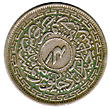
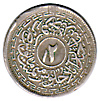
inscription Nizam-ul-mulk Bahadur Asaf Jah around it. The reverse carried the
value. These coins confirmed to the British coins in denominations and metals.
Coins of Hyderabad
| Ashrafi |
 |
 |
| Rupee |
 |
 |
| 8 Annas |
 |
 |
| 4 Annas |
 |
 |
| 2 Annas |
 |
 |
Some Representative Coins of other Princely States
Coins of Datia State
Coins of Faridkot
State
Coins of Udaipur
| Rupee |
 |
 |
| Half Rupee |
 |
 |
| One Fourth Rupee |
 |
 |
| one Eight Rupee |
 |
 |
| One Sixteenth Rupee |
 |
 |
| |
| Top |
| |